Let me start by saying I don’t know much about Camden, New Jersey. So if you know more, help me figure things out.
The city of Camden is just across the river from Philadelphia. It’s part of Camden County. The city has a declining population of about 75,000. Camden is about half black and half hispanic. It is, by any quantifiable measure, a “struggling” place. I wrote a post about violence in Camden back in 2015.
In 2011 the city and police department were in crisis and announced plans to abolish the police department and start fresh, with a new police department. In May 2013, the city police department was abolished (in part to break the police union, which has since re-formed). Anybody that wanted to stay on had to re-apply for the job. Since then, the new Camden County Police Department covers Camden City (and only Camden City) while in Camden County, I guess some other agencies (I presume local agencies and/or the sheriff) do the work.
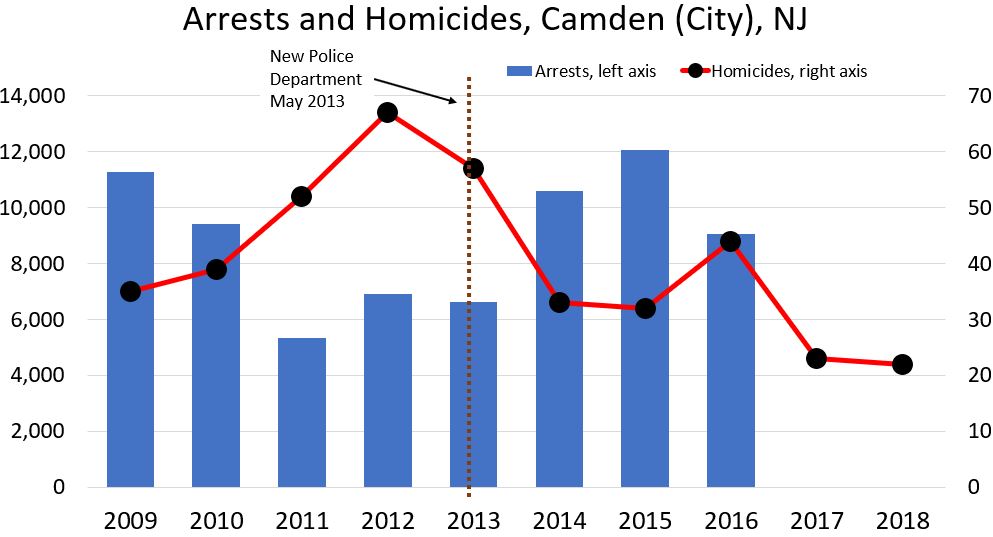
This all makes data gathering a bit confusing. But I (painstakingly) went through the UCR’s arrest numbers for Camden City from 2009 to 2016 (the last available year).
 |
| Nice chart, if I do say so myself. |
If history is a guide, and they say it is, when people blame an institution for human problems and tear it down and start new, after a few years you end up with pretty much the same situation and problems. Police are as much a product of their environment as anybody else. There are still occasional problems of corruption and brutality in Camden. Cops still get attacked. And Camden is still mired in poverty (a 37% poverty rate). But poverty is declining and money is being invested.”
Meanwhile, across the river in Philadelphia, murders are up 25 percent (2016-2018). I do presume “underlying social conditions” haven’t gone that drastically in opposite directions in these neighboring cities just since 2016. So what if — crazy idea — police (and prosecution) actually matter. Maybe a lot. And even more than the so-called “root causes.”
I mention this because the new Camden County Police, policing Camden City, have become the progressive reformers’ dream team (despite being founded, in part, in a fit of Republican union busting). Since 2013 there have been a lot of positive press, but here is one example that presses all the feel-good buttons like “strategic shift toward community policing” and “rebuilding trust between the community and their officers” and “being mentors in the community” and “a showroom for community policing techniques” and “nothing stops a bullet like a job.” OK, but all that sets off my BS alarm.
In terms of crime, the proof is in the pudding. Give credit where credit is due. And here’s the thing: violence really is down. A lot!
Last year there 22 murders and the year before 23, down from 67(!) in 2012. Shootings also been cut in half. Maybe police culture really did change for the better. Or training. Or technology. Or strategies. Or maybe police are now simply funded at the proper level they had not been. Or maybe we’re getting more for less. I don’t know.
But I do know, despite what is often reported, it hasn’t been just kumbaya with carnivals and free ice cream. Those gimmicks can be part of building trust, but they’re not crime prevention strategies. Non-criminals need more positive casual interactions with police. Criminals need more interactions, too Perhaps not all so positive, but still professional and respectful. (The person you arrest today can be your source or even save your ass tomorrow.) As Chief Thomson says), “Nothing builds trust like human contact.”
And speaking of human contact, reported use-of-force — usually something reformers want to reduce — increased dramatically with the new police department. That could mean cops are now more brutal, but more likely cops are policing more, and some of that leads to justified use of force. Camden is being lauded by reformers for bringing down crime with exactly the form of pro-active policing loathed by the same reformers!
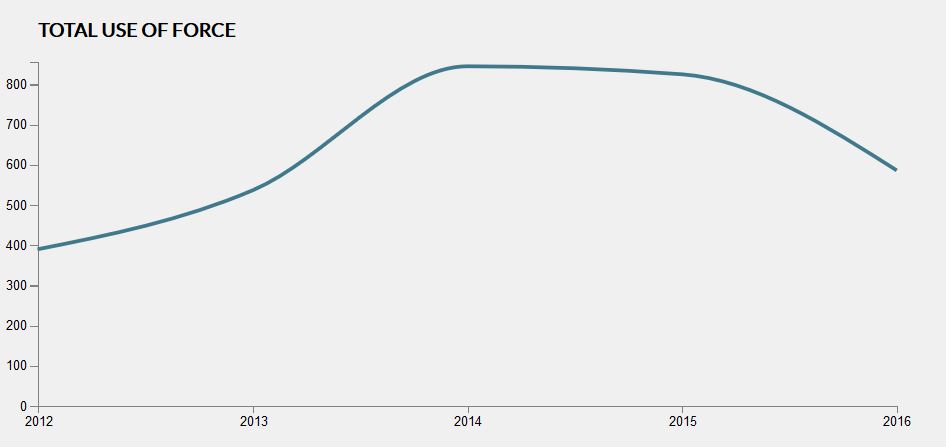 |
| http://force.nj.com/database/pd-dept/camden-camden |
Force went up. Arrests went up. Crime went down. But what about the idea, very popular among reformers who don’t live in high-crime neighborhoods, that arrests are bad, and people in dangerous neighborhoods hate police because police are arresting (or shooting) people of color for no good reason.
If you decriminalize minor offenses, goes the hope, police “legitimacy” will increase, which along with leading to less incarceration means more solved crimes and many other wonderful things. It sounds good, especially if you think police are the problem and your neighbors aren’t.
Based on UCR arrest numbers, arrests went up with the new police department. Camden cops are arresting more people, and crime is down. There may have also been better policing, but there was also just more policing. And the kind of arrests that increased — low-level discretionary arrests — would indicate that police focused on quality-of-life issues and Broken Windows. This is not the reformers’ party line.
Caveat: I really hate using arrests as a metric for anything, much less good policing. But arrest data is available. And huge changes in arrest numbers tell you something is going on. Arrests can be a proxy for pro-active policing: cops stopping suspicious people, chasing and catching the bad guys, cops less afraid of making an honest mistake. My inquiry into Camden was inspired by thisarticle from March 2017 (that I just read) saying drug arrests were way down. Except that seems not to be true.
In 2011, Camden cops may have lost a little of whatever go-getter spirit they still had. This was Camden’s Ferguson Effect (pre-Ferguson). Cops were told they were no good and their job was on the line. Arrested dropped 50 percent, from 11,000 in 2009 to 5,348 in 2011. Along with Camden, Baltimore and Chicago also saw similarly quick and drastic decreases in quantifiable policing. And in all three violence shot way up. Yes, correlation that is also causation [thunder clap]. At the start of 2012 Camden laid off 45 percent of the police force. Murders went up to 67 (which is a shocking number for a city of 75,000).
Let’s compare 2012 and 2014 Camden, when murders went down from 67 to 33:
- Drug arrests up 79% to 3,052.
- Marijuana possession arrests in particular up 467% to 488.
- Curfew and loitering violations up 34% to 1,128.
- “All other offenses (not traffic)” up 50% to 3,352 (This most minor category is probably something catch-all like disorderly conduct, trespassing, loitering).
- DUI arrests up 483% to 175 (an indicator of more policing).
- Non-felony (ie: discretionary) assaults up 57% (to 754).
- And murder arrests — because there were fewer or them — down 23% (to 20).
Policing get “better,” but what does that mean? Maybe police officers have better manners. That matters. But what brings down crime is focusing on repeated violent offenders, usually young men, who commit the vast majority of violence crime.
There’s irony here in that this little department so loved by progressives, has achieved success, in part, by arresting more minorities. And you know what kind of arrests increased the most? All the little ones that reformers want to stop in the name of social justice But those progressive reformers don’t live in Camden. If you do live in Camden, you probably support anything that works.
For a small city, 9,000 arrests is a very large number. Scaled up to the population of New York City, for instance, this would be over one million arrests a year (compared with the 240,000 arrests in NYC last year). One arrest for every 8 people is similar to the arrest rate that Baltimore had in the early 2000s (when I was there and violence was going down). This is the same arrest rate people (stupid people, mind you) blamed for Baltimore’s riots a decade later (arrests and crime in Baltimore dropped drastically from 2003 up until the riot of 2015).
Now keep in mind arrests are not good on their own. It’s very important what the data do not reveal. How many times did cops change behavior without resorting to arrest? My guess is a lot. More good policing does often lead to more arrests, but it’s really important to put the horse before the cart. Policing is the goal. Not arrests. “More arrests” is never a good strategy.
I’d like to know how many people were arrested in Camden in 2017 and 2018 when murder really dropped. In the ideal world, violence and arrests (and incarceration) all go down in sync. That’s the win-win(-win). But residents will always choose more arrests and less violence rather than the standard police reform package of less policing and more violence.
One moral, and you see it time and again, is you don’t have to fix society’s problems to fix violence. Violence is not inevitable. But equally important is the corollary that you can’t fix society when violence is out of control. Most residents want more police. They want visible police who maintain order and treat people with respect. It’s not too much to ask for.
Maybe what is going on in Camden is just slapping lipstick on a pig. But hey, it’s hard to argue with success. Don’t underestimate good PR and a progressive-sounding chief who both controls the narrative and won’t give in to anti-policing naysayers. And it’s likely that what the arrest numbers do not show — better hiring, training, culture, attitude, accountability, and leadership — is what makes effective aggressive policing possible, or at least palatable.
Camden homicide numbers
2018: 22
2017: 23
2016: 44
2015: 32
2014: 33
2013: 57
2012: 67
2011: 52
2010: 39
2009: 35
2008: 53
2007: 45
2006: 33
2005: 35
2004: 49
2003: 41
Non-fatal shootings
2017: 95
2016: 92
2015: 109
2014: 90
2013: 143
2012: 172
Arrests
2009: 11,280
2010: 9,414
2011: 5,348
2012: 6,903
2013: 6,613
2014: 10,582
2015: 12,049
2016: 9,052
Notes: In the data (for 2016, ISPSR 37056 and 37057) variable “offense” the value 18 is the total for drugs. Subtotals follow. Values 180 and 185 are again subtotals of what follow. This makes drug arrest numbers very easy to triple count, as I did at first.
For 2009-2012, I’m assuming Camden City is the agency with the listed population of 77,665. I ignore the other Camden, which presumably is the rest of the county. After 2013 (unless I’m wrong) Camden City is the agency “Camden County Police Dpt” with a listed population of about 75,000.
As always comments and corrections are welcome. Replications welcome; data available on request.
Some sources: https://www.nj.com/camden/index.ssf/2018/01/camdens_2017_murder_rate_was_the_lowest_in_decades.html
http://www.camconnect.org/resources/CrimeMaps.html
https://camdencountypros.org/unit-list/homicide/#tabpanel22
https://www.icpsr.umich.edu/icpsrweb/ICPSR/series/57