Tag: cop in the hood

  • Cops and dealers (and The Wire)

    Dolan Cummings of Culture Wars has written the best review of my book. I don’t mean the most positive review (though I’m very glad he liked my book); I mean the best written review. They sure writes good with that there English language in England.

    Along with being the first to juxtapose me, Venkatesh, Homicide, and The Wire (which is a natural but he’s the first), I actually found myself learning more about my own book through this review. It’s outstanding writing (and it’s very rare to see a good use of “yadda yadda”).

    Read the whole review here. It’s a bit lengthy, and worth it.

  • “I do miss working with people willing to risk their lives for me”

    “I do miss working with people willing to risk their lives for me”

    There’s another profile of me, this time in the Financial Times of London.

    Like the Wall Street Journal, this is another big conservative economic paper I don’t read. Hopefully it will have some of the same impact as the Wall Street Journal review, which has been by far the best publicity to date.

    It’s funny to read an “as told to” when I know I didn’t say things quite like that. I can’t imagine I said I thought long and hard about joining, because I didn’t. I thought it was a great opportunity and I didn’t have a choice, really. But who knows what I say? Sometime my mouth moves faster than my brain. While I may have said The Wire is a good show because “it doesn’t portray cops as always being good.” What I meant is the that The Wireis good show “because it doesn’t show cops and being always bad.” But I’m not complaining. This is great publicity. And the feel of the interview is correct. But let it be known I have never in my life said “learnt.”

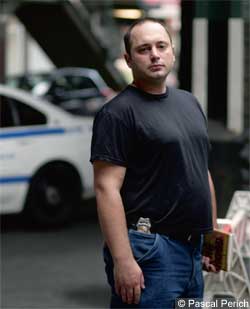
    I do like the picture. It’s the “classic police shot.” The photographer, Pascal Perich, called me and I recommended going to the Ditmars elevated subway stop here is Astoria. That’s where where a good scene in the old movie Serpicowas filmed. They didn’t choose the shot from the alley of the shoot out, but this is from under the tracks. The photographer strongly requested I bring my old badge (it wasn’t my idea), my book, and “look intimidating.”

  • Prop Joe? He Dead.

    Prop Joe? He Dead.

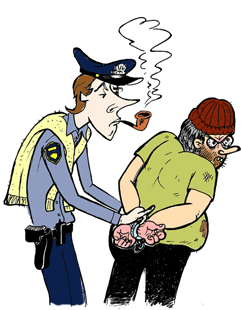
    That’s a Wirereference, if you don’t know. There’s a short Q & A about me in Vanity Fair titled “The Ivy Leaguer Who Took on Prop Joe.” The art cracks me up:
    While ace writer Jordan “slugger” Heller’s text makes me sound so rough and blue-collar, the art just captures my naturally effeminate and pompous persona perfectly.

    Hmmm, yes, indeed, I remember arresting that ruffian. It sure felt mahvalous to get that rapscallion and his dirty scowl off the street! I always carried a sweater just in case it got chilly or I needed to pat my high brow. In this arrest, I was just so thrilled that the scoundrel didn’t make me perspire (or even put out my pipe)! It was so nice to have that sketch artist capture the moment! What a dah-ling!

    When Harvard-trained sociologist Peter Moskos entered the Baltimore Police Academy, back in 1999, his objective was simple: observe up-close the methods and culture of an American police department. He never planned on actually becoming a cop. But one day after Moskos arrived, the police commissioner who’d approved his project left office, and the new regime was not so accommodating. “Why don’t you become a cop for real?” he was asked—or rather, dared—by the interim commissioner, who was threatening to throw him out on his Ivy League butt. Six months later, the Princeton/Harvard alum had a badge and a gun, and was patrolling the graveyard shift of Baltimore’s high-crime Eastern District, the same drug-riddled streets that served as a setting for HBO’sThe Wire. The result:Cop In the Hood: My Year Policing Baltimore’s Eastern District, Moskos’s book recounting his year in the ranks of the thin blue line.
    VF Daily: Your background is not typical for a police officer. Did you take much flak from your fellow cops?
    Peter Moskos: Actually, I found that I got surprisingly little flak from fellow cops about being a Harvard student. I got more shit from Harvard professors about being a cop.
    What were your professors worried about?
    Originally I wasn’t going to become a cop; traditional academics aren’t supposed to do that. [They’re supposed to observe, not participate.] So I think they felt I was pulling the bait and switch. But some of it I think was just class snobbery: “You’re a Harvard student, you’re not supposed to become a cop. That’s a blue-collar job.”
    The midnight shift in Baltimore’s Eastern District. That’s serious. Aside from the criminals you’d be dealing with, did you worry about encountering police corruption?
    [The Eastern District] could be perceived as the heart of darkness of police culture, so yeah, I was worried about it, but I didn’t see any corruption. What I did find, however, is that the average cop has more integrity than the average professor.

    There’s more. The whole Q & A can be found here.

  • CUNY Podcast

    Enjoy CUNY radio’s podcast interview of me. “Book Beat.” What a good name for a show that features a book about police.

    (CUNY, pronounced Quny, stands for the City University of New York, of which John Jay College is a part)

  • Interview

    Here’s the linkto the interview I did today. I haven’t heard it yet. I hope it’s good.

  • Real Police

    I just received this email. It’s an interesting take on on the concept of being “real police.” “Real police” is both a concept and a compliment. It’s what in the NYPD they call a “cop’s cop.” Also, when you actually say “real police,” you have to stress “real” and the first syllable of “police.” Otherwise it doesn’t make sense.

    I find the resentment over your book interesting. I would like to focus on the retired Major from the city who refuses to read it. I am very much “real police,” but I am not entirely sure my 4.5 years as a Baltimore City officer would qualify as “experience” according to this commander (I now have an additional 2 years in [***] police department). I guess you have to inefficiently manage a district and treat subordinates poorly in order to qualify for “real” experience in Baltimore City … a little cynicism I had to add.

    Experience, in my humble opinion, does not have a definitive time frame; rather, it’s how you use your time while you are there. An officer can lazily choose to sit in their patrol car for a year, answer calls for service, never act proactively and consider that experience. Or that officer can choose to commit to hard work, be aggressive and gain the experience sought after by many. However, whether aggressive or not, I think it is accurate to say the average officer has a certain level of comfort for the job after one year.

    Personally, I worked hard for two years in patrol which opened up the door for two years in flex. I have great experience, particularly in the field of drug work. Do I know everything? No. But I was able to handle myself efficiently and safely on the street. But then again, according to certain police, experience is seemingly based solely upon your sequence number, not in what you do.

    Finally, I’d like to address a quote from his letter. The Major writes, “… that is why your book upsets real police; … when some opportunist such as yourself, exploits a mere year of service, converting it in some way to confer expertise on his puny observations, which were subsequently recorded for future use and gain!”

    Again, I am “real police” and I am not upset. I thought the book was a great read. I felt your writings were fundamentally correct based upon YOUR observations and experiences in the city. If the Major would have read your book, he would understand your reason for coming to the city and for the book. From my perspective, it was research which turned into hands-on experience. What better way to do research than that? What is with the major’s anger with officers (in general it seems) coming to the city and leaving after a short period, to better themselves or perhaps even, dare I say, write a book. Countless officer’s come to Baltimore to gain experience and leave.

    I cannot apologize for being unwilling to wallow in the disastrous Baltimore City Police Department and that complete hole of a city. Individuals like the Major are one reason (among the countless others) I cannot wait to leave law enforcement. When I am done with my graduate studies at [***], I am out the door not looking back!

    I enjoy the blog. I’m sure I’ll continue to comment on what I read from time to time.

    Respectfully,
    [***]

  • Inform the public

    I got this in a email from a Baltimore Police Officer. I couldn’t say it better myself:

    At the end of the day, I hope more officers will see your book as a vehicle to inform the academic community and public about the many challenges of policing in a poor urban environment. I think the average police officer will view the book more favorably if he understands he is not the book’s target audience.

  • A voice of reason

    I was starting to think I was the only sane person in a crazy world. Then another email flew in over the transom:

    I read the “real” first edition of your book, before the publisher recalled it for typographical errors. I mention this not because it confers upon me any particular credibility, but to highlight the point that I read the book quite some time ago and did not intend to share with you my critique of “Cop In the Hood.” That all changed after reading your exchange with the retired Eastern District commander.

    I’m a veteran and don’t resent the fact you used the department to write a more informed piece of field research than you would have otherwise been able. I don’t think I’m a minority in this opinion. I’ve spoken with several other officers who have read the book – including some with whom you worked – and they don’t hold your relative inexperience against you either.

    As you rightly stress in your responses to the retired commander, what matters is the content and structure of the book: Is it factually accurate? Do you support your conclusions with quality evidence? Do you bring a perspective that is lacking in existing scholarship on the subject? I could quibble with a few points here and there, but overall I think your book meets these criteria.

    Those who disagree with the content of your book have an opportunity to write their own. Perhaps the retired commander, with all his experience and infinite wisdom, will write one himself. I’m confident that if he does, you will write a critique that addresses the content of the book rather than the content of his alleged character.

    Regards,
    [name omitted on request]
    Lieutenant, BPD

    Thanks, Lieutenant!

  • More crusty outrage

    I received an email from a former commander of the Eastern District (he retired before I was there). He too refuses to read my book [everything below is edited and cut for length from the original emails]:

    Your apparent motivation for writing your book would indicate that it was successful, you have your new profession, that of college professor; but then again, you didn’t really have law enforcement as your “old profession”, did you? Your book was obviously matter of expediency! What “real police” find offensive, is when interlopers such as yourself, apparently believe that a year on the street grants them some kind of miraculous wisdom to analyze, and be critical of, probably the most complex area of public service that exists today!

    You see professor, police are special, very much so; they have conferred upon them an awesome, and totally unique responsibility, by the public that they serve, and that is the power to take a life!

    Oh, our military can kill people, but only after they have an identifiable enemy, and in today’s military, after the legal advisor who is deployed with them, grants them the permission to do so! But our police, they make split-second decisions, decisions that may see them taking a human life, and there are no advisors deployed with them, nor is the “enemy” often readily identifiable! No one, and I mean no one, in our society, has that awesome power; not the well over paid Congress, the activist judges, nor the President himself!

    And professor, that is why your book upsets real police; there is a sort of snobbish effrontery to every working police officer, when some opportunist such as yourself, exploits a mere year of service, converting it in some way to confer expertise on his puny observations, which were subsequently recorded for future use and gain!

    In order to truly legitimize your book, you would have needed to spend much more time on those streets in the Eastern, but then, that would have interfered with your future employment schedule, wouldn’t it? Do you still wonder why your book is resented?

    [signed]
    Major (retired) BCPD

    Dear Major ,

    I just composed an honest but rude email to you. Because you were a major, I respect you. I want to get your permission before sending it to you. It’s nothing personal, but it’s a bit rude. I think you can take it.

    Here’s my polite response:

    I think you misunderstand me as some anti-cop academic. Nothing could be further from the truth (well, except the academic part). I respect and honor every police officer to ever wear the BPD uniform. Especially the patrol officer. My book is dedicated to those who have died in service! And you dare criticize?

    I speak for the underappreciated patrol officer riding around right now in the Eastern District (and Western District, and other districts like it, if there are any). I never pretend or claim to know more than people with the experience of you. But really, how can a respond to criticism if you have no idea what I have to say?

    I’ll tell you what: can I send you a copy of my book? On me. You don’t even have to buy it. Like a gift. That’s right, you can make me spend my own money to buy my own damn book and mail the damn thing to you (I’ll just have it shipped from Amazon——please don’t think I get them for free). Just because you have the balls to write me.

    But I’ll tell you what: if you like my book or not, you have to write me and tell me what you honestly think. That’s the deal. That’s your duty. And I’ll post it on my blog. And one more condition: if you actually enjoy reading my book, or think there’s something of worth in it, then I want a check from you for the $25 cover price.

    Peter

    Dear Professor Moskos,

    First of all, the question about the “reduction” in homicides while I commanded the Eastern; to be quite honest, since my retirement in 1995, which was several years after my assignment as the Eastern District Commander, I honestly do not recall that statistic; however, in deference to you, I must admit that there probably was no reduction!

    There is very little that police can do to reduce the rate of occurrence of homicides: every minute of every day, presents an opportunity to commit these crimes, there simply are not enough police officers to significantly impact the opportunity to commit homicide! Most crimes of passion homicides are committed inside, and between people who know each other; there is very little likelihood that police officers will be present to prevent these!

    Oh yes, good police officers know who “the bad guys” are where they patrol, and yes, they know which ones have a homicidal proclivity also, but that prevents nothing! I will wager, that if we would “allow” police to make preemptive arrests of known violent criminals, many homicides would be prevented, but that is not the case, is it? Police experience and intuition, and yes that “gut feeling” that goes with being a true professional, if unleashed, could prevent a lot of crime, including homicides, but that would be violative of someone’s rights, wouldn’t it?

    Now for that “rude” response that you prepared for me; I say have at it, I have been called things that I would be willing to bet that you have never even heard, even during your extensive time on the streets of the Great Eastern District!

    Dear [Major],

    I just find it amazing that you think so much about me without having a clue as to who I am or what I stand for.

    My book isn’t about being a sergeant. Or a major. Or anything but being a lowly patrol officer of the midnight shift in the Eastern.

    What does strike a nerve is when you imply or say I wasn’t a real police officer. That does bother me. You wouldn’t tell a soldier he wasn’t a veteran because he “only” served 2 years, would you?

    You can say I wasn’t a police officer for long. True. Or that I would know a lot more had a stayed on the force for longer. Very True. But while I was there, I was a damn good police officer risking my life every damn night for my brothers and sisters in blue and also for the worthless scum of the Eastern District (and, oh yeah, the good citizens, too).

    I’ll be back in Baltimore this very weekend. Eating crabs at my sergeant’s church with him a bunch of my former squadmates. You know what, they criticize me too. But I can take it from them because they know me. They also risked their lives for me and know I did the same.

    My offer still stands, by the way. I’ll buy you a book if you want. If you don’t read my book, I don’t have more to say. You can be a fool and criticize me for what you think I stand for, or we can have an intelligent discussion about what I wrote and what police can do, if anything, to prevent crime.

    Anyway, here’s what I wrote last night. The “rude” letter. Looking over it again, it’s not so bad. So I call you an asshole and a fool and full of shit. I know you’ve been called far worse.

    Dear [Major],

    I don’t wonder why my book is resented. Because in truth, it’s not. No cop who was read the damn thing resents it. Only people who believe what they read in the “liberal media” (frankly, I’m surprised you read The Sun) have something against me. You’re full of shit.

    Why don’t you just read the damn thing (my book, that is, not The Sun) and then bitch? A man who condemns something about which he knows nothing is at best ignorant. And also perhaps a great fool. Consider that.

    I wasn’t a cop for long. But at least I earned my chops the tough way.

    Frankly, sir, and forgive my bluntness: I think you’re an asshole. But you know what, I’ll forgive you, because I can be an asshole myself. And hell, some of my best friends are assholes. But at least I had the common courtesy to read what you wrote.

    What I give in my book is an honest portrayal of what it was like to be a patrol officer in the Eastern District for over a year. Nothing more. Nothing less. You got a problem with that? Write your own damn book.

    Peter
  • Good stuff!

    I received this email a while back from a Baltimore Cop who transferred elsewhere. I’m protected his identity (of course) by blocking out a few details with ****. (By the way, I think the “proper” spelling of “screet” is with a K, but that’s a minor issue.) This is good stuff. perhaps even better than my book:

    Much like a person’s upbringing in life influences some of their behavior and personality, my training, or “upbringing” as a cop, if you will, in Baltimore will continually influence how I police. I find myself very different from many of my current co-workers. I am more jaded and uncompassionate. I want every suspect to go to jail (which rarely happens here in ****).

    Thug life and the ghetto is another aspect of Baltimore I will never forget. Again, I grew up in **** and graduated with 5 or so African Americans out of 225. Not much contact. However, after 4 years in Baltimore, I am fluent in “ghettoese” (p62). “Peoples” “Hair-ron” “bounce” “up the screet” “on the corna” and “hoppers” are among my favorites.

    In regards to the ghetto, from my * years in Baltimore, I agree with the thought (p39) about not blaming poverty and racism for the ghetto life and wanting to “napalm the whole area” (I wish I had a dollar every time I heard that). It was hard as a white upper-middle class conservative male to feel sorry for African Americans there, but in the same light, I agree with the “hate everybody philosophy”(p40). My partner (white male) and I, knew when we saw a white junkie in the ghetto, they were getting locked up for something. Fair or not, that is how I played the game.

    One of the thoughts I am in agreement with many of the other officer’s in the book is the negative opinion of “junkies.” Drugs never had an impact on anyone in my family, any of my friends family growing up, or for that matter even in our community (it was unheard of). I took that with me to Baltimore. I was naive, but also cold and uncompassionate, and to this day I still am.

    My opinion of junkies (pp43-46) is that they are, “not even considered people … Who gives a flying fuck about a junkie!?” (My wife actually got mad at me during the reading of the book because I continually interjected my thoughts about this issue: “****, you are not in Baltimore anymore, let it go,” she says). It’s difficult to let it go, especially when you experience it firsthand and are so disgusted with it. I will never forget stopping a male junkie (Pennsylvania Avenue market, heroin shop), telling him to give me his tools, whereby he proceeded to bend over, spread his butt cheeks and show me a capped needle shoved into his anus. And people wonder how I got to be so bitter.

    Departmentally, I found your thoughts and opinions on point. Without a doubt, there is an unwritten quota at work. In flex it never bothered me because I locked a lot of people up, but regardless, we still heard about having to beat the other flex and bike squads in stats. During the latter part of my career in Baltimore, officers were temporarily transferred to other districts as punishment for poor stats. Yeah, that makes sense, send a poor producing officer to an unfamiliar district and ask them to produce. Command staff, you are genius!

    District and Circuit Court was a joke. Officer’s working until 3 or 4 am and then expected to be in court by 9am. And they wonder why officer’s FTA’d[failure to appear].I had court 5 days a week sometimes. I was never one for overtime; I wanted my free time. Talk about burnout. Court was one of the top reasons I wanted to leave Baltimore after my four years.

    I could write a lot more about the book, but I think it would be easier to just say I am in agreement with your thoughts about Baltimore policing, and leave it simply at that. I recommend this book to people curious about “real”(?) police work!