Tag: crime drop

  • Murdered in the Park

    Murdered in the Park

    Just last month, I swear I told my class, “People won’t talk about crime until a cute white girl gets murdered.” Tessa Majors, unfortunately, is that woman. Would her murder be getting as much press if she had been black? I doubt it. But who knows? Turns out not a lot college students of any race get robbed and killed. But that’s not what I’m going to write about.

    Nor am I going to write about that the murder weapon seems to have been a 4-inch folding knife. Why do I point this out? Because this is the exact kind of knife that was made legal just last year, against the advice of law enforcement, and heralded by some as a “heroic” and “a massive victory for justice in New York.” Bravo.

    Nor will I go into what Majors might have been doing in the park. Nor the shameful conduct of the SBA (union) President, Ed Mullins, in publicly releasing details of an in-progress investigation to make political hay.

    Nor will I touch on the fact that the apparent robbers and murders are but kids, aged 13 and 14. “What can you do?” cops say, “Our hands our tied. They’re kids and weed isn’t enforceable anymore.” That’s bullshit, of course. They seem to have been causing trouble for quite a while. Cops could at least ask, “What are doing and where the hell is your guardian?” and take it from there. That’s where the attention and proactive help needs to be focused. The problem is coming from inside the house. I guarantee it. But if nobody else dares go there, why should I?

    Cops, at least in theory, might have prevented this murder with proactive policing. But in doing so they might have become a media sensation. And not in a good way. If you were a police officer and you suspected these kids of previous crimes, would you risk
    stopping them on reasonable suspicion? In a park? God forbid the kid is uncooperative and runs. Or puts up a fight. With indignant Columbia students pulling out their phones and calling you racist?

    For police, at least in terms of public relations — and this is a current and real problem — it’s probably better to have a poor woman murdered that risk the public indignant public and political pushback from stopping a 13-year-old black kid on suspicion of criminal activity.

    I’m not going to talk about any of that. Here’s where I do want to go: the numbers. I like data. And when I looked at them in New York City, I see these kinds of robbery/murders are rare. Really rare. Particularly for women. And then for white women? It basically doesn’t happen. But it did. and I guess that’s the definition of news.

    I took the UCR murder numbers [FBI Uniform Crime Reports] for New York City. I excluded “unknowns” for all the variables I’m looking at. That is not a moderate cut, particularly with regards to “offender 1 circumstance” and “victim 1 relation to offender 1.” How much it matters? I don’t know. But it does matter. But perhaps not so much to my main point, which is that this type of crime really is rare.

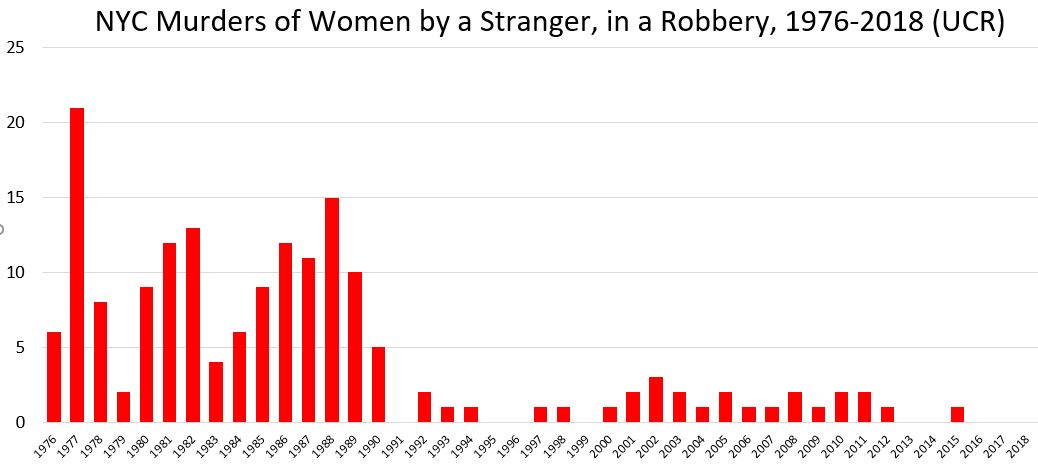
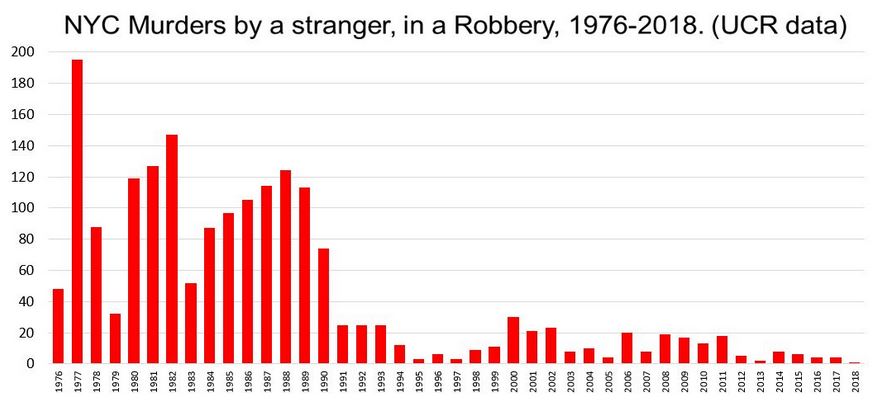
    In the past 20 years — since 2000 — only 2(!) women under 20 have been murdered by strangers in a robbery. It’s the not young who are at risk, but the old. Most women victims are over 50. Five of the 20 women victims were over 80 years old, which seems particularly bad. The last time a white woman of any age was killed by a stranger in robbery was 2015. Before that was 2011 and 2009. All three of the victims were senior citizens. The robber/killers were all in the 30s. One was white, one was black, one was hispanic.

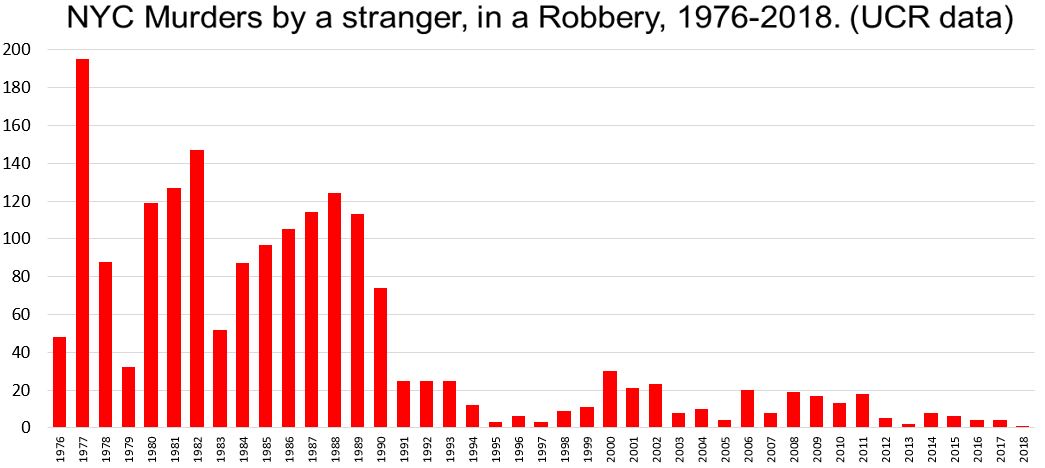
    Since 2012, there have been but 30 people murdered by strangers in robberies in New York City. Total. Last year just one person in New York was murdered in a robbery by a stranger. One. A 66-year-old Asian man. In 2017? Four. All men. Same in 2016. There haven’t been more than 10 such murders a year in nearly a decade and not more than 20 such murders in a year since 2002. But in 1988, there there were 124 such victims! It really was a different city.

    Since 1992 — arguably when New York City started becoming safe — there have been 28 murders of women (and 287 of men) by strangers in robberies. Yes. Total. Since 1992. In 8 different years since 1990, the number of women killed in robbery has been zero.

    As to race, it seems that Asians are disproportionately targeted and victimized. But with that notable exception, victims or robbery/murders seem to reflect the demographics of New York City, at least generally. Offenders are disproportionately (but not exclusively) black men. For the women victims since 1992, 17 were white, 8 black, 2 Asian (1 unknown). Of their robber/killers, 17 were black, 10 white (1 unknown). Two women were murdered by women.

    Note the scale of the y-axis is much more magnified on the second picture.

    My point is that this type of crime — a woman being killed by stranger in a robbery — is rare in New York City. No, not just for white women. And not just for women. So when something like this does happen, it should be news. No, not cause for alarm and the ever-feared (at least in criminal justice circles) “over reaction.” But no, this shouldn’t be swept under the rug. Because we don’t want to go back to the days when the public lived in fear and people were literally being murdered by strangers in robberies gone wrong on a near daily basis.

    Rest in peace, Tessa Majors.

  • Murder down for whites but not blacks

    The 2018 murder rate is down from the previous two years, but higher than we’ve seen in 6 of the past 10 years. Last year’s murder rate is the same as 2015. And 2009! And yet I keep hearing every year that violence is down. So what’s this trend? And sort of related, why do some people insist on the “violence is down” message year after year, even when it’s not true?

    Yes, violence is lower than it was in 1991. Violence will hopefully always be lower than 1991. But that doesn’t mean violence is trending down year after year. If we keep starting the graph around 1991, violence will always look downward trending.

    The murder rate in the US actually peaked in 1980 at 10.2 (per 100K). And then there was the lesser but better-known crack-trade-related murder peak of 1991 (9.8 per 100K). So we’re down from there, no doubt.

    Violence plummeted in America between 1994 and 1999. It might be worth pointing out that is right after the Biden-supported and now maligned crime bill. I don’t actually think that’s why crime went down, but it does correlate. And it didn’t hurt. It might have helped.

    Whatever the causes — and I do think better policing (along with changes in drug dealing) was a huge part of the solution — many lives were saved between 1994 and 1999. Of course, as always, there were racial disparities. Blacks benefited most from the decline in violence. From 1994 to 1999 the number of black murder victims dropped from about 12,000 to 7,000 per year! White murder victims declined, too (but less so, from 11,000 to 8,000). This brings us to 1999.

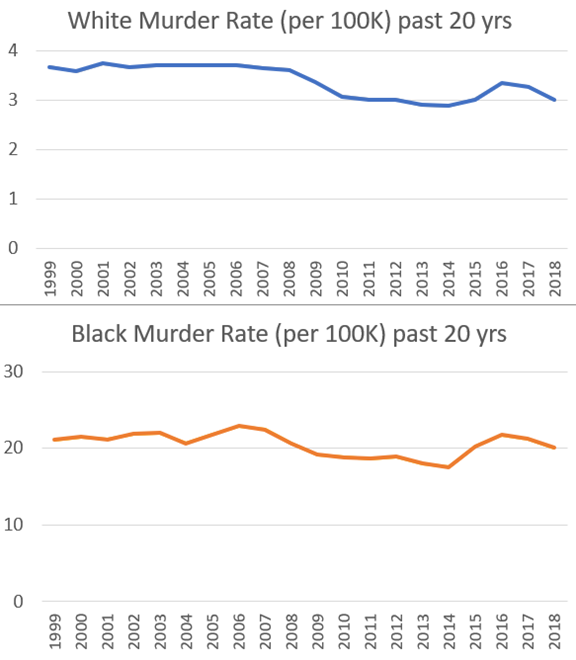
    Since 1999, the murder rate for whites has dropped even more, another 20%. Great news! But not for blacks. In absolute numbers, more blacks were murdered in 2018 than in 17 of the past 20 years. That’s not a good trend.For African Americans, murder has been up and down over the past 20 years. But the murder rate is no better in 2018 than it was in 1999.

    Image


    What bother me is some of my friends who insist “violence is down” are well intentioned white people who live in safe neighborhoods, hashtag#BLM, and believe those who advocate less policing in other people’s neighborhoods. (Neighborhoods they won’t set foot in, mind you.)


    Yes, violence is down compared to 1991. But is it a sustained “trend”? Not really. Not if you start the clock in 2000. And not for non-whites. Not for young black men in particular. So when people say violent crime is down, ask “For whom?”


  • What’s Up With Crime Being Down in Camden?

    What’s Up With Crime Being Down in Camden?

    Let me start by saying I don’t know much about Camden, New Jersey. So if you know more, help me figure things out.

    The city of Camden is just across the river from Philadelphia. It’s part of Camden County. The city has a declining population of about 75,000. Camden is about half black and half hispanic. It is, by any quantifiable measure, a “struggling” place. I wrote a post about violence in Camden back in 2015.

    In 2011 the city and police department were in crisis and announced plans to abolish the police department and start fresh, with a new police department. In May 2013, the city police department was abolished (in part to break the police union, which has since re-formed). Anybody that wanted to stay on had to re-apply for the job. Since then, the new Camden County Police Department covers Camden City (and only Camden City) while in Camden County, I guess some other agencies (I presume local agencies and/or the sheriff) do the work.

    This all makes data gathering a bit confusing. But I (painstakingly) went through the UCR’s arrest numbers for Camden City from 2009 to 2016 (the last available year).
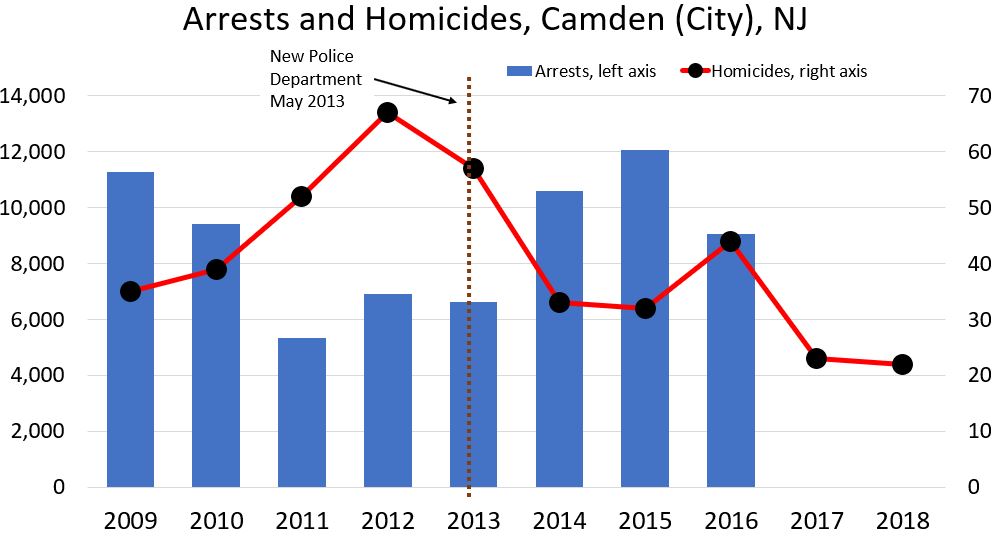
    Nice chart, if I do say so myself.

    If history is a guide, and they say it is, when people blame an institution for human problems and tear it down and start new, after a few years you end up with pretty much the same situation and problems. Police are as much a product of their environment as anybody else. There are still occasional problems of corruption and brutality in Camden. Cops still get attacked. And Camden is still mired in poverty (a 37% poverty rate). But poverty is declining and money is being invested.”

    Meanwhile, across the river in Philadelphia, murders are up 25 percent (2016-2018). I do presume “underlying social conditions” haven’t gone that drastically in opposite directions in these neighboring cities just since 2016. So what if — crazy idea — police (and prosecution) actually matter. Maybe a lot. And even more than the so-called “root causes.”

    I mention this because the new Camden County Police, policing Camden City, have become the progressive reformers’ dream team (despite being founded, in part, in a fit of Republican union busting). Since 2013 there have been a lot of positive press, but here is one example that presses all the feel-good buttons like “strategic shift toward community policing” and “rebuilding trust between the community and their officers” and “being mentors in the community” and “a showroom for community policing techniques” and “nothing stops a bullet like a job.” OK, but all that sets off my BS alarm.

    In terms of crime, the proof is in the pudding. Give credit where credit is due. And here’s the thing: violence really is down. A lot!

    Last year there 22 murders and the year before 23, down from 67(!) in 2012. Shootings also been cut in half. Maybe police culture really did change for the better. Or training. Or technology. Or strategies. Or maybe police are now simply funded at the proper level they had not been. Or maybe we’re getting more for less. I don’t know.

    But I do know, despite what is often reported, it hasn’t been just kumbaya with carnivals and free ice cream. Those gimmicks can be part of building trust, but they’re not crime prevention strategies. Non-criminals need more positive casual interactions with police. Criminals need more interactions, too Perhaps not all so positive, but still professional and respectful. (The person you arrest today can be your source or even save your ass tomorrow.) As Chief Thomson says), “Nothing builds trust like human contact.”

    And speaking of human contact, reported use-of-force — usually something reformers want to reduce — increased dramatically with the new police department. That could mean cops are now more brutal, but more likely cops are policing more, and some of that leads to justified use of force. Camden is being lauded by reformers for bringing down crime with exactly the form of pro-active policing loathed by the same reformers!
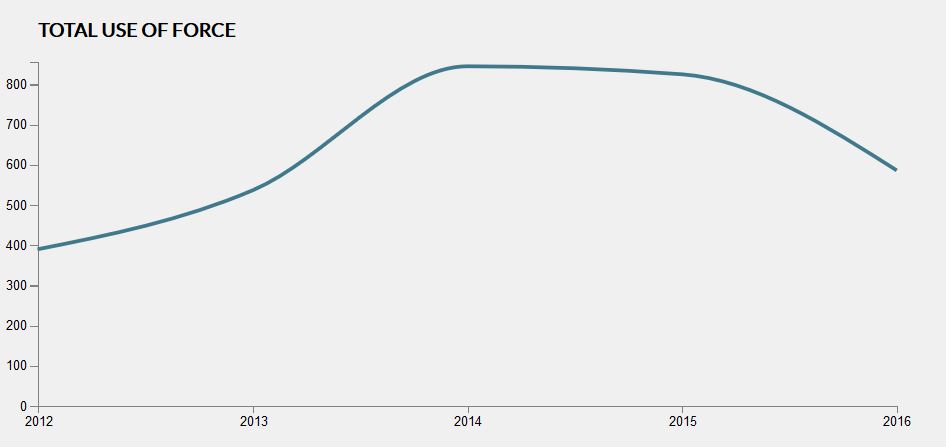
    http://force.nj.com/database/pd-dept/camden-camden

    Force went up. Arrests went up. Crime went down. But what about the idea, very popular among reformers who don’t live in high-crime neighborhoods, that arrests are bad, and people in dangerous neighborhoods hate police because police are arresting (or shooting) people of color for no good reason.

    If you decriminalize minor offenses, goes the hope, police “legitimacy” will increase, which along with leading to less incarceration means more solved crimes and many other wonderful things. It sounds good, especially if you think police are the problem and your neighbors aren’t.

    Based on UCR arrest numbers, arrests went up with the new police department. Camden cops are arresting more people, and crime is down. There may have also been better policing, but there was also just more policing. And the kind of arrests that increased — low-level discretionary arrests — would indicate that police focused on quality-of-life issues and Broken Windows. This is not the reformers’ party line.

    Caveat: I really hate using arrests as a metric for anything, much less good policing. But arrest data is available. And huge changes in arrest numbers tell you something is going on. Arrests can be a proxy for pro-active policing: cops stopping suspicious people, chasing and catching the bad guys, cops less afraid of making an honest mistake. My inquiry into Camden was inspired by thisarticle from March 2017 (that I just read) saying drug arrests were way down. Except that seems not to be true.

    In 2011, Camden cops may have lost a little of whatever go-getter spirit they still had. This was Camden’s Ferguson Effect (pre-Ferguson). Cops were told they were no good and their job was on the line. Arrested dropped 50 percent, from 11,000 in 2009 to 5,348 in 2011. Along with Camden, Baltimore and Chicago also saw similarly quick and drastic decreases in quantifiable policing. And in all three violence shot way up. Yes, correlation that is also causation [thunder clap]. At the start of 2012 Camden laid off 45 percent of the police force. Murders went up to 67 (which is a shocking number for a city of 75,000).

    Let’s compare 2012 and 2014 Camden, when murders went down from 67 to 33:

    • Drug arrests up 79% to 3,052.
    • Marijuana possession arrests in particular up 467% to 488.
    • Curfew and loitering violations up 34% to 1,128.
    • “All other offenses (not traffic)” up 50% to 3,352 (This most minor category is probably something catch-all like disorderly conduct, trespassing, loitering).
    • DUI arrests up 483% to 175 (an indicator of more policing).
    • Non-felony (ie: discretionary) assaults up 57% (to 754).
    • And murder arrests — because there were fewer or them — down 23% (to 20).

    Policing get “better,” but what does that mean? Maybe police officers have better manners. That matters. But what brings down crime is focusing on repeated violent offenders, usually young men, who commit the vast majority of violence crime.

    There’s irony here in that this little department so loved by progressives, has achieved success, in part, by arresting more minorities. And you know what kind of arrests increased the most? All the little ones that reformers want to stop in the name of social justice But those progressive reformers don’t live in Camden. If you do live in Camden, you probably support anything that works.

    For a small city, 9,000 arrests is a very large number. Scaled up to the population of New York City, for instance, this would be over one  million arrests a year (compared with the 240,000 arrests in NYC last year). One arrest for every 8 people is similar to the arrest rate that Baltimore had in the early 2000s (when I was there and violence was going down). This is the same arrest rate people (stupid people, mind you) blamed for Baltimore’s riots a decade later (arrests and crime in Baltimore dropped drastically from 2003 up until the riot of 2015).

    Now keep in mind arrests are not good on their own. It’s very important what the data do not reveal. How many times did cops change behavior without resorting to arrest? My guess is a lot. More good policing does often lead to more arrests, but it’s really important to put the horse before the cart. Policing is the goal. Not arrests. “More arrests” is never a good strategy.

    I’d like to know how many people were arrested in Camden in 2017 and 2018 when murder really dropped. In the ideal world, violence and arrests (and incarceration) all go down in sync. That’s the win-win(-win). But residents will always choose more arrests and less violence rather than the standard police reform package of less policing and more violence.

    One moral, and you see it time and again, is you don’t have to fix society’s problems to fix violence. Violence is not inevitable. But equally important is the corollary that you can’t fix society when violence is out of control. Most residents want more police. They want visible police who maintain order and treat people with respect. It’s not too much to ask for.

    Maybe what is going on in Camden is just slapping lipstick on a pig. But hey, it’s hard to argue with success. Don’t underestimate good PR and a progressive-sounding chief who both controls the narrative and won’t give in to anti-policing naysayers. And it’s likely that what the arrest numbers do not show — better hiring, training, culture, attitude, accountability, and leadership — is what makes effective aggressive policing possible, or at least palatable.

    Camden homicide numbers

    2018: 22

    2017: 23

    2016: 44

    2015: 32

    2014: 33

    2013: 57

    2012: 67

    2011: 52

    2010: 39

    2009: 35

    2008: 53

    2007: 45

    2006: 33

    2005: 35

    2004: 49

    2003: 41

    Non-fatal shootings

    2017: 95

    2016: 92

    2015: 109

    2014: 90

    2013: 143

    2012: 172

    Arrests

    2009: 11,280

    2010: 9,414

    2011: 5,348

    2012: 6,903

    2013: 6,613

    2014: 10,582

    2015: 12,049

    2016: 9,052

    Notes: In the data (for 2016, ISPSR 37056 and 37057) variable “offense” the value 18 is the total for drugs. Subtotals follow. Values 180 and 185 are again subtotals of what follow. This makes drug arrest numbers very easy to triple count, as I did at first.

    For 2009-2012, I’m assuming Camden City is the agency with the listed population of 77,665. I ignore the other Camden, which presumably is the rest of the county. After 2013 (unless I’m wrong) Camden City is the agency “Camden County Police Dpt” with a listed population of about 75,000.

    As always comments and corrections are welcome. Replications welcome; data available on request.

    Some sources: https://www.nj.com/camden/index.ssf/2018/01/camdens_2017_murder_rate_was_the_lowest_in_decades.html

    http://www.camconnect.org/resources/CrimeMaps.html

    https://camdencountypros.org/unit-list/homicide/#tabpanel22

    https://www.icpsr.umich.edu/icpsrweb/ICPSR/series/57
  • Pushing the Ideological Narrative

    Pushing the Ideological Narrative

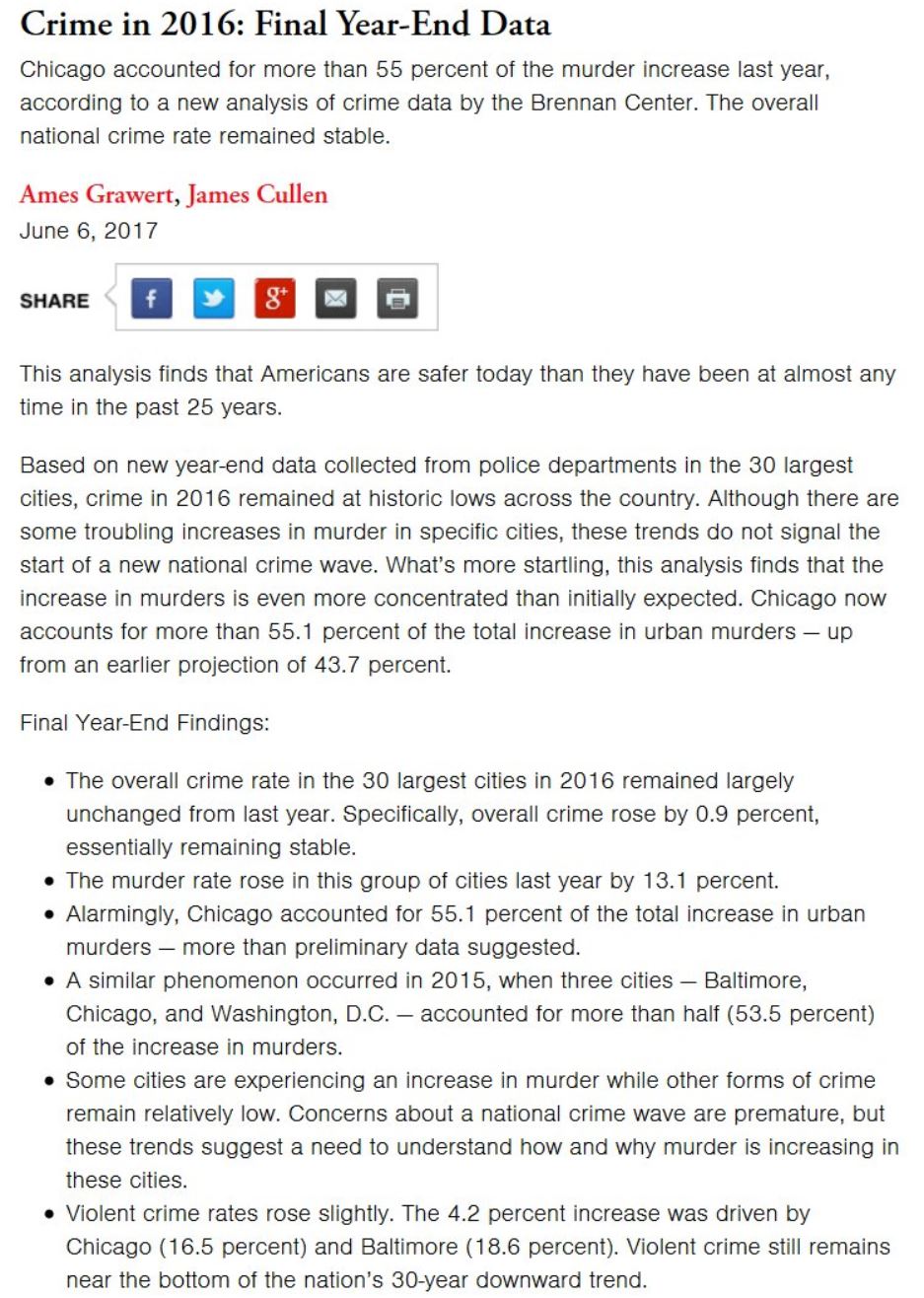
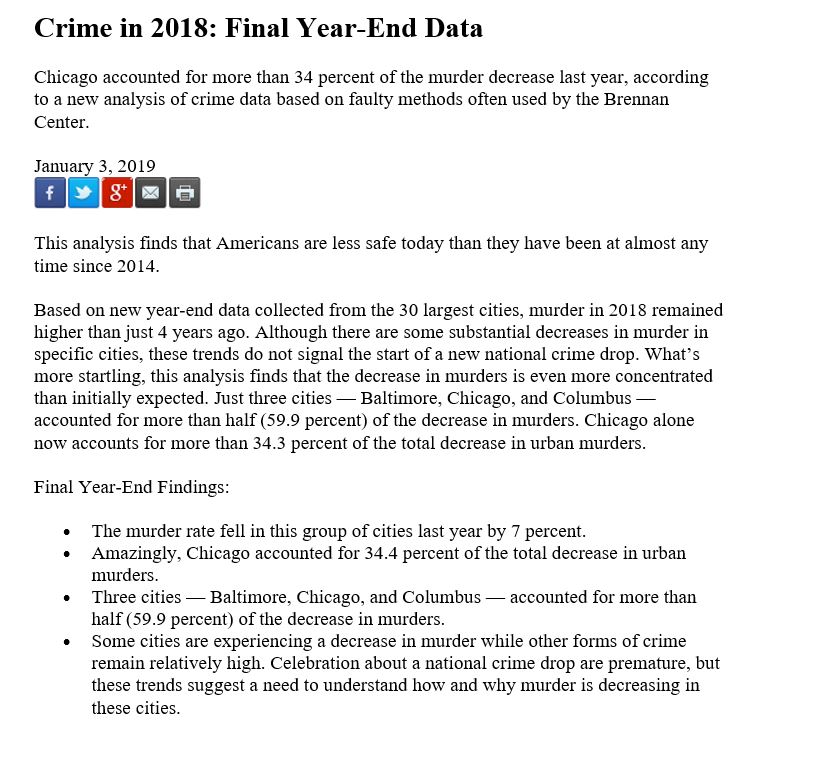
    I updated the Brennan Center’s crime report from 2016, to update it for 2018. I still have this urge to show how goofy their methods are. Why? Because, the authors are still cited by reputable journalists as experts, despite never acknowledging or correcting their past efforts to intentionally mislead journalists and the public. It’s advocacy data-analysis. It’s unethical, wrong, and harmful to the cause of truth.

    Here’s my parody of the Brennan Center style, adopted for 2019. The numbers I use are actually accurate, based on the best available city-data. The logic and conclusions and push, however, are just as absurd.

    Crime in 2018: Final Year-End Data

    Chicago accounted for more than 34 percent of the murder decrease last year, according to a new analysis of crime data based on faulty methods often used by the Brennan Center.

    January 4, 2019

    This analysis finds that Americans are less safe today than they have been at almost any time since 2014.

    Based on new year-end data collected from the 30 largest cities, murder in 2018 remained higher than just 4 years ago. Although there are some substantial decreases in murder in specific cities, these trends do not signal the start of a new national crime drop. What’s more startling, this analysis finds that the decrease in murders is even more concentrated than initially expected. Just three cities — Baltimore, Chicago, and Columbus — accounted for more than half (59.9 percent) of the decrease in murders. Chicago alone now accounts for more than 34.3 percent of the total decrease in urban murders.

    Final Year-End Findings:

    • The murder rate fell in this group of cities last year by 7 percent.

    • Amazingly, Chicago accounted for 34.4 percent of the total decrease in urban murders.

    • Three cities — Baltimore, Chicago, and Columbus — accounted for more than half (59.9 percent) of the decrease in murders.

    • Some cities are experiencing a decrease in murder while other forms of crime remain relatively high. Celebration about a national crime drop are premature, but these trends suggest a need to understand how and why murder is decreasing in these cities.

    Highlights of this style (faulty logic obscured by dressed-to-impress layout, footnotes, and statistical concepts).

    1) The murder rate fell in this group of cities last year by 7 percent.

    * “In this group of cities” added only when called out. http://www.copinthehood.com/2017/07/two-year-increase-in-homicide.html

    2) Amazingly, Chicago accounted for 34.4 percent of the total decrease in urban murders.

    *Note: this simply is not true. But is a reflection of only looking at a number cities.

    3) Three cities — Baltimore, Chicago, and Columbus — accounted for more than half (59.9 percent) of the decrease in murders.

    *This is true when one includes the caveat “of the sample used.” And if one includes this caveat, the statement is statistically worthless.

    4) Celebration about a national crime drop are premature — America remains much more violent than just 4 years ago — but these trends suggest a need to understand how and why murder is decreasing in these cities.

    *If you cherry pick the baseline year, you can say anything!

    One lesson is always be suspicious of data presentation. Is somebody pissing on your leg and saying it’s raining? Trust your gut or your “lying eyes.” When crime is up and people say it’s not, be wary. But use the same vigilance when crime is down and people say “be afraid!”

    Know your source, if possible. Assuming people aren’t just making numbers up, see when people use one form of logic when data go one way, but sing another tune when the same data go in the opposite direction. (Could be crime, the stock market, gas prices, etc.)

    Luckily, murder really was down in 2018. I wouldn’t want to waste your time pretending otherwise.

  • Crime is up then down than level then down slightly (then up)

    Crime is up then down than level then down slightly (then up)

    The Atlantic has a fun guess-the-homicide-rate-over-timegame!

    Turns out I’m really good at this game.

    But I shouldn’t boast; I have no excuse not to do well. I show this chart literally half a dozen times in each and every class I teach.

    What I don’t like is how dismissive they are of the current increase in violence, the largest percentage increase in homicide in decades. They quote the Brennan Center, which has been bending over backwards to downplay the recent increase in killing. (Lest there be any evidence of an effect whose name shall not be spoke…. You know, the one that starts with F, son.) The Center wants us to see those dead bodies not as real lives who mattered, but statistical flukes.

  • Why did New Yorkers stop shooting each other?

    In New York City not only has the number of homicides being going down, but the percentage of homicides committed with a gun has been decreasing.

    Put another way, there were about 309 people shot and killed in 2011 in NYC (for UCR reasons we’re talking incidents, so this is a bit of an undercount). In 2013: 188. That’s a huge decrease. (2014 saw 184.)

    If you look at all other city homicides (ie: non-gun), they’re down a little. But the decrease in NYC is all about fewer people shot. Did New Yorkers get together in 2011 and decide to stop shooting each other? I missed that meeting. Was it because of Occupy? Or because Occupy was broken up? Did anti-police protests somehow reduce gun violence? I doubt it. But something happened, and I don’t know what it is.

    Oddly, the NYPD didn’t take credit for this crime drop because it coincided with anti-police protests and the end of stop and frisk. Cops and Kelly and those on the right were certain — hoping even — that crime was going to skyrocket. They’ve been saying that since at least 2012. Well, it’s 2016.

    Here is some UCR homicide data from 2014 (if you hold your breath for 2015, you’ll turn blue and pass out):

    New York City: 56 percent of homicides are by gun, 26 percent by knife (“or cutting instrument”). Nationwide is 68% gun, 13% knife.

    A few other cities:

    Baltimore: 75% gun, 18% knife.

    Chicago: 87% gun, 7%knife.

    Los Angeles: 73% gun, 13% knife.

    Here’s the percentage of NYC homicides that were gun-related at various years (UCR data):

    1990: 74% of homicides by gun

    1997: 61%

    1998: 60%

    1999: 59%

    2000: 66%

    2002: 61%

    2005: 61%

    2009: 63%

    2010: 61%

    2011: 61%

    2012: 57%

    2013: 59%

    2014: 56%

    So maybe that’s not the issue. Honestly? A five-percent decrease since 1997 ain’t such a big deal. But my gut tells me a 5-percent slow but steady drop since 2011 does mean something.

    Of course it *is* related to gun control. But as any 2nd-Amendment-loving Trump-loving patriot will tell you (often in all caps) “CHICAGO HAS GUN CONTROL!!!!” And Chicago, if this is too subtle for you, has a lot of killings.

    So maybe, at least this is what I think, gun control isn’t about gun laws as much as actual prosecution and deterrence. New York is the only city where people believe — mostly correctly I might add — that illegal gun possession will bring you real time.

    What if it were that simple?

  • Why did crime plummet in the US?

    Over at Vox there’s a fair and brief look for and against all the theories of the crime drop.

    1. There’s about half as much violent crime in the US as there was 25 years ago

    2. The theory: putting more people in prison helped reduce crime

    3. The theory: putting more police on the streets prevented crime

    4. The theory: broken-windows policing prevented serious crime

    5. The theory: police have gotten better at detecting and preventing crime

    6. The theory: more guns, less crime

    7. The theory: the economy got better and crime got less appealing

    8. The theory: crime is harder because people don’t carry cash as much anymore

    9. The theory: people aren’t committing crimes because they’re inside playing video games

    10. The theory: gentrification is taking over crime-ridden neighborhoods

    11. The theory: people are committing fewer crimes because they’re drinking less alcohol

    12. The theory: psychiatric pills reduced violent and criminal behavior

    13. The theory: less crack use led to less crime

    14. The theory: America’s gangs have gotten less violent

    15. The theory: the US population is just aging out of crime

    16. The theory: legal abortion is preventing would-be criminals from being born

    17. The theory: lead exposure caused crime, and lead abatement efforts reduced it

  • Is there a new crime wave?

    “Don’t bet on it,” say Frank Zimring in the NY Daily News. I could not have said it better myself:

    At their current rate, killings in New York City would end 2015 as either the third or fourth lowest year in the city’s modern history.

    “Ferguson Effect”? Doesn’t look like it.

    To a student of crime data, this sounds much more like white noise than a blaring siren.

    There are real increases in violence in Baltimore, Maryland in recent weeks and perhaps in St. Louis, but making that into a national crime wave deserves an Olympic medal for jumping to conclusions.

    Why Mac Donald’s fearful haste?

    On the subject on Zimring, I always show this 9-minute Vera talk on why crime went down in the 1990s. It’s the best 9 minutes you’ll ever hear on the subject.

  • Better Policing Equals Less Crime

    This is a no-brainer to many, but a lot of people — usually those who don’t like police — still deny or diminish it: cops matter. And national trends are the result not some crime-related miasma but of the collective work in individual cities and neighborhoods.

    Camden, NJ, is worth paying attention to. I haven’t been following it too closely, but what I do know (in part due to my colleague John DeCarlo) is very interesting. Then:

    In January 2011, the state slashed the budget for the city’s police department by nearly 23 percent. The police union was dissolved after half of the uniformed officers were let go. The department – criticized by some as incompetent and ineffective – was then reconstituted as a county-run enterprise. But until new recruits could be brought on, the city suffered under the draconian cuts. There were nights when only 12 officers patrolled the entire nine square miles of the city.

    And now:

    The city – frequently labeled “America’s Most Dangerous” – has recorded as of Friday the fewest homicides in a year going back to at least 2010.

    In addition, during the first six months of 2014, the number of gunshots in the city fell nearly 50 percent over the previous year….

    Despite two fatal shootings in quick succession this week, the number of killings is less than half of that two years ago. By Halloween 2012, Camden had buried 55 victims. This time last year, it had 43. As of Oct. 31, the city had seen 24. In 2010, at this point, there were 30.

    By civilianizing or outsourcing every job that does not require a gun or a badge, the county-run force bolstered the number of boots on the ground.

    Police walking beats are supplemented with “virtual patrols” by civilians, who monitor 120 surveillance cameras bolted to light poles. An additional 40 to 60 private security guards, sporting yellow-and-blue vests, roam the business district, calling in reports to the command center.

    Of course some people still complain, but haters are always gonna hate.

    Meanwhile…

    Vallejo [California] has struggled for years. Crippled by high pension costs and public-employee salaries, it filed for bankruptcy in 2008. Things didn’t get much better after the city emerged from Chapter 9 in 2011: Crime was bad and the city’s police department was perpetually short-staffed. There were 10 murders in 2010, 14 in 2012, and 24 in 2013.

    Obviously both cities cannot simply be reflective of some “national trend.”

  • Laments of the Qualitative Researcher

    I don’t apply for many grants, in part because they’re so hard for a qualitative researcher to get. Ethnographic work and qualitative research isn’t taken seriously in a generally quantitative field. My research doesn’t follow the standard “theory, hypothesis, experiment, verify” model of hard science. Nor should it. But it’s hard to get grants or get published in Criminology if you don’t. (The quantitative/qualitative ratio leading journals is roughly a depressing 90%/10%.) So why is this work not valued in research grants and journal publications? I do my research the old-fashioned way: I talk to people. Perhaps it’s worthless research, but professors do assign my books to students. But why is the worth of qualitative research only recognized after the fact?

    [If you look at Amazon’s list of “best sociology,” you have to get to number seventy-six before you find one written by an actual sociologist! I would see this is a crisis of the field (even given issues with how Amazon classifies sociology).]

    So here’s my next book idea: I’m going to research and write an oral history of the Great New York City Crime Drop. Why? Because crime went down more than anybody thought possible, and there is still no academic consensus about what actually happened. It’s one thing to talk about Broken Windows and Compstat in theory. But I want to explain the crime drop from the perspective of the NYPD officers who were actually there. What police have to say may be profound. And nobody ever talks to the lowly beat cop. At least what they have to say will be revealing. And if nothing else, it should be a very good read.

    The grant rejections (I wanted money to pay for transcribers) were check-the-box, so I don’t want to read too much into specifics. And the single most important reason may be: “Proposal needs stronger organization or writing.” Had they just left it at that, I would said, gosh, maybe they’re right. That’s a good reason for rejection. I could have spent more time writing it. (But then, in a catch-22, I didn’t want to waste more than a few days writing a grant application that would probably be rejected…)

    It’s the other specific reasons that I have issues with, such as:

    • Proposal does not clearly state a testable hypothesis, goal or aesthetic vision

    Well of course there’s no clearly stated testable hypothesis because I’m not testing a hypothesis. It’s called Grounded Theory, if you want to get fancy (I don’t). I’m going to talk to people to listen to them and try and understand what they have to say. There’s no shame in that (nor, apparently, grant money).

    • Research methodology is underdeveloped

    I’m going to interview a lot of cops who worked the streets from the late 1980s to the mid 1990s. And then I’m going to write a book about it. Just because you don’t like that plan doesn’t mean it’s underdeveloped.

    • Proposal fails to convince reviewers of scholarly significance

    Murders in NYC decreased eighty-some percent and we, the so-called “experts” in the field, still can’t agree on a theory that has any practical use. If explaining the crime drop doesn’t have scholarly significance, I don’t know what does!

    • Proposal does not demonstrate sufficient understanding of the state of the discipline or field

    Really? This is my field, and I don’t think I’m an idiot. I guess we’ll just have to agree to disagree.

    I’ve done some pretty good research in my day. I’ve written good books and social science. But because I choose not to follow the hard-science model of methods and writing, I still feel like an idiot when my grant applications are rejected. It’s not so much the rejection that hurts (don’t “poor baby” me; I have thick skin). This wasn’t a large grant. And I’m good at research on the cheap. Still, it’s the stated reasons for rejection that make me throw up my hands in frustration.