Tag: crime prevention

  • Anybody have San Diego PD Connections?

    I want to look at the impact of cell phones of crime prevention. I can’t seem to make any progress getting such data from the NYPD. The San Diego paper has this story. Maybe I’d have better luck there. Besides San Diego has always been an interesting case vis-a-vis crime reduction because they mirrored the crime drop in New York in the 1990s but the police then all-but refused to take credit for it.

    Anyway, before I start cold calling, I thought I’d ask to see if anybody has police connections in San Diego. If you do feel free to send me an email. Basically I’d want to look a bunch of 911 and 311 call data going back years, with a focus on “crime in progress.” And calls from cell phones, if it’s broken down that way.

    Of course if any other city wants me to look at this for them, I’d be happy to.

    (I ask not what I can do for the blogosphere, but what the this damn blog can do for me!).
  • Fewer Cops, More Crime

    Seems to be what’s happening in Newark, which laid off 163 police officers last month.

  • Zimring on the NYPD crime drop

    Frank Zimring has always been one of the better criminologists out there.

    This nine minute video from the Vera Institute of Justice hows some of the reasons why.

  • A fresh start with a new State’s Attorney?

    People normally don’t get very excited over the elections of a State’s Attorney. But the recent election lose of Patricia Jessamy (and victory for Gregg Bernstein) is the most exiting crime-fighting development in Baltimore in many years.

    Peter Hermann has a good story in the Sunabout the potential for corporation between police and prosecutors.

    In my last poston this, people asked for examples of why Jessamy was no good. I give some in my book, Cop in the Hood. And Hermann provides more examples of the typical B.S. that came from her office:

    Another minor and long-forgotten skirmish in what has been a years-long war between Jessamy and most if not all of the six police commissioners who ran the department during her 15-year tenure as Baltimore’s elected top prosecutor.

    She kept a list of officers she deemed untrustworthy and unable to take the witness stand, effectively ending their careers, even if nothing was ever proved.

    She once required a minimum 30 rocks of crack cocaine or vials of heroin to bring a felony drug charge.

    And she had a standing practice of not prosecuting homicides and some other crimes in which police had only one witness, even if there was other evidence.

    [In one case] Her staff agreed to a plea deal and a suspended sentence … even though the victim begged to testify at a trial…. The suspect got out of jail [and two-years later was] charged with robbing three women at gunpoint and abducting a college student.

    A few months ago, a prosecutor dropped a robbery charge against a man…. The suspect was later charged with fatally stabbing Johns Hopkins researcher Steven Pitcairn in Charles Village.

    Read the whole story here.

    Now Everything Jessamy said and did wasn’t crazy. Sometimes she was right. Sometimes police are deserving of criticism and need a little slap to keep them honest and grounded in reality. But it’s possible to criticize police and still be pro-police. Jessamy wasn’t. With her constant harassment, Baltimore cops didn’t work better. We get demoralized and wondered why we’re putting our life on the line. I worked hard and her office let people walk. Why bother?

    Think about this: Al Sharpton is at times a lying libelous self-aggrandizing anti-police buffoon. But the NYPD probably does a better job because of his existence. Still, I wouldn’t want Al Sharpton to be District Attorney (New York’s equivalent of the State’s Attorney). Baltimore doesn’t have an Al Sharpton. Maybe it needs one, but that anti-police attitude shouldn’t come from the Office of State’s Attorney.

    She’s the prosecutor. She’s supposed to partner with police and be anti-criminal.

  • Baltimore Arrest Settlement

    Seems like the city got off easy by having to pay $870,000 and promise to do the right thing.

    About 100,000 people were arrested each year in first half of the 2000s. Last year the number was down to about 70,000, which is still a lot. By comparison, New York City had 341,000 arrests in 2009. That means the Baltimore arrest rate is about 2.5 times higher than the rate in New York City. Of course, Baltimore has a murder rate about six times higher and has a lot more public drug dealing. So it’s not easy to conclude what that all means.

    When I was a cop, I had a half-hour meeting in City Hall with a certain high-ranking elected official. At one point I remember telling him, “You know, you can’t arrest your way out of this murder problem.” He looked at me quizzically and said, “Why not?” Anyway…

    Perhaps the days of locking people up for just standing around are over. But police need an “or-else” to get people to follow lawful orders. So if loitering arrests decline, I predict arrests for disorderly conduct (the catch-all charge in New York City) and failure to obey a lawful order will go up.

  • Crime and arrests down in Baltimore

    A good article by Ben Nuckols about crime in Baltimore and the good things happening under Police Commissioner Frederick Bealefeld.

    In a blighted west Baltimore neighborhood, Lt. Ian Dombroski turns his unmarked police car around a corner and sees several men standing outside a liquor store. They scatter immediately.

    Dombroski knows they’re probably selling drugs, but he keeps driving. Five years ago, he said, officers who happened upon a similar scene wouldn’t take such a selective approach.

    “We’d all jump out, grab all the junkies, find out who had the drugs on ’em, lock ’em up, and that might be three or four drug arrests right there,” Dombroski said. “And we’d go, ‘Good, those are numbers.’”

    But under Police Commissioner Frederick H. Bealefeld III, officers in one of the nation’s most violent cities are no longer being told to beef up arrest statistics. The number of arrests has declined the past two years. Yet homicides and shootings are down, too — to totals not seen since the late 1980s.

  • New York Black and Latinos Frisked 9 Times as Often as Whites

    Ninety percent of those stopped by the NYPD are black and latino. So says the New York Times. Is this a cause for concern? I don’t know. Something certainly bothers me when my male black and hispanic students complain of being stopped by the police often (and often rudely stopped).

    But there is one touchy and politically incorrect fact that seems remiss not to mention: nine-in-ten murderers in New York are black or hispanic (just seven percent are white) [here’s a previous post].

    Police go where the violent crime is. And if you work in a neighborhood were the robbers and murderers are black or hispanic, you stop black or hispanic people.

    Given the raw data, the racial disparity doesn’t seem to be the problem. But what do I know? I don’t get frisked. I’m white and live in a safe neighborhood.

    The questions we should be discussing is whether or not aggressive stop-and-frisks are an effective crime prevention strategy. I like the idea that criminals are leaving their guns at home rather than risk being stopped, frisked, and arrested by the NYPD. Is that a result of stop-and-frisks? I don’t know. Do the crime prevention benefits outweigh the negative community interactions with innocent people? 575,000 stops yielded 762 guns. That doesn’t seem like a great hit rate to me.

    If frisks are done because officers really have reasonable suspicion that a suspect is armed, go for it. But if officers are simply trying to meet “productivity goals” (read: quotas), something is very wrong.

  • NYPD Stop and Frisks

    Lenny Levitt poses an interesting question is his weekly column:

    From 2004 through 2009, [New York City] police have had nearly three million stop-and-frisk encounters, which involve patting people down or questioning them. Virtually all of those stopped are black or Hispanic. In 88 per cent of the cases, the people searched or questioned were innocent of wrongdoing. [ed note: I think innocent is too strong a word for not arrested or given a citation. But regardless, many if not most of those frisked turn out to be guilty of nothing more than living in a neighborhood where police stop and frisk a lot people.]
    Stop-and-frisk had been the tactic of the department’s former plainclothes Street Crime Unit, which prided itself on getting guns off the streets. After four improperly trained Street Crime cops shot and killed the unarmed Amadou Diallo in 1999, Police Commissioner Howard Safir put the unit into uniform, in effect destroying it. Upon taking office in 2002, Kelly abolished it entirely.

    For the record, nobody wants a return to the random violence of the early 1990s. But is the current crime decline, which has continued for the past 15 years, in any way related to Kelly’s aggressive stop-and-frisk policies, which began in 2004?

  • Bratton and L.A.

    Everywhere Bill Bratton goes, crime seems to go down. Since 2002, homicides in L.A. decreased by more than 50%. And yet so many professors are unwilling to accept that good policing has a major impact on crime. In the academic world, Bratton still seems to get little credit and respect. Why is that?

    Here’s an article by Scott Gold, Catherine Saillant, and Joe Mozingoin in the L.A. Times about Bratton’s success.

    There’s a chance that Bratton will return to NYC. I hope so. Bratton is pro-cop and generally maintains good relations in high-crime communities. It’s a tough act to balance.

  • More Prison, Less Crime?

    More Prison, Less Crime?

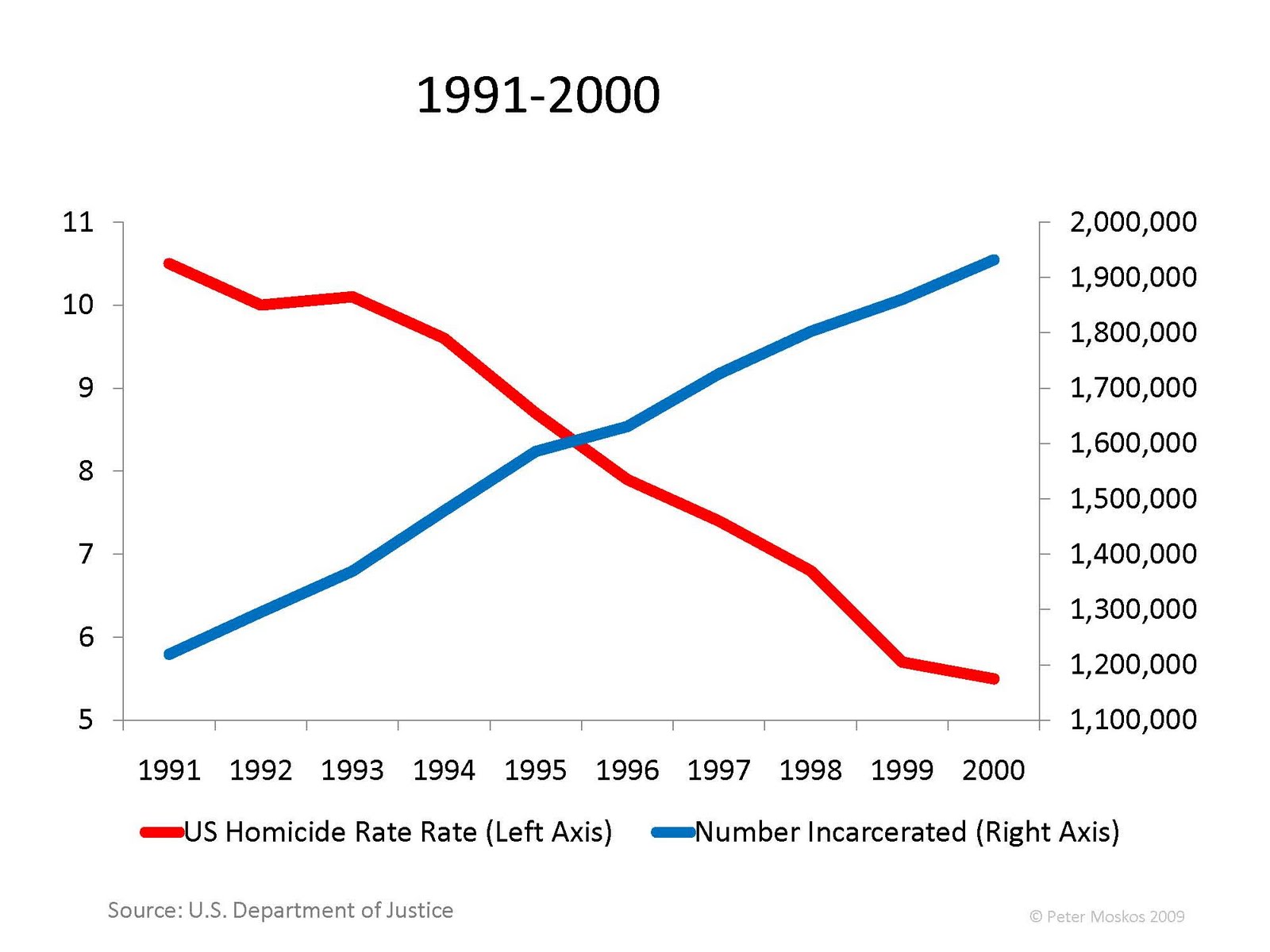
    If you look at this chart, it’s not hard to think that the great crime drop was caused by locking up all the criminals. A student brought this up in class. In the 1990s, it looks pretty convincing:

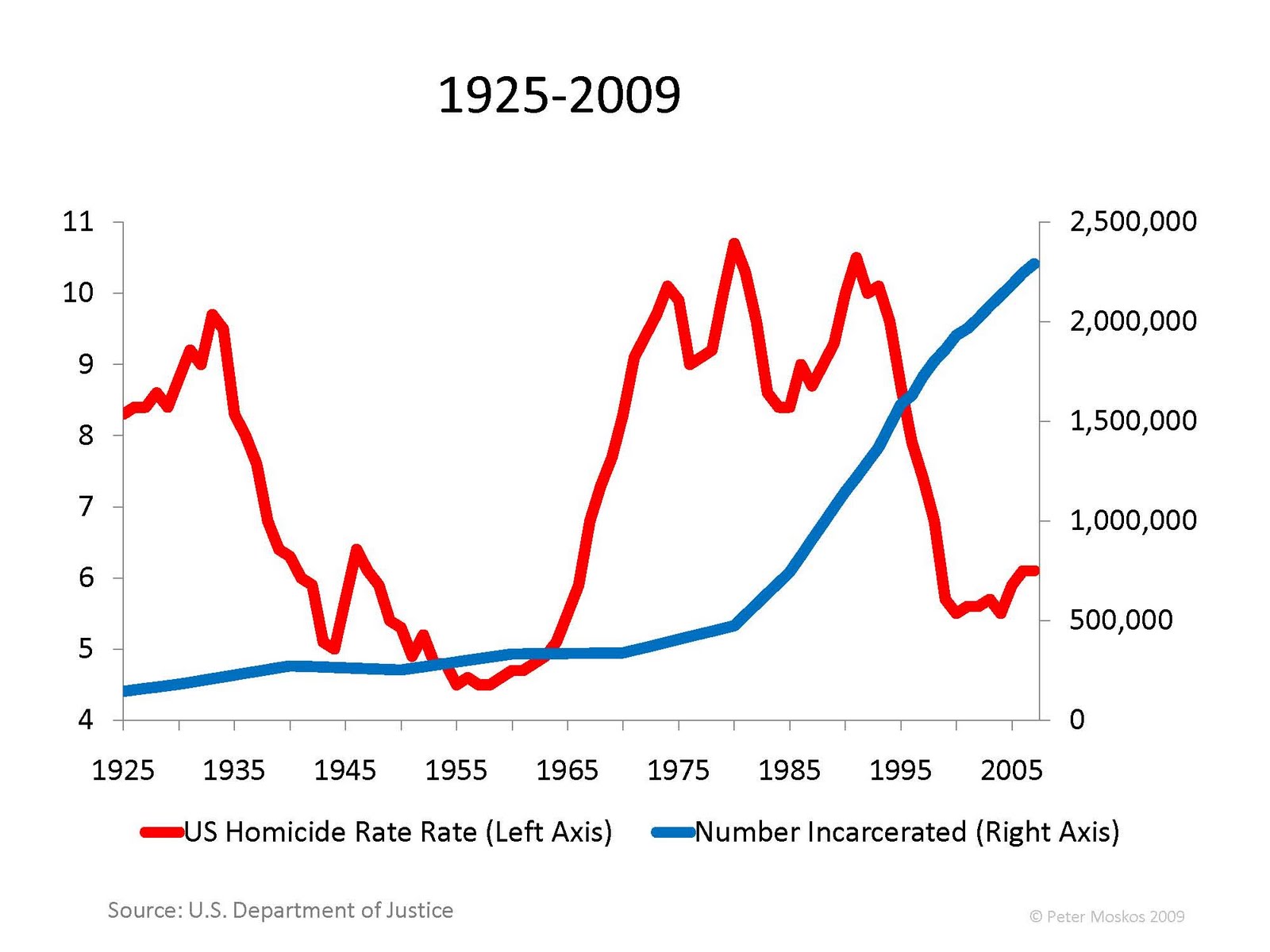
    But just looking at the 1990s misses the big picture. Here’s the same data going back to 1925. Crime went up and down and up and down, but the prison rate stayed more or less the same, and then skyrocketed after 1970.
    And here’s what happens it you look at each decade separately:
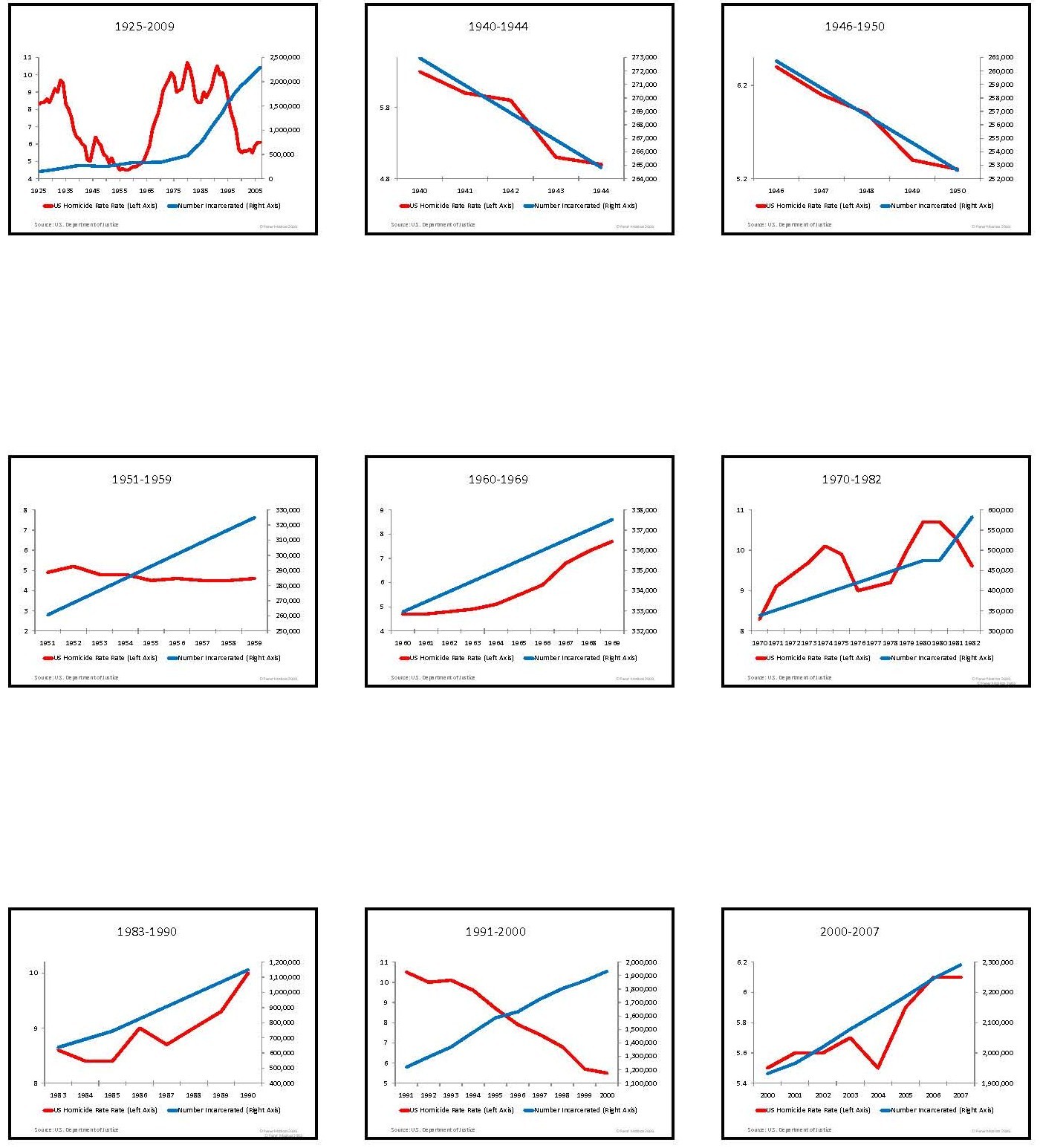
    What it comes down to is this:

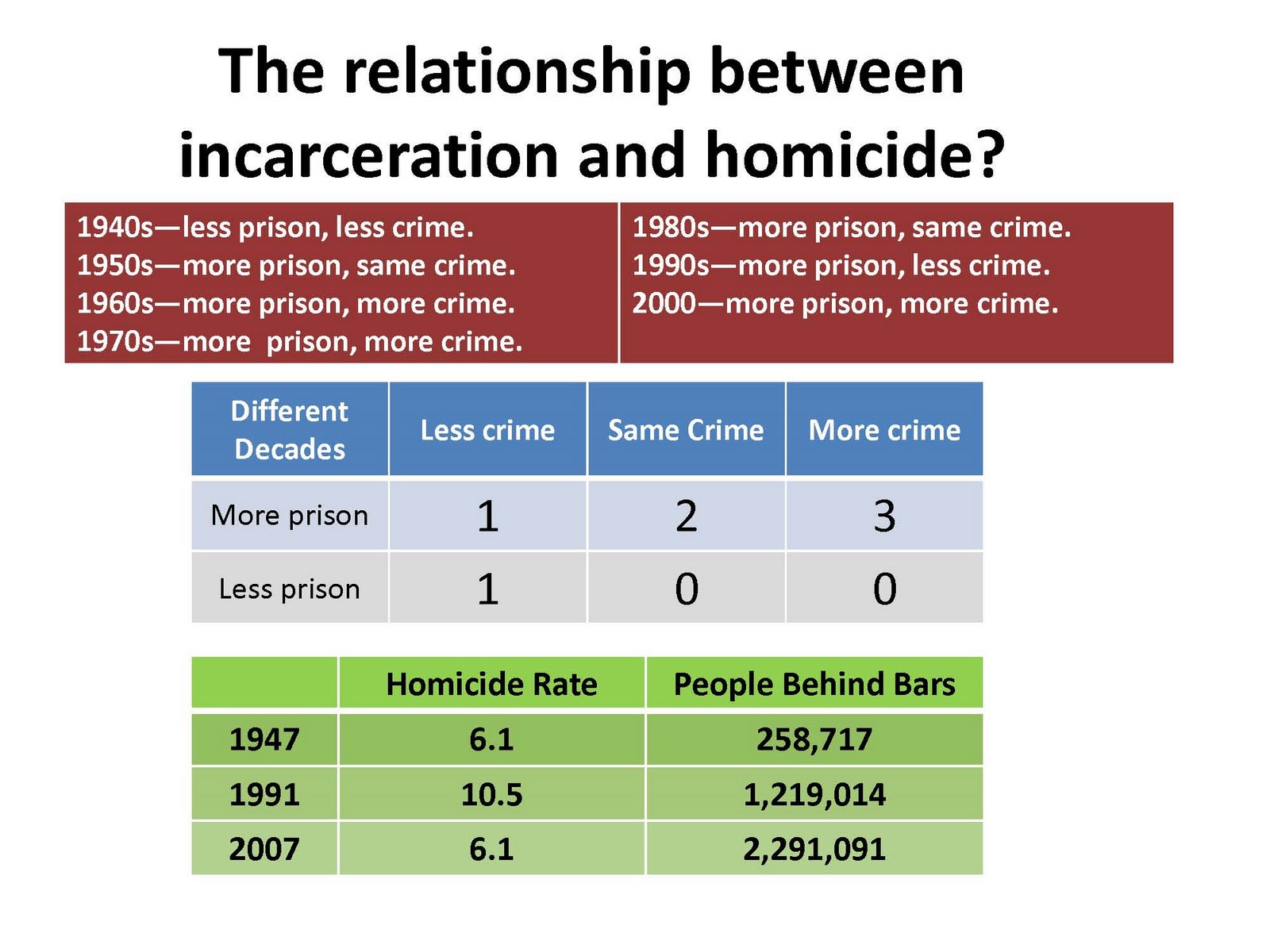
    In three decades we’ve had moreprison and moremurders. In two decades we’ve had more prison and murders were basically unchanged. In one decade we had lessprison and lessmurder. And in just one decade, the 1990s, we’ve had more prison and less murder.

    Between 1947 and 1991, the prison population increased almost 500 percent. Meanwhile the homicide rate went up by more than a third. Did locking up more people increase the homicide rate? Probably not.

    So what makes the 1990s the decade of choice that proves incarceration is the solution to crime? Was there some magic tipping point? Was there something special about the second million we incarcerated that didn’t apply to the first million? Probably not.

    I’ll put it another way, in 1947, the homicide rate was 6.1 per 100,000 and we had 259,000 people behind bars. In 2007, we had the same murder rate of 6.1 and yet 2.3 million people are behind bars. What good have we gotten from locking up an extra two million people, spending something like $50 billion per year for the privilege?

    You think there might be a better way?