Tag: crime

  • “Will the anti-cop Left please figure out what it wants?”

    Heather MacDonald in City Journal:

    Will the anti-cop Left please figure out what it wants? For more than a decade, activists have demanded the end of proactive policing, claiming that it was racist.

    Equally vilified was Broken Windows policing, which responds to low-level offenses such as graffiti, disorderly conduct, and turnstile jumping. Black Lives Matter activist Shaun King launched a petition after the 2014 shooting of Michael Brown in Ferguson, Missouri, demanding that Attorney General Eric Holder “meet with local black and brown youth across the country who are dealing with ‘Zero Tolerance’ and ‘Broken Windows’ policing.”

    Well, the police got the message. In response to the incessant accusations of racism and the heightened hostility in the streets that has followed the Michael Brown shooting, officers have pulled back from making investigatory stops and enforcing low-level offenses in many urban areas. As a result, violent crime in cities with large black populations has shot up — homicides in the largest 50 cities rose nearly 17 percent in 2015. And the Left is once again denouncing the police — this time for not doing enough policing.

    King scoffs at the suggestion that a new 70-question street-stop form imposed on the CPD by the ACLU is partly responsible for the drop-off in engagement. If American police “refuse to do their jobs [i.e., make stops] when more paperwork is required,” he retorts, “it’s symptomatic of an entirely broken system in need of an overhaul.” This is the same King who as recently as October fumed that “nothing happening in this country appears to be slowing [the police] down.”

    The activists’ standard charge against cops in the post-Ferguson era is that they are peevishly refusing to do their jobs in childish protest against mere “public scrutiny.” This anodyne formulation whitewashes what has been going on in the streets as a result of the sometimes-violent agitation against them.

    That officers would reduce their engagement under such a tsunami of hatred is both understandable and inevitable. Policing is political. If the press, the political elites, and media-amplified advocates are relentlessly sending the message that proactive policing is bigoted, the cops will eventually do less of it. This is not unprofessional conduct; it is how policing legitimacy is calibrated. The only puzzle is why the activists are so surprised and angered that officers are backing off; such a retreat is precisely what they have been demanding.

  • Chicago Police Report

    It’s kind of hilarious that Chicago Mayor Rahm Emanuel is trying to present his cover-up-and-dictate style of management as concern for police misconduct. But leaving that aside, a task-force he appointed has released its report.

    Some of what it says needs to be said: “From 2011-2015, 40% of complaints filed were not investigated by IPRA.” And: “These events and others mark a long, sad history of death, false imprisonment, physical and verbal abuse and general discontent about police actions in neighborhoods of color.”

    And let’s not forget the false (and consistently false) police reports and (mayoral?) cover-up related to the killing of Laquan McDonald:

    Not until thirteen months later — after a pitched legal battle doggedly pursued by local investigative journalists resulted in the court-ordered release of the dash-cam video of the shooting — did the public learn the truth: McDonald made no movements toward any officers at the time Van Dyke fired the first shot, and McDonald certainly did not lunge or otherwise make any threatening movements. The truth is that at the time Van Dyke fired the first of 16 shots, Laquan McDonald posed no immediate threat to anyone.

    They really should have added that McDonald didn’t pose any threat when the last shots were fired.

    There are the ignored red flags:

    The enduring issue of CPD officers acquiring a large number of Complaint Registers (“CRs”) remains a problem that must be addressed immediately. From 2007-2015, over 1,500 CPD officers acquired 10 or more CRs, 65 of whom accumulated 30 or more CRs. It is important to note that these numbers do not reflect the entire disciplinary history (e.g., pre-2007) of these officers.

    The inability to act on red flags:

    Sadly, CPD collects a significant amount of data that it could readily use to address these very troubling trends. Unfortunately, there is no systemic approach to addressing these issues, data collection is siloed and individual stakeholders do virtually nothing with the data they possess.

    And the perennial problem with “community policing”:

    Historically, CPD has relied on the Community Alternative Policing Strategy (“CAPS”) to fulfill its community-policing function. The CAPS brand is significantly damaged after years of neglect. Ultimately, community policing cannot be relegated to a small, underfunded program; it must be treated as a core philosophy infused

    But here’s where ideology begins to trump common sense. It’s claptrap to advocate for “community policing” without defining community policing or offering any evidence to its effectiveness. Yes, police right now need better relations with the non-criminal public in minority neighborhoods. But the main job of police, lest we forget, is to deal with the criminal public.

    And then there’s the absurdity — the dangerous and even racist absurdity — of promoting racial balance in police activity and use of force.

    Police Officers Shoot African-Americans At Alarming Rates: Of the 404 shootings between 2008-2015:

    • 74% or 299 African Americans were hit or killed by police officers, as compared with

    • 14% or 55 Hispanics;

    • 8% or 33 Whites; and

    • 0.25% Asians.

    For perspective, citywide, Chicago is almost evenly split by race among whites (31.7%), blacks (32.9%) and Hispanics (28.9%).

    Really? That’s your perspective?

    The idea that police should stop, arrest, and even shoot and Tase people in proportion to population demographics is nutty. For real perspective, consider that of 3,021 Chicagoans shot last year, just 25 were shot by police. 79 percent of murder victims were black; 4 percent were white. For known assailants (which is known just a shamefully low 26 percent of the time) the figures are comparable.

    With this perspective, the use-of-force stats seem quite reasonable. To say this is not to deny a historically troubling legacy or even current problems. But if the benchmark for success in policing is racial parity in use of force, then Chicago and Chicagoans are in for more bloody years.

    Chicago is 5.5 percent Asian. As a benchmark of success, will we not rest till more than 5 percent of those shot by police are Asian?

    Overall, use of lethal force by the Chicago Police Department is on par with the national average (0.33 per 100,000 for the CPD, compared with 0.31 for the nation). Chicago is below LA, Houston, Atlanta, San Francisco, and most cities. The Chicago Police Department may have 99 problems, but an excessive use of lethal force and a racial disparity in that use of force doesn’t seem to be one of them.

    Still, there is a room for improvement. The NYPD kills people at an outlyingly-low rate of 0.08. Maybe, instead of suing police departments into institutional paralysis, folks could determine what the NYPD is doing right and advocate better — rather than less – policing based on best practices. (But who on the Left wants to talk about what the NYPD is doing right?)

    But I’ll finish on a positive note:

    The findings and recommendations in this report are not meant to disregard or undervalue the efforts of the many dedicated CPD officers who show up to work every day to serve and protect the community. The challenge is creating a partnership between the police and the community that is premised upon respect and recognizes that our collective fates are very much intertwined.

  • How people get killed

    Murders are usually thought of in the abstract. People “get killed.” Homicides “rates” go up or down. But to each killing, there’s a person who kills and a person killed. This isn’t really understood by those who don’t live or work in high crime areas. (Yes, while murder can happen anywhere… no, murder actually doesn’t happen everywhere).

    Not to glorify snuff films — because, spoiler alert, this guy gets killed [update: or maybe just critically wounded] — but I think it’s important to understand the individual nature or homicides when talking about crime and police.

    From the Daily News:

    Police statistics said that as of Wednesday morning there had been 727 people shot and 135 homicides so far this year in the city of Chicago.

    However, the Chicago Tribune reported at 9 p.m. that nine more people had been shot during the course of the day, including a 23-year-old man and a 43-year-old woman, who were both killed.

    The incident is the latest in the city’s most violent start to a year since 1999.

    Earlier this week a young woman named Camiella Williams, 28, told The Trace that she has lost 23 loved ones to shootings, and is now an anti-gun violence advocate.

    As the story was being edited another one of her friends, 27-year-old Cordero Mosley, was shot six times and died.

  • Why fewer police-involved shootings in Chicago might be bad

    Why fewer police-involved shootings in Chicago might be bad

    Police-involved shootings in Chicago are way down.

    From heyjackass.com

    This is great news for advocates of police reform.

    Chicago in 2016 will probably see police shoot just 15 or so people (based quite sketchily on January through March figures). This compares to 45 people shot in 2014. The decrease is without doubt due in part to those who keep a laser-like focus on police misconduct. The number of those shot by Chicago Police has plummeted for two consecutive years.

    But it’s also very likely that Chicago will see close to 3,500 people shot this year. That would be 500 more than 2015. And that was 500 more than 2014. And that was 500 more than 2013. And for each 500-person increase in shootings, roughly 480 victims are black or hispanic.

    What if — hypothetically of course and absent any corresponding decrease in violence in general — what if police-involved shootings served as a proxy (an indirect indicator) for police officers’ engagement and interaction with violent criminals and the criminal class? It’s not inconceivable. Another indicator is that police stops in Chicago have also plummeted.

    In the police world we’d call these facts “clues.” Of course in the academic world I’m “just guessing.” But I’ll have a lot of time to guess before “hard social science” (that’s a joke, by the way) can prove what’s going on.

    But hey, why focus on the negative? Why focus on criminals and dead young black and hispanic men when we can just keep the heat on police? Let’s assume heroic police behavior is criminal. Let’s criminally prosecute innocent cops and drive other cops who defend themselves into hiding. Let’s build a social movement on (what turns out to be) a lie and then pretend it doesn’t matter because, well, it could have been true. And then, when police do less and crime goes up, deny it. And then, when you can’t deny it any longer, say we don’t know why crime is up. Or better yet, blame the police.

    But police-involved shootings are way down!

    Update: here’s the same data but compiled on June 6:

  • Chicago violence

    Chicago violence

    Maybe killers don’t dress with such flair in Chicago as they do in Detroit. But what Chicago murders lack in quality, they make up for in quantity.

    Some experts prefer to put their head in the sand and hope it all goes away:

    “Trying to read too much into this is a grave mistake,” said Craig B. Futterman, a clinical professor of law at the University of Chicago. “We’re all just guessing.”

    Really? A “grave mistake” when homicides are almost doubled compared to the same time last year? No. It’s high time for everybody to give their best guess. Here’s mine:

    Since January, officers have recorded 20,908 times that they stopped, patted down and questioned people for suspicious behavior, compared with 157,346 in the same period last year. Gun seizures are also down: 1,316 guns have been taken off the streets this year compared with 1,413 at this time last year.

    And convictions in gun cases are getting hard to win:

    In part, that’s because of the public’s concern over police tactics in the wake of high-profile shootings of African-Americans by police officers around the country, according to both prosecutors and defense attorneys.

    It’s not so much as a “guess” as connecting the dots. That decrease in stops was by design:

    …tied to a departmental change that took effect in January, requiring officers to fill out a far more detailed form for each one. The change was imposed after the American Civil Liberties Union raised questions about whether officers were targeting minorities in their stops.

    Well, of course they were. How are you going to target homicides in Chicago without a focus on minorities? Of 3,000 people shot and 506 killed in Chicago, 80 percent were black and another 15 percent hispanic. 95 percent of those killed are black or hispanic in a city that is roughly two-thirds black or hispanic.

    So yeah, when it comes to preventing gun violence in Chicago, the police would be remiss if they didn’t focus on minorities. And men, too (90 percent of victims). Should police stop more Polish-American women in Jefferson Park? Jefferson Park would love more police presence (if that were possible). (To my surprise, there even was a murder in Jefferson Park last year. One.)

    Of last year’s murder carnage just 123 suspects have been arrested. The clearance rate was 25 percent. So there’s room for improvement there, too. Right now literally hundreds of active murderers are walking around the streets of the South and West Sides of Chicago. 142 murders just through March.

    Look, maybe an increase in shootings in Chicago isn’t related to decreasing interaction between police and criminals. Maybe there is no cause and effect between attempts to limit and control police activity against young black and hispanic men and an increase in violence among some of these same young black and hispanic men. Yes. It’s a guess.

    But what if aggressive policing — and inevitably some of that will cross the line to an illegal stop or search — actually prevents violence? What if there were a cost to a laser-like and exclusive focus on police misconduct? Reducing police stop in general is one way to reduce illegal police stops and citizen complaints. But maybe it’s the wrong way. What if one consequence of focusing only on police misconduct were fewer gun convictions? What if it were more murders? (And God forbid you call this relationship something like the Ferguson Effect, because that doesn’t exist.)

    Hey, on the plus side, police-involved shootings in Chicago were down in 2015. Mission accomplished, I guess.

    Here’s the most shameful response to more murdered black men:

    Some experts… point out that the numbers in recent years have been below those in the early 1990s, when more than 900 murders were reported some years.

    Wow. And so effing what?! Talk about the soft bigotry of low expectations. Imagine saying we needn’t worry about institutional racism because it’s so much less today than it was in the 1960s (and 1860s, for that matter). Or check into a hospital where mortality is up and their response is: “Trying to read too much into this is a grave mistake. We’re all just guessing. Besides, mortality was so much greater in the past.”

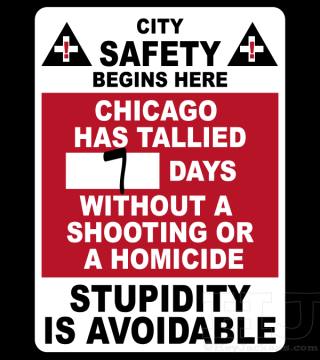
    Also, from the fun info at heyjackass.com, Chicago saw but 7 days in 2015 without a reported shooting or homicide. Seven.

    Also, on the subject of the CPD, I’m happy an insider seems to have been tapped to be the next chief of police in Chicago. I have no idea who the person is. But I’m happy it’s not another outsider with no real clue coming in to save the day.

  • I wanna be a cowboy…

    In some ways this is just another shooting in the hood.

    But I post it because, well, look at her Jessie getup!

    Also, she packs her gun in her panties.

    And there’s high quality video.

    Does there have to be more?

    I wanna be a cowboy… and she can my cowgirl.

    This is the violence problem in America. Have an argument? Upset? Feel bad? Get a gun, holster it in your undies, and then use as needed at the gas station.

    On the plus side, no police officer got in trouble for confronting, frisking, or even having to shoot this juvenile.

    I’m assuming she’s just a “girl” since her name wasn’t released. I also feel sorry for any youngsters who watched this and say, “That’s mom!”

    [Also, notice the cross around her neck. Here’s yet another example of radical Christian terrorism. And yet nobody but me has noticed this clear sign of Christian jihad.]

  • Defining the Ferguson Effect

    Denying the Ferguson Effect and any link between policing and crime has become almost a cottage industry in some circles. It’s sort of the liberal equivalent of conservatives denying climate change and, er, on the small chance it is changing, any link between global warming and human activity. Sure, the world may be warmer. But God works in mysterious ways. Same with crime, if you listen to many of the Left.

    Here’s a new study :

    There is no evidence to support a systematic Ferguson Effect on overall, violent, and property crime trends in large U.S. cities.

    OK. But the author do admit:

    The disaggregated analyses revealed that robbery rates, declining before Ferguson, increased in the months after Ferguson. Also, there was much greater variation in crime trends in the post-Ferguson era, and select cities did experience increases in homicide.

    OK…. So doesn’t that mean there is a Ferguson Effect? Apparently not:

    Overall, any Ferguson Effect is constrained largely to cities with historically high levels of violence, a large composition of black residents, and socioeconomic disadvantages.

    “Constrained to”? Isn’t “constrained to” synonymous with “present in”? Aren’t cities with “historically high levels of violence, a large composition of black residents, and socioeconomic disadvantage” exactly where you’d expect to find a Ferguson Effect!? I mean, I wouldn’t expect to find a Ferguson Effect in Winnetka, for crying out loud! (Winnetka, Illinois: median income $211,000; 0.3 percent black.)

    Liberals, myself excluded, have long tried to discount the efficacy of policing vis-à-vis crime prevention. And now academics seem to want to deny any “Ferguson Effect” because… I don’t know. Just guessing, but maybe it goes against a Progressive narrative that police are racist enforcers of bourgeois heteronormative values?

    There’s no reason the Ferguson Effect needs to be universal or even linked specifically to one event in August, 2014. The question shouldn’t be if all cities haven’t seen an increase in all crime but rather why why some cities — most cities, in fact — have.

    What if, hypothetically to be sure, a laser-like focus on police-violence reduced police-involved killings but simultaneously allowed hundreds and even thousands of more murders to happen? If that were true, then what?

    What if “hands up don’t shoot” were built on a false narrative? What then? What if, just for the sake of debate, we assumed that most police-involved killings were actually justified (since most are) and even life saving? What if the goal of eliminating police-involved killings was, in part, counterproductive? Then what?

    Different cities have had different “Ferguson Moments.” It wasn’t like something magically changed everywhere when Michael Brown was (justifiable) killed. All policing is local.

    In New York City the Ferguson moment may have been protests after the death of Eric Garner. Cops were verbally attacked, physically attacked, and two were killed and another bludgeoned with a hatchet. If you think none of that matters… well then you haven’t talked to any New York City cop.

    In Baltimore, just thinking out loud here, perhaps it was the protests and riots after the death of Freddie Gray. And the misguided criminal prosecution of innocent cops. In Cleveland, not that I know much about Cleveland, I would assume policing changed related to the killing of Tamir Rice. In Nashville? Beats me. But maybe it was giving hot chocolate and coffee to protesters. I applauded that move. Liberals like me love that shit. But I bet it pissed off a lot of the rank-and-file.

    So no, it’s not Ferguson per se. Call it whatever you effing want. (I’ve never been a fan of the actual term “Ferguson Effect.”) I’m talking about the real-world effect of an anti-police narrative, the fear cops have of getting in trouble for doing their job, and perhaps the first-hand experience of policing anti-police protests.

    Meanwhile, in Chicago:

    Cops say they have avoided making many of the stops they would have routinely done last year. They fear getting in trouble for stops later deemed to be illegal and say the new cards take too much time to complete.

    Their reluctance to make stops was borne out by a police statistic released Sunday: Officers completed 79 percent fewer contact cards in January 2016 than over the same period last year.

    January 2016 was the deadliest first month of the year since 2001

    Just coincidence, of course. There’s no way to prove any of this. But I sure haven’t heard any good alternative explanation. (At some point, I am partial to Occam’s Razor.)

    The ACLU rejects any correlation between declining street stops and rising violence…. Other cities have scaled back their street stops without an explosion of shootings. The reduction of “invasive” street stops is actually a good thing.

    Really? Well, yes, the NYPD scaled back its stops and crime did not increase. (Not only did crime not increase, between 2011 and 2013 homicides in New York City plummeted 35 percent!)But that doesn’t mean that all police stops are bad and to be prevented.

    The ACLU released a report in March that found blacks accounted for 72 percent of [Chicago] stops between May and August of 2014, but just 32 percent of the city’s population.

    Again?! Once again we have a denominator problem. Eighty percent of Chicago homicide victims are black. And presumably murderers, too, since most homicides are intra-racial. Should only 32 percent of those arrested for homicide be black? I don’t think so. Are only 32 percent of public drug dealers black? No. So why would one expect only 32 percent of those stopped by police to be black?

    Look, cops aren’t always right. And cops will always complain. But if homicide is going up and cops are saying, “Uh, here’s the problem: I can’t do my job. And this is why….” Perhaps we should listen. What worries me is the goal to eliminate virtually all discretionary police activity couched in the language of social and racial justice. But if you want police to do less, there’s no better way than mandating a two-page form for every stop.

    We will see what happens. But crime already is up in many cities. And that — not reducing the number of police stops — should be our first concern.

    [see also this]

  • The Baltimore 6 Effect

    To paraphrase Tip O’Neill, “All policing is local.” But that doesn’t mean that something in one town can’t have an effect on policing nationwide. And a trend can be large and worrisome — and national — without being universal. That’s why they call it a trend.

    I don’t know what’s going on everywhere (or even most-where), but I can tell you a bit about Baltimore. And I suspect it holds true in many cities.

    I looked calls for service, arrest numbers, and crimes. Most dramatic is the drop of arrests in Western District. I looked at arrests with a post number assigned to it. The majority of arrests by patrol officers are discretionary. These are the ones I presume were not being made. Arrests listed without a post (a geographic beat) would be a specialized unit that didn’t know or care about the post, a court arrest, or a probation violation. Arrests with no post listed also declined, but not nearly as much.

    Arrests in the Western District, from May to December, were down a whopping 47 percent comparing 2014 and 2015 (39 percent overall in the city).

    Look, the link between police and crime prevention will always be shrouded in some mystery. Causation in the real world can never be “proved” with certainty. But at some point, if you get enough correlation and no alternative causation, correlation might actually be indicative of causation! [queue stats-class thunder bolts.]

    Now there are good and not so good reasons for this drop in arrests. But leaving that why: it happened. Police were less involved, by choice and necessity, and violence skyrocketed. Just because correlation does prove causing, correlation certainly doesn’t mean causation is impossible or even unlikely. I mean, what else changed in the Western except police and crime?

    Arrests and crime vary a lot during the year. Winter is slow. Late spring and late summer hot. But the drop in Baltimore arrests began before the riots of April 2015. They started going down in July and August of 2014, after the deaths of Eric Garner (Staten Island) and Michael Brown (Ferguson). That’s when attention turned to police. That’s when officers started feeling they were being targeted, not for malicious actions but for trying to do good. And there’s a huge drop is arrests in December of 2014 (when protests really got going). Just 2,126 citywide (probably the lowest monthly figure in 50 years). December 2014 was 28 percent off 2013.

    And then May 2015, when normally you’d see more arrests as the weather warms and kids get out of school, arrests were down 50 percent from the previous year. (I looked at arrests that have a post number listed in Open Baltimore data. I can’t be 100 percent certain, but I think these are more likely to be on-view arrests from patrol officers and in response to calls for service. Arrests without post number are more likely to be specialized units and administrative arrests.)

    Cops stopped making discretionary arrests and being proactive in clearing corners and frisking subjects. Look, it’s no surprise where shootings happens and who gets shot. There is a criminal class in Baltimore. You can police aggressively or wait for somebody to call police. Even then, when responding, you can get out of your car or not risk “harassing” the “innocent” youth.

    Arrests, especially non-domestic misdemeanor arrests, are a good proxy for discretionary officer interaction with the public. Arrests can also tip the crime stats up because many crimes aren’t recorded unless an arrest is made (which is why, as an indicator of crime overall, I trust shootings and homicides more than anything else). In 2015, arrests in the Western District went down from 215 April to 114 in June (and an outlyingly low 79 in May, when cops were busy with post-riot curfew). The previous year, 2014, saw 259, 292, and 265 arrests in April, May, and June, respectively. To put this in perceptive, my squad (one of three working midnight and one of nine total in the Eastern District) used to make 60 arrests a month on average.

    Meanwhile, after the riots, with police demoralized and understaffed and politicians wasting resources prosecuting innocent cops, criminals in the Western were shooting or killing another black man every other day. These deaths are real. They are evidence. And they matter.

  • Ferguson and Death in Baltimore’s Western District

    Ferguson and Death in Baltimore’s Western District

    Usually I focus on the Eastern District, because that is where I policed. But I was looking at stats for the Western District, where Freddie Gray died. Homicides in the Western went from a long-time record low (but still shamefully high) 21 in 2014 to a record high 66 in 2015. Holy mackerel, that’s a huge increase! (The Eastern went up from 34 to 55. Baltimore as a whole from 211 to 355 homicides.)

    People, crime is up.

    If memory serves me correct, the entire Western District is like 2.7 square miles and has a population of 40-some thousand. (Without going to block-level census data, population for Baltimore’s police districts is not easy to determine. And even with the census, could any area be as hard to count accurately?)

    66 homicides is about 25 murders per square mile. In one year. Extrapolated over a lifetime, you’re more likely to be murdered in Baltimore’s Eastern or Western District than die in the D-Day Assault on Normandy.

    I just spent a day in Malta, perched over the Grand Harbour, looking at Open Baltimore data. This is my view:

    (Which goes along great with this book.)

    Here’s what bothers me about all these killings: the concerted effort to shift focus elsewhere, specifically to police. And one result of this police-are-the-problem narrative is more dead people. I’m all for fixing society and even fixing police. In the meantime, can we let police do their job? In the Nation, Mychal Denzel Smith writes:

    The fight to end police violence is not separate from that to end intra-racial violence, because they are direct results of the same system, and must be addressed through the same measures.

    Actually, no. They’re not the result of the same system. Police violence does, some of the time, represent America’s history of racial oppression. But other times it represents nothing more than a good cop having a bad day or a bad cop simply being bad.

    Intra-racial violence may be a legacy of slavery (though I find it interesting that the Left doesn’t like subscribing to this belief) or it may be because of more recent discrimination. It also may be because people choose a culture and lifestyle that thinks it’s OK to pick up a gun and shoot somebody. It may — get this — be all of the above.

    But at some point, from a police perspective, I don’t care what caused it; I care what causes it. A homicide happens when somebody has a beef, gets a gun, loads it, finds the sucka, goes up to him, pulls out the gun, pulls the trigger, and aims well enough to hit the person. And then the person has to die.There are a lot of steps. So much can go wrong! If any one of those steps breaks down, the person lives! A homicide postponed is often a homicide prevented. This is where police can be effective.

    Except for the death of Freddie Gray, things had been looking up in Baltimore. People were moving into the city for the first time in decades. Homicides were near a multi-decade low. Police were arresting a small fraction of what they had been just a few years earlier. And then Freddie Gray done dies and some knuckleheads decide police are the biggest problem facing Baltimore City. Next there were protests, and then riots, and then six cops were criminally charged, at least most of them, for being in the wrong place at the wrong time.

    Nothing else changed in Baltimore. Not in the macro sense. The “system” didn’t change when some Baltimoreans decided to riot.

    Smith links to some post, Stop Pretending the “Ferguson Effect” is Real:

    In fact, 2015 has been one of the safest years in the past two decades. … As such, fears of a national “crime spike” are not based in reality.

    Really?!

    2015 saw a huge increase in murder, perhaps the largest increase in the homicide rate in US history. Just because we don’t yet know the accurate numbers doesn’t mean those bodies aren’t dead. Those dead bodies are a reality some people prefer not to see.

    The “system” didn’t get more racist and unjust on or after April 27th. There is “evidence” — no matter how much it is denied — that A) violence is up, B) policing matters, and C) Ferguson, broadly defined, changed things.

    But Smith says:

    This position rests on a few different fallacies: first, that police are being less aggressive out of fear of being the next cop to have their tactics publicly scrutinized, and secondly, that aggressive policing leads to a reduction in violent crime. There is no evidence to support this.

    Except it is true. I’ve been noticing this “there is no evidence to support this” a lot recently. And it’s always from those who deny the efficacy of police. It’s a smug assertion from people ideologically biased or simply too lazy to open their eyes to reality. Usually it’s from those who simply wish they could wish the existing evidence away, be it the effective Broken Windows policing in 1990s or the dramatic rise in violence last year.

    Smith turns to incidents of cops being violent to prove his point. But dammit, a schoolgirl brought to the ground in a classroom really does not prove anything about policing a drug corning in Baltimore. If you want to say the whole damn system is guilty, great; y ou might even be right. You still haven’t told a single police officer how to confront a violent criminal. And God only knows you’ve never done it yourself.

    So after Freddie Gray’s death and the riots of April 27, calls for service in the Western went down some 20 percent, compared to the previous year (this is a bit of an educated guess as Open Baltimore data goes back only to Jan 2015). Maybe people bought the narrative that police were no good. Maybe people thought police were too busy with real problem to bother with their petty bullshit. For whatever reason, calls for service went down and crime went up. (Even at a reduced load, there were still 280 calls dispatched a day, just in the Western District. As one friend put it, “If they hate us so much, why do they keep calling for us to be with them?”)

    Those racist cops, most of them black and other minorities, were worried about their safety and worried about being arrested for making on honest mistake or no mistake at all. Moreso, police were disgusted at a political system that made them the scapegoat and a liberal narrative that made police out to be the bad guys while simultaneously making a hero out of some two-bit junkie criminal who never held a real job and cycled in and out of the criminal justice system. Of everybody who’s died in Baltimore. Hell even if you think Freddie Gray was killed, of everybody who’s been killed in Baltimor — hell, of everybody who’s been killed by police in Baltimore, you go make make a hero out of this guy?! It just don’t make sense. Of course that affected how police do their job.
  • How many strikes do you get?

    I’m not for “three strikes and you’re out.” I am, however, supportive of 32 strikes and you’re out (I’d even go down to 20). Kari Bazemore, who has a history of random violence, slashed a woman walking down 23rd St at 6AM. There’s something particularly chilling about the pointless randomness of it. No argument. No robbery. No conflict. Just cut and run. This one was caught on video.

    Here’s an interviewwith the latest victim. Good for her for facing the camera, scar and all.

    Thirty-two priors and that doesn’t begin to could all the sh*t he’s done without being arrested? He’s a one-man crime wave. His last arrest was on December 30 (yes, one week prior), when he randomly punched a woman on East 8th Street. He was also arrest in February 2015 for grand larceny and in 2013 for “forcible touching.”

    Does the guy need help? Obviously. But what kind and how do we give it to him? If he hasn’t been able to get needed help by now, what makes anybody think the 33rd arrest is going to be charm? He simply needs to be kept off the streets.