Tag: crime

  • Occupy the Corner

    Protests in Baltimore against violence. From the Baltimore Sun:

    “Occupy the Corner,” as it was called, was the opening salvo in another year of community outreach arranged by the anti-violence group known as 300 Men March. As they have for the past two years, members plan to gather every Friday evening into the fall to walk the streets as a group and engage residents young and old in an effort to make neighborhoods safer.

    “There are a lot of people who want to do something about the violence but don’t necessarily have the outlet,” Bahar said before Friday’s event. “That’s why we created ‘Occupy the Corner’ — to give people an outlet, not against police violence but more specifically the day-to-day violence happening in the communities, of young folks gunning other folks down.”

    City Councilman Brandon Scott joined the sign-wavers, saying he hopes it will help reclaim the Penn North neighborhood from drug dealing.

    “When we are engaged in our communities, we have less violence,” Scott said. Last year, the group focused its efforts in the Belair-Edison community in Northeast Baltimore, Scott said, because there had been a spate of homicides there. During the months of activity there, he added, the number of killings dropped.

    Scott also drew a distinction between the anti-violence efforts of 300 Men March and the protests against police violence.

    “Both issues are valid,” he said, adding that he may very well join the rally Saturday, too. But complaints about police misconduct are no excuse, he added, for failing to take personal responsibility for what goes on in the community.

    “This is very good, but it’s only symbolic,” said Field, 63, who leads African-American heritage tours. “As soon as the 300 crowd came, the evil folk left,” he said. But he added that “five minutes after they leave, it’s going to be a drug corner.”

    If you really think that people (black people in particular) only care about violence when it comes from police, you’re either woefully uninformed or willfully ignorant.

  • Meanwhile, in the Land of the Free…

    A bad police-involved shooting is a bad shooting. Now admittedly police, being armed representatives of the state, have a higher degree of responsibility than an average Joe. But my problem with the dozen or so media requests I get after something like this is perspective and selective outrage. Perhaps 500 or 600 people are killed by police America each year (it’s a shame we don’t know for sure). The vast majority are justified.

    Just today in my newsfeed there are stories about these other issues. And I’m happy they’re in the news. But these are mostly one-off issues. Bad shootings by police are such a small part of greater nationwide problems. And nobody is calling me about any of these other issues. They don’t galvanize the public. Why not?

    1) People out of jail can’t get jobs. This is a problem that affects 66 million Americans. 66 million! Oh, well.

    2) A prisoner who was going to be released this month dies because of bad health care. A dialysis technician didn’t show up for work. You know, sometimes people can’t get to work. But is our system so screwed up that there’s no backup plan? Somebody died. Others were hospitalized. Hope it doesn’t happen again. But it will.

    3) Something like 90 rounds were fired at a Sweet 16 party in Cincinnati. Just another day in the city. People be crazy. Oh, well. (Also in Cincinnati papers today parents were charged in killing their 2-year-old child. And officials identified a man, a white man with a knife, who was killed by Cincinnati police on Monday.)

    4) A professional basketball player was cut in some stupid club argument.

    5) In Ferguson, you know, that Ferguson, all of 30 percent of registered voters voted in a local election. And that was considered high voter turnout. I mean, if you’re not voting in Ferguson in this election this year… Jeeze, what can I say?

    Meanwhile, and not just today:

    5) More than two-million Americans woke up today behind bars. No other country in the history of the world has locked up so many people, by rate or numbers. I mean Rwanda is the only country that comes close, by rate. And they, it should be pointed out, had a friggin’ genocide.

    6) Best I know, villages in St. Louis County and elsewhere are still funding 30 percent of their budget through taxes, fines, and civil penalties, in effect criminalizing having no money. Similar to the guy in South Carolina who was wanted for failure to pay child support, and then killed. Oh, well.

    And this is just the news from today. And the only way we seem to be able to broach any of these issues is in relation to a questionable police-involved shooting. Here’s the problem: Even if there were no bad police-involved shootings, a few dozen people each year wouldn’t be be dead. But shouldn’t we also care that 38 Americans who are going to be murdered today. 120 Americans will die today from drug overdoses (about half prescription and half illegal drugs). 110 Americans will kill themselves today. Oh, well.

  • Blacks against Black-on-Black Violence

    This isn’t really news. But some seem to think that blacks only care about black lives murder when it’s at the hands of police. (And certainly police-involved killings seems to be the only ones that get a lot of press). But when blacks do protest and act against violence in the black community, very few seem to notice.

    This happenedin Baltimore. The mayor said, “Some people have said the work we’re doing here is blaming black men. I refuse to ignore the crisis.” The sobering facts:

    This year, all but three of the city’s 44 homicide victims were black. Last year, 189 of the city’s 211 murder victims were black. And most were young. The largest group of victims — 54 — were age 25 to 29,

  • Policing in California, post Prop. 47

    Being in NYC, I miss a lot of what happens west of the Mississippi (and sometimes even west of the Hudson). So I haven’t really been following California’s Proposition 47.

    Recently I posted about a minor increase in property crime in LA, which was both news to me and made intuitive sense. Sure, it sounds logical to focus law enforcement on drug dealers rather than drug addicts. And who can be against “treatment” (whatever that means). But a block full of east coast heroin junkies or west coast meth heads is not a good block.

    Very much in the spirit of Broken Windows, police need to maintain order. And the threat of arrest is key. It’s not that you can or should arrest every drug addict, but sometimes somebody needs to spend a night in jail. I couldn’t easily build drug distribution cases for prosecution, but if I guy wouldn’t close up shop when asked repeatedly, I could use my discretionary power to make a street-corner drug dealer spend a night in jail. On paper it was just a bullshit small-scale drug possession arrest. But the actual crime was more serious.

    Or take stolen goods. One could argue, for instance, that possession of a few scavenged copper pipes or wires isn’t that big of a deal. But that drug-addict “recycler” is systematically destroying the housing stock of an entire neighborhood. The odds that somebody in possession of stolen goods is doing it for the first and last time is pretty slim. So the hammer of punishment may need to be disproportionate to the individual crime.

    In general, I support any attempt to reduce our prison population and also to move towards a more rational and less criminal drug policy. Prop 47 was supposed to do that. I probably would have voted for it. And it may work in the end. But there are problems now. And it certainly is in the best interests of those who advocate for drug and prison reform to follow through and fix what is broken. Without focusing on behavior and drug distribution, simply decriminalizing hard-drug possession can be the worst of all possible worlds. (I’m reminded of how Kurt Schmoke set the logical policy of “harm reduction” back by a decade with a failed attempt at “drug decriminalization” in 1990s Baltimore.)

    So what’s going on in California? I asked a cop friend out west about the impact of Prop. 47 on policing. His reply is very insightful:

    I do think there has been a noticeable change in terms of diminished felony arrests, although the long-ranging impact of prop 47 may be more problematic. While it may have been structured to simply reduce penalties in order to alleviate prison crowding, I think there will be a negative outcome in terms of how low-level crimes affect communities.

    Basically, I don’t think the public realized the full extent of property and theft crimes which they were voting to essentially decriminalize. For instance, felony “wobblers” such as forgery and fraud where the values don’t exceed $950 have been dropped to misdemeanors, as well as shoplifting or theft charges where the values of the stolen property don’t exceed $950.

    If I’m not mistaken, possession of any controlled substance (for personal use) is now a misdemeanor. For me I see a problematic thread, in that where I work (and live) there is a distinct nexus between methamphetamine use, and theft, and particularly multiple incidents of forgery and check fraud. There is a distinct link between methamphetamine use and theft — at least from what I have observed where I work.

    And I deal with a lot of “speeders” (for lack of a better word) who, if taken into custody, typically have a ton of stolen property in their possession, a violation which has also been dropped down to a misdemeanor. There is a factual interrelation between methamphetamine and organized theft rings in the area I work, and I just don’t think these people are going to show up for court dates on citations. I think they will continue doing what they are doing, which is ripping people off over and over as opportunities arise.

    I do not think that all drugs are the same, and I am a big believer in rehabilitation, but methamphetamine wreaks exponential havoc on people who use it. I haven’t seen too many meth users successfully “bounce back” from meth addiction — and I have seen a lot of extremely damaged people, spiritually eviscerated by this drug, who are now zombies, lurching through town, resorting to scrappy thefts and break-ins and strange, convoluted schemes of identity theft (which are HARD to investigate and prove) and which often involve elements of forgery and fraud.

    There are lots of victims of these property crimes who are very disheartened when they get ripped off — it is a big deal for them. On a more practical note, Merchants (often small businesses) cannot believe I just “cite and release” the people who steal hundreds of dollars of worth of merchandise from their stores. I should also clarify that people who are arrested for most “misdemeanors” are typically issued a citation and are released at the scene (with proper ID), but it requires a felony charge or outstanding warrants for a suspect to go to jail. Receiving a paper citation and being released at the scene does not seem to have the same “heft” as sitting behind bars (usually for a few hours or a day or night) before you see a judge.

    While this may seem simplistic, I do think that jail, in the most basic sense, can be an effective “time out” for folks who have actually been “bad.” I don’t mean to sound reductive, but I do feel it’s beneficial for criminals to face an immediate consequence for some of the nasty stuff they do, so they will at least consider that they should stop doing it. At the very least, getting booked, losing some personal freedom, and spending some time behind bars is an immediate consequence for wrong-doing.

    I do see that prop 47 does essentially “streamline” the process of arraignments and preliminary hearings, in that the DA usually drops a lot of felonies to misdemeanors anyway, BUT I still don’t think that voters realized what they were voting for.

    I also feel if they are going to reduce penalties for all drugs, it would be beneficial to beef up various resources and rehab services for people who are struggling with their addictions. The transient population I deal with struggles with many substance issues, and I don’t judge them for their coping strategies, but I would posit that their addictions are not “helping” them out of despair, but further manifesting it. There are a LOT of people who go to jail, maybe for petty stuff, who spend a little time indoors and out of their routines of self-destruction, whose lives are actually saved and possibly extended because of the forced “time-outs.”

    I am not saying that jail time is a vacation or that it is a permanent corrective measure, but I do think it has some rehabilitative value. I am open-minded but I don’t think prop 47 is a good model.

  • Blue Flu

    Word on the street is that NYPD summonses are down almost 95% and arrests by two-thirds since officers Ramos and Liu were killed (and the PBA was vocal with their opinion).

    Let’s see what impact this has on crime. It would be interesting if the answer were zero. But since I believe police matter, I don’t think this is good.

    But what I don’t get — along with the immoral nature of telling cops not to do their job — is that the best assurance for police officer safety is low crime. Right now so many police officers (and unions) want crime to go up. Many police would be happy to see the city go to hell just to stick it to liberals in general and De Blasio in particular. I don’t like that. More crime means more hurt cops. And I’m not willing to accept that.

    All that said, I’m a quit sympathetic to cops actually “following the rules.” The public doesn’t realize how absurd so many rules are. Pick up a copy of the Patrol Guide (“General Orders” in Baltimore), if you can (it’s heavy). Rules are not there for effective policing or crime prevention, but rather to arbitrarily punish cops when the department wants to get you. Rules don’t tell police what to do. They’re just all the ways you can get in trouble if you piss off the wrong person.

    It’s not fair to expect and ask cops to violate the rules some of the time (and I’m talking about rules, not laws). I’m for anything that brings together formal and informal rules. So yes, inspect those cars as required. Fill out all the paperwork. Wait for supervising officers to sign God knows what. But for God’s sake, answer your calls!

  • “A fairer, safer city”

    I stumbled across this column by Harry Siegel yesterday in the Daily News while getting my shoes shined. It’s bar far the best thing I’ve read in a while about the current state of crime and New York City. Read the whole thing. But here are some highlights:

    Pay no mind to the shrill voices on the left warning of a creeping police state. Or to those on the right shrieking about urban anarchy around the corner.

    Almost everyone lies about crime and cops, because no one knows exactly how the two relate and almost no one cares to admit an obvious truth: that safety and justice are often competing interests.

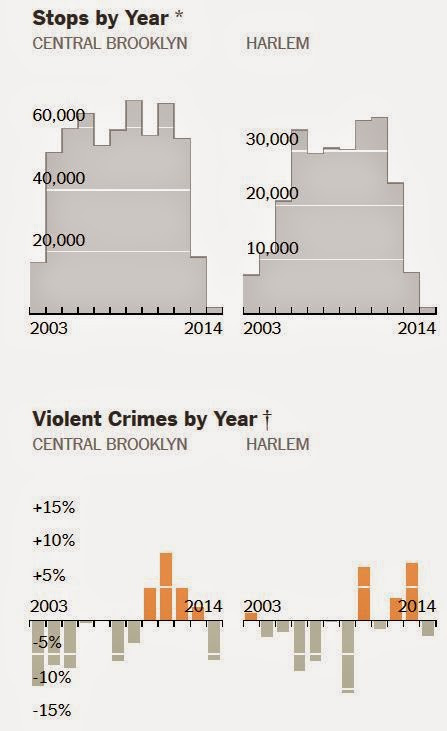
    Still, former Commissioner Ray Kelly sounded ridiculous insisting hundreds of thousands of stops and frisks of New Yorkers, the vast majority young men of color who had done nothing wrong, were crucial to keeping guns and blood off the streets. And his critics sounded equally ridiculous insisting those stops had no impact on crime, never deterred anyone from taking their guns to town.

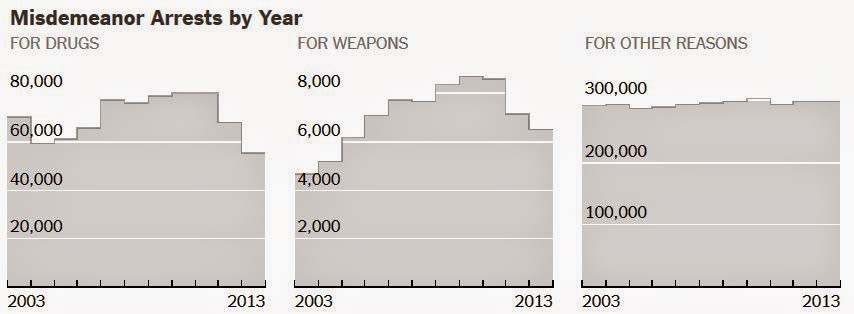
    But it’s the police unions — who complained bitterly about Kelly’s quotas and numbers-driven approach and now are muttering about a work slowdown in response to Bratton’s calls for cops to exercise “discretion” on pot arrests and more generally — who sound most ridiculous of all.

    How many bad stops are worth a saved life? There’s a reason cops and critics have both ducked that question for a decade now.

    But, as de Blasio has rightly stressed, broken windows is based on officer discretion, and only stopping people suspected of a crime. Stop-and-frisk-based policing, on the other hand, was based on stopping huge numbers of people, mostly black and brown young men, who had done nothing wrong.

    The bottom line: Crime is down. Stops are down. The new mayor — politically accountable in ways his billionaire predecessor was not — and his commissioner are living up to a wonderful, difficult promise to deliver a “fairer, safer” city.

  • Brrrr… it’s cold outside

    I can’t help but notice — now that another long hot summer is done and a commie mayor and Al Sharpton are running the show and the police have been thrown under the bus and Obama is president and the ACLU stopped letting police stop criminals and there’s no more stop question and frisk and there’s independent oversight and body cameras are coming and it’s open season on cops and people don’t show any respect and society going to hell — but crime *still* isn’t up (-4% by stats I don’t trust. But what I *do* trust is 249 homicides to date compared to 262 in last year’s record low. Shootings are up 6%). I know it’s in good part because of the hard work of the men and women of the NYPD, but I’d still like just one Republican, one conservative cop (or maybe somebody like Heather MacDonald) to admit he (or she) was wrong. It’s all very strange to me.

    Or maybe the only thing keeping New York City from become The Warriors are all the marijuana arrests or the bike ticketing blitz in Crown Heights? Nobody really believes that, right?

  • Black are 4 times more likely than whites to be killed by police

    [Update: Cut to the chase. You might just want to read my summary post.]

    Related to the “not 21 times” previous post, I received a tweet from one of the authors: “Differences in our methodologies: you count Hispanic homicides as white… deflate the results.”

    So back to running stats for me. But there’s a problem in that the UCR homicide data does a particularly poor job in counting hispanics. Most cities simply do not record hispanic data.

    As a result, 56% of homicide data has nothing for “hispanic or not.” I would guess that most of this 56% is non-hispanic, since cities without many hispanics are less likely to care about counting hispanics, but we do not know. In general, you really shouldn’t use data when half is missing.

    [The UCR would like police departments to do like the census: record race and then overlay hispanic-or-not on top of that. (If you’re a cop, this is probably how you record domestics.) But I don’t think any police department does this. So what the UCR seems to do, for the departments that list hispanic at all, is just call them all white hispanics.]

    But if one does exclude hispanic whites from the count of whites over the past three years, one finds all of 9 young white males shot by police over the past three years. If one then uses non-hispanic white for the population denominator, I get a black-to-white ratio of 21:1 [replicated! And updated from the original post].

    But what I will quibble about is the validity of that number. It means very little because there’s just not enough data.

    I mean, one could look at just one year. The last available year, 2012, has a black-to-white ratio for teen males killed by police a less headline worthy 7:1 [13:1 if you exclude hispanic whites]. But you can’t just look at one year — or three. Put bluntly, police don’t kill enough teens each year to be statistically useful (which is good news, I suppose).

    And since we can look at more years, we should. So if one wants to only look at 15-19 year-olds males shot by police, let’s look at the past 15 years. The most shocking result I discover is that a majority of “whites” killed by police are listed as hispanic. (109 versus 95. And overall there are 6.3 million non-hispanic whites and 2.1 million hispanic white males 15-19.)

    The overall black-to-white ratio (15-19 year-old males) is 5.5:1. If one removes white hispanics from the sample (I’m not sure you should), the black-to-white killed-by-police ratio goes up 9:1. Though if one removes white hispanics for the overall homicide rate, the overall black-to-white homicide ratio in society goes from 9:1 to 15:1. All this gets a bit silly.

    So let’s include everybody.

    The overall racial disparity in homicides — and presumably other violent crimes as well (but they’re not counted as reliably) — is 6:1. The racial disparity among police-involved killings is about 4:1 (3.8:1, to be exact). Given the former, I don’t find the latter disturbing high (though I suppose reasonable people could disagree).

    Here’s the thing. We should focus on bad police-involved shootings. And also we should focus on overly aggressive use of less-lethal force. These are issues of training, issues of a relaxing a paranoid “warrior” mindset. Sure, race matters, but if you want to improve policing, you need to move past the idea that police only do bad things to black people. This isn’t a black and white issue. It’s a police issue.

    [It’s always good to put a disclaimer in any post related to police-involved shooting. The data, in general, is very limited. That said, some of the UCR data on police-involved homicides is good. While one cannot infer absolute numbers, looking at ratio of included data, such as race, presents much less of a problem, since one is looking a ratio within the data.

    [Update: Also, some of the numbers have changed as I’ve updated and corrected and double-checked figures. Nothing substantively major. But you’re not going crazy if you think the actual headline used to 3 times and now it says 4 times (the actual number is 3.8. Using different population figures and/or just making a mistake, I first came up with 3.3).]
  • CRIME (not) SKYROCKETING

    The real headline of course, the one you don’t see very often, is that crime is down.

    So says the BJS. Though I’m skeptical of the NCVS, since it reported a 40 percent increase in the previous two years, which, quite frankly, as I wrote, I do not believe. (The UCR showed an every-so-slight drop during the same time). So this “drop” in crime may be a bit of a statistical correction.

    Still, “crime isn’t up” is always nice news, since people always assume the world is always going to hell in a handcart (which seems like an awfully slow and old-fashioned way to get somewhere, these days).

    Meanwhile, in New York City, despite the claims, or should I say desire, nay, let’s go all out and say despite the knowledge, dreams, and aspirations of police unions and many police officers, crime in New York is basically steady.

    Yes, shootings are up 6 to 7 percent. Homicides are down. Other crimes are basically steady. (Now PBA and SBA, please stop, as you’ve so often done in the past, trying to harm the city that most of you don’t live in).

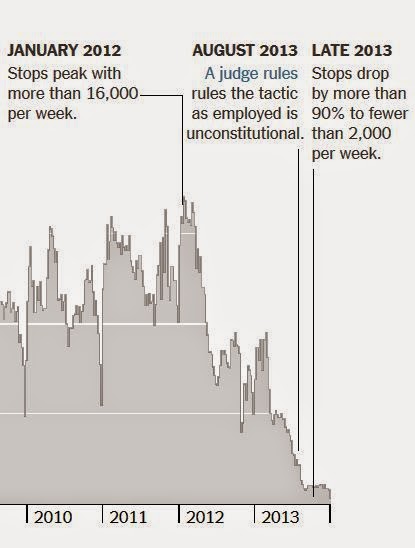
    Oh, how it must pain conservative ideologues to see that even without strong conservative leadership, crime isn’t going through the roof. Now let’s not forget that in the 1990s liberals knew that crime couldn’t go down. It did. Now conservatives have been certain for about two years now that crime would go up. But it hasn’t. At least not dramatically and definitively. (And we’re now through the second summer after the demise of stop and frisk, which was what I was waiting for.)

    Imagine this: the city is still safe even with a commie mayor, Al Sharpton as police adviser, extra and probably unneeded police oversight, unfair accusations of murder when criminals die resisting arrest, and unnecessary stop and frisks all-but stopped.

    See it’s not about ideology. It’s about hard work. It’s about an intelligent police department and intelligent police officers using discretion and doing their job. I know haters (on both sides) are gonna hate, but instead of seeing impending doom, why not take credit for a job well done?