Tag: crime

  • On Gunshot Wounds

    The second in a series from Adam Plantinga’s 400 Things Cops Know: Street-Smart Lessons from a Veteran Patrolman:

    The seriousness of a gunshot wound depends on a host of factors, including the type and caliber of round, the distance the bullet travels, and if anything is present to slow the bullet down (a wall, a door, another person) before the moment of impact. But it’s a given that anything into the spine is a disaster and close contact handgun rounds to the face can leave the victim’s molars spilled out on the ground, or can blast off half of their skull, leaving a conical section of bone and skin that resembles the head of a unicorn. Other than that, anything goes.

    Bullets rarely maintain a straight path. They loop and spin and sometimes follow the curve of the body. A shot into the arm can be “through and through” or it can ricochet off the elbow bone and explode the heart. A bullet entering the lower torso can rip through the intestines and cause lifelong complications or end up lodged in soft tissue without any lasting damage. Many gunshot victims in the latter category are released from the hospital the same day they entered, as it is often medically safer to leave the bullet right where it is. A shot in the buttocks can be a painful but ultimately colorful tale for the shooting victim to share with others, or it can result in an artery being pierced, causing the victim to bleed to death, something one of my sergeants witnessed years ago and to this day still cannot quite believe.

    I spoke with a man once who had recently attempted suicide by shooting himself just behind the left ear. The bullet caromed off the front of his skull, and exited out the top of his head, leaving him dazed but very much alive. I could still see the corresponding C-shaped scar on his scalp. I once investigated a shooting where a round entered through a woman’s back, shattered the shoulder blade, and came to rest perched on top of her right clavicle, jutting out like a marble without breaking the surface of the skin. As a police officer, you look at bullet wounds with both respect and wonder because you know that for a gunshot victim, the difference between life and death can be the narrowest of margins.

  • Reporter fired for politically incorrect editorializing

    With regards to the killing of Jersey City Police Officer Melvin Santiago, Fox News TV reporter Sean Bergin no longer has a job after editorializing on-air:

    It’s important to shine a light on this racist mentality that has so contaminated policing and America’s inner-cities. … The underlying cause for all of this, of course, is America’s racist criminal justice system that makes it impossible for young black men to succeed. It’s nearly impossible to cover the issue in-depth and accurately when surrounded by stark raving conservatives who masquerade as journalists.

    Just kidding.

    Bergin didn’t say that. And he didn’t work for Fox. The truth is, if he had said that, it’s very unlikely he would have been fired. He was fired for editorializing in a conservative manner, based on his what he’s seen as a reporter.

    What Bergin actually said on-air was:

    We were besieged, flooded with calls from police officers furious that we would give media coverage to the life of a cop killer. It’s understandable. We decided to air it because it’s important to shine a light on the anti-cop mentality that has so contaminated America’s inner cities. This same, sick, perverse line of thinking is evident from Jersey City, to Newark and Patterson to Trenton.

    It has made the police officer’s job impossible, and it has got to stop. The underlying cause for all of this, of course: young black men growing up without fathers. Unfortunately, no one in the news media has the courage to touch that subject.

    Do I agree with this? Not one-hundred percent, but he certainly brings up a fair issue. Is what he said overly simplistic? Of course. But let’s not set the bar too high for local TV news. This sure beats another cute animal video. And don’t give me that “reporters shouldn’t have an opinion” bit. Or “there’s a time a place for everything.” This was a great time and place to express his opinion on a major problem.

    Bergin later told The Blaze(and then it was picked up by the AP and other news sites):

    I broke the rules, but I broke the rules because I was doing the right thing. You can’t fix a problem if you don’t talk about the problem. The truth is, 73 percent of African-American children grow up without fathers. It’s a topic that needs to be handled delicately — and really, this situation could have been used as a way to explore that.

    Now that 73 percent figure isn’t true and a reporter should know better than to throw around misleading statistics. (There’s a big difference between not having legally married parents living together at time of birth and “growing up without a father.” Regardless, the comparable figure for whites is 29 percent.) But still, Bergin’s greater point is valid: there’s a problem here; we need to talk about it and get to the bottom of it.

    Bergin went on:

    “I’m in these housing projects all the time, and it’s all for the same thing: black men slaughtering each other in the streets. Why is this happening?” he continued, adding that it’s nearly impossible to cover the issue in-depth and accurately when surrounded by “stark raving liberals who masquerade as journalists.”

    OK, strike two again Bergin for using the phrase “stark-raving liberal.” But I’ll give him credit for this: his opinions come from actually visiting the homes and neighborhoods where the violence happens. He sees bad things happening and actually cares. Before you criticize him, ask yourself if you care. Think about the last time you’ve done anything in a high-crime neighborhood other than lock your car doors.

    As I wrote in Cop in the Hood:

    If you really want to learn about the ghetto, go there. There’s probably one near you. Visit a church; walk down the street; buy something from the corner store; have a beer; eat. But most importantly, talk to people. That’s how you learn. When the subject turns to drugs and crime, you’ll hear a common refrain: “It just don’t make sense.”

    Bergin did all this. Reality, as cops well know, isn’t always politically correct. And you don’t have to like what what he says to defend his right to say it.

  • Guns and Homicides

    Guns and Homicides

    We all, er, know that guns don’t kill people (even though that is what they’re designed to do).

    But what I didn’t know was that guns really didn’t kill people until just a few decades ago.

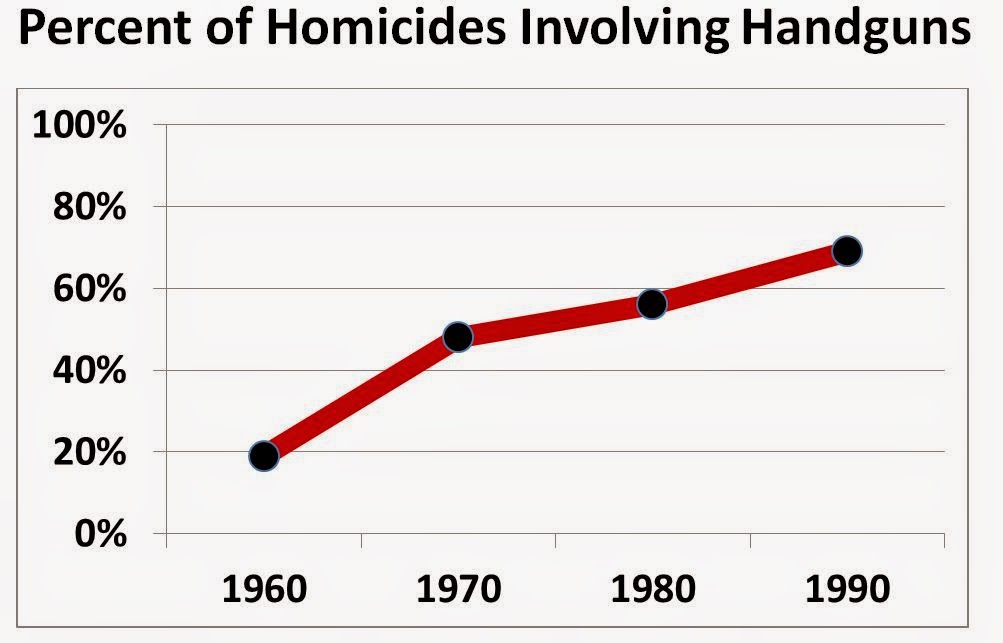
    As recently as 1960, just 20 percent of NYC homicides involved a gun! That went up to 48 percent in 1970 and 69 percent in 1990. And I think it’s remained at about two-thirds ever since.

    The jump from 1960 to 1970 is amazing. Remember, this isn’t the crime rate or the number of homicides but the percent of homicides using a gun. What happened? How and why did guns suddenly spread to the criminal class?

    (And feel free to applaud me for an all-too-rare use of full-and-honest scaling on the y-axis… you know want to.)

  • The non-coming of the super-predictor

    The non-coming of the super-predictor

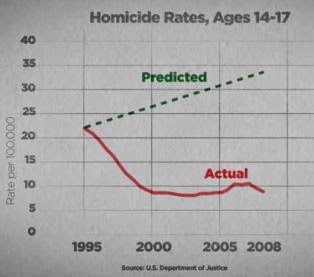
    A nice New York Times video piece about the coming of the “superpredators” who never came. File under C for crack babies?

    From the Times:

    What happened with the superpredator jeremiads is that they proved to be nonsense. They were based on a notion that there would be hordes upon hordes of depraved teenagers resorting to unspeakable brutality, not tethered by conscience. No one in the mid-1990s promoted this theory with greater zeal, or with broader acceptance, than John J. DiIulio Jr., then a political scientist at Princeton.

    DiIulio was also a very good professor, by the way. I got an A in his Politics 240 class.

    As John DiIulio says, “Demography is not fate, and criminology is not pure science.”

  • Rich folk don’t “fare well” behind bars

    A du Pont family heir plead guilty to raping his 3-year-old daughter in 2008.

    From The Daily News:

    Superior Judge Jan Jurden sentenced Richards to eight years in prison, but suspended the time for probation that requires monthly visits with a case officer. “Defendant will not fare well in [a prison] setting,” Jurden wrote in her sentencing order.

    Well that’s very sweet. Money does have its privileges. But as much as I’d love to go off on trust-fund babies, a large part of me says this judge did exactly the right thing: not send this guy to prison. Why? Because he will be killed in prison. The problem is that the state cannot protect its prisoners from being murdered. How could you, as a judge, knowing sentence someone to prison knowing they will be killed? Now were he killed, I wouldn’t shed a tear, but still… if we as society want this guy to be executed, then we as society should have the balls to kill the guy. Legally. By the book. But to gleefully put a guy in locked cage knowing that convicts will do our murderous dirty work for us? For shame.

    [The definition of “rape” has come to mean too things; here’s the definition of 4th degree rape in Delaware.]

    [hat tip to Jay Ackroyd]

  • It just don’t make sense…

    Angel Rojas came to the US four years ago from the Dominican Republic with his wife, Maria Lopez and their two kids, now 12 and 8. Rojas was on a break between two jobs, riding the bus home to, (from the New York Times):

    …hug his children and grab a quick bite. When three young adults stepped aboard the bus, he most likely thought nothing of it.

    Several rows back, the police say, a 14-year-old boy, a member of a street gang called the Stack Money Goons, had a visceral reaction. At least one of the three young adults belonged to a warring crew; there was a shared flash of recognition, and then, the police say, the 14-year-old pulled out a .357 revolver and fired one shot inside the bus.

    The bullet missed the intended target but struck Mr. Rojas in the back of the head. Mr. Rojas had no time to react; there were few if any words exchanged, and police officials said a video of the encounter showed Mr. Rojas’s head simply slumping forward after sustaining the mortal wound.

    After Kathon fired the shot aboard the bus, he and the three young adults ran off the bus; five more shots were fired outside…. None of those bullets struck anyone; the police recovered the revolver, and all six rounds had been fired.

    The age of this killer made me think of the youngest armed kids I arrested, I searched my notes and found it on Christmas Day, December 25, 2000:

    Busy night at work. Merry Christmas. People getting their last minute Christmas robbing in. And lot’s more Christmas Fussing.

    A guy was robbed by 2 kids at Monument and Port. The kids were caught under a car at Patterson Park. 13 years old and really young looking. About 4 feet tall. I found the knife at Montford and Patterson Park. A small cheap steak knife. Turns out both of these kids have quite a record, going back about 2 years. Selling coke. Attempt 1st degree sex offense. 2nd degree sex offense.

    Back in New York, says the Times:

    One young man would not answer questions and pointed at the windows of the housing project beside him, to indicate crew members might be watching. “One thing I’m going to tell you, those little kids, they ain’t to be messed with,” he said.

    Well… those gun-toting kids are to be messed with. And the police are those who are paid to do the messing.

    Police have to deal with these kids, not just after they kill an innocent person, but before, when they’re hanging on the corner acting tough, and maybe not carrying a gun. But faced with a potentially armed person, no matter the age, police do not put on kids’ gloves.

    Some 14-year-old kids carry gun and use them to kill people on the bus. Keep that in mind next time you blame police for harassing kids. Had young Kathon been shot and killed by the cops before his murder, the Times would print a picture of cute 13-years-old Kathon “graduating” from 8th grade. Kathon’s mother would be found, crying, saying how her lil’ angel may have been involved in a little trouble, but he was a good kid. Sure a gun was recovered, but a “witness” would come forward saying Kathon wasn’t armed: “Police just shot the kid for no reason!” You, dear liberal reader, would think the truth was somewhere in between and blame the police. It doesn’t make sense.

  • “The true lives of low-level drug dealers”

    Erin Rose wrote a great piece in Salon about your average run-of-the drug dealer. It’s not like Breaking Bad (though it is in Albuquerque). It’s not like Baltimore’s Eastern District. Most drug dealers are not violent. Most drug dealers are not black.

    Some highlights (but it’s worth reading in its entirety):

    Rico works a full-time job and only deals as much as he can reasonably use or hide. He lives in the the same small house he’s lived in for 12 years, in a down-and-out part of Albuquerque that recently began to “yuppify,” as he puts it.

    “I’m not trying to be some rich guy. I’m just trying to get money to enjoy myself. Real-world jobs don’t allow people to do that. I think that’s why a lot of people sell drugs,” Rico says.

    His “real-world job” pays a few bucks more than minimum wage.

    These men don’t belong to cartels or gangs. They’ve never murdered or physically hurt anyone while selling drugs. They don’t keep guns. With the exception of Shorts, they’ve never been arrested. Each of the dealers I spoke with said that they began selling drugs when they realized that there was no way their jobs would allow them to do what they wanted to do.

    Selander sees it as a larger societal problem. “Try to raise a family working at McDonald’s or Wal-Mart. Try to buy a house.”

    While dealing is not significantly more lucrative — economic researchers report that independent drug dealers make, on average, $20,000-to-$30,000 a year – being self-employed offers these men a freedom unavailable to them at a normal job. Working at McDonald’s or Wal-Mart puts them at the mercy of a system that will ruthlessly replace them should they break any of its rules. Drug dealing, they say, allows them to set their own priorities and schedules.

    “I’m not lazy,” he continues. “They call it hustling for a reason!” He cackles. “But I ain’t dumb enough to wear myself out making someone else money.”

    Shorts sold meth for a short time, he told me, but complains that the people he sold to were unable to wait, and liable to do something crazy. He prefers to deal only with professionals — and, he says, the professionals do cocaine.

    “I like to sell to the lawyers, the doctors, you know, people who have something to lose.”

    “Everybody does drugs, but it’s the poor who go to jail for it, ” another dealer, named Cruz, told me.

    Cruz had grown up broke. At one point, he, his mom and his brother were living on $9,800 a year. “We tried to go through the bank. No financial institutions would lend to us, because we didn’t have repossess-able assets.”

    Without the money Cruz made selling drugs, he never could have opened his legal, and so far successful, business. Once he had the money he needed, he stopped selling blow. When I asked him why, he told me, “If you don’t get addicted to the drugs, you get addicted to the money.”

  • Lexington Market

    Last week I mentioned“the army of junkies outside Lexington Market.” My tender New York eyes were a bit shocked by 20 people shouting and 20 other people nodding in what I call the “junkie lean.” You can’t expect decent people or caring parents with children to walk a gauntlet of junkies to go shopping. They won’t do it. Nor should they have to. Scott Calvert writes about the efforts to deal with this in the Sun:

    A man staggering around zombie-like, eyes slowly closing and opening. He came to rest against Konstant’s outdoor peanut counter, next to the market entrance.

    Gerald Butler, one of about two dozen unarmed market police officers, approached. “You need to keep it moving, sir,” he said.

    “I’m not trying to do anything, to be smart,” murmured the man.

    Canty walked up and asked if he needed recovery treatment.

    “I’m already on the program,” the man replied. He told Canty that he’s on methadone and had also taken other medication that day. Canty warned that he could be banned from the market for his behavior. “They see you nodding, they’re going to bar you.”

    “I will keep it under control,” the man promised. “I will leave. Thank you very much.”

    Canty handed him a referral card just as the man’s eyes fluttered shut. A moment later he was headed north on Eutaw, swaying as if buffeted by a strong wind.

    “We don’t see much violent crime around Lexington Market,” he said, “but the environment that’s conducive to the sale of prescription drugs is not conducive to drawing tourists to the market on a daily basis.

    I’ll say!

    Two weeks ago, after getting a crabcake with a friend, I too was leaning on Konstant’s outdoor peanut counter looking at the wares. A few feet away were dozens of junkies doing their slow junkie dance. Meanwhile right next to me and my friend was an overly made-up white woman in a full-length fur coat. On a weekday afternoon, she and I were perhaps the only two white customers in the market. She was sampling a peanut, seemingly oblivious to the chaos swaying around her. I asked her if the peanuts were good. In a slow southern drawl she said, “These are excellent, darling. And I know because I used to grow peanuts.” Only in Baltimore, hon! I bought two bags. They are excellent.

    We can disaggregate the problems outside Lexington market (inside things tend to be OK) into four issues:

    1) quality of life for customers

    2) economic survival of the Lexington Market (and Baltimore)

    3) crime

    4) public health of the addicts

    So while a holistic approach would be best, I have no objection to simply pushing the junkies somewhere else. I’m a police guy, so I’ll leave public health to others (alas, there is no silver-bullet solution to heroin addiction), but the market entrance is too important. It is not right (or economically viable) that a few dozen people damage the market and the city.

    Law enforcement efforts (and the threat of arrest) combined with social services can work. Port Authority was cleaned up in 1990s. It’s worth looking at how they did so. But one big difference is that the main problem of Port Authority was people living inside the bus station while the biggest problems of Lexington Market are addicts outside the market.

    The Sun article also quotes an architect who…

    thinks focusing too much on the scene around the market is “misguided.” He said it makes him feel uncomfortable, and no safer, to see police handcuffing someone sprawled on the sidewalk.

    If the market can attract a broader range of customers, he said, “that will thin out the impression one currently has that mostly they’re very poor people.”

    Philipsen says there’s also a racial dimension that “nobody wants to talk about.” Most market patrons are black, including those living in parts of West Baltimore without a supermarket nearby. Ideally, he said, the market would appeal across socioeconomic, racial and geographic lines.

    “If you’re white and want to see more white people, we can get them there by making this more attractive,” Philipsen said. “It’s not about subtracting people or making poor African-American folks not go there, but bringing some additional people so everybody feels comfortable.”

    Well I mentioned the racial dimension, and I also don’t think we need to focus on the tender comfort of white folk who “want to see more white people.” The solution to the problems of Lexington Market is not a few more white people. White people are not the solution. Besides, (to paraphrase Yogi) if white people don’t want to come to the market how are you going to stop them?

    [Best pickup line I heard outside the market, to a woman passing by: “Yo, baby, I got a job!” That was it. Alas, it didn’t seem to work.]

    I’m bothered by the architect’s comments because they seems to equate race and poverty with drug addiction and the shitty public behavior that makes decent people of all colors and income afraid. This isn’t about race or poverty (or even, to some extent, drug addiction) but about bad (and illegal) behavior.

    Most of the shoppers at the market may be poor and they may be black, but they’re inherent “decent” — to invoke Elijah Anderson’s concept. The problem is not the demographics of the customers, but the two or three dozen (decidedly non-“decent”) junkies shouting, nodding-off, and buying, selling, and using illegal drugs. That’s it! It’s their behavior that needs to change (or move elsewhere), not their race or socioeconomic status. If people could get in the market without being hassled and made to be fearful, you’d see more “decent” people — of all races (and yes, that would include white people, I suppose).

    And then there’s this: “The market’s image took a hit in 2009 when the owner of the Utz Potato Chip stall was sentenced to 15 months in federal prison after pleading guilty to selling illegal guns from his stand.” Oh yeah. That.And for the record that malaka was neither poor not black.
  • A tale of two cities

    Murder in Baltimore is at a four-year high.

    Murder in New York City is at a record low.

    Meanwhile, from Justin Fenton’s Baltimore Sun article, in other cities:

    Homicides across the country

    Oakland, Calif. — down 25 percent (as of Dec. 12)

    Philadelphia — down 24 percent (as of Dec. 16)

    Flint, Mich. — down 22 percent (as of Dec. 18)

    New Orleans — down 22 percent (as of Nov. 14)

    Chicago — down 19 percent (as of Dec. 8)

    Detroit — down 14.6 percent (as of Dec. 18)

    Baltimore — up 8 percent (as of Dec. 24)

    Newark, N.J. — up 19 percent (as of Dec. 1)

    Washington — up 26 percent (as of Dec. 18)

  • Idiot walks through bus robbing people at gunpoint, gets beat down

    The stories don’t usually have happy endings. And it was caught on video.

    He then kicked the window out of the police.

    But the robber’s mother said this was “not within his character.” Oh, mom.