Tag: discretion

  • Make misdemeanors great again!

    Shoplifting has gotten a boost in California. From the AP:

    Shoplifting reports to the Los Angeles Police Department jumped by a quarter in the first year, according to statistics the department compiled for The Associated Press. The ballot measure also lowered penalties for forgery, fraud, petty theft and drug possession.

    The increase in shoplifting reports set up a debate over how much criminals pay attention to penalties, and whether law enforcement is doing enough to adapt to the legal change.

    It’s so rare (but more common than many people admit) to see good direct cause and effect in criminal justice. My general belief is that people don’t give a damn a potential penalty and instead commit crimes when they think they won’t get caught. But I could be wrong.

    I remember a conversation on the street, back when I was a cop. From my notes:

    Had a weird talk with a guy who was suspected of pointing a gun out a car window. No gun was found. The guy said, “I don’t have a gun, I’m a convicted felon!” I asked him for details. He said he did strong armed robbery, no weapon involved other than hands, got four years.

    I said, you didn’t do that in Baltimore, cause you won’t get 4 years for yoking [unarmed robbery] in the city. Turned out it was in the county. He said the max was seven years. He was expecting 2 years for a four year crime: “I wouldn’t have done it if I knew it was seven years.”

    Let me get this right, you’re saying you weighed the severity of the punishment with the how-useful-is-the-crime?

    “I always weighed the punishment…. I was [also] copping for others, but they didn’t send me any commissary money. Fuck that, if they won’t look after me…. So now I’m trying to go straight.”

    Back in California:

    Prosecutors, police and retailers … say the problem is organized retail theft rings whose members are well aware of the reduced penalties.

    “The law didn’t account for that,” said Capt. John Romero, commander of the LAPD’s commercial crimes division. “It did not give an exception for organized retail theft, so we’re seeing these offenders benefiting and the retailers are paying the price.”

    On the other hand:

    Adam Gelb, director of the public safety performance project at The Pew Charitable Trusts, disputes those sorts of anecdotes.

    His organization recently reported finding no effect on property crimes and larceny rates in 23 states that increased the threshold to charge thefts as felonies instead of misdemeanors between 2001 and 2011. California raised its threshold from $400 in 2010.

    “It’s hard to see how raising the level to $950 in California would touch off a property crime wave when raising it to $2,000 in South Carolina six years ago hasn’t registered any impact at all,” Gelb said.

    My first thought is that seems like ideological wishful thinking. It might be hard to want see how… but you can try harder.

    But here’s what I don’t get. Why can’t police investigate serious misdemeanor? (Hell, in Baltimore they’re putting cops on trial for minor misdemeanors.)

    The article concludes:

    For his part, Lutz, the hobby shop owner, has provided police with surveillance videos, and even the license plate, make and model of the getaway vehicles.

    “They go, ‘Perry, our hands are tied because it’s a misdemeanor,’” Lutz said. “It’s not worth pursuing, it’s just a waste of manpower.”

    But why should a legal and semantic redefinition “tie police hands”? Police could investigate; they are choosing not to investigate because the crime — with the same dollar amount as last year — has been redefined a misdemeanor. That’s more a police choice. And maybe it’s not the right one.

    [Though in some states (I don’t know about California) the rules are different and many misdemeanor crimes need to be viewed by a cop for a cop to make an arrest. That said, shoplifting is an exception.]

    Leaving aside the specifics, I think more felonies should be misdemeanors. Misdemeanors are crimes, too. These days almost everything can be a felony, and that’s not right. Felonies are supposed to be life-changing citizen-disqualifying kinds of crime. Not run of the mill drugs or non-violent theft. Maybe sometimes people should get a year for a serious misdemeanor instead of a PB&J (probation before judgement).

    Of course the prosecutor plays a big role, too. If misdemeanors don’t get prosecuted, there’s little point in making an arrest. The problem isn’t that a serious crime is only a misdemeanor; the problem is we don’t take misdemeanor’s seriously.
  • “It’s Showtime NYC”

    Interesting conceptreported in the New York Times to get subway dancers out of the subway. An arrest based approach wasn’t working (not the first time you’ve heard that):

    Arrests alone — though drastically increasing — were not solving the problem, Mr. Bassin said. He said many of the dancers interviewed in the planning stages of the new effort viewed being arrested as part of the cost of doing business. The statistics appear to bear that out: A quarter of those arrested in 2015 for dancing on the subway had previously been arrested for the dancing

    I should mention I know Mr. Bassin, a lawyer in the mayor’s office. This is a very Broken Windows approach:

    Ian Bassin, approached the Police Department with an idea for addressing the problem — which results in regular complaints from passengers — by providing an alternative to the criminal justice system.

    And I like that even de Blasio is getting better at understanding Broken Windows:

    “Broken windows doesn’t mean simply arresting our way out of every minor infraction,” Mr. de Blasio said in a statement. “It means focusing on quality of life while providing pathways for all New Yorkers to reach their full potential.”

    One reason I like this program is it does not limit police discretion. It’s still up to the officer. But now cops can actually help solve the problem (and most people, myself included, think it is a problem) rather than just choose between basically no enforcement and arresting a kid for dancing on the subway:

    Though officers may still pursue arrests or issue summonses for soliciting on trains, they have been urged to consider the alternative approach: handing out the cards with information about the dance initiative.

    Every transit officer now carries the small, brightly colored square cards. Roughly 200 have been handed out to dance groups since officers began the effort in May.

    “It’s very refreshing for us and our officers to have another alternative when we’re out there,” said Joseph Fox, the chief of the Police Department’s Transit Bureau. “What this program has given us is something in between warning and admonish, and enforcement.”

    As a result, Chief Fox said, arrests of dancers are down, 185 through late August, compared with 264 over the same period in 2014. (There were 153 arrests of dancers in all of 2013.)

    Also of note:

    Chief Fox said he and Mr. Bassin looked into the backgrounds of the men who were arrested or given summonses for dancing on the trains and found that, while a large number had had some contact with the criminal justice system, it was mostly for minor offenses such as fare beating. A smaller fraction, roughly 25 percent, had been previously arrested for a serious crime like robbery, burglary or felony assault.

    The jury is still out on whether the program is working. And success can be judged a few way: fewer complaints on the subway, fewer conflicts on the subway (I’ve seen a dancer punch a guy for not moving out of the way on a busy train), more people being able to enjoy the right to get home without illegal distractions, fewer people entering the criminal justice system, and potentially more dance potential. Some of the guys do have serious skillz, but they’re probably not going to be “found” on the subway. They might be in a city-sponsored public performance space.

    Now if only they could make a city-sponsored public performance space for all the subway beggars…

  • Too many? Too few? Or just right?

    Arrests are way down in Baltimore. But not just this month (though they are) but over many years.

    There were 40,000 arrests in 2014 (3,300 a month). In 2003 there were 114,000 arrests. Like I said, arrests are way down. This is worth repeating because it goes against a narrative that the riots were somehow the inevitable result of overaggressive policing and too many arrests.

    Now of course arrests could be down and Baltimore could still be over-policed — and the war on drugs continues to be the problem — but even if over-policing were a problem, Baltimore and America is less overpoliced now that it was a decade ago.

    I think we need to ask just what number of arrests would be around right. Generally. I don’t mean this as a quota. And I know this doesn’t help day-to-day policing. As a police officer, you don’t make arrests based on some arbitrary ideal yearly goal. I know that.

    But as part of society, as an thinking person, as an American, it’s fair to come up with some rough number of arrests at which we can collectively say, “yeah, that seems about right.” Because the status quo seems to be to criticize cops for making too many arrests, and then criticize cops again when they make fewer. What do we want police to do?

    Take arrests in New York City. There were about 315,000 adults arrest year for the past 20 years. That’s some variance, to be sure, but it’s all in the same big ballpark. The number was lowest in 2003 (279,000) and highest at about 345,000 (in 1998 and 2010).

    Questioning arrest numbers allows us to ask, for instance, what good NYC got from a 20 percent increase in arrests between 2003 and 2010? Not much, I would say. See, if you can keep crime down and quality of life up, certainly fewer arrests are better, other things being equal. Arrests are harmful to the people arrested and their family. Also, if nothing else, arrests are expensive.

    Now Baltimore City went from 2,677 arrest in April of this year to what will probably be about 1,600 in May. That’s a big drop. But policing in Baltimore has changed. And since crime is up, people are saying police aren’t doing their job. But it does beg the question, what is the right number of arrests for a high-crime city of 620,000 people?

    If you refuse to answer that, that’s fine. But then don’t complain that arrests numbers are too high or too low. And I don’t want arrest number to be a goal. I can’t state that clearly enough. But I do think arrest numbers are a useful crude indicator of discretionary police activity (not a very good one, but useful nevertheless).

    For years, critics — myself included — said there were too many arrests in Baltimore. 84,000 in 1999; 111,529 in 2003. I don’t care if everybody arrested was guilty of whatever. It’s just too many arrests.

    And then arrests declined (25 percent from 2004-2009). Homicide and crime also went down. Win-win!

    But in 2007, the Baltimore Sun reported on declining arrests:

    Some complain the pendulum has swung to the other extreme — police aren’t doing enough to quell violence.

    Israel Cason… said it is less common to see police “slamming people on the ground, emptying their pockets on the street.”

    “You don’t see that too much no more,” he said.

    The downside, he said, is that drug dealers are congregating on street corners again without getting challenged.

    “They know what [the drug dealers] are doing, but [the police] don’t do nothing,” Cason said. Referring to free samples of drugs that dealers circulate through the community, he said: “We got testers out here every day, the police stand right there with them. They went from one extreme to the other.”

    But arrests kept getting lower. And so did homicides. Again, win-win.

    Last year, 2014, there were just under 40,000 arrests in the city. Homicides were a low (for Baltimore) 211. Seems like job well done, right? But if 40,000 is good, is 20,000 even better? Well, not if that more recent drop is because patrol officers aren’t able to do their job. And the department isn’t willing to support them when they do.

    So say what you want about the causes of the riots. (Myself, I like to blame rioters and Baltimore’s too large criminal class.) In 2014 arrests were down 50 percent over six years and 65 percent from 2003. So it doesn’t seem like Baltimore police are currently locking up too many people for no reason. Francis Barry talks about this in BloombergView:

    If the riot was fueled by anger not only over police brutality but also police arrests for low-level crimes… it’s a good thing the rioters were too young to light a match or loot a store in 1998 or 2003.

    It’s actually well worth reading his whole Barry piece, and his earlier article, too, in which he takes on David Simon and points out, among other things, that “the national decline in arrests runs counter to the idea that America has become increasingly over-policed, particularly in poor minority communities.” So what’s the problem in Baltimore. Could it not be, at least in part, that criminals just don’t like police?

  • Broken Windows in question

    This article in the Times is worth reading. Of note: the most discretionary arrest in NYC, Dis Con, down 91 percent. Meanwhile the courts are close to empty.

    “This proves to us is what we all knew as defenders: You can end broken-windows policing without ending public safety,” said Justine M. Luongo, the deputy attorney-in-charge of criminal practice for the Legal Aid Society.

    I love how it took the police union and police (in)action for police officers to prove what Legal Aid lawyers have been saying along. But are they correct?

    Stupid arrests are not part of Broken Windows. And they have been part of NYC policing. And by “stupid” I mean giving tickets or summonses to non-criminals using a park at night, riding the subway, riding a bike on a bike path/sidewalk, and walking through a park at night to get home (p 207 of Cop in the Hood). Now I don’t think those BS things were the majority of arrests and summonses, but they did happen. And they happened because pressure from compstat and community meetings got passed down through the chain of command. And there didn’t seem to be any way to stop these abuses from happening. Until now!

    Any time discretionary arrests go down 90 percent without crime going up, it’s noteworthy. First it was stop and frisk going down and now it is arrests. Maybe this is good. There have always been too many arrests in American policing because policing in American has for too long been defined by making arrests. And that’s a shame (see p 144 of Cop in the Hood). You don’t need to arrest people to use Broken Windows. Indeed, you shouldn’t need to. That’s been the disconnect here in NYC. This takes a major shift in police mentality. One that is hopefully happening right now. The optimist in me likes to think of this as a clean slate, where a police department and can get its priorities in order and police officers can be left to use discretion and do their job. The realist in me knows better.

  • Just following the law

    Just following the law

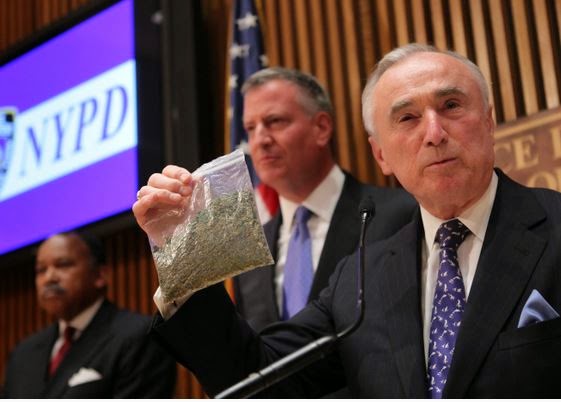
    The major final ordered the police commissioner to order the department to follow New York State and not arrest people for small-scale possession of marijuana. This has actually been the law since 1977. But the NYPD has subverted the law, especially in the past decade, by arresting people anyway. And we’re talking tens of thousand of people per year. And yes, of course it’s racial unfair (since whites smoke just as much if not more weed than blacks, but don’t get arrested for it).

    The Times account is here. The Post’s is here.

    The union reps issued their usual tone-deaf disbelief. Which is their right, I suppose, but it would be better if the union reps kept to things like pay and working conditions rather than promoting their uniquely conservative ideological world view. From the SBA head; “People are asking: ‘What is going on? Is this department losing its mind? Has the city lost its mind?’”

    Answer: A liberal mayor wants cops to stop arresting minorities when the crime is marijuana posession.

    The head of the city’s Detectives’ Endowment Association: “I just see it as another step in giving the streets back to the criminals. And we keep inching closer and closer to that.” But here’s the thing, we’re not giving the streets back to criminals (at least not yet)….

    And besides, most of you guys didn’t vote for the mayor. And not just because you hate him, but because you don’t live in the city. But the citizens of New York City did elected the mayor. And so de Blasio does, to a great extent, actually reflect the represented will of the people. And besides not arresting people for small-scale possession of marijuana has been the law since friggin’ 1977! It’s just that since the late 1990’s, police officers just decided to subvert the law.

    Here is the rule: don’t arrest people for small-scale possession of marijuana. I’m not certain why that is so radical. You don’t arrest people for a lot of things. You don’t arrest people for jay walking. You don’t arrest people for littering. Hell, you don’t arrest drivers for killing people with their cars! Just add marijuana to the list.

    Now you can still stop people. You can still run them. You can still cite people for possession. But you cannot arrest them. Guys, I’m sorry you don’t like it. But them’s the breaks.

    So what does this mean? Well, it could mean a lot fewer arrests for police officers. That’s not bad if you’re a taxpayer or a fan of the bud. But what if anything can police do compensate for the lost overtime? I don’t know.

    Here’s the thing: cops do not and did not actually give a shit about marijuana any more than than they do about jaywalking. Cops wanted to make arrests. And stopping people and finding weed because a way to make arrests. And we’re talking a good chunk (like 1 in 7) of all arrests in New York City. Up to 50,000 a year! So we’ll see if something else takes the place for such discretionary arrests. But probably not.

    This could actually be a pretty major shift in police culture. But it has been argued that marijuana arrests became a thing in New York because of arrest pressure combined with the drop in crime. So will something else because the new reason to arrest when there’s no other good reason to? I hope not. Probably, in the long run, the past 20 years of massive marijuana arrests will be seen as the aberration. Just another crazy bit of New York City history. Like the 2nd Avenue L, the New York Giants (baseball), and the 6-shot revolver.

    [Also, based on this picture, 25 grams (0.88 ounces) is a lot more weed than I thought it was.]

  • Collar for Dollars

    My article is in the July issue of Reason is available online:

    When I was a police officer in Baltimore, one sergeant would sometimes motivate his troops in the middle of a shift change by joyfully shouting, “All right, you maggots! Let’s lock people up! They don’t pay you to stand around. I want production! I want lockups!” He said this while standing in front of a small sign he most likely authored: “Unlike the citizens of the Eastern District, you are required to work for your government check.”

    In the police world, there are good arrests and better arrests, but there is no such thing as a bad arrest. In recent years, measures of “productivity” have achieved an almost totemic significance. And because they are so easy to count, arrests have come to outweigh more important but harder-to-quantify variables such as crimes prevented, fights mitigated, or public fears assuaged.

    The drug war, because it can’t be won, encourages outward signs of police effectiveness at the expense of good old-fashioned policing. Hard-working cops, especially those who ask for little more than a middle-class income in return for the dangerous work they do, turn to drug arrests to make ends meet. The Baltimore sergeant was right: Police officers do need to work for their government check. It’s a shame “collars for dollars” has become the easiest way to do it.

    Read the rest here.

  • Marijuana Arrests in NYC to Decrease in 2011

    As one does, I was just reading the future in my Greek (née Turkish) coffee grounds, and I saw an interesting development.

    [Cue swamy music] I see that the NYPD is going to start making fewer arrests for possession of marijuana this year starting right about now… I predict that in 2011, misdemeanor marijuana possession arrests in NYC are going to be down from 50,300 in 2010… and somewhat substantially… maybe a third fewer?… but now things are getting a little hazy.

    How do I know? I don’t. That’s wall they call it a “prediction.” But I’m not just saying this because of the gypsy blood in me tells me so (even though I am 1/8th gypsy).

    Remember to check back in a year or so. Cause I’d love to be the first to say, “I told you so!”

    [Updatefrom the future: I was wrong.]

  • NYC Marijuana Arrests Cost City $75 mil

    So reports the Daily Newsabout a new reportby the Drug Policy Alliance.

    In response, Commissioner Kelly says if you don’t like, call your state senator. Of course, that’s a bit disingenuous because the law is already pretty clear: small-scale possession of marijuana in New York State is not an arrestable offense. The problem is how the NYPD enforces a violation they’ve been told to just write a ticket for. The law is pretty clear: it doesn’t want an arrest for small-scale personal weed possession. But the NYPD gets around this law by “asking” people to empty their pockets (that’s the legal way, at least). But… why?

    I can answer that question, by the way: overtime, paperwork, compstat pressure, and the boss. Remember, in the police world, some arrests are better than others, but all arrests are good. Of course in the tax-paying world and even the crime-fighting world, all arrests are not necessarily good.

    Kelly says the NYPD must be doing something right, because crime is still low. He’s right about that…. But that doesn’t mean it has anything to do with $75 million worth of marijuana arrests. One can make a stronger argument that marijuana arrests increased becausecrime went down. It became harder and harder to keep up those numbers for Compstat and meet certain “productivity goals.”

  • Gates Arrest was “Avoidable”

    Ya think?

    Here’s the final report by the Cambridge Review Committee. I haven’t read it yet, but this may be the key sentence: “But instead of de-escalting, both men continued to escalate the encounter.”

    And the key insight may be here: “To say that the arrest of Professor Gates was avoidable is not to say that it was unjustified from a legal standpoint…. [S]ome police actions that may be ‘within policy’ are not necessarily the best outcomes to a situation.”

    Like I said… ya think?

    Meanwhile, according to the Boston Herald, “Professor Gates’ Attorney Blasts New Report.”

    If you still care, you can all my posts related to Gates.

  • A strike against “zero tolerance”

    Discretion is good. In schools. In society. And in policing.

    Here’s an example of why it doesn’t work so well in school.

    The law was introduced after a third-grade girl was expelled for a year because her grandmother had sent a birthday cake to school, along with a knife to cut it. The teacher called the principal — but not before using the knife to cut and serve the cake.

    (Though something strikes me odd when a mother claims a six-year-old “wears a suit and tie some days to school by his own choice because he takes school so seriously.” Really?)

    October 14 Update.