What can universities do to improve the IRB? Zachary Schrag, Professor of History at George Mason University and the author of, Ethical Imperialism: Institutional Review Boards and the Social Sciences, 1965-2009, summarizes what your school can do (in ten easy steps).
Tag: Ethnography
-
In Defense of Introversion
In the New York Timestoday, there’s an article extolling the benefits of introversion. I love reading pieces like this, which make it clear that introversion is a personality trait and not a medical problem that needs to be “cured” or treated with drugs.
My understanding of introversion began after I realized that being introverted is not the same as being shy. Rather, and more simply, introversion is simply the opposite of being an extrovert. This came to me in a great moment of self-realization after picking up a copy of Marti Laney’s The Introvert Advantage that was lying around the house (my wife is more introverted than I am). I am not shy and have no fear of public speaking, yet I positively dislike mingling with strangers at parties and usually find extroverts extremely tiring. It turns out I am in introvert. This was news to me. But then it all made sense.
So I got thinking about the nature of introversion (which is in itself a very introverted reaction) and decided (conveniently) that being an introvert is better for academic participant-observation research. Why? The Timesarticle puts it like this:
[Introverts] notice more things in general…. [and] tend to digest information thoroughly, stay on task, and work accurately … even though their I.Q. scores are no higher than those of extroverts.
This comes from my chapter, “In Defense of Doing Nothing: The Methodological Utility of Introversion” which was recently published in New Directions in Sociology: Essays on Theory and Methodology in the 21st Century:
My goal is to introduce the psychological concept of introversion into the sociological world.
…
The interpersonal nature of qualitative research and the perceived “action” of participant-observation research may perpetuate a belief that extroversion is a good quality for ethnographers. In fact, nothing is further from the truth.
…
If you’ve ever seen a group of ethnographers party, you may be struck by a general sense that we may not have been the most popular kids in high school. Despite what is often a very lively style of writing, ethnographers can be be soft-spoken and introverted. Now don’t get me wrong: As a group, we ethnographers are hardly the dorkiest in school (a few other academic disciplines spring to mind, but for politics’ sake I’ll refrain.).Certainly qualitative researchers must have basic social skills, but let’s be honest, no prom king or queen ever went on to write an ethnography. As a group, almost by definition, academics are nerds. We like the library. We don’t mind being alone. We walk down the street reading. We thrive in small groups and intellectual conversations. And yet mingling and making small talk with strangers is tiresome at best or frightening at worst.
…
Without a clear function in a social setting, the introvert’s natural reaction is to withdraw and become silent. While this may be a problem at the annual Christmas party, it can come in handy for the researcher.
…
With a greater understanding of introversion, I hope sociologists can take advantage of psychological traits that come naturally to many already in the field.Are you an introvert? You can take this self assessment for introverts. I scored 21 out of 29 (which makes me a moderate introvert).
-

Seven Shots
I read this book by Jennifer Hunt. I loved this book. I’ll tell you more about this book… but only when I’m done writing mybook.
On July 31, 1997, a six-man Emergency Service team from the NYPD raided a terrorist cell in Brooklyn and narrowly prevented a suicide bombing of the New York subway that would have cost hundreds, possibly thousands of lives.
In the meantime I’ll leave you with my breathless blurb they put on the back of the book (I had an advance copy):
Seven Shots uncovers the stories, rivalries, and human beings behind the New York City police officers who defused the subway bomb attack that foreshadowed September 11th. With unparalleled access, Hunt uncovers the never-before-told stories of heroism, September 11th, and petty rivalries that drive and destroy life in the NYPD. This is a true-life crime story that shows, warts and all, the unrequited love of good police officers toward an organization that doesn’t love them back. At times gripping, tragic, and theoretical, Seven Shots penetrates deep into the police world. Seven Shots vividly brings me back to my own policing days with laughs, tears, excitement, and adrenaline-filled moments of sheer terror. A groundbreaking, page-turning work.
[I just wish they had edited the redundancy out of the “unrequited love… toward an organization that doesn’t love them back” part. There’s no other kind of unrequited love. Things like that bother me more than they probably should.]
It’s a great book and a wonderful ethnography with amazing insight into the police culture. Plus it tells a story about a big bomb that almost wan.
You can buy it here.
-
Ethnography Bashing
I don’t mind a mixed review of my book (Contemporary Sociology), but it does bother me when a reviewer calls my participant-observation research a “major flaw.” It’s like a man who doesn’t like olive oil, fish, and lamb bashing a Greek restaurant for being too “Mediterranean.” If you don’t like the concept, don’t review it.
Basically, goes the tired old sociological argument, because I was a cop, I can’t see police objectively. This is called “going native.” Like all sociology majors, I learned this in college (in my case as a Princeton sophomore in Professor Howard Taylor’s most excellent “Introductory Research Methods in African American Studies”–the class that made me a sociologist!).
While going native certainly is a possibility. Given the sum of my book and writing, to say I did so is a bit absurd.
The reviewer writes:
This raises the possibility that [Moskos] was not privy to some of the more sensitive issues and events that may have happened. He states categorically that he witnessed no instances of illegal police behavior while on the Baltimore Police Department which suggests that he failed to encounter them either because he was shielded from such events or he did not define them as illegal because he had adopted the police view that such activities were necessary to get the job done.
Actually, I stated categorically I saw no instances of police corruption. I wrote a bit about illegal behavior: “High-arrest officers push the boundaries of consent searches and turn pickets inside-out. Illegal (and legal) searches are almost always motivated by a desire to find drugs.” So much for a thorough reading.
I did write this (p. 78):
I policed what is arguably the worst shift in the worst district in Baltimore and saw no police corruption. … Incidents do happen, but thepolice cultureis not corrupt. Though overall police integrity is very high, some will never be convinced. But out of personal virtue, internal investigation stings, or monetary calculations, the majority–the vast majority–of police officers are clean.
Sometimes reality causes cognitive dissonance to people with strong prejudices. I guess the idea that most cops are clean (cleaner than professors, I like to add) is just too shocking for some in academe. Rather than face up to one’s own anti-police biases, I guess it’s easier just to bash ethnography.
-
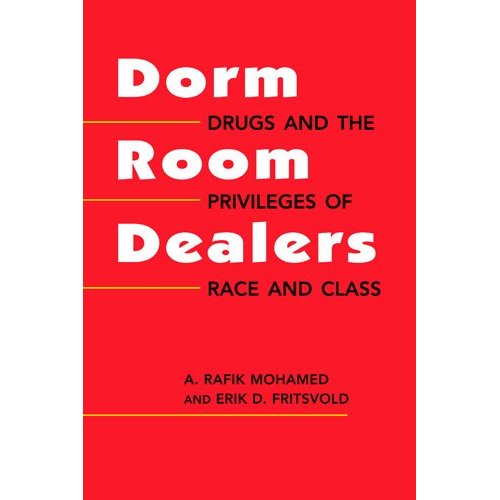
Dorm Room Dealers
There’s a great new academic book out by A. Rafik Mohamed and Erik D. Fritsvold: Dorm Room Dealers: Drugs and the privileges of race and class.

Too many books (my own included) treat drug crimes like it’s some black thing that whites wouldn’t understand unless some kind-hearted interpreters explain to “us” those strange things “they” do.
Well it ain’t like that. Most drug dealers are white. Most drug users are white. It just doesn’t make the news (or get police attention).
And yet, you may be thinking… if most drug crimes are committed by white people, and whites are just as if not more likely than blacks to take and sell drugs, then why do I think of drug criminals as black and why are most people in prison for drug crimes black?
As they say: Ah-hxaaaaaa!
We don’t fight the war on drugs against rich college-educated white folks.
Most prohibition violence in the drug trade happens in non-white neighborhoods. So there’s a reason we focus on crime more on drug crimes in some neighborhoods than others. To me it’s the publicdrug trade that is so brutal.
But what about all those college drug dealers? Why do we never hear about them? Well this book answers that. I might write a proper book review later, but for now let me say this: I mean, I went to college. Anybody who has gone to college knows you can buy drugs in college. It’s like these college drug dealers have no fear of ever getting caught.
Exactly.
These dorm-room dealers sell drugs like they’re dorm-room posters. Everybody can see them. They have no fear. You see, the rules are different for them. College drug dealers get in the game, make some cash (or support their habit), and then graduate and get a job, maybe in daddy’s firm.
Am I oversimplifying? Of course. You should buy the book. If for no other reason than it makes a great ethnographic counterpart to Cop in the Hood. Here’s how the other half deals drugs. There’s a good lesson there for all us all.
-

A night of fieldwork in Amsterdam
I often wonder why anybody would prefer to crunch numbers than do fun qualitative research.
I’m in Amsterdam right now. I made contact with and successfully gained access to my desired police station tonight (to make a long story short).
I want to compare the attitude toward drugs of Baltimore and Amsterdam police officers. These attitudes are very different. Even the most conservative of Dutch cops thinks that people should be able to purchase and smoke weed in “coffee shops.” No Dutch cop thinks that drug users should rot in prison. Most Dutch cops think that punishment needs to be harsher for dealers of “hard drugs” (crack and heroin).
I meet the chief. He is both friendly and smart. And welcoming to an outside American research he doesn’t know. I interview him and some of his main men. Then I ask to talk to some low-level cops, doing the kind of work I did. I am passed around to various police officers and interview them all.
As a cop, I’m impressed with the free coffee machine. It makes much better coffee than the machines they used to have when I did research here 10 years ago in de Pijp.

Next to the coffee machines is a box of free sandwiches. While the cop in me loves free food. I pass on the broodjes. I think it’s strange that the police here make such an effort to keep cops from taking free food outside the police station that they prefer the cops to eat and drink without leaving the police station. Is that a victory?
One police officer asks me if I want to join some plain-clothes officers on their patrol of the Red Light District. Sure, I say. So I do.
The big problem of the area is not drug use or prostitution. Prostitution is legal here. Marijuana and hash can be legally bought in any of many legal “coffee shops.” The big problem of the vice-filled center in this city of sin is, get this, fake-drug dealers.
People who stand on bridges trying to get stupid tourists to buy drugs. Except they don’t have drugs. And they might take you into an alley and rob you. It’s not much of a crime here to sell baking soda. So it’s hard to get rid of these guys. And they really are a terrible P.R. problem for Amsterdam.
So many tourists come here and think, “This city is so overrun with drugs. I mean, there’s a drug dealer standing on every corner!” There’s not a drug dealer on every corner. But there is a man trying to sell you fake drugs on most bridges in this very small part of the city where all the tourists walk around to do their vice-related slumming tour. (Can you imagine if Baltimore’s Eastern District was a tourist attraction… and it was perceived to represent the whole city?)
These cops, a man and a women, have been on this detail for three months. So all the bad guys know them, uniform or not.

You can see this as the guys look down and slink away when they see the plain-clothed police.So the cops ask me to walk in front of them so people would proposition me (really, I’m not well known in the Red Light District). So I do. It’s raining for the first time in days, so the streets are relatively empty. But after maybe 1/2 an hour, I walk by a man.
He says, “Cocaine?”
I say, “What?”
He says, “You want to buy cocaine, heroin, ecstasy?”
That’s it. That’s what they need for the arrest.
I say, “How much?”
He says, “Follow me.”
I say, “No thanks.” And, using our pre-arranged sign, I take off my hat. I walk away. The officers, close behind and in listening range, make the arrest.This is such small-scale stuff for a Baltimore cop. But it’s been years since I’ve been part of the action. Hell, I never even worked plain-clothes. My heart is beating fast as I enjoy the small surge of adrenaline. It’s fun to be back in the game, even if in a very small way.
These cops have arrested this guy before. He is walked (rather freely, in my opinion) back to the police station. He is treated very politely and very humanly.

The prisoner is guilty of the very minor crime of offering (non) drugs. That’s a 150 euro fine. But he doesn’t have any real drugs on him, except his prescription meds. But he’s also guilty of violating his 3-month banishment order (issued four days ago) for the same crime. By law, he must stay out of the city center. Yes, in Europe, you can still be banished. Now he’ll get (re)offered a place to sleep and social help.
Unlike American police, most Dutch police are happy to offer social help.
“Really? Is that real police work?” I asked.
“Yes, because it helps solve the problem…. Isn’t it better to prevent a crime than make an arrest?” I couldn’t have said it better myself. -
Brave ethnographic confession from Cop in the Hood
Professor Corey J. Colyer of West Virginia University sent me the following email:
Peter,
This note is motivated by a remark you make about your methods in the first chapter of Cop in the Hood. It is rare (and therefore refreshing) to see an ethnographer admit that they failed to capture details in their notes. We get tired, overwhelmed, and even bored in our efforts to craft moderately complete ethnographic records. The bulk of the methods literature (in my humble opinion) unrealistically frames the good ethnographer as a tireless scribe, who dutifully returns to the desk after a long day in the field to generate thousands of pages of notes. This leads to what I describe as “ethnographer’s guilt” and worries of being a fraud. I’ve never measured up to this model and it’s nice to see someone as talented as yourself admit to this as well. [By that I mean, you seem to more than adequately support your assertions with rich ethnographic detail]. I suppose it makes me feel less like a fraud as I return to my manuscript this morning.
I’ll sharing that section of your first chapter with my graduate level methods class next Monday.
With respect,
CoreyCorey J. Colyer, PhD
Assistant Professor
Division of Sociology
School of Applied Social Sciences
West Virginia University
PO Box 6326
Morgantown, WV 26506-6326 -
More on IRBs
Fair warning:
If you’re not interested in Institutional Review Boards (IRBs)–and there’s no reason you should be–you should probably just skip this whole post.Brief background: Federal regulations require IRB approval is required for all professors’ research on people. Since 1991 (I just learned this from Shrag’s blog), IRB approval was expanded to cover, among others things, participant-observation research (that’s what I do, with an emphasis on participant). You want to interview or observe somebody? You need IRB approval first. The purpose of the IRB is to protect research subjects. There’s a bit too much history about scientists doing bad things.
Professor Zachary Schrag, a man who keeps a blog about Institutional Review Boards, left me an interesting comment in regards to a previous post:
It’s quite possible that an inept IRB would have blocked Venkatesh’s research. But Venkatesh, by his own admission, “f[oul]ed up” by passing on information that people meant to tell him in confidence. So it is also possible that an adept IRB would have permitted the research while mitigating the harm. Not likely, perhaps, but possible.
Rather than deal in such speculations, I hope you will elaborate on your own experiences with IRBs that led you to distrust them.
I don’t distrust IRBs. My practical experiences have been more or less favorable. I just fundamentally question the very notion of needingIRB approval for non-experimental social-science research on capable adults. And I firmly believe that the simple nuisance and fear of conflict with an IRB limit social-science research.
But first let me deal in some speculations:
Not only do I think an IRB wouldn’t approve Venkatesh’s research. I don’t think an IRB doing its role of protecting research subjects shouldapprove Venkatesh’s research. The risk of some harm from his research was so great as to be virtually inevitable. But I think Venkatesh should do his research, and hence my problem with the IRB in general.
I read one review of Venkatesh’s book that went so far as to to use the word “evil.” I don’t think it is. With regards to potentially violating protection of research subjects, I would draw the line between malum in seand mala prohibita. In other words: drug dealing OK, murder not. I don’t think Venkatesh crosses this line. But for Sudhir’s sake, I’m glad nobody shot somebody while exclaiming, “Am I going to make your book now, Mr. Professor?! Is this what you want?!”
While in theory the IRB could have mitigated harm in Venkatesh’s case, it’s hard to imagine a scenario where this would actually happen. I’ve never heard of an IRB with follow-up. Thus the IRB, while failing in its basic mission, still managing to hinder good qualitative research.
Too often, the quantitative researcher’s goal becomes how to outwit the IRB. I know of many good researchers and otherwise ethical people who admit to lying and deceit when it comes to the IRB. They feel, rightly or wrongly, that such deceit is necessary for research in their field to survive.
For my book’s research, I honestly don’t remember or have a copy of what I gave to Harvard’s IRB ten years ago. I know it took three of four drafts and I agreed to make an announcement on day one of the academy stating who I was. It was good to be forced to make this announcement as it wasn’t easy to make (so thanks, IRB). That being said, I also didn’t want to remind my classmates every hour that they were being watched by a researcher. Is this ethical? I think so. My point was to be honest and overt. And I was. But I think I was supposed to post something that never got posted.
I never got IRB approval for my switch in research plans when I actually had to get hired as a police officer. Between the heat from the P.D. brass disallowing my original research plan (for not being a cop) and the heat from my dissertation adviser for my new research plan (for being a cop), well, I had other priorities.
Alas, my fear of preserving confidentiality and protecting my research subjects went so far that I didn’t leave any way to link specific people at different times to their actions and quotes. What if I get subpoenad(?!), I thought. This was a mistake. I could have written a better book if I had characters. I would have, if it weren’t for the IRB.
My own experiences with John Jay College’s IRB have been pretty good. But there are still problems:
1) The line between doing research and not doing research is not as clear cut as the IRB want to believe. My book is done. I’m no longer doing research for it. But when a friend calls or writes, I’m still going to note information for my records. Am I supposed to get IRB approval before going to a Bull Roast? Am I to stop going to Baltimore now that my “research” is complete? Am I to ignore everything I see and do since I don’t have IRB approval?
2) Signed consent forms are simply impossible in police research. First of all, cops won’t sign them. Second, the social situation is flux. You arrive on a scene and officers come and go. Are you supposed to ask every arriving officer for signature? If signed consent forms were required and if this requirement were actually enforced, qualitative police research would simply end. Researchers who say they’re going to get signed consent forms from police officers are lying. Yet IRBs love signed consent forms. It’s like court overtime pay is for police. Just give ’em some and they’re happy.
3) IRBs want a guarantee of confidentiality. I won’t do that unconditionally. Luckily, Baltimore police behave pretty well, at least within the bounds of reason.
For those interested (and you might be if you’ve read this far), I’ll include the more original parts of my successful IRB submissions for approval withoutsigned consent forms and withoutunconditional guarantees of confidentiality. And they said it couldn’t be done.
Requiring a signed consent form from every research subject would so limit my participant-observation research as to effectively kill it. Given the fluid nature of social interactions in a police station, it is not possible to have every police officer who enters a room or call for service to read, understand, and sign a consent form. My research methods are overt, but informal. While the bulk of police officers will be familiar with me and my research, it is inevitable that I will see and hear police officers who initially will not know who I am. Such confusion is usually clarified immediately by asking me or another police officer.
My research is confidential and offers minimal, if any, risk to police officers.
Police officers are not normally considered an “at-risk” group (quite the contrary, police officers are often seen as the group that places marginalized people at risk). Given the constant risk of observation by their supervisors, the public, the media, and internal affairs, an outside researcher who promises confidentiality present little risk. Police officers are used to being on-guard around people they do not know.
…
A Note on Criminal Behavior and ConfidentialityWhile IRB boards consider harms that may come to research subjects, the potential of research subjects harming others should not be ignored. Should a researcher remain quiet if confronted first-hand with research subjects who commit genocide, mass torture, or major war crimes? Of course not.
In reality, I do not expect to witness any war crimes. But I believe that in extreme cases, a researcher’s obligation as a human being come first. Were I to witness a police officer in severe violation of criminal law, I would have to weigh any promises of confidentiality with my moral and legal responsibility to do the right thing.
I would not violate confidentiality for violations of departmental regulation or even most criminal acts. In my years both as a police officer and as a researcher (often the two overlapped–I was a Harvard University graduate student researcher during my entire two-year tenure as a Baltimore City police officer), I have never participated in nor witnessed an act that would make me consider violating confidentiality.
But if, hypothetically, I witnessed a police officer rob and kill, or sexually abuse a 10-year-old child, or anally violate an innocent man with a plunger, I would feel little compunction legally and ethically to violate a vow of confidentiality. Of course the odds that I will witness such a scene are almost zero. I do not expect such a situation to occur. But I and the IRB must be aware that the possibility, however slight, exists.
I realize that it might facilitate approval of this project if I stated that all research subjects will sign consent forms and confidentiality would never be violated. But to pretend the former denies the reality of participant-observation research on police officers; to pretend the latter is morally irresponsible. I believe it is the combined duty of researchers and the IRB to promote ethical research and protect research subjects. This process begins with the presentation, discussion, and approval of an ethical and honest research proposal.
All researchers are free to use this for their own IRB submissions. I’m happy to try and help the field.
-
Outing the insiders
There’s a very interesting exchange on Slate.com between Sudhir Venkatesh and Alex Kotlowitz. These are two authors I respect deeply (and not just because Prof. Venkatesh was kind enough to offer to write a blurb for Cop in the Hood).
Their letters discuss the role of researchers vis-à-vis their research subjects. You should read all four.
I just finished reading Venkatesh’s Gang Leader for a Day. It’s a great book (and not just because Prof. Venkatesh was kind enough to write a blurb for Cop in the Hood)! I stayed up till 6am to finish it. Sudhir, as you may or may not know, got his hands on the books of a gang in Chicago. Like the actually financial books. With payments, employees, salaries. What a coup! He’s done great research in the old Robert Taylor Homes in Chicago. This book is the story of his research.
I’ve read two of Alex Kotlowitz’s books: There Are No Children Here and The Other Side of the River. They’re both great (and Mr. Kotlowitz didn’t write a blurb for my book). The former is about growing up Chicago projects and the latter about race and economic relations in St. Joseph and Benton Harbor, Michigan. He writes about cities and race honestly, fairly, and with great style.
In Gang Leader for a Day, Venkatesh arguably does some harm to his research subjects. This is a big no-no in the world of academic research. Venkatesh has gotten some flack for kicking a man who was in the process of getting a beat down. That doesn’t bother me, because in addition to arguably “deserving” the beat down, the man was attacking a friend of Venkatesh. More worrisome, at least to me, is Venkatesh taking part in business extortion and unintentionally “outing” the semi-legal hustles people use to get by in the projects.
Venkatesh could never have done his research if he had to go through a Human Subject Review Board (or I.R.B., Institutional Review Board). As a grad student, he somehow skirted this requirement. But I think the world would be a worse place without Venkatesh’s research. It’s good work and shame on the institution of I.R.B.s that wouldn’t allow it!
I’ve never been a fan of the I.R.B. Few professor are. I don’t think that overt non-experimental academic researchers should need approval to observe and interact with most human subjects. We’re not giving out experimental drugs. We’re not running experiments. We’re watching and talking and living. I don’t even like the term “human subjects.” It’s dehumanizing. They’re people, damnit! It’s condescending to think that adults aren’t smart enough to make their own decisions about what to say to whom. And if they’re not, well, such is life.
Nor am I convinced that research subjects who harm others deserve institutional protection. I believe academics should act under a code similar to journalists. But federal law disagrees with me. And the press has explicit constitutional protection that professors don’t.
Kotlowitz, a journalist, doesn’t have to worry about I.R.B.s. But as human beings, both Venkatesh and Kotlowitz are naturally concerned about harms that may come from their presence. They both wonder about the obligation they have to their (poor) research subjects. Especially since they, the authors, are likely to benefit both financially and professionally.
Most research is done on the powerless and abused. In my study of police, I wasn’t dealing with what is traditionally considered an “at risk” group. If anything, police are considered by others to be powerful abusers! I wasn’t particularly concerned about my research “changing” my subjects. I want my research to change things for the better. I want a better police department and better policing.
But I had my concerns. What if I saw a Rodney King? What if I was asked to conspire in crimes? Should I stop my “research” and quit my job? Should I turn in other cops? Luckily, and hard as it is to for police-haters to imagine, I didn’t see any criminal or horrible police behavior (though I do think that somebody needs to keep better tabs on correctional officers—jail guards in particular).
Perhaps I’m underestimating the value of my Ivy League education, but I feel that any of my police colleagues could write a book as good as mine. Unfortunately they can’t write as well(and I give my public high-school English teachers more credit for that than Harvard or Princeton).
Researchers who “do” rather than just “watch” are always accused of not being “objective.” I’m not a big fan of objectivity. For starters, unless you’re a psychopath, I don’t think objectivity is possible. And even if it were, I’m not convinced it’s good. Too often objectivity is just a euphemism for ignorance. Objective outside research—that is to say, most research—runs the risk of being too ass-kissing and desperate, simply in an attempt to gain the access that naturally comes from an insider. Ethnography can’t and shouldn’t strive for the same level of scientific validity as found in the hard sciences. Ethnography isn’t chemistry.
What’s strange to me is the dearth of good social-science research on the police. I do think that it’s tougher to write about police officers than it is to write about gang members. You can write about who a gang member is, because there’s something more exotic there (at least to outsiders). The lives of people who go to work usually isn’t that interesting (so kudos to Ehrenreichfor making it so). Workers provide for their families. I don’t think I have the writing skills to make a police officer interesting. But I do have the analytical skills to notice what police officers do. Luckily, what police do is often very interesting.
People also say police are closed to outsiders and hostile to researchers. That may be true, but only if you’re an outsider. Compared to Venkatesh befriending gang members, my becoming a police officer was a synch! And it’s very easy to become a police insider. They hire. And they even pay you.
You might say that my job as police officer was, to use Venkatesh’s language, a “hustle.” I used the police department to advance my academic career. I didn’t hide this fact. The Baltimore City Police Department knew this (and to their credit still hired me). Other police told me, “If you can use this job as a stepping stone to something better, more power to you.” I actually heard those exact words more than once. I had the luxury of being an insider.
If you’re studying the poor, or the working class, or prison guards, or restaurant workers, or taxi drivers, or drug dealers, you can simply become one or make friends with those who are. Maybe all groups aren’t open to outsiders, but most are. It’s human nature. The fact that most academics don’t even talk to the people they claim to study is either horrible class snobbery or a simple lack of cojones.
-
The problems of ethnography peer review
Way back when, I submitted an article to a prominent ethnography journal. Time passed. Nothing happened. I submitted the article elsewhere. It was reviewed, accepted and published this past summer. Yesterday I received a reply from the journal. Rejection.
I have never been in the somewhat awkward a position to receive a rejection for a published article. (There were good reasons why the process was so delayed in this journal, related to an editor’s personal health).
But the rejections were striking. Three out of three people rejected the article. This article has been published in the peer-reviewed Law Enforcement Executive Forum. And it forms the basis for a chapter in my book. It’s good enough ethnography for Princeton University Press but not, apparently, for this Journal. I couldn’t get over one of the rejections. It stated:
This is not appropriate submission for [the Journal]. I can’t see how in any shape or form that this is ethnography or has anything to do with ethnography.
This bothers me. My research is ethnographic. So I couldn’t help but write the editor, who did write back an understanding email. It’s not the editor’s fault. The problem is the process of peer review, perhaps especially in what seems to be the self-limiting field of ethnography.
My book, Cop in the Hood, is coming out in May (Princeton University Press). It is, dare I say, an ethnography. Here’s what I wrote:
I appreciate the comments and agree with many of the critical points. Perhaps the article isn’t best for [the Journal]. The article is weak on theory. It is geared toward police policy and practice.
I have a few thoughts on my mind from reading the comments. I feel and hope that you and the journal may gain from my thoughts. Take them for what you will. Take them constructively and not as the ranting of a slighted academic. Again, the piece is published, so at some level it doesn’t matter to me. But I care about ethnography.
All three reviewers harp on the fact that this isn’t your typical ethnography. That doesn’t strike me as bad. I know this piece is more policy-oriented, but I hope my research expands the field of ethnography slightly in that direction. It bothers me that a policy or real-world focus would be part of the grounds for rejection or exclusion from the field of ethnography. It bothers me when I see the peer-review process in this field so narrow-minded that it is unwilling to consider a piece that doesn’t “fit the mold.” Likewise it bothers me that ethnographers wouldn’t consider a piece that some numbers in it.
I know this article isn’t the “typical” ethnographic piece. I am well aware of ethnographic theory and consider myself an ethnographer (what else could I consider myself given my research and writing based on two years of P.O. research?).
In my mind, and maybe I’m wrong, research that follows ethnographic methods *is* ethnography. The style of writing and the format of the paper should be issues to judge, but not litmus tests. Again, I understand there are legitimate reasons to reject this piece for the [Journal]. But for cryin’ out loud, ethnographers, have a more open mind about what counts as ethnography!
The comments from reviewer 2601 I think are the best (not the most positive, just the most useful comments). The comments from reviewer 2622 are also constructive. The comments from 2602 are, as you I’m sure know, useless. Please don’t have this person review another piece for the journal. What an asshole. People like that who serve as gatekeepers really limit the field.
Why can’t ethnography combine qualitative and quantitative methods? Why can’t ethnography be more focused on policy than theory? Perhaps these issues would make a better article for [the Journal] than an analysis of 911 calls for police service. But for both for academic and political reasons, I would hope that ethnographers would be a little more open minded. Of all fields to be judgmental and closed minded… how ironic.
Yours,
PeterProfessor Peter Moskos
Dept. of Law and Police Science
John Jay College of Criminal Justice
899 10th Ave, Room 422
New York, NY 10019