Tag: for academics

  • Rate My Professor

    “[Moskos’s] ego barely fits into the room.”

    “His book which he wrote is not great at all, pretty boring, although he thinks its the best. He also has that ‘oh, look at me, I went to Harvard, I’m so great’ attitude at times.”

    “Doesn’t really seem to connect with his students. I also found his way of lecturing rather disjointed.”

    “For the graduate level, his teaching is Amateur. . . . Pointless.”

    “He’s a liberal, its all the same poor me i;m blacka and under privlaged stuff.”

    Those are some of the comments you can read about me at rateyourprofessor.com.

    Students sometimes get asked if I read ratemyprofessor. Of course I do. But not too much. Still, I check every year or two because I want to know what other people can read about me. And if all the rankings were negative, then I would worry.

    I do think the school’s student-written evaluations of teachers are valid and useful. Professors, myself included, can always improve listening to constructive criticism. And I take my teaching seriously; I enjoy teaching and I want to be good at it.

    But it’s silly to get obsessed over website rankings because I have all of 19 comments on that website (and not onesays I’m hot). And I’ve taught over 800 students. As any social scientists knows, a 2-percent response rate is worthless. In many ways, it’s worse than worthless because people will draw false conclusions. Put another way, in hundreds of hours of classroom instruction: is that all you got?

    Honestly, I’d be worried if none of my students didn’t hate me. As everybody knows, you can’t please all the people all the time. I’m happy to please most of my students most of the time.

    What if the tables were turned? Honestly, I really like my students. All of them. Well, almost. But in seven years of teaching, I can only think of three students I did not like (And interestingly, all three were graduate students. One was emotionally unstable. And another later put me down as a reference, which was odd).

  • Anybody have San Diego PD Connections?

    I want to look at the impact of cell phones of crime prevention. I can’t seem to make any progress getting such data from the NYPD. The San Diego paper has this story. Maybe I’d have better luck there. Besides San Diego has always been an interesting case vis-a-vis crime reduction because they mirrored the crime drop in New York in the 1990s but the police then all-but refused to take credit for it.

    Anyway, before I start cold calling, I thought I’d ask to see if anybody has police connections in San Diego. If you do feel free to send me an email. Basically I’d want to look a bunch of 911 and 311 call data going back years, with a focus on “crime in progress.” And calls from cell phones, if it’s broken down that way.

    Of course if any other city wants me to look at this for them, I’d be happy to.

    (I ask not what I can do for the blogosphere, but what the this damn blog can do for me!).

  • A Sociologist’s Response To Anthropology

    I have a short article in the journal PoLAR: Political and Legal Anthropology Review. “Policing: A Sociologist’s Response to an Anthropological Account.” You can read the PDF here.

    I love reading other people’s summary of my work. This is from the issue’s introduction:

    In his commentary on Karpiak’s article, sociologist and criminologist Peter Moskos praises Karpiak for presenting an (in his view) unusually lucid example of anthropological writing. Moskos takes particular aim at the pressure in some sociological writing to conform to natural science models for research method and writing, which he feels take the enterprise off course. Instead, he advocates an interdisciplinary and combined-method approach in which qualitative and quantitative approaches can be brought together, in an effort to check the admittedly partial character of the knowledge produced by each method.

    Is that what I’m saying?

    My favorite part (and what will undoubtedly bring me into the glamorous party circuit of the high-rolling world of international poetry) is my haiku version of “Casey at the Bat.” It goes like this:

    mighty casey swings
    oh two two on down by two
    no joy in Mudville

    All kidding aside (not that I was kidding), I do believe that almost everything can (and should) be summarized in 17 syllables. Talk about cutting to the chase; it’s a useful skill. Recently, for my next book, I took my hand at Foucault. I was going to omit Foucault from the book on principle. But then I realized I couldn’t figure out what that principle was (except for me not liking Foucault’s writing). I also didn’t want people to think I didn’t read Foucault. Oh, no. I read Foucault. I thought about him long and hard. I just don’t like Foucault. And every time I read, “As Foucault said,” I reach for my gun. So to help make my point about the Frenchman’s needless verbosity, I attempted to summarize Discipline & Punish in 17 syllables.

    I couldn’t do it.

    It turns out that Foulcault’s classic treatise needs twohaikus:

    society’s norms
    more like prisons every day
    resistance is futile

    from body to mind
    a new system of control
    the Panopticon

    Speaking of my next book, here’s my 17-syllable summary of In Defense of Flogging:

    punish with the lash
    it’s much better than prison
    why not give the choice?

    That’s all you really need to know, but read the book anyway.

  • On Writing

    On Writing

    People sometimes think I don’t work much (an opinion only reinforced when they see me having my morning coffee at 2pm and still in my bathrobe at dinner time). But I’m a night owl and I work from home.

    So along with teaching four classes (a very heavy load for a college professor), I have to write. And writing is work. To those who think it’s easy to write a book, I suggest they try it. To those who can churn out a book a year, I applaud them (and wonder how they do it). Writing is hard work. And it’s not fun.

    A friend and fellow academic author put it this way in an email:

    There are days in writing (for me usually when I have a decent draft of something and am crafting) that it flows, but most of the time it’s work, work, work, work.

    People who don’t understand writing or who use formulas or hire ghostwriters who use formulas think that a book is like having a baby, nine months and it’s done. such total utter bullshit.

    Now I’ve never had a baby, but I only wish writing was such a passive process that got pushed out after nine months (not to mention the fun that leads to babies in the first place).

    I’ve been working on this book for a while and I’m still not done. When writing, I can produce about 1,500 words a night. But that’s only some nights. Because I’m not productive most nights, my actually production is more like 100 words a night. And that’s just the first draft.

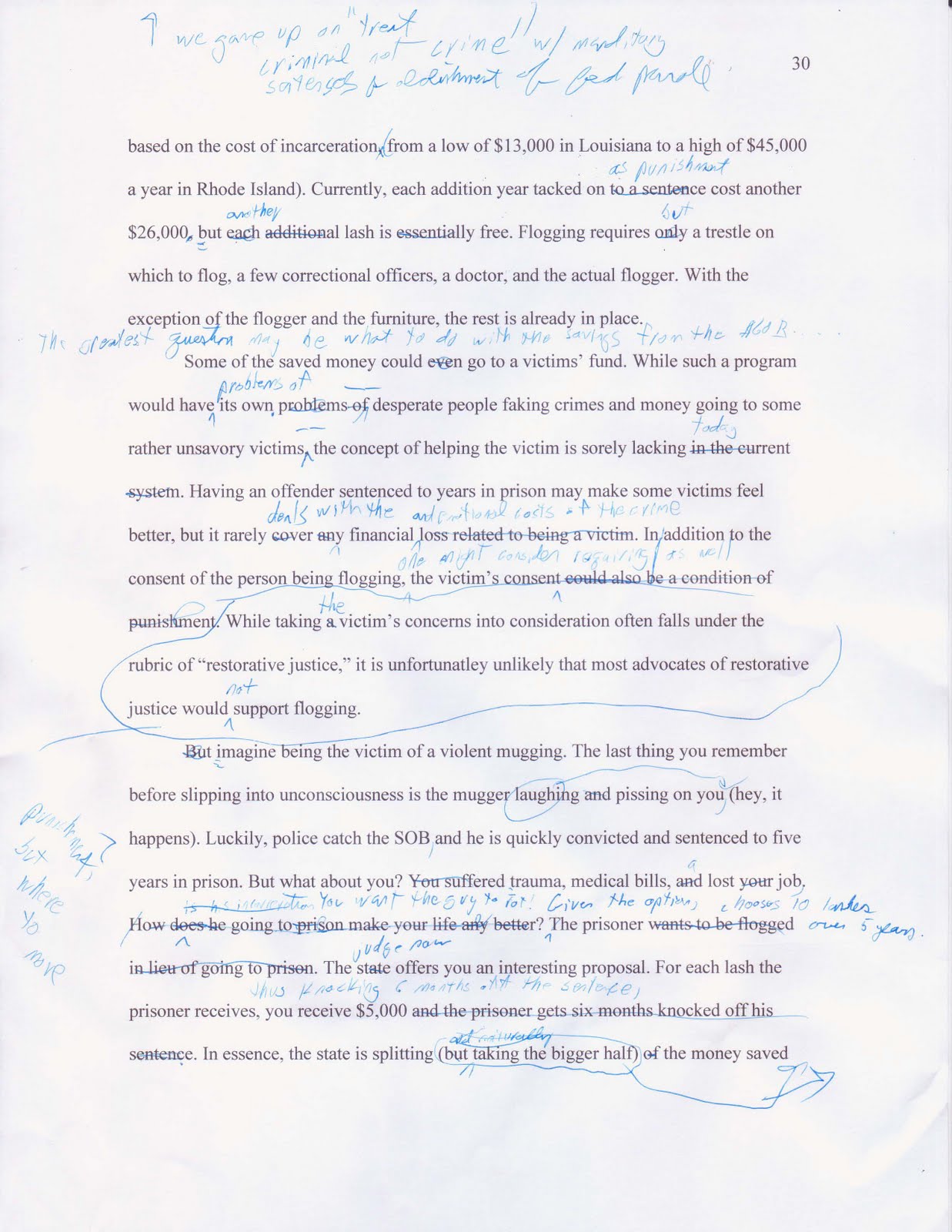
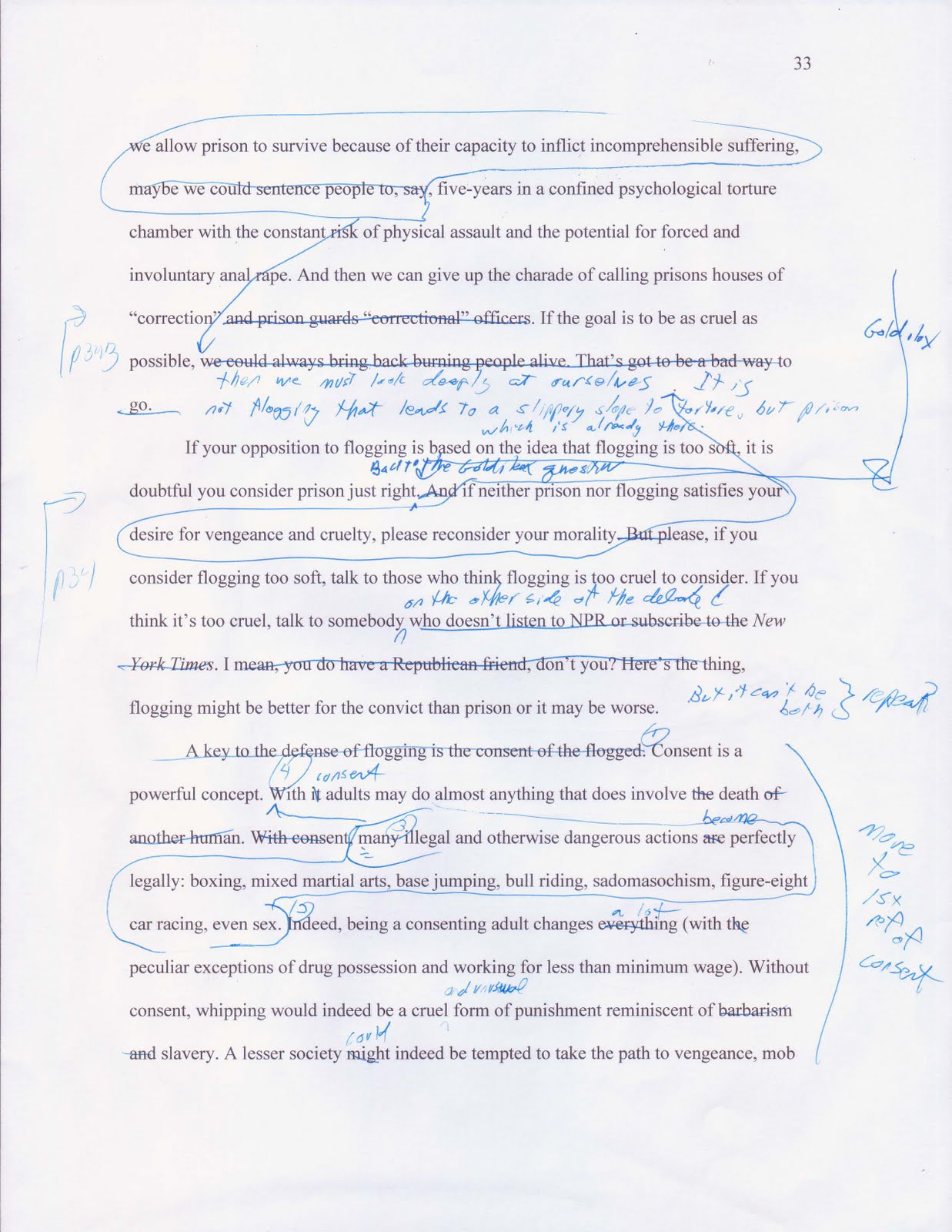
    Now that I have a (rough) first draft of my book, it’s more work. Even after getting all the words on paper–and at 30,000 words it’s a very short book–it’s still a lot of slow painful work. Just to give you some idea of the editing process, here are a two pages of a draft of my forthcoming book, In Defense of Flogging.


    So why do I do it? Sometimes I wonder. Every other job I’ve had has been easier, and yet still I choose this vocation. What did I create as a cop? Hopefully I helped some people, but Baltimore is no worse off without me there. And as a waiter I helped rich people enjoy their dinner, but waiters are just supporting cast to the food. And when I was a boat captain in Amsterdam I learned about boats and made a lot of tourists very happy. That was fun. But at some point I got tired of the same old tourist conversations (and rainy weather).

    The work in those jobs created no lasting product. And none of it could be mistaken for art. Maybe I write because I can’t draw and don’t make sculpture. A book is, or at least should be, a little piece of art. Maybe I like that idea. I really don’t know.

    On any objective level, 99 percent of all writers don’t get enough credit or money to make it all worthwhile, but still people write. I guess there’s something satisfying about creating something from nothing, at least when you’re done with it all.

    But while doing it? Man, there’s very little I wouldn’t prefer to do than write. When I’m sitting at my computer at 4AM, sometimes I think about how nice it would be to have some other job where I could show up, do my job, and go home and watch TV guilt free.

    And yet I wouldn’t change my job for any other (except major league baseball player and Supreme Court Justice). Why is that?

    Perhaps writing involves a deeper calling. I’d like to think I’m doing something that will last and might actually (in some small way) change the world for the better. And though the craft of writing is a tough, I’d like to think I’m good at it. Plus, publishing is, in theory, part of my job.

    It’s great to have written. Too bad it’s not more fun to write.

    Look for my new book, In Defense of Flogging, to be published by Basic Books, in 2011.

  • So You’re Going to be on TV?

    Today was my third time on TV. I loveradio interviews. TV? I’m still not comfortable with it. Radio is kind of like real life. TV is a bizarre and totally different creature.

    In case you’re going on TV, here are a few things I wish somebody had told me before my first time.

    1) Make sure you’re going to be introduced in the way you want to be introduced. If you have a bio online, make sure there’s a concise correct version. Often they’ll take your info straight from your website, if you have one. Make sure they say the name of your school. That’s important to your school. Author of [your book] is also good. (But do not expect any notable increase in book sales no matter how much media attention you get.)

    2) Make sure you have a contact name. And there’s a good chance it won’t be the person who contacted you. Make sure you have a photo ID. Once you get past the front desk (today this was at 30 Rock, which is kind of cool because there really are little tour groups being led around just like you see in… 30 Rock!), you enter the TV studios and it’s never obvious where to go. You’re likely to pass at least a few people walking around. But they’ll all avoid eye contact because they don’t want to get stuck helping you. It’s nice to be able to actually ask for somebody by name.

    3) While you don’t want to be late, there’s no advantage to being early. There’s a “green room” to sit in while you wait. Bringing something to read is a good idea. In a big building you probably won’t get phone reception or public wifi. Of course it’s a good idea to watch the show if you never have before so you know what style of host it has. But don’t worry if you don’t know. For what it’s worth, they haven’t read your book, either.

    Makeup takes about 5 minutes. And right before you go on you’ll get mic’d and given an earbud, with batteries clipped on the back of your pants. The audio person will come over your earbud and do a quick sound check. If you need water, make sure you have it. Don’t be afraid to demand water, even on set. If you start yelling for water, it will appear. Bright lights and nerves will cause dry mouth.

    4) It’s always best to see your interlocutor. But there’s a good chance you’ll be sitting at a table, staring at a not-in-use teleprompeter with an ear bud in your ear. You don’t see the host.

    Today they put me at the kids’ table when the host was standing all but 10 feet away from me. I have no idea why. But it makes for worse TV. It’s hard to have a “natural” conversation when you’re on camera but only have the verbal cues of a phone conversation. And think about it, who wants to be filmed when they’re on the phone?

    5) You can’t see the host… except there is a little monitor in view. Youcanlook at the monitor… but don’t. Because if you do look at the monitor, you look all shifty eyed on camera. And then people think you’re a lying bastard.

    But it’s hard not to look at a monitor with your picture on it. And when I look at the monitor, all I can think of is how fat and squinty eyed I look. I mean, my eyes are kind of squinty. But I’m not *that* fat. So if you’re not next to the person you’re talking to, ask one of the tech guys (like the guy who mic’d you) to point out exactly where the camera is. (It’s at the top of the teleprompter box.) Look at the camera, even if you can’t see it. And don’t be afraid to ask the same guy to turn off the monitor, if it’s distracting. Ironically, on TV, the odds are slim that there will be anything on that screen you actually need to see.

    6) Once your segment is on. Always assume you’re on camera. Because you might be. In a big studio the “on” camera will have a lit-up red light. In a remote studio, you’ll have no clue. I would say act natural… but when I act act naturally I roll my eyes, pick my nose, avoid eye contact, and get easily distracted. You can’t do any of that on TV. Or pace. Or lie on a bed. The last time I did a studio radio interview I had paper towels stuffed in my wet jeans, homeless-guy style. But nobody could see that over WGN radio!

    You don’t have to be perfect. And it doesn’t matter if you’re nervous (you never look as nervous as you feel). My own thinking is not to obsess with being as “polished” as a professional newscaster. It’s futile. They got that job because they’re good at looking polished. You’ll look like yourself when you’re comfortable. So I think not caring too much is a better strategy than, say, trying not to blink too much. So what if my jacket is bunched a bit? (Though guys could remember the pro-tip of sitting on your coat tails).

    So sit there and try to look, if not exactly natural, comfortable. Keep staring forward, even though there’s nothing to stare at. And smile a little as you’re introduced. It will make your image on screen look less like the mug shot of a serial killer.

    7) Unlike longer radio interviews, you don’t actually have a conversation on TV. It’s a strange medium. Roger Ebert said, “When writing you should avoid cliché, but on television you should embrace it.” Unfortunately, that’s true. There are some exceptions, of course. But generally you’ll be “on” for about 5 minutes and in that time you’ll get one or two or at most three bursts of speech. That’s it.

    There’s no point to those notes and things you were planning on saying. Make sure you’ve got something to say right off the bat. And while it would be ideal to answer the question asked, it’s better to answer the one you wanted them to ask than get pulled to place you don’t want to be. While their show isn’t about you, your presentation is. If there’s something you don’t feel comfortable talking about: don’t. You don’t owe them anything. It’s not like they’re paying you.

    But keep in mind that the show is generally on your side. The show wants you to do well. So be energetic without being hyper. You are there because you’re supposed to be the expert. Be confident. You’re there because you know more than your host. But don’t talk down to the viewers. But in the end the show isn’t about you; the show is about the show.

    8) When you’re done, you may get a handshake from somebody who will probably tell you that you did great, whether or not it’s true. The mic person will un-mic you. And that’s it. And don’t let the door hit you on the way out. Nobody will see you out. Go back to the make-up room and grap a wetnap to wipe off your makeup. Take a snack from the Green Room, if there are any. Go to the bathroom.

    9) And then as you leave you’ll wonder how you did. Sure, you could have done better. But you did good enough. Hopefully somebody who watched you will call or text and say something nice. And then hopefully you can find whichever black car is supposed to take you home. And then, days or weeks later, don’t be afraid to watch yourself. Learn from it. You may not want to. But remember, what you’re watching has already happened. It’s history. It is what it is. Learn from it. Of course you’ll look fat. (TV really does add pounds. People who look skinny on TV look bulimic in real life… and probably are). Yes, your voice really does sound that funny (and probably always has).

    In the end only two things matter: A) Did you manage to not look a fool? And B) did you get to say some of what you wanted to say? And hopefully you had some fun.

    As silly as TV can be, you may never have another chance to say so little to so many.

    [updated in 2015, based on a bit more experience]