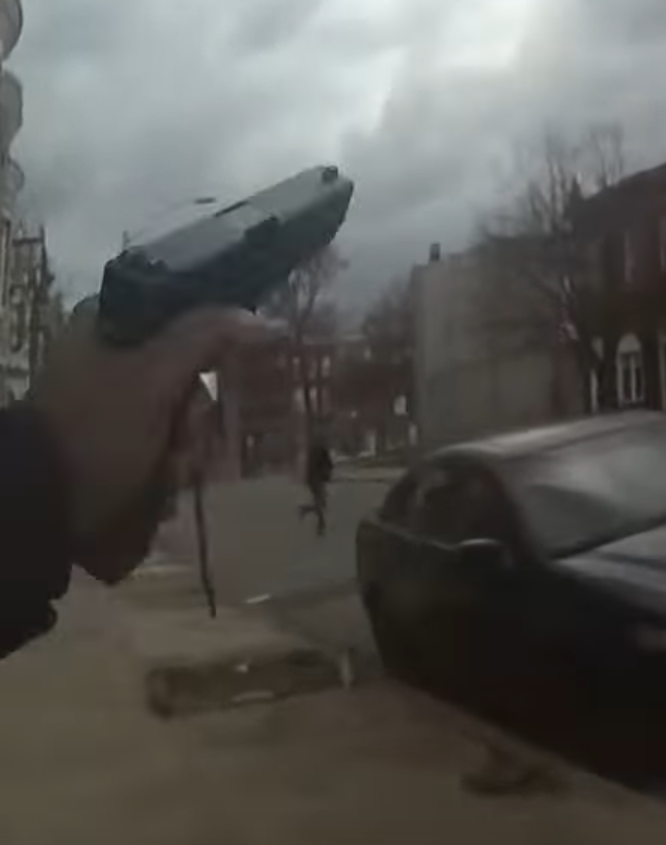
Well done, Officer Rogers!
“An officer was actually on this block on another call and actually heard the shots being fired, said T.J. Smith, Baltimore City Police Spokesman. “That officer gave pursuit.” How often does that happen? And what exactly happened? An edited and shortened version of the bodycam footage had been acquired by WMAR, which made me go, “damn!” I asked T.J. Smith if I could view the entire footage, and he was kind enough to post it publicly.
Here’s what happened. [There’s a timeline, below.] On April 19, 2018, at approximately 15:00 hours, Officer Rogers responded to a 311 call for a landlord-tenant dispute at 1704 N Regester. Probably something like, “landlord says tenant refusing access to her building. Please see Miss Whomever.” The 1700 block is a small block in my old sector. Six homes are boarded up.
Many calls are for disputes that are not or should not be a police matter. It’s not his job. In civil matters, there’s very little the police can or should do. In Baltimore, as in many places, the sheriff’s office handles law enforcement related to housing issues. [This actually takes a great burden off police, who otherwise would have to be seen as taking take sides in evictions and like.]
The landlord tries to make it Officer Roger’s matter by saying she has been threatened by the tenant. There’s some debate about “street talk” at if “going all gangster” is a threat. But the officer wisely won’t play this game. Presumably he’s got other calls to answer. It appears he’s already out of sector handling this kind of nonsense.
[My take: Apparently the furnace broke. That’s a housing violation that needs fixing. Now there is something about hot water, too. The tenant reports this to the city so that he would have legal reason to stop paying rent. But, and here’s the catch, the tenant doesn’t want the violation fixed because as long as the status quo can be maintained, he’s living rent free! So the tenant decides he won’t let the landlord in. The tenant also says he’s moving anyway, which is news to the landlord and no doubt will coincide with the problem being fixed. The landlord says he owes her money. She isn’t going to get it. Yes, this is why people don’t want to be landlords. And basically as a cop you just want to make sure everything is just calm enough — basically that they won’t start fighting — so you can get out of there. Often the show to which police officers have a “front-row seat” is something not worth the price of admission. Again, this isn’t his job.]
It’s all very boring and typical. And it lasts for 7 minutes. Just as the officer is looking for a way out, boy does he find one. Gunshots ring out (7min:48sec). There are 15(?) shots in five seconds. Less than two seconds after the first shot rings out (and three seconds before the last shot) Officer Rogers takes off running, toward where the bullets are coming from. Yes, that is what most cops do.
Walter Baynes, a 30-year-old black male, had just been shot and killed, and George Evans, 69-years-old, reported to be Baynes grandfather, was shot and wounded. One of them, I presume Baynes, had a gun on him when he was shot (13:23). The gunshots sound like they come from one gun, at least to my ears. But given the number of shots fired, it’s possible that Baynes also emptied his revolver at the man who shot and killed him with a semi-automatic. If so, Baynes missed.
In the video, notice how the people, except for the officer, barely react to gunshots. And just a minute later it’s like things are back to normal. Traffic doesn’t stop. People walk by like nothing happened. Not even a reason to interrupt your dog walk (9:44). People act like it’s routine, because, unfortunately, it is. Sixteen of Baltimore 122 murders this year (to date) have been in the Eastern District. Many more get shot and live.
Such brave, good police work is also routine. An officer runs toward gunshots and single-handedly confronts a man whom he believes to be armed, a man who just killed a man. He does this by instinct and training. He does this not necessarily because he wants to, but because it is the right thing to do. Because running toward danger is his job. He did good, Officer Rogers did. Very good.
And then, after all this, all he wants to do is check his bodycam footage to see if the suspect is on it. If it were up to the ACLU and the police-are-the-problem set, police wouldn’t be allowed to do so. That’s crazy. Also, it takes 15 long minutes before somebody will watch the suspect so he can do so.
Good police work doesn’t go viral like a video of bad policing or a cop doing something stupid. And if all people see are videos of cops shooting black men, they start believing that shooting black men is all cops do. So let’s play the counterfactual game and imagine this went down differently. Let’s say at 8:10 in the video the suspect made a move toward his waistband. Or maybe he didn’t. Either way, let’s say the officer shoots and kills the suspect. Would this be legally justifiable? Probably. Would it be correct? Well that depends if the suspect is armed. Can you tell if the suspect is? I cannot.
It turns out the suspect isn’t armed, at least not at this moment when he’s caught by police. So now you would have a scenario in which a bad cop has shot and killed an unarmed black man. In Baltimore, no less. Oh, that would go viral. Doesn’t matter if the guy just killed somebody. The gun used to murder Mr. Baynes? Probably ditched in the alley and picked up by somebody else before it even bounced. Doesn’t matter if the cop is African American (implicit bias and all). There would be protests and perhaps worse.
No matter what would happen now, the officer’s life is ruined. Career over. Thrown under the bus by the department. He and his family will receive death threats. Perhaps they will have to go into hiding. A criminal prosecution would likely occur. Mosby has tried to convict cops for a lot less. All because this officer ran toward gunshots and misperceived a lethal threat. Harsh.
Should any single split-second decision really be the difference between a narrative of brave hero police officer and protests over an evil criminal cop who is now the only person from this incident on trial for murder? Perhaps we demand too much. We all make mistakes. What was the officer’s intention? Well, to apprehend a shooter. It was not to kill the suspect, though he was prepared to do so.
Watch the video in real time, between 7:48 and 8:10. We’re talking a total of 22 seconds. How would you react? Of course you might reasonably say, “I don’t know. It’s not my job to react. I’m not a cop.” Ok. So let me ask this: how do you want police to react? Just as this cop did, right? Run towards gunshots, chase a suspect, and not shoot anybody, not even a bad guy. Job well done, right?
Nope. Not so fast.
See, the DOJ report on Baltimore Police, the one that opened the door to the consent decree, the one written by “progressive reformers” who have never let lack of police experience get in the way of telling police how to do their job, that report? Well it says Officer Rogers did it wrong. I mean, what if somebody got hurt?
If circumstances require that the suspect be immediately apprehended, officers should contain the suspect and establish a perimeter rather than engaging in a foot pursuit, particularly if officers believe the suspect may be armed.
You’re kidding me, right? I don’t even know what “containing” a suspect means, much less how you would go about setting up a “perimeter” to do so. This isn’t idle talk. Last month in Seattle, because of a consent decree, an officer faced discipline for successfully subduing a man with a axe. If police get in trouble for making decisions and acting in the face of danger, there’s really no point to having police at all. And that, of course, might be the “progressive” vision.
Luckily, back in the real world, we’re left with the happy narrative of a brave officer who risked his life to apprehend a murder suspect. And luckily, in this case, no person-of-color was shot or killed at the hands of police. (Which seems to be just about the only thing reformers care about. The fact that two African-American men were shot, one fatally, doesn’t seem to register much with the “woke” set.)
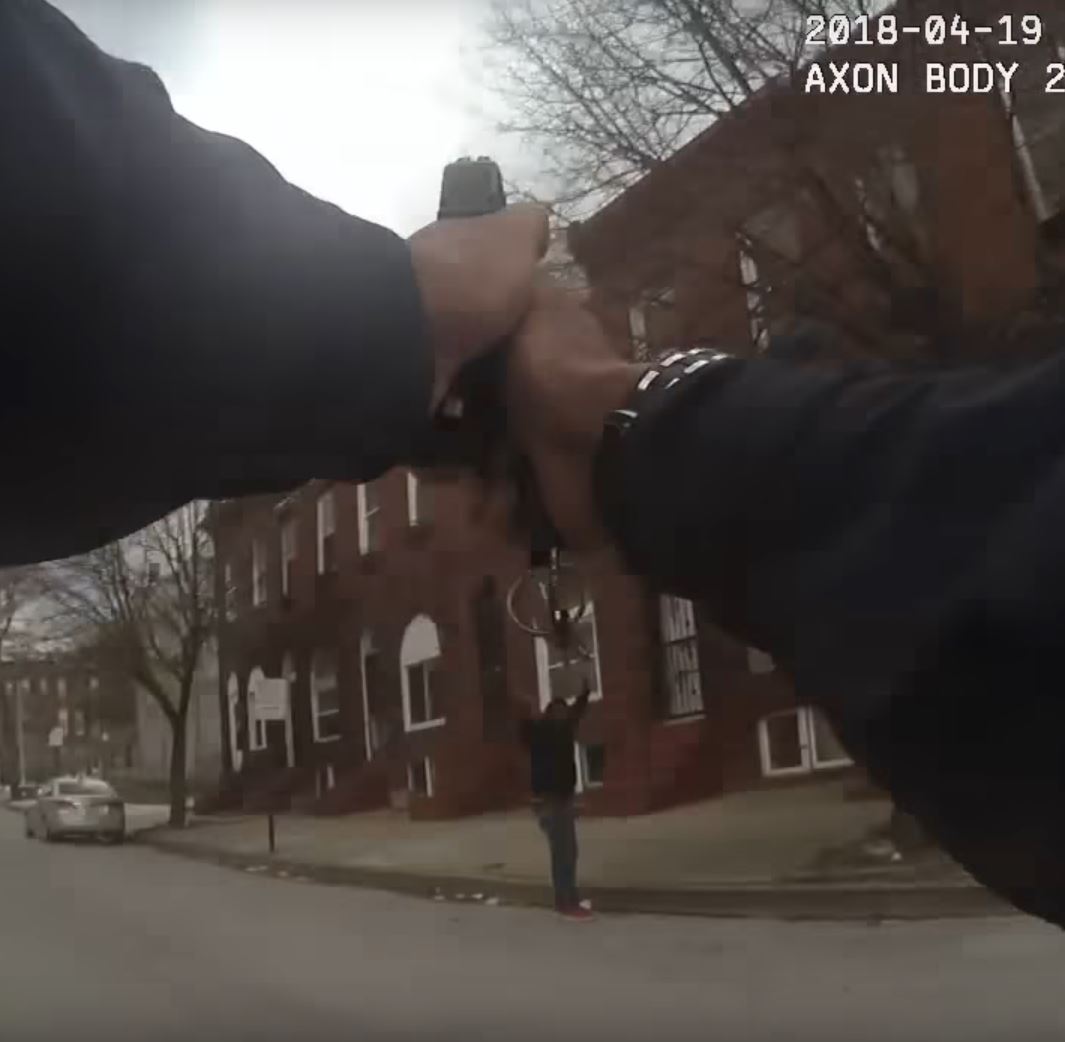
We have this happy narrative because, as is common, the officer did not shoot the suspect when he might have. We have a happy narrative because the suspect complied with the officer’s orders. (The manner in which the suspect complied — quickly and completely — makes me seriously consider that the suspect isn’t the actual shooter. But I don’t know. He has been charged. Presumably gunshot residue on his hands answered this question.) But mostly we have a happy narrative because, despite all the haters, police in Baltimore and elsewhere are still out there, putting themselves in danger, trying to do the best they can in spite of it all.
As to the original call, the landlord-tenant dispute? It ain’t going to close itself. At some point the dispatcher is going to need Officer Rogers to give it a code. I’m guessing it got a David-No, for “no police services needed.”
Timeline:
0:34— Officer is on-scene at 1704 N Regester for a civil dispute.
7:48— 1st shot fired.
7:50— Officer starts running toward gunfire.
7:53— 15th shot is fired. shooting at 7:48-53 15 shots in 5 seconds
7:54— Officer gets on radio to report shots fired
8:00— Officer sees man in alley off to the left
8:08— Tell man to get drop the gun and get on the ground.
8:10— Suspect complies
8:18— Suspect is on ground in prone position
8:27— Officer: “My location…”
8:28— In all the excitement, the officer forgets his location. In his defense, he does appear to be out of sector (331 officer on 321 post). But still. Always know your 20. During the next 20 seconds, given he’s out of breath and already said “shots fired,” the dispatcher should be sending officers in the direction of 1700 N Regester, the location of his call. Little things like that matter. A good dispatcher can save an officer’s life.
8:50— Officer gives his location.
9:26— Finally, the sweet savory sound of clicking handcuffs.
9:44— Man with dog walks by and says good job or something.
9:49— Backup arrives, one minute after location is announced.
10:35— Officer: “Check that alley…. This dude, I’m up there handling a landlord-tenant dispute. Then all the sudden people start shooting. Shooter’s down right here. This dude I believe is the shooter. He just took his hoodie down. He might have dropped the gun in alley cause that’s where he ran.
13:23— Radio: “One of the victims has a firearm in his waistband.” We later learn (at 18:34) that this gun is a revolver. It’s not clear if the revolver was fired at all. Either way, that leaves a semi-automatic belonging to the shooter who didn’t get shot, and fired somewhere between 9 and 15 rounds.
13:30— Officer: “Why was you in the alley? And you just happened up here when the shooter came out, right?” Suspect: “Bro, I was walking up the alley to walk up North Avenue, bro, and I heard some shit. That’s why I started running.”
14:41— Officer tries to get somebody to watch the suspect so he can review his bodycam footage.
16:28— Shift commander: “What hundred block of Lafayette is Register at?” Uh, in the 1700 block, Baker-09. Where it’s always been.
30:08— The suspect assures officer he wasn’t doing nothing.
30:18— Finally, a kindly homicide detective agrees to watch the suspect the officer can return to his car to check his bodycam footage. “I’m not leaving till you do,” she says.
30:20— Officer: “I swear. One simple thing. Ask one person to watch him so I can review the bodycam footage so we can close this. But nobody is listening to me. I’m only the one that chased the goddamn dude.”