Me on Bloggingheads with Glenn Loury.
Tag: good press
-
Me and Bill O’Reilly
If you missed it, here’s me on Bill O’Reilly’s show from back September 1, talking about the non-increase of cops being killed. And here’s me again on October 8th.
-
Kooks of C-SPAN
I expected better from C-Span. Do they not have a call screener?
From the left, do I really need to say on national TV that police departments are controlled lock, stock and barrel by the Klan?
From the right, do I really need to have to answer for a caller who talks about:
Caller: RAMPAGING BLACK CRIMINALITY THAT IS RAMPANT FROM THE ATLANTIC TO THE PACIFIC AND FROM CANADA TO MEXICO IN THIS NATION.
Moskos: YOU KNOW, I AM PART OF THAT REGION. I DON’T SEE THAT RAMPAGE, BUT GO ON…
On the plus side, it was long-form. But it really was the worst format of “remote studio stare into a camera with no visual clues at all.” Plus my head looks fat, as “fat-head” was quick to tell me.
-
Sunday Sunday Sunday
For those interested, I have a schedule long-form interview on C-Span tomorrow (Sunday) at 9:15am eastern, talking about police issues, I suppose.
-
Hey, I’m quoted in the Economist!
But it might be behind a paywall. If so, here is the good parts version:
Even undercounting, America easily outguns other rich countries: in the year to March 2013 police in England and Wales fired weapons three times and killed no one.
Such comparisons should be read in context. America’s police operate in a country with 300m guns and a murder rate six times Germany’s. In recent years the New York Police Department (NYPD) was called to an annual average of almost 200,000 incidents involving weapons, shot 28 people and saw six of its officers shot (mostly non-fatally). Despite the headlines, it is one of America’s more restrained forces.
…
In a small town policemen are investigated by people they work with all the time. “The prosecutor is the guy who went to your kid’s confirmation,” says Mr Moskos.
…
A more obvious culprit is the way policework is measured. Police managers fret about lazy officers. To keep them away from the doughnuts, most forces judge officers by how many arrests they make. Preventing a rape does not count; busting someone for jaywalking does.
There is a paradox in all this. American cities have become much safer in the past two decades. Too many urban forces do not seem to have noticed. In Cleveland, the DoJ found a sign in a police parking lot that read “Forward Operating Base”, as if it were an outpost in Afghanistan.
…
The federal government stokes the culture of the warrior cop by offloading surplus military kit to local police. The Los Angeles School District Police Department has acquired three grenade-launchers and a mine-resistant armoured vehicle, perhaps to keep its sophomores in check.
…
The number of shots fired by police in New York has fallen by more than two-thirds since 1995.
…
Even with these changes, “There is at least one crazy cop in every precinct,” says a retired NYPD officer.That last part is so not true. The actual number of crazy cops in every precinct is three.
-
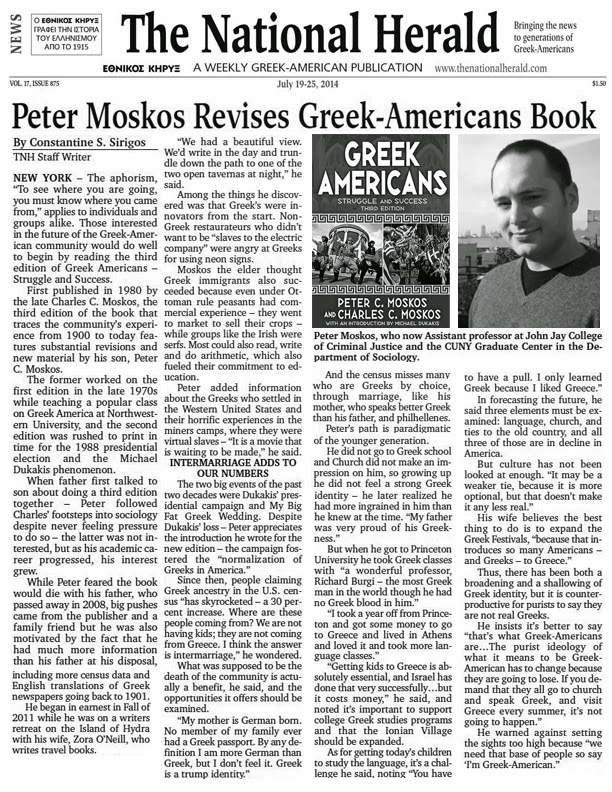
Meanwhile, in the land of Greek Americans
I’m featured in The National Herald, the largest Greek-American newspaper. Front page story, no less (below the fold). Must have been a slow news week. Read all about it.
-
Number two, shooting for number one
The good people over at How-to-Become-a-Police-Officer.com have just informed me that by some fancy measures they use, I have the second most popular law enforcement blog. How ’bout that?
I wouldn’t complete trust that list since it doesn’t include Second City Cop which is quite good and has many more readers, judging from the number of comments. But hey, who can argue with numbers?
The problem with good cop blogs is they don’t last long. I can keep going because I’m no longer a cop. But if you are on the job, no good can come from keeping a blog. And trouble is always just one click away. I just went through my blog role and eliminated far too many moribund links.
-
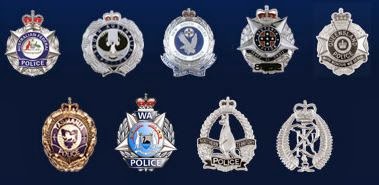
Like David Hasselhoff, but in Australia. And with a whip.
Not too long ago I was kindly very politely by a woman at the Australian Police Journal to restate my argument in defense of flogging. This goes back to my Festival of Dangerous Ideas talk last November. I am generally happy to oblige anything with “police” in the name, even if they don’t pay. So I dusted something off and thought that was that.
Well perhaps I, er, mis-underestimated the APJ. S allow me to plug them:
The Australian Police Journal (APJ) is Australasia’s pre-eminent non-fiction publication about policing.
The APJ is published quarterly on behalf of all the Police Commissioners of Australia in order to educate and inform police and interested members of the community, in policing and related topics – both contemporary and historical. From its humble beginning in 1946, the journal now has over 25,000 subscribers throughout Australia, New Zealand, the Pacific Region and beyond.
The APJ is administered by a not-for-profit company representing all the Australian police services. Its articles are written by police and related professionals, and have a direct relevance to Australian policing.

Admittedly, that description is a bit dry, but that’s actually just the kind of publication I love publishing in.
Anyway, it turns out that more than just flatfoot cops read the APJ. And it turns out my flogging story was their cover story. After the APJ article appeared, it was picked up by the mainstream Australian media. In the past few weeks, me or my argument against prisons and In Defense of Flogginghas appeared down under here, here, here, here, here, here, and here. G’day, mate! (Best of all, because of the 15-hour time difference, even the morning-drive radio interview was at a civilized 3pm.)
And of Friday I’ll be on “The Project.” (Pronounced down-under with a long-O and, as my friend put it, “It’s like the Jon Stewart of Australia, but more serious.” Though actually my friend used the words, “…not as funny,” but let’s not quibble about his comedic taste.) Here was my first appearance on the Prooooject (though last time I checked you couldn’t view from the US).
Anyway, all this is to say it’s nice the flogging is still alive in Oz. Better yet that they’re actually talking about alternatives to incarceration that are politically more feasible. I don’t know if this will sell books or improve the criminal justice system in Australia… but a man can dream. Regardless, it’s a bit odd to be a very minor academic celebrity in a land that is 10,000 miles away.
-
“Taxpayers” Riot in Nebraska after Cop Killed. South Omaha Greektown burned and looted!
What? It’s true!
(Even if it is from 1909.)
Why do I mention this? Maybe because it all started when a Greek-American shot and killed South Omaha Police Officer Ed Lowery. Or maybe not.
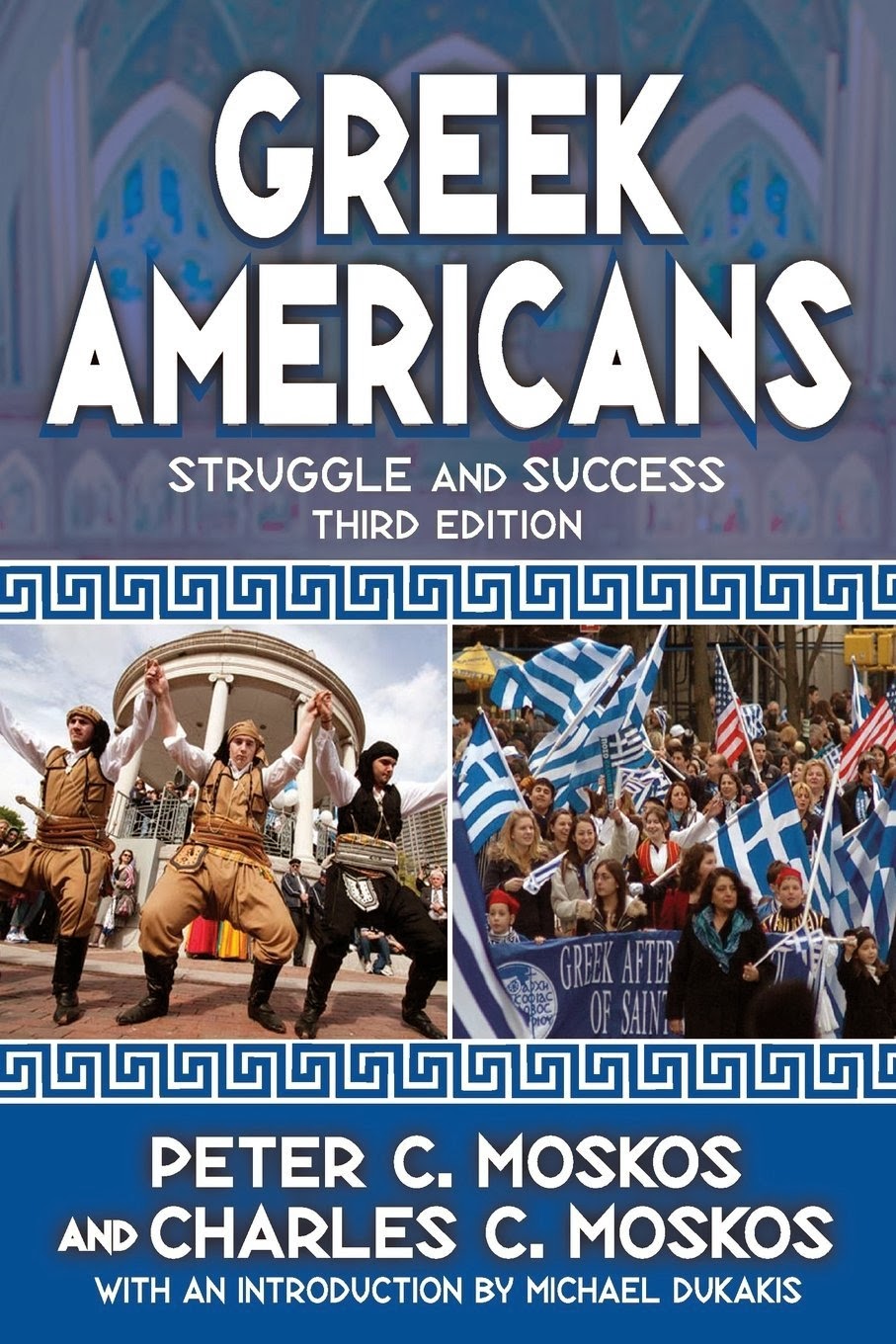
Look, this has nothing to do with police (except for the aforementioned killing), but my third book is finally out. It’s done. It’s a Moskos and Moskos production. It has a dorky cover. And you can buy Greek Americans on Amazon.
Greek Americans makes a great Christmas present…
But let’s be realistic: I know you’re not going to buy this book for yourself. But you might buy it for that Greek guy or girl you know. And come on, you do know a Greek. We’re everywhere. And Greek Americans are guaranteed to love a book on Greek Americans. Why? I don’t know. We just do.
And just think… if give it to that Greek who runs that diner you like, you might get free baklava for life! Why? Because that’s how we Greeks roll.
The killing of South Omaha Police Officer Edward Lowery
Excerpted from Greek Americans: Struggle and Success (3rd Edition):
On the outskirts of South Omaha, Nebraska, was a shantytown of perhaps 3,000 Greek laborers, a number swollen by unemployed railroad workers waiting out the winter. Anti-Greek feeling in South Omaha was already intense owing to the carousing and gambling of the Greeks and, possibly, because many of them were viewed as strikebreakers.
The precipitating incident occurred on February 19, 1909, when one immigrant, Irish-born Police Officer Ed Lowery, arrested fellow immigrant, the Greek-born John Masourides. Lowery was a family man with a labor background. He joined the police force after losing his job at a lard processing plant for refusing, in sympathy with striking workers, to cross a picket line. Thirty-six years old when he left a Peloponnesian village near Kalamata in 1906, Masourides was in many ways a typical Greek immigrant.
He was dark and of medium height, wore a mustache, could speak no English, but could read and write some Greek. He left behind a wife and four children and made his destination Sunrise, Wyoming, where he planned to join his brother Gust. In Wyoming, John worked as a miner for several months after his arrival. The brothers then decided to come to Omaha to start a grocery and confectionary. This they did in South Omaha.
Masourides was with seventeen-year-old Lillian Breese when Officer Lowery arrested him for vagrancy. Some claimed the policeman was drunk and enraged at seeing a Greek publicly walking with a “white” prostitute. Other accounts say Breese was an English teacher and Masourides her student. These two accounts, it should be noted, are not mutually exclusive. Regardless of Breese’s primary vocation, what isn’t in question is that Masourides shot and killed Officer Lowery on the way to the police station.
In court, Masourides said he was attempting to throw his pistol away to avoid being held for carrying a concealed weapon, and was forced to defend himself after the officer began firing. Other witnesses said Masourides fired first. After a failed attempt to lynch Masourides, a petition was circulated and published in two local newspapers:
The so-called quarters of the Greeks are infested by a vile bunch of filthy Greeks who have attacked our women, insulted pedestrians upon the street, openly maintained gambling dens and many other forms of viciousness.
More ominously it declared:
Therefore be it resolved: That we, the undersigned citizens and taxpayers of the city, hereby believe that a mass meeting should be held on Sunday afternoon, February 21, 1909, at the city hall to take such steps and to adopt such measures as will effectually rid the city of the Greeks, and thereby remove the menacing conditions that threaten the very life and welfare of South Omaha.
During the meeting, the crowd was encouraged with anti-Greek speeches. One witness recounted hearing, “One drop of American blood is worth all the Greek blood in the world!”
Following the meeting, over the course of many hours, a mob rampaged through the Greek quarter, burning most of it to the ground. Some thirty-six Greek businesses were destroyed and all the Greeks—and many other immigrants who were mistaken for Greek—were driven by the mob from the city. Later, Mary Demos, the owner of Demos Brothers Confectionary, would testify that when she called the police station for help against the mob, the officer answering “laughed at [her] over the telephone.” Her shop was subsequently wrecked and looted by a group that Demos claimed included police officers.
Another newspaper, which was considered more moderate toward immigrants (and did not publish the anti-Greek petition), still managed to rationalize, if not justify, the rioters’ behavior:
The thing that sticks in the crow [sic] of the anti-Greek element is that they work cheap; live even more cheaply, in groups; are careless of many of the little details that Americans set much store by; once in a while are impudent, ignore the restrictions of American law that lay heavily on the true patriot—in short, do not mix, are not “good fellows” like the citizens we get from northern Europe, for instance.
The press coverage of the riots triggered copycat anti-Greek demonstrations, sometimes violent, in Kansas City, Kansas, and Dayton, Ohio. The irony of immigrant-on-immigrant xenophobia was not lost on at least one newspaper, the Shreveport Journal (Louisiana): “We note with interest that Mr. O’Shaughnessy of Omaha objects to the ‘Greeks taking America.’ As if the O’Shaughnessys and the O’Tooles and other Irish had not already grabbed it.”
One year later, Masourides was found guilty of second degree murder and sentenced to fourteen years in prison. He was furloughed by the governor after five and one-half years, deported, and emigrated, perhaps to Egypt.
The South Omaha riot was given wide coverage in the Greek American press and in Greece. The Greek government lost no time in protesting the acquiescence of the local authorities to the brutality of the mob. The Greek government, along with the Austro-Hungarian and Ottoman Empires, lodged a formal demand for compensation. In 1918 the US Congress did indemnify the Greeks, but for just $40,000 (equivalent in 2012 to $618,000) and not the $288,000 claimed.
-
Defending Flogging Down Under
Waste an hour watching my dangerous idea at the Sydney Opera House’s 2013 Festival of Dangerous Ideas:
There’s also me on a panel “Getting Soft on Crime”:
You can watch all the Dangerous Ideas here. What an amazing weekend and amazingly well run festival! Thanks to everybody at FODI.