Tag: gun control

  • It’s the criminals, stupid. (Or why cops don’t stand for gun control)

    In reaction to this Missouri law, a friend of mine asked me “why police are not standing up to the gun lobby more vociferously and effectively? It seems to me that their jobs are made immeasurably harder and more dangerous by rollbacks in gun laws such as this.” You’d think, she said, police would want fewer guns out there that could kill them. But generally that’s not the case. My reply:

    Partly because there really isn’t any real national police organization to do the standing. And I wouldn’t want a representative national police organization talking about politics, because if such an organization existed, we wouldn’t like what they have to say. [And as if on cue, the FOP came out endorsing Trump. I was hoping they’d keep their mouth shut on that one.]

    There’s the IACP (Int’l Association of chiefs of police). But it’s not like they have a lot of Clout. And this law was opposed by Missouri’s Police Chiefs Association, says the story. I suspect they carry about 20 votes. And organizations of “chiefs” are more Left than their rank-and-file, because a lot of chiefs are appointed by politicians, and have to represent their beliefs.

    Then you’ve got the police unions (the PBA and FOP). They’re technically apolitical, though very much politically conservative. Like any union, there’s a question over how much they should venture beyond working conditions and pay and the like and speak on national issues. Far be it for me to speak for a million cops, but I think most cops do support some gun regulation — and thus oppose what Missouri did — but given the either/or choice between “all guns banned” and “no gun restrictions,” most cops would go with the latter.

    So then we just delve into the gun control debate with all the usual and predictable sides and lack of progress. Cops see danger coming from a small subset of criminals with guns, and not guns in general. Remember: police officers and all their friends are (for the most part) legal responsible gun owners. Cops want laws to focus on criminals and crimes, rather than guns. Collectively, most cops are incredibly pro-gun and equate the 2nd Amendment with freedom (just as you and I might do with the 1st Amendment). Inasmuch as gun laws are seen to infringe their rights while doing nothing to prevent criminals from shooting each other and shooting cops, cops aren’t going to support it.

    Consider this: there are (almost) no shootings in Chicago or New York or Baltimore that involves a legally possessed handgun. We’ve already “controlled” these guns and made them illegal. So what would passing *more* restrictive gun laws do to stop this violence? Are we going to double-dog-dare make them illegal? They’re already illegal. We don’t prioritize the laws we do have.

    How can we take guns out of the hands of criminals? (Or get criminals to use them less?) That’s the $64,000 question. Most gun-control laws are close to irrelevant here. Perhaps the only way to get guns out of the hands of criminals is to confiscate guns with strong gun control, Australian style. Many people, myself included, like this idea. But the majority of Americans and the current Supreme Court would not agree.

    The basic ideological divide is that liberals see guns as the problem and conservatives see criminals as the problem. And nobody on either side has a good plan to keep guns out of the hands of criminals.

    There are three-hundred million guns in America; ten-million guns are manufactured every year! And yet only about 10,000 of these gun are used to murder somebody (plus suicides, of course). How many millions of guns would we have to confiscate before we prevented a single gun homicide? And how would we go about doing this?

    Most proposed gun-control is pretty useless in actually preventing crime (as opposed to preventing a small number of gun sales.) And gun people see this as an ideological battle on gun-owners, so they won’t give in (even on so-called “common-sense” issues). The political reality is that there’s no way right now we could enact gun control so restrictive it would actually do any substantial good.

    Common ground? Maybe actual jail time for people who carry illegal guns? Would liberals support more mandatory sentences for those caught with illegal guns? Without exception? I suspect such a practice did actually contribute to the crime decline in NYC. But you try throwing the words “mandatory minimum” into a room of urban Progressives and see the response you’d get! (The key here is mandatory; the minimum doesn’t have to be long.)

    If gun-control advocates maybe first agreed that criminals with illegal guns are a bigger problem than guns, maybe some political compromise could be reached. I’m afraid gun-control has become a harmful distraction to real issues that can save lives now.

    This past Monday in Baltimore, a 64-year-old man was robbed and attacked while reading a book in a park. A group of young people placed a gun to his head, stabbed him, sprayed him with mace, took his stuff, and then, just for kicks, stabbed him again. That’s just a normal crime, right? But what makes this shocking is less the crime than the girl that was there to film the crime and post it on facebook (which she did)! And this wasn’t their only recent crime.

    I have no clue what gun-control law is going to stop this from happening. Or what law would keep the 13-year-old armed robber with a gun in Ohio (who was just killed by police) from getting his hands on the BB-gun replica he had? And yet there’s more outrage from the Left about police killing this kid armed-robber who had a gun (albeit one that turned out to be non-lethal) than about actual armed robbers.

    Here’s what scares me right now more than guns: the potential right-wing law-and-order backlash. The official 2015 crime data comes out, get this, the day of the next presidential debate. Homicides are way up in America. We know this. Black homicides in particular. It will be the largest increase in decades. And yet the Left has been in denialabout this (and/or discounts its significance). By talking about guns rather than crime, we’re virtually conceding law-and-order issues to Trump and the fascist Right. Politically and morally, this is bonkers.

    [Unrelated, I suspect the phrase “It’s the ______, stupid” is long dated and most people don’t understand it or know its Clinton-Era origin.]

  • Clarence Thomas, misdemeanor convictions, and constitutional rights

    [Note: I wrote this back in March. It never ran. It’s no longer even relevant, since the Supreme Court ruled in June (Voisine v. United States) that you can lose your right to own a gun over a misdemeanor conviction. But I still thought I’d let it see the light of day.]

    On February 22, Supreme Court Justice Clarence Thomas asked his first question from the bench in over 10 years. It might have been worth the wait.

    Most of the news coverage was about the fact he spoke at all. And, of course, of all the questions he could have asked, this one was about giving guns to more people. From the New York Times:

    Justice Thomas’s questions on Monday came in a minor case on domestic violence convictions and gun rights. He made a series of inquiries about whether misdemeanor convictions can permanently suspend a constitutional right.

    “Ms. Eisenstein, one question,” he started, according to a transcript released by the court. “This is a misdemeanor violation. It suspends a constitutional right. Can you give me another area where a misdemeanor violation suspends a constitutional right?”

    After some back and forth, Ms. Eisenstein said she could not think of one, though she added that First Amendment rights could be affected in comparable settings.

    “O.K.,” he said. “So can you think of a First Amendment suspension or a suspension of a First Amendment right that is permanent?”

    She could not.

    Thomas continued:

    You’re saying that recklessness is sufficient to trigger a violation misdemeanor violation of domestic conduct that results in a lifetime ban on possession of a gun, which [is] a constitutional right.

    If the right to own a gun is prohibited because of one misdemeanor plea, can government also take away freedom of speech or the right to vote on a similar pretext?

    Of gun restrictions are particularly relevant to police officers. The Brady Bill, enacted in 1993 after President Reagan and his press secretary, James Brady, were shot, (among other things) forbids anybody convicted of domestic violence from legally possessing a gun. This means that a person who plead guilty to even one domestic-related misdemeanor can’t be a police officer. It’s the only absolute automatic disqualifier to being a cop.

    “Good,” you might say, “people who beat up their partner shouldn’t have guns or be cops!”

    And I’d agree with that. But is our justice system fair? Does it only entraps the guilty?

    You don’t even have to assault someone to be arrested for domestic violence. On a good day police officers’ discretion can weed out most of the innocent before they get arrested. In some states (Maryland, for instance, but not New York) cops cannot arrest people for misdemeanors unless police witness the crime. But in domestic cases the law is different. Police will arrest you if there is any sign of physical injury. But people lie to cops and judges all the time. If you really want to, it’s quite easy to get somebody locked up for domestic violence.

    Sometimes, and it’s never politically correct to bring this up, loved ones be crazy. Many years ago a (female) student of mine was (I do believe) being stalked by her crazy ex-boyfriend. When she called police she got locked up because he was clever enough to go to a judge first, lie, and get a warrant for her arrest. It happens. The irony of a domestic violence victim being arrested because of strong domestic violence laws was not lost on her or me.

    She wanted to be a cop. If she plead guilty, perhaps just to get out of jail that night, she won’t be. And what if she were a police officer?

    Or imagine a case where you get into a small fight with a friend. Nobody is seriously hurt, but somebody called police. You’ve made up by the time police show up. Cops ask if anybody is injured. You both have nothing more serious than minor scratches. That would be that…. “No police services needed,” as the Baltimore Police code goes.

    Unless… unless the case is “domestic.” In Maryland “domestic” means you’ve once had sex. In New York “domestic” expands to people living under the same roof. (Though I’m not certain if two sisters fighting in New York City counts as “domestic violence” under the Brady Bill. I hope not). If it’s “domestic,” somebody is going to jail. That’s how the law works.

    Domestic violence laws eliminate the safeguard of officer discretion, and, unlike non-domestic assault, force police to arrest. Perhaps a domestic victim was defending herself, but gave better than she got. Domestic violence laws handcuff police by forcing police to handcuff others. Basically — and I don’t mean to discount the seriousness of real domestic abuse and progress made in reducing domestic violence — when cops show up to a domestic squabble, two people have had a fight, and cops arrest the winner.

    Innocent people do get arrested. Getting out of jail is one of the reasons people plead guilty to a crime they didn’t commit. We should all remember Kalief Browder. He spent three years in Rikers Island jail for a minor crime of which he was probably innocent. He just wanted his day in court. He never got it. After three years of incarceration (and abuse by inmates and guards) prosecutors dropped all charges. A short time later, after being released, he killed himself.

    Now perhaps you’re willing to accept a few innocent arrests if it reduced crime. But the irony is that mandatory and preferred-arrest domestic-violence laws, because they’re harsh and reduce police discretion, do very little to reduce domestic-violence. And the effect of arrest on the poor and employed — to whom the law is disproportionate applied — is harmful: arrests increase domestic violence recidivism. The laws do not work.

    Take this case I wrote about in In Defense of Flogging (The title, I feel I should point out, does not refer to domestic violence):

    Once I responded to a domestic call after a man came home, admitted to catting around, got yelled at, and earned a big fat lip when his wife slugged him. He deserved it, he told me (and he probably did). But while his wife was yelling, neighbors called the police. Guess what? She went to jail.

    That’s the way it is. That’s how mandatory and preferred arrest laws work on the street. Of course had this case not been domestic-related, I never would have locked her up. And I assume she plead guilty (since she was) to misdemeanor assault. Now she has a record for domestic violence and can never legally own a gun.

    When you combine overly restrictive domestic-violence laws with overly permissive prosecutorial discretion, you get a perfect storm of injustice. Thomas’s point, a valid point, I think, is rarely does one misdemeanor plea have such constitutional — and in a cop’s case, occupational — consequences. It’s time to rethink these laws.

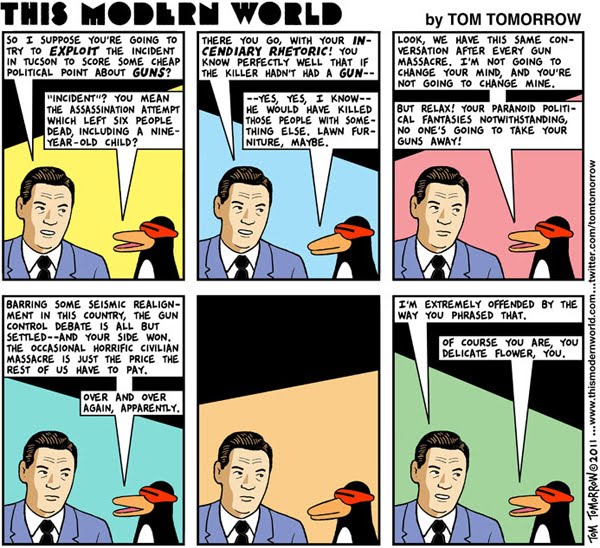
  • Gun Control? “Your Side Won”

    Gun Control? “Your Side Won”

    First published many years ago. I’ll just keep doing so.

    Tom Tomorrow, one of my favorite cartoonists, summarizes gun control and killings quite well. Click through to read.

    “Barring some seismic realignment in this country, the gun control debate is all but settled–and your side won. The occasional horrific civilian massacre is just the price the rest of us have to pay.”

    “But relax,” as the penguin says, “Your paranoid political fantasies notwithstanding, no one’s going to take your guns away!”

    Here’s a more recent one. Tom Tomorrow hasn’t lost it.

  • Why did New Yorkers stop shooting each other?

    In New York City not only has the number of homicides being going down, but the percentage of homicides committed with a gun has been decreasing.

    Put another way, there were about 309 people shot and killed in 2011 in NYC (for UCR reasons we’re talking incidents, so this is a bit of an undercount). In 2013: 188. That’s a huge decrease. (2014 saw 184.)

    If you look at all other city homicides (ie: non-gun), they’re down a little. But the decrease in NYC is all about fewer people shot. Did New Yorkers get together in 2011 and decide to stop shooting each other? I missed that meeting. Was it because of Occupy? Or because Occupy was broken up? Did anti-police protests somehow reduce gun violence? I doubt it. But something happened, and I don’t know what it is.

    Oddly, the NYPD didn’t take credit for this crime drop because it coincided with anti-police protests and the end of stop and frisk. Cops and Kelly and those on the right were certain — hoping even — that crime was going to skyrocket. They’ve been saying that since at least 2012. Well, it’s 2016.

    Here is some UCR homicide data from 2014 (if you hold your breath for 2015, you’ll turn blue and pass out):

    New York City: 56 percent of homicides are by gun, 26 percent by knife (“or cutting instrument”). Nationwide is 68% gun, 13% knife.

    A few other cities:

    Baltimore: 75% gun, 18% knife.

    Chicago: 87% gun, 7%knife.

    Los Angeles: 73% gun, 13% knife.

    Here’s the percentage of NYC homicides that were gun-related at various years (UCR data):

    1990: 74% of homicides by gun

    1997: 61%

    1998: 60%

    1999: 59%

    2000: 66%

    2002: 61%

    2005: 61%

    2009: 63%

    2010: 61%

    2011: 61%

    2012: 57%

    2013: 59%

    2014: 56%

    So maybe that’s not the issue. Honestly? A five-percent decrease since 1997 ain’t such a big deal. But my gut tells me a 5-percent slow but steady drop since 2011 does mean something.

    Of course it *is* related to gun control. But as any 2nd-Amendment-loving Trump-loving patriot will tell you (often in all caps) “CHICAGO HAS GUN CONTROL!!!!” And Chicago, if this is too subtle for you, has a lot of killings.

    So maybe, at least this is what I think, gun control isn’t about gun laws as much as actual prosecution and deterrence. New York is the only city where people believe — mostly correctly I might add — that illegal gun possession will bring you real time.

    What if it were that simple?

  • Yeah, but they’re foreigners!

    What can we learn from them? I know. Nothing. Because this is America. Exceptionalism and all that. I’m not saying we could go to this model overnight, damnit! But we could still learn from it. We could learn a lot from other countries, if we got around to looking. If we start looking at police in other countries, next thing you know we’ll have socialism and universal health care.

    Man… that’s a lot of disclaimers for a thought provoking piece in the Washington Post about Britain’s police and their tendency to not shoot people.

    Of course there are differences — big differences, mostly with guns and gun laws — between the US and UK. No need to point this out. I know. But it’s not like England doesn’t have guns. There are about 1.8 million legally owned guns in England and Wales.

    The stats are amazing. In all of England and Wales, with 56 million people, only about 5 officers discharge their firearm in any given year. (Killing about 3 people per year. There are about 550 homicides over there in all. About 44 or so with guns.)

    About 1 in 13 gun killings in the US are committed by law enforcement. That probably means something like 1 in 20 of all homicides (I have not done the math. But 5 percent is probably a good ballpark figure). That figure kind of shocks me. In England and UK, it’s about 0.5 percent. (For what it’s worth, police over there are still responsible for about 1 in 13 gun killings. It’s just the numbers for both are a lot lower.)

  • Gun Rights

    This recent decision in DC saying there is right to carryis actually bigger news than you’d think. Why? Because up till now you did not have that right.

    This decision asserts constitutional rights beyond what the Supreme Court has ever ruled. The Court said that the government cannot prevent you from having a gun in your home for protections. But that’s it. Now this was a huge decision because, for the first time ever, the Court, in Heller and McDonald, ruled that the 2nd Amendment indeed does give an individual a right to bear arms.

    This wasn’t the intention of the Founding Fathers and has never been the case in US history, but what is good for the (liberal) goose is good for the (conservative) gander. I have no problem with the Court expanding our rights (or more correctly: limited the rights of the government). The 9th Amendment says this explicitly (though this Amendment, for reasons I do not understand, is rarely invoked in Court opinions).

    Still, given those Supreme Court decision, the government could regulate ammo, the kinds of gun, and everything about guns in public. But even with those restrictions, Heller and McDonald were landmark cases that re-interpreted and expanded the 2nd Amendment. But all they said is that regulations could not prevent, again, you from having a handgun in your home for protection. That’s it. But it was huge.

    But now a lower court has said you, my fellow American, have a constitutional right to carry a gun in public. That is a huge expansion of the the core rights of the 2nd Amendment. We’ll see if it stands.

  • Detroit police chief gives credit to armed citizens for drop in crime

    From the Detroit News:

    The incident was the latest in a string of homeowners opening fire to defend themselves, although after a flurry of such shootings early this year, before Monday there hadn’t been a reported incident since May 4 — an indication that criminals are thinking twice about breaking into people’s houses, Craig said.

    Detroit has experienced 37 percent fewer robberies in 2014 than during the same period last year, 22 percent fewer break-ins of businesses and homes, and 30 percent fewer carjackings. Craig attributed the drop to better police work and criminals being reluctant to prey on citizens who may be carrying guns.

    “Criminals are getting the message that good Detroiters are armed and will use that weapon,” said Craig, who has repeatedly said he believes armed citizens deter crime. “I don’t want to take away from the good work our investigators are doing, but I think part of the drop in crime, and robberies in particular, is because criminals are thinking twice that citizens could be armed.

    “I can’t say what specific percentage is caused by this, but there’s no question in my mind it has had an effect,” Craig said.

    A 2013 study by the American Journal of Public Health found that the states with the loosest restrictions on gun ownership had the highest gun death rates. But a 2007 Harvard University study found that banning guns would not have an effect on murder rates.

    I don’t know why it says “but” instead of “and.” Those lat two conclusions are not at all mutually exclusive.

  • Zimmerman Trial (2): Justice vs. Stand Your Ground

    I received this interesting and thought-provoking email from my friend Alan (bold added):

    It seems to me that if Zimmerman is convicted of a felony, then the Florida laws are apparently defensible. Sure, a guy is allowed to shoot someone in certain circumstances; in this case such circumstances did not present and so he’s going to jail. The laws did not apply and the state justly punishes the perpetrator.

    On the other hand, if the prosecution fails and the court acquits, now we can assert the Florida laws have accommodated the brutal slaying (since you can’t call it “murder”!) of an unarmed youth, and now we can more easily make a case that the FL laws are ridiculous.

    In other words, as liberal pacifists who appreciate the state’s monopoly on armed force, a guilty verdict serves us poorly. It has the welcome effect of obtaining immediate justice for Trayvon Martin’s death (since repealing the laws presumably wouldn’t remove Zimmerman’s protections that applied at the time), but Florida civilians can continue to walk around with concealed weapons and use them with impunity. The long play here is to pull for an acquittal.

    I prefer the short-play here and would like to see the killer of Martin convicted. But I think the Florida stand-your-ground law is so broad (and poorly written) that I can see a legal case for Zimmerman’s acquittal (though not a moral one).

  • Police officers’ opinions on gun violence and gun control

    A summary of the results of a survey of 15,000 police officers by Police One.

  • Gun Guys, by Dan Baum

    Gun Guys, by Dan Baum

    I finished reading Gun Guys, and it’s very good.

    Here’s Dan Baum talking about his book on the BBC. And here he a more in-depth interview with Dan Baum on KMO’s C-Realm Podcast (which just happens to have been recorded in my basement). [Update: and here is Baum in the New York Times.]

    Baum makes the point that nothing productive with gun policy unless anti-gun people actually listen to gun guys. And he presents his case from a “liberal Jewish gun-loving” perspective. This book isn’t a defense of the NRA, since the NRA represent but a small minority of gun owners (something like 4 million of 100 million gun owners). But rather an attack on the gut-level reaction so many liberals have against gun, without considering (or worse, mindlessly dismissing) the thoughts, feelings, and needs of hundreds of million of non-criminal gun owners.

    A take-away point is that guns are here, like them or not. We can pass all the pointless laws we want, but if we want a safer and less violent America, we need to have an engaging, serious, and rational conversation about guns. Gun Guys does that. How does it make sense to advocate restricting something when the people advocating such restrictions have no idea what they’re talking about? For instance, if the goal is fewer guns, how does it make sense to push for laws that result in a boom in gun sales?

    I do think Baum places a bit too much of the onus on people who don’t like guns. It doesn’t seem to much to ask for a less violent America. Even an America with fewer guns (not that those two are necessarily related–the past two decades have seen less restrictive gun laws, more guns, and a reduction in violence). But to say something isn’t politically feasible is different than saying something isn’t a good and even noble goal.

    Baum stretches credibility a bit when he makes the analogy that hating gun owners is akin to being racist or anti-semitic. But he’s right in that such mindless hatred is often based in ignorance and fear of people the hater makes no effort to get to know. But what about the mindless and ignorant fear of gun owners who think their guns are going to be taken away or feel an irrational need to protect themselves from some criminal class of people? From my perspective, too much of “gun rights” is linked to “state’s rights” and “protecting a way of life” and fear of some “them” taking over America. Until there is serious discussion about repealing the 2nd Amendment, why such paranoia about an assault on freedom? I mean, I love the 1st Amendment, but I’m not shouting objectionable things in the street to protect my 1st Amendment rights. Why? Because they’re not in jeopardy!

    There’s also the point (not in the book) that guns are not freedom. Guns protect freedom. We should be worried about our freedoms being taken away (warrantless searches, mass incarceration, indefinite detention without due process, Presidential-ordered assassinations of US citizens). Having guns without freedom is, to paraphrase Bill Maher, like being in a titty-bar filled with bouncers but no strippers!

    Regardless, Baum makes the essential point that simply hating guns and people who own them is counterproductive from any anti-gun or anti-violence perspective. Most guns are not the problem. Most gun owners are not the problem. And until gun-control people get that through their thick liberal heads, nothing productive will ever happen. Certainly this book is a great starting point to any rational discussion on guns and gun policy. It’s also a good read.

    At its core (and in its title), Gun Guys is a road trip. Who doesn’t like a road trip? Baum takes the reader on an adventure while he talks to as many gun owners and stops in as many gun shops and gun shows as possible. Entertaining and educational! What more could one ask for?

    Now buy his book and read it. You’ll be happy you did.