Tag: guns

  • Why they carry illegal guns in Chicago

    There an interesting studyby the Urban Institute on young men carrying guns in Chicago. This has already been misrepresented in the Chicago Sun-Timesas “1 in 3 young people surveyed in four Chicago neighborhoods say they carry a gun.” Factually true… but meaningless because they’re trying to survey people who carry a gun. 100% is the goal. It’s not trying to be a representative sample (even of a high violence neighborhood) or figure out how many people carry illegal guns. Rather, they tried to figure out why people carry guns (and what will make them less likely to do so).

    Not surprisingly, most people who carry a gun illegally do not do so all the time. Of gun carriers (n = 97), 7% say they always carry; 16% say they often do; 32% say sometimes; 45% rarely. Most who carry say they do so “for protection,” which also isn’t surprising. (What is surprising is the 6 people who said they carry a gun to commit crime.) Fear is real. So is the chance of being shot. So either we work to arm everybody who is afraid, or — better — we deescalate the streets and work to reduce fear by reducing violence and number of people carrying illegal guns.

    Of those who carry a gun, 37% say they have been the victim of a shooting or attempted shooting in past year. 85% know somebody who has. That figure is important and perhaps not well known enough. Instead of complaining when certain politicians call Chicago a disaster or a war torn — “oh, it’s not all neighborhoods,” say some — perhaps we should focus on making sure some neighborhoods aren’t so lethal!

    Most respondents say it’s easy to get a gun, and they could get one in a few hours from a street dealer, a friend or family member, or steal a gun. 84% of gun carriers say they’re not likely to get caught carrying. That percentage is lower (by a little) for those who don’t carry. Still, this indicates some potential for a deterrent effect.

    The sample of those who have illegally carried a gun is, not surprisingly, not pro-police. 75% of those who have carried say police have stopped them “for no good reason.” This in kind of ironic, since illegal gun carriers are exactly whom we want police to stop.

    And there’s an odd bit of data presentation. Either they’re not being great at the stats game or are trying to mislead. I think it’s the former. Two groups are compared over and over again: “those who have carried” and “entire sample.” But why include the first group in the 2nd group and then compare differences? Separate them. Also, “entire” implies it’s representative of something, but it’s not. It’s a non-random targeted sample.

    The groups are easy to separate. Or at least I did so based on their figure 9. And when I did so, for instance, 71% of the sample says police “often stop people for no good reason.” But of those who don’t carry guns, that figure goes down to 60%. Even for this sample, it’s surprising to me that of those who don’t carry, as many as 40% cannot agree with the statement “police stop people for no good reason.”

    I would like to see a sample in the same neighborhood of those who have nothing to do with carrying illegal guns or those who do. What are their opinions of police? That’s the group I would care about, in terms of police legitimacy.

    Do tell us what illegal-gun carriers think of police. But criminals aren’t supposed to like the police. And as this is an intentionally non-random sample, the part of the sample that doesn’t carry (or says they don’t) is an odd group from which one should not generalize.

    Their attitudes on police will be used to question police “legitimacy,” but that seems like abit of a distraction. The carriers of guns say they are carrying because of fear of victimization. More violence decreases legitimacy. Fewer stops by the Chicago Police Department haven’t increased legitimacy. And after having a “well paid job,” the top 5 leading preventative factors, according to those who carry illegal guns, are “none of their friends did,” “knew they would be arrested,” “more police on the street,” “guns cost more,” and “knew they would end up doing time.”

    To me those are all clues. I do want to know why gun carriers carry guns. And I also want to know what those don’t carry avoid doing so. The study concludes by stressing non-police “holistic” solutions “outside the criminal justice system” (which are no doubt needed). But based on gun-carrying respondents, four of the top six solutions involve police.

    Fear of getting caught can give people an out, a good excuse to not carrying a gun. Even though people don’t want to admit it, arrest, prosecution, legal stops, and legal frisks are *part* of the solution. And while others get holistic, police can focus on the police side. Police can reduce violence by reducing fear by getting people to leave their guns at home. De-policing to reduce encounters in Chicago (and elsewhere) hasn’t worked. “Holistic” needs to include police.
  • Chicago violence

    Chicago violence

    Maybe killers don’t dress with such flair in Chicago as they do in Detroit. But what Chicago murders lack in quality, they make up for in quantity.

    Some experts prefer to put their head in the sand and hope it all goes away:

    “Trying to read too much into this is a grave mistake,” said Craig B. Futterman, a clinical professor of law at the University of Chicago. “We’re all just guessing.”

    Really? A “grave mistake” when homicides are almost doubled compared to the same time last year? No. It’s high time for everybody to give their best guess. Here’s mine:

    Since January, officers have recorded 20,908 times that they stopped, patted down and questioned people for suspicious behavior, compared with 157,346 in the same period last year. Gun seizures are also down: 1,316 guns have been taken off the streets this year compared with 1,413 at this time last year.

    And convictions in gun cases are getting hard to win:

    In part, that’s because of the public’s concern over police tactics in the wake of high-profile shootings of African-Americans by police officers around the country, according to both prosecutors and defense attorneys.

    It’s not so much as a “guess” as connecting the dots. That decrease in stops was by design:

    …tied to a departmental change that took effect in January, requiring officers to fill out a far more detailed form for each one. The change was imposed after the American Civil Liberties Union raised questions about whether officers were targeting minorities in their stops.

    Well, of course they were. How are you going to target homicides in Chicago without a focus on minorities? Of 3,000 people shot and 506 killed in Chicago, 80 percent were black and another 15 percent hispanic. 95 percent of those killed are black or hispanic in a city that is roughly two-thirds black or hispanic.

    So yeah, when it comes to preventing gun violence in Chicago, the police would be remiss if they didn’t focus on minorities. And men, too (90 percent of victims). Should police stop more Polish-American women in Jefferson Park? Jefferson Park would love more police presence (if that were possible). (To my surprise, there even was a murder in Jefferson Park last year. One.)

    Of last year’s murder carnage just 123 suspects have been arrested. The clearance rate was 25 percent. So there’s room for improvement there, too. Right now literally hundreds of active murderers are walking around the streets of the South and West Sides of Chicago. 142 murders just through March.

    Look, maybe an increase in shootings in Chicago isn’t related to decreasing interaction between police and criminals. Maybe there is no cause and effect between attempts to limit and control police activity against young black and hispanic men and an increase in violence among some of these same young black and hispanic men. Yes. It’s a guess.

    But what if aggressive policing — and inevitably some of that will cross the line to an illegal stop or search — actually prevents violence? What if there were a cost to a laser-like and exclusive focus on police misconduct? Reducing police stop in general is one way to reduce illegal police stops and citizen complaints. But maybe it’s the wrong way. What if one consequence of focusing only on police misconduct were fewer gun convictions? What if it were more murders? (And God forbid you call this relationship something like the Ferguson Effect, because that doesn’t exist.)

    Hey, on the plus side, police-involved shootings in Chicago were down in 2015. Mission accomplished, I guess.

    Here’s the most shameful response to more murdered black men:

    Some experts… point out that the numbers in recent years have been below those in the early 1990s, when more than 900 murders were reported some years.

    Wow. And so effing what?! Talk about the soft bigotry of low expectations. Imagine saying we needn’t worry about institutional racism because it’s so much less today than it was in the 1960s (and 1860s, for that matter). Or check into a hospital where mortality is up and their response is: “Trying to read too much into this is a grave mistake. We’re all just guessing. Besides, mortality was so much greater in the past.”

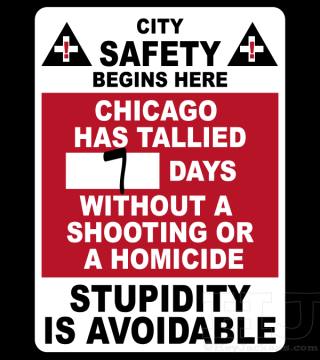
    Also, from the fun info at heyjackass.com, Chicago saw but 7 days in 2015 without a reported shooting or homicide. Seven.

    Also, on the subject of the CPD, I’m happy an insider seems to have been tapped to be the next chief of police in Chicago. I have no idea who the person is. But I’m happy it’s not another outsider with no real clue coming in to save the day.

  • I wanna be a cowboy…

    In some ways this is just another shooting in the hood.

    But I post it because, well, look at her Jessie getup!

    Also, she packs her gun in her panties.

    And there’s high quality video.

    Does there have to be more?

    I wanna be a cowboy… and she can my cowgirl.

    This is the violence problem in America. Have an argument? Upset? Feel bad? Get a gun, holster it in your undies, and then use as needed at the gas station.

    On the plus side, no police officer got in trouble for confronting, frisking, or even having to shoot this juvenile.

    I’m assuming she’s just a “girl” since her name wasn’t released. I also feel sorry for any youngsters who watched this and say, “That’s mom!”

    [Also, notice the cross around her neck. Here’s yet another example of radical Christian terrorism. And yet nobody but me has noticed this clear sign of Christian jihad.]

  • Why did New Yorkers stop shooting each other?

    In New York City not only has the number of homicides being going down, but the percentage of homicides committed with a gun has been decreasing.

    Put another way, there were about 309 people shot and killed in 2011 in NYC (for UCR reasons we’re talking incidents, so this is a bit of an undercount). In 2013: 188. That’s a huge decrease. (2014 saw 184.)

    If you look at all other city homicides (ie: non-gun), they’re down a little. But the decrease in NYC is all about fewer people shot. Did New Yorkers get together in 2011 and decide to stop shooting each other? I missed that meeting. Was it because of Occupy? Or because Occupy was broken up? Did anti-police protests somehow reduce gun violence? I doubt it. But something happened, and I don’t know what it is.

    Oddly, the NYPD didn’t take credit for this crime drop because it coincided with anti-police protests and the end of stop and frisk. Cops and Kelly and those on the right were certain — hoping even — that crime was going to skyrocket. They’ve been saying that since at least 2012. Well, it’s 2016.

    Here is some UCR homicide data from 2014 (if you hold your breath for 2015, you’ll turn blue and pass out):

    New York City: 56 percent of homicides are by gun, 26 percent by knife (“or cutting instrument”). Nationwide is 68% gun, 13% knife.

    A few other cities:

    Baltimore: 75% gun, 18% knife.

    Chicago: 87% gun, 7%knife.

    Los Angeles: 73% gun, 13% knife.

    Here’s the percentage of NYC homicides that were gun-related at various years (UCR data):

    1990: 74% of homicides by gun

    1997: 61%

    1998: 60%

    1999: 59%

    2000: 66%

    2002: 61%

    2005: 61%

    2009: 63%

    2010: 61%

    2011: 61%

    2012: 57%

    2013: 59%

    2014: 56%

    So maybe that’s not the issue. Honestly? A five-percent decrease since 1997 ain’t such a big deal. But my gut tells me a 5-percent slow but steady drop since 2011 does mean something.

    Of course it *is* related to gun control. But as any 2nd-Amendment-loving Trump-loving patriot will tell you (often in all caps) “CHICAGO HAS GUN CONTROL!!!!” And Chicago, if this is too subtle for you, has a lot of killings.

    So maybe, at least this is what I think, gun control isn’t about gun laws as much as actual prosecution and deterrence. New York is the only city where people believe — mostly correctly I might add — that illegal gun possession will bring you real time.

    What if it were that simple?

  • ShotSpotter

    Anybody know if ShotSpotter is good? From an NYPD press release:

    This is one of more than 30 firearms that have been recovered since the inception of the ShotSpotter program, back in March of this year.

    Three guns a month doesn’t seem like so many. But then to get 30 guns off the streets, back in the old stop-and-frisk would have meant stopping 26,370 people!

    How does ShotSpotter work in practice? Is a response mandatory or discretionary? What about false positives?

  • Yeah, but they’re foreigners!

    What can we learn from them? I know. Nothing. Because this is America. Exceptionalism and all that. I’m not saying we could go to this model overnight, damnit! But we could still learn from it. We could learn a lot from other countries, if we got around to looking. If we start looking at police in other countries, next thing you know we’ll have socialism and universal health care.

    Man… that’s a lot of disclaimers for a thought provoking piece in the Washington Post about Britain’s police and their tendency to not shoot people.

    Of course there are differences — big differences, mostly with guns and gun laws — between the US and UK. No need to point this out. I know. But it’s not like England doesn’t have guns. There are about 1.8 million legally owned guns in England and Wales.

    The stats are amazing. In all of England and Wales, with 56 million people, only about 5 officers discharge their firearm in any given year. (Killing about 3 people per year. There are about 550 homicides over there in all. About 44 or so with guns.)

    About 1 in 13 gun killings in the US are committed by law enforcement. That probably means something like 1 in 20 of all homicides (I have not done the math. But 5 percent is probably a good ballpark figure). That figure kind of shocks me. In England and UK, it’s about 0.5 percent. (For what it’s worth, police over there are still responsible for about 1 in 13 gun killings. It’s just the numbers for both are a lot lower.)

  • Shootings up in NYC

    The recent crime numbers in NYC will soon come out, and they’re not good. Homicides this week are way up compared to last year. Of course that’s just one week… till it’s not. Shootings are up in NYC. Not Baltimore up. But up. People are dying. It is time to ring the alarm. Maybe not the crazy 5-alarm fire for Baltimore. Maybe a simple 1-alarm would do NYC. But more people are dying.

    So what might be the cause? A lot of things of course. One factor may be people’s willingness to carry heat. Word on the street is that guns are back in town. As I was told: “People are now shooting into crowds more often, doing drivebys, more often, and shootings as teams more often. The risk for carrying a gun in nearly zilch. Bottom line: cops aren’t stopping people, and young black men are paying for it with their lives.”

    Stop and frisks are down roughly 95%. Now we could debate whether certain police tactics are legal, constitutional, or moral. We should debate these things. Maybe it’s OK to have 50 more dead bodies in NYC if hundreds of thousands of other young black men aren’t stopped by police for no good reason. So let’s have that debate. What bothers me is the disingenuousness of those who refuse to grant criminals any agency in crime. Like Broken Windows is the root of all evil. Like it is inevitable that 2015 would see a 10 to 20 increase in shootings in Brooklyn. And it must have been written by the Almighty that some in Baltimore would riot on April 27, and then the homicide rate would skyrocket.

    Criminals don’t leave their guns at home because they’re asked politely by community leaders. It is possible that force and coercion might, in some cases, keep people alive. Remember (before we forget) that the arguments against stop, question, and frisk weren’t only that it was illegal, unconstitutional, and morally reprehensible. It was that it didn’t work — that stop, question, and frisk was actually counterproductive with regards to crime prevention. (I never quite understood that argument, but it was said.)

    The role of guns in NYC homicides is surprisingly varied. It wasn’t that long ago (well, the 1970s) that guns were used in less than half of all murders in NYC. In 1960, at least according to one source, guns were used in just 20 percent of homicides. But that changed in late 1960s and 1970s.

    By 1990, guns in NYC out of control. 1,650 killed by guns, 75% of all murders, higher than the national average (not including NYC) of 67%. (All these percentage may be a bit low based on “other and unknown”.)

    So along with all murder going down in NYC, gun murders went down in particular.

    In 2000 65% of murders in NYC involved guns. (Compared to 66% in the rest of the nation. UCR data, all.)

    In 2005 61% in NYC. (Rest of nation: 68%.)

    In 2010 60% in NYC. (Rest of nation: 68%.)

    In 2013 59% in NYC. (Rest of nation: 70%.)

    Meanwhile, the percentages of gun homicides in other cities is much higher: 84% in Chicago; 79% in Los Angeles; 81% in Baltimore. So New York looks all the more impressive.

    This was a little heralded victory against gun crime in NYC. While the rest of the country saw a small increase in the percentage of homicides involving guns, NYC saw a decrease.

    I asked my friend, Dan Baum, who insisted on being identified as “a liberal Democrat Jewish gun owner who wrote Gun Guys: A Road Trip“. Baum can write. (Too bad you didn’t buy his book.)

    Anyway, I asked Baum about what changed in the 1960s. Gun violence increased 50% in the 1960s (five times more than other/non-gun violence). He said:

    What changed in the early 1960s? JFK was shot, and the liberals began their long love affair with gun control. Until 1968, you could buy guns through the mail. Guns were things that people owned, but they weren’t a cultural marker, a badge of belonging to a particular subculture.

    The liberals changed all that, by relentlessly pushing the bubbas into a corner. Suddenly, people were in a panic to buy all the guns they could, because they never knew when the liberals were going to ban their sale altogether. The NRA, taken over by the loonies in 1977, pushed that narrative. The number of guns circulating in private hands exploded exponentially, with predictable results. Not only that, a tremendous amount of anger was injected into the national discussion around guns — also not a good thing.

    So I’d argue that we have the liberals, and gun control, to thank for the huge increase in gun murders. Guns are way more prevalent than they used to be, because the liberals made them a thing. Had they not done that, we’d be back in 1960 America — guns being a thing that some people own, that have no cultural/political/spiritual significance.

  • Bringing a gun to a gun fight

    It does seem pretty stupid to rob a gun store. But it also calls into question the deterrent effect of guns. A good man with a gun was not enough to stop four bad people with guns. There was a gunfight. The store owner was killed. His wife believes her life was saved because of his gun. I wonder.

  • Detroit police chief gives credit to armed citizens for drop in crime

    From the Detroit News:

    The incident was the latest in a string of homeowners opening fire to defend themselves, although after a flurry of such shootings early this year, before Monday there hadn’t been a reported incident since May 4 — an indication that criminals are thinking twice about breaking into people’s houses, Craig said.

    Detroit has experienced 37 percent fewer robberies in 2014 than during the same period last year, 22 percent fewer break-ins of businesses and homes, and 30 percent fewer carjackings. Craig attributed the drop to better police work and criminals being reluctant to prey on citizens who may be carrying guns.

    “Criminals are getting the message that good Detroiters are armed and will use that weapon,” said Craig, who has repeatedly said he believes armed citizens deter crime. “I don’t want to take away from the good work our investigators are doing, but I think part of the drop in crime, and robberies in particular, is because criminals are thinking twice that citizens could be armed.

    “I can’t say what specific percentage is caused by this, but there’s no question in my mind it has had an effect,” Craig said.

    A 2013 study by the American Journal of Public Health found that the states with the loosest restrictions on gun ownership had the highest gun death rates. But a 2007 Harvard University study found that banning guns would not have an effect on murder rates.

    I don’t know why it says “but” instead of “and.” Those lat two conclusions are not at all mutually exclusive.

  • Guns and Homicides

    Guns and Homicides

    We all, er, know that guns don’t kill people (even though that is what they’re designed to do).

    But what I didn’t know was that guns really didn’t kill people until just a few decades ago.

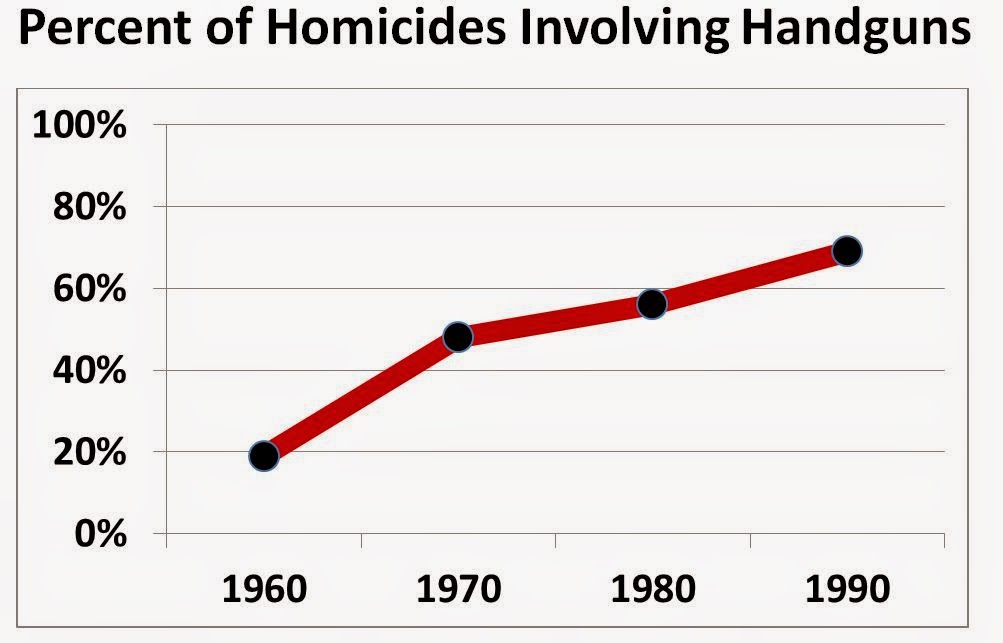
    As recently as 1960, just 20 percent of NYC homicides involved a gun! That went up to 48 percent in 1970 and 69 percent in 1990. And I think it’s remained at about two-thirds ever since.

    The jump from 1960 to 1970 is amazing. Remember, this isn’t the crime rate or the number of homicides but the percent of homicides using a gun. What happened? How and why did guns suddenly spread to the criminal class?

    (And feel free to applaud me for an all-too-rare use of full-and-honest scaling on the y-axis… you know want to.)