Tag: incarceration

  • Eastern and Western State Penns

    Eastern and Western State Penns

    I wrote about Philadelphia’s Walnut Street Jail and Prison and the Eastern State Penn in In Defense of Flogging, but I had never seen the inside of Eastern State Penn…. until now!

    Thanks to having written a book about prisons (to be honest, it didn’t hurt that my wife writes guidebooks, but whatev), we got a little private tour . Unfortunate I didn’t even have my real camera with me.


    Amazingly, by sheer chance, I stumbled across the site of its sister prison, the lesser known Western State Penn, just last week.

    The prison is gone. But the eagle is real!

  • “13 Years in the Slammer … for Two Joints?”

    I’m generally quick to point out that there aren’t too many people doing long time for small scale drug possession. (Usually this in the context of pointing out that drug decriminalization will not empty our prisons.)

    But it does happen. And it shouldn’t happen. Ever.

    How is anyone in prison for 13 years for possessing two joints? It’s possible if you’re a “habitual offender” and in Louisiana:

    In Bernard Noble’s case, getting caught with a couple of joints morphed into more than 13 years behind bars because of the way the state’s harsh marijuana laws intersect with its harsh habitual offender law (known colloquially as “the bitch.”) Because Noble had two previous drug possession offenses, one 12 years old and one 24 years old, he fell under the purview of the habitual offender law.

    Even though his current offense was trivial (pot is decriminalized in nearly 20 states and possession is legalized in four others and DC) and even though his previous offenses were low-level and non-violent, the statute called for the 13 years, without parole.

    Taking into account Noble’s minor criminal history, his work record, and his role as the breadwinner for a family with seven children, and making special note of his overpayment of child support to children not living with him, his sentencing judge departed from the statute and sentenced him to only five years. Orleans Parish prosecutors appealed the lower sentence to the state Supreme Court and got the 13-year sentence reinstated last year.

    What is wrong with us?

  • If crime doesn’t pay, why is it so expensive?

    And in case you were wondering, the cost of housing a prisoner in jail on NYC’s Rikers Island is now officially $100,000 per year! You get what you pay for, they say. $1.1 billion dollars. 42 percent higher than seven years ago. “During the same period, there was a 124 percent increase in assaults on the staff by inmates at city jails, and triple the number of allegations of use of physical force by guards.” Mazel Tov.

  • Life in Federal Minimum-Security Prison… Free Kariakou!

    Life in Federal Minimum-Security Prison… Free Kariakou!

    Not too long ago I sent my Greek Americans book to John Kiriakou. He’s a proud Greek American and about as close to a political prisoners as we have. In his own words:

    I’m one of the people the Obama administration charged with criminal espionage, one of those whose lives were torn apart by being accused, essentially, of betraying his country. The president and the attorney general have used the Espionage Act against more people than all other administrations combined, but not against real traitors and spies. The law has been applied selectively, often against whistle-blowers and others who expose illegal, corrupt government actions.

    After I blew the whistle on the CIA’s waterboarding torture program in 2007, I was the subject of a years-long FBI investigation. In 2012, the Justice Department charged me with “disclosing classified information to journalists, including the name of a covert CIA officer and information revealing the role of another CIA employee in classified activities.” I had revealed no more than others who were never charged, about activities — that the CIA had a program to kill or capture Al Qaeda members — that were hardly secret.

    Eventually the espionage charges were dropped and I pleaded guilty to a lesser charge: confirming the name of a former CIA colleague, a name that was never made public. I am serving a 30-month sentence.

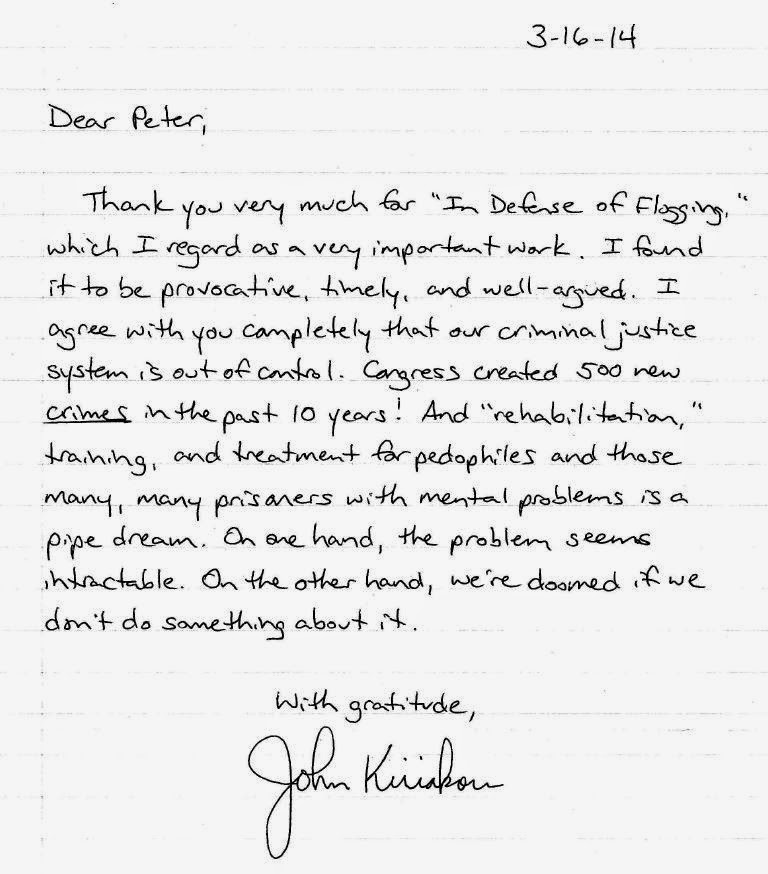
    After getting my book, Kiriakou wrote me back a nice thank-you note (hand-written, of course) so I then sent him another book of mine, In Defense of Flogging. I figured he has plenty of time on his hands to think about incarceration. Kiriakou mentions me in his his latest missive from Loretto Minimum Security Federal Prison. It’s a good read, if for nothing else his concise summary of prison religions and having to deal with pedophiles in prisons. The latter includes this:

    Loretto’s “Education” Department scheduled a prisoner-led class last fall called “Quantum Physics.” Nobody bothered to check whether the prisoner-teacher was qualified to teach a course on quantum physics, nor did anyone request a lesson plan. As it turned out, the gay prisoner-teacher’s only degree was from the Ringling Brothers Barnum & Bailey Clown College. The course had nothing to do with quantum physics. It was a self-help pity party for pedophiles, and it sought to help them expand their rationale of denial, with the theme from “Rocky” playing in the background all the while. The teacher began the course by chanting, “We’re homos and we’re chomos! We’re homos and we’re chomos!” (“Chomo” is short for “child molester.”) One African-American prisoner, who expected to learn something about quantum physics, got up, shouted, “This is fucked up!” and walked out. Otherwise, it was a very popular class among a certain demographic. I’m not kidding.

    The Dissenter has been publishing Kirikou’s letters under the heading: Letter From Loretto. They are worth reading in their entirety.

    Here is a brief summary of one:

    [Kiriakou] has learned “how to cook methamphetamine.” He has learned how best to steal food from a cafeteria to cook food “using only a live electrical wire and a garbage can full of water.” He has learned how to smoke “spitarettes,” which cost $10 each and are cigarettes made with chewing tobacco spit out by prison guards and dried and rolled up with toilet paper.

    He concludes, “The country already is home to an increasingly large population of uneducated, untrained, unreformed, pissed-off ex-felons who are not going to just sit around hoping to win the lottery. Lacking prospects for employment, they’ll do what they do best—commit crimes.”

    “For the pedophiles, they will leave prison emboldened by the fact that they spent their entire sentence among like-minded sickos without once being challenged about their perversions.”

    This the type of prison disparaged as Club Fed. I wouldn’t want to take a vacation there.

    Here’s a copy of one of his thoughtful thank-you letters to me. John Kiriakou will probably be getting a copy of Cop in the Hood for Easter.

  • Rich folk don’t “fare well” behind bars

    A du Pont family heir plead guilty to raping his 3-year-old daughter in 2008.

    From The Daily News:

    Superior Judge Jan Jurden sentenced Richards to eight years in prison, but suspended the time for probation that requires monthly visits with a case officer. “Defendant will not fare well in [a prison] setting,” Jurden wrote in her sentencing order.

    Well that’s very sweet. Money does have its privileges. But as much as I’d love to go off on trust-fund babies, a large part of me says this judge did exactly the right thing: not send this guy to prison. Why? Because he will be killed in prison. The problem is that the state cannot protect its prisoners from being murdered. How could you, as a judge, knowing sentence someone to prison knowing they will be killed? Now were he killed, I wouldn’t shed a tear, but still… if we as society want this guy to be executed, then we as society should have the balls to kill the guy. Legally. By the book. But to gleefully put a guy in locked cage knowing that convicts will do our murderous dirty work for us? For shame.

    [The definition of “rape” has come to mean too things; here’s the definition of 4th degree rape in Delaware.]

    [hat tip to Jay Ackroyd]

  • Since money grows on trees, why not?

    New York City paid $167,731 for each prisoner last year. That’s insane. Crazy high. And much higher than even the highest estimates I had heard. The New York Times reports “83 percent of the cost per prisoner came from wages, benefits for staff and pension costs.” That means it’s not going down anytime soon. Rikers Island is overstaffed (despite what Norman Seabrook says).

    New York State averages $60,000 per prisoner. The national average cost is estimated to be over $31,000 per inmate.

  • End Mass Shootings? The Four-Percent Solution.

    Of the twenty-five worst shootings in the US since 1994 only one was committed by an African American. The vast majority of shootings, twenty-two of twenty-five, were committed by whites and Asians. And these are the two groups most underrepresented in our criminal justice system.

    It’s entirely conceivable that African-Americans are underrepresented in the annals of mass murders because of mass incarceration. If you’re dangerous, emotionally disturbed, and a young black man, there’s a very good chance you’re already behind bars. Prisons are already the largest provider, albeit an extremely incompetent one, of mental health services in the US. More massive incarceration could prevent mass shootings because, well, if you cast a wide-enough net, you’re bound to catch a fish or two.

    President Obama recently said, “if we can save the life of even one child, then we have a responsibility to act.” Indeed, so let us be bold and incarcerate five million white men.

    All we would need to do is identify, through police and the courts, the poorest, most desperate, and most troubled four percent of white men — roughly the percentage of black men presently incarcerated — and lock them up. Thanks to drug prohibition, law breakers are not in short supply. It’s just a matter of cracking down on whites like we’ve done to blacks.

    The cost of keeping the rest of us safe, by housing five million prisoners, is but $150 billion per year, or the equivalent of the budget of the US Navy. But spent wisely, by focusing incarceration on the jobless, as we do, overnight we could cut the unemployment rate in half!

    Along with taking five million potential criminals off the streets, one million new correctional officers would be needed to guard so many white men. Think of the boost to poor, rural, prison-hungry communities. And this doesn’t even count the additional jobs in court, police, and probation related fields.

    Of course… even if it would reduce mass shootings and provide jobs, we won’t and shouldn’t lock up four percent of any population. The moral and financial devastation of such a gulag far outweighs any possible benefit. But, so why then do we lock up four percent of African-American men and have the largest prison system in the world?

    Even without locking up one more person, we already have the largest incarceration system in the world. In rate and numbers, we lock up more people than any country in the world. Ever. We have more prisoners than China, and they have one billion more people.

    Were we to expand our incarceration levels to, in effect, level the playing field for whites, blacks, Hispanics, and Asians, the incomprehensible failings of the status quo would be readily apparent.

    Are Americans such an evil people that we need to lock up so many? Are so many prisons necessary for public safety? Of course not. We got into this mess after 1970, when we decided that the war on drugs and longer sentences were the answer. Historically our country has had its fair share of moral failings, often related to race. More than two million people behind bars reflects American society — all of America — no less than did slavery and segregation.

    This is not about “them,” the prisoners; it is about us.

    To bring our incarceration rate back not just to world standards but to where it was for most of American history, eighty percent of all prisoners would need to be freed. That won’t be easy, but again, the norm in America was to lock up one person per 1,000, not, as we do, seven.

    The good news is that prisons can be closed without increasing crime. Take New York City: Last year there were 414 murders in the city; in 1990, there were more than two thousand. Were all the potential murderers locked up? Quite the contrary. During these two decades, while the city’s population increased by more than a million, the number of incarcerated New Yorkers actually substantially decreased.

    Of course my four-percent proposal is a Swiftian ploy. Luckily the solution of fewer prisoners could also reduce shootings. More palatable options are, in fact, plentiful. We can provide mental health services for those in need. We can restrict gun possession while fully respecting Second Amendment rights. We can expand punishments that don’t involve jail. We can establish a social safety net for all. If we want to stop violence and prison, these are exactly what we have to do. Anger, fear, and retribution only make the problem worse. They’re also not in the best spirit of our exceptional national character.

    Originally published by the Academy of Criminal Justice Sciences in ACJS Today, Vol 38(2), March, 2013

  • Incarceration numbers down

    A BJS reportreports the number of state and federal prisoners decreased last year by 17,264. This has been called a small step in the right direction (since there’s no reason the US should lead the world in incarceration rate and numbers).

    But what I haven’t heard, and it seems relevant, is that this decrease can wholly be accounted for by the Supreme Court ordered reduction of prison overpopulation. This has resulted in a 25,000 inmate decreasein the California prison system. And it means that prisoner population in the non-court-ordered rest of the country actually increased by some 7,000. (Local jail numbers are down 30,000 nationwide, or 45,000 if one excludes California.)

    So while I’m happy to see a reduction in unnecessary incarceration. This isn’t actually a step in the right direction. Because a step implies some sort of trend, where the next step will be in the same direction. California prisons still have another 7,000 prisoners to rehouse. Meanwhile, back in the other 49 states, we’re still walking in the wrong direction.

    [The California jail population increased 15,000. By my math, that means that 10,000 California prisoners are now on the street, without any huge increase in crime. The cost savings of not incarcerating 10,000 California prisoners is roughly $472,000,000.]

  • Less inhumane prisons

    Less inhumane prisons

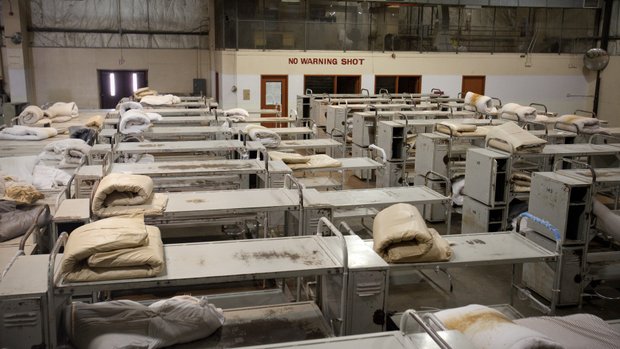
    The massive overcrowding in California prisons has eased up a bit (thanks to court order). Of course much of the problem has just been kicked down to the county level, but the symbolic double- and triple-stacked bunks in gyms-turned-massive-dorm are empty, says the San Diego Union-Tribune.

  • The right to trial by jury

    The Sixth Amendment states, in rather uncompromising terms: “In all criminal prosecutions, the accused shall enjoy the right to a speedy and public trial, by an impartial jury.” But the system can’t handle those rights. That’s why but a very small fraction of cases is decided by a trial, much less a jury trial (the other option is a “bench trial,” where the judge decides.

    The problem is that if you choose to exercise this right, they’ll throw the book at you. Because they want you to plead guilty. From the Houston Chronicle:

    “Our criminal justice system is broke; it needs to be completely revamped,” declared Terry Nelson, who was a federal agent for over 30 years and is on the executive board of Law Enforcement Against Prohibition. “They have the power, and if you don’t play the game, they’ll throw the book at you.”

    Castillo maintains her innocence, saying she was tricked into unknowingly helping transport drugs and money for a big trafficker in Mexico. But she refused to plead guilty and went to trial.

    In 2010, of 1,766 defendants prosecuted for federal drug offenses in the Southern District of Texas – a region that reaches from Houston to the border – 93.2 percent pleaded guilty rather than face trial, according to the U.S. government. Of the defendants who didn’t plead not guilty, 10 defendants were acquitted at trial. Also, 82 saw their cases dismissed.

    The statistics are similar nationwide.

    Is this case a 56-year old grandmother and first-time offender was convicted of conspiracy to smuggle a ton of cocaine from Mexico. She maintains her innocence. Had she plead guilty, she would have got a few years behind bars. But because she demanded her constitutional right to jury trial, they sentenced her to life without parole.