Tag: Mexico

  • Numbers, please

    I don’t normally go around asking for stats. I’ll take a good anecdote over a slippery statistics any day.

    And yet… I feel like an old operator at times saying, “Number, please.”

    Last night I was writing and had a very simple question: how many US prisoners are in solitary confinement? Seems like a simple and important question since this a free country and solitary confinement has been proven to drive people crazy.

    Get this… we don’t know. How can we not know? I don’t think you have to be a bleeding heart to think we should know how many people are locked up in solitary confinement. Isn’t not knowing a sign of the gulag?

    Then by chance there’s a story in USA Today about solitary. At least from the Illinois figure we can extrapolate to the rest of the nation. So I would guess between 40,000 and 80,000.

    Speaking of numbers, there’s this story in The Wall Street Journalabout, a 54-year-old librarian in Las Cruces, New Mexico, who “spends most mornings sifting reports in the Mexican press to create a tally of drug-cartel-related killings in Ciudad Juárez, Mexico.”

    Why? Because nobody else is keeping track. The paper points out, “There is no official count of the people killed in Mexico’s escalating drug wars—whether the victims are drug traffickers, police or civilians.”

    In Juarez, the tally this year already (it’s June) is over a thousand. “I don’t think there’s a phenomenon like that in the world unless it’s a declared war,” Ms. Molloy said, “Ten years from now, people are going to ask ‘What happened in Juárez?’”

    When I see fancy stats I’m always skeptical (especially when they’re based on data of questionable validity). But a basic count? A simple population figure? Solitary confinement? Murders? People… these are numbers we need!

    [Update: LEAP board member Walter McKay lives in Mexico and keeps track of the numbers. He posts on the LEAP Blog. He also maintains a Google map of the murders.]

  • Mexican drug raid wins drug war!

    Mexican drug raid wins drug war!

    In 2007, Mexican and US drug agents raided a home in Mexico City. Over $200,000,000 in cash was found. Lot’s of other stuff, too. Like tigers and gold guns!
    It’s pretty impressive. I put the pictures in a PDF file.
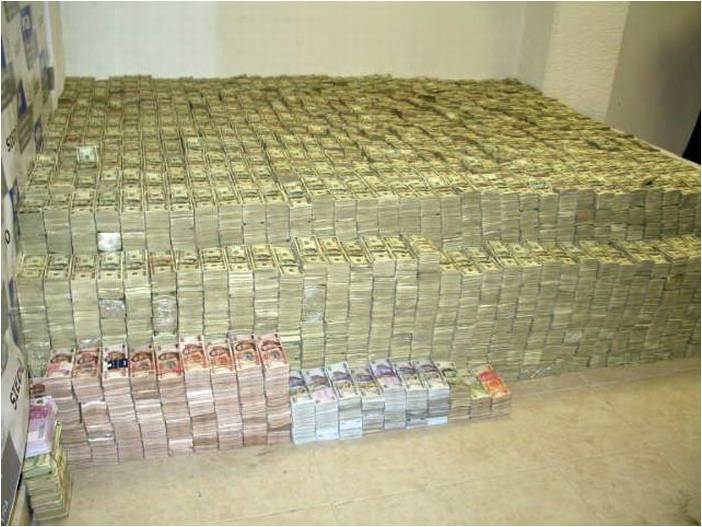
    It’s not recent, but I just got an email with the pictures from a student. Unlike a lot of forwarded email sent around, this one is true.

    Amazing how, in hindsight, this one raid really changed the tide in the war on drugs. I will be the first to admit that I was wrong. I mean, since this raid in 2007, drug barons have finally gotten the message that drugs simply do not pay.

    Rule of law has returned to Mexico and police there can now wear their uniform with safety and pride. The economy has improved and fewer illegal immigrants are forced by drug-war violence to come to the US.

    Hell, even in the US drug supply has been so squeezed that every measurable indicator shows that drug use has plummeted.

    Best of all, the Cubs won the World Series last year!

    Did I almost mention that the bulldogs all have rubber teeth and the hens lay soft-boiled eggs?

    There’s a lake of stew and of whiskey too
    You can paddle all around ’em in a big canoe.

    I’ll see you all this coming fall in the Big Rock Candy Mountains.

  • Deaths in Mexico Drug War Pass 22,000

    Not the government wants you to know.

    Immediately after Calderon came to office in late 2006, he deployed up to 50,000 troops in a frontal battle with narcotics cartels, a move that drew widespread praise for its courage. More than three years later, the pace of killings is soaring and public security worries are beginning to affect the tourism industry, which employs nearly one out of eight Mexicans.

    Calderon has earned high praise in Washington.

    Read the whole article by Tim Johnson.

    Ending the drug war in Mexico is one way to curtail illegal immigration in the U.S. I’m just sayin’.

  • Calls for Drug Legalization in Mexico

    From the Wall Street Journal:

    Growing numbers of Mexican and U.S. officials say—at least privately—that the biggest step in hurting the business operations of Mexican cartels would be simply to legalize their main product: marijuana. Long the world’s most popular illegal drug, marijuana accounts for more than half the revenues of Mexican cartels.

    “Economically, there is no argument or solution other than legalization, at least of marijuana,” said the top Mexican official matter-of-factly. The official said such a move would likely shift marijuana production entirely to places like California, where the drug can be grown more efficiently and closer to consumers. “Mexico’s objective should be to make the U.S. self-sufficient in marijuana,” he added with a grin.

    He is not alone in his views. Earlier this year, three former Latin American presidents known for their free-market and conservative credentials–Ernesto Zedillo of Mexico, Cesar Gaviria of Colombia and Fernando Henrique Cardoso of Brazil–said governments should seriously consider legalizing marijuana as an effective tool against murderous drug gangs.

  • They are most definitely not playing

    Only hours after the grieving family had finished burying [Ensign Melquisedet Angulo Córdova, a Special Forces sailor killed last week during the government’s most successful raid on a top drug lord in years] in his hometown, gunmen burst into the family’s house and sprayed the rooms with gunfire, killing his mother and three other relatives, officials said Tuesday.

    More violence. More victory!

    The storyby Elisabeth Malkin in the New York Times.

  • “The rising death toll is a sign the drug gangs are weakening”

    Of coooourse.

    Washington says the rising death toll is a sign the drug gangs are weakening under President Calderon’s military crackdown, which has seen some 49,000 extra troops deploy across Mexico.

    You see the rising death toll in Mexico is always a sign that the drug gangs are weakening because, well, when the gangs are weak, they lash and kill lots of people. And when the gangs are strong, then they don’t kill anybody. So we want to attack the drug gangs so they become weak and kill more more people, which is how how we know we’re winning the war on drugs. Or something like that.

    Logic like that makes my head hurt.

    I do know we’re notwinning the drug war. In Mexico 14,000people have died in drug-prohibition violence in the past four years. You know, ever since President Calderon started his military crackdown to win the war on drugs. And they must be winning, because a whole lot of people are getting killed.

    Anyway, one of Mexico’s bad guys, a most wanted, a “boss of bosses,” he was killed by the good guys. Another stirring victory. Keep up the good work. Drive safely. Sleep well. Tip your waitstaff. War is Peace! Ignorance is Strength!

    And there’s another sure sign the drug gangs are weakening:

    Separately, the severed heads of six policemen were found near a church in the north of the country, police said.

    [Update: And more about prohibition murder in Mexico, if you needed it.]

  • Police Bribes in Mexico?

    Strange question, but have any of you ever paid a bribe to a Mexican police officer in, say, the past 10 years? If so, when, where, why, and how much?

    There was an article in the New York Times the other day about Cancun police extorting people, in this case a Minnesota state senator. My wife, cookbook and travel writer extraordinaire, thinks this is yet another undeserved example of U.S. anti-Mexico propaganda.

    Mexico is a lot less third-world than many Americans think. Sure we wear rose-colored glasses, but our experiences in Mexico have been pretty rosy. I’ve sped through thousands of miles in southern Mexico and my wife has been stopped for driving the wrong way done a one-way street (it’s easier than you’d think) and been in a minor accident that was entirely her fault. And yet neither of us have ever been in a situation where we’ve been presented with any bribe possibility.

    We think it happens very rarely. If it does happen to you, don’t pay! Now of course there may be reasons you want to pay (like paying $10 is quicker and easier than going the legal route), but the Timesarticle says they coughed up $300 when the maximum fine was $50. And it is a crime to bribe police officers. Some rental car companies even offer a voucher to pay any traffic fines. Clever!

    It’s also interesting what happen after word got out of this state senator’s experience (especially compared to what might happen in the US). The police officers were fired, the mayor got involved, and the city of Cancun reimbursed the Americans for the amount of the bribe.

    Here’s the story in the Yucatan paper.

    For non-Spanish speakers (like me), here’s the gist: car rental agencies say they get an average of 50 tourist complaints a month about bribe attempts by cops in Cancun. Typical amounts are US$10 to $20. (Which, for the record, is cheaper than paying for the ticket, usually about US$50.)

    It also says that this is about double the rate of complaints last year. Which the car-rental group rep attributes to the economic crisis. Although what isn’t, these days?

  • More from Mexico

    The BBC has a good video reportage on the latest gun battles between the drug mob and police. This time in the port city of Lazaro Cardenas, Michoacán.

    The complete disrespect the drug people have for law enforcement is shocking. They engage in gun battles with heavily armed police and expect to win. Sometimes they do.