Tag: NYPD

  • Bratton says morale was low in the NYPD under Kelly…

    …And Bratton is right. Should be the end of the story, despite what you’ll read in the Postand the Daily News.

    More interesting is what is buried in the Daily News story:

    Police made 12,495 stops between October and December — down a staggering 86% from 89,620 during the same time period in 2012. And of the stops during the last quarter of 2013, 16% resulted in an arrest. That’s up from 6% over the same period in 2012.

    Raising the hit-rate of stops is a great indicator that more stops are based on actual real articulatable reasonable suspicion (you know, what is legally required) and not just quota pressure (er, productivity goals). 2,000 arrests from 12,500 stops is better than 5,400 arrests from 90,000 stops. Of course if these data simply mean more stops are unrecorded, this “improvement” could mean nothing…

  • It just don’t make sense…

    Angel Rojas came to the US four years ago from the Dominican Republic with his wife, Maria Lopez and their two kids, now 12 and 8. Rojas was on a break between two jobs, riding the bus home to, (from the New York Times):

    …hug his children and grab a quick bite. When three young adults stepped aboard the bus, he most likely thought nothing of it.

    Several rows back, the police say, a 14-year-old boy, a member of a street gang called the Stack Money Goons, had a visceral reaction. At least one of the three young adults belonged to a warring crew; there was a shared flash of recognition, and then, the police say, the 14-year-old pulled out a .357 revolver and fired one shot inside the bus.

    The bullet missed the intended target but struck Mr. Rojas in the back of the head. Mr. Rojas had no time to react; there were few if any words exchanged, and police officials said a video of the encounter showed Mr. Rojas’s head simply slumping forward after sustaining the mortal wound.

    After Kathon fired the shot aboard the bus, he and the three young adults ran off the bus; five more shots were fired outside…. None of those bullets struck anyone; the police recovered the revolver, and all six rounds had been fired.

    The age of this killer made me think of the youngest armed kids I arrested, I searched my notes and found it on Christmas Day, December 25, 2000:

    Busy night at work. Merry Christmas. People getting their last minute Christmas robbing in. And lot’s more Christmas Fussing.

    A guy was robbed by 2 kids at Monument and Port. The kids were caught under a car at Patterson Park. 13 years old and really young looking. About 4 feet tall. I found the knife at Montford and Patterson Park. A small cheap steak knife. Turns out both of these kids have quite a record, going back about 2 years. Selling coke. Attempt 1st degree sex offense. 2nd degree sex offense.

    Back in New York, says the Times:

    One young man would not answer questions and pointed at the windows of the housing project beside him, to indicate crew members might be watching. “One thing I’m going to tell you, those little kids, they ain’t to be messed with,” he said.

    Well… those gun-toting kids are to be messed with. And the police are those who are paid to do the messing.

    Police have to deal with these kids, not just after they kill an innocent person, but before, when they’re hanging on the corner acting tough, and maybe not carrying a gun. But faced with a potentially armed person, no matter the age, police do not put on kids’ gloves.

    Some 14-year-old kids carry gun and use them to kill people on the bus. Keep that in mind next time you blame police for harassing kids. Had young Kathon been shot and killed by the cops before his murder, the Times would print a picture of cute 13-years-old Kathon “graduating” from 8th grade. Kathon’s mother would be found, crying, saying how her lil’ angel may have been involved in a little trouble, but he was a good kid. Sure a gun was recovered, but a “witness” would come forward saying Kathon wasn’t armed: “Police just shot the kid for no reason!” You, dear liberal reader, would think the truth was somewhere in between and blame the police. It doesn’t make sense.

  • “Ambassadors of the NYPD”

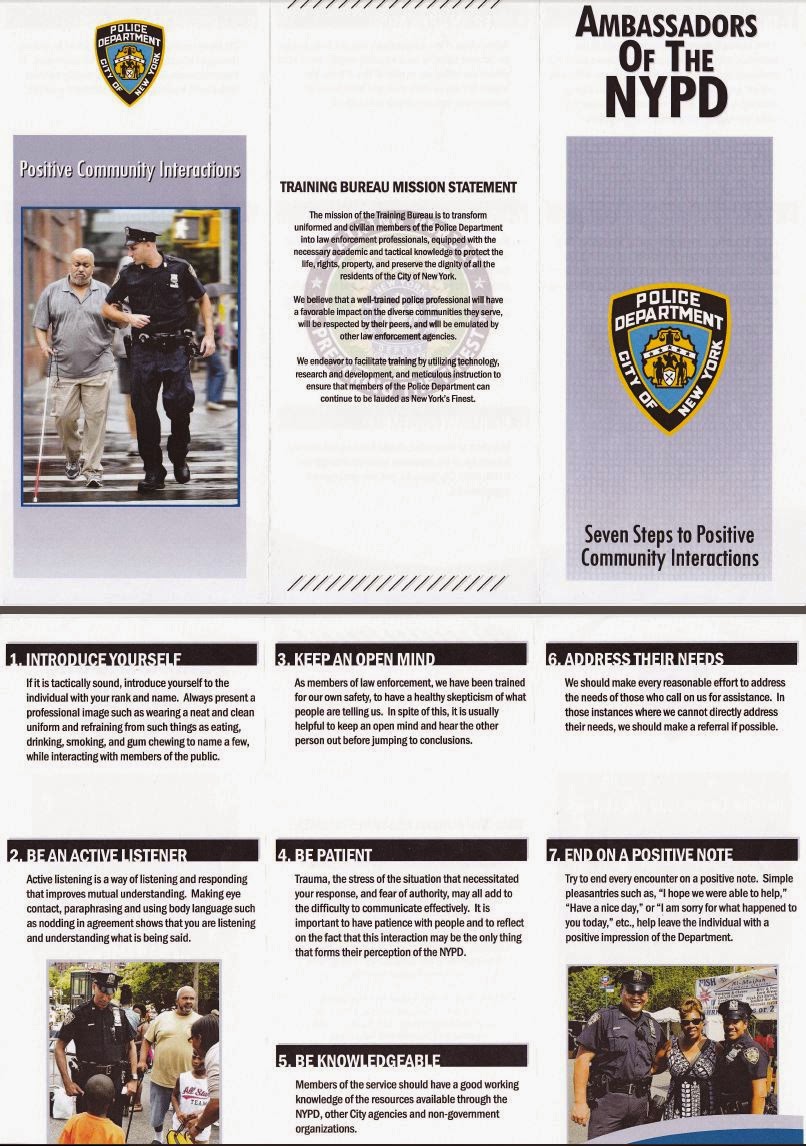
    “Ambassadors of the NYPD”

    “OK, academy class, pay attention. Today we are going to learn the ‘seven steps to positive community interactions.’ OK? And, um, even though Number Seven says ‘end on a positive note’ — stop snickering in the back — you should not say ‘have a nice day’ after cuffing somebody.”

  • Too *few* stop, question, and frisks? Perhaps…

    Bill Bratton was just quoted in the Post saying that the NYPD is conducting too few stop and frisks.

    Who would have thought that the shameful practice of mass stop, question, and frisk would ever end? Actually, I did (though I was two years too quick to predict its gradual demise). I knew there was internal pressure from up high in the NYPD to reduce quota-based stops. But nobody I know, certainly not me, expected the stops to completely stop! For that, we can thank not just the stop and frisk lawsuit but the absurd over-reaction of the PBA.

    We’re down to 3,000 stops a month. That’s 36,000 stops a year. Back when the NYPD conducted almost 700,000 stops a year (in 2011), I said that most of these stops were quota (er, “productivity”) driven, not needed, and bad police work.

    More recently I wrote:

    We now know that all these stops were not needed. Throw out that bathwater! But be careful, because there is baby somewhere in that murky water. Surely some of these stop are needed. You know, the stops based on officers’ reasonable and honest suspicion.

    We need to ensure we don’t let “stop and frisk” give a bad name to good police officers using discretion legally stopping (and questioning, and sometimes frisking) suspects.

    So is there a “right” number of stop, question, and frisk? I hate to quantify individual acts of police discretion (doing so is what got us into the stop and frisk mess). Bratton pointed out that stops should be “based on what officers are seeing and what they are reacting to. There is no number that you want to project toward.” But on a city-wide macro level, I think it’s fair to expect a certain number of proactive stops conducted by the NYPD en masse.

    Based on my intuition (and the “hit rate” for white people stopped, I suspected that an 80 percent reduction in stops would have no adverse effects (and much positive impact on police morale and police/community relations. Cut stops 80 percent and what’s left, the remaining 20 percent, might actually serve an essential crime prevention purpose.

    An 80 percent reduction from the peak would have been about 11,000 stops a month. (Put another way, this is less than one stop per month per patrol officer. Of course that number is just an intuitive guess. Perhaps the ideal number of stops is half or twice that.) But no matter how you look it, 3,000 stops per month is to low. To paraphrase a politically incorrect sign in the police station in which I used to work, “Unlike the citizens you police, you are required to work for your government check.” Police officers (and the PBA) would be wise to remember that.

  • The NYPD is a-changin’

    Bratton Tells Chiefs He’ll Stop Sending Rookies to High-Crime Areas

    And, as you probably know, DeBlasio is dropping the city’s appeal to the stop and frisk lawsuit. But hoping to limit a federal monitor to 3 years. In response: “Four unions representing NYPD officers have filed appeals and motions opposing dismissal of the city’s appeal, which are pending.”

    Good times. Fun times.

  • A tale of two cities

    Murder in Baltimore is at a four-year high.

    Murder in New York City is at a record low.

    Meanwhile, from Justin Fenton’s Baltimore Sun article, in other cities:

    Homicides across the country

    Oakland, Calif. — down 25 percent (as of Dec. 12)

    Philadelphia — down 24 percent (as of Dec. 16)

    Flint, Mich. — down 22 percent (as of Dec. 18)

    New Orleans — down 22 percent (as of Nov. 14)

    Chicago — down 19 percent (as of Dec. 8)

    Detroit — down 14.6 percent (as of Dec. 18)

    Baltimore — up 8 percent (as of Dec. 24)

    Newark, N.J. — up 19 percent (as of Dec. 1)

    Washington — up 26 percent (as of Dec. 18)

  • “Decreased Stop and Frisk Causes Crime to Skyrocket in NYC”

    Well that’s the headline I would have expected to see after listening to Ray Kelly and Mayor Bloomberg (and almost all my police friends) over the past few years. They had me believe that each and every one of those more than 600,000 annual stops in 2011 was absolutely essential to prevent the city from descending into an Orwellian Escape from New York type chaos!

    Well this year stop, question, and frisks are down 50 percent and homicides are down another 20 percent (which is really amazing).

    Today the city released a press release touting this most recent crime drop (did I mention how amazing this is?!). Interestingly, nothing was said about stop and frisk. How odd.

    So while some stop and frisks are needed — you know, ones based police officers’ actual reasonable suspicion that a suspect is armed — it seem like the NYPD can do just fine, gosh, perhaps even better, while stopping 800 fewer people per day.

    The problem when you try and quantify the “productivity” of police work (or almost any occupation) is that those being judged start to play to the stats. Means becomes ends. Ends be damned.

    But now Bloomberg barely gives the police any credit at all! Here’s the press release:

    To: Interested Parties

    From: Howard Wolfson

    RE: T-Minus 5

    Over the last 10 days, Mayor Bloomberg has been to each of the five boroughs, cutting ribbons, touring schools, riding on a new subway extension, visiting new parks, and discussing the incredible progress of the last twelve years.

    Today and tomorrow the Mayor will highlight the Administration’s record fighting crime while reducing incarceration rates by visiting a Neighborhood Opportunity Network Center and by attending his final police graduation ceremony to swear in more than 1,100 police recruits.

    Under Mayor Bloomberg and Police Commissioner Ray Kelly crime has fallen in New York City to record lows:

    Safest big city in the nation: New York City has fewer major felony crimes per 100,000 residents than any of the nation’s top 25 largest cities.

    Total Crime: Down 32% compared to 2001, despite the added demand of counterterrorism, having fewer officers in the ranks, and adding 300,000 more people to the city’s population.

    Murder: On pace to have a record low number of murders in 2013 following a record low established in 2012.

    Murder is down 49% compared to 2001.

    Shootings: On pace to have a record low number of shootings in 2013 following a record low established in 2012.

    Terrorism: Since 9/11, there has not been a successful terror attack against New York City, despite the city remaining a top terror target.

    At the same time that Ray Kelly and the NYPD have brought crime to record lows, the Bloomberg Administration has actually reduced incarceration rates in New York City by 36% over the last twelve years.

    This drop occurred as the national incarceration rate rose by 3% during the same period.

    So during the last twelve years, the United States also saw crime declines, but it was achieved by locking more people up. But New York City didn’t reduce crime by locking more people up: in fact the City actually put fewer and fewer of its citizens behind bars as crime fell to record lows.

    How? The crime prevention strategies implemented by the NYPD, and under the leadership of Deputy Mayor Gibbs, Commissioners Vincent Schiraldi, Dora Schriro and others the City have expanded use of felony drug courts, alternative-to-incarceration programs for substance abusers, expanded alternatives to jail sentences for misdemeanants, created more effective probation programs and implemented the Young Men’s Initiative, which is reducing increasing opportunities for young black and Latino men and reducing the number of young black and Latino men who are entering the criminal justice system.

    The result? New York City is the safest it has ever been.
  • Broken Windows does not equal Zero Tolerance

    This article in Slate by Justin Peters is perhaps not the stupidest thing I’ve ever read on policing. But it is the stupidest thing I’ve read about Broken Windows since Bratton was announced as the next NYPD commissioner about 20 hours ago.

    Peters writes, “Broken-windows strategies and zero-tolerance policing strategies go hand in hand.” Well, no. They don’t. Bill Bratton is not a defender of Zero Tolerance policing. He never has been. In fact, Broken Windows is the philosophical opposite of Zero Tolerance. Bill Bratton can tell you why this is so. George Kelling can tell you why this is so. Kelling is the guy who coined the phrase and write the “Broken Windows” article (coauthored with James Q. Wilson) in the March, 1982, issue of the Atlantic. (I took a class from Kelling back in the 1990s when I was a graduate student at Harvard.) And I can tell you how. This and why so many seemingly rational people oppose Broken Windows — often on an ideological level — is important. And I will tell you this, but not tonight. It’s late and I’m going to bed. But I leave you with this:

    The equation … between police order-maintenance activities (“broken windows”) and “zero tolerance” for disorderly behavior raises issues that go beyond semantics. … It is an equation that I have never made, find worrisome, and have argued against, considering the phrase “zero tolerance” not credible and smacking of zealotry.

    –George Kelling “‘Broken Windows’ and Police Discretion.” NIJ (1999).