Tag: NYPD

  • Don’t sh*t where you live

    The Villiage Voice reportson how, after much effort, a guy got data on where NYPD officers live (the zip codes). There’s nothing too surprising here, but it is worth noting 1) the NYPD was reluctant to give it up, and 2) NYPD officers are forbidden to work in the precinct in which they live. This goes back to anti-corruption efforts, and it is at odds with community policing. (Not that many cops want to live where they work, but that’s another matter.)

    58 percent of cops live in the city, but just 45 percent of white compared with three-quarters of black and hispanic cops.

    Just under 30 cops live in my zip code in Queens. 114 cops live in 10940, Middletown, NY. That’s 70 miles to the city limits and a 2-hour drive to 1PP, police headquarters. Suffolk County to Western Queens can take just as long. A few cops live even further away. I don’t think that’s a healthy commute, especially for a job that requires flexibility and going to court. But what do I know?

  • “Number Two” at the range

    “Number Two” at the range

    Two days ago in the Bronx, an NYPD sergeant shot and killed Deborah Danner, a 66-year-old with schizophrenia armed with a baseball bat. Deborah Danner’s death is a tragedy. It is a failure of the system. But almost immediately, the officer who shot was stripped of his badge and gun and denounced by the mayor and police commissioner. DeBlasio — who according to the Times, “struggled to answer basic questions about the shooting” — felt he knew enough to throw the cop under the bus:

    The shooting of Deborah Danner was tragic, and it is unacceptable. It should never have happened. It is quite clear our officers are supposed to use deadly force only when faced with a dire situation. And it’s very hard for any of us to see that that standard was met here.

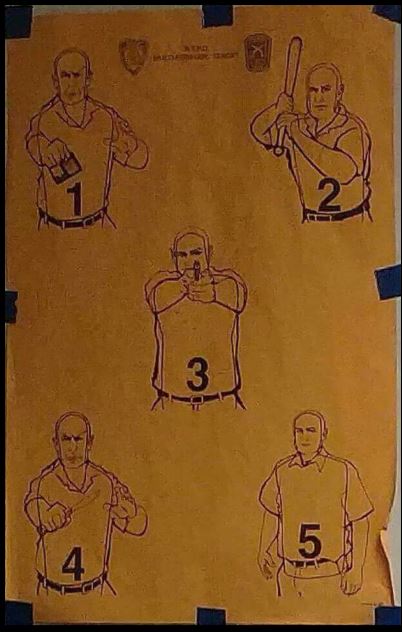
    Really? At NYPD target practice, there’s a simple shoot/don’t-shoot scenario. (This is something we did not have in Baltimore, which might help explain the NYPD’s overall extremely low rate of using lethal force.)

    The guy with a bat is known as “Number Two.” When you hear, “Number Two,” you’re supposed to see the guy with a bat and shoot Mr. Number Two. (Also Three and Four, but not Numbers One or Five.)

    I am not saying this was a good shooting. I am saying that if we don’t want cops to shoot people with baseball bats, why do we train cops to do just that?

    The mayor continued:

    There was certainly a protocol that called for deferring to the Emergency Service Unit (ESU). That was not followed. There was obviously the option of using a taser. That was not employed. We will fully investigate this situation and we will cooperate fully with any prosecutorial agencies. We need to know why this officer did follow his training and did not follow those protocols.

    [The New York State attorney general said he would not investigatethe shooting.]

    Protocol, so I hear, does say that officers confronted with an emotionally disturbed armed person (apparently initially naked and armed with scissors) should back off, close the door, and call for ESU and wait.

    I’m not convinced the department really wants this to happen all the time. This protocol, let’s call it Plan B, would tie up a few officers for a few hours in what would then be a barricade situation. It would also draw on the military-like resources of ESU.

    Plan A is for two cops to simply handle the inncident quickly and professionally, and get back in service to handle the next call. When violating “protocol” is routine, even encouraged, it’s not fair to only crack the whip when things go bad.

    But one thing about these events is they can change police culture quite quickly. ESU is now going to have a lot more work, for better or for worse. But wouldn’t be ironic if ESU responded to every call, especially in light of demands to de-militarize the police? And then what happens when ESU kills somebody? Then we blame ESU?

    Then who do we call? The really issue is that police shouldn’t be responding to this type of call at all.

    Here’s Alex Vitale (whom I’m actually agreeing with!) in the Gotham Gazette:

    The fact that police had to even be dispatched in the first place is a sign that something went wrong.

    Health officials knew about this woman’s condition…. Why was she returned to her apartment without adequate ongoing supervision or care?

    Yet thousands of profoundly disabled people continue to roam the streets and subways or idle away at home with little or no support, leaving police to deal with the crises that inevitably result.

    The mayor was wrong when he said that current training is adequate and this was just the mistake of a single officer. Ultimately, police are the wrong people to be responding to a person experiencing a mental health crisis.

  • Trends in NYPD police-involved shootings

    Trends in NYPD police-involved shootings

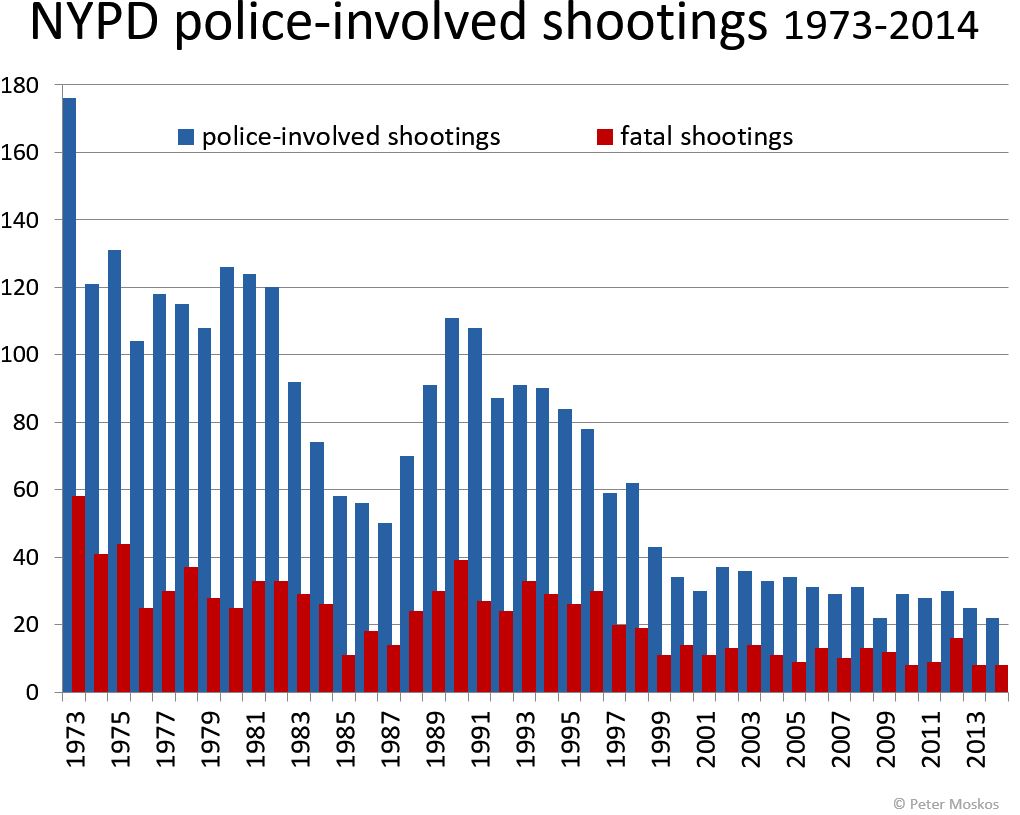
    In relation to my previous post, it’s not like the NYPD didn’t used to shoot a lot of people.

    There are two trends going on here. Police-involved shootings always reflect homicide numbers. (Cops are more likely to shoot a murder with a gun.) So there’s a spike in 1990 the then a big drop after that, which reflects crime in NYC. But even taking that into account, there’s a long-term downward trend. I have no idea what the long-terms trends in Oklahoma have been.

    Source: NYPD

  • NYPD: “Broken Windows Is Not Broken”

    NYPD: “Broken Windows Is Not Broken”

    The NYPD released its response to the “quality-of-life policing is bad” report issued by the NYC Dept of Investigation. Guess what? Quality-of-life policing is good! (The original report, the one this responds to, is titled, and I’m not joking: “The New York City Department Of Investigation’s Office Of The Inspector General For The New York City Police Department Releases A Report And Analyses On The NYPD’s Quality-Of-Life Enforcement.”)

    Here’s what I wrote about the DOI’s report. I was bit gentle. Well Bratton and his people sure as hell are not. From Azi Paybarah in Politico describes it like this:

    Bratton, who is scheduled to step down Sept. 15, said the June 22 report from the Department of Investigation’s Inspector General for the NYPD is of “no value at all” and that the office does not have experts on staff capable of analyzing NYPD work.

    The report has an “incomplete understanding of how quality-of-life policing works and mischaracterizes Broken Windows as zero-tolerance, which it is not, and never has been,” Bratton said during an hour-long press conference at police headquarters. “Police go where people call. The vast majority of quality-of-life calls come from some of the poorer neighborhoods in our city.”

    Bratton also cast doubt on the ability of the OIG-NYPD to analyze police work.

    “I’m not sure of the quality of the researchers at the OIG,” he said. “I think we made it quite clear that if you want to delve into these types of areas, you’re going to need experts, not amateurs. Otherwise, you’re going to get the rebuttal that you’re seeing here this morning where we have a lot of experts within the NYPD [and] access to experts who are objective reviewers of the issue [that] the IG just, apparently, does not have, based on the poor quality of this report.

    Here’s the first footnote from the NYPD’s report, which actually is a very good point:

    The OIG report contains numerous modifiers and disclaimers that seem to contradict its own conclusions in many places. On the one hand, it strives to support the conclusion that there is no positive correlation between what it defines as quality-of-life enforcement and decreasing felony crime, but, on the other hand, it acknowledges that this conclusion cannot be reasonably drawn. It is as if the report’s authors wish to insulate themselves from possible criticisms by preemptively mentioning these criticisms in their report without allowing any of the criticisms to alter their conclusions. Taken together the disclaiming statements in the report form a virtual rebuttal to the report itself.

    See, the report said it wasn’t a critque of Broken Windows, but we all knew it was. And that is exactly how the media summerizedthe report.

    The NYPD response is a thorough report. I’ll highlight parts that illustrate Broken Windows. (I’m assuming you’re not going to read the whole report).

    From page 10:

    The Broken Windows Theory does not assert that 20 more misdemeanor arrests, for instance, will result in one or two fewer felony crimes. Rather, the concept holds that a general atmosphere of order and a general sense of police presence resulting from the enforcement of lesser crimes, will reduce the opportunity for more serious crime with generally positive results.

    Page 11:

    Misdemeanor arrests and summonses should not be used as simple surrogates for quality-of-life policing which has many other dimensions. Police officers can effectively respond to reports or concerns regarding quality-of-life conditions without arrests or summonses simply by dispersing groups, warning people to cease disorderly activity, establishing standards of behavior, and assisting with social service interventions.

    Page 12:

    Enforcing quality-of-life standards, without actually using misdemeanor arrests and summonses, still relies on the ability to invoke these sanctions. Telling people to move along when they know an officer can arrest or summons them is far more effective than it would be if they believe the officer cannot. Police officers require the fundamental authority to manage street situations and the option to move swiftly to criminal sanctions when necessary.

    Page 15:

    There actually is a strong statistical link between minor and felony criminals. The populations that commit both types of crime overlap to a significant degree. About half of all misdemeanor arrestees in New York City in recent years have had prior felony arrests, and nearly three quarters of felony arrestees have had prior misdemeanor arrests. [Ed note: This is surprisingly low. I would have guessed something closer to 90 percent.]

    Page 16:

    From the Broken Windows perspective, street management is a critical element in controlling street violence. It is an observable phenomenon that drunken, carousing groups may become involved in violence as an evening wears on. Summary enforcement, or police intervention prior to the violence, is one way of controlling it.

    Page 18:

    Quality-of-life enforcement should not be confused with reasonable-suspicion stops. Reasonable-suspicion stops are based on a significantly lower standard of reasonable suspicion, whereas misdemeanor arrests and summons issuance each require probable cause, the same standard required for felony arrests. The NYPD uses quality-of-life policing as a way of countering more serious crimes, but it does not make misdemeanor arrests and issue summonses without meeting the probable cause standard.

    Page 19:

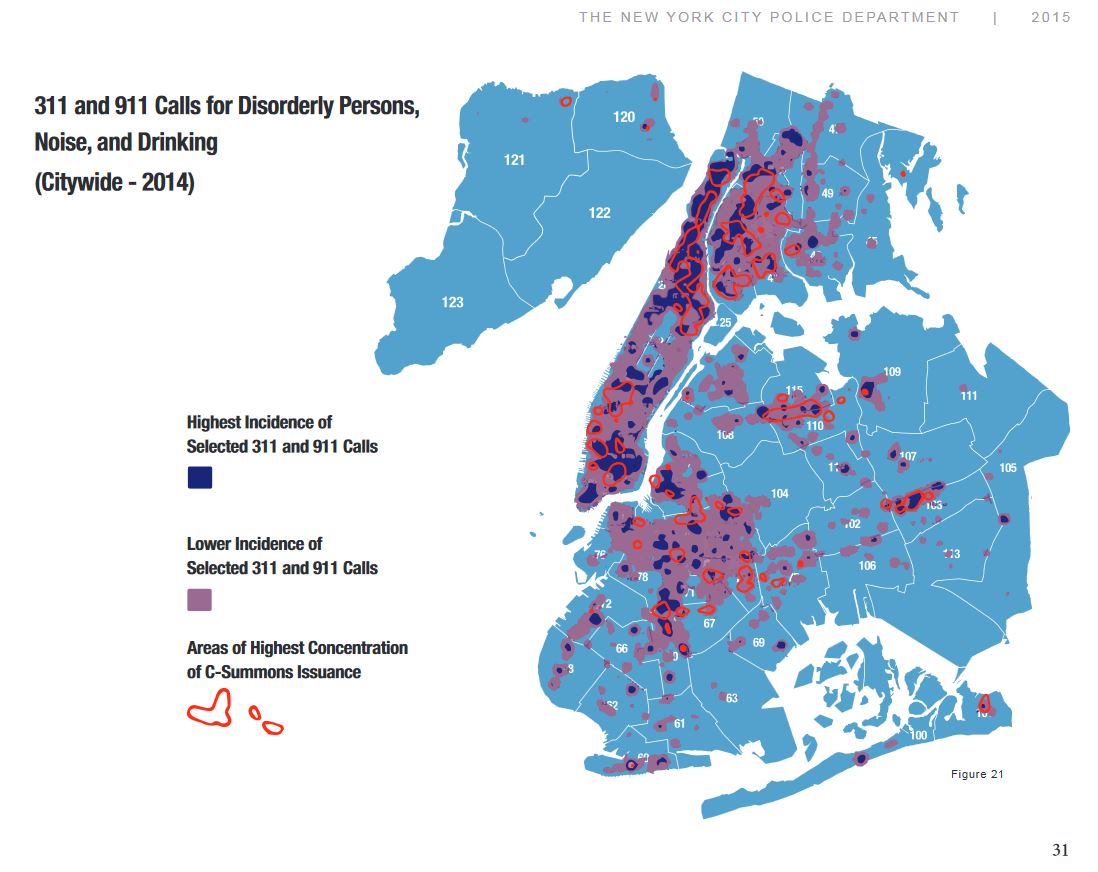
    The OIG report largely ignores calls for service as a reason why quality-of-life enforcement may be pursued more intensively in one precinct than in another. As the NYPD has shown in its own report on quality-of-life policing “Broken Windows and Quality-of-Life Policing in New York City,” racial disparities in enforcement of minor laws in New York City can be largely explained by calls for service that have pulled officers to particular locations and particular offenders.

    It’s worth pausing here. This is important. Quality-of-life enforcement — which does affect minorities disproportionately — is in response to minority citizens’ calls for service. Here’s a page from that linked-to report.

    Quality of life enforcement happens because residents want it to happen. And residents in black and hispanic neighborhoods call police for quality-of-life issues most of all.

    In the name of racially non-disproportionate policing, should police ignore these calls for service? Not according to the poll data of New York blacks and hispanics (page 21). Similarly there’s a 2015 Gallup poll that showed 38 percent of blacks (nationwide, compared to just 18 percent of whites) want more police presence; just 10 percent of blacks want less police presence. Blacks want more policing more than whites want more policing. You wouldn’t sense that from the current cops-are-the-problem. Now of course more policing and better policing are not mutually exclusive, but it comes down to this: you can’t have community policing if you ignore the quality-of-life issues the community cares about.

  • “Do Not Shoot Anyone”: Policing J’Ouvert and the West Indian Day Parade

    “Do Not Shoot Anyone”: Policing J’Ouvert and the West Indian Day Parade

    Yes, the NYPD and others politely asked people to not shoot each other at J’Ouvert this year. The New York Postquotes a police source as saying, “I guess this is the de Blasio crime prevention program.”

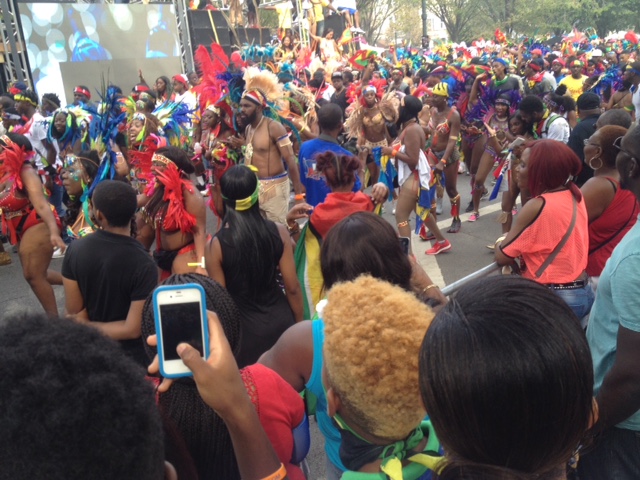
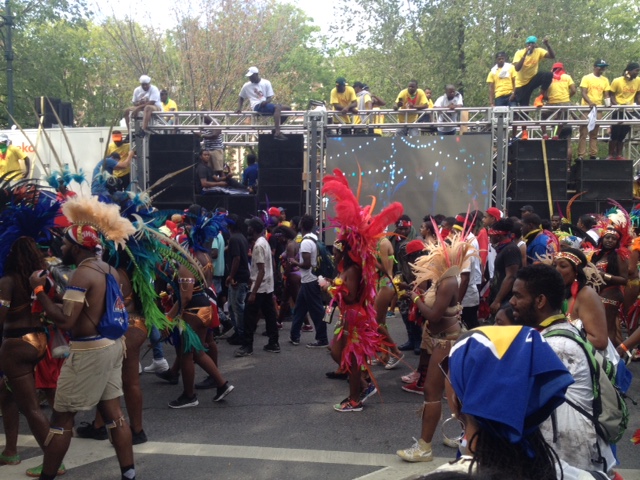
    In Brooklyn, pre-lent pre-dawn J’Ouvert is followed by the massive (like one-million people massive) Caribbean Day Parade (which has also had a few unfortunate deathsover the years). The two events are organized separately and not related but by culture and heritage.
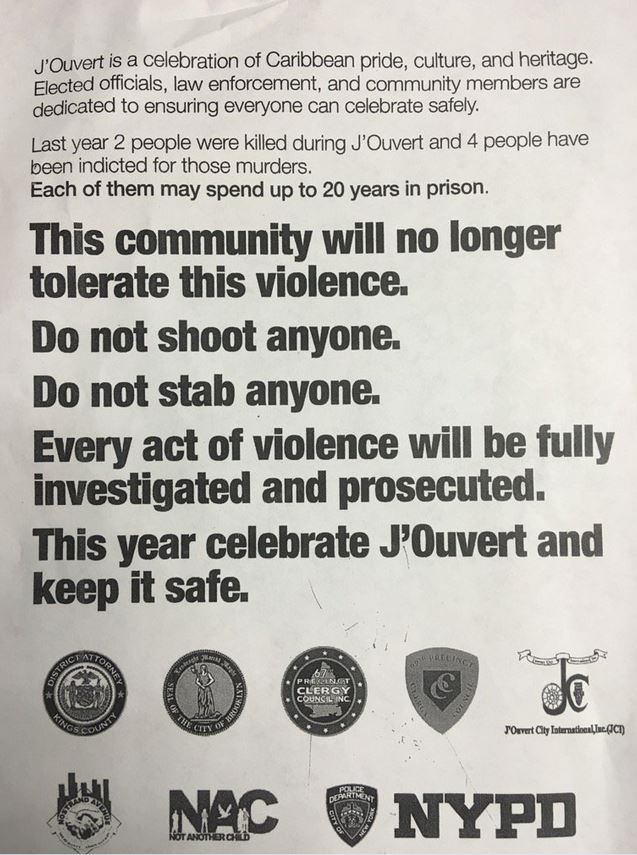
    It’s easy to mock a poster, but I don’t know if it was a bad idea. It’s never a bad idea to work collaboratively and ask politely. It’s not like the poster was the only thing police were doing. If nothing else, at least you can say, “At least we tried.”

    Last year an aide to Gov. Cuomo was shot and killedin the pre-dawn J’Ouvert hours.

    While onlyone bullet struck Gabay, some 20 or so people using some 27 firearms, mostly pistols, blasted off as many as three dozen rounds during the exchange.

    When the smoke cleared, three others were shot and two people were stabbed, one fatally.

    Last year organizers claimed the shootings happened during the parade, but not because of the parade. Just, you know, typical Brooklyn violence. Former cop and City Council Member Eric Adams saidthe reaction to the violence was “hysteria”: “We don’t stop celebrating the Fourth of July because some crazy breaks out a gun.” No, we don’t. But people don’t break out guns in most festivals.

    In 2014, “a gunman opened fire into a crowd of revelers, killing one man and wounding two others. In 2012, two people were stabbed to death and at least two were shot.”

    From the New York Times:

    Along with colorful costumes and dancing in the streets, there has been another constant: violence. Over the past decade, 21 shootings and other violent acts have been recorded at J’ouvert festivities, said Assistant Chief Steven Powers, the department’s Brooklyn South commander.

    At a news conference on Monday morning, Mayor Bill de Blasio said that the additional security measures “were exactly the right things to do,” but added, “We didn’t get the results we wanted.”

    Asked whether the parade should be moved or canceled, the mayor said only that “every option will be on the table.”

    He compared the J’ouvert festivities with other large New York City celebrations like the St. Patrick’s Day Parade and the Puerto Rican Day Parade, both of which were once far more raucous.

    “All of those previously violent events were brought under control,” Mr. de Blasio, a Democrat, said. “We will find a way to keep this one under control.”

    So yeah, you need to police J’Ouvert and the West Indian Day Parade differently than a million people listening to classical music in Central Park. And no, it’s not because the attendees at the former are mostly black and the latter mostly white.

    This year, rather than a scatter-shot police approach, for city decided to work with the organizers of J’Ouvert (the Caribbean Day Parade has always been much more legit). The city granted its first ever permit to J’Ouvert. There was a route, street closures, light towers, and an even greater police presence. The whole nine yards.

    Alas, it didn’t work. Two people were killed and last I heard at least three others were shot. A 17-year-old and 22-year-old were fatally shot a block from each other, at 4 and 4:30 AM, along the route of the official J’Ouvert parade.

    One of those shot, 73-year-old Margaraet Peters, said,

    The youths seem to want to ruin the West Indian parade. They’re smoking marijuana, carrying on, looking for fights with other groups…. The bystanders are always the ones getting hurt. It’s so sad – I could have died. I told my family the most important thing is I’m alive.

    For cops, this day is a no-win no-fun too-loud not-worth-the-mandatory-overtime hassle. I suspect Caribbean cops, and there are many in the NYPD, may beg to differ. But the few I know don’t want anything to do with policing this event either.

    Cops hate working these events because, like you, they want to be eating burgers with their families on Labor Day. Instead, they have to work a chaotic scene of literally a million people. And the 999,000 who aren’t causing trouble aren’t cops’ concern. Because at some point, especially pre-dawn, you know there will be fights and gunfire. And God forbid you actually stop somebody, cause then the New York Times will say you’re racist.

    For the often anti-cop Daily News, the story isn’t just violence but the cops complaining. Cops “crowing” over killings on “racist online message board,” screams the headline. Juicy! For example, right there in the first post, say the News:

    It’s 0644 on Mon. morning and already we have 4 SHOT with 2 DEAD (SHOT IN FACE) and we have 1 reported STABBING. Godless DeBlowsio was on his hands and knees PRAYING FOR THE STORM TO WASH OUT THE PARADE.

    Uh, actually, yeah. I bet de Blasio would have happily had the skies open up at 02:00 hours last night.

    [For the record Thee Rant often brings out the worst cops and the worst in cops. And yeah, some cops and retired cops are racist and know how to use the caps-lock key. But bitching about violence and the political sensitivities around working J’Ouvert makes you human, not racist.]

    But at least we tried. I guess you try again next year. It’s not like I’ve got the answer. I don’t think you could shut it down, even if you wanted to. And why would you want to? You really shouldn’t stop Carnival.

    I try and avoid massive crowds and police barriers, but my intrepid wife sent this report from the front line:

    Pretty freakin’ awesome, and made me sorry I’ve never gone before. Not terribly crowded. Insanely good fashion everywhere. Great-looking food. Only intermittently loud, as sound systems are pretty spread out in the parade. I did not find the girl I was trying to meet, but, oh well.

    Maybe next year I will go. I do look great in feathers.
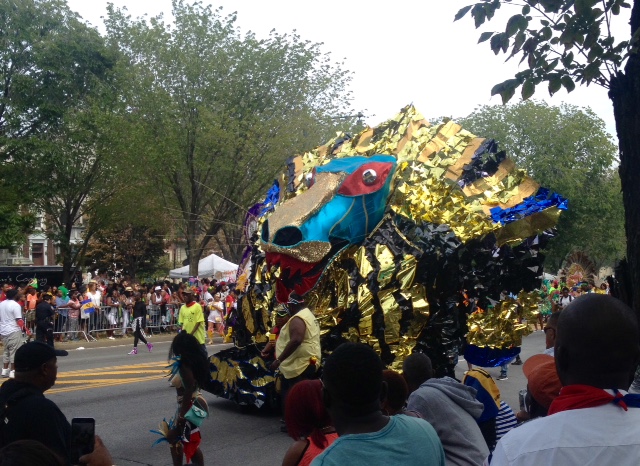


    [Photos by Zora O’Neill]
  • Oh, yeah, Bratton resigned

    Hey, it’s been a busy few weeks in police events. Go read Lenny Levitton the abrupt resignation of NYPD’s Commissioner Bill Bratton.

  • “Unarmed” man shoots and kills store worker

    “Unarmed” man shoots and kills store worker

    Did you see the headline in today’s New York Counterfactual?: “NYPD Kills Unarmed Man in Bronx”:

    Protests erupted after police killed a hispanic man in a Bronx bodega. Efraim Guzman, 30, was unarmed when he was shot and killed by police. One round entering Guzman’s back.

    Police allege Guzman was engaged in a dispute at a store at 230 East 198th Street around 1 a.m. and was shot when he attempted to reach for an officer’s gun. Witnesses say the man was surrendering and surrounded by three officers when he was shot and killed in a Bronx bodega.

    Liam Murphy, the family’s lawyer, said, “A simple store dispute is no reason to kill a man. This is the kind of broken windows policing that is so lethal to young men of color.” Murphy also criticized police for confiscated the in-store video of the shooting and called the release of Guzman’s criminal record “a disgraceful attempt by police to justify this unlawful execution.”

    A store worker, 49-year-old Wally Camara, said that Guzman was being disruptive, but added, “police didn’t need to shoot him. I wish they could have resolved this some other way.”

    Pedro Moscoso, a friend of Guzman, said, “Effi was a good man, like a brother to me. He was turning his life around. He was there for you. I’ll miss his cooking. When he made mofongo, he would make extra, enough for anybody to just drop by.”

    Bronx District Attorney Darcel D. Clark said her office was investigating the shooting, and criminal charges against police could be pending. The officer who shot Guzman, a three-year veteran who has not been identifed, has been placed on administrative desk duty.

    Last year police nationwide shot and killed 18 unarmed hispanic men, according to data compiled by the Washington Post. Unarmed hispanic man are twice as likely to be killed by police as unarmed white men.

    Of course this isn’t what happened. Guzman did take a cop’s gun. And despite then being shot and wounded by police, he managed to squeeze off 15 rounds. One of those killed Wally Camara, a longtime worker at the store and immigrant from Africa.

    One of the officerslooked like he was trying to protect the civilian,” Nikunen told reporters. “He was shielding and trying to push him away as Mr. Guzman was firing shots in the store.”

    Investigators believe the victim was caught in the crossfire and not the intended target.

    Had police shot Guzman before he killed Camara, Guzman would have been another “unarmed” man of color killed by police; people would be angry. Instead Camara is another black men killed in the Bronx; people don’t care.

    So what should cops have done? Consider this, kind of like the that philosophical dilemma where a streetcar is barreling towards three men and you’re at switch-track and can flip the switch so only one man dies.

    You’re a cop. There’s a chaotic scene. Your partner is wrestling with a man. The man is reaching for your partner’s gun. At least that is what you think. Do you shoot him?

    If you do shoot, you will have killed an unarmed man of color and have to face the consequences: there will be protests; you will be on desk duty; you might face criminal trial for murder and lose your pay and your family’s health insurance. But thanks to your action, an innocent black man would still be alive.

    If you don’t shoot, a man will take your partner’s gun and kill an innocent black man. But you’ll be OK, more or less: there will be no protests; you’ll face to independent investigation; your life and job won’t be terribly disrupted.

    What would you do? Given this choice, what cop in his right mind would shoot the unarmed criminal and save a life? You’d have to be a martyr to make the morally correct choice.

    But in hindsight, knowing what we now know, of course the cops should have shot and killed Guzman before he got control of the cop’s gun. Had police had been quicker to shoot and kill Guzman, Camara would still be alive. Though we wouldn’t know that. But had this happened, would you be willing to defend the officer’s decision to shoot as correct? Or “justified.” Or at the very least “reasonable?” Unless you’re a cop, my guess is probably not.

    Guzman was a threat before he got shot, when he was still unarmed. Any time a man is trying to take a cop’s gun, cops are in a no-win pickle, since they’re fighting with an “unarmed man.” But being willing to kill a killer before he kills is not a flaw of policing; it’s a feature. By the time it was 100 percent clear Guzman was a lethal threat, it was too late. He got off fifteen rounds. Anybody on the block could have been shot and killed, but the fates picked Camara.

    The problem, the logical fallacy even, is you never know for sure what will happen. Cops sure don’t. And they have to make split-second decisions. But when a man is fighting for control of your gun, he needs to be shot. Sooner rather than later. But that is not the lesson of Ferguson. Cops are fully aware of the potential consequences of even good shootings. Some people call this “progress.” I doubt it’s any consolation to Camara’s family and friends.

  • RIP Thomas Lynch, d. 1849

    On July 22, 168 years ago, Thomas Lynch was the first police officer in America (at least best I can tell) to be fatally injured in the line of duty:

    Patrolman Lynch responded to 16 Dover street after receive a report of a large dispute. As he tried to mediate the dispute, he was struck in the head 11 times with an iron pipe. He was seriously injured and died 14 months later from his injuries.

    Keep mind the the New York Municipal Police Department was the only municipal American police department for four years. (In the 1850s most cities set up similar organizations.)

  • “The people ride in a hole in the ground”: Subway Broken Windows

    One point of Broken Windows policing is that it requires police discretion and intelligence. Yes, rules are important so police act without the bounds of the law, but just because something is against the rules doesn’t mean it’s a Broken Window worthy of police attention.

    Similarly, just because something is a Broken Window wouldn’t necessary mean it’s against the law. (Though I can’t think of a single example… Actually maybe topless women in Times Square? Not that I personally mind or think breasts are a Broken Window, but apparently others do).

    When Bill Bratton was on the cover of Time Magazine in 1996 (for which he was later fired), he was called, correctly, “A leading advocate of community policing.” When dealing with quality-of-life issues as a police officer, it’s not just about blind rule enforcement. It’s about selective rule enforcement based order maintenance and public fear. The law focuses only on the criminal individual. Broken Windows policing gives consideration to the reasonable community standards.

    Thankfully (over significant objections from the ACLU and others who wanted to let the live and beg in the subway system), the courts ruled in 1990that begging on the subways is not constitutionally protected free. (Nor should it be, damnit, because it’s a closed and confined space, and people have a right to be left alone, especially when they can’t get away.) In 1997 the court upheld a ban on the unauthorized sale of goods, even political materials.

    Yesterday on the subway, in very short order, I saw three illustrative examples. In ascending order of disorder:

    1) Is this guy a Broken Window?

    Not in my mind. I have a soft spot for Mexican singers on the train. I really do.

    I’m a strong believer that people riding the train have a right to be left alone. The subway is for commuting. It is not a free and open public space. And though this guy was violating the rules, I don’t think he’s a Broken Window. Reasonable people can differ. But as a cop, I’m using my discretion and not citing him.

    But it is illegalto play any instrument or “sound production device” on the subway. [I can’t believe phonographs are expressly prohibited! (Or that I once violated the phonograph rule….]

    [Here’s the unedited two-minute version. He gets added props for playing the whole song rather than hustling through a verse to move to a new car every stop. And another nice thing about musicians like this is they keep away the straight-up obnoxious beggars. I’ve never seen them on the same train. Bad for business. Who would give something to Joe-Junkie demanding our attention when this guy is singing, telling us not to cry?]

    2) Are these musicians on the platform a Broken Window?

    At first I was thinking that was an officially issued (and auditioned for) spot for subway musicians. Yes, if it’s MTA approved(and quality controlled) it’s legit. But it’s not:

    Notwithstanding any other provision of this section, the use on subway platforms of amplification devices of any kind, electronic or otherwise, is prohibited.

    That makes sense. A good rule of thumb is that it’s OK if you can walk away from it. It’s not that they’re bad musicians, but what if I don’t want to hear them? Broken Window? Probably not. But I could go either way.

    3) What about these guys?

    The “showtime” style dancers bother me and a lot of people. Not that these two seem like bad kids (unlike other whom I have seen start fights for people unwilling to move). I call Broken Window. But why? What’s the difference? It’s not just that they’re young and more “urban” (I love using that code word in a completely urban environment). But as a police officer (and believer in Broken Windows) you have to articulate the differences. For starters:

    A) Amplified sound.

    B) Dancers move. Musicians don’t.

    C) There are two people rather than one. These two were not particularly threatening, there is something potentially dangerous about swinging around in small confined spaces. The law generally only recognizes individual action, but the public and police are and should be sensitive to group behavior.

    D) I don’t want anybody’s ass in my face.

    E) I have to pay attention else so I don’t receive an errant (or intentional) kick.

    F) This is known and generally(not universally) disliked behavior in New York City.

    Maybe there are a few others you can come up with.

    And as a practical matter I’d be willing to give up Mexican singers to get rid of showtime dancers. And the city has tried some creative non-puntative methods. But part of the point of Broken Windows is you do selectively enforce rules based on non-discriminatory community standards. But you have to be able to articulate differences between acceptable and unacceptable behavior.

    And keep in mind all three of those examples were from just one subway ride yesterday.

    4) And then there’s this guy. This tweet and this videois actually what started this whole post. This is a Broken Window that needs immediate action.

    This doesn’t happen often in New York, but it does happen.

    [This guy is clearly having some mental episode. And I suspect drugs are involved — both drugs he shouldn’t be taking but is along with drugs he should be taking but isn’t. He needs help. But along with his long-term needs, there is the short-term matter of everybody else on that subway. People should not be expected to tolerate this behavior as just a normal part of a commute in which you ride in a hole in the ground. And the passivity you see is less acceptance than self-preservation.]

    Yes, of course it would be great if there were a mental health crisis team at the ready. But in the short term, if there were a cop on this train, he or she better not walk away saying, “Broken Windows is racist and quality-of-life enforcement is not my business.”

    That said, I actually had a tough time figuring out what crime this guy was actually committing. There’s no begging or “sound production device.” But that is why you need police discretion and a catch-all like disorderly conduct: “in any manner which may cause or tend to cause annoyance, alarm or inconvenience to a reasonable person or create a breach of the peace.”

    This man needs to be taken off the train at the next stop and committed, hopefully through deescalation and voluntary compliance, but by force if necessary. (And no, I’m not willing to stop the whole transit system to wait for a response team. Tens of thousands of commuters have rights, too.) But I could imagine people criticizing a cop for having to use force on this poor unarmed man…. But if you’re the cop? What do you do. It’s not so easy.