Tag: on writing

  • Why is Academic Writing So Bad?

    Stephen Walt in Foreign Policy:

    In the end, it comes down to what a scholar is trying to achieve. If the goal is just narrow professional success — getting tenure, earning a decent salary, etc. — then bad writing isn’t a huge handicap and may even confer some advantages. But if the goal is to have impact — both within one’s discipline and in the wider world — then there’s no substitute for clear and effective writing. The question is really pretty simple: do you want to communicate with others or not?

    Back in October I looked at Amazon’s top 40 books in sociology. You had to get to number 43 (Alone Together by Sherry Turkle) before you came across a sociologist. Foucault came in at #61.

    It’s not to say there wasn’t great sociology in the top 40. It’s just that this sociology isn’t being done by sociologists. Admittedly Amazon’s classification of “sociology” leaves a bit to be desired, but in the top 40 are 7 journalists, 3 moms, 2 CEOs, 1 priest, 1 aspiring model, 1 rapper, 1 liberal TV talk-show guy, 1 survivor of child abuse, 1 public speaker, and 1 community organizer / President of the United States. There were 8 professors selling in the top 40 of sociology: three economists, and one each from political science, computer science, law, clinical psychology, and business administration. Where are the sociologists?

    Here’s what’s weird. Sociologists assign many of these books in our classes. The outstanding work of Alex Kotlowitz comes to mind. He wrote There Are No Children Here and The Other Side of the River. Last weekend I heard him on This American Lifediscussing the horrible effect of gun violence in one Chicago high school (really worth listening to, especially for those who think the American playing field is level). I don’t know a single sociologists who doesn’t respect Kotlowitz’s as sociology. And yet his work, as written, would be rejected from every top sociology journal (poor guy has probably never ran a regression in his life). The same could be said for Malcolm Gladwell, Michelle Alexander, Eric Schlosser, Jane Jacobs, and Robert Putnam. Sociologists rightfully claim such excellent research and writing as sociology, and yet we do not reward sociologists who follow in their footsteps.

  • On Deadline. On Writing. On Editors. On Getting Paid.

    In line with my last post, I got an email around noon yesterday from my favorite editor at the Chronicle of Higher Education. We worked together on my flogging piece.

    He asked if I could write 1,000 words on James Q. Wilson. Quickly. For $500. Why, yes, I replied, I think I can. I’ve always been pretty good with the op-ed length. And $500 is pretty good pay for 1,000 words. On this blog, 1,000 words pays me $0.

    So I went into my all-too-rare “on deadline” mode. It’s just like those newspaper reporters you see in old movies. Writing a book, I average about 100 words a day. So I rather like writing on deadline. It helps me get shit done. So I turned off the internets and got cranking. Six hours and three drafts later, just before few friends rang my doorbell, I had 1,000 decent words. I ripped the paper out of my warm humming typewriter and yelled “Copy!” (Actually, I just sent an email.)

    I got a reply pretty quickly saying it wasn’t crap (every writer’s fear). Actually, in the editor’s words: “I think this reads really nicely and has a refreshingly different spin than most of the ink that will be spilled on Wilson this week.” I’m happy with that. So I was able to go to bed happy that my time and effort were not wasted.

    This morning I had a little coffee and my draft came back to me, magically improved. Wilson’s bio had been filled in. Umpteen parenthetical phrases magically got pared down to three. Syntax improved. The opening line was better.

    I do love me a good editor. Nothing better than going to bed, and while I was dreaming of microphones dispensing samples of tasty Asian beef broth (what can I say? That was my dream), it was like little elves–very literate and skilled elves–were hard at work, fixing my work. Just like those little scrubbing bubbles on the TV ad. And then, at the end, everything is all shiny and I get all the credit. Strange world, the writing world is. (So thanks again, Alex, all the other fine editors I’ve worked with.)

    Today we clarified a few minor edits. For instance, my editor flagging “Wilson’s co-authors spanned the political spectrum.” We decided it would be better (ie: more true) to refer to the “authors in volumes Wilson edited.”

    I said that “somewhat intellectually dishonest” should be put back in a parenthetical phrase since I’m taking a step back from a more authoritarian author’s voice to make what is, honestly, a snide little comment.

    And I changed “practitioners who liked Wilson and Kelling got their hands dirty” to “practitioners who liked Broken Windows got their hand dirty.” Why? Because Kelling actually didget his hands dirty. And by listing his name in that context, it makes it sound like he didn’t. More accurately we could have said something like, “practitioners who liked Broken Windows, including co-author Kelling, got their hands dirty.” But that didn’t flow as well. And besides, this piece isn’t about Kelling (a very good man). It’s about Wilson.

    Such edits may seem minor. But they’re important. And parsing and manipulating phrases for meaning and clarity is the part of writing and editing I actually love. (It’s creating the damn words on a blank screen that drives me bonkers!)

    And then it’s done. I’m pleased to write a piece about James Q. Wilson. He was a monumental figure in criminal justice. And besides, $500 for a day’s work (plus a few hours) ain’t bad. Mitt Romney makes $500 every 12 minutes and 7 seconds.

  • Less/Fewer

    Less/Fewer

    I not a fan of arbitrary grammar rules. And now I’m going to bore you with one.

    I don’t like rules for rules’ sake (eg: split infinitives, ending sentences in preposition, etc.) Along with being based in some bizarre Latin-lover’s 19th-century wet dream, such rules get in the way of style. Rules are supposed to clarify and–to a lesser but still important extent–tell you how not to sound stupid.

    I’ve always wondered about the old less/fewer distinction. People generally say less for everything. I couldn’t figure out if it matters. As I understand it, “fewer” is for things you can count (like anything in the plural); “less” is for everything else. Fewer liberals; less intelligence. Because you can say “two liberals,” but you can’t say “two intelligence.” Yeah, “less liberal” has a different meaning that “less liberals” (when it should be fewer), but so what? There’s still no ambiguity.

    Once again, ViceMagazine comes to the rescue. And this time not with nudity and/or slutty American Apparel ads. From the ever important Department of Dos & Don’t comes this Grammar Don’t:

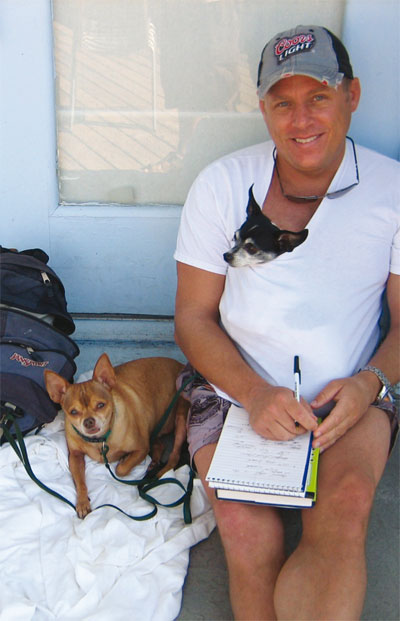
    Momentarily sidestepping the crotch shorts, public writing project, and twin loneliness mascots, nothing says “I know less than three black people” more than a Coors Light hat that was pre-tattered at the time of purchase.

    Really? How much dothree black people know?

  • The Art of Report Writing

    Cops hate paperwork. Hell, everybody hates paperwork. But policing has more of it on a day-to-day basis than most occupations. And there’s an art to writing a good police report. I like to think my writing skills made me a better police officer. And it’s why as a professor I stress the importance of writing style and basic grammar.

    Most police reports are basically form letters and require little or no thought or creativity: “At such and such day and time I responded to so and so location and was met by the suspect, later identified as whomever. Further investigation revealed blah-de-blah. Suspected taken into custody without incident and transported to CBIF.”

    But life without personality is no fun. Take this DOA (who wasn’t, technically, deadon arrival. But it’s a pretty standard report for such an incident. Terse, to the point, and as short as possible while included all (and only) necessary details (I’ve changed names and the address):

    On 19 APR 01 at 0705 hrs responded to 1581 E Lafayette for an overdose. Upon arrival Mr Jackson was being carried to an ambo, medic 10, in full cardiac arrest. Mr Jackson was brought to Hopkins and treated by Dr. Arjun Chanmugam before being pronounced dead at 0737 hrs.

    Mr Jackson given medication at 1845hrs on 18 APR 01 by Ms. Ethel White.

    Mr Jackson was last seen in good health by Mr Henry David at 0200 hrs. At 0700 hrs Mr David saw Mr Jackson with “his eyes rolled up” and called for a paramedic. Mr Jackson was asleep in upstairs middle bedroom. No paraphernalia was seen.

    Mr Jackson on the following medication: Roxicodone, Prednisone, and Valtrax.

    Hearn at M.E. notified and accepted body for autopsy. Patton #6481 at homicide notified.

    That’s that. RIP, Mr. Jackson. Why did I notify homicide? He probably wasn’t murdered, but you never know; that’s not my call to make.

    But what strikes me is my completely superfluous inclusion of the quote, “his eyes rolled up.” It adds nothing but is a great reason to call for an ambulance! I tried to include a good quote whenever I could–especially if the quote included naughty words, which were otherwise taboo. If “fuck you Mike bitch” was going to be keyed in a car, you could be sure it would be transcribed verbatim in my report.

    When I wrote of a man throttling a woman on the ground, later I referred to this, “vehement emotional display.” In return I received this joking note: “Officer Moskos, Please stop using big words in your reports. I have a hard time understanding all of them. Thanks, OIC Woollen.” But the report was accepted.

    Once I chased a suspect from an alley. He was easy to catch because his pants fell down as he was trying to get away. I described him as fleeing “in a rather ungraceful manner.” It wasn’t relevant, but why not? Why pass up a chance to make my sergeant roll his eyes or let some ASA in the bowels of CBIF smile for a moment. You gotta have fun.

    But, more seriously, a well-written report can be and often is the difference between a case being dropped and the successive conviction of a dangerous criminal. If you don’t write it down, it’s like it didn’t happen. And there’s always room for a good writer’s eye. My favorite quote served such a purpose: “Squeaky beat me with a two by four, and then they came at me like locusts and beat me down.”

    “They came at me like locusts and beat me down”?

    Such Biblically-inspired language deserves to be inscribed. And since it added flavor to an otherwise dry description of a old man getting beat down, it helped in conviction. I wastrying to paint a story and help convict the guilty–all the while sticking to the objective tone police reports require.

    Other times the night was slow and I was simply bored.

    Once, on foot, I ran across a guy with a needle sticking out of his arm. He was homeless and bloody. He needed help, but none I could give him. Still, I had a job to do. I put on my latex gloves and slowly arrested him. Yuck. He was riding high. (Luckily CBIF took him.) Later I wrote in my Statement of Probable Cause:

    After getting a delicious hot cup of coffee, I … could not help but notice a man, later identified as Mr. Guizotti, with a needle in his arm. Mr. Guizotti stated that he was a heroin addict and that the substance he injected himself with was, “good shit.”

    All this comes to mind because Ellen Collett, who reviews police reports for the L.A.P.D., writes this fine piece in the Utne Reader, “The Art of the Police Report.” If you’re more into writing, I recommend reading the original version that appeared in The Writer’s Chronicle (but if words like “subtextual” and “syntactically” scare you, stick with the first link):

    Monday through Friday, I’m enthralled by a man I’ve never met. His name is Martinez and he’s a cop with the Los Angeles Police Department.

    Crime reports are written in neutral diction, and in the dispassionate uni-voice that’s testament to the academy’s ability to standardize writing. They feel generated rather than authored, the work of a single law enforcement consciousness rather than a specific human being.

    So how can I identify Martinez from a single sentence? Why do his reports make me feel pity, terror, or despair? Make me want to put a bullet in someone’s brain—preferably a wife beater’s or a pedophile’s, but occasionally my own? How does he use words on paper to hammer at my heart? Like all great cops, Sergeant Martinez is a sneaky fucker. He’s also a master of inflection and narrative voice.

    That poster-child for cop writing, Ernest Hemingway, once observed, “Prose is architecture, not interior decoration.” A good incident report also gives us the necessary shape of the thing, but spares us the cluttering details.

    Choose strong verbs. Beware of modifiers. Shun figurative language. Be leery of parentheticals. Avoid abstractions. Eliminate superfluous ornamentation. Omit needless words. Be concrete. Show what happened; don’t explain what it means.

    There was a sign in the police academy: “We’re not just report takers. We’re the police.” There is more to writing a good report than just getting down the facts. For most incidents, the responding officer isthe investigation. Nobody will even be as close to some form of objective truth. Yes, reports need to maintain a objective tone. But if there’s a guilty SOB, it’s got to be clear in the written report. You only have one chance. The report is true, but certain facts may be selectively left out if these details distract from some greater truth. For instance, in a case of child abuse where the wasfood in the kitchen, you probably wouldn’t mention that in the report (other times, less nobly, facts may be left out simply to avoid more paperwork).

    Collett’s advice is good for writers and good for police officers. And allpolice officers, like it or not, are writers of stories: “Like Martinez, a good story always has an agenda. Like Martinez, a good story is a sneaky fucker.”
  • Word Frequency

    I’m ran the latest draft of my book through a word-frequency count. 47 uses of “simply”?! That’s simply too many, and I got that down to 11 (mostly just by deleting them–it’s interesting how often “simply” simply isn’t needed). Now I’m working on “certainly,” “of course,” and “actually.” It’s very easy to fall on such linguistic crutches when you’re writing.

    So the total number of different words in my new book is about 4,900 (out of 30,000 words).

    I don’t know why I find that interesting. I also wondered if it’s a lot or a little.

    Turns out I’m not the only one curious about such matter (oh, the world wide webs, how magic you are!).

    Zachary Booth Simpson was all over this, ten years ago.

    Compared to most books, I don’t use many words at all (that’s good news for my friend, Gotti).

    Moby Dick uses 17,227 different words. But Moby Dick is long. And my book is short. It turns out that for books of my length, my vocabulary seems perfectly respectable.

    Thanks, Zach!

  • Text-to-voice software

    If you’re not a writer or a computer nerd, just skip this. Really.

    I’m editing my book (and being doing so for a long while). It’s very near done and still a very slow process.

    About six hours ago, I bought a text-to-speech program online for $50 (NaturalSoft, for what it’s worth. I have no idea if there are better ones). Honestly, it doesn’t work too well in Word, at least not when two word files are open at the same time, but it works just fine when you cut and paste text.

    It took me two days to get through about 30 pages. Tonight, using this program and having my book read to me while I looked at it, I swear things went at least three times as fast. That number is an estimate, but it’s not an exaggeration. I got through 50 pages tonight!

    Not only that, but I know I did a better job catching things I would never have noticed from just reading the text.

    And here’s why: because the damn thing doesn’t stop (unless you want it to, like when you have to make substantial changes). Slow and steady. It’s like being on an assembly line of your own words. I felt like cross between John Henry and Laverne De Fazio.

    But now it’s almost 6am and I’m off to bed.

  • On Writing

    On Writing

    People sometimes think I don’t work much (an opinion only reinforced when they see me having my morning coffee at 2pm and still in my bathrobe at dinner time). But I’m a night owl and I work from home.

    So along with teaching four classes (a very heavy load for a college professor), I have to write. And writing is work. To those who think it’s easy to write a book, I suggest they try it. To those who can churn out a book a year, I applaud them (and wonder how they do it). Writing is hard work. And it’s not fun.

    A friend and fellow academic author put it this way in an email:

    There are days in writing (for me usually when I have a decent draft of something and am crafting) that it flows, but most of the time it’s work, work, work, work.

    People who don’t understand writing or who use formulas or hire ghostwriters who use formulas think that a book is like having a baby, nine months and it’s done. such total utter bullshit.

    Now I’ve never had a baby, but I only wish writing was such a passive process that got pushed out after nine months (not to mention the fun that leads to babies in the first place).

    I’ve been working on this book for a while and I’m still not done. When writing, I can produce about 1,500 words a night. But that’s only some nights. Because I’m not productive most nights, my actually production is more like 100 words a night. And that’s just the first draft.

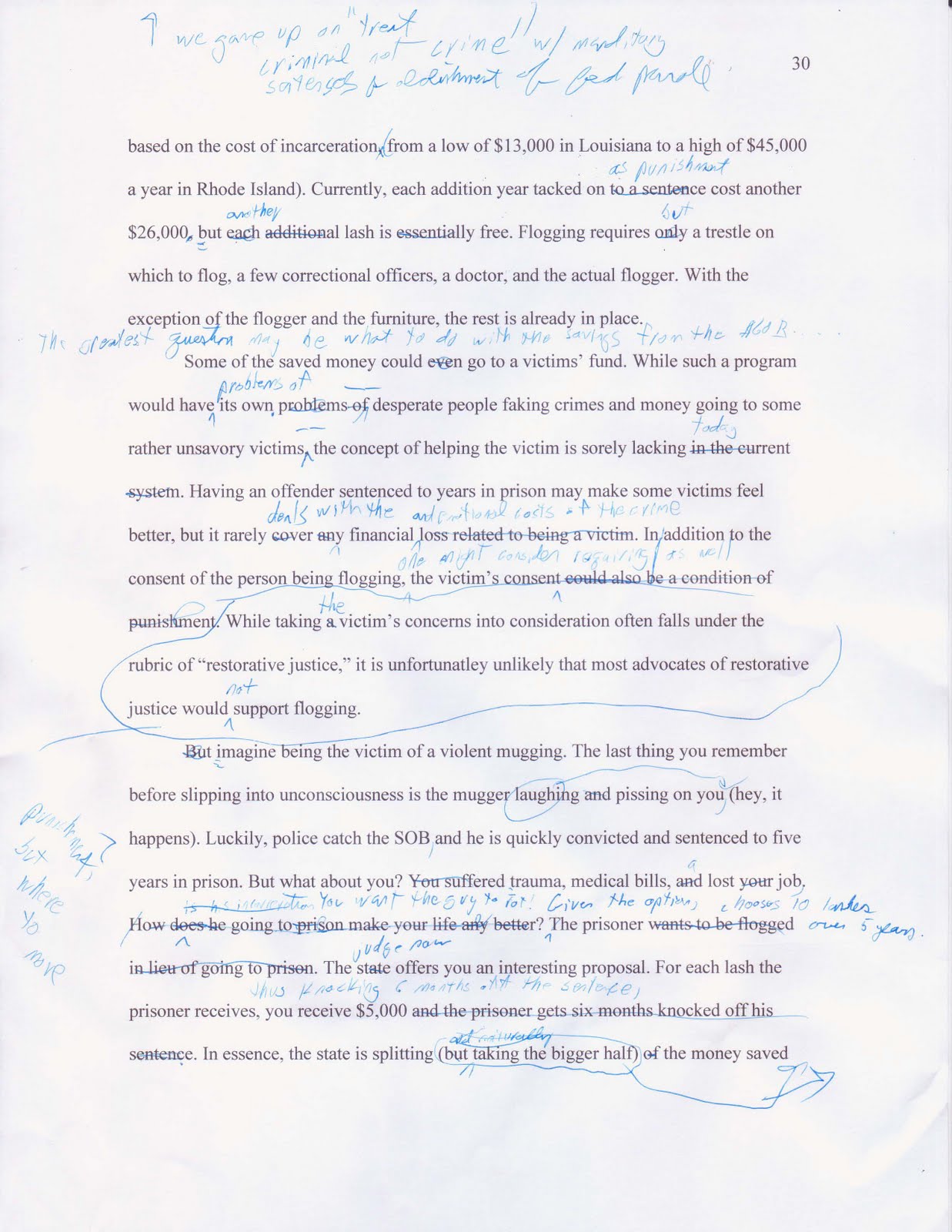
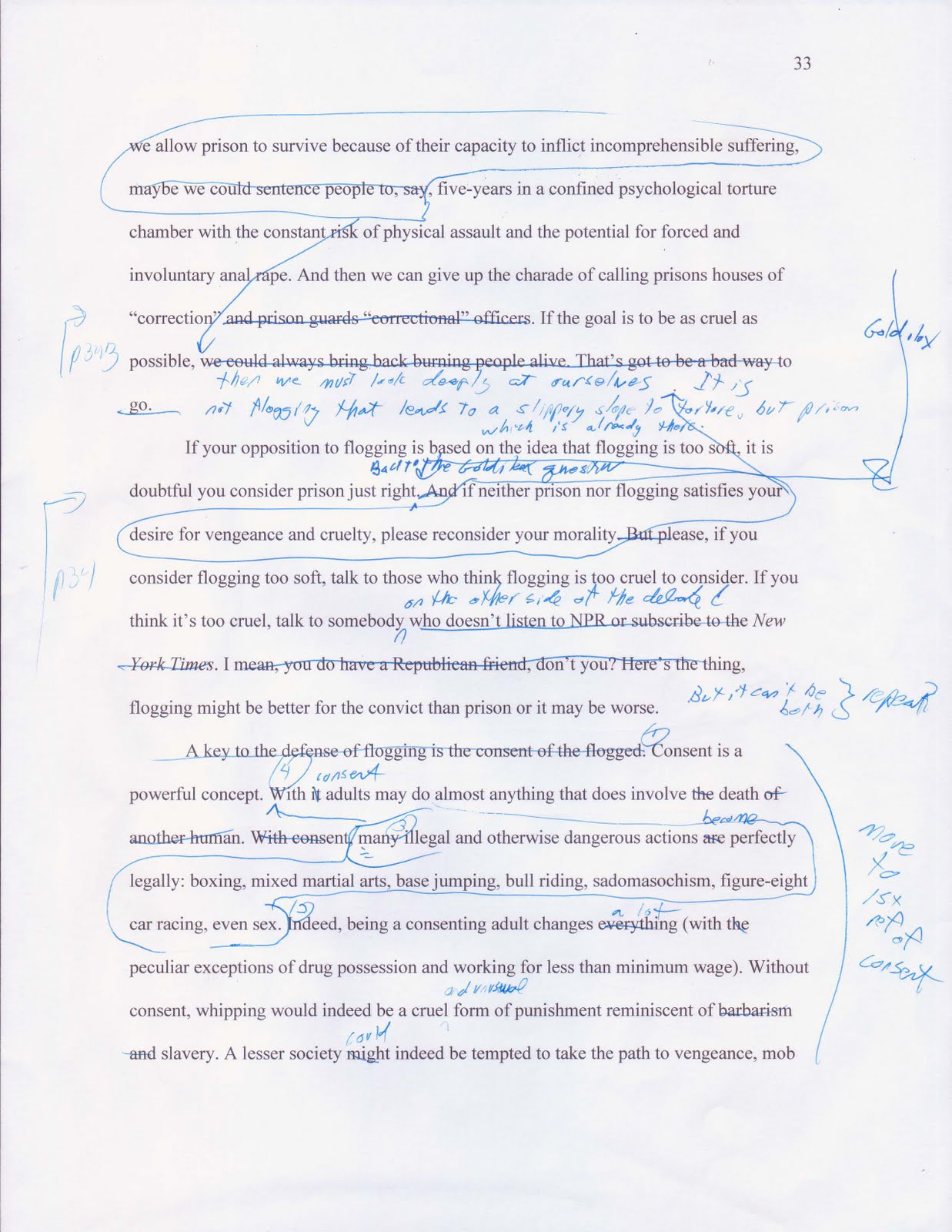
    Now that I have a (rough) first draft of my book, it’s more work. Even after getting all the words on paper–and at 30,000 words it’s a very short book–it’s still a lot of slow painful work. Just to give you some idea of the editing process, here are a two pages of a draft of my forthcoming book, In Defense of Flogging.


    So why do I do it? Sometimes I wonder. Every other job I’ve had has been easier, and yet still I choose this vocation. What did I create as a cop? Hopefully I helped some people, but Baltimore is no worse off without me there. And as a waiter I helped rich people enjoy their dinner, but waiters are just supporting cast to the food. And when I was a boat captain in Amsterdam I learned about boats and made a lot of tourists very happy. That was fun. But at some point I got tired of the same old tourist conversations (and rainy weather).

    The work in those jobs created no lasting product. And none of it could be mistaken for art. Maybe I write because I can’t draw and don’t make sculpture. A book is, or at least should be, a little piece of art. Maybe I like that idea. I really don’t know.

    On any objective level, 99 percent of all writers don’t get enough credit or money to make it all worthwhile, but still people write. I guess there’s something satisfying about creating something from nothing, at least when you’re done with it all.

    But while doing it? Man, there’s very little I wouldn’t prefer to do than write. When I’m sitting at my computer at 4AM, sometimes I think about how nice it would be to have some other job where I could show up, do my job, and go home and watch TV guilt free.

    And yet I wouldn’t change my job for any other (except major league baseball player and Supreme Court Justice). Why is that?

    Perhaps writing involves a deeper calling. I’d like to think I’m doing something that will last and might actually (in some small way) change the world for the better. And though the craft of writing is a tough, I’d like to think I’m good at it. Plus, publishing is, in theory, part of my job.

    It’s great to have written. Too bad it’s not more fun to write.

    Look for my new book, In Defense of Flogging, to be published by Basic Books, in 2011.