An email from a Chicago Police Officer (emphasis added by me):
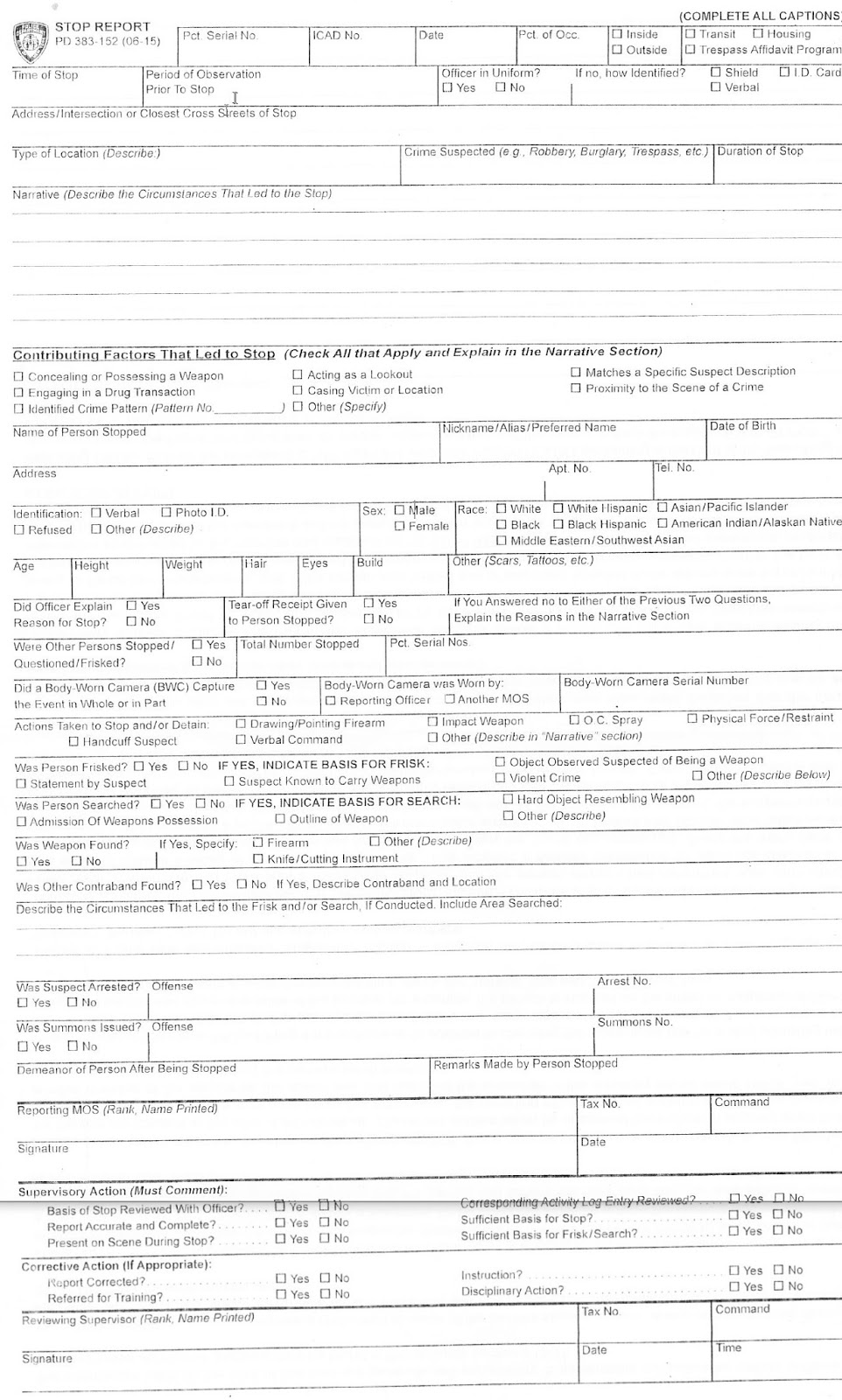
I wanted to go through our new “investigatory stop report (ISR)” training before I replied. By now you realize we have an extremely long form to fill out every time we do a street stop. The form is ridiculous and redundant but fortunately the department has created a shorter form that will we start using on March 1st. I think they missed the point with the gripes about low street stops. The form sucks, is burdensome, and redundant, but it’s just paperwork.
The issue is that there is still heavy oversight by the ACLU and many private attorneys and their quick access to all information on ISRs. So now, instead of just your sergeant deciding if you have articulated enough reasonable suspicion, each ISR has to be approved by a sergeant, the integrity unit, and then combed over by an endless amount of lawyers looking for the slightest hiccup in the report. Private attorneys have started contacted people stopped about two weeks after each incident, by phone and/or mail and asking them how the police treated them while they were stopped. This is really unsettling.
All of this seems like a direct result from the McDonald shooting, even if it’s not. Although no one is talking about it (the media has moved on to other police issues from where we park to the “thin blue line” code of silence). Immediately after the dashboard camera video came out, most cops were defending the shooting even after seeing the video. I get it. I would not have shot, but I understand why Van Dyke did. A crazed maniac on PCP with a knife is certainly dangerous and it doesn’t morally bother me that he was shot. I do think it was a bad shooting, but not by much. Although, I come from a newer generation of policing with a different mindset I suppose.
After the protests and eventually when the ISR system came out, everyone started to vilify Van Dyke as the cause of all this oversight whether or not they believed it was a good shoot or not. Those that believed it was a good shot, no longer say anything about it, if that makes any sense. Basically, no one is supporting Van Dyke anymore, at least not openly. Meanwhile, street stops are down an astronomical percent and homicides are at at 12-year high through February. On the 11th, the superintendent sent out an email to the department reminding them that it’s still okay to do street stops. No one took it seriously but the bosses have to do something to get numbers.
The idea that every report is being read by people looking to sue police officers is not a way to encourage productive proactive discretionary police activity.
The first two months of 2015 saw 51 homicides. 2016 has seen 101. That’s double, for those slow in math. If you don’t want to call this a “Ferguson Effect,” fine. I’ve never liked the term. But perhaps we can agree that if police feel they can’t do their job for fear of lawsuits and/or criminal prosecution and thus do their job differently and then crime goes up, something is going on?
So if you don’t like “Ferguson Effect,” how about we call it the “when police feel they might get in trouble for doing their job, so police — mostly to satisfy critics on the left who seem not to care how many people die as long as police are not involved — get out of their car less, stop fewer people, interact with fewer criminals, and then murders skyrocket” effect?
See part of the police job is to harass criminals. Maybe you can think of a better word than “harass,” but I use that work intentionally. Because policing isn’t all please-the-old-ladies-going-church. People don’t like to talk about it, but there is an actual repressive part of the job — legally and constitutionally repressive, but repressive all the same. When that doesn’t happen, criminals commit more crime.
[What I also find interesting in that a change in police culture with regards to what constitutes a good shooting is happening in front of our very eyes in Chicago.]
And here’s the email from the Acting Chief:
Good Evening Everyone,
I want to clarify concerns regarding the Investigatory Stop Report (ISR) and the Department’s Agreement with the American Civil Liberties Union of Illinois (ACLU). I have heard your concerns and I am working toward a solution.
First, since January 1, 2016, Illinois Law requires all law enforcement agencies in Illinois to document investigatory stops and protective pat downs. We are not alone in this endeavor; the entire state is tasked with documenting investigatory stops and protective pat downs. Neither the law nor the Department’s Policy has changed as to when stops and pat-downs are appropriate; merely the documentation has changed.
Second, Officers will not be disciplined for honest mistakes. I know that the Department ISR Policy has been in effect since January 1, 2016. The Department is working tirelessly to train everyone on the ISR policy and procedures. I know there is a learning curve and I appreciate your understanding as we make this transition.
Third, I would like to clarify the agreement between the Chicago Police Department and the ACLU. The Department has not relinquished any control of our policies and procedures to the ACLU. The agreement does not provide the ACLU with any role whatsoever with respect to individual officers’ compliance with the Department’s policies. The Department alone is responsible for supervising compliance with policies and procedures. Rather, the Department’s agreement with the ACLU provides that a former federal judge, the Honorable Arlander Keys, will review CPD’s policies, practices, and data regarding investigatory stops and recommend any changes that are reasonable and necessary to comply with the law, and that the ACLU will have an opportunity to review and comment upon CPD’s policies, practices, and data.
Fourth, our Department is working to reduce the burden on officers. Remember, completing an ISR is in the best interests of Officers based on the Illinois State Law. A properly completed ISR helps protect the officer by documenting the basis for the stop and any resulting pat-down. Additionally, the transparency of the agreement with the ACLU and the ISR create a trust and mutual respect between our agency and the communities we serve.
Lastly, officer safety is one of my greatest concerns, and continues to be a valid basis for a protective pat down. Officers simply need to describe in the ISR why they believe their safety was at risk. To perform a stop, an officer must have reasonable articulable suspicion, based on the facts and circumstances, that a crime has been, is being or is about to be committed. And, before an officer conducts a protective pat-down, he or she must have reasonable articulable suspicion that a person stopped is armed and dangerous and therefore poses a threat to the officer’s safety or the safety of others. Neither of these requirements are new policies.
I appreciate all of the hard work that each of you do on a daily basis. Additionally, thank you for your service and dedication to the people of Chicago. Take care and stay safe.
Sincerely,
John J. Escalante
Interim Superintendent of Police
Chicago Police Department
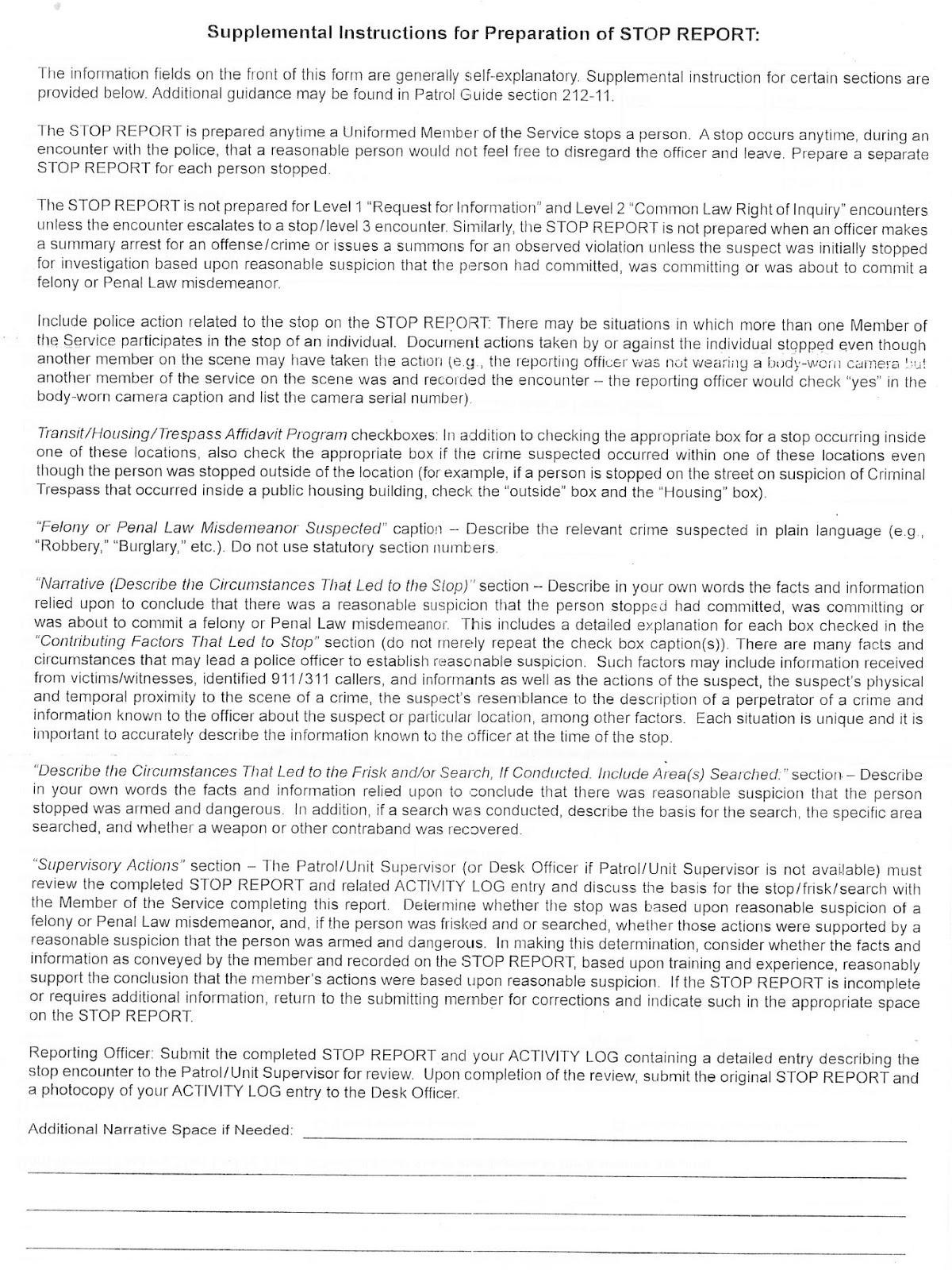
Here’s the long form in question and my previous post on “stop paperwork.”
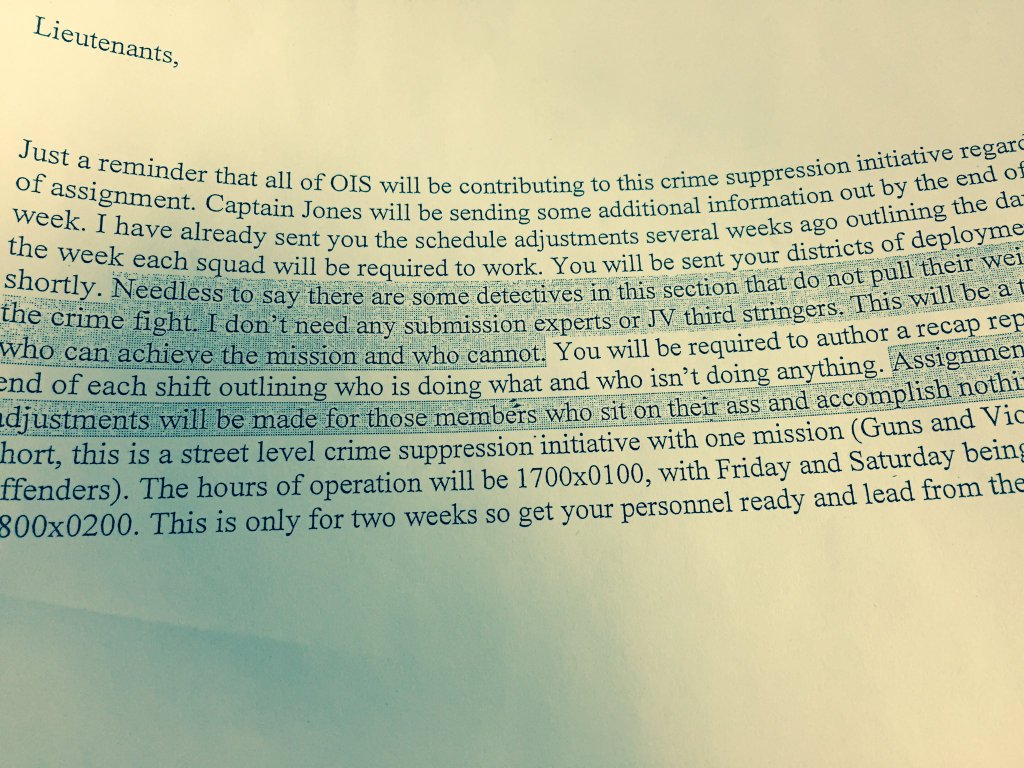
Maybe Chicago could learn from the Baltimore way of motivating cops: pull your weight; and no “submission experts” or “JV third stringers” need apply!