Tag: people shot by police who aren’t black

  • Perhaps the worst police-involved shooting ever

    I don’t say that lightly. There have been some bad ones.

    Click on this link or you can jump to about 0:50 sec on this:

    Andrew Thomas, the victim, a drunk driver, is paralyzed. He is white. So is Paradise, California.

    1:35: “I got a male in the car refusing to get out.”

    Maybe, you think, just maybe, it’s because you just shot the mother f*cker for no reason?!

    And yet I hadn’t even heard of this shooting until a Baltimore cop just brought it to my attention tonight. We were talking about Baltimore cops actually do their job pretty well, all things considered. A Baltimore cop would never do this; we can’t imagine this happening in Baltimore. Apparently the officer in this shooting won’t face charges.

    And yet in Baltimore six cops are being tried for failure to seat belt and bring prompt medical care? Has the world gone mad?

    It’s not just that white people don’t care about black lives. Honestly, most white people don’t care about white lives, either.

    [Update: he died]

    [Further update: The officer was found guilty of involuntary manslaughter and sentenced to 6 months in jail.]

  • Bad shooting in Gardena, California

    Usually when I get called from the media about a police-involved shooting I expect I’m going to have to explain how a reasonable police officer might perceive a potentially lethal threat.

    Not here.

    This is a bad shooting:

    The killing happened two years ago. The video was just released. The officers faced no legal consequences. The city paid $4.7 million. The victim, Diaz Zeferino? Never heard of him before yesterday:

    Three media outlets pushed for its release…. A judge granted their request, saying it was in the public’s interest to know why that city money was being spent.

    Why are these cops so afraid? Why it is so obvious to me, formerly a reasonable police officer, that the guy is holding a hat and thus isn’t holding a gun?

    Might this help demonstrate why citizens of California are 50 percent more likely than the national average and almost 4 times more likely than New Yorkers to be killed by police.

  • Cops shoot and kill unarmed man

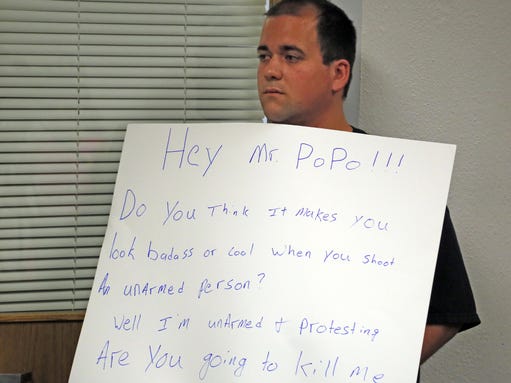
    No real point here. Except it happens. And you won’t hear this (except in Des Moines) because there’s no racial element to the story. Does that make the shooting any better or worse? I don’t think so.

    Apparently there was a protest of one.

  • “Can’t tase me, bro!”

    There’s an excellent article by the Atlantic’s Conor Friedersdorf about the use of a taser for non-compliance. I’ve long argued that, without an actual threat, tasers should not be used for compliance. The taser is too easy, usually not necessary, and sometimes kills people.

    Now I’m all for people complying with lawful orders; you do not have the right to refuse a lawful police order. But this case gets at the heart of non-compliance. What do you do when somebody does not comply?

    Cops will be quick to justify use of force for non-compliance. I don’t have a quibble with that. But what kind of force is reasonable? Lethal force is not OK. Hands-on is OK. But what about the taser? Sometimes you need to take a step back and ask what kind of society we want to live in.

    Personally, I don’t want to live in a society where non-threatening people — whether they are criminally stupid or not is beside the point — routinely get zapped by government agents.

    (Just think, this is why our Founding Fathers were wise enough to include the right against self-incrimination in the 5th Amendment. Were it not for the right to remain silent, police could and would use tasers in routine interrogations.)

    Tasers have been used — shamefully, I might add — against naked people, the homeless, a legless man in a wheelchair (you can’t make this shit up), a 76-year-old man driving a tractor, a 10-year-old girl, a guy running on a baseball field (I thought that one was OK), the “Don’t tase me, bro” dude, a guy who didn’t understand English, and the misuse of a taser led to a good police offier’s suicide. If you scroll down to the bottom of the Atlantic piece, you can see lots of bad taser-use videos.

    Now there are good uses for the Taser, and tasers have been shown to reduce injuries. (Serious question: how many injuries prevented per taser-related death is acceptable?) But none of this, not even National Institute of Justice recommendations, justify the massive overuse of tasers in law enforcement. Police are trained to use tasers for non-compliance. In many of those above instances, officers were acting in accordance with their training and regulation. And then the same officers were punished when the craziness of such training and policy becomes apparent.

    What I like about this recent case is that I can see the complete absolutely correct unassailable logic… for both sides of the case.

    Here’s what happened: a jogger, Gary Hesterberg, is stopped by a law-enforcement officer for an infraction. Hesterberg doesn’t have ID and says his last name is Jones. He then fails to comply with a lawful order and resists arrest. Finally, when attempting to flee, Hesterberg gets tased and arrested. So clear cut. So logical. But the problem with such a description is that no matter how logical each step is, at some point it is absurd — to use phrasing of the court it is not “objectively reasonable” — to use a Taser against a jogger violating a leash law!

    In court, the government conceded the violation was minor. Lying to police officer and failure to comply are less minor, but, said the court, “not inherently dangerous or violent.” Still, all this and the jogger’s resistance to arrest “weighs in the government’s favor.” The arrest was valid. The court accepted the government’s claim that “using communication skills was not a viable alternative to effect Hesterberg’s arrest.” Nor was arresting the jogger at his house — he gave his real address but said his last name was Jones — given the jogger’s willingness to lie. The jogger said he wasn’t even certain that green-uniformed Federal Park Ranger was law enforcement. The court said, tough titty, kid. And the court also understood that the jogger could have avoided this whole mess had he simply A) given his real name or B) complied with lawful orders.

    And court understands that the decision made by the officer needs only be reasonable “from the perspective of a reasonable officer on the scene, rather than with the 20/20 vision of hindsight.” This makes allowance for the fact that “police officers are often forced to make split-second judgments.”

    Now given all this, I would think the court is about to offer unqualified support for the government’s position and taser use. From Tennessee v. Garner (cops can’t shoot a fleeing felon), when know the government interest in stopping a fleeing suspect is not absolute:

    The Court finds that the intrusion on Hesterberg’s Fourth Amendment interest to be free from being tased greatly outweighs the minimal governmental interest in apprehending him for his violations of the law. Cavallaro’s use of her taser on Hesterberg was therefore unconstitutional.

    Did you get that? Here it is again: “The government’s interest in apprehending Hesterberg is simply too low to justify his tasing even if he willfully disregarded such a warning.” Daaaaamn.

    Weren’t listening? One last time: “The Court is not persuaded that the need to identify Hesterberg for his low-level violations of law justify Cavallaro’s use of the taser, even if the taser was the only tool remaining to collect Hesterberg’s identifying information.” Boo-ya.

    So what are you supposed to do? Let him jog away? Uh, yes. This is news to me and to most cops,

    Let him flee. Even if you have less-lethal weaponry at your disposal.

    This requires a seismic shift in the minds of law enforcement. Under certain circumstances sometimes it is OK, permissible — even required — to simply allow a person under arrest to flee. Cops will hate this, but it is a common sense, pro-police discretion, and pro-4th Amendment decision. It is worth remembering that though Garner was not “pro-police,” it turned out great for cops: scores fewer officers shot and killed!

    The judge, and this is important, even recognized that her decision goes against the regulations of the law enforcement agency that would permit tasing a 9-year-old girl or an 8-month pregnant woman: “The Court cannot imagine a rational fact-finder that would find it reasonable to tase a nonviolent and nonthreatening nine-year-old or eight-month-pregnant woman fleeing from non-serious misdemeanors.” Good.

    The jogger got $50,000.

    This certainly puts the rank-and-file in an awkward position. Their departmentally justified use-of-force policy is deemed, after the fact, to be unconstitutional and negligent. Once again somebody is telling police what not to do without any clear guidance as to what to do.

    Since you know it will take ages for police departments to catch up. I wouldn’t mind seeing a few police officers sue their own police department for policies that encourage or require officers to violate their oath to the constitution. “Failure to obey” doesn’t mean you get to use every toy on your belt. Police need to use their intelligence and common sense to understand the totality of the circumstance. I’ve got no problem with that. Because police generally have, despite what some may think, plenty of intelligence and common sense. Officers just need support from above and permission to use that discretion.

    I’m curious what cops out there might think. If you think this decision is absurd — if you think it should be OK for a cop to tase a minor offender fleeing arrest — at what kind of weaponry would you draw the line? Would rubber bullets be OK? Dog? Tear gas? Flash grenade? Sound cannon? Anything short of the lethal force prohibited by Garner? Or was Garner wrongfully decided?

    In an age where more and more less-lethal weaponry is in the hands of police, I think it’s important to clarify what kind of force is reasonable. For a leash-violation, a taser crosses the line.

    [Here’s a pdf of the court decision by the Federal Northern District of California case 13-cv-01265-JSC.]

    [Also, with regards to previous posts on race and police, it seems relevant to point out that the jogger was white. Had the jogger been black, I’m sure this would be seen as a racial incident and some people would claim, “Police never would have stopped a white jogger, much less tased him!” And this despite seeing again and again that police sometimes overreact to people of all races.]
  • Won’t be national news

    I’m going to wait till more is known before saying more. But here is yet another — I won’t say “common” but I will say “too common” — shootings that perhaps should but won’t become big national news. There probably won’t be protests. There won’t be unrest.

    But did police really break into the house of Jack Jacquez and shoot him? I don’t know what happened, but I do know there’s a lot here that doesn’t sound good.

  • Utah shooting of unarmed man justified

    Dillon Taylor was another unarmed white boy shot and killed by police. In (mostly) conservative circles, Dillon Taylor was compared to Michael Brown of Ferguson, Missouri. In some liberal circles, people believe police only shoot and kill black people. But Taylor, who is white, got almost no press (and I think the officer who shot him was hispanic). Michael Brown was black (and shot by a white officer). There were protests about both shootings (no looting in Utah), but unless you make an effort to follow these things, you’ve probably never heard of Taylor.

    Comparing Taylor and Brown, one person wrote:

    But they are alike in this important way: Neither young man deserved to die that day. Neither Michael Brown nor Dillon Taylor was convicted of a crime related to their activities on their last days, and even if they were, it wouldn’t be a capital crime. And this doesn’t appear to be an uncommon mistake.

    Well leaving aside what “common” means, a police officer does not shoot you because of the crime you did or did not commit. You are justifiably shot because a reasonable police officer believes you to be an imminent and potentially lethal threat

    To be clear, Taylor was not armed (nor was Brown). But Taylor sure doesn’t act like like he’s no threat. Taylor was — and acted like — an armed criminal. Still, knowing only that Taylor did not have a gun when he was shot, anti-police folk went out and filled in their ignorance with their ideology. The inevitable conclusion: police are to blame.

    But comparing the homicide of Taylor and Brown, there is one important difference: the officer who shot Taylor was wearing a body camera! As is usually the case, the video shows exactly what police claimed to have happened. We’ll never for sure what happened in the moments before Brown was shot: Here’s the Taylor shooting:

    The shooting was declared justified. This is maybe not the best shooting, as Taylor was eventually raising his shirt, presumably to show he wasn’t armed. I also can’t see Taylor’s right hand, which could change things. But at some point it seems to me that Taylor is doing the old “life your shirt to show you’re not armed” thing. So it does seem unfortunate to shoot a guy when he finally does comply with “getting his hands out.” But there was a period of non-compliance. And then there sure was a quick move from a concealing waistband. And had Taylor been armed, and I think a reasonable officer had good reason to believe Taylor was armed, then yes, this is a justified shooting.

    There are certain things you have to take on the job: dumb people; dirty people; violent people. But a depressed criminal idiot (perhaps with a death wish), playing “I might have a gun on me” is not one of them. Still, though I’m willing to give the officer on scene the benefit of the doubt, well, like I said, it’s not the best shooting. But yes, I think it is justified.

    Many people don’t realize how many idiots police deal with. As a police officer, more than once I was approached by a kid (always on a bike) who would quickly reach into his waistband and act like he was pulling a gun to shoot me. Honestly, driving toward them, I never had time to react. Also, they were young teenagers. And unarmed. Still, it’s the kind of dumb move that can get you killed.

    And yet when I’ve told seemingly smart people (who are far removed from ghetto policing) that this happened a few times, they stare at me in disbelief. They simply can’t believe that anybody, much less a unarmed young black male, would do something so potentially lethally stupid as pretend to pull a gun out and shoot a cop. And yet that attitude was routine enough that I didn’t even deem it worth mentioning it in my book. It was just some real life FATS training, I suppose.

    It was more common, it might be worth pointing out in this post, for young men to routinely (and without any prompting from me) raise their t-shirts to show they were not armed. That move would baffle ride-alongs.

    [For what it’s worth, I strongly suspect that police who work in violent areas — and though those officers will be involved in more shootings overall — those same officers will shoot fewer unarmed people because those officers are acculturated to a certain level of danger. Those cops who work the tough beat have more experience and less fear. I have no idea how to test this killer hypothesis.]

  • When police-involved shootings aren’t about race

    There’s still the strange belief among some people that police only do bad things to black folk. When I was on Chris Hayes the other night, some commentators thought the initial stop was racially biased. Chris himself questioned whether a white person would have been stopped for a seat-belt violation. I find that crazy talk. There was so much bad going on in that shooting that to be distracted by the initial stop seems to miss the greater point. I know the vast majority of cops don’t give a damn about your race. And the idea that white people don’t get stopped for seat-belt violations is also demonstrably false. (If you want to download and read a large and rather academic pdf report from the National Highway Traffic Safety Administration on the matter, knock yourself out.)

    Bad things do not only happen to black people. Most bad shootings don’t become issues till there’s unrest and/or Al Sharpton raises a fuss. And sometimes, a fuss should be raised. (And the last time the Rev tried to help some poor white guy who claimed he was brutalized by police, well, Sharpton sure picked the wrong white guy.)

    I’ve written a few times times about police killing white people, first on this blog in 2008. And then in 2009 there was the horrible police f*ck-up that resulted in police shooting and killing Rev. Jonathan Ayers. This was never big news. (In fact, to my dismay, my limited account of Ayer’s death seems to be the most extensive on record.)

    I’m not saying race never matters, but cops are not shooting black people because they’re black. Cops are not stopping black drivers for seat-belt violations because they’re black (though police may be searching your car for drugsafter that stop because you’re black). To believe that race is the issue in policing ignores and won’t solve the problem of people of all races who are wrongfully shot (or tased, or maced) by police. The issues have less to with race than with bad training and police officers making bad split-second decisions.

    So here’s a black cop shooting Bobby Dean Canipe, an unarmed white person (and a 70-year-old disabled vet at that).

    Clearly in hindsight this is not a good shooting. It’s a traffic stop and an old guy with a cane. And yet when Canipe gets out of his pick-up truck, on the highway, and I see a long hard object turn toward my face — and keep in mind I’m watching a youtube video and I *know* it’s not going to be a gun — I felt my ass pucker.

    Would a reasonable officer have feared for his or life in that situation? Yeah, potentially, probably, I think so.

    Sure it would have been great if the cop had known it was a cane. It also would have been great if the guy hadn’t gotten out of his truck and reached for his cane.

    A mistake. But I think a reasonable one. I’d let the cop off.

    [Hat tip to a commenter for bring this shooting to my attention.)

  • Undercover Cops Kill Jonathan Ayers

    In an off-topic comment to another post, “Badge Licker” (is that like Holster Sniffer?) wrote:

    “Undercover narcotics agents take out the trash this week.”

    I clicked on the link and realized this was talking about Jonathan Ayers. That got me thinking.

    Here’s a later report [dead link removed] from the same Fox News station.

    [dead link removed]

    I replied to Badge Licker:

    I assume by “trash” you mean “Christian” and by “taking out the the trash” you mean “undercover officers killing a man who thought he was getting car-jacked because the cops weren’t in uniform?”

    I’m actually shocked that Pastor Ayers is white.

    Maybe Ayers was involved in a little something something. But maybe not. We don’t know. But we do know he wasn’t the target of the raid. And the woman who was, was charged with (gasp) cocaine possession.

    Badge Licker said:

    The undercover narcotics officers announced, so that automatically means Reverend Ayers heard and understood and believed they were police and knew that it was not a car jacking as you implausibly suggest, PCM. Because Reverend Ayers knew they were police and tried to run them over anyway that means that Reverend Ayers was involved in some type of crime. Ergo, trash was taken out by them. The video shows how undercover narcotics officers help keep Georgia safe.

    A guy with gun yelling police isn’t necessary convincing. What is convincing is a guy in a police uniform yelling police.

    PCM said:

    It is certainly not unreasonable to consider the possibility that that Ayers thought he was being carjacked.

    We don’t know how clearly the officer announced they were police. And we certainly don’t know if Ayers understood. The owner of the gas station said he had no idea they were police. So they didn’t announce themselves *that* clearly. This is a problem that happens again and again with undercover. Sean Bell comes to mind (and Bell was less innocent that Ayers). So does the killing of Agent Michael Cowdery.

    And what justifies shooting at the car as it’s driving away (this is after the officer pulls the very cool roll-off-the-car-and-land-on-your-feet move)? Ayers was no longer a threat and, at least according the police department, he was not a suspect in their investigation.

    Perhaps others also have thoughts on this shooting?

    Above link is dead. But this onestill works.

    And without the news-broadcast audio: