Tag: police brutality

  • History isn’t Bunk, part 1

    History isn’t Bunk, part 1

    This is Part One of Two.

    There’s so much Jill Lepore gets wrong in her New Yorker article “The Invention of the Police.” The spoiler is in the subtitle: “Why did American policing get so big, so fast? The answer, mainly, is slavery.” She seems to ignores the actual history of police in America, but I’ll get to that in my next post. For now let me obsess on this paragraph Lepore wrote:

    One study suggests that two-thirds of Americans between the ages of fifteen and thirty-four who were treated in emergency rooms suffered from injuries inflicted by police and security guards, about as many people as the number of pedestrians injured by motor vehicles.

    Now if you, gentle reader, were to read a study that said that, what would your reaction be? Perhaps: “Huh?” “Can’t be.” “Crazy.” “Must be a bad study.” “Maybe I misread it?” Also, not to get all math on you, but “how can you have admissions made up of two distinct groups of two-thirds each?”

    All of the above. Actually, though, it’s not a bad study. It’s a clever study by Feldman et al (2016). Limited by data, as the authors admit, but good for what it is.

    As to Lepore, I had a tough time reading the rest of her article. I like (or liked) her work. But this is subject I know a little about. And her article is so skewed, so biased, and so absent of historical context and accuracy. But keep in mind, though, I just teach this at a public university. She’s a chaired Harvard historian. Plus she writes in the New Yorker. But has she never visited a high crime neighborhood? Has she never been to an emergency room?

    This mistake stood uncorrected online for more than a week. Currently it’s gone from the web version. But the mistake went to print. Online it says this:

    An earlier version of this piece misrepresented the number of Americans between the ages of fifteen and thirty-four who were treated as a result of police-inflicted injuries in emergency rooms.

    That’s it? Shouldn’t the correction correct the error, and not just make it go “poof”? It should say: “An earlier version of this piece suggested that nearly 66% of Americans between the ages of fifteen and thirty-four who were treated in emergency rooms suffered from injuries inflicted by police and security guards. The real number closer to is 0.1% We regret the error.”

    The error isn’t in the study she’s citing. The error is in how she read it. It could have been from reading this:

    We restricted our queries to persons age 15–34, the highest risk group, accounting for 61.1 % of all legal intervention injuries over the study period.

    But most likely she didn’t even read the study and misread the Harvard press release about the study:

    Sixty-four percent of the estimated 683,033 injuries logged between 2001-2014 among persons age 15-34 resulted from an officer hitting a civilian. The data did not distinguish between injuries caused by police and private security guards, who the authors said now number nationally about the same as police officers.

    But the context for the 64% isn’t all admissions. It’s 64% of those admitted for injuries related to what the authors call “legal intervention.” 64% of them have been hit. That might mean, hypothetically, that 20% were beaten with a rubber rose, 10% fell down stairs, and 6% had too tight hand-cuffs.

    Aside from common sense, there is also another way this error should have been caught. Lepore says two-thirds of injuries are from cops or security, and it’s the same number as pedestrians injuries by cars. Last I checked, 2/3 + 2/3 > 1.

    Here’s a more thorough take-down of Lepore’s claim by Louise Perry.

    So what is the correct percentage? The number of people in the ED (Emergency Department, AKA ER) for cop-security injury annually is 683,000 divided by 14 years. About 48,800 admissions a year. The data doesn’t break down how much of this is police vs private security (the authors’ acknowledge this).

    I would note: 1) private security — and they’re more of them than there are cops — can be much more brutal than police (I’m thinking bouncer / club-security). And 2) police can be very quick to take people to the hospital (to CYA), no matter how minor the injury. So of those 48,800 admissions, some (an unknown fraction) have been injured by police. But we don’t know. But grouping two groups when you’re talking about one is a bit dodgy. Potentially like saying, “cops and grandmothers killed a 1,000 people” and blaming grandmothers.

    There are 139 million Emergency Departments visits in the US. Roughly 45 million of this visits are 15-34 years old. (That exact age breakdown isn’t in that link, but you can find it if you care). So 48,800 is 0.1%, one-tenth of one percent. Were to Lepore to claim “two in three” when the actual number was “one in three,” I’d be upset. But she claimed “two in three” when the real number is “one in one thousand.” How could you be off by so much?

    If you could for even a moment believe that 67% of hospital emergency admissions for any group are because they’re getting beat by cops (or security), how clueless can you be? What does that say about your worldview? What crazy lens are seeing the world through? Who actual believes this? And why? Is it the articles there about cops hunting black men, talk of a literal epidemic of police brutality, comparisons to a real pandemic? Maybe.

    Partly what bothers me about Lepore’s statement is that it was in the New Yorker. This means that after it was written, it went through an editor, a copy editor, a proofreader, and, in theory, a “fact checker.” All this and not one of those people — and by “those people” I mean people of New Yorker persuasive (liberal and white) — thought, “Hey, this can’t be true.” No, it’s almost like they want it to be true.

    The blueprint for law enforcement from Nixon to Reagan came from the Harvard political scientist James Q. Wilson between 1968, in his book Varieties of Police Behavior, and 1982, in an essay in The Atlantic titled “Broken Windows.” … Wilson called for police to arrest people for petty crimes, on the theory that they contributed to more serious crimes. Wilson’s work informed programs like Detroit’s STRESS (Stop the Robberies, Enjoy Safe Streets), begun in 1971, in which Detroit police patrolled the city undercover… The campaign to end STRESS arguably marked the very beginnings of police abolitionism.

    To say say something “informed” something is a cheap why to link two things that aren’t related, simply because one happened before the other. She wants to slander James Q. Wilson because he was conservative. It’s what Ivy League academics do, I suppose. But what do Varieties of Police Behavior and “Broken Windows” have to do with either Nixon or Reagan? And nobody outside the field knew of “Broken Windows” until Bratton brought it to New York in the early 1990s (and brought down crime).

    And why go after August Vollmer? There are enough bad guys you don’t have to go after the good guys, too. And Vollmer, ironically, could have strengthened her point and serve as an inspiration for today’s police-reform movement. In his 1936 The Police and Modern Society, Vollmer questioned the police roll in traffic enforcement. He said the laws against prostitution can’t work and therefore we shouldn’t have them; gambling should the licensed and regulated; prohibition was a mighty failure; and let’s leave the moralizing to the church and other such agencies. As to to illegal drugs?

    Drug addiction, like prostitution, and like liquor, is not a police problem; it never has been, and never can be solved by policemen. It is first and last a medical problem…. The first step in any plan to alleviate this dreadful affliction should be the establishment of federal control and dispensation–at cost–of habit forming drugs.

    Instead (why? I don’t know) Lepore blames slaps the label of “Vollmer-era Police” on everything bad (including some items that were before Vollmer’s time). [Though I too, like Lepore, like to highlight the harm of the so-called “progressive” era of policing, which generally gets off too easy. And I would start police abolitionism a bit early. The mayor of New York called for the abolition the police in 1848. But those facts don’t matter when you’re writing about narrative.] Why blame Vollmer for what he was trying to change? Why not call it the “W.E.B. Du Bois-era Police.” Would almost make as much sense. Du Bois, too, wrote about crime and police.

    In Lepore’s narrative nobody gets shot, except by police; the only legitimate fear is to be afraid of police; riots are protests; crime is a non-issue (and police do nothing to prevent it); the only victims are “victims of police brutality [who] are disproportionately Black teen-age boys: children.” I doubt that to be true. But who knows? Certainly not Lepore.

    I don’t mean to “whatabout” her article by bringing up crime and victims of violence, but she did write an article about the history of police. I’m supposed to snuggle down with my New Yorker, sip an herbal tea, and believe violent crime is but a figment of the racist right. At a time when shootings in my city have recently tripled and 96% of shooting and murder victims in New York City are Black or Hispanic, I’m supposed to think the roots of US police lie in slavery? That police have never been anything more than agents of White Supremacy? But I don’t live in Lepore’s world; a world without violence; a world divided between privilege and victimhood; a world in which one can think hospitals Emergency Departments are just filling up daily with black children beat by police.

    My next post is going to talk about the history of policing in New York City, where modern police in America started.
  • Seven Baltimore cops indicted

    The Feds arrested seven Baltimore City cops today. I don’t know all the details yet, but the robbery charges seem major. “Robberies while wearing a police uniform,” I just heard. But you know what? Even without knowing the details I can go out on a very short limb and predict a few things. Why? Because it’s always the same. And that’s what makes it so frustrating. It’s like we never learn.

    Articles in the Wall Street Journal and the Baltimore Sun. And an unrelated scandal in Chicago. Though I will read these stories thoroughly. It bothers me that I don’t have to. Some things are always the same. Always:

    • Drugs. Always drugs. I’m not one for “root causes” theories in the abstract, but if you want to end police corruption, you’ve got to end drug prohibition. That’s it. Until then, this will happen. This only question is when, where, and how often. The drug game is dirty. And it is a game with arbitrary rules. It taints all involved, even the honest cops.

    • A specialized unit, removed from the generally non-corrupt culture of most police officers.

    • A selective unit, in that people don’t just get assigned there. Officers need to self-select. And the more aggressive cowboys do. And this aggressive hot-headed police sub-culture can feed on itself. Here’s something you may not know: most officers have no desire to work with those cops. Why? Because most cops don’t like they way they operate. Do cops know they’re dirty? No. But they certainly suspect things aren’t kosher. So the good cops stay away. You stay away because there’s guilt by association in the police department, and when the shit hits the fan, and it always does, you don’t want to find yourself in the jackpot.

    • Red flags galore. Let me guess, the officers involved had tons of overtime (this seems to be one of the charges). Too much legal (or illegal) overtime is a red flag. But usually what now happens is the department cracks down on all overtime. Collective punishment, in essence. And that will only piss off the honest cops who are trying to do their job.

    I bet a few of these cops are “highly decorated.” Yes, too many awards is a flag.

    I’m also going to guess there were a lot of complaints against these officers over the years. Now of course if you do aggressive work you’ll get more complaints than some lazy hump who never gets out of their car. And you need to be careful not to see every complaint as legit, because most are BS. But still, when you get a dozen complaints — use of force, discourtesy, the whole nine yards — in a year or two? I think of the line from the Wire:

    “…which for Herc will make an even four in the last two years.”

    “None sustained.”

    “But all of them true.”

    On the flip side, you can’t treat every complaint as a career hold. That’s how you get the maxim, “If you don’t work you can’t get in trouble.” Flags aren’t guilt. That’s why they call them “flags.” You notice them. You investigate. And maybe there’s nothing to them. But sometimes there is. Somebody up top needs to notice these flags. And somebody with authority, you know, a “leader,” needs to put their neck on the line and take action.

    • High “productivity.” You want guns and drugs and cash on the table? You reward officers for arrests? Then you get this. (Not always, mind you. Not immediately. Not all officers. But yes, eventually it is inevitable). It’s not easy to balance “productivity” on one hand with “laziness” on the other. But I’m telling you, there’s a huge middle ground into which fall 80 percent of cops.

    • Bad supervision. The sergeant got arrested, and this implies the squad was rotten to its core. So, I can’t help but wonder, who was the Lieutenant? Go on up the chain of command, for a change. Not just to punish and blame, but to inquire, reform, and figure out how this happened. Did the LT close his or her eyes because of pressure from higher up? I don’t know. Where exactly was the communication breakdown? Because this is about bad apples. But it’s not just about bad apples. There’s the barrel that allows these apples to rot.

    The military-like chain-of-command does nothing more efficiently than suppress open communication. In a police department, it’s too easy to put on blinders and not know what is happening around you. In fact, you’d be a fool to do otherwise. This is not the same as a “blue wall of silence,” mind you. But it is a problem. But even if those higher up don’t know about the crimes happening under them, it’s still a failure of leadership.

    Anyway, I’m just writing about scandals in general. But if these facts are true in this case — and I bet they are — isn’t that, as they say in the police world, a clue?

  • Ouch

    Alameda Country deputies beat the crap out of this car thief in San Fransisco. Pesky security camera caught most of it (and with audio).

    I haven’t seen a police beating like this since God knows when. And now the cops are going to go down. All because they thought somebody deserved a beat down.

  • A Toddlin’ Town

    From AP:

    In all, Chicago has paid a staggering sum — about $662 million — on police misconduct since 2004, including judgments, settlements and outside legal fees, according to city records. The payouts, for everything from petty harassment to police torture, have brought more financial misery to a city already drowning in billions of dollars of pension debt.

    The Chicago police said there were 45 firings and 28 suspensions from 2011 through 2015 in a department of about 12,000. Some cases remain open.

    The city’s top lawyer, Stephen Patton, says his office has reduced costs with new strategies: It has cut the number of outside lawyers by more than 80 percent, taken more cases to trial (the corporation counsel’s office won 21 of 28 last year), whittled down a backlog and spread the word it will no longer settle small cases routinely.

    Burge cases — including settlements and outside lawyers — have cost the city more than $92 million (about $109 million, if county and state expenses are included), according to Taylor, who keeps his own tally.

    And I’m just going to beat Pirate to the punch.

  • Fight Police Brutality

    Fight Police Brutality

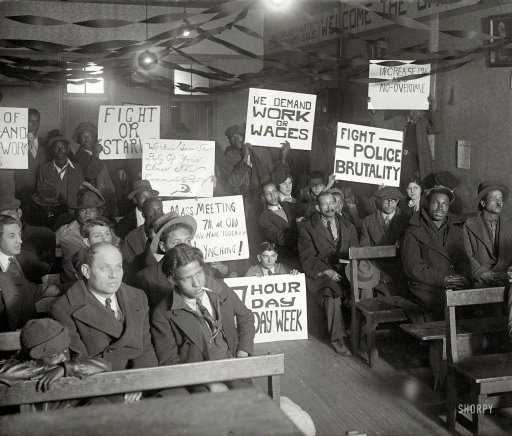
    No point here. I just like old pictures. From Shorpy.com.

    Caption:

    Washington, D.C., circa 1925. “Protesters” is all it says on the caption card for this National Photo glass negative showing what seems to be a meeting of the “Communist Party Young Communist League.”

  • “When Cops Violate Civil Rights, It’s City Taxpayers Who Pay”

    From Citilab.

    As a taxpaying city resident, I don’t like having to foot the bill for bad behavior. (I also don’t think cities should be so quick to settle.)

    My solution is give whatever money the city is now paying out to the police department budget. Raise the police budget by that much. And we’re talking millions. And then tell the police department: it’s on you. All future lawsuits will come from your budget. I guarantee you this would result in fewer lawsuits.

  • Bad cops

    OK, my cop friends: please tell me what I’m missing here or how any of this (from February) is defensible. It’s so rare I can watch a video and not understand or at least empathize with the police.

    These Bloomfield, New Jersey cops are going to end up in jail right? And is the salary range really $57K starting up to $100,000. 

    Here’s an update from July. I don’t know the latest.

  • How to change occupational culture

    New York City just paid $2.75 million to settle a lawsuit from a prisoner who killed in Rikers. As a taxpayer, I worry about a million here and a million there. Pretty soon, as they say, we’re talking about real money. To the tune of $100 million each yearfor New York City. And indeed it does not grow on trees.

    Everybody who has ever been a jail — guard, police officer, prisoner, lawyer — knows some bad stuff happens in there. If you want to find brutality, stop looking at police and start looking at C.O.s. (Of course, it’s a lot easier to film police than to film what goes on in jails and prisons.)

    But those big settlements don’t cost the agencies where it happened one penny. The Department of Corrections or NYPD budget doesn’t pay for the lawsuits they brought about. The city pays. It’s a lot easier to be irresponsible when somebody else picks up the tab. It’s like you’re playing baseball and break a neighbor’s window. You’ll probably break fewer windows if you have to pay for the replacement. But as long as mom and dad pick up the tab, play on.

    If some or all of that money came from the agencies that were responsible, I guarantee you those agencies would find a way to change the behavior and working culture that leads to lawsuits. Instead, the culture stays the same, and every now and then an officer gets thrown under the bus.

    [Update: Jim Dwyer has a July 22 story with a similar themein the NYT.]

  • More on UC Davis Pepper Spray

    You can watch the 45 minute version here. This may not be thedefinitive version, but if you care about this issue, you owe it to yourself to at least take 45 minutes from your busy life and watch a version of the whole thing.

    Some have said the cops are surrounded. That is after-the-fact rationalization (at best). Perhaps it was true in a technical sense, though I’m not even certain of that. The police seemed to be able to walk freely over the students. The police were certainly not acting as if there were surrounded; they made no effort, even after macing some of the students, of breaking out. I do not believe that police used force because of any perceived threat to their physical safety. And if there was a threat (I wasn’t there), it wasn’t coming from the people who were maced.

    If you think police acted out of necessity here — as opposed to legal, justified, or even acceptable behavior — if you real believe it was tactically necessary for the safety of the officers to mace the people sitting down, you probably can’t ever conceive of a situation where police did the wrong thing. That’s your right, but… well… you’ve got nothing to add to any talk of bettering police.

    Here’s my take:

    Except for the use of mace, it all seemed to be handled pretty well. Seriously — and I know it’s a bit like saying, “other than that Mrs. Lincoln, how did you enjoy the show?” — most police officers and most protesters deserve a star for staying cool in a potentially hot situation. This includes the initial police arrests.

    Now whether the students needed to be dispersed and/or arrested is an issue I’m going to pass over because it’s not relevant to analyzing the behavior of the officers on scene following lawful orders. There were no students being clubbed. There were no bottles lobbed at police. There was no vindictive pepper-spraying of students on the way out. There was no riot. This was not Kent State. All that is good.

    Everything was just fine until somebody made a bad (not illegal, mind you) decision to use O.C. spray against passively resisting non-threatening students.

    In the end, the police retreated and the students chanted “you can go.” And police did.

    It gets me thinking, people have been upset about the militarization of police for years. Seems like nobody listens or cares until a few college students get maced by cops in riot gear. I guess better late than never. But the smell of mace in the morning is so minor compared to what is going on elsewhere in this country. For instance, innocent people continue to get killed in drug raids.

    People are actually fighting and dying for real freedom in other countries (Egypt comes to mind). I’m happy our standards are higher. But we should all be a bit thankful for the (mostly) civil society in which we Americans live. I can write this. You can disagree. And nobody is going to knock on our doors and arrest us. God bless America.

    Finally, a few minor points:

    Am I the only one, but chanting crowds always bug me. Something about the mindlessness of chanting always rugs me the wrong way. Is there not a certain dignity to silence?

    And since when did college students start referring to themselves as “children”? What ever happened to “I am a man”?

    And before some huffy cop corrects me, I know that police do not technically “mace” people. Police use O.C. (Oleoresin Capsicum) spray, which is a related to hot peppers (hence the “capsicum” of O.C.). I think mace is actually another chemical. But many people, including myself, always use mace as a generic term for anything that comes out of spray can and hurts like hell. Besides “stop or I’ll administer a chemical O.C. spray” does not have the same ring to it.

    Finally, on the lighter side of pepper spray, of course there’s a tumblr blog.

  • Dumb-ass Training and the U.C. Davis Pepper Spray Incident:

    I’m in Dublin. I love Ireland (though England was great, too).

    I received an email from the Washington Monthly (you may remember them as one of the first magazines to publish a Flogging piece) asking my opinion about the UC Davis pepper-spray incident. I hadn’t heard of it. But ignorance is not bliss.

    So now I’ve watched the video. I wasn’t there, but here are my thoughts (best read at the Washington Monthly):

    This UC Davis pepper-spray incident from yesterday, in which campus police sprayed a group of protesting “Occupy” students who were sitting on the ground, was just brought to my attention. I don’t know all the facts, but as a former cop-turned-academic, there’s one thing I can say.

    In the police academy, I was taught to pepper-spray people for non-compliance. Ie: “Put your hands behind your back or I’ll… mace you.” It’s crazy. Of course we didn’t do it this way, the way were taught. Baltimore police officers are too smart to start urban race riots based on some dumb-ass training. So what did we do to gain compliance? We grabbed people. Hands on. Like real police. And we were good at it.

    Some people, perhaps those who design training programs, think policing should be a hands-off job. It can’t be and shouldn’t be. And trying to make policing too hands-off means people get Tased and maced for non-compliance. It’s not right. But this is the way many police are trained. That’s a shame. (Mind you, I have no problem using such less-lethal weapons on actual physical threats, but peaceful non-compliance is different.)

    When police need to remove protesters—whether that’s even the case here I don’t know—it needs to be crystal clear who gives the order, be it the president of the university or the ranking officer on scene. Officers on the scene shouldn’t be thrown under the bus because their superiors gave stupid (albeit lawful) orders. Accountability matters.

    And if police need to remove these students, then the police can go in four officers to one protester and remove them. Lift them up and take them away. Maybe you need one or two more officers with a threatening baton to keep others from getting involved. It really can be that simple.

    People don’t hate the police for fighting off aggressors or arresting law breakers. They do hate police for causing pain—be it by dog, fire house, Taser, or mace—to those who passively resist. And that’s what happened yesterday at U.C. Davis.