Tag: police culture

  • What if the messenger actually is a bit to blame?

    The BBC has a story about Michael Wood and his reporting of police wrong doing.

    I still don’t doubt the truth of what he says he say and participated in. That’s important. As to his character or motives, nobody outside of policing really gives a damn what they are or if Wood was a good police officer or not.

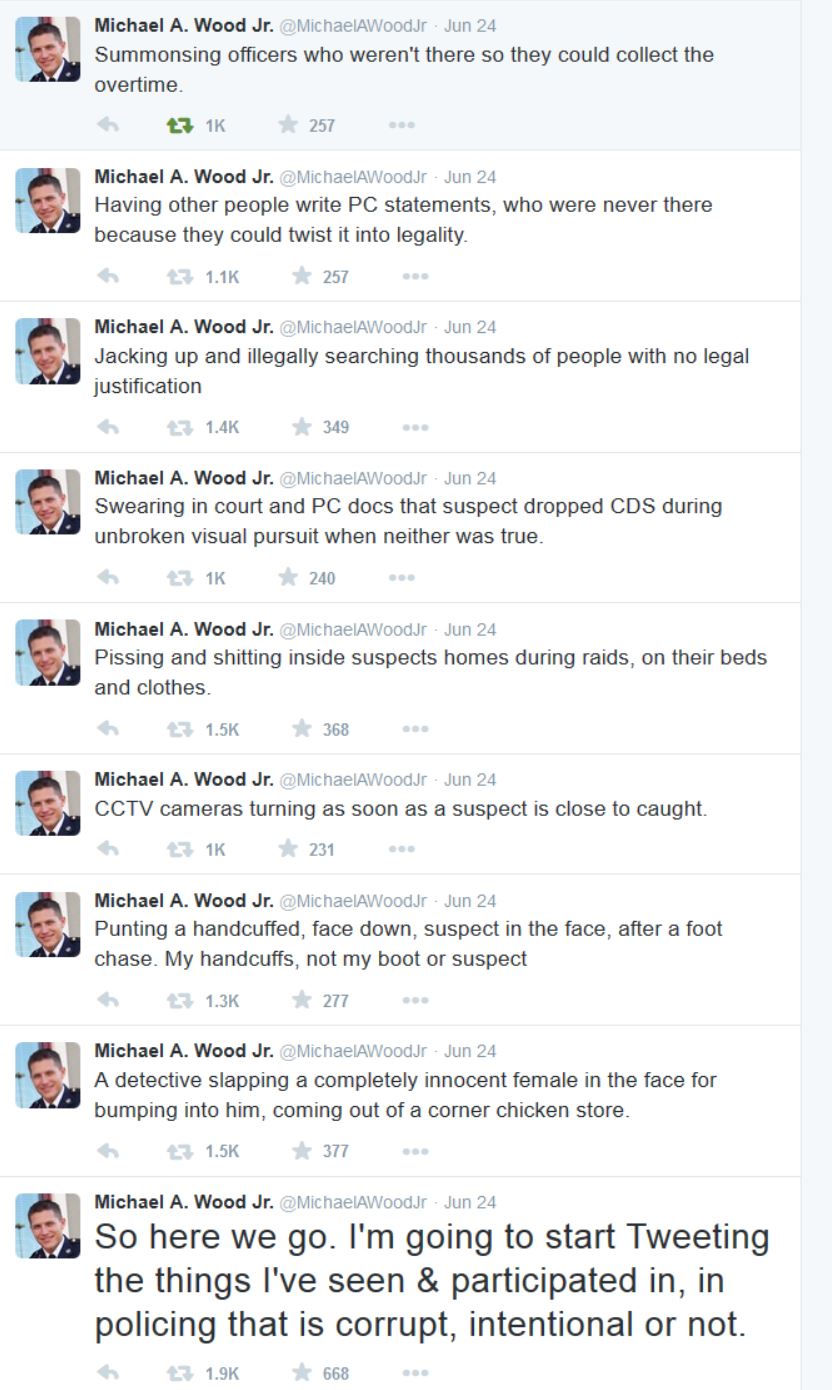
    Wood makes some very good points. Points that need to be made. So good on him for making them! These are all from his twitter feed:

    Guess what will happen if police act super courteous while being filmed? Would get boring huh? Kill em w/ kindness, duh.

    Of importance is that, because of the culture, nearly any BPD officer could have been involved in Freddie Gray, that’s the shock they have.

    PC Batts has been feeding you BS from day one, research what he says. Is it true? Does he carry out?

    7pm-3am shifts with 9am court, destroy your sanity, your family, your life.

    [It’s wrong to place] people in a situation where they can choose either a 6 month guilty plea or face 20+years in prison.

    These things need to be heard more. And right now people are listening to Wood.

    But people are most interested in the bad and illegal things Wood saw and did.

    It’s one thing, as a young cop, to go along with the flow or not report on bad behavior. I’m not saying it’s good. But it’s understandable. It’s one thing to decide six years after your last arrest that something needs to be said. That’s even understandable.

    But at some point you can’t just admit that bad things you did and hold your head high. Wood says this in the BBC story:

    I was a shift commander [VCID, I would guess, known as “Impact” in my days] and I told the shift that when you go out there doing car stops: “I don’t want to see you stopping an old lady – this is Baltimore! You stop 16-24 year old black males.” Why? Because 16-24 black males are the ones who commit all the crime.

    Seriously? What the fuck?!

    You’re not some great whistleblower if you blow the whistle against yourself. That’s called confessing to your crimes. Look, I’m glad Wood if has matured and no longer says racist or anti-semetic comments. But as Chris Rock once said, you don’t get credit for shit you’re supposed to do!

    To be clear, I don’t mean this as a personal attack on Wood. If Wood is using himself as Exhibit A for a messed-up system, more power to him. There is a problem not just with individual people but with a system that allows a supervisor to issue such racist illegal commands. There’s a problem with a system that allows people to get through the academy no matter what they do. There’s a problem in a system that thinks their way is the only way. But when you want to change and improve that system, attack the system. Attack those who do wrong. But you shouldn’t besmirch others by thinking your own malfeasance is typical.

    My shift supervisors never told us to stop black men. I was never encouraged to conduct an illegal search. I didn’t conduct illegal searches. Though like Wood, I saw many cops’ hands unconstitutionally empty pockets. Also like Wood, I wrote about this (in Cop in the Hood) and mentioned it whenever I could. (“But do they call me Pierre the Great Whistleblower? Non.”)

    Now I and those in my squad were not angels. But I never heard of a cop taking a dump in a home. Nor did I witness cops slapping anybody. I didn’t see a handcuffed man get beat by police (I did see that happen once in CBIF, but that’s another story). There is a pretty hard and fast rule that once the cuffs are on, the fight is over. That said, if you are going to criminally assault a prisoner, you would certainly want to assault somebody else’s prisoner!)

    So what’s different about Wood? Best I can tell:

    1) Wood was a cop longer than I was;

    2) Wood was in a specialized drug squad that did more bad stuff;

    3) Wood actually did more bad stuff. And like attracts like.

    Kind of related, and this is one of the few good things I’ve heard Batts has done as chief, but the worst offenders were demoted from specialized units. Rumor has it that complaints against police dropped 40 percent. Of course what happened to these obnoxious cops? Most were just sent back to patrol to be bitter and pissed off at even less criminal citizens.

    My sergeant (who never went to college) could articulate the legal distinctions between a stop and an arrest, between a frisk and search, and between reasonable suspicion and probable cause. Why can’t others? Also, he never took a day of medical.
    Update here:

    What if the messenger actually is a bit to blame?

  • Low Morale

    The NY Post reports an NYPD study that says: “More than half of city cops have bad feelings about being a police officer because of their bosses.” It goes on:

    The findings also revealed 85 percent of cops feared being proactive on the street because they are wary of civilian complaints.

    More than two-thirds say they have not taken lawful activity against criminals because they feared being sued.

    Only 15 percent of cops thought they were trained well in crisis intervention and 18 percent in management.

    The highest training rating was given to firearm training — and even that was at only 50 percent. Only a third of cops thought they were trained well in officer safety.

    And training in both investigations and domestic violence was also rated badly, at a pitiful 26 percent.

  • I still like the baton

    Maybe this is minor in the bigger picture of what people are saying about Michael Wood Jr, but I have to disagree with Wood’s dislike of the baton. In a radio interview he said he didn’t carry his because he couldn’t imagine hitting somebody with it. In the Balko interview he says cops used them to dent doors.

    I loved my baton. I still have it. Right by the front door, just in case. The straight baton I’m talking about, not the asp. Wood never had a straight baton (BPD phased them out in 2001). The straight baton can do so much more than the asp. It’s defensive. You can wack a leg or arm. You can thrust forward and back. You can hold it in multiple positions (some more benign than others). You can twirl it. (One of my great regrets was trying and failing to master the espantoon.)

    The old-fashioned baton gives you a certain gravitas when you walk the beat.

    Unlike most cops I carried my stick with me to almost every call. I wanted to avoid being in a situation where I might be on the losing end of a fight and have to kill somebody. And partly because of my willingness to carry it (combined with the general view on the street that cops carried a baton only when they planed on using it) I never actually did have to strike anybody.

    But I sure did use it to knock on doors. Did I dent any? I don’t know. Not intentionally. But how else are you going to be heard knocking on a door? The door bell hasn’t worked in decades. I learned pretty quickly that my knuckles aren’t hard enough. There’s loud stuff going on. And I don’t want to waste everybody’s time — they did, after all, call 911 — not knowing whether or not you heard me knock the first time. Also, I wanted to make damn sure you knew that police were at your door. When you’re a cop you knock like a cop. You take a step to the side, rap a few knocks loud as hell (once), and say “PO-lice.” Worked every time.

    I wrote more in defense of the straight baton in 2011.

  • The Futility of the War on Drugs

    Given the recent discussion started by Michael Wood, Jr. this last excerpt from Cop in the Hood couldn’t come at a better time:

    It may seem incongruous for police officers to see the futility of drug enforcement and simultaneously promote increased drug enforcement. But for many, the drug war is a moral issue and retreat would “send the wrong message”:

    “It’s a crusade for me. My brother and a cousin died from heroin overdoses. I know that on some level it’s a choice they made. But there was also a dealer pushing it on them. I want to go out and get these drug dealers.”

    Another officer was more explicit: “You’ve got to see it [drugs] as evil. What do you think? It’s good? When we’re out there, risking our lives, we’re on the side of good. Drugs are evil. It’s either that or seeing half the people in the Eastern [District] as being evil. I like to think that I’m helping good people fight evil. That’s what I’d like to think.”

    The attitudes of police and criminal are largely controlled by a desire to protect their turf while avoiding unnecessary interactions. On each call for service, drug dealers generally do not wish to provoke the police and most police officers are not looking for adventure. At night, curfew violations can be enforced on minors. Open containers can be cited. People can be arrested for some minor charge. But arrests take officers off the street and leave the drug corner largely unpoliced while the prisoner is booked. Nothing police officers do will disrupt the drug trade longer than it takes drug dealers to walk around the block and recongregate. One officer expressed this dilemma well: “We can’t do anything. Drugs were here before I was born and they’re going to be here after I die. All they pay us to do is herd junkies.”

  • Things Police Do

    Things Police Do

    Michael Wood Jr. has made some waves by tweeting about things he saw as a Baltimore cop.

    [To get up to speed, single best thing to read now is the Balko interview.]

    Honestly, I don’t doubt what Wood says. I am curious if all the bad he saw came from his time in narcotics. And for better or for worse, he wasn’t in narcotics long. I don’t think he made an arrest since 2009. There has been lots of time to bring up these issues. Lots of time to go to IAD. In fact, he still could. But anyway…

    I never worked a specialized unit. I didn’t want to. I didn’t like they way the worked. (I also wasn’t there long enough anyway to get out of patrol.) I saw the drug squads tear up homes during raids. (I was sometimes the lone “uniform” out back.) It was immoral and ugly. Worst of all, it was legal.

    End the drug war and 80 percent of police problems vanish.

    But I’m curious, if Wood was a sergeant, did this stuff happen under his command? Because then it’s also on him. But all in all, I have no reason not to take him at his word:

    I will admit to some self interest in coming forward. I’d like to part of the solution. I woke up to this, and I think I can be a bridge. I speak the language cops speak. If there’s some task force or policing reform committee I can serve on, I’d love to do that.

    Other than that, I think we just need more conversation.

    Unlike Wood, I never had a “come to Jesus” moment working as a cop. The world — and policing — is filled with a lot of gray. I already knew the war on drugs was doomed. (What I learned as a cop on the front line was how that failure worked out on the front line.) I suppose I went in a bit more world weary and cynical than the average cop. I was older (29) than the average rookie. I lived in the city. I did not have a military us versus them attitude. I was college educated. Well traveled. I spent a lot of time with the police in Amsterdam (on and off from 1996 to 1999). So I had a certain perspective as to what I was seeing and doing on the job. I was not completely unfamiliar with the ghetto, black people, or urban life in general. I was not afraid.

    I am afraid that lost in the sensationalism of a cop “telling all” will be the subtlety and nuance of what Wood is saying. It would be unfortunate were this just filed away as ammo in the “cops are bad” camp. I know — as I presume Wood does — too many cops who do care, do have empathy, and do work very hard to help people. I also know a lot of cops who maybe stopped caring, but still do a good job. And, sure I’m all for societal justice, but lofty ideals don’t tell police what to do in neighborhoods with these kinds of problems!

    In a very long radio interview Wood mentions something which deserves highlighting:

    This job is largely impossible.

    The expectation of the modern police officer is that they should be a medic. They need to be MapQuest. They need to be a jujitsu expert. They need to be a handgun superstar who can shoot somebody in the knee…. They need to be a psychiatrist. They need to understand mental illness. They need to be able drive effectively. They need to do all of this while making $45,000, having minimal training, and no education.

    Wood makes the point that there’s too much injustice in our society. He’s right. And he’s right that they’re linked to race and class. He’s right that the rules are different if you grow up in the ghetto. He’s right that the war on drugs is a failure. And he’s right that too many cops come from completely different backgrounds without any empathy or understanding of the area or the people in the area they police. He’s right that what we’re doing isn’t working. He’s right that police can do better.

    Here’s an interview of Wood by Radley Balko in the Washington Post:

    What we’re doing to people to fight the drug war is insane. And the cops who do narcotics work — who really want to and enjoy the drug stuff — they’re just the worst. It’s completely dehumanizing. It strips you of your empathy.

    I found his take on veterans as cops (he is one) interesting:

    But when it comes to former military joining law enforcement, I’m in the camp that says they’re going to be better when it comes to shootings and using force. Bad police shootings are almost always the result of a cop being afraid…. The military strips you of fear. Here’s the thing: There’s nothing brave or heroic about shooting Tamir Rice the second you pull up to the scene. You know what is heroic? Approaching the young kid with the gun. Putting yourself at risk by waiting a few seconds to be sure that the kid really is a threat, that the gun is a real gun. The hero is the cop who hesitates to pull the trigger.

    That’s where I think a military background can help. Very few of these bad shootings were by cops with a military background. There may have been a few, but I can’t think of one.

    I’ve often said it would be nice if we could talk about some of the important issues before somebody dies. Maybe Wood is giving us that opportunity.

    [Though he’s wrong about the baton.]

  • Police/Community relations in Baltimore

    They weren’t good then. They’re not good now. From Cop in the Hood:

    While the police see good communication between the public and the police as essential to fighting crime, relations are quite poor. This shouldn’t be surprising. Drug users are criminal. If they want to stay out of jail, they and those who care for them have every reason to be wary of police. One officer complained:

    “Nobody here will talk to police. Half the public hates us. The other half is scared to talk to us. I would be, too. But we can’t do anything without the public. They know who’s dirty and who’s not. They know who’s shooting who. We don’t know. They live here. We just drive around in big billboards. How are we supposed to see anything? The public doesn’t understand that nothing will ever go to court if nobody talks. We can only do so much. As long as nobody ever sees anything, things aren’t going to change.”

    New or not, the impact of silence is hugely detrimental to police and prosecutors. Even without personal risks, there is little incentive to testify. Nobody gains through interaction with the criminal justice system. You don’t get paid for it; there is no guarantee that testimony will result in conviction and jail time; and after the second or third postponement, a sense of civic duty usually fades. The hassles of court–passing through metal detectors, wasted days, close contact with crowds of criminals–combined with practical matters such as work and childcare make it far easier, even smarter, to see nothing, hear nothing, and mind your own business.

    That’s the real wall of silence we need to break down. And I have no idea how to do it. Especially given the rules of the game, both judicial and criminal. Make no mistake about it: snitches do get stitches. Witnesses get killed. Not that often, mind you. But just enough to shut people up. (This also seems relevant if you’ve read Ghettoside, which I wrote about in a comment to this post.)

  • Violence and the Drug Corner in Baltimore

    Too many people are getting killed! From Cop in the Hood:

    Still the risk of death is astoundingly high. For some of those “in the game,” the risk of death may be as high as 7 percent annually. Each year in Baltimore’s Eastern District approximately one in every 160 men aged fifteen to thirty- four is murdered. At this rate, more than 10 percent of men in Baltimore’s Eastern District are murdered before the age of thirty- five. As shocking as this is, the percentage would be drastically higher if it excluded those who aren’t “in the game” and at risk because of their association with the drug trade. Yet if everybody you know has been shot, killed, or locked up, perhaps such is life.

    Linked to the recent increase in homicides:

    Police don’t find many guns when frisking suspects. The threat of arrest may outweigh the risk of being robbed or attacked. For others, a reputation for violence may be enough of a deterrent. Yet there is no doubt that guns are accessible to many. After all, gunfire is a daily reality and pacifist corner drug dealers don’t last long.

  • Corruption in the Baltimore Police Department

    When I hear people, Commissioner Batts including, talk about the horrible institutional problem of Baltimore police corruption, I know they have never spent any time working on the streets of Baltimore. Batts certainly hasn’t. He’s the chief. He’s separated by five thick layers of chain of command from the rank-and-file. And he didn’t work his way up through that chain of command.

    Here’s what I saw. If you have no first-hand experience, please don’t try and convince me otherwise. It’s the old line about “Who are you going to believe? Me or your lying eyes?”

    This comes from Cop in the Hood:

    Temptation is everywhere. Given the prevalence of drug dealing and the fact that drug dealers hold hundreds and sometimes thousands of dollars in cash, police officers routinely face the opportunity for quick and illegal personal gain. Police could get away with stealing drugs or money, at least for a while. But robbed drug dealers can and will call Internal Affairs. And officers with criminal dealings will usually be ratted out by another criminal. Putting a dirty cop behind bars is as good a get-out-of-jail card as exists.

    I policed what is arguably the worst shift in the worst district in Baltimore and saw no police corruption. I know there are corrupt police officers. After three years on the street, one Eastern District officer stopped a man who drove his motorized scooter through a red light. The man had $6,300 in his pocket. The officer counted the money and allegedly returned $4,900 of it. The man called police to report the missing money and the officer was arrested and indicted on felony theft charges. One year later, these charges were dropped on condition that the officer resign from the police department and agree not to work in law enforcement again. When a cop is dirty, there is inevitably a drugs connection. Over a few beers after work, the subject of the drug squad came up. An older cop warned me to “stay away from drugs [in your dealings as a cop]. They’ll just get you in trouble in the long run.”

    Incidents do happen, but the police culture is not corrupt. Though overall police integrity is very high, some will never be convinced. But out of personal virtue, internal investigation stings, or monetary calculations, the majority— the vast majority—of police officers are clean. A greater problem is that high- arrest officers push the boundaries of consent searches and turn pockets inside- out. Illegal (and legal) searches are almost always motivated by a desire to find drugs. In the academy, an officer warned the class, “Corruption starts six months to a year after you’re out of the academy. When you’re on the streets and you start shaking down drug dealers because they’re worthless shits.” Similarly a sergeant explained:

    You’ll get out there, thinking you can make a difference. Then you get frustrated: a dealer caught with less than twenty- five pieces will be considered personal use. . . . Or you go to court and they take his word over yours. You’re a cop and you’re saying you saw something! . . . After it happens to you, you don’t care. It’s your job to bring him there [to court]. What happens after that is their problem. You can’t take this job personal! Drugs were here before you were. And they’ll be here long after you’re gone. Don’t think you can change that. I don’t want you leaving here thinking everybody living in this neighborhood is bad, does drugs. Many [cops] start beating people, thinking they deserve it.

    Police officers are often in a position to hold various amounts of drugs and money. Legally seized drugs and money are kept in one’s pockets (carefully separated from personal belongings) before being taken to the station house and submitted in the proper fashion. Officers have to be careful not to make honest mistakes. They could put something in the wrong pocket. Something could fall out of a pocket. The night gets busy and they might forget to submit. Before each shift, police officers search the squad car for anything left behind.

    Many residents, after repeated calls to police about drug dealers, assume that officers are either incorrigibly corrupt or completely apathetic:

    I understand what you [police] deal with. But you got to understand. People see police drive right by the dealers, don’t even get out of the car. Or they [police] got them [dealers] with their legs spread [being searched]. Who’s to say you ain’t taking a little something on the side? You can’t have drugs on this scale without somebody letting it happen.

    Police discount such accusations:

    People get bad ideas from the media or from criminals that we’re corrupt or brutal. But we’re not. Or they refuse to think that their son could be involved with drugs. They want the corner cleared, but if we pick up their son it must be the racist cops picking on him because he’s black. And with the amount of drugs you’ve got in this area, of course they aren’t going to like police because we’re trying to lock them up. Too many people here are pro-criminal.

    Even financially, it pays to be straight. A New York City police officer explained:

    My pension is worth between one and two million dollars. I’d have to be a fool to risk that for $100, even $1,000. I’ll tell you when I’ll be corrupt: the day I walk into a room piled with drugs, five million dollars in cash, and everybody dead. For five million, I’d do it. I’d leave the drugs and take the cash.

    Some officers enter the police department corrupt. Others fall of their own free will. Still others may have an isolated instance of corruption in an otherwise honest career. But there is no natural force pulling officers from a free cup of coffee toward shaking down drug dealers. Police can omit superfluous facts from a police report without later perjuring themselves in court. Working unapproved security overtime does not lead to a life in the Mob. Officers can take a catnap at 4 am and never abuse medical leave. There is no slope. If anything, corruption is more like a Slip ’N Slide. You can usually keep your footing, but it’s the drugs that make everything so damn slippery.

  • “Police earn court overtime pay while residents get rap sheets. It’s a horrible equilibrium, and police are the fulcrum”

    I hear a lot of people with very strong opinions try and tell me and others about a place they’ve never been and a job they’ve never worked. I wrote about police the drug corner, places like where Freddie Gray was arrested and died in police custody. The next few posts will be exerts from the chapter in Cop in the Hood called “The Corner: Life on the Streets.” It starts with this quote from a Baltimore City police officer:

    It’s a different culture. You know, what is normal for us–like going to work, getting married–they don’t understand that. Drugs are normal. Mommy did it. Daddy did it, not that he’s around. But if people want to take drugs, there’s nothing we can do. All we can do is lock them up. But even that is normal.

    On “clearing the corner”:

    [It’s] what separates those who have policed from those who haven’t. Some officers want to be feared; others, respected; still others, simply obeyed. An officer explained: “You don’t have to [hit anybody]. Show up to them. Tell them to leave the corner, and then take a walk. Come back, and if they’re still there, don’t ask questions, just call for additional units and a wagon. You can always lock them up for something. You just have to know your laws. There’s loitering, obstruction of a sidewalk, loitering in front of the liquor store, disruptive behavior.” Police assume that if the suspects are dirty, they will walk away rather than risk being stopped and frisked. You can always lock them up for something, but when a police officer pulls up on a known drug corner, legal options are limited.

    If a shop is run efficiently, the boss, himself working for or with a midlevel dealer, should be able to sit and observe the operation. By not handling drugs or money, he faces little risk of arrest from uniformed patrol officers. The boss may be sitting on a stoop of a nearby vacant and boarded-up building posted with a “no loitering” sign. Because of the sign, he could be arrested for the very minor charge of loitering, the catch-all arrest charge. But how often can that be done? Repeated arrests for loitering, especially if no drugs are found, could easily result in a complaint about police racism and harassment to Internal Affairs.

    Don’t worry. It gets better.

  • “Cop of the Year”?

    I was recently asked for comments about a “Cop of the Year.” It doesn’t matter which. I didn’t know the cop, so I didn’t say much. I have no clue what he did (or didn’t) do. But I am suspicious of “cops of the year.” Are my suspicions justified? I’ll presume there are lots of nice “cops of the year” out there. Wonderful cops of the year. But I don’t remember meeting one. Of course a good cop would be modest about such an award and wouldn’t wear it on his sleeve.

    So maybe I’m just barking up the wrong tree. But it sure does seem like a disproportionate number of arrested cops have been a “cop of the year” at some point. (Of course if I’m looking for something like this, and I am, then I’m susceptible to “confirmation bias.”)

    I do worry that the same factors that make a cop “cop of the year” — aggression, a lot of arrests, a focus on results, seeing your job as a crusade against evil, seeing no gray in the world — these are exactly the same factors that get you in trouble in the long run.

    Quite simply, it’s nearly impossible to consistently make 10 times as many arrests as other cops. Seems to me that being a “super cop” is more a red flag than a cause for celebration.

    Also, I never wanted to work with an over-driven I’m-going-to-save-the-world let’s-lock-up-all-the-bad-guys adrenaline-loving supermen. I mean, why is somebody getting into a signal-13s when you’re off duty? And when that happens, why would that person end up on my post saying, “you never saw me.” I never wanted to see him because trouble was always finding him. Maybe he was just a better cop than me. Either way, I stayed clear.

    [I just googled the guy I’m thinking of, because I assumed he didn’t retire as a cop. And he didn’t. Though he does seem to have a better job. So for all I know he mellowed and learned and took a wise career move. Maybe. But to see him described in one article as a “by the book” cop? Ha.]

    Anyway, this all came to mind because another “cop of the year” was just sentenced to 10 years for drug charges. So I googled “‘Cop of the year’ sentenced” and came up with a bunch pretty quickly. Coincidence? I don’t know. But they were all described as having at one been recognized as a “cop of the year”:

    Philip LeRoy, Queens. Drugs. The most recent.

    Noe Juarez in Houston. Cocaine trafficker for Los Zetas.

    Drew Peterson, Illinois. Domestic murder.

    Ron Coleman, Houston, Drugs.

    Jonathan Bleiweiss, Florida. Forced sex with male illegal immigrants.

    Jerome Finnigan of Illinois. Armed robbery (and racist bad taste).

    David Britto, Boynton Beach, Florida. Drugs.

    James Joseph Krey, Florida (again). Domestic-related.

    Michael Grennier, South Plainfield, NJ. Child porn.

    Michael Froggatt. Gold Coast, Australia. Drunk Driving.

    Matthew Anselmo. Omaha Nebraska. Mail fraud & money-laundering.

    Pace yourself, I say. You got years on the force to do good. And you don’t want to get burnt out of banged by the department because you took the job too seriously.