Alton Sterling was shot and killed by police yesterday. Maybe you’ve watched the video. I have. And I’ll tell you what: Other than a tussle and Sterling being shot, I have no friggin’ clue what is going on. And I’m what they call a so-called “expert” on these things. So I really don’t know how everybody else has it all figured out.
It might be a bad shooting. Honestly, it looks like a bad shooting. And even if justified, it’s probably unnecessary in terms of the style of policing that led up to the shooting. Make note: yet another shooting precipitated by the A) failed use of a Taser, B) cops who don’t seem very good at verbal persuasion, and C) cops not doing hands-on well. (Seriously, what’s with the solo tackle?)
And yet all that said, I can’t get over one pretty important detail: Alton Sterling was armed with a gun. An illegal gun. And cops very clearly saw that gun.
“Why did police have to shoot that man with a gun?!” is a question I am generally inclined to dismiss.
A witness to the shooting (who perhaps should have been doing something if he really was “two feet away”) said Sterling had a gun in his pocket, but also that Sterling’s hands weren’t near that pocket. And I’ve read that police were called to investigate a complaint that from somebody who objected to having that gun pointed by Mr. Sterling in his direction. Yes, even in Louisiana that is a crime.
We don’t what happened before when police approached Sterling. Seems relevant to the discussion. There might be other video. I’d like to know more.
And a big deal seems to made that Sterling was on the ground and shot in the back. To me this is a non-issue (except to note that police did seem to have the advantage). A fighting man, even on his belly, can reach for his gun. What if he does get his gun? Should police have to wait for him to point and pull the trigger before shooting? Shoot the bullet out of the air or something? Or reach under Alton before shooting, to avoid shooting him in the back?
I’m not saying this is a good shooting. I’m saying I don’t know what happened. And neither do you.
Hours after posting about the police-involved killing of robber Robert Howard, I read Justin Fenton’s amazing storyabout the robber: “Man fatally shot by off-duty officer was also shot by police 20 years earlier.” Are you effing serious?! What are the odds? I don’t think anybody in American history has ever been shot by cops in two separate incidents. I don’t know what that amazes me, but it does. Oh, Baltimore.
But wait, there’s more. It’s deja vu all over again! Remember how in last week’s shooting, witnesses reported Howard was unarmed and running from cops? And they said that cops shot him in the back? If it weren’t for the video, many people (and a Baltimore City jury) would doubt the cops.
How many “witnesses” come forward when the shooter isn’t a cop?
Well back in 1996 Howard was again busy robbing. He pulled a gun on cops, fired on cops, and cops shot back. Cops could have kept shooting. But the police didn’t kill Howard because once Howard was no longer a threat, they stopped shooting. That’s what cops are supposed to do. Police arrested Howard, without further incident, after Howard tried to kill them. Job well done, right?
Well in the 1996 shooting there was no video, and a jury acquitted Howard of all criminal charges. Howard’s attorney said officers planted a “drop gun” on Howard. One witness adamantly testified Howard did not have a gun. (Boy, if cop did have drop guns to plant, why are so many “unarmed” people shot by cops? Think Sean Bell, Diallo, Zongo, and Michael Brown.)
As an outsider, this may seem like just a shame, understandable given years of oppression. Or maybe even true. But it’s not. And it happens all the time. It what frames cops’ worldview. And if you’re the cop involved? It’s life changing. And not for the better.
Howard then (unsuccessfully) sued the officers for $12 million. He claimed he was unarmed and had his arms raised.
When I was in Baltimore, Kevon Gavinwas killed after his car was deliberately struck by a criminal being chased by other cops. The killer was doing 80mph and rammed Gavin’s car, crushing it. The killer was arrested at the scene wearing a bulletproof vest and carrying a semi-automatic handgun. Later, in the jury trial, the killer was acquitted of all criminal charges. He walked free. (Even his lawyer admitted he was surprised at the verdict.)
It’s happened before and it will happen again.
So back in 1996, Stephen Cohen was one of the two cops that shot Howard:
The fallout prompted Cohen to leave the agency: He said he was accused at the civil trial of being corrupt and racist.
“The most upsetting thing about it was that he had the audacity to come after us, like we did something wrong,” Cohen says in a phone interview…. He pulls a gun, we shoot him, and now he’s accusing us, because he did nothing wrong and we’re the bad people.”
“I saw the writing on the wall. I decided, I can’t live my life like this. This is not what I want for my life,” he said.
…
Cohen said the civil case with Howard 20 years earlier caused him to lose faith in his role as a police officer.
“This was life-changing. You’re a young white guy, being crucified by a whole community of black people saying the only reason you shot him is because he was black,” Cohen said.
“At the end of the day, you can’t help people who don’t want your help, and can’t help themselves,” he said. “I was saying, ‘What am I doing in this picture? I can’t change anything. I’m going to end up miserable, bitter or dead in jail.”
So he quit.
Right now people are getting away with robbery and murder. This year alone there have been 67 homicides and 1,219 reported robberies in Baltimore. And yet when the story is reported, the only questionable characters are the cops.
I wonder how many people Howard robbed in the past 20 years. You have to assume he didn’t die with a lifetime robbery record of 0 – 2.
The guilty pleas, which drew prison terms from three to 12 years, were the latest development in a wrenching 10-year saga that began when police officers responding to a distress call on the Danziger Bridge on Sept. 4, 2005, opened fire on unarmed residents, killing two and injuring four.
…
Under the terms of Wednesday’s deal, the four officers involved in the shooting received sentences ranging from seven to 12 years, with credit for time served. The fifth man, Mr. Kaufman, who was accused in the cover-up, got three years.
…
The victims, in a city still without order and drowning in floodwaters, were crossing the bridge in search of food or relatives when police officers rushed to the scene in a rental truck. The officers opened fire with shotguns and AK-47s, leaving four people severely injured and two dead: 17-year-old James Brisette, and Mr. Madison, a 40-year-old developmentally disabled man who took a shotgun blast in the back.
…
But other officers who had pleaded guilty testified that defendants had fired without warning, stomped on the dying and immediately afterward began to construct what would become an extensive cover-up.
What I saw of the police during the storm were heroic officers operating with no leadership or resources whatsoever. The cops I was with were protecting and serving under incredibly trying conditions, and doing so with professionalism and compassion. That they were cut adrift from any command or support was obvious; Eddie Compass (and Ray Nagin) were … criminally incompetent.
…
Everyplace I was, people were taking care of each other with unbelievable tenderness…. I never once saw a black man with a gun who was not in uniform.
…
I say all this because for the NOPD to say, “we had to do what we did because the city was in chaos” is patent bullshit and disgraces the majority of officers, who did their jobs without any support at all. There was no chaos. The structure of government disappeared, and the people behaved themselves admirably.
…
We now are learning about some of the things bad cops did. And it’s certainly true that a small number of civilians did bad things during Katrina. But the vast majority, cop and civilian alike, behaved exactly as we would hope they would.
On April 15th, an off-duty Baltimore cop shot and killed a man. “Witnesses” said, according to WBAL:
The officer was having an argument with the man outside the store and the man ran away toward the store.
“As he was running in the store the police shot him, boom. When he got in the store, the police (officer) got over top of him, but once he seen us run up there, he tried to pause and say, ‘Stay right there, don’t move,’ and then he called for the ambulance,” a witness said.
It’s a pretty detailed account. Yes, says this good citizen, who of course prefers to remain anonymous. A cop chased and shot another black man in the back. But luckily these good Samaritans — and at great personal risk — followed the cop in the store to make sure the cop didn’t deliver the coup de grâce. Is hero too strong a word?
This is how false narratives gain traction “Hands up, don’t shoot!” (Which was also a lie.) After all, all cops wake up every morning thinking, “who can I shoot today?” and Baltimore cops in particular love killing innocent people.
This WBAL story does note, really an afterthought:
Police said witnesses inside the store, including clerks, told them that the suspect announced a robbery in the store.
Police are reviewing surveillance video.
But really, who you gonna believe? I mean, this wreaks of a police cover up, store owners cowering in the face of police pressure, and the bad word of police against the good word of criminals.
Luckily, in this case there was video. Good video.
Reporters, in their defense, can’t verify that a witness was there. But they could try a bit harder. In places like Baltimore “witnesses” appear after every police-involved shooting. And the story is always that the cops killed a surrendering man. Hands-up-and-shot. It’s nothing new. I’ve been keeping an eye on this for the past 17 years. And in Baltimore it’s never happened. Not once. Sure, it could happen. But it hasn’t. And you’d think that might matter. (When I was in the academy a housing cop was accused of this but luckily shot this criminal through the criminal’s pants’ pocket and the criminal’s hand. But what if he hadn’t been so luckily in missing center mass?) And during that time there have been 4,422 murders.
Eight times out of ten, the “witness” didn’t see it; and nine times out of ten, they’re lying. (And the 10th time? Well, I’m glad there’s video.)
In this case it’s not just the “witness” was wrong. Sometimes reasonable people can disagree on what they see. It’s that the witness’s story was 100 percent anti-police fiction and still reported as very possibly true.
A cop is in the store and a guy comes in a pulls a (turns out to be fake) gun and a knife. He tells the cop to kick it out (or whatever the kids are saying these days when robbing people). Presumably, after rubbing the customers, he would rob the store.
And yes, if you try and rob a cop, you get shot. Nothing wrong with that. And cops in Baltimore (unlike many cities) are required to carry a gun off duty while in the city (and permitted to in the rest of the state). When I took out my trash, I was packing.
And, as usual, the video showed exactly what police said happened. Of course you generally only hear about the exceptions. And you should hear about the exception. But you don’t have to base your worldview on them.
Again, Commissioner Davis had the cop’s back, as he should. From the Sun:
“He did the absolute right thing,” Davis said of the officer.
Davis said the officer acted appropriately and courageously. He said a witness in the shop told him he felt his life would have been in danger if the officer had not acted.
…
Davis on Saturday also criticized some media outlets who quoted people at the scene who identified themselves as witnesses and gave what he said was false information.
Davis read an excerpt from a Baltimore Sun story in which a man said Howard “ran in the store for safety.” A second man said the officer started “fussing” with the Howard, who cursed at the officer before the officer drew his weapon.
Davis said several other outlets spoke to the men, but that their accounts were false. He called the reports “absolutely erroneous and irresponsible,” and said the two men “lied about what occurred.”
The department released surveillance video outside the store that shows the officer walking into the shop, and Howard crossing the street just behind him, contradicting the witness accounts.
In their later story, after the video was released, WBAL dropped the “witness.” Given everything that has happened in the past year in Baltimore, maybe the lying “witness” should have been mentioned.
Yesterday I was asked by a journalist what it means for politicians and police brass to “have cops’ backs.” It’s a fair question. It doesn’t mean not being critical of police. It doesn’t mean defending cops when they make an unreasonable mistake. It does mean giving cops the benefit of the doubt and supporting officers when they do their job.
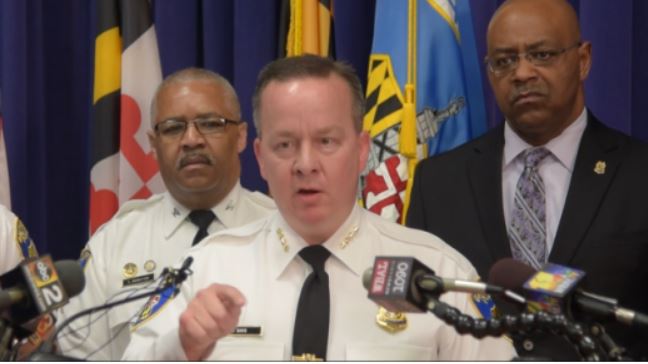
This is Baltimore City Police Commissioner Davis having the cops’ backs (I transcribed from the video in this story):
We had three police officers who were in the right place at the right time.
…
The police came and did their job and did what they had to do.
And I would add to that if not for the Baltimore police department yesterday, we could have had a mass shooting on our hands where several innocent lives could easily have been taken. I’m very proud of the work of our police officers yesterday. Their bravery. We can’t run from danger. We don’t run from bad guys with guns. We engage them.
We fired 56 rounds yesterday, until this threat was eliminated. I want to put that right out there right now: 56 rounds. And you can see, and you can perhaps imagine confronting, in a neighborhood street in broad daylight, a father and son duo, with an intent to kill, that’s what it took to eliminate that threat.
I’ll add to that, the son, one of the two men that we shot and killed yesterday, the son was out on bail for a handgun offense and the father was out on probation for a handgun offense. And that’s why I’ve personally spent so much time in Annapolis in this legislative session, in an effort to convince lawmakers, and we certainly have convinced the ones from Baltimore, about the necessity to do more with these laws and make these misdemeanors felonies. It’s about time. But that message still isn’t getting through.
But our police officers and our community knows [sic] that unfortunately there are violent repeat offenders among us, who live right here in our city, who think nothing about carrying two guns like that in broad daylight and popping out of a car. If it weren’t for the bravery of the Baltimore City Police Department, we could be having an entirely different press conference right now.
Kudos to Davis. You couldn’t ask for more. Now this is what one would expect from a good leader. But good leadership, especially in Baltimore, is not a given.
Davis didn’t have to say what he said. He didn’t have to say anything. Or he could have had a spokesperson say something neutral like “we’re investigating the incident.” Or he could have raised an eyebrow by mentioning the number of shots fired before emphasizing how the “officers guns were taken immediately after the shooting and they remain on modified duty, as is departmental policy.”
But Commissioner Davis didn’t do any of that. He went out of way to support his officers how bravely engaged with armed gunmen. This matters.
Contrast this with former commissioner Batts who, in the name of progress and reform, threatened cops and led the city into riots and violence.
But really contrast this with Baltimore City’s elected State’s Attorney, Marylyn Mosby, who pushes a cops-are-the-problem perspective. Her husband is running for mayor. She’s wasting her precious prosecutorial resources by prosecute good cops who may or may not have made an honest mistake.
After this shooting, Mosby treated the officers like criminals. For the first time in as long as anyone can remember, officers involved in a good shooting were read their Miranda Rights like common criminals. For shame. These cops aren’t criminals; they aren’t suspects in “custodial interrogation.”
Were it not for Davis and his strong and passionate words at the press conference (and also good journalism by the Baltimore Sun from which Davis quoted), it’s easy to imagine an anti-police narrative taking root. After all, this is Baltimore, where police are quick to gun down a father and son (with latter with junior-high-school graduation pictures at the ready) over a misdemeanor! (In Maryland and many states, illegal gun possession is just a misdemeanor).
I’m sure some non-present “witness” could be found saying, “The cops didn’t have to fire all those shots. They had already given up.” Academics would criticize Broken-Windows policing. Al Sharpton, able to get a few days off work, would appear to criticize racist policing. Protesters could chant “56 shots!” while the national media returned to Baltimore and ask if (ie: hope that) more violence would be forthcoming.
In that world, if Davis doesn’t have the cops’ backs, the next time a group of officers in an unmarked car see two guys getting out with guns? The cops could just keep on driving.
Eventually, after the shooting stops and bodies drop, somebody would call 911.
Would you engage armed gunmen? Why risk your life? Why face potential criminal prosecution? This is why having cops’ backs matters.
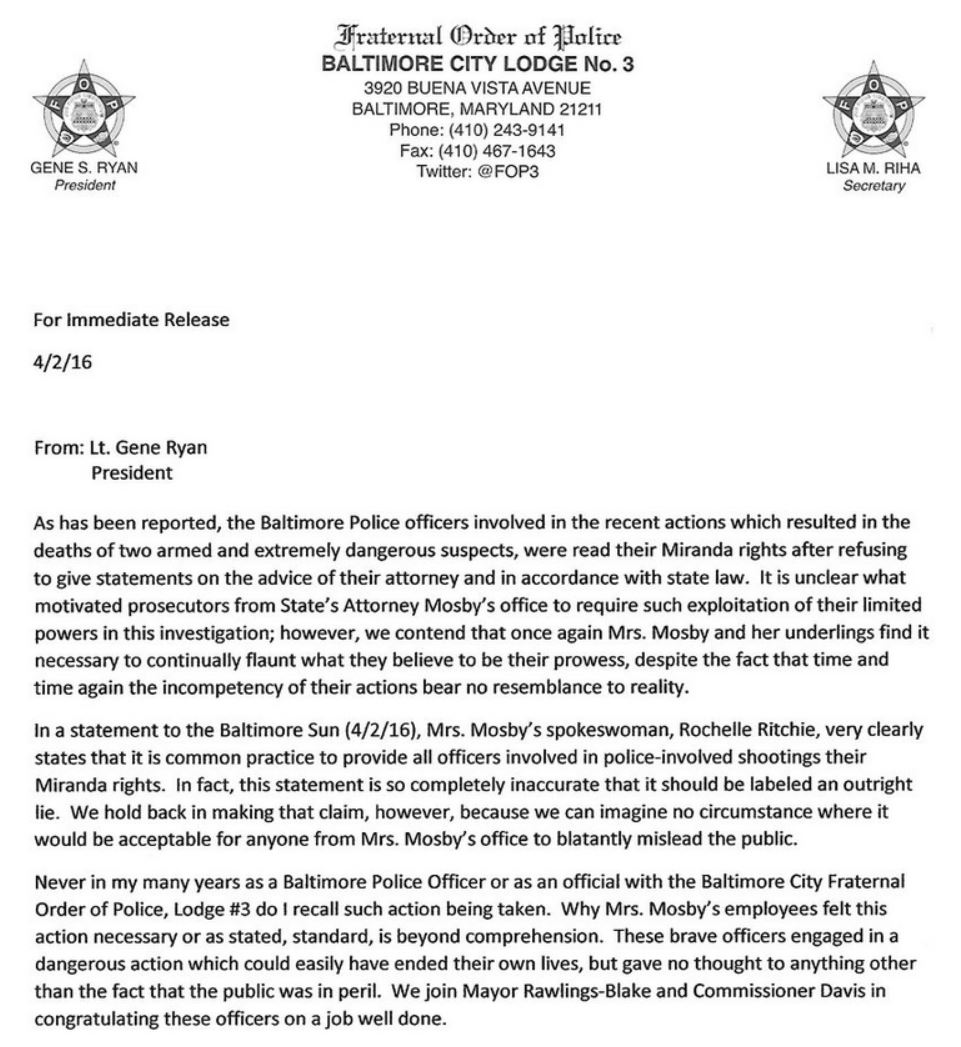
Update: Regarding Mosby reading the cops their rights, here’s the FOP’s statement:
2nd Update: Also, homicides year-to-date are up 25 percent this year compared to last. But given the post-riot near doubling in violence last year, being up only 25 percent from pre-riot figures is actually a massive improvement of sorts.
3rd Update: Mosby’s office denies it. (I wasn’t there. But I don’t believe her. It’s not like she has a track record of telling the truth.) And the BPD decides not to engage. But the union will play:
Lt. Gene Ryan, president of the Fraternal Order of Police, said Saturday that the statement from the state’s attorney’s office was “so completely inaccurate that it should be labeled an outright lie.”
This is great news for advocates of police reform.
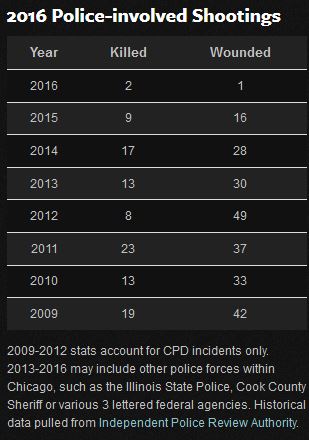
Chicago in 2016 will probably see police shoot just 15 or so people (based quite sketchily on January through March figures). This compares to 45 people shot in 2014. The decrease is without doubt due in part to those who keep a laser-like focus on police misconduct. The number of those shot by Chicago Police has plummeted for two consecutive years.
But it’s also very likely that Chicago will see close to 3,500 people shot this year. That would be 500 more than 2015. And that was 500 more than 2014. And that was 500 more than 2013. And for each 500-person increase in shootings, roughly 480 victims are black or hispanic.
What if — hypothetically of course and absent any corresponding decrease in violence in general — what if police-involved shootings served as a proxy (an indirect indicator) for police officers’ engagement and interaction with violent criminals and the criminal class? It’s not inconceivable. Another indicator is that police stops in Chicago have also plummeted.
In the police world we’d call these facts “clues.” Of course in the academic world I’m “just guessing.” But I’ll have a lot of time to guess before “hard social science” (that’s a joke, by the way) can prove what’s going on.
I’m surprised that I can still be surprised at Baltimore’s State’s Attorney Marilyn Mosby’s continued battle again Baltimore’s police. I don’t know, maybe she thinks all cops are bad because she grew up around so many bad cops. But Freudian analysis aside, imagine if the public prosecutor was out to get you and your colleagues. This concerns the latest police-involved shooting:
The Baltimore Police officers involved in Thursday’s fatal shooting of a father and son armed with weaponswere videotaped being read their Miranda rights at the direction of prosecutors after declining to give statements, a police union attorney said.
Michael Davey, the attorney, said it was the first time he could recall such a move by prosecutors in 16 years working with the police union.
“These guys should get a medal for what they did, instead of being treated like criminals by the State’s Attorney’s Office,” Davey said.
It’s almost charming, in that Baltimore criminal kind of way, that father and son were out doing something together. My dad used to take me to the beach.
If that guy could’ve let off with that rifle, all three of those cops would’ve been dead. That pink rifle might look silly, but it is highly lethal. You’re goddam right they fired 56 shots.
Harry Siegel’s excellent column in the Daily News:
The progressive prosecutor — elected on a promise to salvage Brooklyn justice from the oxymoronic state his predecessor had reduced it to — did the right thing first in holding the cop to account and convicting him before a jury of his New York City peers, and again in recommending that he be let off the hook of incarceration.
The whole system failed here: in the screening that let Liang join the force in the first place and the Academy “training” that left him certified in but never actually taught CPR; in the lousy NYCHA buildings where stairwells are blacked out and elevators broken down, where the good people who live there sometimes need police to help keep common areas safe.
By recommending no jail time for Liang, Thompson made plain that he wouldn’t make one cop the scapegoat for all that, and for a national conversation about killer cops, too. But by prosecuting him, Thompson made plain that what Liang did, letting off a fatal shot in the dark, was a crime, cop or no cop.
…
“A lot of people have trouble getting their heads around this case, because they think it’s like other police shootings and it’s not,” explains John Jay Professor Eugene O’Donnell, a former cop and prosecutor in New York City. “The others are shoot-don’t shoot events, about decisions cops make in one second.
“That is the obstacle to charging the police, those ‘fear of my life’ shootings. The law of self-defense is extremely favorable to the police — to everybody, actually, as we found with George Zimmerman — but especially the police.”
None of that, he notes, applies to Liang, and — with no legal leg to stand on — he became the rare cop to ask for a jury rather than a bench trial, perhaps in the hopes that at least one juror would overlook the law and cut him a break.
One bitter irony: Thompson’s choice not to punish Liang for going to trial highlighted how often other defendants are effectively punished for pleading their innocence. A pound of flesh frequently gets taken in sentencing after a guilty verdict, in part to account for the turmoil a trial puts a victim’s family through but mostly to “pay” for the resources trials demand of prosecutors and police.
Which is outright un-American, but also at the heart of our justice system as it normally functions. …
Bottom line: In a complex case fraught with racial politics, Thompson did his job as a minister of justice, holding a cop to account for the fatal consequences of his actions, and trying to find the right measure of justice. …
And that’s how our justice system should work, for everyone.
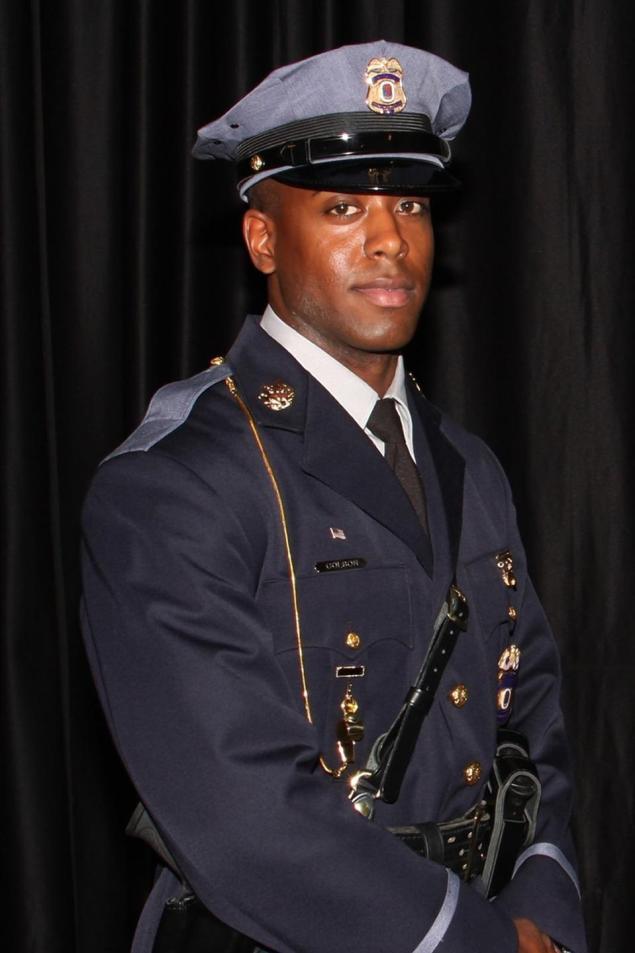
“The shot that struck and killed Detective Colson was deliberately aimed at him by another police officer,” Stawinski said. “It’s another tragic dimension to this unfolding story.”
A black cop in civilian clothes being killed by other cop? This is not exactly frequent… but it is all too regular.
In 170 years of US policing, you know how many white cops have been killed in similar cases of mistaken identity? Best I know, four. (Jenkins, Skagen, Stamp, and Breitkopf)