Tag: police patrol

  • Demand More Foot Patrol

    Demand More Foot Patrol

    More foot patrol is always possible. Back in the days, all patrol was foot patrol. Our almost complete dedication to cars responding to dispatched calls is a choice we make… or maybe a choice made for us. But if we really wanted and demanded more foot patrol, we could have it. Police departments need to defend car patrol with something better than tradition and response time. Here’s an op-ed I wrote a few years back for the cause.

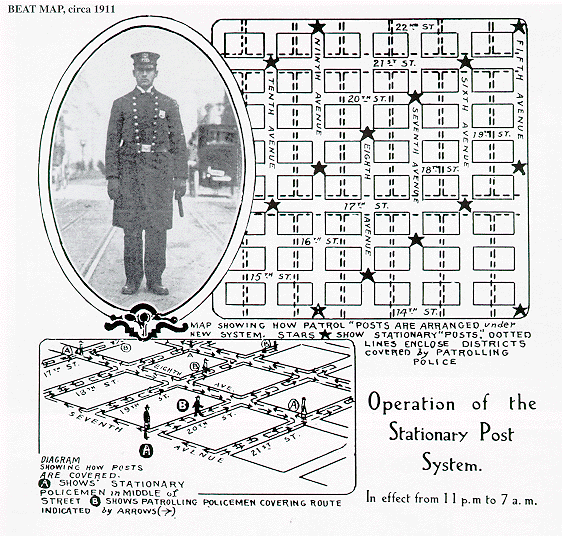
    One of my favorite pictures shows how it was done in 1911 New York City, at least in theory. Maybe today cops shouldn’t stand in the middle of intersections like bowling pins, but the idea is better than any patrol done today.
    (If anybody knows the source of this picture, let me know. I got it from an old Yale Alumni Magazine. They could only tell me they thought it was public domain.)

  • I [heart] foot patrol

    The smart folks at Marginal Revolution mentioned my book again. There’s nothing I like talking about more than foot patrol.

    The following are taken mostly from a comment I wrote to this post.

    The Kansas City Preventative Patrol experiment is the most amazingly ignored police study ever. For police and crime prevention, it’s one of the few scientific studies ever (meaning there was actually a control group). It showed that a post with no “randomly patrolling” cars has no more crime than a post with twice as many cars. Cars don’t matter. Cops only need to be in cars to backup other police officers. Almost everything else could be done by foot and bike.

    And yet the Kansas City study changed nothing. It’s ignored because police officers like cars and the police department is tied to radio dispatch. Culturally, it’s almost impossible to get police out of cars. Policing on foot is hard work. It’s usually punishment. So even cops who liked foot patrol, like me, didn’t want to do it.

    In cars you can stay dry and warm (or cool) and listen to the radio. You can also more easily avoid crazy and stinky people that want to talk to you. Why do you think police hang out in cars in the back of remote parking lots?

    People don’t feel safer with more police cars driving around (or sitting in parking lots) Putting more cops on foot *does* make people safer. See the Newark Foot Patrol Experiment (Police Foundation 1981) and common sense. It’s very debatable if foot patrol reduces crime. I think it does. But I may be wrong. But if people want more foot patrol (and they do), why not give it to them?

    When patrol cars first hit the street, cars were supposed to save money (and oh yeah, eliminate crime). That didn’t happen. More foot patrol is not a matter of needing resources; it’s a matter of priorities and will. It’s not the citizens or the politicians who want car patrol, it’s the police.

    My idea to get police officers out of cars is to give patrol officers, if they patrol on foot, the gas money they saved. Police model Crown Vics go through about 3/4 of a gas tank per shift. Cops don’t want to walk the beat, but $30 per shift could change that.

  • Fixing Broken Windows in Chicago

    Chicago Police Superintendent Jody Weiss says he plans more foot and bike patrol and an emphasis on “broken windows” policing. This is great news for Chicago… if it actually happens. It’s tough to get cops out of cars. But Weiss is certainly saying the right things. This is reported in the Sun Times.

    The point of getting tough on the little things isn’t just to get tough on the little things for no reason. It’s either because the little things are bad (like people pissing on your front door) or because the little things are part of a greater problem (like subway turnstile jumping was in New York City).

    Broken Windows is not Zero Tolerance. Broken Windows is a strategy that respects police officers (by encouraging officer discretion) and the community (by listening to the community). Broken Windows is about problem solving and reducing crime. Zero Tolerance is about enforcing rules to increase police “stats.”

    You can read the original 1982 Broken Windows article here. It’s a classic.

  • Missing. . . . not!

    New Jersey Governor Corzine signed “Patricia’s Law” mandating that police must accept—without delay—any report of a missing person. I would assert that no law named after a person has ever been good. This one sure isn’t.

    The Recordreports:

    Under Patricia’s Law, police cannot refuse to take on the case of a missing person — whether child or adult — on any basis, including if circumstances do not indicate foul play or if it appears the person disappeared voluntarily.

    Police must then take down more than two dozen pieces of information, from the person’s name to the address of his or her dentist. If the person remains missing after 30 days, police must attempt to gather DNA samples as well.

    People worry about their loved ones. But the last thing you want is police hunting down dental records because a bus is late and a cell phone is out of juice.

    The vast majority of “missing” persons aren’t missing. Missing persons come home. Traffic was a bitch. Or they had to work late. Or they’re having an affair. This is not police work. Mandating police to waste hours on useless cases is no way to help find real missing persons. And the strain on resources will hurt us all. Any law that assumes that police have unlimited resources is a bad law.

    One probable outcome is that police response time to a call for missing person will increase in to the hours. That’s what I would do. Because 99 times out of 100, that person will appear before then. And for the 1 time out of 100, it’s not like broadcasting a report one hour faster will help anyway.

  • Wild gun fight. Police shoot bad guy. Officers shot.

    This one, if the Sunis to be believed, sounds wild. Though if the Sunis to be believed, this happened in East Baltimore (you know, where bad things happen). Best I can tell it started in the Central and ended in the Northern.

    Officer Anthony Jobst, 47, was in his patrol car in the first block of E. Lafayette Ave. about 2:30 a.m. when he heard gunshots and saw a white Audi speeding away. Jobst, who was joined by four other uniformed officers, drove after the Audi and followed it for about a mile to an alley in the 400 block of E. Lorraine Ave. in the Harwood neighborhood.

    The Audi crashed in the alley, and the driver ran out and hid behind a brick wall. When officers approached him, the man opened fire, shooting Jobst in the foot and grazing the left leg of 27-year-old Officer Hadyn Gross, Bealefeld said.

    Officers returned fire, striking the man several times in the upper torso, but the gunfight was “protracted” because he was wearing body armor enhanced with steel inserts.

    Back at Lafayette Avenue, where shots were first fired, police found Rico Alston, 27, with two bullet wounds to the chest. Alston was taken to an area hospital.

    He was in serious but stable condition yesterday, police said.

    [March 19 update: 88 rounds were fired. The bad guy died Monday night. The Sunreports, “At one point, the man signaled to police that he was surrendering – but police said he used the lull in gunfire to reload the Smith & Wesson.”]

  • The fire-bombing of 324 car

    The fire-bombing of 324 car

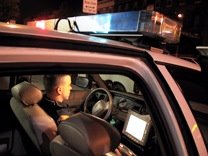
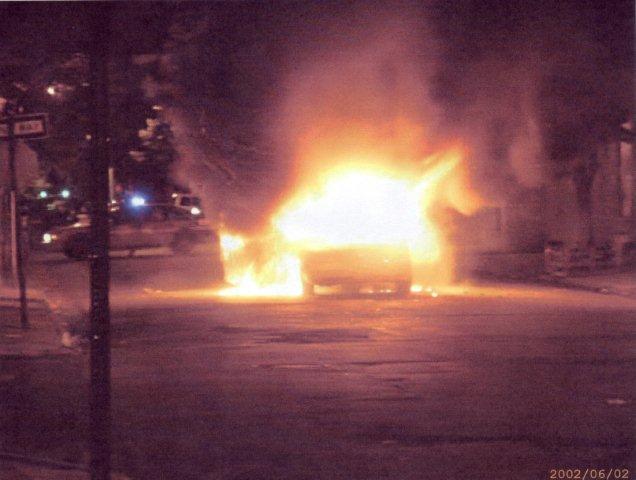
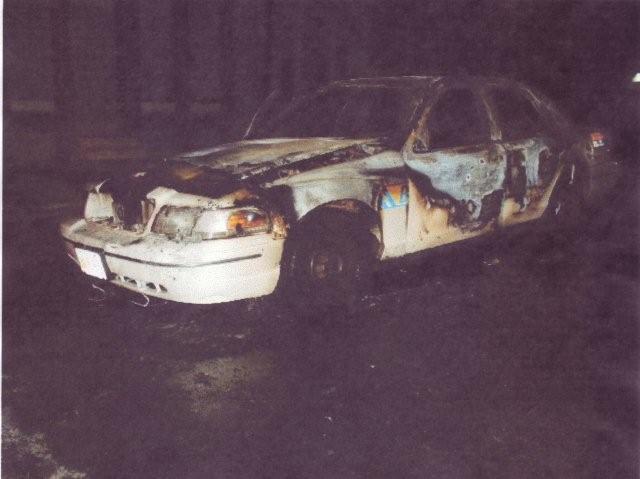
    About a year after I left the B.P.D., this happened. 324 car got firebombed. Some locals didn’t like the officer driving it because he could outrun and catch anybody in the district who tried to run from him. Somebody led him on a foot chase while his friends torched the car. It was our best car, too. The only one with a computer.

    It got torched.

    And burnt-out shell.

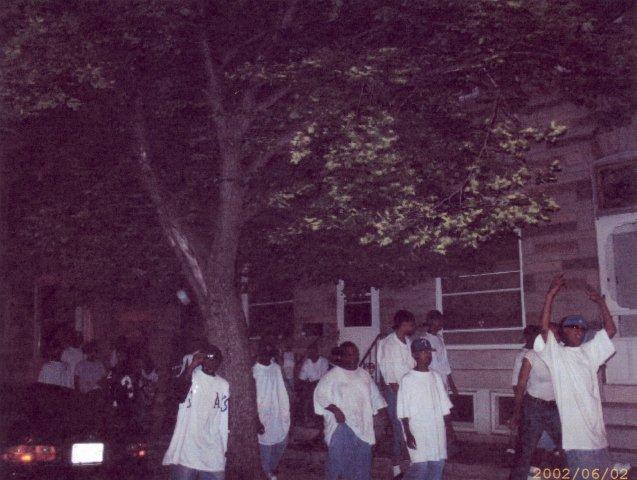
    The yo-boys celebrating their victory. What can you say about a group of mostly kids, all in white T-shirt and jeans, celebrating their victory? It’s 1AM, do you know where your child is?
    [originally posted 9/07]

  • Officer shot

    Something strange is going on here. There are important details not reported.

    No matter, I’m glad the officer is alive. The rah-rah part of these stories bothers me. If the bullet was anything but a graze, odds are this officer will never patrol again.

    City officer shot by gunman who was hiding in bushes
    By Ruma Kumar

    12:06 PM EST, March 8, 2008

    A rookie Baltimore police officer is recovering and in good condition at Maryland Shock Trauma Center this morning after he was shot in the leg around 1 a.m. in Southwest Baltimore, police said.

    Officer Pedro Perez, 24, who graduated from the police academy in July, was injured during a patrol stop in the 100 block of Palormo Ave., Police Commissioner Frederick H. Bealefeld III said at a press conference today. Perez and his partner had stopped to talk to two men loitering in an area where criminal activity is rampant when a gunman jumped from behind some bushes and shot at the officers.

    At least three shots were fired, Bealefeld said, and one hit Perez above his right knee. Bealefeld said police are following a number of “good leads” and do not believe there is a link between the unidentified gunman and the two men the officers were talking to at the time of the shooting. The two have been held for questioning, but are considered “more witnesses than suspects at this point,” Bealefeld said.

    “This definitely reinforces the dangerous nature of the work these police officers do, and (shows) that more work needs to be done,” Bealefeld said today.

    Saying Perez is with his family, Bealefeld added, “this man is in excellent spirits…he’s eager to get back.”

    Police did not release a description of the gunman.

    Copyright © 2008, The Baltimore Sun

  • 911 Is a Joke

    Rapid response doesn’t work for police. I’ve published an article in Law Enforcement Executive Forum saying as much. It’s also a chapter in my book. I was reminded of the futility of 911 yesterday when I came across an old man who had fallen down and cracked his head open here where I’m visiting my parents in Santa Monica, California.

    I really don’t remember my medical first responder training from 8 years ago. But I still figure I’m better in such situations than most people. At least I can stay calm and not do anything incredibly stupid. Luckily, for the both me and the bleeding man, an off-duty firefighter was there who actually knew what he was doing (apply pressure to stop the bleeding and give the guy some basic tests to make sure he was with it).

    I fished the man’s wallet from his pocket to look for any medical warnings and check for ID (that’s the cop in me). Then there wasn’t much for me to do except watch the scene and wait for a cop or paramedic to turn the wallet over to (it would have been a little difficult for me to put the wallet back in his pocket and I didn’t want to bother the guy examining him… no, I didn’t take anything, but I couldn’t help but notice that his wallet was a lot thicker than mine).

    One woman made us aware of her presence by deciding that the bleeding man’s problem was the head wound, but the firefighter helping him. She yelled: “You way too much up in his face and need to step back and let the man breath! He can’t get no air! Step back!” She meant it, too, and seemed about ready to set things straight.

    Now that I’m a professor and not a cop, I’m so rarely reminded of complete, honest, and destructive stupidity! I was reminded how quickly a scene in the ghetto could get ugly with someone like her provoking a crowd. Luckily, this was a crowd on Santa Monica’s 3rd St. Promenade. It isn’t by a long stretch the hood. A few other people in the crowd kind of cut her off and blocked her out.

    Meanwhile others were trying to call 911 from their cells phones and nobody could get through. The entire L.A. County system was either overloaded or down. Luckily, some public security person (I think their main job is to harass the homeless) could radio directly for paramedics. The guy had bled some, but he was going to be OK.

    What surprised me wasn’t that people couldn’t get through to 911. I was surprised that they were surprised they couldn’t get through. We’ve been sold on the wonders and necessity of rapid response. But anybody who needs it knows the truth: 911 is a joke, most of all for police.

  • A police perspective on cameras in squad cars

    Today’s Los Angeles TimesOpinion Section has an excellent article by an L.A. police officer about cameras in squad cars.

    I couldn’t have said it better myself, so I won’t. Here’s his piece:

    View from a squad carPutting video cameras in black-and-whites won’t clear up a distorted picture of the LAPD.
    By Jack Dunphy
    Los Angeles TimesFebruary 17, 2008

    The federal consent decree mandating reform of the Los Angeles Police Department was supposed to expire in 2006, five years after the city negotiated it with the U.S. Justice Department following the Rampart scandal. But in May 2006, the federal judge overseeing it ruled that the department was still not complying with several of its provisions and ordered that the court-appointed monitor keep watch over the department until June 2009.

    According to the Police Protective League — the police union — the city has already spent more than $13 million for the monitor’s fees and expenses and more than $30 million in complying with the decree’s many provisions.

    Now the Police Commission wants to spend more money to install digital video cameras in the LAPD’s fleet of patrol cars. Its members believe that the cameras, along with a computer database of every officer’s complete personnel information, will help satisfy the section of the consent decree that requires the department to “examine and identify officers demonstrating at-risk behavior,” such as using excessive force or displaying racial bias.

    Many police departments across the country have installed video cameras in their patrol cars. The images they capture have provided evidence in criminal cases and have helped prove or refute allegations of officer misconduct. The L.A. City Council is weighing several contract proposals for installing cameras in the LAPD’s black-and-whites.

    But many of us who work in the department are skeptical about how these video images will be used. And we have good reason to be. Consider: A recent internal audit of arrest reports concluded that a large number were unsatisfactory because they did not properly document whether Miranda warnings were given to suspects. On its surface, the finding suggested a dire problem. But a closer look at the audit revealed that there was hardly a problem at all. Department policy dictates that when a suspect under arrest has not been advised of his Miranda rights, the words “not admonished” must be written in a designated space on the arrest report. Some officers, however, used different words — such as “not advised” and “not given” — to report the same thing.

    No matter, said the auditors. Because these officers didn’t use the required language, they had to complete follow-up reports spelling out what any fool could have seen was clearly meant in their original reports.

    Now imagine the effect on police officers if this kind of obsessive punctiliousness were applied to the images captured by the video cameras installed in their patrol cars. It wouldn’t be long before officers reverted to the “drive-and-wave” mode of policing practiced during the tenure of former Police Chief Bernard C. Parks. Many officers regarded Parks as a heavy-handed disciplinarian, and rather than risk censure or punishment for breaking his rules, they backed off proactive policing. Total arrests declined 33% during his time as chief, and homicides jumped 41%.

    The LAPD manual is hundreds of pages long and contains thousands upon thousands of individual regulations governing every conceivable aspect of police operations. In addition, special orders, training bulletins and all manner of directives are annually issued about such activities as how to park police cars in a traffic stop and how to answer a telephone.

    If some auditor were to watch a video of me on any given day in the field, it wouldn’t take long before he would see me violate at least one of the orders. Police officers sometimes cut corners, not because they are corrupt or dishonest or lazy but because no set of rules and regulations, no matter how voluminous, can possibly address every situation they may confront on the streets. If you show me an officer who does things strictly by the book all day every day, I’ll show you one who doesn’t have much of an effect on crime.

    Compliance with the consent decree may be a worthy goal, but it should not come at the expense of fighting crime. If officers believe that their recorded actions in the field would be as rigorously scrutinized as were the arrest reports, they might be less inclined to risk their careers by being proactive.

    What’s disheartening to L.A. cops is that the need for reform seems the longest-running and most familiar narrative about their department. I’ve lived through many LAPD scandals during my career, including on-duty cops committing burglaries in Hollywood in 1981, the beating of Rodney King in 1991 and Rampart. These stories were exhaustively covered in this newspaper and in other media.

    But how many people will recognize the names of Steven Gajda, Filberto Cuesta and Brian Brown? These police officers were murdered doing their duty during the time former officer Rafael Perez and other cops were committing the crimes that led to the Rampart scandal and the consent decree.

    Randy Simmons, the SWAT officer killed Feb. 7 in a shootout in Winnetka, was laid to rest Friday. He has been justly praised in this newspaper and elsewhere not only for his on-duty valor but for his off-duty outreach to disadvantaged youngsters. But in a few days or weeks, he will likely be forgotten by all but those who knew him.

    But the word “Rampart” will live on and continue to evoke images of a police department gone bad. Sadly, putting cameras in patrol cars to record “at-risk behavior” by cops is unlikely to lift the stigma of scandal that wrongly plagues the LAPD.

    Jack Dunphy is the pseudonym of a Los Angeles police officer who writes a column for National Review Online.
    The article can be found on the LA Timeswebsite. They hold all copyrights.