Tag: police tactics

  • “Stop the car or I’ll step in front of it”

    “Stop the car or I’ll step in front of it”

    This was not a good shooting. And cringe-worthy from an officer’s perspective. From the suspect’s perspective, well, he’s dead.

    I’m quoted in this article.

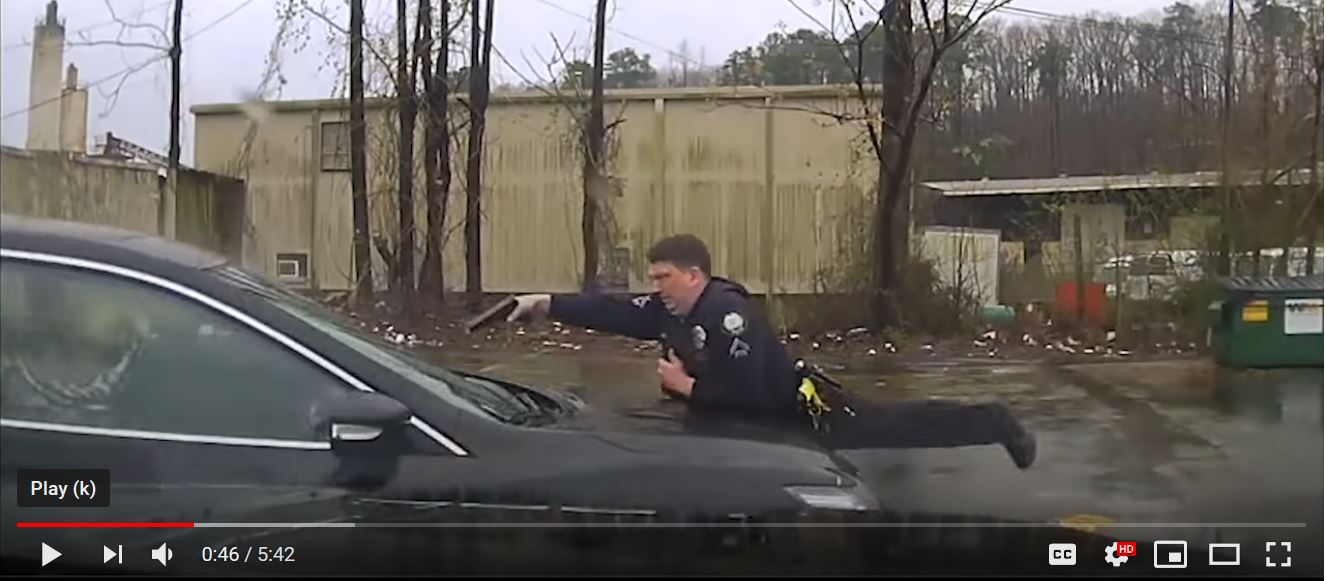
    The background is the car popped up on a stolen car list (I think from an automated license plate reader). The officer is told to investigate. The car is in a parking lot. There is no car stop. There was no fleeing that preceded this.

    The first problem is Officer Starks stops his car in front of the stolen car. That in itself isn’t bad, if you don’t care about your police car. But he does so in such a way that he has to get out of the police car in front of the suspect’s car. You don’t do that by choice.

    The second problem is the officer doesn’t wait for backup and the third problem is he exits the car with his gun drawn (or immediately does so after exiting the car). If you feel the need to approach the car with your gun drawn (which is fine but not required for a car that comes back stolen), shouldn’t you also feel the need to wait for backup? Either there’s a potential threat or there isn’t. And if there isn’t, he shouldn’t have had his gun out. And if there is, he should have waited for backup.

    There was no good reason to think the driver of the car, later identified as Bradley Blackshire, was armed. Though indeed he might have been. But he wasn’t. (Though in an odd but irrelevant twist the passenger later tells cops on the scene that Blackshire “has a gun,” even though he doesn’t; no gun is found. Turns out she got of jail that day. She asks to get her jacket back, because, you know, it’s cold. She’s bizarrely calm and compliant after all this.)

    But the fourth problem is the biggie. The driver, Blackshire, starts to slowly drive away after not getting out of the car, and the officer shoots and kills. When the car starts moving, Officer Starks is on the driver’s side of the car. The car is brushing against him, but it is not going to hit him. There is no threat. Just a dude slowly driving away at gunpoint. Yes, the driver could have complied. Should have, even. But non-compliance is not the issue. Non-compliance is pretty common. More to this point, non-compliance is not a lethal threat. The officer shot four times and killed Blackshire over being in a car reported stolen (it’s not clear it ever was) and “failure to obey a lawful order.” That’s unacceptable. Also likely a convictable criminal offense.

    And then, to make matters worse — who knows, perhaps Blackshire would still be alive if Starks had left well enough alone, but no — Officer Starks chooses to nominate himself for a Darwin Award. He steps in front of a moving vehicle.

    Sure, sometimes police officers end up in a chaotic situation where they find themselves in front of a moving vehicle. Shit does happen. But you don’t choose to put yourself in front of a moving vehicle. Especially not if you just shot and incapacitated the driver.

    As I say in the newspaper article: “It’s just shocking to see. Not getting in front of a car is the rare case where general orders, common sense and officer safety coincide.”

    It looks like the driver does indeed hit the brakes when Starks steps in front of the car. But then, if I had to guess — which I don’t, but I will — Blackshire can’t keep his foot on the brake, perhaps because, you know, he’s been shot and is dying. So the car, as cars do, idles forward. At this point Starks goes up on the hood of the car and fires another 11 rounds.
    The car hits and stops against dumpster or something, and then there’s the predictable period of curse-filled verbal commands being shouted at a dead or dying man. Blackshire seems to have enough life left in him to raise his hands, until he doesn’t.

    What makes this situation unusual is that the officer was actually in control of setting the stage for this interaction. Officer Starks chose how to approach, and he chose wrong. And then Officer Starks shot when there was no imminent threat, and then he placed himself in danger and shot again. There never even was a split-second decision that had to be made.

    I’d bet this isn’t the first time Officer Starks made unwise aggressive decisions in his career. And if I have to bet — and I don’t, but I will — this time will be his last.

    [Update: In January 2020, A judge ruled that firing the officer was unjust.] 
  • “Chicago cop murders unarmed man after fender bender”

    That’s the headline that wasn’t.

    Instead we have this headline: “Officer Didn’t Shoot Attacker Because She Feared Backlash.”

    A 43-year-old female 17-year-veteran suffered this:

    The man had punched her and “repeatedly smashed her face into the pavement” until she was knocked out, police said. She suffered head trauma and multiple cuts to her face and head.

    When you’re a cop losing a fight and a man is bashing your head on the ground trying to kill you, it’s OK to shoot the guy. Can we agree on that?

    Fran Spielman in the Sun-Times:

    A “simple traffic accident” that turned ugly.

    “A subject who was under the influence of PCP attacked a female officer. Viciously pounded her head into the street as her partner was trying to get him off of her. This attack went on for several minutes,” [Chicago Police Supt.] Johnson told the assembled dignitaries.

    “As I was at the hospital last night visiting with her, she looked at me and said she thought she was gonna die. And she knew that she should shoot this guy. But, she chose not to because she didn’t want her family or the department to have to go through the scrutiny the next day on national news.”

    The superintendent said he plans to turn that around by “encouraging” his officers and assuring them he has their backs.

    “But, at the same time, we know we have to change this national narrative that the cops are the bad guys. The cops are actually the good guys trying to do a difficult job,” Johnson said.

    It took many cops to arrest this guy. And three of those cops were hurt. The female officer is still hospitalized.

    Tribune Columnist (and fellow Greek American) John Kass:

    She’s alive, but what if she had pulled her gun and used it?

    We’d be going through the old rituals we know by heart, angry activists, the dead re-created as the victim of state-sponsored racism, politicians cowering and turning their backs on her, the entire urban political liturgy we’ve seen so many times.

    Cops are getting in trouble for shooting armed suspects. You think she’s get a pass for killing an unarmed black man? (I’m not 100 percent certain the man is black, but the neighborhood is.)

    “She murdered an innocent unarmed man!” “They should have helped him after his accident.” “How could one man be a threat to multiple officers?” “They didn’t have to kill him!” And indeed, they didn’t. He was taken alive.

    Of course the guy who beat the cop is a violent felon. But who would hold that against him after being victimized by police? I’m sure there’s a nice picture of him and relatives willing to say how “he was turning his life around” and would “never hit a woman.” Who would believe Chicago cops?

    So this officer was willing to let herself be beat to unconsciousness in order to save her family and the department from the now inevitable “scrutiny” had she decided to use lethal force.

    So what should have she done? Honestly, I don’t know. I’m not convinced she made the wrong choice. The reality today is there would be hell to pay if she shot the guy. Her job and family might be ruined. There would be protests. Threats. She could lose her job or face criminal prosecution. She might have to move and take her family into hiding. She made her choice. But that is a choice no cop should ever have to make, especially at the moment when your face is smashed on concrete again and again and the world fades into darkness around you.

  • Dejuan Yourse Arrest

    For the life of me, I can’t figure what Yourse is going to be charged with. Even with the game rigged in cops’ favor, I don’t see a crime. Yourse is under arrest after 9:10 when the officer doesn’t take kindly to Yourse invited his friends over. I can understand why the officer doesn’t want a posse of friends showing up at the scene, but what’s the crime? This was in Greensboro, NC.

    I’d be curious to see how he’d be able to articulate reasonable suspicion at 8:13. I’m not saying he couldn’t; it’s a low standard. But I’d like to see how. That’s when things go South. Before that moment, everybody is playing along and sticking to the script. Poking a guy rarely serves any tactical benefit. Alternative if you don’t want him to leave? Hold your palm out. If you’re going to make physical contact, let the suspect initiate it. Also then you’re in a better position to push back or grab.

    After that, it becomes your standard shit show of trying to get a guy’s hands behind his back. First he is resisting arrest. But then even when he isn’t, it would seem like that because he’s so built that his arms don’t physically move in a way that can be cuffed (without double cuffs). Anyway, resisting arrest is a charge, but first you actually to be arrested for a crime before you can be charged with resisting. The standard catch-alls — loitering, failure to obey, disorderly — none of those even seem to apply here.

    Anyway, word on the street (ie: a journalist told me) is that the officers resigned. I’m not going to defend how the male officer handled this. He sure could have benefited from de-escalation or common sense. I mean, as long as he doesn’t come back wanted, I’m pretty convinced he’s not breaking into the house. Too bad she wasn’t handling this with him running the warrant check. But why in the world would she resign? Unless the lied on her report or something.

    Also, once again, you have cops serving as force multipliers, forced into a situation by a call from an ignorant and/or racist citizen. That happens a lot. But it may not be the case here.

    My wife just told me that Yourse actually was wanted on some warrant, but the cops didn’t know that yet when the arrested Yourse. According an attorney for the Greensboro Police Association:

    Once Mr. Yourse was taken into custody, the officers were able to continue attempting to verify his identity. Upon doing so, it was learned that Mr. Yourse had two active warrants for his arrest, along with two additional orders for his arrest [?]. Additionally, they discovered that Mr. Yourse had been charged twice in the past for breaking into his mother’s house, 2 Mistywood Ct.

  • Shootings up in NYC

    The recent crime numbers in NYC will soon come out, and they’re not good. Homicides this week are way up compared to last year. Of course that’s just one week… till it’s not. Shootings are up in NYC. Not Baltimore up. But up. People are dying. It is time to ring the alarm. Maybe not the crazy 5-alarm fire for Baltimore. Maybe a simple 1-alarm would do NYC. But more people are dying.

    So what might be the cause? A lot of things of course. One factor may be people’s willingness to carry heat. Word on the street is that guns are back in town. As I was told: “People are now shooting into crowds more often, doing drivebys, more often, and shootings as teams more often. The risk for carrying a gun in nearly zilch. Bottom line: cops aren’t stopping people, and young black men are paying for it with their lives.”

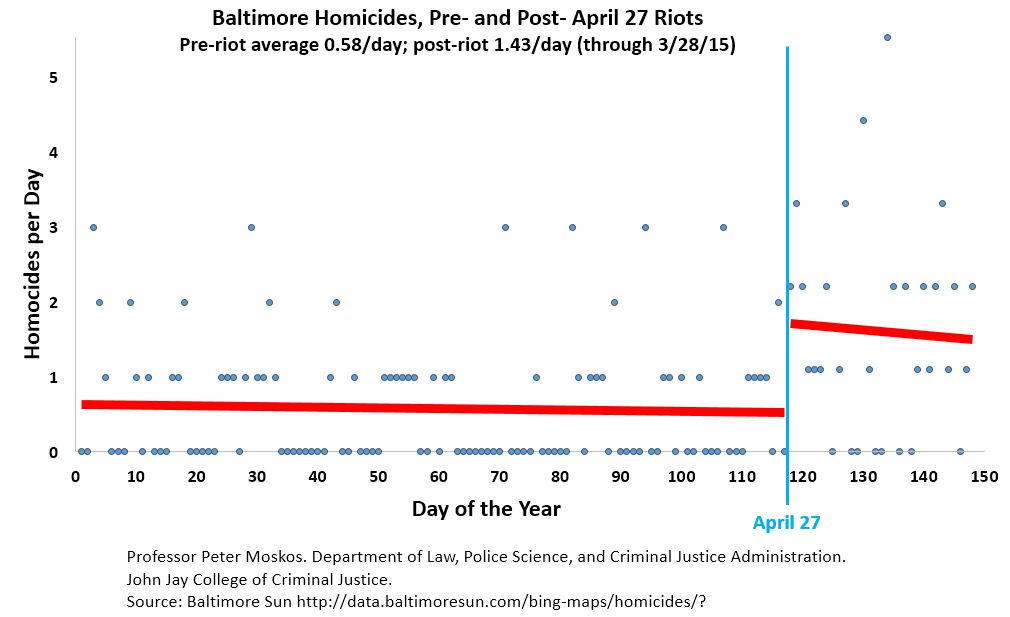
    Stop and frisks are down roughly 95%. Now we could debate whether certain police tactics are legal, constitutional, or moral. We should debate these things. Maybe it’s OK to have 50 more dead bodies in NYC if hundreds of thousands of other young black men aren’t stopped by police for no good reason. So let’s have that debate. What bothers me is the disingenuousness of those who refuse to grant criminals any agency in crime. Like Broken Windows is the root of all evil. Like it is inevitable that 2015 would see a 10 to 20 increase in shootings in Brooklyn. And it must have been written by the Almighty that some in Baltimore would riot on April 27, and then the homicide rate would skyrocket.

    Criminals don’t leave their guns at home because they’re asked politely by community leaders. It is possible that force and coercion might, in some cases, keep people alive. Remember (before we forget) that the arguments against stop, question, and frisk weren’t only that it was illegal, unconstitutional, and morally reprehensible. It was that it didn’t work — that stop, question, and frisk was actually counterproductive with regards to crime prevention. (I never quite understood that argument, but it was said.)

    The role of guns in NYC homicides is surprisingly varied. It wasn’t that long ago (well, the 1970s) that guns were used in less than half of all murders in NYC. In 1960, at least according to one source, guns were used in just 20 percent of homicides. But that changed in late 1960s and 1970s.

    By 1990, guns in NYC out of control. 1,650 killed by guns, 75% of all murders, higher than the national average (not including NYC) of 67%. (All these percentage may be a bit low based on “other and unknown”.)

    So along with all murder going down in NYC, gun murders went down in particular.

    In 2000 65% of murders in NYC involved guns. (Compared to 66% in the rest of the nation. UCR data, all.)

    In 2005 61% in NYC. (Rest of nation: 68%.)

    In 2010 60% in NYC. (Rest of nation: 68%.)

    In 2013 59% in NYC. (Rest of nation: 70%.)

    Meanwhile, the percentages of gun homicides in other cities is much higher: 84% in Chicago; 79% in Los Angeles; 81% in Baltimore. So New York looks all the more impressive.

    This was a little heralded victory against gun crime in NYC. While the rest of the country saw a small increase in the percentage of homicides involving guns, NYC saw a decrease.

    I asked my friend, Dan Baum, who insisted on being identified as “a liberal Democrat Jewish gun owner who wrote Gun Guys: A Road Trip“. Baum can write. (Too bad you didn’t buy his book.)

    Anyway, I asked Baum about what changed in the 1960s. Gun violence increased 50% in the 1960s (five times more than other/non-gun violence). He said:

    What changed in the early 1960s? JFK was shot, and the liberals began their long love affair with gun control. Until 1968, you could buy guns through the mail. Guns were things that people owned, but they weren’t a cultural marker, a badge of belonging to a particular subculture.

    The liberals changed all that, by relentlessly pushing the bubbas into a corner. Suddenly, people were in a panic to buy all the guns they could, because they never knew when the liberals were going to ban their sale altogether. The NRA, taken over by the loonies in 1977, pushed that narrative. The number of guns circulating in private hands exploded exponentially, with predictable results. Not only that, a tremendous amount of anger was injected into the national discussion around guns — also not a good thing.

    So I’d argue that we have the liberals, and gun control, to thank for the huge increase in gun murders. Guns are way more prevalent than they used to be, because the liberals made them a thing. Had they not done that, we’d be back in 1960 America — guns being a thing that some people own, that have no cultural/political/spiritual significance.

  • Meanwhile, roughly 1 in every 250 young black men was shot in Eastern District. Last month!

    Meanwhile, roughly 1 in every 250 young black men was shot in Eastern District. Last month!

    Maybe you were too busy blocking traffic into the city to notice, but this past weekend 32 people were shot in Baltimore. Nine were killed.

    (as usual, click to embiggen)

    This past weekend. In Charm City. With just over 620,000 people.

    Meanwhile, from April 25 to May 23, this past month, 122 people were shot or killed in Mobtown. Last year the comparable figure was 52.

    [During these same 28 days, Part One reported crimes in the Land of Pit Beef did not increase. Domestics (again, as reported to police) did not increase.]

    Where are these shootings happening? The Central District was basically steady. In the Northern District, shootings were actually down to two, from four. Shootings in the Southeast did increase, but just to eight. Not much up in the Southwest.

    The Northwestern District? Shootings were up to 13 in the past 28 days. That’s compared to 1 last year.

    The Wild West? There were 33 shootings this year (compared to 10 last year). I don’t know what the population of the Western is, but it’s probably even smaller than the Eastern.

    In my beloved “Historic” Eastern District? 22 shootings and homicides in 28 days. Last year there were 7. (For what it’s worth, homicides in the Eastern actually were lower than last year, 3 versus 4!)

    Keep in mind that these victims (and shooters) come mostly from the population of 15- to 35- year-old black men.

    The actual population of 15- to 35-year-old black men in the Eastern District is likely less than 5,000 people. (Source: See page 219 of Cop in the Hood).

    Now this is just one month, mind you. Twenty-eight days. And we’re talking about a “Formstone figure” (OK, I just made that one up) of roughly 1 out of every 250 young black men being shot. In one month! Chew on that bony Lake Trout for a while. But this ain’t no bull and oyster roast.

    I don’t know what else to say. Go ahead, if your world-view inclines you thusly, go ahead, hon, and see police as the biggest problem facing young black men in the land of Pleasant Living. And Boh, I’m not saying police are without blame. But seriously, this is about priorities. If you think police are the biggest problem facing young black men in urban America… I don’t know what else to say.

    [Maybe I did something wrong with my math? Let me know.]

  • Cops aren’t shrinks

    The headline in the Daily News says “Cops talked to Elliot Rodger three times before Santa Barbara killing spree, didn’t know he owned guns”

    So what? What if police did know he had three legally purchased guns and ammo? How would have that changed anything. There was no crime.

    Anyone who wonders why cops didn’t do more doesn’t understand police. When police deal with an individual, the bottom line is only two things matter: 1) Has the person committed a felony crime? (A few states, like New York, but I don’t know how many others, allow police to arrest for not-witnessed lesser crimes as well) 2) Is the person a threat to themselves or others?

    Certainly owning your legal and constitutionally protected firearms doesn’t qualify as a crime, so the latter issue is more relevant here. Far be it from me or any cop to say this guy was going to shoot a bunch of people. If you can remain calm and hold a half reasonable conversation with police, congrats: by police standards, you’re officially sane enough! That’s the way it works. (The standards are quite a bit stricter in domestic situations.)

    So when cops have to judge someone’s sanity, and I say this out of experience, all they can do is look for obvious signs of crazy. I’m not talking about zany, eccentric, or senile. I mean even walking around in your underwear because you say snakes were crawling up your legs probably does not qualify (cause that’s a sign of a bad drug trip). By crazy I’m talking about loopy tin-foil hat wearing. I’m talking actively delusional. I’m talking no-awareness-of-reality insane. Cops look for crazy; cops look for insane. But crazy and insane aren’t medical terms found in the DSM-V.

    There’s the problem: cops aren’t shrinks; cops are not medical doctors. It is not and it should be the police officer’s job to diagnose mental illness. If you haven’t committed a crime and you’re not clearly a threat to yourself or others, police shouldn’t be able to detain and involuntarily commit you to the funny farm.

    Take this case I handled during field training:

    Dealt with the same mental patient in a high rise that I dealt with one or two days ago. Swearing, exposing himself, thinking the whole building was his, just being a big crazy problem. Obviously, he was a horrible person to have around. He also couldn’t remember that we was in jail the past week and that he wasn’t on his medication. The building management wanted him out with justification. Eventually, his mother and a “friend” talked him into going to the hospital. (The friend, an older black guy who lived in the building, was not actually a friend, but at least he was a good and caring man.)

    What would have been the right thing if he hadn’t gone voluntarily? Cops can’t make somebody take their meds. Plan B could have been to provoke him into threatening us, thus giving us a reason to take him against his will. Otherwise, his mother would have had to go through a lengthy civil process to get him committed. Or we just leave him there till he does hurt somebody. He needs help, but, as is often the case, help police cannot give.

    Cops do not like mental cases and generally don’t handle them well. Though admittedly some cops handle them much better than others. In certain situations police need to focus on more goal-oriented tactics — like what is the best way to get this person to do exactly what I want him or her to do — rather than demanding deference to police authority as a starting point. Some of this could be taught with better training, but police will never be great handlers of the mentally ill. The power of police is to detain people; the tools of police can kill people. Neither is right for the job.

    Luckily, there’s actually an easy solution: psychiatrists and mental health professionals. Doctors on call with judgement and the power of involuntary detention. Of course it would cost some money upfront, but in the grand scheme it saves because their prisons don’t house their mentally ill. When I did my police research in Amsterdam, there was this white car with some writing on the side and a yellow mars light on top. They were the shrink squad. We, as police, didn’t deal have to deal too much with these professionals because, get this, they dealt with the crazies and we dealt with the criminals. Imagine that. Separate groups. Sometimes the two worlds would overlap, but not that often. Yes, this is another un-American socialist European concept: have a system to deal with the mentally ill. Now that is crazy.

  • Police versus Disciples in Chicago

    There’s some good reporting by Frank Main of the Chicago Sun-Times. He goes beyond Police Supt. Garry McCarthy’s bombast (“We’re going to obliterate that gang,” he told police brass in a meeting in June. “Every one of their locations has to get blown up until they cease to exist.”) to talk to actual gang members. I’m generally tempted to dismiss “get tough” language as ineffective bombastic bravado, but I have faith in Superintendent McCarthy. And so far what police in Chicago are actually doingseems to be working.

    “Maniac Latin Disciples members are now under gang orders to keep violence to a minimum because of the police crackdown, the ranking member said.”

    Well now, isn’t that the idea? The gang member continues, talking about their cars:

    “Most of the shorties don’t have licenses or insurance,” the ranking member said. “They’re easy to pick off.”

    He said a lot of them aren’t reclaiming their seized cars because they don’t have the money. Some of the seized cars contained hidden guns the police didn’t find, he added.

    Asked if he thinks the police will let up, the gang member acknowledged, “Stopping the violence is the only way. They know we’ll always be selling drugs. The cops will tell you, ‘I won’t trip out about you having weed in your pocket to feed your kids.’ But when you start shooting across schoolyards and shooting little innocent kids and s— like that, they’re not going to tolerate that. I get mad. I’ve told the mother-f—— shorties in our mob to stop doing that f—— b——-. How do you think the parents feel? That’s our neighborhood.”

    Surprisingly, the gang member said he didn’t know police Supt. Garry McCarthy’s name — even though the superintendent is the source of the Maniac Latin Disciples’ recent troubles.

    But he does know McCarthy’s face from the TV news as the “top dog who gives the orders to the foot soldiers.”

    “All I know is that people are hiding under rocks because of him,” the gang member said.

    Between Jan. 9 and Feb. 5, for example, there weren’t any shootings in the district, compared to seven for the same period of 2011, police said.

    Beat 1423 saw calls for police service drop from 127 for the last six months of 2010 to 56 for the last six months of 2011.

    Let’s keep an eye on this and see whether it lasts. That’s what separates a dumb crackdown from smart policing. You can always flood an area with cops, and that will reduce crime. But you can’t afford to keep an area flooding with cops. And what happens after police leave is the real test. Violence stays down when police patrol and police intel and the DA and probation and patrol all get on the same page.

    I mention this because there’s a tendency among academics to fail to notice the key moment when police do something right. If violence does stay down, in a few year’s time the SPSS set will say, “Correlation doesn’t equal causation. We can’t say police were the cause because there was no proper control-group study (or any study at all).” And then later, looking back, you’ll hear, “well, the neighborhood got better” and “there were a multitude of factors” and “community efficacy really coalesced.” Sociologists will look at the community and might credit the positive transformation of gang culture; economists will notice a greater involvement of gang members in the legal workforce; teacher will credit themselves; preachers will credit God. Well, yes, but sometimes it all starts with the good, smart, aggressive policing.

    In effect, academics assert that if we can’t prove (to a level of 95-percent statistical certainty) that police are the cause of a crime drop, then it would be misguided (at best) to give police (or, God forbid, an individual police chief) credit. Think about it… we use our own ineptitude and short-sightedness to justify our dismissal of effective policing. That’s a nice little trick!

    The time to do research isn’t after the fact, from your office, but right now, on the streets around Humboldt Park, Chicago.

    Maybe what’s going on in Chicago isjust a few months of police overtime and a few extra arrests. Maybe next year everything will be back to normal and cops will be sitting in their cars waiting for the next shooting. But maybe not. It would be nice to know.

  • In Defense of the Straight Baton

    I think I’m fighting a lost cause here, but I still like the straight baton. Expandable batons are all the rage. But let me explain why I think the straight baton is better.

    When I was a cop, I had a 29-inch straight baton (think big stick or small baseball bat). I also trained with the expandable baton, which most cops like more. Not me. Here’s why (from least to most important):

    1) The expandable baton is more expensive (not my problem, but somebody has to pay for it).

    2) The expandable baton is less intimidating when extended. I know they try and sell it by talking about the intimidating effect of whipping it out. But that is no greater than simple taking the straight baton out of its belt-grommet. I also believe a straight baton has a air of authority — not intimidation — when holstered that then expandable baton lacks. I suspect, but do not know, that officers with expandable batons use them more. As the expression goes, “once you open that can of whup-ass, it’s hard to put it back in the can.”

    3) The straight baton does notget in the way of anything (except, for some reason, climbing through a window) if worn properly, at the side. And it fits nicely in the space between car seat and door.

    4) Yes, officers have to remember to take it with them. I never found that hard (but it can be an argument in favor of the expandable).

    5) The straight baton has more stages of escalation (and deescalation). You can take it out, hold it flush with the arm, hold it in front, and so on. When you pull out the expandable, there’s no middle ground. You can’t “activate” the expandable without escalating the scene. You can access the straight baton and almost do it secret like. This is important. You can also put away the straight baton easily while it’s a bit more of a show to holster up the expandable.

    6) The straight baton has more uses defensively. It is better at parrying a blow.

    7 and 8) The straight baton both looks better, in use, and isbetter. You strike two-handed with a straight baton. It is powerful. And you strike, generally, at the thigh. You strike one-handed with the expandable and you strike repeatedlyin a downwardmotion. The head is too close. It will get hit. On video the expandable baton looks like Egyptian security repeatedly beating somebody in the head. It looks (and kind of is) brutal. Wack wack wack wack wack. And a cracked skull is not the goal.

    With the straight baton you use it once and that is it. Threat is gone. In many ways the expandable is more about pain compliance, something best avoided both for tactical (it doesn’t work that well) and PR (looks horrible) reasons. The straight baton better removes the threat. One good wack (I believe the technical term is “strike”) in the leg and the person goes down. Game over. Time for coffee and paperwork.

    I’d love to hear from those who disagree.

  • The Headline You Never See

    “An Angry Man Is Met by a Smart, Experienced Police Team”

    But this headline is real. And it’s not from the Onion.

    It’s from the New York Times. The story is by Al Baker. I did not know, as his bio says, that he’s the son of a police officer. Maybe that’s why his stories are generally more nuanced and intelligent than your average reporter’s.

  • The Rumbler

    I reserve the right to change my mind, but I think this is a good idea.

    I generally hate loud sounds, especially high-pitched loud beeps that seem to be more and more common. I don’t know, maybe I’m just a bit autistic, but whatever. I’ve thrown eggs at honking cars. Hell, I’m proud of that: They were honking at the sanitation workers picking up trash, for crying out loud! And I tried talking to the honkers first. They told me to get stuffed. F*ck ’em. And then there was that time I slashed the tires of a car whose car alarm kept me and my neighbors up, literally, for hours.

    (Did I just admit that? It was years ago. Just two tires… and I first called the police a few times, who did nothing. And I did, after releasing my anger on the right front and rear tires, leave a note making very clear that this was most definitelynotsome “random” act of vandalism.)

    This new siren is half the perceived volume (10 dB less) of a standard siren. That’s great if you happen to be pedestrian or bike. It’s low frequency, which is great if you happen to be in a car. If this means less high-pitched siren use, I’m all for it. If it’s just another sound to add to an already too loud city, I’m against it.

    And who knows… maybe people willactually get out the way of emergency vehicles. That would be a change.

    But just for fun, I wish officers would have to put a quarter in a machine on the dash to activate “The Rumbler.”