Tag: politics

  • Pushing the Ideological Narrative

    Pushing the Ideological Narrative

    I updated the Brennan Center’s crime report from 2016, to update it for 2018. I still have this urge to show how goofy their methods are. Why? Because, the authors are still cited by reputable journalists as experts, despite never acknowledging or correcting their past efforts to intentionally mislead journalists and the public. It’s advocacy data-analysis. It’s unethical, wrong, and harmful to the cause of truth.
    Here’s my parody of the Brennan Center style, adopted for 2019. The numbers I use are actually accurate, based on the best available city-data. The logic and conclusions and push, however, are just as absurd.

    Crime in 2018: Final Year-End Data

    Chicago accounted for more than 34 percent of the murder decrease last year, according to a new analysis of crime data based on faulty methods often used by the Brennan Center.

    January 4, 2019

    This analysis finds that Americans are less safe today than they have been at almost any time since 2014.

    Based on new year-end data collected from the 30 largest cities, murder in 2018 remained higher than just 4 years ago. Although there are some substantial decreases in murder in specific cities, these trends do not signal the start of a new national crime drop. What’s more startling, this analysis finds that the decrease in murders is even more concentrated than initially expected. Just three cities — Baltimore, Chicago, and Columbus — accounted for more than half (59.9 percent) of the decrease in murders. Chicago alone now accounts for more than 34.3 percent of the total decrease in urban murders.

    Final Year-End Findings:

    • The murder rate fell in this group of cities last year by 7 percent.

    • Amazingly, Chicago accounted for 34.4 percent of the total decrease in urban murders.

    • Three cities — Baltimore, Chicago, and Columbus — accounted for more than half (59.9 percent) of the decrease in murders.

    • Some cities are experiencing a decrease in murder while other forms of crime remain relatively high. Celebration about a national crime drop are premature, but these trends suggest a need to understand how and why murder is decreasing in these cities.
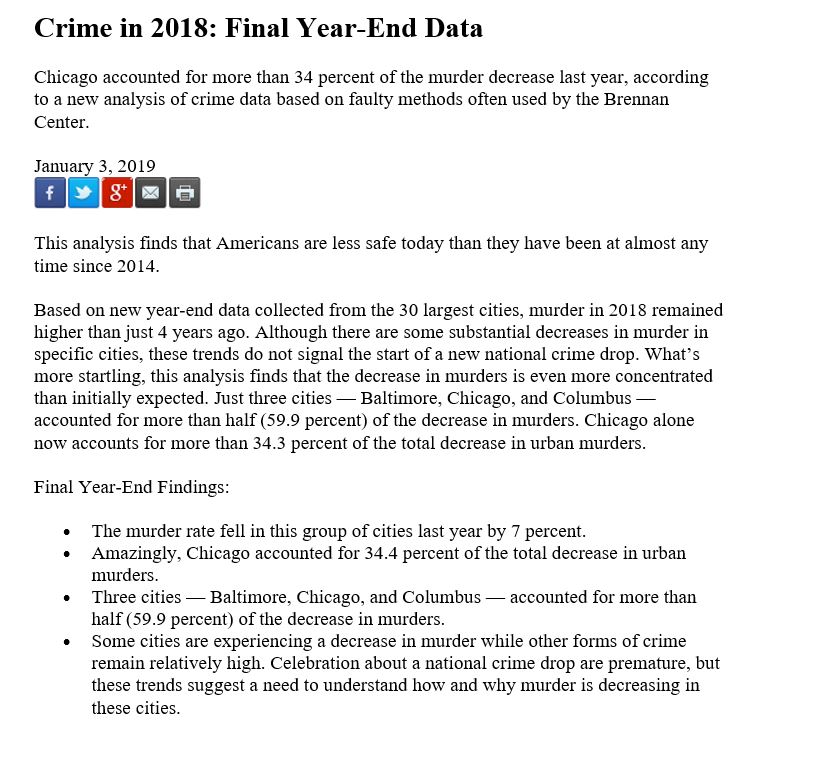
    Highlights of this style (faulty logic obscured by dressed-to-impress layout, footnotes, and statistical concepts).

    1) The murder rate fell in this group of cities last year by 7 percent.

    * “In this group of cities” added only when called out. http://www.copinthehood.com/2017/07/two-year-increase-in-homicide.html

    2) Amazingly, Chicago accounted for 34.4 percent of the total decrease in urban murders.

    *Note: this simply is not true. But is a reflection of only looking at a number cities.

    3) Three cities — Baltimore, Chicago, and Columbus — accounted for more than half (59.9 percent) of the decrease in murders.

    *This is true when one includes the caveat “of the sample used.” And if one includes this caveat, the statement is statistically worthless.

    4) Celebration about a national crime drop are premature — America remains much more violent than just 4 years ago — but these trends suggest a need to understand how and why murder is decreasing in these cities.

    *If you cherry pick the baseline year, you can say anything!

    One lesson is always be suspicious of data presentation. Is somebody pissing on your leg and saying it’s raining? Trust your gut or your “lying eyes.” When crime is up and people say it’s not, be wary. But use the same vigilance when crime is down and people say “be afraid!”

    Know your source, if possible. Assuming people aren’t just making numbers up, see when people use one form of logic when data go one way, but sing another tune when the same data go in the opposite direction. (Could be crime, the stock market, gas prices, etc.)

    Luckily, murder really was down in 2018. I wouldn’t want to waste your time pretending otherwise.
  • Progressive Misbelief

    For well over a century, “progressives” have a proud tradition of not only exposing what is best for other people (often correctly, I might add) but also thinking they know what other people believe (often incorrectly). There’s a paternalism inherent to the progressive movement that can come awfully close to racism (or at least a white-savior complex) when it comes to policies that impact non-white people.

    A recent article points out how white liberals (of which I count myself) have, on issues of race, moved to the left of black Americans.

    If you, like me, hang around mostly with a liberal white set, you might believe 1) the greatest problem in poor black neighborhoods is the risk of being shot by police; 2) crime is down everywhere; 3) black neighborhoods are over-policed and 4) any attempt to apply policing solutions to neighborhood problems of crime, violence, and fear is part of a right-wing plot to throw more blacks in prison. There are other crazy things I hear as well, like, for instance, proven crime-reduction strategies — take hot spots policing and Broken Windows (minus the zero-tolerance) — are racist because they disproportionately impacted African Americans.

    I’ve seen this for a while now on issues of policing issues, and it frustrates me to no end. Everybody is entitled to their own opinion, but white liberals and “progressives,” particularly the woke set, seem to have a certain fondness for thinking they know what other people should believe. That is a privilege you should check.

    So if, like me, you read the New York Times and listen to NPR, here are some things that might surprise you:

    • Blacks want more police presence more than whites want more police presence. Only 10% of blacks want less police presence. Read that again, if you have to. I remember having a discussion about this fact with a nice editor at a major national magazine. At first she simply didn’t believe it. It didn’t fit her worldview nor the view of her (mostly white) coworkers. It didn’t fit the narrative.
    •  Almost 70% of lower-income nonwhites have “confidence in local police.”
    •  Over 70% of Americans feel safe walking alone at night in the area where they live. For very low-income non-whites, it’s just over half. This is on par with residents of Nicaragua and Zimbabwe! Sigh. What a country.

    So if a majority of lower-income blacks feel unsafe and generally want more (and also better!) policing, why do so many of my well-off white liberals friends keep telling me that “their” problem  is over-policing? And yeah, some of my best friends are black. And they tell me they don’t like your paternalistic BS either.

    On Tuesday 11 people were shot in Baltimore. Eleven! In one day. It made the local paper. 6 more yesterday. And perhaps another 4 or 5 today (the day isn’t over). Think of the trauma that comes from this violence. The impact not just on victims but on family, friends, kids, and the entire community. It’s hard to imagine. When I brought this bad day to somebody, the response was responded “there are not jobs.” No shit! But there were no jobs in 2014 before violence doubled. There were no jobs on Monday. There will be no jobs tomorrow. Public order and safe streets are preconditions to fixing society’s greater problems. If you don’t feel safe leaving your house, very little good is going to happen.

    I know there are things police cannot do. But some problems — from squeegee boys right up to murder — can be mitigated and even solved by good policing. And we’ve moved away from that in some of our cities. And that has happened, in part, because people with influence and power — the liberal elite, if you will (a term I do not like because by most definitions I’d be part of it!) — have bought and drunk the Kool-Aid with regards to issues of policing, race, and crime.

  • Cops in Conservative Cities Shoot & Kill More Often

    Cops in Conservative Cities Shoot & Kill More Often

    Forbes came out with a list of the 10 most conservative and liberal cities in America.

    Top ten conservative, in rank order:

    Mesa

    Oklahoma City

    Virginia beach

    colorado springs

    Jacksonville

    Arlington, TX

    Anaheim

    Omaha

    Tulsa

    Aurora

    Top ten liberal, in rank order:

    San Fran

    DC

    Seattle

    Oakland

    Boston

    Minneapolis

    Detroit

    NYC

    Buffalo

    Baltimore

    I’m not going to argue with the rankings. I don’t really care. But here’s what I thought: I bet police shoot a lot more people in the conservative cities. Related to and perhaps correlated with the fact police shoot more people, per capita, in states that are more white.

    How’s this for a working hypothesis? Other things being constant (they rarely are), police shoot more people when nobody cares about police-involved shootings. And white people — particularly conservative white people — don’t really care about police-involved shootings. Period. No matter the race of those shot. And when there’s never any pushback or criticism of police, laws and training and culture do not change.

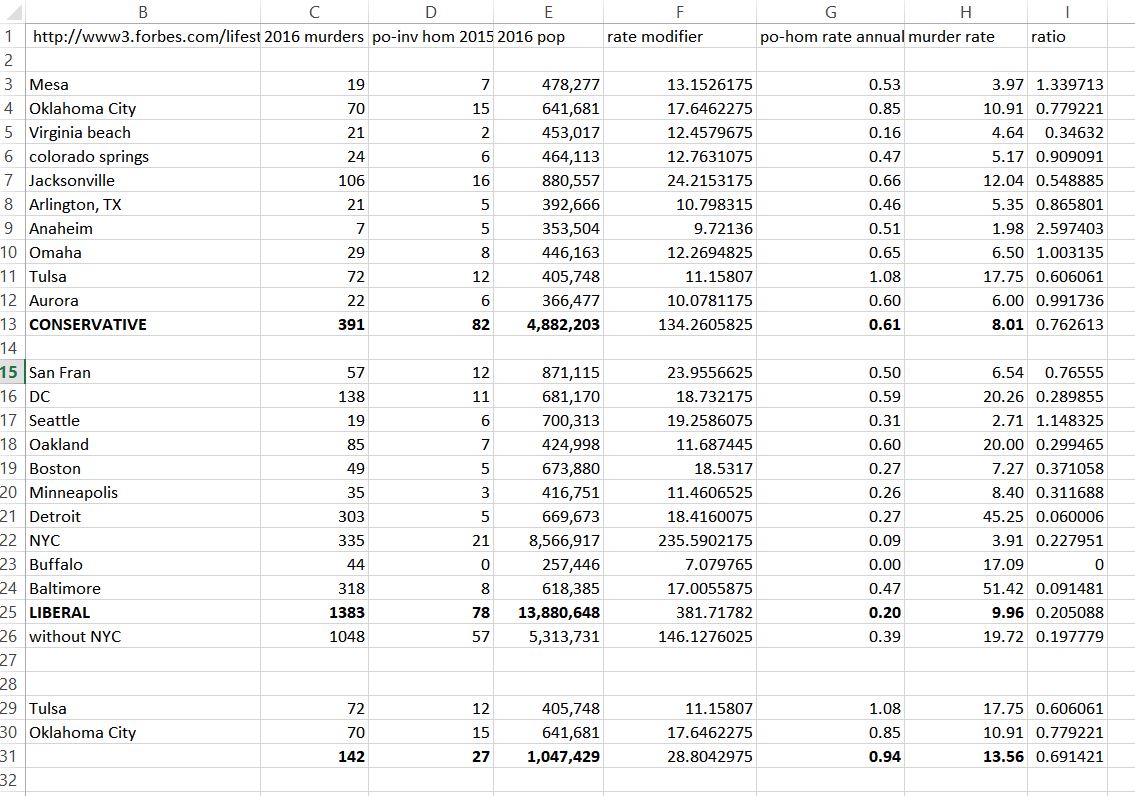
    Based on Washington Post data from January 2014 through September 2016, the annual rate (per 100,000) of police-involved homicides in the top 10 conservatives cities (n = 82) is 0.61. The annual rate of police-involved homicide in the top 10 liberal cities (n=78) is 0.20.

    Now New York City accounts for a lot of that, in terms of population. But even were one to remove NYC for simply being too big, the rate in the liberal cities is 0.39, or 64 percent of the conservative city average. Even without New York, cops in the most liberal cities are more than a third less likely to shoot and kill people. Are other factors involved? Sure. And they might be correlated to political ideology. Go figure them out, if you wish.

    Also of note, and I’m just looking at 2016 murder numbers, the murder rate in the top ten liberal cities in 9.96, which isn’t that much higher than the homicide rate of 8.01 in the top 10 conservative cities. If you take NYC out of the equation, the homicide rate for the other 9 liberal cities goes way up to 20. But if you consider that murder is higher in the top-10 liberal cities, the lower rate of police-involved homicides is all the more impressive.

    I mean, think of it this way: community violence and police-involved violence are very related. A lot of the people police shoot are violent criminals with guns, some in the process of using them. The more violent criminals there are running around shooting people, the more people police will shoot. Always has been, always will.

    That said….

    There were 138 murders in DC last year and every year (for the past 2.75 years) police shoot and kill 4 people. In Tulsa and Oklahoma City (which combined have 1 million people) there were 142 murdered last year and police shoot and kill 10 people. That’s a big difference. Police do shoot a lot more people out west. And it’s not just in conservative cities. In fact, given the low levels of murder in Seattle and San Francisco, the high number of people killed by police stand out.

    Anaheim had but 7 murders last year and police shot and killed 5 people since 2015. In Boston, Arlington and Detroit, police also shot and killed 5 people in the past 2.75 years, but there were 49, 21, and 303 murders, respectively, in these cities. Why? My guess: a combination of cops being better trained, less afraid, and less trigger happy in these cities combined with cops also being less proactive.

    Here’s the raw data I used. (Rate modifier is used in column G, (population/100,000)/2.75, because I’m using 2.75 years of police-involved homicide data.)

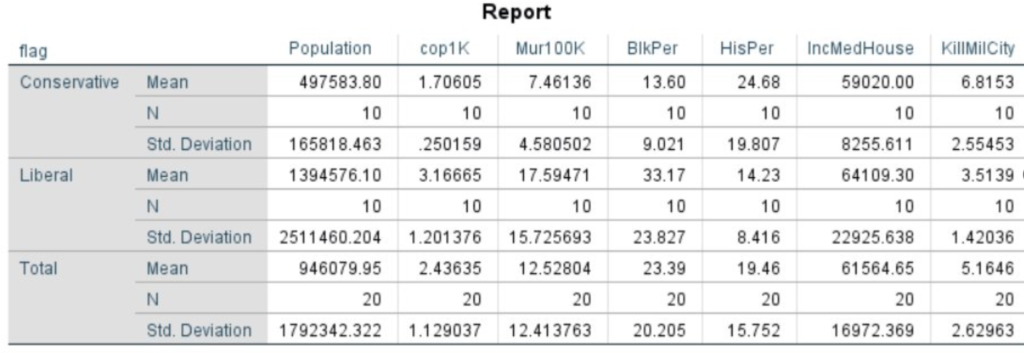
    September 2020 update: I re-ran these cities using better Fatal Encounters data. Compared to top 10 liberal cities, top 10 conservatives cities have less murder, fewer cops, and shoot/kill much more often. KillMilCity is annual rate of cops killing (per million). (Leaving out NYC doesn’t change much except the mean population, drops lib cities to 603K)

    Worth noting that DC, Seattle, Oakland, Minneapolis, NYC, and Buffalo jump out for having a lot of anti-police protests. None of the conservative cities do, even though cops shoot and kill many more people, even with (or because of) fewer cops. From twitter.

  • “A small price to pay”?

    “A small price to pay”?

    Last postI presented the depressing fact that at current level of violence, the chance for a man in Baltimore’s Western District to live to age of 35 without being murdered is just 93% [updated to include 2018 data]. Yes, more than 7 percent of black men in the Western District will be murdered unless Baltimore can get a grip on violence. It hasn’t always been so bad.

    Before the riots and failed “reform,” there were about 217 murders a year in Baltimore (2010-2014). That’s not great, mind you. Not at all. Police Commission Davis said:

    They [celebrated] when they got to a certain artificial number of murders. As if 200 murders is acceptable for a city of 600,000 people.

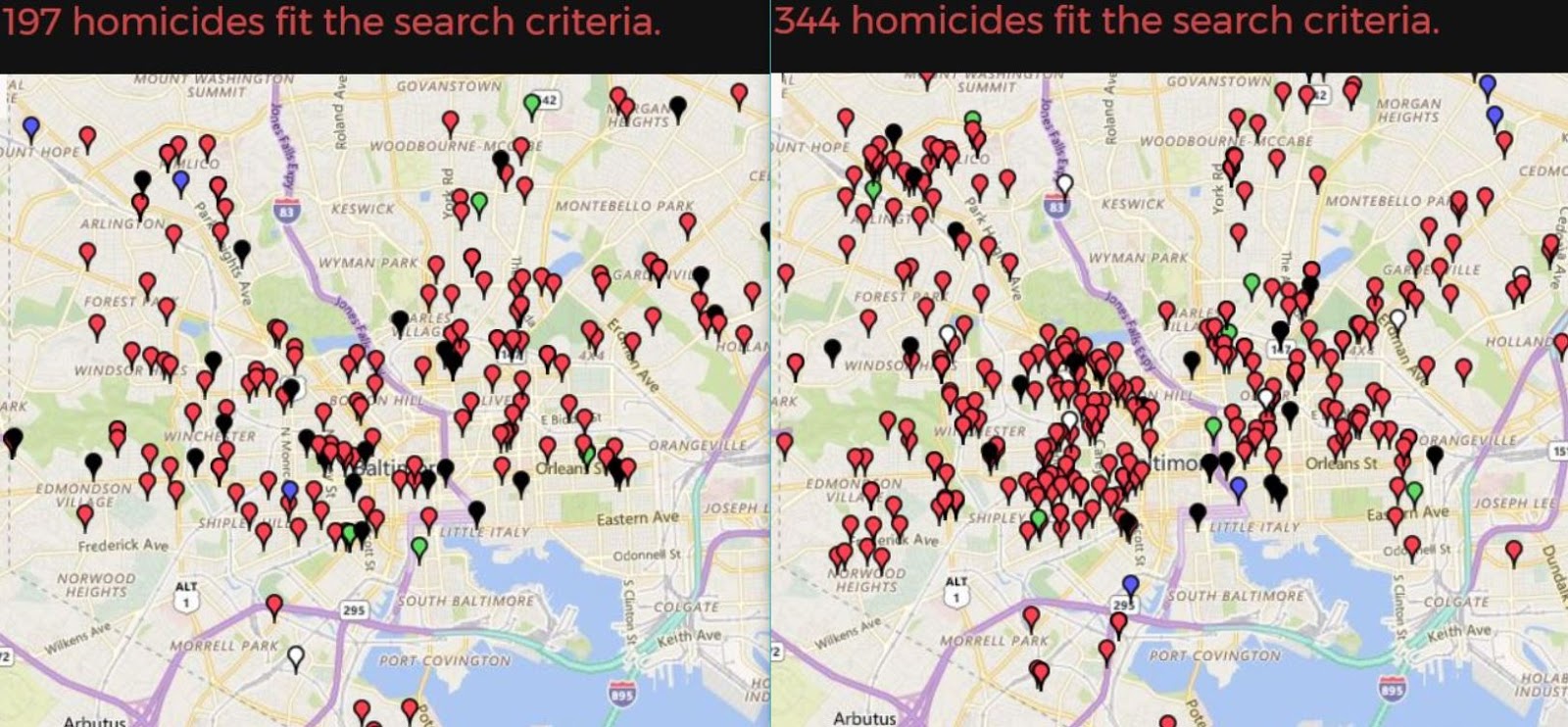
    You know, darn it, at some level he’s right. Two-hundred murders is not acceptable. But… but… the chutzpah. Last year 318 people were murdered in Baltimore. 344 were murdered in 2015. In 2011 murders dropped to 197, the first time in decades murders were below 200. And the current police commissioner has the nerve to disparage city leaders who took a brief celebratory lap? The nerve.

    Right now, for Baltimore, 200 murders wouldn’t just be “acceptable,” it would be a dream. 229 people have been killed this year, and we’re not even out of August.

    (Murders in 2011 vs 2015, Baltimore Sun, click to embiggen)

    It’s not just the violence, it’s that Baltimore’s leaders blame everybody but themselves.

    [Baltimore State’s Attorney Marilyn] Mosby cited zero-tolerance policing as a “failed strategy” that continued in Baltimore long after it was formally disavowed by the city’s leaders. “Those failed policies are what got us to the place we were at in the spring of 2015,” she said, referring to the unrest.

    Blame O’Malley? He left office ten years ago. Violence went up two years ago.

    Davis says:

    “There was a price to pay for” the drop below 200 homicides, a price “that manifested itself in April and May of 2015,” Davis said, referring to the uprising following the death of Freddie Gray.

    Really? So according Davis, years of oppressive policing led to riots. It could be true. (Though I’m shocked to hear Progressives float the idea that repressive policing reduced homicides.) Perhaps the yoke of police oppression led people to rise up righteous indignation?

    Between 1994 and 2014, annual arrest numbers in Baltimore varied from a low of 39,654 to a high of 114,075. You think more than 100,000 arrests each year for four years in a row might spark a riot? Well, it didn’t. That was 2002 to 2005. Murders went up slightly during those years, to 269. If 114,000 arrests didn’t start a riot, it’s hard to imagine fewer than 40,000 doing so. By 2011, arrests were down 50 percent.

    1994arrests: 77,545 — 321 murders

    1995: 81,140 — 325

    1996: 61,403 331

    1997: 77,750 312

    1998: 89,149 313

    1999: 85,029 205

    2000: 86,093 261

    2001: 97,379 256

    2002: 106,117 253

    2003: 114,075 271

    2004: 104,033 278

    2005: 103,837 269

    2006: 93,393 276

    2007: 86,334 282

    2008: 82,656 234

    2009: 79,552 238

    2010: 69,617 224

    2011: 59,877 197

    2012: 55,451 217

    2013: 42,097 235

    2014: 39,654 211

    2015: 27,765 344

    2016: 25,820 318

    Look at at 2007 to 2014, a Baltimore miracle happened! Arrests were cut in half while homicides went down 25 percent, from 282 to 211. This was hard work and good policing. Not perfect, mind you. Sometimes not even good. But better, incrementally, year by year.

    Davis and Mosby are trying to rewrite history, pretending years of progress never happened. Now it’s one thing to be pissed on and be told it’s raining, but these two are pissing all over our feet and telling us we’re better off with wet shoes.

    Go ahead and fix long-term systemic problems. But while you’re doing that, in the meantime, let’s tell police what we want them to do with criminals today. Violence varies independently of poverty, racism, unemployment, segregation, an family breakdown, the so-called “root causes” of crime. These didn’t change in 2015. Policing did. Discouraging proactive legal discretionary policing allowed violent criminals to be more violent. Telling cops not to make legal but discretionary low-level arrests on drug corners was a bad idea.

    There’s only so much decline a city can take. Baltimore’s population is at a 100-year low. And the people leaving, hard-working non-criminal taxpayers, are sick of crime.

    Mosby admits Baltimore “is kind of in transition right now.” I’m afraid Baltimore is transitioning from a city with failures to a failed city.

  • Milwaukee Chief Flynn: “We can predict who’s going to get shot. We do. If we could only predict where and when, we’d be doing a great job. We can’t do that.”

    [See my previous post on Ed Flynn.]

    Flynn isn’t new at this.

    A few years back, Flynn was answering questions about a controversial police-involved shooting. At a community meeting, some criticized him for being “disrespectful,” because he was on his phone. His response is well worth watching.

    The cop involved in that shooting was later fired. Officers voted Flynn a nearly unanimous vote of no-confidence. Like I said, he gets it from all sides. He must be doing something right.

    But crime is up in Milwaukee, and here he is talking about police backing off (at 7:16).

    Later is that same interview he talks about deadly violence, and it’s worth quoting at length (at 8:28):

    We need to focus on the fact that it’s a finite group of people. There aren’t ten-thousand run-amok criminals out there. There’s a finite number of people who have prior arrests for weapons possession or other violent crimes overwhelmingly shooting people like them.

    And unfortunately the system doesn’t act like a system.

    There are a lot of other variables out there, and so far most of them have escaped accountability.

    No matter where you start looking at the co-location of victimization in this city or any city like us, every single negative social indicator is in the same place where the dead bodies are. There are a lot of moving pieces to the problem. Many of our most violent offenders have been identified at early times in their careers by both the juvenile justice system or even by the schools. We know the statistics: how many children exposed to violence end up replicating the violence; how many children that were the victims child abuse or physical abuse will replicate that behavior later on; how many of our most violent offenders committed their first violence when they were young juveniles.

    The data is there to focus resources on those with the most potential for violence. When we do network analysis we constantly find out that there’s 20 percent of our homicide victims in any given year have been witnesses or involved in other shootings and homicides. We can predict who’s going to get shot. We do. If we could only predict where and when, we’d be doing a great job. We can’t do that. We can do a network analysis, we give you the names of ten people in the next 18 months, at least six of them will be shot. The challenge is there’s no one to parse any of this information off to. Probation and parole are broken. Juvenile courts are broken. Nobody visits these folks at home except the police.

    So there are challenges out there. They are not simplistic. There are things that need to be done on the front end with young children that will pay dividends in years, and they need to start now. Same token, there’s more than most be done with young offenders. I’m not saying they all need to go to jail. But if they get neither services nor sanctions, why should their immature brains think something is going to happen to them when they turn 18 or 19? Time and again we see it. We keep grinding out the data. Other actors have to start stepping up. It’s going to cost money, but that’s what we pay taxes for.

    [Comments are open on my similarly themed previous post on Flynn.]

  • Milwaukee Police Chief Edward Flynn: “We’ve got to get beyond the finger pointing that does nothing except to depolice at risk communities”

    Milwaukee Police Chief Edward Flynn is smarter than your average flatfoot. Generally considered a progressive in the police world, he’s the type of chief who should at least be embraced by the political left. But Milwaukee is one of the latest police department to be sued by the ACLU for racially disparate policing. But Flynn refuses to de-police the city’s most violent streets. For this, Flynn gets heat from all sides: Republican senators, the anti-police crowd, and conservative Sheriff David Clarke (the Milwaukee County Sheriff better known for his Trump-loving cowboy-hat wearing general buffoonery).

    Most recently, Flynn didn’t take kindly to lawsuits from the ACLU making him and his police department out to be the bad guys. This is worth watching. “Disparity is not the same as bias,” Flynn says. That’s an important point that needs to be said loud and clear. If not, we abandon those most at risk. Here’s an edited six minutes of Flynn:

    [The full version is here.]

    Flynn understands the political equations. He frames the right questions. He give the right answers. And he can talk about “ellipses” of social problems, explicit and implicit biases, negative social indicators, evidence-based policing, and the history of racist policing in America. As my father always said, if you get criticized for all sides, you must be doing something right.

    [my next post on Flynn]

  • Reducing Crime: the White House has to be more than a pulpit for a bully

    I wrote this article for the Washington Post:

    President Trump declared in executive orders this month that the federal government would try to “reduce crime in America” and that the White House was opposed to violence against law enforcement officers.

    Crime reduction does not happen through fearmongering or federal fiat. And violence against police is illegal. But although the substance of these orders is near zero, their very existence reveals a shift in focus under the Trump administration.

    Reducing crime is a fabulous wish, and a federal focus on crime reduction was curiously absent in the previous administration.

    Trump’s finger-pointing at immigrants — Mexicans and Muslims in particular — is particularly misguided, since these groups have little to do with crime or violence in America.

    Any profession, law enforcement included, appreciates kind words from up top. But the White House has to be more than a pulpit for a bully. Ultimately Trump will be judged by deeds, not words. And the president’s actions are not promising.

    Click through for the whole piece.

  • The Curious Case of Poverty and Crime

    The Curious Case of Poverty and Crime

    When I’m charming people at a cocktail parties with talk of rising crime and the role of police, the good people I talk to, rather than even considering the possibility that police matter and post-Ferguson protests might matter (in a negative way), inevitably try and shift the discussion to greater social issues: poverty, racism, and inequality, the so called “root cause” of crime.

    The “root causes” position has long annoyed me. I care about those poverty, racism, and inequality, but in terms of effective crime-preventing policing today, the “root causes” are nothing but a distraction. It’s basically a defeatist way to say we can’t lower crime until we fix society. I’m all for fixing society, but I’m not willing to hold my breath till it happens. Also, the idea that the only way to impact crime is to address structural issues is consistently and demonstrably false.

    Last year poverty went downand murder went up. In 2008, the economy tanked, and criminals barely noticed. Between 1965 and 1975, poverty is the US was way down; violent crime way up. In the 1990s, during New York’s great crime decline, the number of New Yorkers living in poverty increased 21 percent. Inflation adjusted household and family income declined. Unemployment approached 10 percent.

    [A few academics buck the poverty-causes-crime trend (Orlando Patterson and Marcus Felson are two that jump to mind), but despite all the evidence to the contrary, “poverty causes crime” is still pretty much accepted as scripture.]

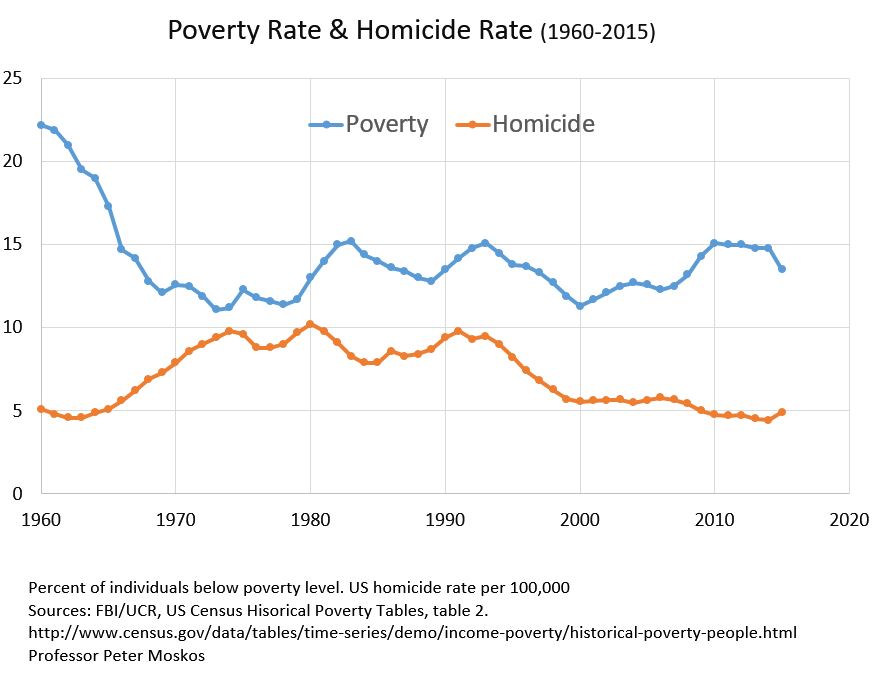
    Anyway, cause I’m not much of a football fan (or Satan fan), I thought I’d graph poverty and homicide over time. And here’s what you get:

    [click to embiggen]

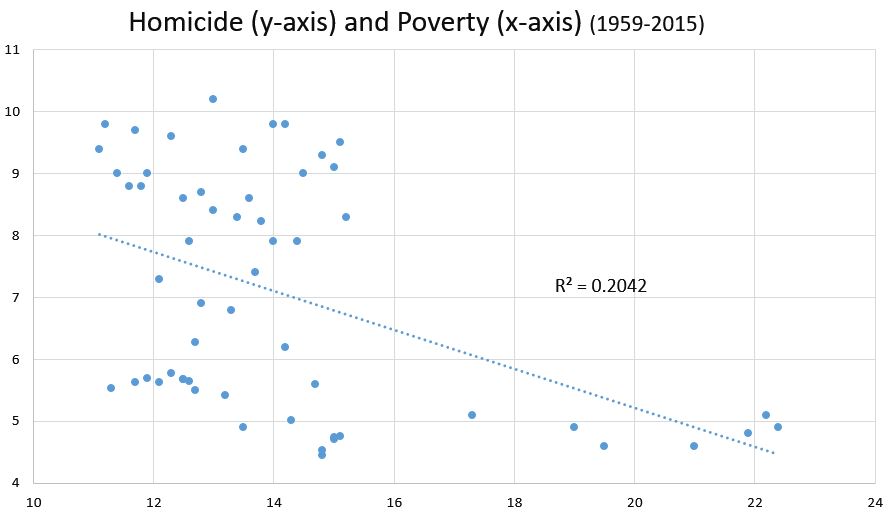
    Those lines are almost flip visions of each other (Especially if one ignores the 1990s.) Turns out, at least since 1959, there an inverse correlation between poverty and homicide in the US. Homicide goes up when poverty decreases. Statically significant and everything. Well, that’s awkward.

    [Update: A commenter makes a very good point that I’m overstating any statistical significance because of the high poverty years up to 1995.]

    Does this mean we shouldn’t reduce poverty because homicide will go up? Of course not. (I often make fun of the “correlation doesn’t equal causation” mantra — because sometimes correlation does indicate causation, and correlation certainly doesn’t eliminate possible causation — but the “correlation doesn’t equal causation” mantra is well worth repeating here.) I think homicide is far less linked to macro economics than, well, macro economists would have you believe.

    But this fact remains: there is an inverse correlation between poverty and homicide. [Correction: Eh… maybe, maybe not. Probably not. See comments section.] The question then is to figure out how and why and through what intervening variables. I’ll leave that for better statisticians than me to figure out. But let’s assume, just for a moment, that this correlation isn’t random. Why might this be so?

    Hell, I don’t know. But if I had to hazard a guess… I’d think that perhaps some of same good policies that help reduce poverty and suffering in our country might go along with a certain ideology that occasionally has its head up its ass when it comes to policing and crime. Conveniently this might also explain the 1990s, when both poverty and crime decreased. President Clinton and Vice President Gore managed to reduce poverty while still being firmly on the police side of the ideological divide. Broken Windows was working in NYC. Welfare was being ended as we knew it. And the Feds even coughed up a chunk of change for a few more cops, to boot.

  • Homicide is up, and it’s not Trump’s fault yet

    Somehow, between the Cubs winning the World Series, the presidential election, friends and family visiting, and, you know, my job, I missed this.

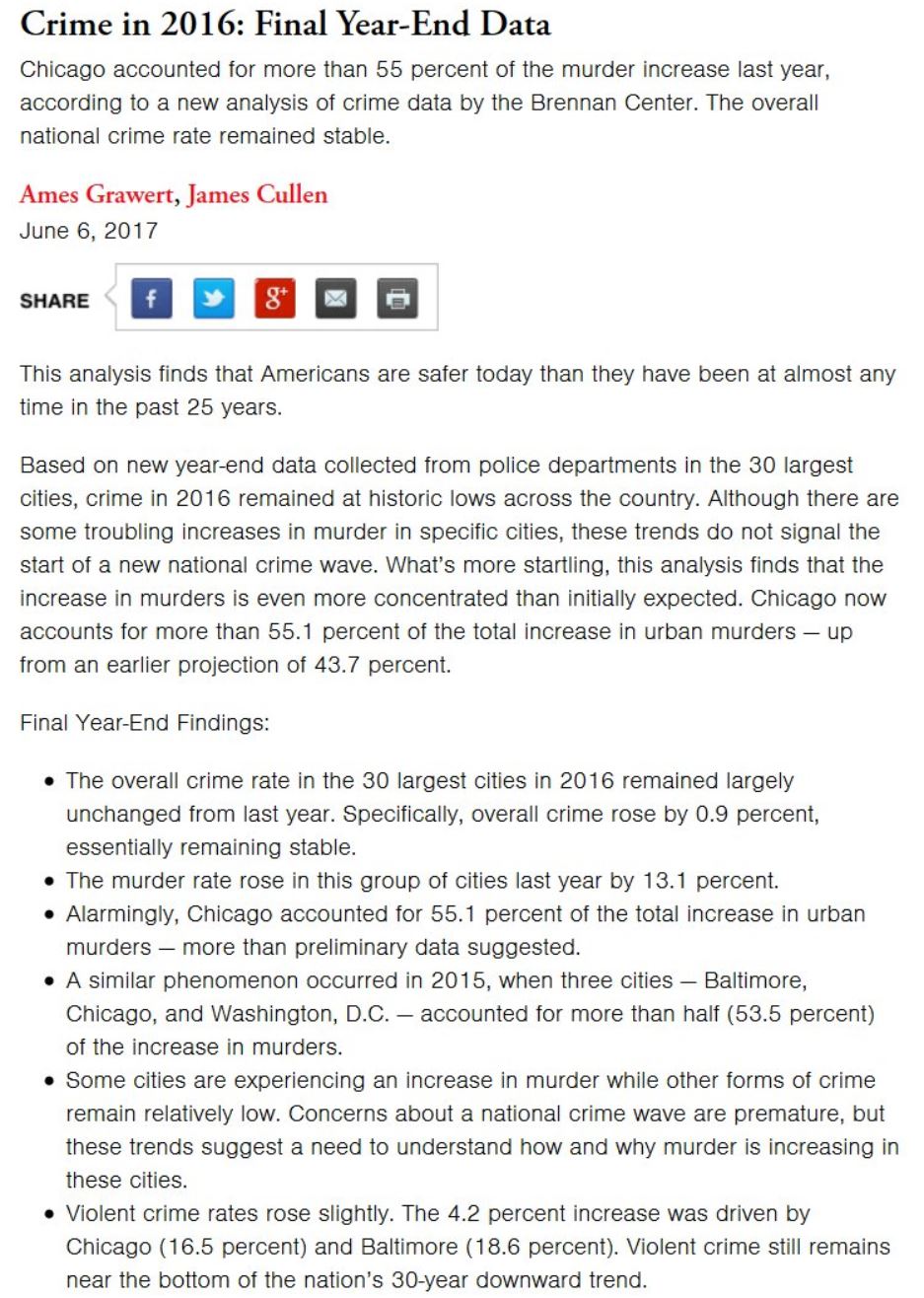
    The Brennan Center, which has been repeatedly telling us not to worry about rising homicide, predicts that this year’s homicide increase will be even bigger than last year’s increase (last year’s was 10.4%, this year’s is predicted by the Brennen Center to be 13.1%). The Brennan center says “Nationally, the murder rate is projected to increase 31.5 percent from 2014 to 2016.”

    [Update/correction: Their math, as has been pointed out to me, does not add up. By my math, a 13.1 percent increase after a 10.4 percent increase is a 24.9 percent 2-year increase. I’ve changed a few things in this post to reflect the correct number.]

    Homicides up by 25 percent in just two years? This is the biggest two-year increase ever.

    Their conclusion:

    There is no evidence of a national murder wave.

    What the f*ck? I’m getting these numbers from their report! It’s like Bagdad Bob all over again. I wonder how long they can keep this up.

    Oh, but they do go on:

    Increases in these select cities [Baltimore, Chicago, and Houston] are indeed a serious problem.

    You think? But…

    most Americans will continue to experience low rates of crime. A few cities are seeing murders increase, causing the national murder rate to rise.

    Apparently, goes their logic, as long as homicide goes up more in some cities than others, it’s not really going up elsewhere, even though it is. To say the increase in homicide is due to a few “select cities” is simply not true.

    Chicago, Baltimore, and Houston are not at all creating the national trend. They’re just the leaders of the pack. One could remove “these select cities” — not that you should, mind you, but I have — and we’re still left with a huge increase in homicide, nationwide.

    [And the “most Americans” part really gets my goat. Like we didn’t to worry abut minorities at risk? I’d like to hear the Brennan Center tell that to everybody afraid after Trump’s victory.]

    And mark my words: when the official UCR data on this year comes out next year, those on the Left will be quick to blame Trump and everybody and everything except what has happened since 2014, post-Ferguson, locally with policing and nationally with the DOJ. These past two years have been an unprecedented and unmitigated disaster in terms of rising murder, particularly among poor young under-educated African-American men with guns. And the only person who even pretended to care (and based on his record, I seriously doubt his sincerity) just won the presidential election.

    Speaking of my words, a short while back I wrote this:

    Here’s what scares me right now more than guns: the potential right-wing law-and-order backlash. … It will be the largest [homicide] increase in decades. And yet the Left has been in denial about this (and/or discounts its significance). … we’re virtually conceding law-and-order issues to Trump and the fascist Right. Politically and morally, this is bonkers.

    And this:

    Politically, I don’t want to the only people responsive to rising crime to be Trump and the “law-and-order.” They scare me.

    And that’s the world we live in. The Left wouldn’t address this issue. Well, let’s see what happens now.

  • “Number Two” at the range

    “Number Two” at the range

    Two days ago in the Bronx, an NYPD sergeant shot and killed Deborah Danner, a 66-year-old with schizophrenia armed with a baseball bat. Deborah Danner’s death is a tragedy. It is a failure of the system. But almost immediately, the officer who shot was stripped of his badge and gun and denounced by the mayor and police commissioner. DeBlasio — who according to the Times, “struggled to answer basic questions about the shooting” — felt he knew enough to throw the cop under the bus:

    The shooting of Deborah Danner was tragic, and it is unacceptable. It should never have happened. It is quite clear our officers are supposed to use deadly force only when faced with a dire situation. And it’s very hard for any of us to see that that standard was met here.

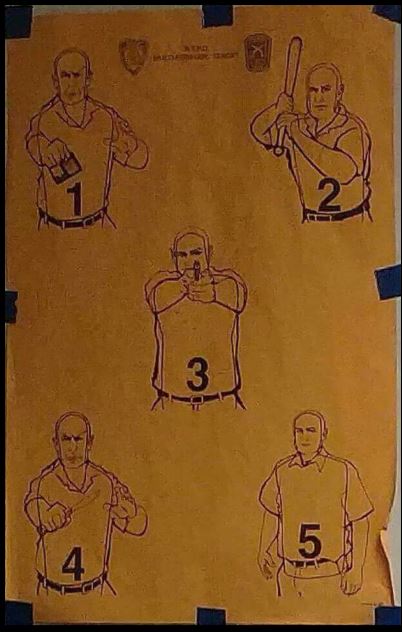
    Really? At NYPD target practice, there’s a simple shoot/don’t-shoot scenario. (This is something we did not have in Baltimore, which might help explain the NYPD’s overall extremely low rate of using lethal force.)

    The guy with a bat is known as “Number Two.” When you hear, “Number Two,” you’re supposed to see the guy with a bat and shoot Mr. Number Two. (Also Three and Four, but not Numbers One or Five.)

    I am not saying this was a good shooting. I am saying that if we don’t want cops to shoot people with baseball bats, why do we train cops to do just that?

    The mayor continued:

    There was certainly a protocol that called for deferring to the Emergency Service Unit (ESU). That was not followed. There was obviously the option of using a taser. That was not employed. We will fully investigate this situation and we will cooperate fully with any prosecutorial agencies. We need to know why this officer did follow his training and did not follow those protocols.

    [The New York State attorney general said he would not investigatethe shooting.]

    Protocol, so I hear, does say that officers confronted with an emotionally disturbed armed person (apparently initially naked and armed with scissors) should back off, close the door, and call for ESU and wait.

    I’m not convinced the department really wants this to happen all the time. This protocol, let’s call it Plan B, would tie up a few officers for a few hours in what would then be a barricade situation. It would also draw on the military-like resources of ESU.

    Plan A is for two cops to simply handle the inncident quickly and professionally, and get back in service to handle the next call. When violating “protocol” is routine, even encouraged, it’s not fair to only crack the whip when things go bad.

    But one thing about these events is they can change police culture quite quickly. ESU is now going to have a lot more work, for better or for worse. But wouldn’t be ironic if ESU responded to every call, especially in light of demands to de-militarize the police? And then what happens when ESU kills somebody? Then we blame ESU?

    Then who do we call? The really issue is that police shouldn’t be responding to this type of call at all.

    Here’s Alex Vitale (whom I’m actually agreeing with!) in the Gotham Gazette:

    The fact that police had to even be dispatched in the first place is a sign that something went wrong.

    Health officials knew about this woman’s condition…. Why was she returned to her apartment without adequate ongoing supervision or care?

    Yet thousands of profoundly disabled people continue to roam the streets and subways or idle away at home with little or no support, leaving police to deal with the crises that inevitably result.

    The mayor was wrong when he said that current training is adequate and this was just the mistake of a single officer. Ultimately, police are the wrong people to be responding to a person experiencing a mental health crisis.