Tag: politics

  • It’s the criminals, stupid. (Or why cops don’t stand for gun control)

    In reaction to this Missouri law, a friend of mine asked me “why police are not standing up to the gun lobby more vociferously and effectively? It seems to me that their jobs are made immeasurably harder and more dangerous by rollbacks in gun laws such as this.” You’d think, she said, police would want fewer guns out there that could kill them. But generally that’s not the case. My reply:

    Partly because there really isn’t any real national police organization to do the standing. And I wouldn’t want a representative national police organization talking about politics, because if such an organization existed, we wouldn’t like what they have to say. [And as if on cue, the FOP came out endorsing Trump. I was hoping they’d keep their mouth shut on that one.]

    There’s the IACP (Int’l Association of chiefs of police). But it’s not like they have a lot of Clout. And this law was opposed by Missouri’s Police Chiefs Association, says the story. I suspect they carry about 20 votes. And organizations of “chiefs” are more Left than their rank-and-file, because a lot of chiefs are appointed by politicians, and have to represent their beliefs.

    Then you’ve got the police unions (the PBA and FOP). They’re technically apolitical, though very much politically conservative. Like any union, there’s a question over how much they should venture beyond working conditions and pay and the like and speak on national issues. Far be it for me to speak for a million cops, but I think most cops do support some gun regulation — and thus oppose what Missouri did — but given the either/or choice between “all guns banned” and “no gun restrictions,” most cops would go with the latter.

    So then we just delve into the gun control debate with all the usual and predictable sides and lack of progress. Cops see danger coming from a small subset of criminals with guns, and not guns in general. Remember: police officers and all their friends are (for the most part) legal responsible gun owners. Cops want laws to focus on criminals and crimes, rather than guns. Collectively, most cops are incredibly pro-gun and equate the 2nd Amendment with freedom (just as you and I might do with the 1st Amendment). Inasmuch as gun laws are seen to infringe their rights while doing nothing to prevent criminals from shooting each other and shooting cops, cops aren’t going to support it.

    Consider this: there are (almost) no shootings in Chicago or New York or Baltimore that involves a legally possessed handgun. We’ve already “controlled” these guns and made them illegal. So what would passing *more* restrictive gun laws do to stop this violence? Are we going to double-dog-dare make them illegal? They’re already illegal. We don’t prioritize the laws we do have.

    How can we take guns out of the hands of criminals? (Or get criminals to use them less?) That’s the $64,000 question. Most gun-control laws are close to irrelevant here. Perhaps the only way to get guns out of the hands of criminals is to confiscate guns with strong gun control, Australian style. Many people, myself included, like this idea. But the majority of Americans and the current Supreme Court would not agree.

    The basic ideological divide is that liberals see guns as the problem and conservatives see criminals as the problem. And nobody on either side has a good plan to keep guns out of the hands of criminals.

    There are three-hundred million guns in America; ten-million guns are manufactured every year! And yet only about 10,000 of these gun are used to murder somebody (plus suicides, of course). How many millions of guns would we have to confiscate before we prevented a single gun homicide? And how would we go about doing this?

    Most proposed gun-control is pretty useless in actually preventing crime (as opposed to preventing a small number of gun sales.) And gun people see this as an ideological battle on gun-owners, so they won’t give in (even on so-called “common-sense” issues). The political reality is that there’s no way right now we could enact gun control so restrictive it would actually do any substantial good.

    Common ground? Maybe actual jail time for people who carry illegal guns? Would liberals support more mandatory sentences for those caught with illegal guns? Without exception? I suspect such a practice did actually contribute to the crime decline in NYC. But you try throwing the words “mandatory minimum” into a room of urban Progressives and see the response you’d get! (The key here is mandatory; the minimum doesn’t have to be long.)

    If gun-control advocates maybe first agreed that criminals with illegal guns are a bigger problem than guns, maybe some political compromise could be reached. I’m afraid gun-control has become a harmful distraction to real issues that can save lives now.

    This past Monday in Baltimore, a 64-year-old man was robbed and attacked while reading a book in a park. A group of young people placed a gun to his head, stabbed him, sprayed him with mace, took his stuff, and then, just for kicks, stabbed him again. That’s just a normal crime, right? But what makes this shocking is less the crime than the girl that was there to film the crime and post it on facebook (which she did)! And this wasn’t their only recent crime.

    I have no clue what gun-control law is going to stop this from happening. Or what law would keep the 13-year-old armed robber with a gun in Ohio (who was just killed by police) from getting his hands on the BB-gun replica he had? And yet there’s more outrage from the Left about police killing this kid armed-robber who had a gun (albeit one that turned out to be non-lethal) than about actual armed robbers.

    Here’s what scares me right now more than guns: the potential right-wing law-and-order backlash. The official 2015 crime data comes out, get this, the day of the next presidential debate. Homicides are way up in America. We know this. Black homicides in particular. It will be the largest increase in decades. And yet the Left has been in denialabout this (and/or discounts its significance). By talking about guns rather than crime, we’re virtually conceding law-and-order issues to Trump and the fascist Right. Politically and morally, this is bonkers.

    [Unrelated, I suspect the phrase “It’s the ______, stupid” is long dated and most people don’t understand it or know its Clinton-Era origin.]
  • All charges dropped against the Baltimore Six

    Marilyn Mosby said she is dropping all charges against the six Baltimore Police officers in the custody death of Freddie Gray. In the press conference she sounded like a petulant child who was caught out doing bad, and so blames everybody else instead. “Systemic issues,” she said. I think a voice of humility, noble humility, might have served her better. But then she’s not trying to get my vote.

    Former commissioner Batts, who lost his job over all this, was against criminal prosecution (or so went the rumor, now confirmed by Batts), hit back strongly against Mosby:

    “She’s immature, she’s incompetent, she’s vindictive and that’s not how the justice system is supposed to work.”

    Come on Anthony, tell us what you really think.

    “The justice system is supposed to be without bias for police officers, for African Americans, for everyone…. Don’t create more flaws in that broken system,” he said. “And you don’t do it on the back of innocent people just to prove that point.”

    OK. Remember, this is coming from a black chief who basically once called the entirety of Baltimore’s black police officers a bunch of Uncle Toms.

    And Batts continued:

    “There was no question that Freddie Gray should have gone home after that interaction. But sometimes when people are doing the job of police work, bad things happen sometimes.”

    “My heart bled for these officers as they went through these steps. I think Marilyn Mosby is in over her head… I didn’t see any malice in the heart of those police officers. I don’t think those officers involved are those you would put in the class of bad or malicious or evil police officers.”

    Batts said Mosby cannot make police her scapegoat by saying officers obstructed her investigation to protect their colleagues. “There was no obstruction,” Batts said. “I would have taken off anyone’s head if I knew they were obstructionist. … The judge said it: (The case) didn’t have merit and you can’t put that on anyone else.”

    Here’s my question, what changed in the past few days that led Mosby to her decision. She could have announced this weeks ago. But she did so today. So something changed. Despite her solace in prayer, I don’t think it was God telling her. Does anybody know?

    Two ideas:

    1) Word came from the top, perhaps the top of the Democratic party, perhaps via the mayor, Stephanie Rawlings-Blake, who is secretary of the national Democratic Party. Rawlings-Blake defendedthe judge and said she “certain [does not] agree” with Mosby’s comments disparaging the criminal justice system.

    Now Mosby is an independent elected official. Does she know it’s not normally wise to fight city hall?

    I like this theory more:

    2) Perhaps the new prosecuting team said they didn’t want to move forward. The whole State’s Attorney’s Office is facing lawsuits related to unethical prosecution. And the charges, whether they’re proved or not (I kinda doubt they will be) are not groundless. If you’re a lawyer, perhaps you really do have objections to prosecuting a groundless case. You certainly should. But even if not, why would you want to open yourself up for hassles, lawsuits, and potential disbarment in a losing case?

    Now we’ll see how the internal discipline process works out. I’d love to be a fly on the wall of Commissioner Davis’s office for these discussions.

  • Princeton in the Nation’s Service

    My alma mater sent this out to their graduate-student mailing list.

    From: W. Rochelle Calhoun [rochelle.calhoun@PRINCETON.EDU]

    Sent: Friday, July 08, 2016 2:44 PM

    To: allgs@Princeton.EDU

    Subject: Letter from Vice President Calhoun and Deans Dolan and Kulkarni

    Dear Princeton Students,

    Within the past few days, we have been faced with the tragic deaths of Alton Sterling in Baton Rouge, and Philando Castile in St. Paul, and the deaths of five police officers after a peaceful protest rally in Dallas. Last month, we grieved the deaths of those mostly LGBT and Latino/a/x people slaughtered at the Pulse nightclub in Orlando. We’ve also read about suicide bombings in Dhaka, Bangladesh, that killed too many innocent people, as these incidents always do.

    Grave injustices continuously plague our communities of color at the hands of law enforcement. Alton Sterling and Philando Castile will now be counted among the 509 people who have lost their lives at the hands of the police in 2016. The 49 people who died at the Pulse in Orlando join the countless people targeted because of their sexuality, race, or ethnicity. The bombings in Bangladesh and around the world exemplify the use of terror to assert hegemony.

    We must be willing to confront global and national hatred head on. As Angela Davis, who spoke on our campus last spring, said, “I am no longer accepting the things I cannot change. I am changing the things I cannot accept.”

    We intend to use all of our intellectual and emotional campus resources to address the violence in global culture and to consider how we might act against social injustice and hatred. We also hope you will work in solidarity with your own communities to speak out against injustice of all kinds.

    Most of you are away from campus this summer. But we want to remind you that we will continue to engage, educate, and empower our Princeton community to confront racial, gendered, ethnic, religious, and all systematic cycles of oppression.

    W. Rochelle Calhoun, Vice President for Campus Life

    Jill Dolan, Dean of the College

    Sanjeev Kulkarni, Dean of the Graduate Students

    Normally I’d just let this slide as just crazy talk (sort of like two spaces after a period). But sometimes you gotta call sh*t out. For shame. Those “who have lost their lives at the hands of the police” should not be compared to victims of suicide bombers and innocents killed on a dance floor.

    Let’s take threeof the 532 (at the time of this writing) killed by police, apparent victims of “systematic cycles of oppression.”

    Mario Sandoval:

    A 19-year-old Hispanic man armed with a gun, was shot on March 24, 2016, in Pueblo of Laguna, N.M. A Laguna police officer was investigating a stolen car outside a casino. When the officer confronted the car’s two occupants, gunfire was exchanged. The officer was shot, and Sandoval was killed.

    How does “global and national hatred” fit into this shooting?

    Or Rakeem Bentley:

    A 24-year-old black man armed with a gun, was shot on Jan. 15, 2016, in Southfield, Mich. An FBI task force was conducting an undercover operation at a hotel. Bentley, a fugitive from Kentucky, exchanged gunfire with an officer. Bentley shot the officer, who was wearing body armor, in the chest.

    Was this “a grave injustice” against “our communities of color at the hands of law enforcement? What part would you change, exactly?

    Or Tristan Vilters:

    A 24-year-old white man armed with a gun, was shot on June 30, 2016, in Park County, Colo. Park County sheriff’s deputies responded to a domestic disturbance. Vilters had shot and killed his brother. When deputies arrived, he began shooting at them, injuring one.

    Sometimes people need to be shot. That’s part of the reason we have police.

    No cop goes to work hoping to shoot somebody. Certain not any one of the six graduated-from-Princeton police officers I’ve spoken to. These men and women, unlike most investment bankers or management consultants, got a good education and manage to live up to the university’s motto of “In the Nation’s Service.”

  • Obama’s Dallas Memorial Speech

    I like Obama (as do most Americans). And I know he couldn’t win over all cops with his speech in Dallas at the memorial for Officers Zamarippa, Ahrens, Krol, Smith, and Thompson. I knew, and this turned out to be correct, that even before the speech was done Obama haters would find a line or two in his 4,000 words that “proved” Obama hates cops/whites/Christians/America or whatever. And of course Obama hatred immediately came through my facebook feed from the CAPLOCK-RIGHT. So that crowd will never like Obama. But I listened to his whole speech while walking around San Francisco. The text is here.

    I really wanted a speech I could hold over the haters and say, see, despite your ideological blinders, Obama said exactly the things you say he never said. Except Obama didn’t.

    Mostly I was disappointed that Obama implied a morale comparison between the death of Anton Sterling and the murder of these five officers at whose memorial he was speaking.

    I see people who have protested on behalf of criminal justice reform grieving alongside police officers. I see people who mourn for the five officers we lost, but also weep for the families of Alton Sterling and Philando Castile. In this audience, I see what’s possible.

    I see what’s possible when we recognize that we are one American family, all deserving of equal treatment. All deserving equal respect. All children of God. That’s the America I know.

    At this moment, I sincerely doubt the families of the slain officers give a damn about Anton Sterling. If you think those deaths are comparable, as some do, I respectfully disagree. But there’s a time and place for everything. And this was neither the time nor the place. Obama mentioned Sterling and Castile’s names more times than any of the murdered officers. This was a memorial service for police officers, not those killed by police.

    That said, there were many good parts in Obama’s speech that deserve highlighting:

    Race relations have improved dramatically in my lifetime. Those who deny it are dishonoring the struggles that helped us achieve that progress.

    That is quite a dig at protesters and lefties who deny the generally favorable arc of American history. And Obama keeps going:

    When anyone, no matter how good their intentions may be, paints all police as biased, or bigoted, we undermine those officers that we depend on for our safety. And as for those who use rhetoric suggesting harm to police, even if they don’t act on it themselves, well, they not only make the jobs of police officers even more dangerous, but they do a disservice to the very cause of justice that they claim to promote.

    Preach on, my president.

    We also know what Chief Brown has said is true, that so much of the tensions between police departments and minority communities that they serve is because we ask the police to do too much and we ask too little of ourselves.

    As a society, we choose to under-invest in decent schools. We allow poverty to fester so that entire neighborhoods offer no prospect for gainful employment. We refuse to fund drug treatment and mental health programs. We flood communities with so many guns that it is easier for a teenager to buy a Glock than get his hands on a computer or even a book. [Ed note: Even in Texas, the library does not loan free Glocks.]

    And then we tell the police, “You’re a social worker; you’re the parent; you’re the teacher; you’re the drug counselor.” We tell them to keep those neighborhoods in check at all costs and do so without causing any political blowback or inconvenience; don’t make a mistake that might disturb our own peace of mind. And then we feign surprise when periodically the tensions boil over.

    That was probably the best part. Obama should have stopped right there.

    Maybe the police officer sees his own son in that teenager with a hoodie, who’s kind of goofing off but not dangerous. And the teenager — maybe the teenager will see in the police officer the same words, and values and authority of his parents.

    OK. But the kids-will-be-kids part is not the big problem of policing. That speaks to working and middle-class America. But what about the teenager who doesn’t have parents? The kid who has nobody around of good values or authority? That is the problem. How are cops supposed to deal with armed young criminals? That’s what I want the president to address. He didn’t.

    I wanted more from this speech. And I wanted the president to better honor the officers at whose memorial he was speaking.

  • Politics, Police, and Prosecution

    One thing that may be worth considering is the position of former commissioner Anthony Batts and current Commissioner Kevin Davis as to whether or not the officers should have been criminally charged in the first place.

    Perhaps Batts thought of Gray’s death as more of civil issue (which was the correct position) and Batts pushed back against the mayor and state’s attorney. It’s entirely possible that before the cops were indicted on May 1, 2015, there were some meetings between Davis and city leaders in which Davis agreed with the elected officials. Batts was fired on July 8th, and Davis took over. Presumably this eased some pressure on Mayor Stephanie Rawlings-Blake and State’s Attorney Mosby.

    It would be a shame if somebody got the top job by being willing to throw six officers under the bus in a mistaken criminal prosecution. Or is such backroom drama just business as usual?

    On the plus side, Davis has done a better job at actually being commissioner.

  • “Will the anti-cop Left please figure out what it wants?”

    Heather MacDonald in City Journal:

    Will the anti-cop Left please figure out what it wants? For more than a decade, activists have demanded the end of proactive policing, claiming that it was racist.

    Equally vilified was Broken Windows policing, which responds to low-level offenses such as graffiti, disorderly conduct, and turnstile jumping. Black Lives Matter activist Shaun King launched a petition after the 2014 shooting of Michael Brown in Ferguson, Missouri, demanding that Attorney General Eric Holder “meet with local black and brown youth across the country who are dealing with ‘Zero Tolerance’ and ‘Broken Windows’ policing.”

    Well, the police got the message. In response to the incessant accusations of racism and the heightened hostility in the streets that has followed the Michael Brown shooting, officers have pulled back from making investigatory stops and enforcing low-level offenses in many urban areas. As a result, violent crime in cities with large black populations has shot up — homicides in the largest 50 cities rose nearly 17 percent in 2015. And the Left is once again denouncing the police — this time for not doing enough policing.

    King scoffs at the suggestion that a new 70-question street-stop form imposed on the CPD by the ACLU is partly responsible for the drop-off in engagement. If American police “refuse to do their jobs [i.e., make stops] when more paperwork is required,” he retorts, “it’s symptomatic of an entirely broken system in need of an overhaul.” This is the same King who as recently as October fumed that “nothing happening in this country appears to be slowing [the police] down.”

    The activists’ standard charge against cops in the post-Ferguson era is that they are peevishly refusing to do their jobs in childish protest against mere “public scrutiny.” This anodyne formulation whitewashes what has been going on in the streets as a result of the sometimes-violent agitation against them.

    That officers would reduce their engagement under such a tsunami of hatred is both understandable and inevitable. Policing is political. If the press, the political elites, and media-amplified advocates are relentlessly sending the message that proactive policing is bigoted, the cops will eventually do less of it. This is not unprofessional conduct; it is how policing legitimacy is calibrated. The only puzzle is why the activists are so surprised and angered that officers are backing off; such a retreat is precisely what they have been demanding.

  • Chicago Police Report

    It’s kind of hilarious that Chicago Mayor Rahm Emanuel is trying to present his cover-up-and-dictate style of management as concern for police misconduct. But leaving that aside, a task-force he appointed has released its report.

    Some of what it says needs to be said: “From 2011-2015, 40% of complaints filed were not investigated by IPRA.” And: “These events and others mark a long, sad history of death, false imprisonment, physical and verbal abuse and general discontent about police actions in neighborhoods of color.”

    And let’s not forget the false (and consistently false) police reports and (mayoral?) cover-up related to the killing of Laquan McDonald:

    Not until thirteen months later — after a pitched legal battle doggedly pursued by local investigative journalists resulted in the court-ordered release of the dash-cam video of the shooting — did the public learn the truth: McDonald made no movements toward any officers at the time Van Dyke fired the first shot, and McDonald certainly did not lunge or otherwise make any threatening movements. The truth is that at the time Van Dyke fired the first of 16 shots, Laquan McDonald posed no immediate threat to anyone.

    They really should have added that McDonald didn’t pose any threat when the last shots were fired.

    There are the ignored red flags:

    The enduring issue of CPD officers acquiring a large number of Complaint Registers (“CRs”) remains a problem that must be addressed immediately. From 2007-2015, over 1,500 CPD officers acquired 10 or more CRs, 65 of whom accumulated 30 or more CRs. It is important to note that these numbers do not reflect the entire disciplinary history (e.g., pre-2007) of these officers.

    The inability to act on red flags:

    Sadly, CPD collects a significant amount of data that it could readily use to address these very troubling trends. Unfortunately, there is no systemic approach to addressing these issues, data collection is siloed and individual stakeholders do virtually nothing with the data they possess.

    And the perennial problem with “community policing”:

    Historically, CPD has relied on the Community Alternative Policing Strategy (“CAPS”) to fulfill its community-policing function. The CAPS brand is significantly damaged after years of neglect. Ultimately, community policing cannot be relegated to a small, underfunded program; it must be treated as a core philosophy infused

    But here’s where ideology begins to trump common sense. It’s claptrap to advocate for “community policing” without defining community policing or offering any evidence to its effectiveness. Yes, police right now need better relations with the non-criminal public in minority neighborhoods. But the main job of police, lest we forget, is to deal with the criminal public.

    And then there’s the absurdity — the dangerous and even racist absurdity — of promoting racial balance in police activity and use of force.

    Police Officers Shoot African-Americans At Alarming Rates: Of the 404 shootings between 2008-2015:

    • 74% or 299 African Americans were hit or killed by police officers, as compared with

    • 14% or 55 Hispanics;

    • 8% or 33 Whites; and

    • 0.25% Asians.

    For perspective, citywide, Chicago is almost evenly split by race among whites (31.7%), blacks (32.9%) and Hispanics (28.9%).

    Really? That’s your perspective?

    The idea that police should stop, arrest, and even shoot and Tase people in proportion to population demographics is nutty. For real perspective, consider that of 3,021 Chicagoans shot last year, just 25 were shot by police. 79 percent of murder victims were black; 4 percent were white. For known assailants (which is known just a shamefully low 26 percent of the time) the figures are comparable.

    With this perspective, the use-of-force stats seem quite reasonable. To say this is not to deny a historically troubling legacy or even current problems. But if the benchmark for success in policing is racial parity in use of force, then Chicago and Chicagoans are in for more bloody years.

    Chicago is 5.5 percent Asian. As a benchmark of success, will we not rest till more than 5 percent of those shot by police are Asian?

    Overall, use of lethal force by the Chicago Police Department is on par with the national average (0.33 per 100,000 for the CPD, compared with 0.31 for the nation). Chicago is below LA, Houston, Atlanta, San Francisco, and most cities. The Chicago Police Department may have 99 problems, but an excessive use of lethal force and a racial disparity in that use of force doesn’t seem to be one of them.

    Still, there is a room for improvement. The NYPD kills people at an outlyingly-low rate of 0.08. Maybe, instead of suing police departments into institutional paralysis, folks could determine what the NYPD is doing right and advocate better — rather than less – policing based on best practices. (But who on the Left wants to talk about what the NYPD is doing right?)

    But I’ll finish on a positive note:

    The findings and recommendations in this report are not meant to disregard or undervalue the efforts of the many dedicated CPD officers who show up to work every day to serve and protect the community. The challenge is creating a partnership between the police and the community that is premised upon respect and recognizes that our collective fates are very much intertwined.

  • Scandal in the NYPD

    It’s still hard to figure out what exactly is going on. But Banks seems to be toast. Banks never had money problems. Maybe the IRS is interested. Overall, the best summary to date is by Lenny Levitt in NYPD Confidential.

    Along with connections to Da Mayor, the white elephant in the room is the “special consideration” given to the Hasidic community. It’s an open secret in the NYPD that Hasids and some of the Orthodox community are treated very kindly. Why? Because they got, as they say in Chicago, clout.

    In 2013 DeBlasio won the Democratic primary (and hence the general election) by 101,503 votes. He avoided a runoff by 5,623 votes. Fewer than 700,000 votes were cast. Yes, in a city of 8.5 million, local elections are decided in an off-year with less than 10 percent of total residents voting. Meanwhile, there are 15,000 Satmars whose leaders offer their votes as a block. Most voted for deBlasio.

  • Bratton on Cruz

    Bill Bratton in the Daily News:

    There seems to be a widespread belief among certain members of the political class that protecting the country against terrorism is a matter of ideology. According to them, the strong leaders in this area are the ones who are willing to insult Muslims, advocate torture, and engage in various other provocations. They claim that other leaders are paralyzed by political correctness and that they alone have the ideological fortitude to guard against the terrorist threat.

    Recently, Republican presidential candidate Ted Cruz called for police to “patrol and secure Muslim communities before they become radicalized.” We already patrol and secure Muslim neighborhoods, the same way we patrol and secure other neighborhoods.

    In New York City, we protect all communities from crime and terrorism — yes, Muslim communities too — because like us, they are Americans who own businesses, work hard, pay taxes and dream of a better life for their children. Over 900 of them work in my police department as police officers, many of them in counterterrorism and intelligence. Many of them have served in the military and fought for their country.

    For what it’s worth, I wrote this a few years ago about the problems of “Demographics Unit” 2006 report.

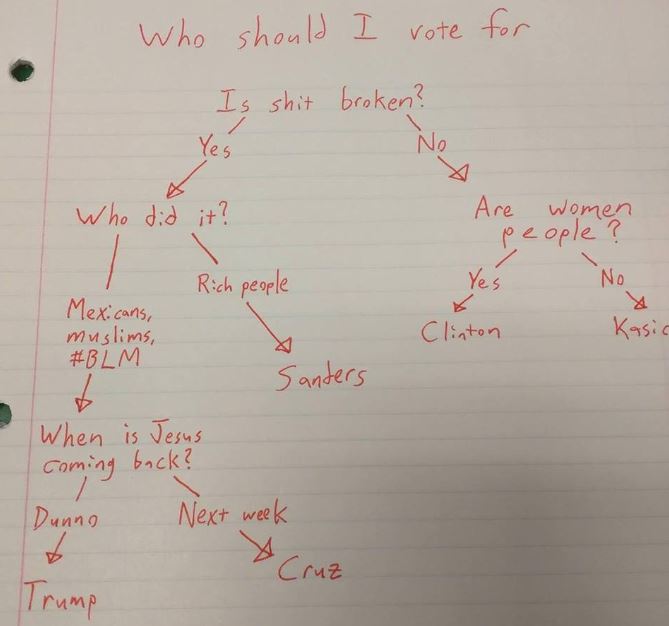
  • Who should you vote for?

    Who should you vote for?

    Somebody got it all figured out: