Tag: quality policing podcast

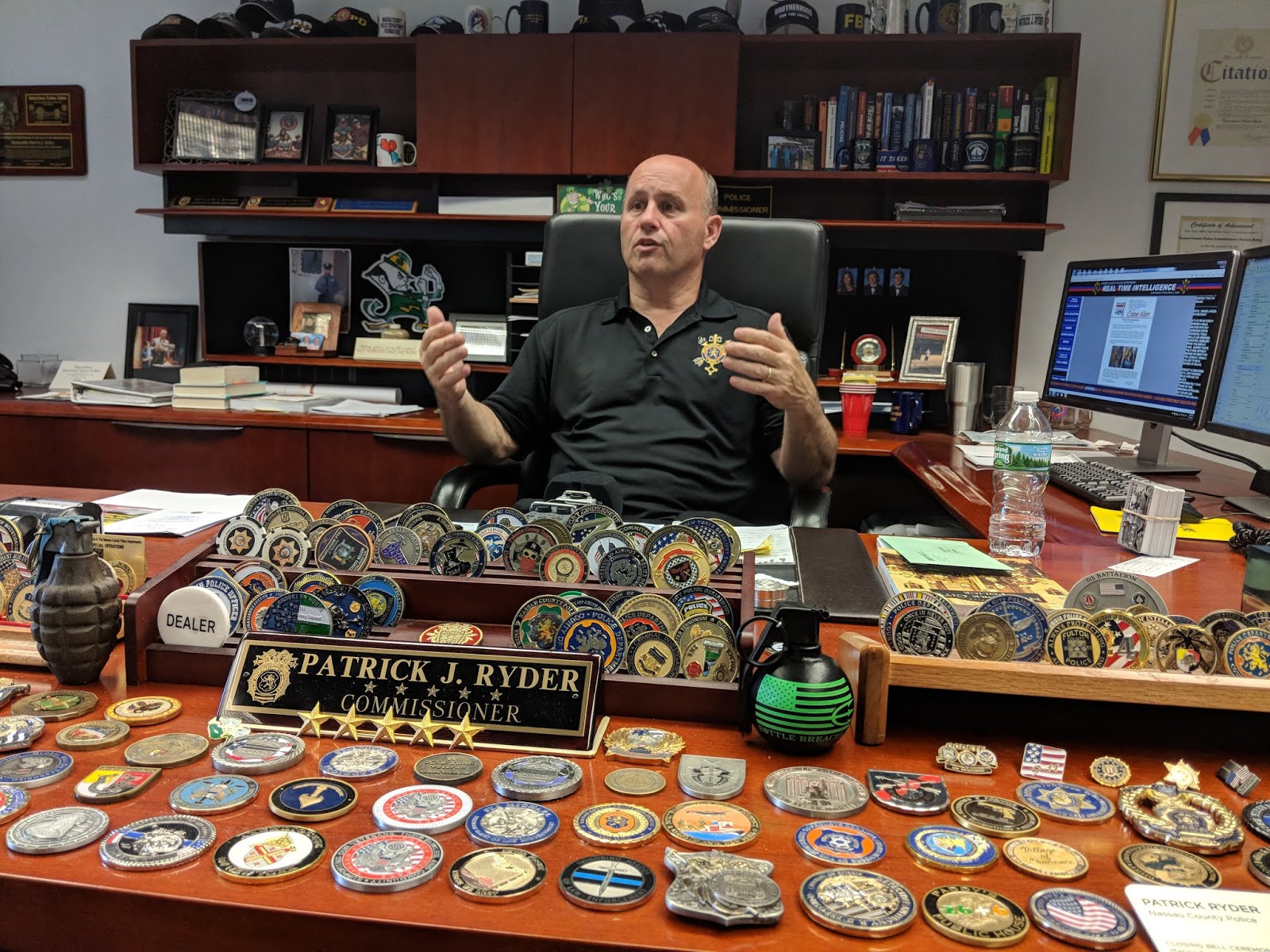
  • Nassau County Police Commissioner Patrick Ryder

    Nassau County Police Commissioner Patrick Ryder

    Over on our Quality Policing podcast, Nick Selby and I hit the road and interview Nassau County Police Commissioner Patrick Ryder

    Nassau County, if you don’t know, is the closer of two counties on Long Island outside of New York City. It’s largely a low-crime suburban community but has been in the news lately because of MS-13 and also a high number of drug overdose deaths. 1.3 million people live in Nassau County and the police department is (give or take) the nation’s 15th largest.

    We discuss information sharing, gangs, immigration, drugs, opioids, diversion court, the PC police, technology, relations with the Muslim community, and so much more.

  • Qualily Policing #13: Baltimore, BWC, and more

    Qualily Policing #13: Baltimore, BWC, and more

    The first Quality Policing Podcast of the new year is up. Peter and Nick begin in (where else?) Baltimore, discussing the trial of detectives Daniel Hersl and Marcus Taylor, from the Baltimore Police Department’s Gun Trace Task Force. The two are accused of a range of criminal activities, including robbing drug dealers, and carrying pellet guns as “drop guns,” and using Donald Stepp of Double D bail bonds as a fence for stolen drugs. Also, if you must break into and steal from Kenny Bird Johnson’s car, please do not be a “rat punk.”

    Also on tap is a discussion of the Electronic Frontier Foundation’s new guide to the evils of body worn video, which Nick described with not a small amount of revulsion – listen to Nick’s QPP Extra on Body Cameras and surveillance here.

    This week a cop was shot in the face in Louisville (he will survive), and Peter and Nick discuss that, and the response to it, and Peter raised the story from San Francisco of cops getting run over by car thieves, and the officers not shooting at the moving car that ran over the cop and one of the suspects, not once but twice.

    Finally, a story from Christmas-time, the continuation of the monumentally stupid practice of cops stopping people to hand out money donated by local businessmen. This started, we think, a few years ago (here’s aUSA Today story from 2015) but it’s continuing now; here’s a story from Ohio about cops stopping cars to hand out cash… And here’s the story from Kansas City, KS Nick was discussing.

    Handing out charity used to be function of police. While this is unprecedented in recent history, it is not without precedent. In New York City, for instance, under Mayor Fiorello La Guardia, police handed out “relief.” Who better to give to the needy than the neighborhood officers who knew the needy (and “worthy”) residents of their beat. Peter forget to mention that in the podcast, so thanks for reading.

  • Dogs, Data, and Dastardly Deeds

    Nick Selby and I talk about all this and more on our latest Quality Policing Podcast.

    Here’s the bad shooting we discuss.

    It’s not much in the news because there’s no racial angle to it. The officer was criminally charged today. I would say this might be third worst shooting of all time (Walter Scott and Andrew Thomas come to mine. Jonathan Ayers, too.) Speaking of Walter Scott. Former Officer Slager, who shot Scott, was sentenced today to 20 years in prison.

    [Update: Dustin Pigeon was killed by Sgt Keith Sweeney on November 15, 2017. Sweeney was convicted of murderin November 2019.]

  • Quality Policing Episode 6

    A new episode of Quality Policing is out. Check it out. We talk about many things including the DC body cam study that seems to show body cams don’t change anything. We beg to differ. Body cams just don’t change what people think they do.

    We don’t, however, talk about the details of the dirty gun squad in the Baltimore Police Department. You can read about that in the Sun. The details are salacious.

    Nor do we talk about the Feds busting a drug crewin East Baltimore. Arrested a dozen or so, including “Rat” and “Juicy” and recovered, get this hundreds of, er, grams of drugs.

    The shop opened at 6:30AM and continued into the early evening. with about 10 drug transactions per hour. Let’s say 100 transaction a day at $10 profit per. That’s a good living. But divided by 13 plus people, it’s not that much money. One of the dealers worked “at the Sheraton Inner Harbor Hotel downtown and sold drugs to hotel guests in addition to working with the East Baltimore gang.” He remarked on a wiretap:

    That it was “more stressful to have a job” than to “just be out here hustlin’.”

    Ain’t that the truth.

    Meanwhile in Baltimore, a supervisor in the Department of Transportation was charged by the Feds. Shoplifting turns violent. And the killing continues unabated, 23 people killed to date, this monthalone.

    All this, and you’d think some city leader would take blame for something. But no, it’s never the fault of the leaders. Not as long they say they’re for “reform.” What are they reforming? Perhaps, in a city without accountability, they’re part of the problem.

    On the plus side, lead is down. Maybe homicides will drop similarly in the 2030s.

  • Quality Policing Podcast

    Nick Selby and I have a new episode over at qualitypolicing.com. Among other things, we manage to have a rational debate about gun control. Imagine that.

    It’s Episode Five. (And yet somehow, from two people who claim to be good with numbers, we now have ten episodes.)

  • St. Louis and the acquital of Officer Stockley

    So somehow perhaps I thought doing a podcast would be less time consuming or easier than writing a blog post? No. Hell, no. Do you know what editing entails? Even light audio editing? But it’s different. Kind of fun. What the hell. I hope it’s educational (and hopefully also entertaining).

    Anyway, here’s Nick Selby and I talking about the acquittal of Officer Stockley in St. Louis.

    We now have six episodes up. (Even though with our odd counting system it only counts as three.) And Nick finally got a decent mic (not till be heard till the seventh episode).

    The episode we’re most proud of is our interview of former Decatur Police Officer Andrew Wittmer. He talks about his police-involved shooting and the post-incident PTSD.

  • Quality Policing: Episode 2

    Enjoy. You can add Quality Policing to your podcast subscription or download the MP3 audio file old-school style. Either way, head on over to the webpage for info and links.

  • Quality Policing Podcast: Interview With Jeff Asher

    Quality Policing Podcast: Interview With Jeff Asher

    There’s another quality policing podcast in which I talk to data analyst Jeff Asher about the Brennan Center’s latest report on crime. Asher had posted this thread about methodological problems in their data and analysis.

    Brennan has a new report out showing murder down 2.5% nationally, but there are some major issues with that finding.

    1) The figures cited aren’t year-to-date, they’re projected year end numbers based on around midyear counts.

    2) Murder tends to pick up over the second half of the year, and any projection using midyear numbers will almost certainly be wrong.

    3) They found murder -2.5% but included San Fran’s 2016 count in that. There was no count for 2017. Removing SF makes murder -1.5%.

    4) Detroit is estimated to be -27%, but that’s based on Detroit’s open data site.

    5) That’s problematic because the open data site is slow to add murders, so any year-to-date count will be wrong.

    6) Detroit had over 130 murders as of late June according to the Detroit Police Department, and the 220 murders they project would be the fewest there since 1966.

    7) Taking Detroit’s inaccurate count out takes murder in their sample from -1.5% to +0.7% overall. So Detroit’s inaccuracy explains the drop

    8) The Phoenix count is similarly wrong. Phoenix had about 150 murders in 2016 but this report says they had 80 and project 60 for 2017.

    9) The Phoenix figure was reached by using MCCA midyear data and doubling it, but Phoenix only reported Q1 data to the MCCA.

    10) As of May Phoenix had 58 murders year-to-date in 2017 and 56 in 2016. Take away Phoenix and Detroit and suddenly murder is up 1.2% in the sample.

    11) Which is to say nothing of the methodological issue of projecting midyear for 30 cities to a full year and calling it a national trend.

    12) For what it’s worth, my midyear piece for @FiveThirtyEight shows murder up a few % but rising slower than previous years.

    13) Also worth reading is @Jerry_Ratcliffe on why doing year-to-date analysis isn’t a great idea

    14) Larger point is that measuring murder nationally is tough, drawing sweeping conclusions from badly incomplete data is a huge mistake in my opinion

    This isn’t the first time the Brennan Center has released faulty and misleading reports on the rise in homicide. In July, after the last one, I finally made an attempt to talk to one of the report’s authors. Once I laid out my concerns, the correspondence ended. Today I asked the other author (via twitter) if he wished to be interviewed or engage in a civil discussion of methods. No dice, apparently he’s “alright, thanks.” It’s still an open invitation.

    There are numerous problems with their analysis, but the most irksome to me is the straight-up misleading statement. I asked:

    Is this statement [from your report] true? “Notably, 55.6% of murder increase 2014 to 2017 is attributable to two cities — Chicago and Baltimore.”

    Because I know it’s not true, since about 14 percent of the murder increase from 2014 to 2017 is attributable to Chicago and Baltimore. He replied:

    Yes. It’s true for the 30 largest cities (our cohort), not nationally.

    This not an explanation as much as a confession because they don’t say “for the 30 largest cities (our cohort), not nationally” in their report.

    I understand how they got their numbers; on my calculator, I can replicate their methods. That’s good, but not good enough. Their methods are faulty.

    Here are some of my remaining unanswered questions I posted on twitter.

    Since 2013, what is the change in homicides in those 30 cities? I get a decrease in 3 cities and an increase in 27. Is this correct?

    Do you understand problems in saying a “percentage of increase in sample“? Substantively meaningless & statistically absurd.

    If you have three years of data, why do 2017 tables only compare with last year, 2016?

    It may turn out to be true, but still seems a odd choice that only mention of (20%!) 2-year homicide increase is as “short-term fluctuation”

    If twitter can’t do this justice, I’d be happy to interview you for @QualityPolicing podcast.

    I asked if we could “continue w/ a civil discussion of your methods?” Alas, the reply was: “I’m alright, thanks.

    For two main reasons, I’m not OK. I’d like the Left to stay committed to the truth. The generally decent Brennan Center should be above Heritage-Foundation-style BS.

    But more importantly: when you say murder is down when murder is up, it’s not just an issue of truth. It’s also an attempt to make the murder victims — disproportionately poor young black men — disappear from our consciousness. As if they never existed. Do their lives not matter, too?
  • Quality Policing Podcast

    Quality Policing Podcast

    Nick Selby and I made a podcast! Check it out at qualitypolicing.com/. The first episode is up. And cut us some slack, it’s the first episode.