Tag: race

  • A Mugging on Lake Street

    A Mugging on Lake Street

    A reader pointed out a good article in Chicago Magazine by John Conroy, “A Mugging on Lake Street.” It’s a bit heartbreaking to learn that John Conroy, whose name I recognize as a quality journalist, doesn’t have a regular gig. But at least he got this assignment. Too bad it all started with Conroy getting jumped while riding his bike home through the West Side of Chicago. (Actually Conroy was “banked” more than “jumped,” but only those in Baltimore will understand that subtle distinction.)

    The story that follows is all about crime and race and punishment. It’s worth a complete read.

    I was ambushed on the West Side last year, an attack that on its face made no sense. I’d never seen my assailant before; he’d never seen me; no words were exchanged; nothing was taken. Like many crime victims, I wanted the incident, which changed my life for the worse, to have some meaning. I’m white, he is black, and in time it was hard not to wonder if race had something to do with it.

    I stopped by the 15th District police station, at 5701 West Madison Street, hoping to thank the officers who’d helped me. Looking for help in finding them, I asked for an acquaintance, T. C. McCoy, an African American officer who lives in the district and has worked there for 24 years. When he heard my story, he said, “It’s a hate crime.”

    Conroy wants to meet his offender. He does. He wants to interview him. He doesn’t.

    But in the process Conroy learns what it’s like to be a victim in our f*cked-up criminal justice system. It’s not good and Conroy ends up being had. But read the whole article because I can’t do it justice in excerpts. And it’s far deeper than a simplistic tale of a naive liberal who got mugged (though there’s some of that, too. I wonder if he’ll becomes conservative, as the old cliche goes).

    His article hits home with me for many reasons.

    1) I was born in Chicago.

    2) I bike around cities in all neighborhoods at all times. I’ve never been the victim of violent crime (or been hit by a car), on or off a bike. I hope to keep it that way.

    3) My father grew up less than two miles from where Conroy was jumped. I drove through this area coming back from my father’s funeral last year. Before my father died he liked to say that his block on N. Avers Avenue (the eight or ten-hundred block?) looked basically the same as it did when he was a kid, except now everybody is Mexican and Puerto Rican.

    My in-depth knowledge of Chicago basically ends in 1989 when I went to college. I still call L lines by their destination and can’t get over the fact that yuppies live around Cabrini-Green. Cabrini-Green was a no-go area when I was a kid. So was the West Side.

    So my first thought when I saw Conroy’s piece was, “What the hell is a white boy doing biking down Lake St?” In my slightly dated mind, the map of Chicago turns to dragons and winds west of Greektown and Halsted Street. My how times have changed; Conroy was biking home.

    Of course sometimes sh*t just happens. But it usually takessh*ts to dosh*t. And most people choose to live as far as possible from sh*t.

    You could say that Conroy was just in the wrong place at the wrong time. But some neighborhoods have more wrong places and wrong times than others. The corner of Lake and Laramie is a wrong place. There’s a liquor store, a check cashing store, a phone store, a Chinese take-out, loitering people, and a vacant lot. Presumably it was the vacant lot from where Conroy was attacked.

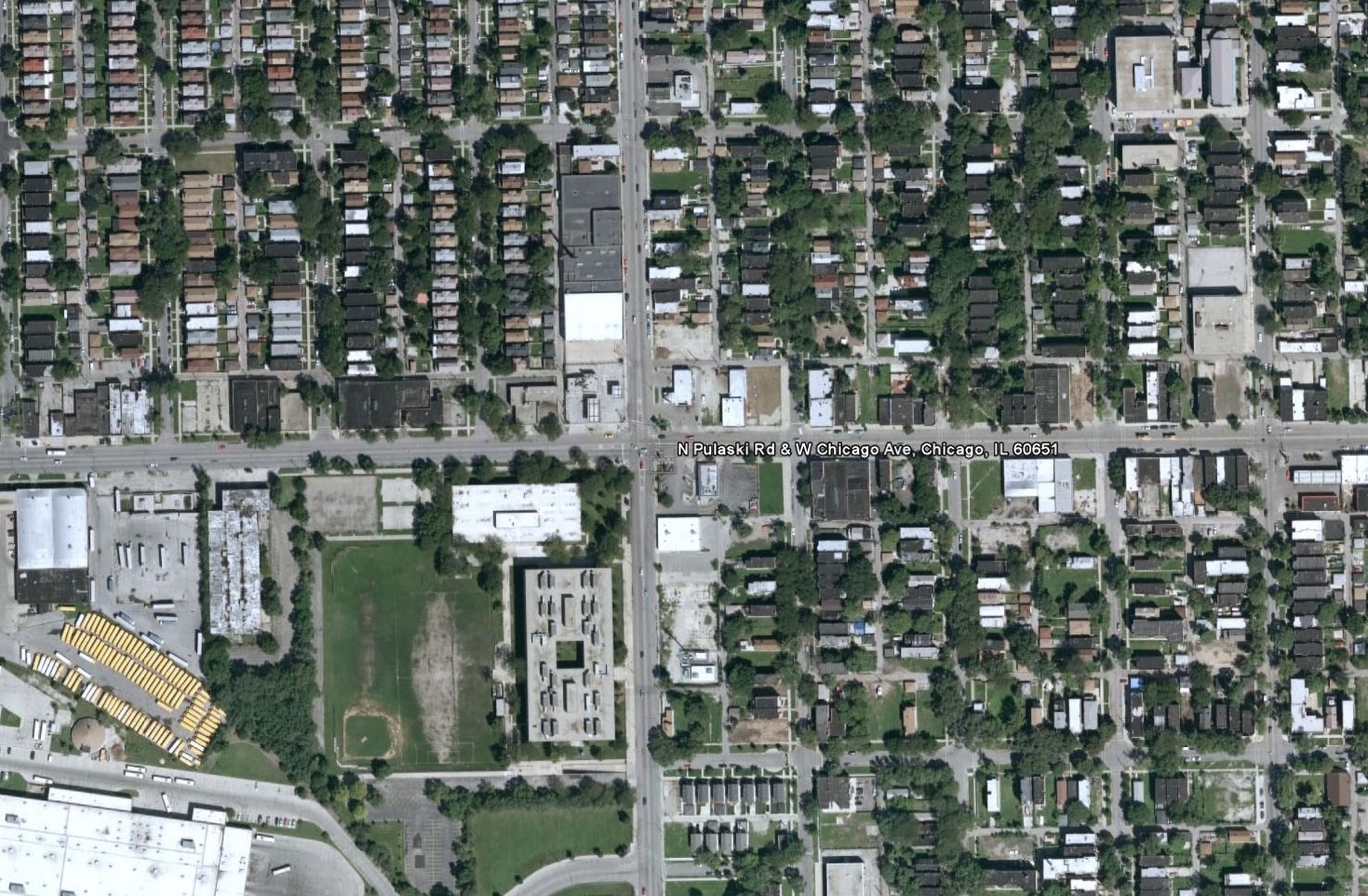
    I learned that from google earth’s street view. You can learn a lot about a neighborhood from google earth. If you like google earth (and who doesn’t?), zoom in on the intersection of Chicago and Pulaski, north of Garfield Park in Chicago and cornering a big industrial zone.

    To the northwest you get row upon neat row of Chicago bungalows. All’s well there. That’s probably what Conroy’s block looks like.

    To the northeast is where my father grew up. Things still look OK. You have homes and trees. But a few vacant lots are very worrisome. Still, you can even see nice block party / church festival being set up by Our Lady of Angels. That’s where my father went to school (before the horrible fire) until the family moved out to Albuquerque.

    But go south on Avers past Chicago and things start to git grim. Now you’re in the rough black West Side. From above, you can see fewer trees, more vacant lots, roofs in disrepair, trash in backyards, and abandoned cars littered to and fro. The street view shows boarded-up buildings next to well kept-up homes.

    It’s always the abandonment that strikes me. Entire city blocks empty. And just a short distance from where people pay half-a-million dollars for a “tear-down” lot. Crime, fear of crime, and race matter so much that in just miles property goes from being worth millions to being worthless and literally abandoned.

    Ta-Nehisi Coates comments on Conroy’s article here and here. As usual, he’s insightful, bold, and more often right than wrong (and who can resist the title, “The Logic Of The Bumrush”).

    I was struck by Conroy’s quest to find a deeper meaning in what happened to him. This may be more about me than him–but my sense of what always makes the hood so dangerous is the actual lack of real meaning, the random nature of violence, and how it pervades everything.

    Put bluntly, it’s not that they treated [Conroy] like a honky–it’s that they treated him like one of their own, like a nigger.

    And

    Eventually you tire of the whole dynamic. At least those of us who aren’t built like that, do. And make no mistake, most of us aren’t.

    One thing I learned policing in Baltimore is that I canhandle tough streets. I just don’t want to. Luckily for me, I don’t have to.

  • Really the last word on Gates. Really

    In comments, Jack left a great link to this piece by Ruth Wisse, another Harvard professor. It is her “letter” to Skip Gates. Bold and very well written.

    Dear Skip,

    My first thought on hearing of your arrest was for your welfare, so I was relieved to learn that the case against you had been dropped and you were off to join your family on Martha’s Vineyard.

    It seems it wasn’t the policeman doing the profiling, it was you. You played him for a racist cop and treated him disrespectfully.

    Rather than taking offense at being racially profiled, weren’t you instead insulted that someone as prominent as you was being subjected to a regular police routine? A Harvard professor and public figure—should you have to be treated like an ordinary citizen? But that’s the greatness of this country: Enforcers of the law are expected to treat all alike, to protect the house of a black man no less carefully than that of white neighbors.

    Since, inadvertently I assume, you have made the work of our police force more difficult than it already is, I wish that you would help set the record straight. You are the man to do it.

    It’s worth reading the whole piece in the Harvard Crimson.

  • Bob Herbert on Gates

    Bob Herbert, a very good columnist has a powerful op-ed attacking the police sergeant and defending Gates’ behavior. It is worth a read even if–especially if–you don’t agree with it.

    By saying that Herbert is a good columnist doesn’t mean I agree with everything or even most of what he says. But whatever Herbert has to say, he says it well. I like reading him and thinking about his perspective.

    The message that has gone out to the public is that powerful African-American leaders like Mr. Gates and President Obama will be very publicly slapped down for speaking up and speaking out about police misbehavior, and that the proper response if you think you are being unfairly targeted by the police because of your race is to chill.

    I have nothing but contempt for that message.

    Those who defend police behavior (as I often do) focus on the legality of specific situations. If the sergeant’s report is correct as written, I have no doubt the arrest was legally correct.

    Those who attack police behavior (as I sometimes do) see this one arrest as symbolic of a greater pattern of racist police behavior. An arrest can be legally correct but morally wrong.

    Your opinion on the Gates’ arrest probable depends on which perspective you like starting with. If you say, “What in the hell does slavery, Jim Crow laws, and a history of racism have to do with Gates’ arrest?!”, then you’re on the side of Sergeant Crowley.

    If you heard about this arrest and said, “Here we go again,” then you agree with Gates.

    Think of it this way: police are trained to think about “the totality” of the individual circumstance.

    But society is more likely to judge collective circumstances in their totality.

    Later in his column Herbert says, “While whites use illegal drugs at substantially higher percentages than blacks, black men are sent to prison on drug charges at 13 times the rate of white men.”

    One can look at all the individual cases of men in prison and say that each one is OK. But collectively, something is wrong.

    Let’s assume, for the sake of argument, that all men in prison are guilty as charged. Is that enough? Is it enough to say there’s no problem with the racial disparity in prison simply because all the black drug offenders behind bars are guilty? Or does it matter that blacks are 13 times more likely than whites to be in prison for the same crime?

    Now personally I think it’s a stretch to link, as Herbert does, Gates’ arrest to institutional racism in the entire criminal justice system. But I do agree that something about our criminal justice system is racist (mostly the war on drugs) and that is terribly terribly wrong.

  • Should a cop be fired for off-duty offensive speech?

    More Gates fallout.

    Police are and should be held to a higher standard. But I’m pretty much an absolutist when it comes to free speech. I don’t think you should be fired for what you do and say at home.

    (But on the other hand I wouldn’t want a nazi or klan leader to be a police officer. Even if they argue that they can keep their private life and beliefs separate from their job performance.

    We all say things in private that would be inappropriate, insensitive, and offensive if taken out of context or said in public. I know I have. But this guy was an idiot. I mean, first he writes an offensive comment to a columnist and then he forwards it to all his friends in the National Guard. So it wasn’t exactly private anymore. But I still think it’s free speech. But then what should the police department do? Doing nothing doesn’t seem like the answer, either.

    Here’s the story by Maria Cramer in the Boston Globe.

  • Fly on the Wall

    Mike O’Neil has a good article in the Huffington Post. What he hopes three well intentioned men will say in the White House.

    I would write more. And respond to comments. But I’m in Chiapas, Mexico, on the Pacific Coast with what must be the world’s worst internet connection. On the plus side, all is peaceful here. And the food is delicious. And in Comitan, you can even drink the water!

  • Last word (yeah, right) on the Gates’ case

    The 911 call is here:

    Part of the 911 tape is here:

    Here is my take on the matter. Only the first three points are new.

    1) The 911 call was excellent. A woman saw something suspicious and reported it. Race was not mentioned. In fact, the caller specifically said she could not determine race and raised the possibility that the people lived there. But better safe than sorry.

    2) The call was dispatched as typical, with the officer knowing very little about the actual 911 call. But the 911 operate seems to have done a pretty job at getting the relevant info to the dispatcher.

    3) Once a wagon is called for, it means somebody is going to be put in it. It’s not clear about the time frame or officer’s location at this point. I don’t know if the clip above is complete or edited or what.

    4) The officer had every legal right to be in the house and needed to investigate a possible burglary.

    5) The arrest of Gates was dumb. That does not mean the arrest was wrong. The arrest was dumb because it Henry Louis Gates Jr. and you don’t want discretionary arrests for disorderly conduct to become national news. I thought so on day one and I still think so.

    And thank you for all your comments. It’s been a great discussion. Too bad I’ve been in Mexico, missing all the fun.

  • In the New York Times

    I wrote a short piece about the racial profiling for the New York Times. Some other good opinions there, too.

    And thanks to 10-8 for pointing out the article by Syracuse Professor Boyce Watkins in The Grio.

  • You want to step outside, Mr Gates?

    Leave it to me to have to read another blog to find out about stuff that I’ve already written.

    See, there’s this book I wrote, Cop in the Hood. I hear it’s pretty good. It’s also, uh, for sale. Anyway, on pp. 117-118 I describe how officers can invite a person outside in order to arrest him for disorderly. I never used this trick, but it certainly was something I could have used. I gave the example of a domestic situation:

    Though the officer believes this argument will continue and perhaps turn violent, there is no cause for arrest. Police may not order a person from his or her home. But an officer can request to talk to the man outside his house. At this point the officer might say, “If you don’t take a walk, I’m going to lock you up.” The man, though within his rights to quietly reenter his house and say goodnight to the police, is more likely to obey the officer’s request or engage the police in a loud and drunken late-night debate. The man may protest loudly that the officer has no reason to lock him up. If a crowd gathers or lights in neighboring buildings turn on, he may be arrested for disorderly conduct.

    Crooked Timber writes: “Moskos is in general in favor of police having a fair amount of discretion (he seems to believe that much basic policing work would be impossible without it).” True, indeed.

    From the arrest report:

    I told Gates that I was leaving his residence and that if he had any other questions regarding the matter, I would speak with him outside his residence. As I began walking through the foyer toward the front door, I could hear Gates again demanding my name. I again told Gates that I would speak with him outside. My reason for wanting to leave the residence was that Gates was yelling very loud and the acoustics of the kitchen and foyer were making it difficult for me to transmit pertinent information to ECC or other responding units.

    Gates ignored my warning and continued to yell, which drew the attention both of the police officers and citizens, who appeared surprised and alarmed by Gates’ outburst.

    Crooken Timber says:

    Now, I should emphasize that I have no personal reason whatsoever to doubt that Crowley’s account of the arrest is accurate – it may very well be that the acoustics were such that communication was difficult indoors. I am not acquainted with the physical specifics of the building where Gates lives. It is, however, notable that Moskos’ Baltimore police officer both (a) uses a verbal invitation to induce the targeted individual to leave the building, and (b) then uses the attention of bystanders to generate a charge of disorderly conduct. Whether these resemblances are purely accidental or not (in the absence of more facts, you could generate arguments either way), I leave to the imagination of the reader.

  • Henry Louis Gates Jr. Arrested

    Apparently for pissing off a Cambridge cop who responded to a burglary call. Gates had sort of broken into his own house because the key didn’t work. A witness called police. Words are exchanged and Gates gets cuffed for dis con.

    It’s hard to overstate just how esteemed of an intellectual Harvard Professor Gates is.

    If you’re a police officer and run into the director of Harvard’s W.E.B. Du Bois Institute for African and African American Research–even if he is rude to you–best to let it slide. Really.

    But this arrest has as much to do with class conflict as it does with race. There’s a big blue-collar/egghead divide back in what used to be my home town. I can imagine the unfortunate glee the cop felt as he locked up this big-shot intellectual. That glee is probably tempered significantly by national news coverage.

    The AP story by Melissa Trujillo.

    [Update: The police report is here. All charges have been dropped. And Al Sharpton chimes in. Read Gates’ reply in gawker.]

  • New Haven Firefighters

    Interesting story in the New York Times about Ben Vargas, the lone Hispanic firefighter on the winning side of Ricci v. DeStafano.