Tag: real police

  • John Timoney

    A nice homage to John Timoney in the New York Times. Among other things:

    In 1972, New York officers fired 2,510 bullets and killed 66 people. By 2014, there were 288 shots fired and eight people killed.

    What happened? Mr. Timoney said that in 1972, the department put restrictions on when officers should shoot their weapons. Within a year, officers were firing about half as many shots.

  • John McAndrew Sr.

    Western District Officer McAndrew retires after 50 years of service. From the Sun:

    He had no idea that he would carry this passion for 50 years of service. Asked how many police commissioners he had served under, McAndrew smiled, and said: Everyone.

    (anybody know his sequence number!?)

  • “Zero tolerance for what?”

    Here’s a great interview from Investigative Voice with Baltimore homicide detectives Irving Bradley and David Hollingsworth.

    You had to be an actor. I had to convince you, what I was telling you to do was the right thing to do. Even though before I got you, you had torn out every window in the neighborhood, you had torn up somebody’s car, and threw a hatchet at somebody — all of this prior to my arrival. I had to convince you that fighting me was wrong, and that it would be better for you to come with me and let me lock you up so I could solve your problem.

    You see, we were on our own; the community is who you depended on. Those neighbors, they knew who the assholes were in the neighborhood. When they saw you confronting them, they would get on the phone and call the police and say, “Officer so-and-so is out there and I’m sure some shit is going to happen.” And you would look around the corner and an officer would be coming for back-up, but that was initiated by the community. Because you protected them.

    The worse thing they could have ever done is put everybody in a car and create this 911 system without proper instructions. Because what is an emergency to you is not necessarily an emergency to me. You call 911 and say, My cat is stuck up on the fire escape.” And another guy calls 911 and says, “I have stabbing in progress and if someone doesn’t get here soon he’s going to die.” Both are 911 calls.

    But the officer in the car has got to go; he does not have the discretion to say, “Okay, that cat got up there, he can stay there.

    You should know the players, you should know who is on your post. If you have a 64- year-old man on your post, I would know him. Like I said, it’s the basics that are lost.

    “You really can’t arrest your way out of the problem,” Bradley says.

    When I was a cop, I met the mayor in 2001. One meeting. One-on-one. Nice guy, I thought. I remember telling him, “You know, Mr. Mayor, you can’t arrest your way of the problem.” He looked at me quizzically and said, “Why not?”

    On Zero Tolerance, Hollingsworth says:

    Where’s the crime? They have no idea what a tolerable crime is, and what an intolerable crime is. It depends on the neighborhood. Your dog, you’re walking through Charles Village, and you have Foo Foo with you and Foo Foo craps on the ground, you put it in the bag and you keep walking. Well, on Mount Street, a guy is walking home with his bulldog and the dog craps in your yard… what are going to do, call a police officer and say, “He ain’t pulled that poop up?’ It all depends.

    Get out of the car. Walk in the neighborhood. They would see a world of difference if they could get out of that car. Get out of the car and you’ll learn real fast.

    These are real police. And they were Broken Windows when Broken Windows wasn’t cool.

    Part I is here. Great stuff on community policing back in the old days. (But they’re actually wrong–not morally, but legally–about the requirements for frisks. I couldlegally frisk almost everybody on my post. Reasonable suspicion and the Terry Frisk go a long way to get me touching your pockets).

    (And I’m glad Lt Peel is still raising hell. I liked that goof when he was just a crazy sergeant with a dirty shirt. Oh and the things he read! I couldn’t hang with him intellectually… and I was the Harvard Student! I got to send him my book. If you’re reading this, LT, will you get in touch with me? I’d love to hear what you’re reading this month.)

    Part II is here.

    [thanks to a Canadian reader]
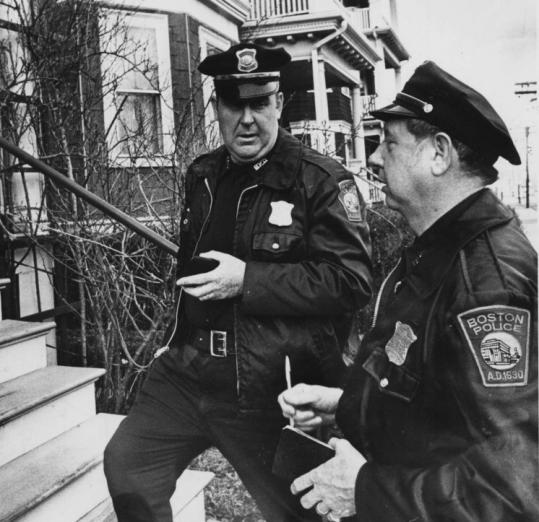
  • Here’s to Officer Walter Fahey

    Here’s to Officer Walter Fahey

    The Boston Globehad a nice tribute to Boston Police Officer Walter Fahey, who died in October.

    [Update: I just received a very gracious email from Walter Fahey’s son. He mentions this piece in particular as capturing the spirit of his father. As my father wrote before he recently passed away: We shall never see their likes again.]

  • Real Police

    I just received this email. It’s an interesting take on on the concept of being “real police.” “Real police” is both a concept and a compliment. It’s what in the NYPD they call a “cop’s cop.” Also, when you actually say “real police,” you have to stress “real” and the first syllable of “police.” Otherwise it doesn’t make sense.

    I find the resentment over your book interesting. I would like to focus on the retired Major from the city who refuses to read it. I am very much “real police,” but I am not entirely sure my 4.5 years as a Baltimore City officer would qualify as “experience” according to this commander (I now have an additional 2 years in [***] police department). I guess you have to inefficiently manage a district and treat subordinates poorly in order to qualify for “real” experience in Baltimore City … a little cynicism I had to add.

    Experience, in my humble opinion, does not have a definitive time frame; rather, it’s how you use your time while you are there. An officer can lazily choose to sit in their patrol car for a year, answer calls for service, never act proactively and consider that experience. Or that officer can choose to commit to hard work, be aggressive and gain the experience sought after by many. However, whether aggressive or not, I think it is accurate to say the average officer has a certain level of comfort for the job after one year.

    Personally, I worked hard for two years in patrol which opened up the door for two years in flex. I have great experience, particularly in the field of drug work. Do I know everything? No. But I was able to handle myself efficiently and safely on the street. But then again, according to certain police, experience is seemingly based solely upon your sequence number, not in what you do.

    Finally, I’d like to address a quote from his letter. The Major writes, “… that is why your book upsets real police; … when some opportunist such as yourself, exploits a mere year of service, converting it in some way to confer expertise on his puny observations, which were subsequently recorded for future use and gain!”

    Again, I am “real police” and I am not upset. I thought the book was a great read. I felt your writings were fundamentally correct based upon YOUR observations and experiences in the city. If the Major would have read your book, he would understand your reason for coming to the city and for the book. From my perspective, it was research which turned into hands-on experience. What better way to do research than that? What is with the major’s anger with officers (in general it seems) coming to the city and leaving after a short period, to better themselves or perhaps even, dare I say, write a book. Countless officer’s come to Baltimore to gain experience and leave.

    I cannot apologize for being unwilling to wallow in the disastrous Baltimore City Police Department and that complete hole of a city. Individuals like the Major are one reason (among the countless others) I cannot wait to leave law enforcement. When I am done with my graduate studies at [***], I am out the door not looking back!

    I enjoy the blog. I’m sure I’ll continue to comment on what I read from time to time.

    Respectfully,
    [***]