Tag: riots

  • St. Louis and the acquital of Officer Stockley

    So somehow perhaps I thought doing a podcast would be less time consuming or easier than writing a blog post? No. Hell, no. Do you know what editing entails? Even light audio editing? But it’s different. Kind of fun. What the hell. I hope it’s educational (and hopefully also entertaining).

    Anyway, here’s Nick Selby and I talking about the acquittal of Officer Stockley in St. Louis.

    We now have six episodes up. (Even though with our odd counting system it only counts as three.) And Nick finally got a decent mic (not till be heard till the seventh episode).

    The episode we’re most proud of is our interview of former Decatur Police Officer Andrew Wittmer. He talks about his police-involved shooting and the post-incident PTSD.

  • The Consequences of Bad Leadership: the Baltimore Riots of 2015

    Last postI talked about what didn’t cause the 2015 riots in Baltimore. Well, what did? Macro theory too often assumes happenings and history are per-ordained, that leadership decisions don’t have consequences, and that individuals have no free will. But what if the buses kept running? What if police continued to disperse crowds in the street instead of retreating? What if Gregory Lee Butler hadn’t cut (or been able to cut) a fire hose outside the burning CVS? What if police had arrested him on the spot? These things matter. If they don’t, I don’t know why we bother to try at all.

    The riots were not inevitable. Systemic problems matter, but they’re a constant. As important as they are, poverty and segregation and drug addiction and broken families and violence are nothing new in Baltimore. And they certain were not worse in 2015 than they were in the preceding decade. Why on April 27, 2017 and not on April 25 or 26? Or why not in 2003, when police arrested 312 people a day, many for minor zero-tolerance bullshit reasons? By 2014, the arrest rate had dropped by two-thirds and violence was down. God did not ordain Baltimore would burn a week after the death of Freddie Gray. It didn’t have to happen.

    Bad leadership caused the Baltimore riot of April 27, 2015. Effective leadership and tactics can be the difference between a protest or even a violent disturbance and a riot. The latter happens not just because people are pissed off. People are always pissed off, sometimes for good reason. Now this is a weird point to make, but Freddie Gray wasn’t the first guy to die in the back of a police van; sadly, since the city still hasn’t procured safe transport vehicles, he probably won’t be the last. Angry people are a necessary but insufficient cause of rioting. Poor decisions in planning, message, and tactics let a bad situation spiral out of control.

    Bad leadership has consequences. If not, why seek good leadership? Actions and inaction matter. Only on April 26, 2015, for instance, did the mayor, Stephanie Rawlings-Blake, defended a “measured” police response to protests by saying: “We also gave those who wish to destroy space to do that as well.” The riots started the next day.

    At the time, in 2015, many said the mayor’s words didn’t matter. And also that she didn’t mean what she said, which may be true, but those were the words she said and the words people repeated. Also, now it’s 2017. Does anybody still believe that the words from a chief elected executive have no impact? That they can’t incite violence?

    But it took many more bad decisions before the riots started. Somebody (and oddly, we still don’t know who) made horrible transit and crowd control decisions at Mondawmin Mall on April 27. School kids were stranded en masse because the transit system was stupidly shut down. Kids couldn’t get home. It was bad, but the city still wasn’t in riot mode.

    Ultimately the riots started because when things got rough, and cops received orders to pull back. The fear at the top, the mayor and Commissioner Batts, was that was police would be criticized for over-reacting. (And truth be told, they probably would have been.) But good leadership is willing to face criticism.

    This video shows where and when the riot started, at the corner or North and Pennsylvania Avenues. (And just a block from the aptly named Retreat St). The looting began at 4:37pm. A line of cops was present near the CVS at 4:41pm. Even after looting began, cops didn’t act. For more than hour cops stood by while the store was set on fire. A fire hose was cutwithin steps of officers who followed orders and did not engage. Police didn’t move till 6pm, and even then it took 50 minutes to regain control of the corner. By then it was too late. “Hold the line,” police officers were ordered, and they did. And while waiting for orders to act, the “Thin Blue Line” (that ever-trite but here apt cliché) broke down, and the city burned out of control.

  • Beware of the Risen People

    Beware of the Risen People

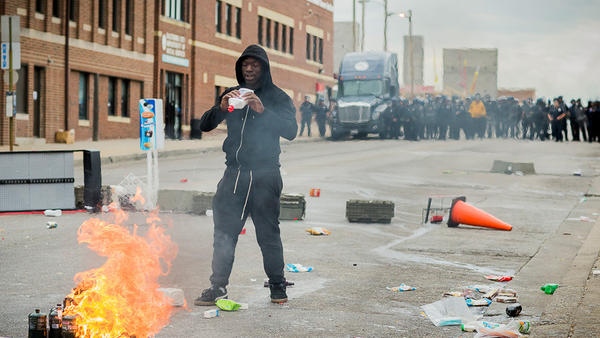
    The ATF released a version of this photo taken during the April 27 riots. The guy (“repeatedly captured in photographs and other images on the day of the rioting”) was later identified as Donta Betts:

    He confessed to creating the explosion to ward off the cops “so people could finish … stealing whatever they was going to steal.”

    “I figured I did all this because that was my period of time to go wild on the police…. I figured I did all this because that was my period of time to go wild on the police.”

    The image above became a symbol.

    It’s pretty easy to find people defending looting, riots, militancy, and destroying police cars. “All that rage is justified.” At the time (and still today) some insist they were no “riots.” Just an “uprising.” Beware of the risen people, oppressed, angry at (among other things) arrest-based policing that under Mayor O’Malley (who left office when Betts was 11, presumably before even his first arrest). People living in the hood in Baltimore have reason to be angry. That doesn’t mean they’re burning down drug stores and old-folk homes.

    So it’s with a bit of schadenfreude that I read Kevin Rector’s story in the Sun today in which Betts pleaded guilty to a bunch of stuff:

    Donta Betts participated in the looting of the CVS pharmacy at the intersection of Pennsylvania and North avenues on April 27 — which became a symbol of the unrest when it burned to the ground — and lighted a roll of toilet paper, placed in on top of propane cylinders and then squirted lighter fluid onto both in an attempt to prevent police from responding to looting at the pharmacy.

    But wait, there’s more:

    Then on July 2, Betts shot a woman after she only paid him $20 for $40 worth of heroin, according to Rosenstein’s office and the plea deal. He was later captured on a recorded call by the Maryland Department of Public Safety and Correctional Services admitting to the shooting but asking an associate to get the woman to sign an affidavit saying he did not shoot her, according to Rosenstein’s office.

    In summary:

    “Donta Betts engaged in arson, looting, assault and other mayhem during the Baltimore riots. He threw rocks at the police near Mondawmin Mall; tried to destroy police cars; stole from a pharmacy, a liquor store and a shoe store; and set off a homemade bomb. Ten weeks later, he tried to murder a woman over a $20 drug dispute, then he conspired to get her to sign a false affidavit. We caught him only because police and prosecutors spent many hours reviewing video and audio recordings. It may sound like a story arc from a TV series, but it is real life in Baltimore.”

    You know what pains me about the picture? The line of cops “holding the line.” It was the tactics of April 2015, and not the oppression of centuries, that allowed parts of Baltimore to explode. Bad leadership has consequences. The mayor and police commissioner were not up for the job. Of course there’s always been oppression. Luckily riots happen less often.

  • The “Gray Effect”

    Stephen Morgan, my grad-school colleague, released his Baltimore report (co-authored with Joel Pally) that looks at crime and arrests pre- and post-riot.

    [The Harvard sociology cohort of 1995 always turned to Morgan as the quant guy when we needed help with stats class, which was often. So rather than blame my own limitations and laziness, I prefer to entirely and falsely blame Steve for the fact that I still can’t really tell you what a poisson regression is and why you would want to use one.]

    I had some input in the drafts. One of my points was that the take-away would be an idiotic headlines like this one: “Study: There Has Been No ‘Ferguson Effect’ in Baltimore.”

    Citilab never talked to Morgan, which seems odd.

    Of course that headline isn’t the point of the study. I think the narrative focus of the study should have been centered around April 26, 2015 (the riot) and not early events half a country away (Ferguson). All policing is local. Buried halfway down that Citilab story is a mention of the “Gray Effect.” It is a better term. Perhaps because of the double meaning of gray, it can be applied elsewhere in a generic sense.

    I’m baffled by many people’s attempt to disaggregate a so-called “Ferguson Effect” from local police issues, since I’ve been arguing this is the same thing. But shorthand terms are only helpful if they have an accepted meaning. And clearly the Ferguson Effect does not. I’m not willing to waste time in a semantic debate or defend a term — the Ferguson Effect — that I never liked. So let’s call it the Gray Effect. My point is that police matter and that society influences policing, sometimes for the good and — as last year’s spike in homicides portends — sometimes for the bad. Call it what you will, the effect is real.

    Better reporting is done by Baynard Woods and NBC. From the latter:

    “I do think we provide some pretty compelling evidence that it is possible for the police to use discretion, to use alternatives to arrest, in a place like Baltimore without influencing the pattern of crime,” Morgan said.

    That is why Morgan says the eight months before Gray’s death could represent a “sweet spot.”

    The next part of Morgan’s analysis, the Gray period, was much less surprising.

    “Everything fell apart,” Morgan said.

    Crimes of all types, violent and non-violent, spiked, for an overall increase of more than 11 percent. [Ed note: In reported crime…. Homicides doubled, and there is good reason to believe more crime was non-reported. And decreasing arrests will also serve to reduce crime stats without a corresponding reduction in actual crime.] The drop in arrests became much more pronounced, from 19 percent to 30 percent, “consistent with the widely discussed conjecture that the Baltimore police pulled back from some routine policing in response to a perceived lack of support from the city’s leadership,” the researchers wrote.

    [Maybe it’s minor, but I’ll take credit for the subtle addition of “lack of support from the city’s leadership,” thank you very much. Correction: Steve, ruining my fun as only a quant guy can, says that phrase was in the earliest drafts and had nothing to do with me. –eye roll– ]

    From Woods in the Guardian:

    “One reasonable interpretation of these entangled effects is that the crime spike in the Gray period could be a Ferguson effect that would have remained dormant had it not been ignited by a localized Gray effect,” the report states. “However, the size and duration of the crime spike is almost certainly attributable to particular features of the unrest.

    The study found a decrease in crime in the period after the new police commissioner, Kevin Davis took office, which they dub the “Davis effect.” Davis replaced then-commissioner Anthony Batts, who was fired just after a Fraternal Order of Police report criticizing his handling of the riot came.

    The whole point of the Gray Effect (née Ferguson Effect) is that it is not necessarily centered around the events of Ferguson. Let’s the just accept that and move on. It is about media focus and changing political pressures of the past few years.

    The substantive issue is that anti-police movements and protests can affect policing and policing impacts criminals and crime. The events around the riots in Baltimore — specifically the failure of political leadership and the politically motivated prosecutions of police officer — were Baltimore’s Ferguson Gray Effect.

    Public events, media reporting, and political leadership all matter to police officers. And when this process is happening in many different cities, a shorthand label can be useful. When the factors combine to change policing in a negative way — when police are less proactive and more young black men are killed as a result — we need to recognize the facts and react accordingly.
  • The Freddie Gray investigation

    Haven’t read this yet, but looks interesting. By Justin George in the Baltimore Sun:

    In the days following Freddie Gray’s death, The Baltimore Sun had exclusive access to police investigators as they gathered evidence, debated legal issues and weathered public pressure.

  • Murder in Baltimore Post Riot

    Murder in Baltimore Post Riot

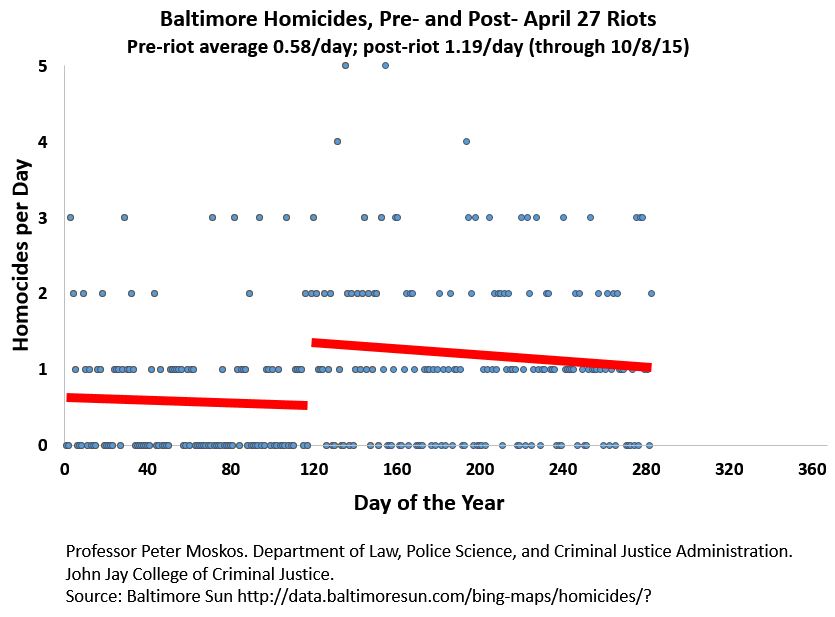
    Here’s the latest in terms of Baltimore homicides, pre and post riot. The downward slope is a slight silver lining in a homicide rate the doubled overnight.

  • “He shouldn’t be up there with Martin Luther King”

    No, Freddie Gray should not be. What a disgrace to MLK, Jr. I hate to paraphrase The Trump, but just because you are killed or die in police custody does not make you a hero. But such is politics in Baltimore.

    When these officers look at this larger-than-life mural with Gray in the center, they see a drug dealer next to the greatest civil rights leader of all time and they can’t seem to make sense of that.

    “Put that little girl up there. McKenzie. Not him,” the officer says.

    He is referring to 3-year-old McKenzie Elliot, who was killed in a drive-by shooting last August. “Why weren’t there riots for her? That, I would understand.”

    This comes from a piece in Salon by Danielle Ariano, who went on a ride-along in Baltimore. It’s well worth reading the whole thing.

  • Meanwhile, “discovery” back in Baltimore

    A bunch of people are getting shot. Including kids. An arrest was made.

    But more out of the ordinary is this by Keven Rector in the Sun:

    Attorneys for six Baltimore police officers charged in the arrest and death of Freddie Gray said in a court filing Thursday that prosecutors either failed to turn over evidence or lied about conducting a thorough investigation into Gray’s death.

    The evidence already provided by prosecutors is “completely devoid of any information obtained during the course of the State’s investigation,” the defense attorneys said, leading them to conclude that “either the State is withholding the information from its investigation, or there was no investigation.”

    I suspect the former. A judge will rule soon.

    Prosecutors are required by law to share any “exculpatory” evidence that would help clear a defendant of charges, and the defense said it is “difficult to imagine” that nothing in the state’s investigation was “in some way exculpatory to at least one of the Defendants in this case.”

    Other than one witness interview by an investigator in Mosby’s office, the defense attorneys said, they have not received “a single document, witness interview, report, recording, or even mention of a shred of evidence procured through” the independent investigation.

  • Cue happy riot montage scene!

    Apparently — and I didn’t know this — Baltimore is actually a role model for other cities in how to control civil unrest.

    Baltimore Mayor Stephanie Rawlings-Blake didn’t exactly jump the shark right here. She jumped the shark a long time ago. But this is becoming insane. She actual said this:

    And while you say it’s under negative scrutiny, when I go around the country and I look at the fact that other cities have burnt for weeks — Baltimore itself burnt for weeks during the riots of 1968 — we were able to control the unrest and riots to a few hours on one day. There are a lot of cities right now that would love to have that record.

    And just which cities are those, Ms. Mayor? Madam Mayor is perhaps crazy (does she even believe what she says?). She is certainly incompetent. She is also dead wrong.

    At the latest, the riots began at 4:44pm on April 27 when the Rite Aid on North Avenue was looted and then set on fire. So, by her logic, everything was basically OK after a few hours. A record a lot of cities would “love to have”! What’s a few? Four or five hours? So can we can still catch a late show at the Senator Theater?

    The riots were not over by midnight. The city called down in the early morning hours. The riots weren’t really even over the next day. The national guard left and the curfew was lifted on May 3rd.

  • Got Milk

    Got Milk

    A unique form of assaulting a police officer. From the New York Times.

    That’s in Brussels … Belgium … between France and the Netherlands.