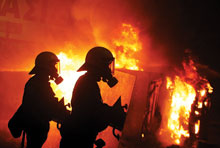
Greek police shot and killed a 15-year-old boy in Athens Saturday night after a confrontation between police and a group of people.
There have been some pretty big riots ever since. Here’s the latest from English-language version or Kathimerini. And the New York Timeshas a storyand slide show.
The fact that there were copycat riots in other cities means this clearly strikes a nerve.
 These are probably worse than your average Greek riot, most likely the worst since Greece’s return to democracy in 1973. But… and here the rub… there issuch a thing as an “average” Greek riot.
Every year, on November 17, there are riots in Athens. As the BBC puts it: “Each year, on that date, tens of thousands of trade unionists, left-wingers and ordinary people march from the Polytechnic to the heavily fortified US embassy. Invariably the demonstration disintegrates into a ritual battle between riot police and anarchists.”
I lived in Athens for a while back in the early 1990s. I speak enough Greek just to get into conversations whereby I can’t understand a thing (“It’s all Chinese to me,” say the Greeks).
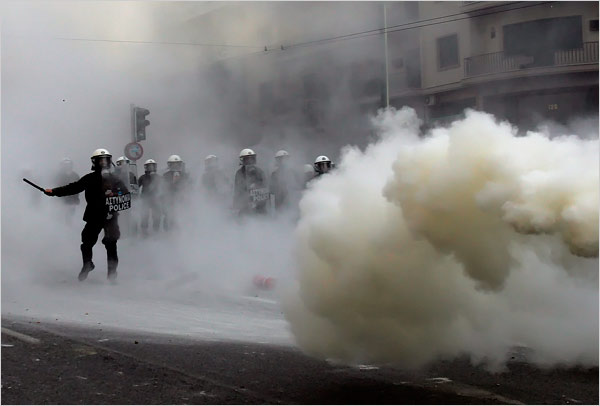
I’ve never felt Athens to be a dangerous place. So on November 17th one year, because it’s the kind of thing I do, I went to the University to check things out. Now I tried not to open my mouth and out myself as an American (though it probably would have been fine if I had) and I went a little earlier than I thought things would get really hot. But still, in the early evening I walked past the police line into a pro-riot zone and strolled around balaclavad youths filling Molotov cocktails with fuel.
Dangerous? I don’t know. There was also an old man, a kafetzis, strolling though the crowd with full tray of coffee, selling frappe to the rioters. Frappe, Greek iced coffee, to the rioters. And yes, people were coming up to him politely, paying for coffee, and then going back their business. What kind of riot has a coffee vendor?!
 The only thing that comes close… and it really doesn’t come close, was when I was at an Ice Cube concert and people were buying and drinking tea, with cup and saucer and coffee cookie and everything. That was in Amsterdam at the Paradiso.
To a certain extent, riots in Greece are ritualized. Injuries are kept to a minimum. And nobody gets killed. Maybe a bank gets burnt. A few cars. And a perhaps a small rocket-propelled grenade is launched at the American Embassy. Truman Statue tipping is always fair game. At some point, either to quell or to instigate, the MAT (that’s Greek for S.W.A.T.) comes in and fires tear gas and stands behind plastic shields blocking missiles.
 My point is simply that pictures of Greek riots are always worse than reality. If I may overgeneralize, Greeks are more full of passion than anger. I have no doubt there is real passion. There’s a huge left-right divide in Greece. The civil war in Greece came after WWII. There was a right-wring military dictatorship 35 years ago. Even the language your write in and the color of your graffiti have political connotation.
Of course it’s not November 17. So this riot wasn’t on the agenda. And a kid did get shot and killed. The official police version seems to be it was a warning shot gone array. The cops were arrested, by the way.
Plus, there’s also a lot of corruption in Greek police (especially in the night-life arena). And police brutality is probably more accepted there than it is in the U.S.
 No doubt when you’re dealing with anger, alcohol, Molotov cocktails, bottles, bricks, fires, police reaction, and less-lethal force, somebody could get seriously hurt. But usually nobody does.
My point is just that this isn’t L.A. 1992. This isn’t the suburbs of Paris 2005. Yes, the rocks and firebombs are real. But if that man is still walking the streets selling frappe, I wouldn’t be too worried.
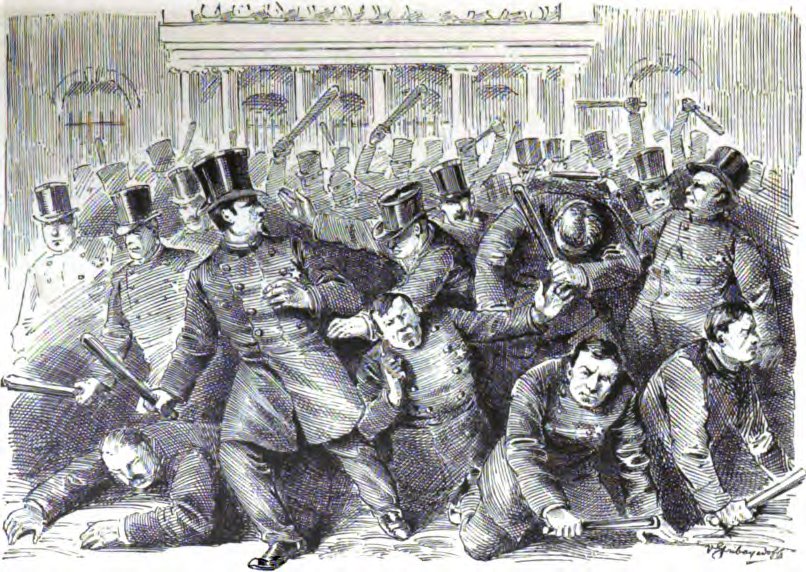
 The mayor was arrested and New York State took over the police (before giving them back a few years later).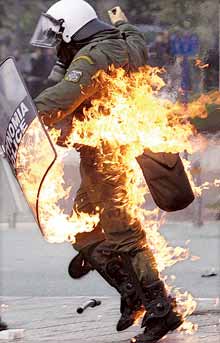
 [December 13: In response to Nick’s comment that the media has such a pro-police bias, I’d like to provide a caption to the picture to the right. Luckily, according to the Kathimerini (and to think, I was duped by their biased and horribly pro-police propaganda simply because they publish in English), the police officer in the picture was not seriously injured.