Tag: rising crime

  • Shootings up in NYC

    The recent crime numbers in NYC will soon come out, and they’re not good. Homicides this week are way up compared to last year. Of course that’s just one week… till it’s not. Shootings are up in NYC. Not Baltimore up. But up. People are dying. It is time to ring the alarm. Maybe not the crazy 5-alarm fire for Baltimore. Maybe a simple 1-alarm would do NYC. But more people are dying.

    So what might be the cause? A lot of things of course. One factor may be people’s willingness to carry heat. Word on the street is that guns are back in town. As I was told: “People are now shooting into crowds more often, doing drivebys, more often, and shootings as teams more often. The risk for carrying a gun in nearly zilch. Bottom line: cops aren’t stopping people, and young black men are paying for it with their lives.”

    Stop and frisks are down roughly 95%. Now we could debate whether certain police tactics are legal, constitutional, or moral. We should debate these things. Maybe it’s OK to have 50 more dead bodies in NYC if hundreds of thousands of other young black men aren’t stopped by police for no good reason. So let’s have that debate. What bothers me is the disingenuousness of those who refuse to grant criminals any agency in crime. Like Broken Windows is the root of all evil. Like it is inevitable that 2015 would see a 10 to 20 increase in shootings in Brooklyn. And it must have been written by the Almighty that some in Baltimore would riot on April 27, and then the homicide rate would skyrocket.

    Criminals don’t leave their guns at home because they’re asked politely by community leaders. It is possible that force and coercion might, in some cases, keep people alive. Remember (before we forget) that the arguments against stop, question, and frisk weren’t only that it was illegal, unconstitutional, and morally reprehensible. It was that it didn’t work — that stop, question, and frisk was actually counterproductive with regards to crime prevention. (I never quite understood that argument, but it was said.)

    The role of guns in NYC homicides is surprisingly varied. It wasn’t that long ago (well, the 1970s) that guns were used in less than half of all murders in NYC. In 1960, at least according to one source, guns were used in just 20 percent of homicides. But that changed in late 1960s and 1970s.

    By 1990, guns in NYC out of control. 1,650 killed by guns, 75% of all murders, higher than the national average (not including NYC) of 67%. (All these percentage may be a bit low based on “other and unknown”.)

    So along with all murder going down in NYC, gun murders went down in particular.

    In 2000 65% of murders in NYC involved guns. (Compared to 66% in the rest of the nation. UCR data, all.)

    In 2005 61% in NYC. (Rest of nation: 68%.)

    In 2010 60% in NYC. (Rest of nation: 68%.)

    In 2013 59% in NYC. (Rest of nation: 70%.)

    Meanwhile, the percentages of gun homicides in other cities is much higher: 84% in Chicago; 79% in Los Angeles; 81% in Baltimore. So New York looks all the more impressive.

    This was a little heralded victory against gun crime in NYC. While the rest of the country saw a small increase in the percentage of homicides involving guns, NYC saw a decrease.

    I asked my friend, Dan Baum, who insisted on being identified as “a liberal Democrat Jewish gun owner who wrote Gun Guys: A Road Trip“. Baum can write. (Too bad you didn’t buy his book.)

    Anyway, I asked Baum about what changed in the 1960s. Gun violence increased 50% in the 1960s (five times more than other/non-gun violence). He said:

    What changed in the early 1960s? JFK was shot, and the liberals began their long love affair with gun control. Until 1968, you could buy guns through the mail. Guns were things that people owned, but they weren’t a cultural marker, a badge of belonging to a particular subculture.

    The liberals changed all that, by relentlessly pushing the bubbas into a corner. Suddenly, people were in a panic to buy all the guns they could, because they never knew when the liberals were going to ban their sale altogether. The NRA, taken over by the loonies in 1977, pushed that narrative. The number of guns circulating in private hands exploded exponentially, with predictable results. Not only that, a tremendous amount of anger was injected into the national discussion around guns — also not a good thing.

    So I’d argue that we have the liberals, and gun control, to thank for the huge increase in gun murders. Guns are way more prevalent than they used to be, because the liberals made them a thing. Had they not done that, we’d be back in 1960 America — guns being a thing that some people own, that have no cultural/political/spiritual significance.
  • Too many? Too few? Or just right?

    Arrests are way down in Baltimore. But not just this month (though they are) but over many years.

    There were 40,000 arrests in 2014 (3,300 a month). In 2003 there were 114,000 arrests. Like I said, arrests are way down. This is worth repeating because it goes against a narrative that the riots were somehow the inevitable result of overaggressive policing and too many arrests.

    Now of course arrests could be down and Baltimore could still be over-policed — and the war on drugs continues to be the problem — but even if over-policing were a problem, Baltimore and America is less overpoliced now that it was a decade ago.

    I think we need to ask just what number of arrests would be around right. Generally. I don’t mean this as a quota. And I know this doesn’t help day-to-day policing. As a police officer, you don’t make arrests based on some arbitrary ideal yearly goal. I know that.

    But as part of society, as an thinking person, as an American, it’s fair to come up with some rough number of arrests at which we can collectively say, “yeah, that seems about right.” Because the status quo seems to be to criticize cops for making too many arrests, and then criticize cops again when they make fewer. What do we want police to do?

    Take arrests in New York City. There were about 315,000 adults arrest year for the past 20 years. That’s some variance, to be sure, but it’s all in the same big ballpark. The number was lowest in 2003 (279,000) and highest at about 345,000 (in 1998 and 2010).

    Questioning arrest numbers allows us to ask, for instance, what good NYC got from a 20 percent increase in arrests between 2003 and 2010? Not much, I would say. See, if you can keep crime down and quality of life up, certainly fewer arrests are better, other things being equal. Arrests are harmful to the people arrested and their family. Also, if nothing else, arrests are expensive.

    Now Baltimore City went from 2,677 arrest in April of this year to what will probably be about 1,600 in May. That’s a big drop. But policing in Baltimore has changed. And since crime is up, people are saying police aren’t doing their job. But it does beg the question, what is the right number of arrests for a high-crime city of 620,000 people?

    If you refuse to answer that, that’s fine. But then don’t complain that arrests numbers are too high or too low. And I don’t want arrest number to be a goal. I can’t state that clearly enough. But I do think arrest numbers are a useful crude indicator of discretionary police activity (not a very good one, but useful nevertheless).

    For years, critics — myself included — said there were too many arrests in Baltimore. 84,000 in 1999; 111,529 in 2003. I don’t care if everybody arrested was guilty of whatever. It’s just too many arrests.

    And then arrests declined (25 percent from 2004-2009). Homicide and crime also went down. Win-win!

    But in 2007, the Baltimore Sun reported on declining arrests:

    Some complain the pendulum has swung to the other extreme — police aren’t doing enough to quell violence.

    Israel Cason… said it is less common to see police “slamming people on the ground, emptying their pockets on the street.”

    “You don’t see that too much no more,” he said.

    The downside, he said, is that drug dealers are congregating on street corners again without getting challenged.

    “They know what [the drug dealers] are doing, but [the police] don’t do nothing,” Cason said. Referring to free samples of drugs that dealers circulate through the community, he said: “We got testers out here every day, the police stand right there with them. They went from one extreme to the other.”

    But arrests kept getting lower. And so did homicides. Again, win-win.

    Last year, 2014, there were just under 40,000 arrests in the city. Homicides were a low (for Baltimore) 211. Seems like job well done, right? But if 40,000 is good, is 20,000 even better? Well, not if that more recent drop is because patrol officers aren’t able to do their job. And the department isn’t willing to support them when they do.

    So say what you want about the causes of the riots. (Myself, I like to blame rioters and Baltimore’s too large criminal class.) In 2014 arrests were down 50 percent over six years and 65 percent from 2003. So it doesn’t seem like Baltimore police are currently locking up too many people for no reason. Francis Barry talks about this in BloombergView:

    If the riot was fueled by anger not only over police brutality but also police arrests for low-level crimes… it’s a good thing the rioters were too young to light a match or loot a store in 1998 or 2003.

    It’s actually well worth reading his whole Barry piece, and his earlier article, too, in which he takes on David Simon and points out, among other things, that “the national decline in arrests runs counter to the idea that America has become increasingly over-policed, particularly in poor minority communities.” So what’s the problem in Baltimore. Could it not be, at least in part, that criminals just don’t like police?

  • Deadliest month in Baltimore. Ever.

    The Sun reported that this month has been the fifth deadliest in 40 years.

    Actually, by rate, since Baltimore has fewer people than it used to have, May has been the most deadly month ever.

    In number of dead, the deadliest months have been:

    Aug 1972: 45

    Dec 1971: 44

    Aug 1990: 42

    Aug 1996: 39

    May 2015: 42

    But the homicide rate (per 100,000) for these months are, in rank order:

    May 2015: 6.7

    Aug 1990: 5.7

    Aug 1996: 5.7

    Aug 1972: 5.0

    Dec 1971: 4.8

    And it’s worth pointing out that May isn’t over yet. (Also, May isn’t August, the usual deadliest month.)

    Also, those homicides rates are for one month and still higher than the yearly national rate. Put another way, even if no other people had been murdered in Baltimore before May, and even if no more people were killed from today until 2016, Baltimore would still have an above average annual homicide rate just based on the May killings.

    Population figures are here.

    UPDATED June 4, 2015

  • Meanwhile, roughly 1 in every 250 young black men was shot in Eastern District. Last month!

    Meanwhile, roughly 1 in every 250 young black men was shot in Eastern District. Last month!

    Maybe you were too busy blocking traffic into the city to notice, but this past weekend 32 people were shot in Baltimore. Nine were killed.

    (as usual, click to embiggen)

    This past weekend. In Charm City. With just over 620,000 people.

    Meanwhile, from April 25 to May 23, this past month, 122 people were shot or killed in Mobtown. Last year the comparable figure was 52.

    [During these same 28 days, Part One reported crimes in the Land of Pit Beef did not increase. Domestics (again, as reported to police) did not increase.]

    Where are these shootings happening? The Central District was basically steady. In the Northern District, shootings were actually down to two, from four. Shootings in the Southeast did increase, but just to eight. Not much up in the Southwest.

    The Northwestern District? Shootings were up to 13 in the past 28 days. That’s compared to 1 last year.

    The Wild West? There were 33 shootings this year (compared to 10 last year). I don’t know what the population of the Western is, but it’s probably even smaller than the Eastern.

    In my beloved “Historic” Eastern District? 22 shootings and homicides in 28 days. Last year there were 7. (For what it’s worth, homicides in the Eastern actually were lower than last year, 3 versus 4!)

    Keep in mind that these victims (and shooters) come mostly from the population of 15- to 35- year-old black men.

    The actual population of 15- to 35-year-old black men in the Eastern District is likely less than 5,000 people. (Source: See page 219 of Cop in the Hood).

    Now this is just one month, mind you. Twenty-eight days. And we’re talking about a “Formstone figure” (OK, I just made that one up) of roughly 1 out of every 250 young black men being shot. In one month! Chew on that bony Lake Trout for a while. But this ain’t no bull and oyster roast.

    I don’t know what else to say. Go ahead, if your world-view inclines you thusly, go ahead, hon, and see police as the biggest problem facing young black men in the land of Pleasant Living. And Boh, I’m not saying police are without blame. But seriously, this is about priorities. If you think police are the biggest problem facing young black men in urban America… I don’t know what else to say.

    [Maybe I did something wrong with my math? Let me know.]

  • “So what’s the big deal?”

    What’s weird, at least to me, is that many (mostly from the political left) seem to dismiss the never-before-seen increase in homicides in Baltimore as just some random uptick. “You know,” I’ve been told (and more than once), “violent crime is up in New York City, too.”

    Are you fucking crazy?!

    Homicide in Baltimore is up 250 percent over-fucking-night! And that night, April 27, 2015, just happened to be the night of the worst riots “Mobtown” has seen since 1968. This was a time when the mayor said police need to give room to people who want to destroy. (To be clear, I firmly believe this is not at all the message the mayor was trying to say… but still, a good mayor doesn’t let things slip from her lips that can be — and were — reasonably misinterpreted as letting people know that violence and destruction would be tolerated.)

    April 27th was also (and this is more Commissioner Batt’s fault) when police were confronted with some kookie young kids at Mondawmin Mall. The police, in riot gear, were told to stand down. I don’t think police should go too quickly to riot gear… but when you do use force, you go in strong! Instead, cops charged… and then retreated. This was on order, say police friends who were there, of the high-command.

    So the police charge became a half-assed charge. And 5 angry kids became 15 when police retreated. And then one more pseudo charge. And then 15 rock-throwing kids became 50. It was horribly policing, tactically. Horrible. (But not the only problem, mind you. I still want to know who the hell closed down the MTA and thus prevented school kids from leaving the mall?)

    So on April 27th, 2015, there were riots. And fires. And looting. And then starting the next day, twice as many get shot. People, this isn’t a fucking coincidence! This isn’t something that was meant to happen. It’s not like the Almighty wrote it. People on the streets, with guns, go up to other pull people, pull the trigger, and shoot them. So now, in a city of 620,000 people, this is happening one more time every goddamn day!

    So yeah, to those who point out homicides in NYC are up 13 percent compared to the same time last year: whatever.

    13 percent may be a statistical fluke. Or maybe it’s not. Maybe we can live with 40 more people murdered annually in NYC if it is at all related to half-a-million other people not stopped by police. I don’t know. But those are the discussions we should be having.

    Here’s the thing — and this is what bother me — I’m willing to discuss why crime is up, the role of police in crime prevention, what we can do to reduce violence, and the relationship between more aggressive/repressive police and less violent crime. I mean, that is kind of what I do for a living.

    But I’m not willing to debate that more people are getting killed in Baltimore and that something changed because of the fallout from the death of Freddie Gray.

    So the starting point for me is that something has changed in Baltimore vis-a-vis violence and homicide.

    The reason some people can’t accept this, I suppose, goes back to the fallacy that police don’t really matter, except as agents of racist repression. This argument says that crime is caused by society and root causes (and not criminals, per se). If racism, unemployment, and even aggressive policing cause crime, than some are happy to blame cops, society, racism, Broken Windows, Bill Bratton, and everybody but those who actually pull the trigger and kill somebody.

    Get real.

    So here we have the most sudden sustained increase in violence — overnight, mind you — in American history (best I know… please, if you know anything comparable to this, let me know). Of course it has to do with the riots. Not directly the riots, mind you. They’re over, at least for now. And nobody was actually killed during the riots, which is kind of amazing. This surge in shooting? It’s because of politics and police.

    Given that six officers were criminal charged for the death of Freddie Gray — a death that certainly not all six of them were responsible for — why would you go out and do more than have to?

    What you have — I can’t help but keep harping on the failed “gang truce” so loved by the mayor and police commissioner — is a police department that:

    A) isn’t doing much proactive police work (which means not doing more than answering calls for service);

    B) isn’t going hands-on with criminals hanging out on the corner so much (ie: not frisking people on violent drug corners means criminals are emboldened and guns are more accessible);

    C) an understaffed force that has been reduced to about 2,200 (down from more than 3,000 cops when I was there — doing more with fewer cops is yet another west-coast concept that hasn’t worked so well in Baltimore);

    and D) large crowds getting in the way of every routine call for service. (This means more cops need to respond to every call. And keep in mind that some of those getting in the way are responsible for the horrible increase in shootings. So it’s not like cops are paranoid about the situation.)

    Maybe I’ll break those down more later, but let’s just keep going with the 250 percent increase in killings.

    I’d bet (though I don’t know) that complaints against police are down equally dramatically. Probably the same 50 percent that arrests are down. Some say police arrest too many people. So fewer arrests should be good (it happened in NYC without a big increase in crime)…. so if you believe that, please try and explain this increase in murders in a way that doesn’t involve police. Or tell me what you want police to actually do. It’s not a simple question. And I’m all ears.

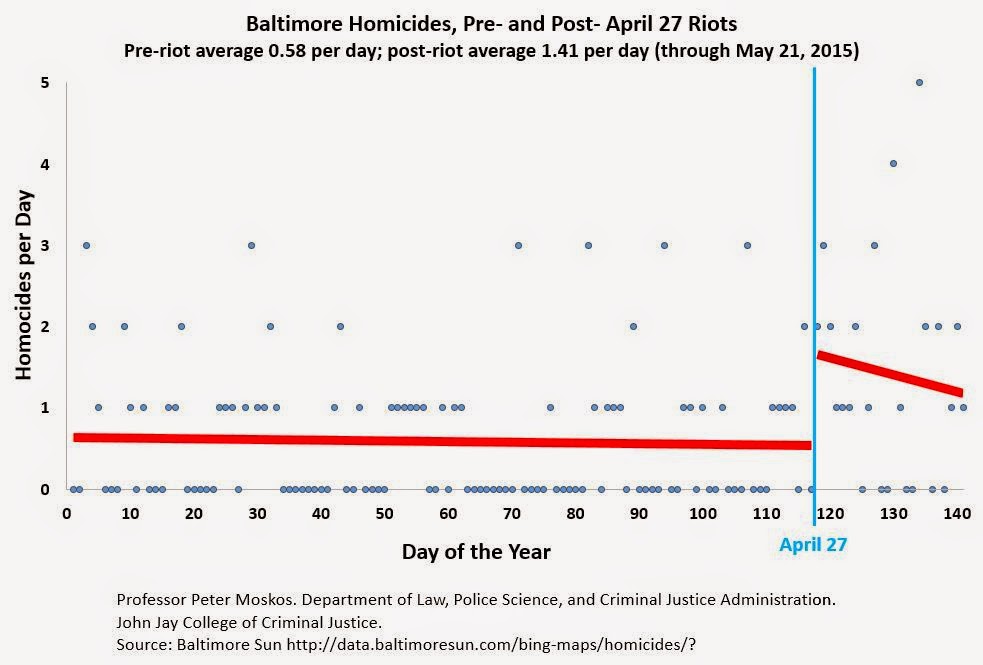
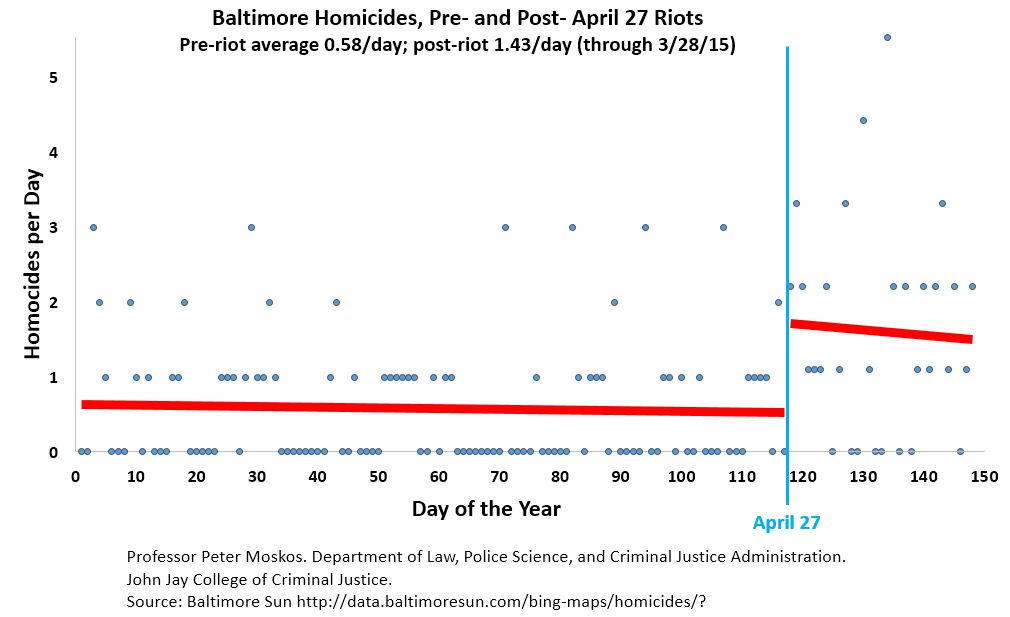
  • Baltimore Homicides, pre- and post- riot

    Baltimore Homicides, pre- and post- riot

    After the riots, the daily number of homicides in Baltimore more than doubled from 0.58 to 1.41. That’s a lot more dead people. 0.8 per day. (For those of you not too good with math, that’s almost one a day. And yes, Gotti, I’m looking at you.)

    Click to embiggen.

    The trendlines, pre- and post-riots, are in red.

    [Updated May 21]

  • Crime up in NYC (this time for real)

    Compared to last year, shootings and homicides in NYC are up 20 percent. Twenty percent is a real increase.

    Here’s the compstat page and also a link to last week’s summary (no matter when you click the link).

    I don’t know why crime is up. But… I can’t help but think it’s part of (or some combination of) everything that has happened in NYC in the past year. I mean, I know what most cops think is the cause: stop and frisk has stopped; marijuana arrests have plummeted; there’s more oversight of cops; De Blasio is mayor; Obama is president; Eric Holder is Attorney General; cops find it preferable to do too little rather than do to much (“if you don’t work you can’t get in trouble”).

    Some of that is just ideological sour grapes. But some of it, part of it, is true.

    What I find amazing is I don’t hear any critic of the NYPD sounding any alarm. Oh well, I guess 60 extra murder victims per year — 54 of whom, based on passed statistics, will be black or hispanic men — is a small price to pay to keep innocent people from getting harassed by the police. I for one don’t buy that equation.

    Those who opposed past police practices (and to be clear it’s not like I loved everything the NYPD was doing) seem to be very silent right now. Shouldn’t the increase in murders lead to a discussion about what police should be doing?

    I guess the same people who think the police had little if anything to do with the crime drop now just think it’s preordained that crime goes up. But it is not “written.” Why don’t I hear debate? Instead I hear a lot of silence.

  • Prop. 47’s effect on jail time

    From LA, where Proposition 47 reclassified many crimes as misdemeanors. Drug arrests are down by about one-third. Property crimes are up nearly 10 percent. The problem seems to be this: “The new law specifies that the financial savings on the incarceration side be reinvested in truancy, drug treatment and mental health programs. But that provision does not take effect until mid-2016.”

    I’d be curious how much and how they determine how much money is being saved by fewer arrests (in court, corrections, and police).

  • Brrrr… it’s cold outside

    I can’t help but notice — now that another long hot summer is done and a commie mayor and Al Sharpton are running the show and the police have been thrown under the bus and Obama is president and the ACLU stopped letting police stop criminals and there’s no more stop question and frisk and there’s independent oversight and body cameras are coming and it’s open season on cops and people don’t show any respect and society going to hell — but crime *still* isn’t up (-4% by stats I don’t trust. But what I *do* trust is 249 homicides to date compared to 262 in last year’s record low. Shootings are up 6%). I know it’s in good part because of the hard work of the men and women of the NYPD, but I’d still like just one Republican, one conservative cop (or maybe somebody like Heather MacDonald) to admit he (or she) was wrong. It’s all very strange to me.

    Or maybe the only thing keeping New York City from become The Warriors are all the marijuana arrests or the bike ticketing blitz in Crown Heights? Nobody really believes that, right?

  • Is the sky falling?

    Not yet. But the sky did get a little lower in NYC last month. Over the 28-day period ending 4/6/14, compared to 2013, the number of people shot increased 40 percent (101 vs 72). The increases were found, not surprisingly, in the Bronx (27 vs 18), Brooklyn North (28 vs 17) and Queens South (12 vs 6).

    Cause for alarm? I don’t know. But my eyebrow is raised…

    Still, for the year, shooting and murders are a bit lower than last year.