Tag: sociology

  • On Writing

    On Writing

    People sometimes think I don’t work much (an opinion only reinforced when they see me having my morning coffee at 2pm and still in my bathrobe at dinner time). But I’m a night owl and I work from home.

    So along with teaching four classes (a very heavy load for a college professor), I have to write. And writing is work. To those who think it’s easy to write a book, I suggest they try it. To those who can churn out a book a year, I applaud them (and wonder how they do it). Writing is hard work. And it’s not fun.

    A friend and fellow academic author put it this way in an email:

    There are days in writing (for me usually when I have a decent draft of something and am crafting) that it flows, but most of the time it’s work, work, work, work.

    People who don’t understand writing or who use formulas or hire ghostwriters who use formulas think that a book is like having a baby, nine months and it’s done. such total utter bullshit.

    Now I’ve never had a baby, but I only wish writing was such a passive process that got pushed out after nine months (not to mention the fun that leads to babies in the first place).

    I’ve been working on this book for a while and I’m still not done. When writing, I can produce about 1,500 words a night. But that’s only some nights. Because I’m not productive most nights, my actually production is more like 100 words a night. And that’s just the first draft.

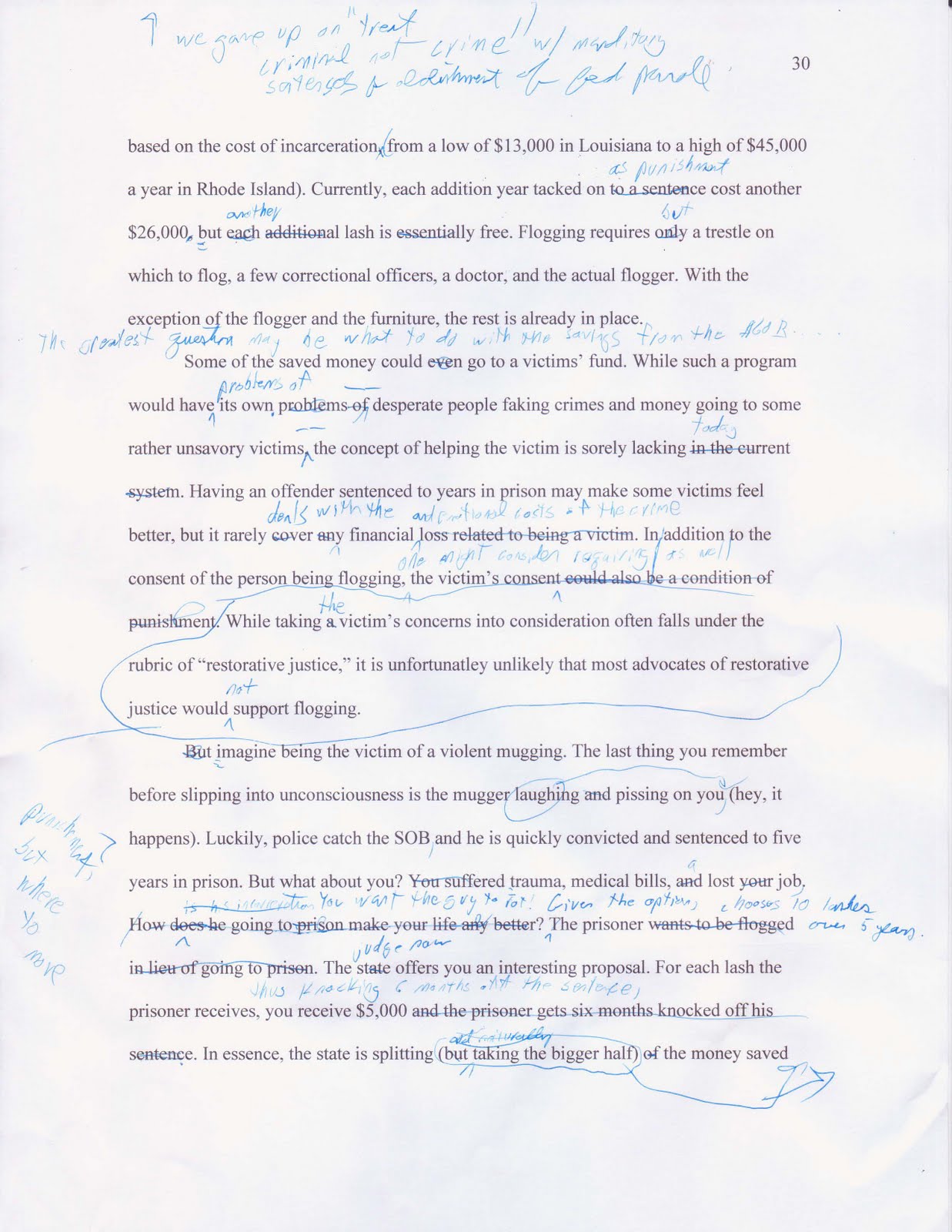
    Now that I have a (rough) first draft of my book, it’s more work. Even after getting all the words on paper–and at 30,000 words it’s a very short book–it’s still a lot of slow painful work. Just to give you some idea of the editing process, here are a two pages of a draft of my forthcoming book, In Defense of Flogging.
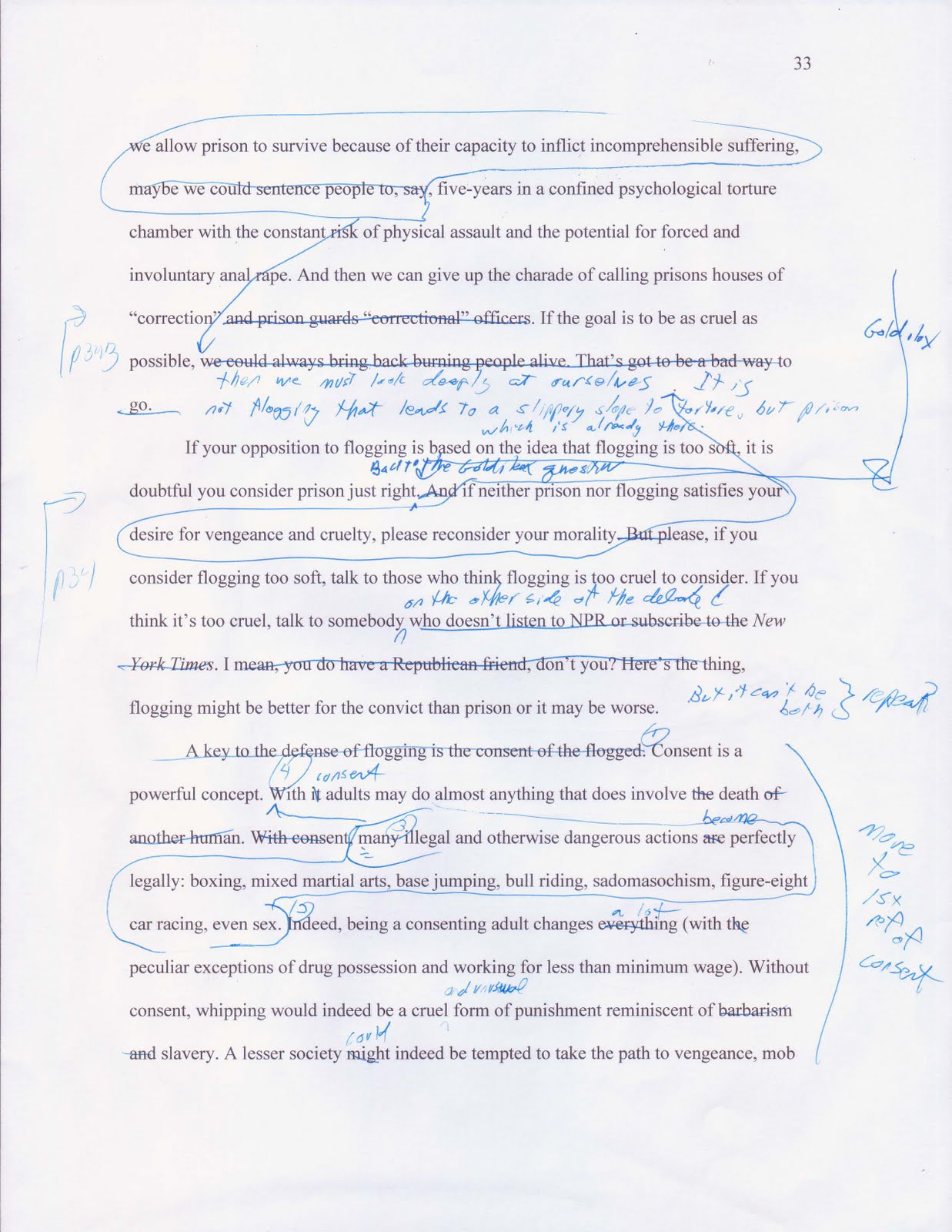

    So why do I do it? Sometimes I wonder. Every other job I’ve had has been easier, and yet still I choose this vocation. What did I create as a cop? Hopefully I helped some people, but Baltimore is no worse off without me there. And as a waiter I helped rich people enjoy their dinner, but waiters are just supporting cast to the food. And when I was a boat captain in Amsterdam I learned about boats and made a lot of tourists very happy. That was fun. But at some point I got tired of the same old tourist conversations (and rainy weather).

    The work in those jobs created no lasting product. And none of it could be mistaken for art. Maybe I write because I can’t draw and don’t make sculpture. A book is, or at least should be, a little piece of art. Maybe I like that idea. I really don’t know.

    On any objective level, 99 percent of all writers don’t get enough credit or money to make it all worthwhile, but still people write. I guess there’s something satisfying about creating something from nothing, at least when you’re done with it all.

    But while doing it? Man, there’s very little I wouldn’t prefer to do than write. When I’m sitting at my computer at 4AM, sometimes I think about how nice it would be to have some other job where I could show up, do my job, and go home and watch TV guilt free.

    And yet I wouldn’t change my job for any other (except major league baseball player and Supreme Court Justice). Why is that?

    Perhaps writing involves a deeper calling. I’d like to think I’m doing something that will last and might actually (in some small way) change the world for the better. And though the craft of writing is a tough, I’d like to think I’m good at it. Plus, publishing is, in theory, part of my job.

    It’s great to have written. Too bad it’s not more fun to write.

    Look for my new book, In Defense of Flogging, to be published by Basic Books, in 2011.
  • Gladwell on Strong and Weak Ties

    I’ve written:

    It’s to our shame as [academic] writers that the average Malcolm Gladwell New Yorker piece is more thought provoking than 95 percent of journal articles. If we can’t explain ourselves to others in a style both illuminating and interesting, we won’t and don’t deserve to be taken seriously.

    Here’s that kind of article. Gladwell talks about strong a weak ties. It’s straight of out a sociology textbook… but talks about Twitter, is interesting, doesn’t involve a single statistical regression, and has real world applications. What else could you ask for?

  • Race and Ethnicity in cities

    Cool maps! And interesting data presentation that shows the detailed racial and ethnic make-up of various cities broken down by very small units.

  • American Ethos

    “In America, individuals, not groups, act; and individuals, not groups, should be held accountable.” Most of you would probably agree with that statement. I do, too. But I would be quick to add that culture and background matter. A lot.

    Background isn’t destiny, but it’s a damn good predictor of your future. You can tell an amazing amount of information about somebody based just on where they’re born (particularly what country) and how much education their parents have. The apple really doesn’t fall far from the tree. Not usually.

    Take crime and punishment. I’m not surprised when a black male high-school drop-out ends up in prison. It’s (unfortunately) predictable. To know the odds in no way negates individual responsibility, but it does mean perhaps it makes more sense (morally and economically) to change the odds rather than build more prisons.

    Conservatives love giving lip service to individuality. They mock liberal sociologists (a term that indeed isgenerally redundant) for never holding individuals accountable for their actions. And sociologists may indeed be a bit slow to hold some individuals accountable for their actions. But that’s better than holding individuals accountable for the actions of others.

    Take Timothy McVeigh. I remember I was driving in California when the Oklahoma City bombing happening in 1995. The report on the radio talked about, “dark-skinned possibly Arab men seen fleeing the scene.”

    “No f*cking way!” I said to my friend. “There are no Arabs in Oklahoma. And if Arabs were bombing something, they would do somewhere else! These were crazy white guys.” Now I may be ignorant about the thriving Arab scene in Oklahoma City, but I happened to be right about the bombing not being done by an Arab, and also the more likely location of terrorist attack when it was done by Arabs.

    As Stanley Fish writes in the Times:

    In the brief period between the bombing and the emergence of McVeigh, speculation had centered on Arab terrorists and the culture of violence that was said to be woven into the fabric of the religion of Islam.

    But when it turned out that a white guy (with the help of a few of his friends) had done it, talk of “culture” suddenly ceased and was replaced by the vocabulary and mantras of individualism: each of us is a single, free agent; blaming something called “culture” was just a way of off-loading responsibility for the deeds we commit.

    If the bad act is committed by a member of a group you wish to demonize, attribute it to a community or a religion and not to the individual. But if the bad act is committed by someone whose profile, interests and agendas are uncomfortably close to your own, detach the malefactor from everything that is going on or is in the air (he came from nowhere) and characterize him as a one-off, non-generalizable, sui generis phenomenon.

    Need more proof? Compare the flack Obama got from the right for what Rev. Jeremiah Wright preached with the flack George Bush got for the preachings of Jerry Falwell and Pat Robertson. Except Bush didn’t get any flack.

    So now there are those who say the proposed mosque in Lower Manhattan is “symbolic of a culture that wants to kill Americans.” (Ironic since more Muslims want to be American than kill Americans.) But when a crazy American slashes an innocent Muslim, the right is quick to say that the stabbing is “the act of a disturbed individual” and “we shouldn’t let anyone suggest that this criminal reflects anybody but himself.”

    So let me get this straight: peaceful tolerant Americans who want to build a large mosque and community center represent foreign terrorists who destroyed the World Trade Center and killed Americans; but hate-filled Americans who actually commit real acts of violence against Muslims represent… nothing at all.

    Got it.

    Why does my head feel like its about to explode?

  • On [Acadmic] Writing

    I have an article in the current Political and Legal Anthropology Review, “Policing: A Sociologist’s Response to an Anthropological Account”:

    In order to be read (and who among us writes for sheer compositional joy alone?) writing needs to be good; people won’t read the other kind. The more jargon and sociobabble we anthropologists, sociologists, and ethnographers spew out, the more we strive to define ourselves as literate scribes in an academic temple, the more irrelevant we become.

    I’m all for sound and progressive arguments, but style is the key to good writing. I just wish more academics would worry about the Elements of Style as much as they obsess over the whims of anonymous reviewers and straitjacket themselves with journal orthodoxy.

    As an added bonus I’ve become a published poet in the same piece by reducing “Casey at the Bat” to haiku form:

    mighty casey swings
    oh two two on down by two
    no joy in Mudville

    Yes, folks, inspiration like that is why we professors always rake in the big bucks.

  • Odd Are, It’s Wrong

    There’s a good article by Tom Siegfried in Science News about what’s wrong with statistics.

    Take the idea of statistical significance. Much of social science is based on the (very arbitrary) idea that for any given correlation, there should be a less than 5% chance of that result being due to random chance.

    [And as any sociology grad student knows, if you run 20 random regressions, one will be found to be “significant” at the p < .05 level. This is why quantitative methods are no substitute for having a brain.]

    More counter-intuitive is the idea that a 5% chance that findings are random is most definitely notthe same as saying there’s a 95% chance the result is accurate.

    Take drug testing. You pay some private company too much money to test 400 people. 400 people go to some office and pee in a cup. 38 test positive. So what percent take drugs? You might guess that 38 positives mean 38 people (or 9.5%) take drugs. But you’d be very wrong. Oh, those stats… they are slippery!

    The answer is we don’t know. The results by themselves mean very little. We need more information. And there are two questions that might be asked here: 1) what is the level of drug use overall and 2) does a certain individual takes drugs. The former is a bit easier because you can adjust for errors. But when you’re talking about a individual, there is very little room for error.

    Let’s say we knew the tests are 95% accurate (a big if). If there were 40 drug takers, the drug test would test accurately positive for 38 of these 40. So if we got 38 positives out of 400, could we say that the drug use overall is 40 out of 400 or 10%? No. That’s not how it works in the real world.

    Now let’s say we know there are 20 drug users out of 400. Of course in the real world it’s hard to imagine knowing this “prior probability” before you gave a drug test. And let’s say we also knew that the test were 95% accurate. If we knew all this, then we could say that of the 20 who take drugs, 19 would test positive. And of the 380 who do not take drugs, another 19 would also test (falsely) positive.

    So after the tests, the people making money looking at pee would report that based on their test (which they advertise is “95% accurate!”), 38 of 400 people tested positive for drugs. But we started this based on the assumption that there are only 20 drug users! Of these 38 “positive” results, only 50% are actually drug takes! Half. And that’s a 50% error rate for a test that is “95% accurate”!

    Look at it this way: if nobody among the 400 took drugs, 20 people (5%) would still test positive!

    Want your money back?

    Now if you just cared about the overall usage rates, you could make a simple little table that tells you, based on the accuracy of the tests and the total number of positive results, what percentage of the group actually takes drugs. (Though keep in mind that as long as the actually percentage of drug users is less than the “confidence” level of the test, in this case 95%, the number of “positives” will always be greater than the actual number of users.) Such data would be useful for researchers and major league baseball.

    But the tests don’t tell you which of those who test positive are actually guilty. This, as you can imagine, is a big problem. Consider the employee not hired or the paroled man sent back to the joint for pissing hot.

    Of course you could improve the drug test or re-test those who test positive. But even with a retest at 95% accuracy, 1 in 400 would still falsely test positive twice. Sucks to be him.

    Back in the real world, at least in our free country, we continually re-test those who test negative. But if “positives” are only 50% accurate, what’s the point?

    What does this mean for the world of science and statistics? “Any single scientific study alone is quite likely to be incorrect, thanks largely to the fact that the standard statistical system for drawing conclusions is, in essence, illogical.” Put thatin your quantitative pipe and smoke it.

  • The Talented Tenth

    W.E.B. DuBois (pronounced doo-boyz, by the way, cause he wasn’t French) wrote about “The Talented Tenth.”

    DuBois was, among other things, a great American, a suffragist, a sociologist, and a Harvard grad. Had his groundbreaking The Philadelphia Negrobeen written today, I can only wonder if it would have been called, DuBois in the Hood.

    In contrast to the Talented Tenth, he wrote:

    At the bottom, of course, quibbles the mole with his eyes in the earth. Aye! truly at the bottom, at the very bottom; at the bottom of knowledge, down in the very depth of knowledge there where the roots of justice strike into the lowest soil of Truth.

    This came to mind after reading that 1 in 10 criminal youths in Illinois are held longer than their sentence because they have no place to go.

    Notes in the records tell sad stories. “Youth has no family that will take him,” reads the comment in the case of one downstate boy who was sent to prison for aggravated robbery and was still there two months beyond his scheduled release.

    “Placement denied 5X w/relatives,” reads the status report on another case.

    “Aunt denied by parole. Uncle has refused. Working on other (extended) family,” one document reads.

    In another case, in which a 20-year-old was more than a year past his ARD, the comment reads: “Youth had approved parole site; mother had change of heart, site denied. Mother seeking other resources.”

    It’s sad (though sometimes perfectly understandable) that nobody, not even parents, wants responsibility for some of these kids. I know that no person should be thrown away at such a young age. But I also have no illusions that all people, just because they’re younger than eighteen, are angels that can be redeemed. I arrested of few pretty bad youngsters myself.

    Sometimes they had no home to go to (in which case I did have some sympathy for the kid… I mean, given the choice between living in a f*cked up “home” like the ones I saw or slinging on the corner, I know what I would choose).

    Certainly the problems in part–sometimes a small part and sometimes a large part–rest with the parents (or lack thereof). But placing blame isn’t always enough. And some times the family was, if anything, too tough and strict–though who am I to cast doubt? If you raise three good kids and fourth is a f*ck-up… I don’t know, maybe you’ve done a good job. What are the odds we expect in neighborhoods where most boys end up doing time?

    DuBois had an answer: education. It’s a good one. But in the shorter term, what isthe answer?

  • Overrated Careers

    I’m proud to announce that “professor” has joined the list of overrated careers that already includes “police officer.”

    Boy, I sure know how to pick them!

    So says U.S. News and World Report.

  • Police, Ethography, Sociology, Crime, and How Things Work

    I always like academics who can explain things simply. I rarely find any greater knowledge or meaning hidden behind esoteric words and jargon-filled academic prose.

    Here’s Professor Jay Livingston on the difference between ethnography and survey research. While it’s not a distinction that most non-academics give two-beans about, it’s a great description. From A Shot of Ethnography:

    Survey research shows the relation between variables. Ethnography tells you how things work. Ethnography is about knowing who the players are and how they think. I remember Robert Weiss saying that if you’re a survey researcher and you want to know about cars, you get a sample of cars, and you discover that a car has an average of 5.38 cylinders, 164.7 horsepower, etc. (this was so long ago that he also included something about carburetors). But if you’re an ethnographer, you get a car, you open the hood, and you try to figure out how all those parts fit together.

    I might also add that a participant-observer would watch a car race.

    A quantitative-methods person would try and tell you everything about cars, despite never actually having seen one in person.

    A journalist would sit in the passenger seat go for a ride.

    And to really understand cars? You’ve got to get in the driver’s seat and go!

  • Notes on the Balinese Cockfight

    Notes on the Balinese Cockfight

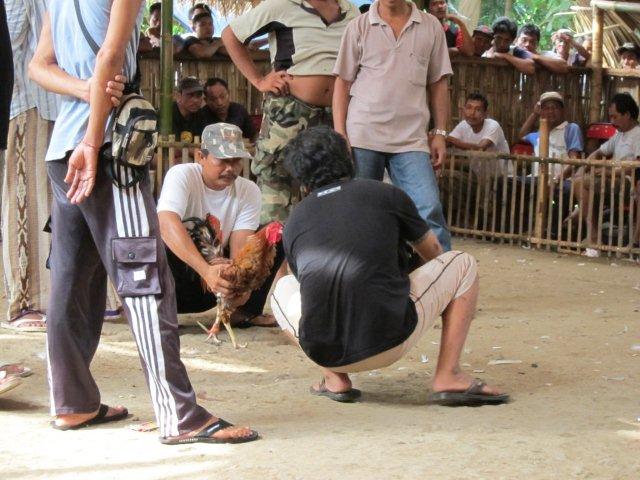
    My wife and I were in Kalibukbuk, Bali, visiting a few friends from Amsterdam, one of whom kind of lives in Bali now. He asked if we wanted to go see a cockfight. Well, in the name of Clifford Geertz and “thick description,” yes! (Hell, and this slightly worries me, I’ve enjoyed every bit of blood sport I’ve ever seen from bullfights to Thai Muay Thai kickboxing.)

    Every student of sociology and anthropology knows Clifford Geertz’s classic, “Deep Play: Notes on the Balinese Cockfight.” It’s based on his 1958 fieldwork. It’s a qualitative classic. Not until Geertz and his wife ran from a police raid of a cockfight were they accepted in the village.

    Well I didn’t have to any running but it turns out that 50-years later, cockfighting is still illegal and not at all underground. Some places are shut down. But just because they don’t have enough money to pay off the police.

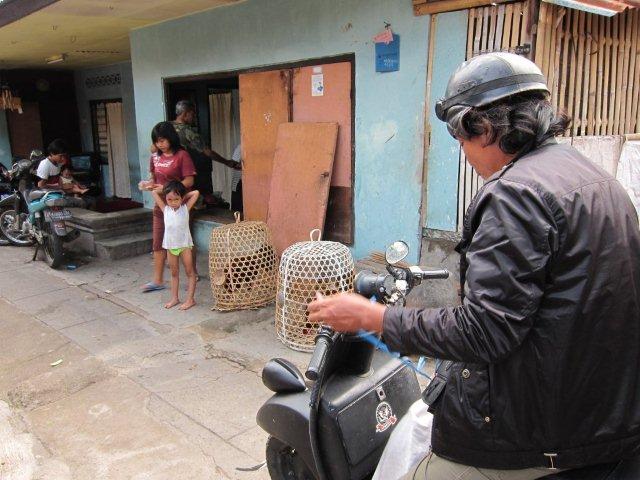
    So one night at dinner we’re introduced to a slightly hardcore character who will take us (but only the men, he says) to a cockfight the next day.

    So my buddy and I meet him and follow his mopen to the town of Singaraja. First we stop by his house where he judged the feistiness of a few of his cocks (and yes, the puns are same in the Balinese language) before placing one in a bag. They’re kept throughout Asia in these wicker cages.


    We continued and got to the venue (we never would have found it on our own). I love the parking lot. I resisted the urge to push a bike over, starting the domino effect and certain bar fight.


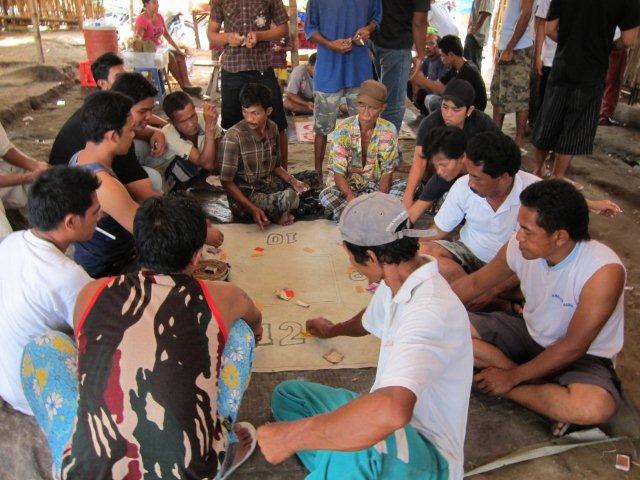
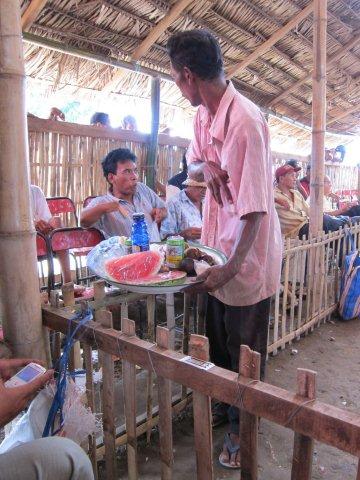
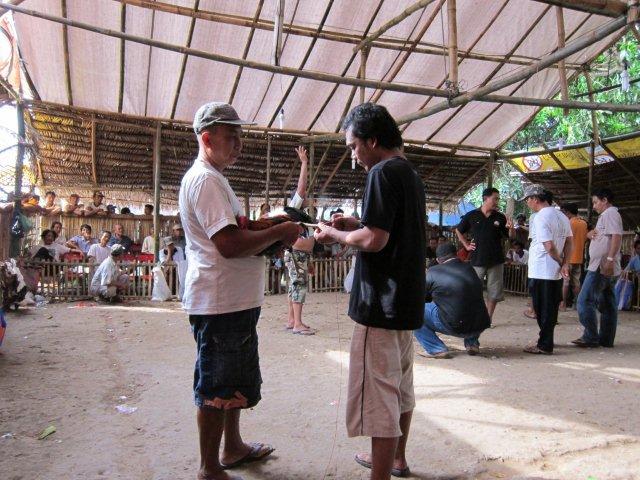
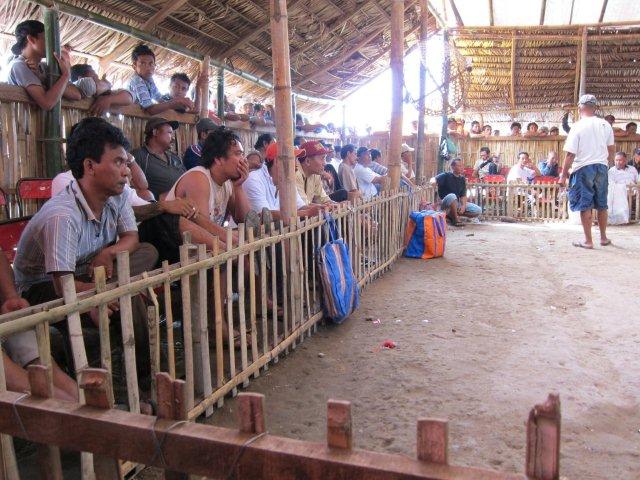
    In some ways all sports venues are the same. There are parking lot attendants, tickets, seats, fans, food vendors, and games. But nothing I’ve seen is quite like a Balinese cockfight. I wish I had internet access and could have reread Geertz’s piece. There was a lot going on I didn’t get. I respect a man with the skills to tie a razor to the foot of the rooster. The betting, $10 was normal, is high stakes for a poor country.

    Some side betting games.

    And one of the food vendors. We ate nuts and drank warm beer.
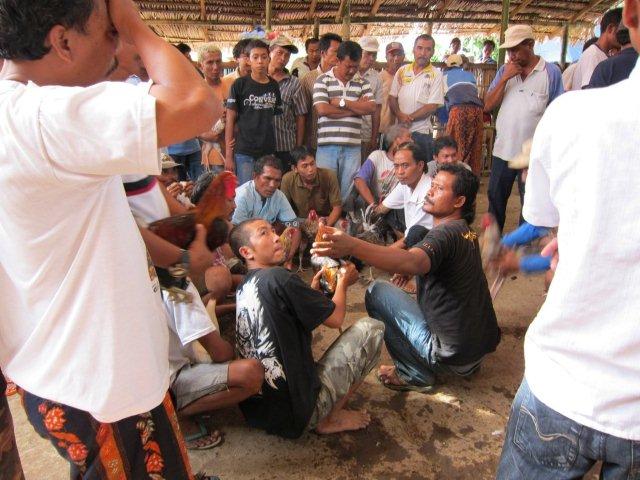
    I guess pairing up the birds.

    Tying on the razor.


    Our man told us which bird to bet on.

    Here’s some of the pre-fight scene:

    Then, right before the fight start, there’s this brief silence and then this wave of sound, unlike anything I’ve ever heard. You can hear the sound (I didn’t start the recording early enough to get the “wave”) at the very start of this video. Fair Warning:this a video of a Balinese cockfight. These are birds with razors strapped to their leg killing each other. Don’t watch it if you don’t like it.

    That was our man’s two-year old bird that died first. It was sold as food to somebody for $5. But the fight was a draw. I was happy with a draw because I may not know all the nuances of cockfighting, but I know a dead bird when I see one! If somebody won, it sure wasn’t us. But part of the rules is that the “winning” bird has be standing after or for a ten count.

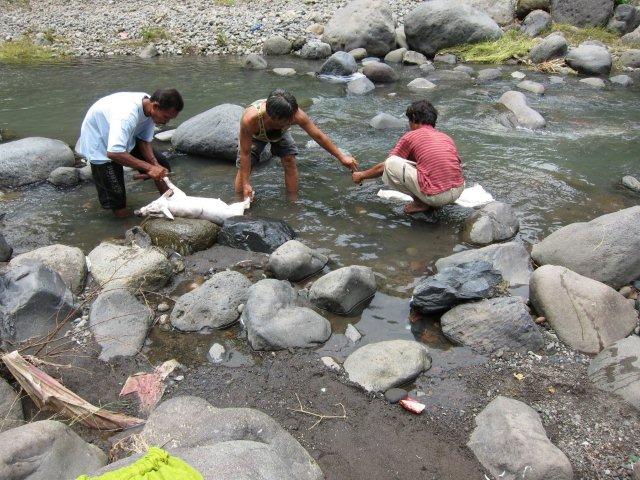
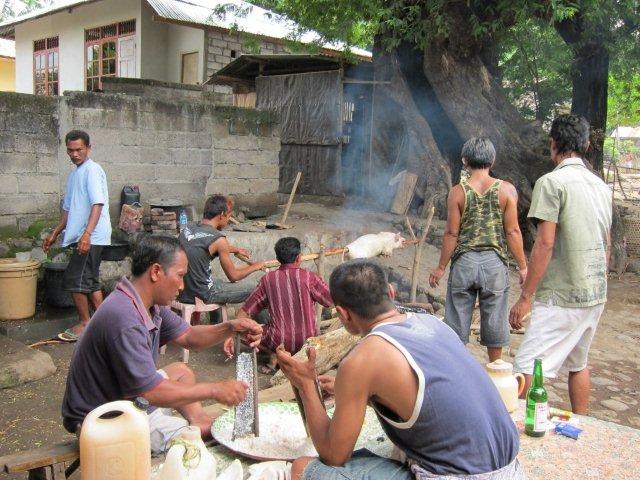
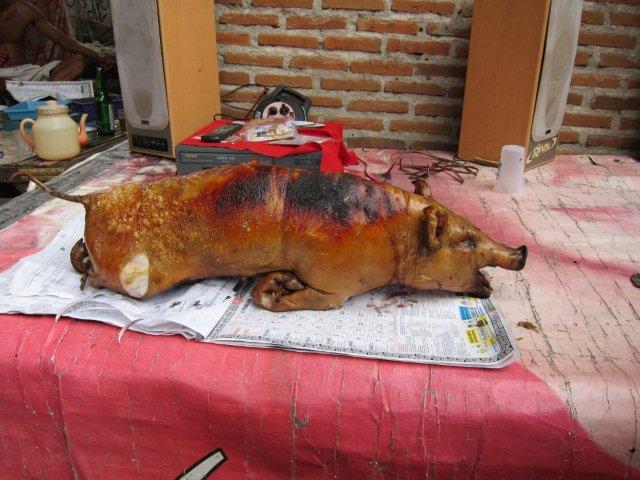
    Also worth a few pictures is the following day’s “pig roast in the hood” (my friend’s words, not mine). This involved killing a pig, cleaning it in the river, and roasting it over an open fire.

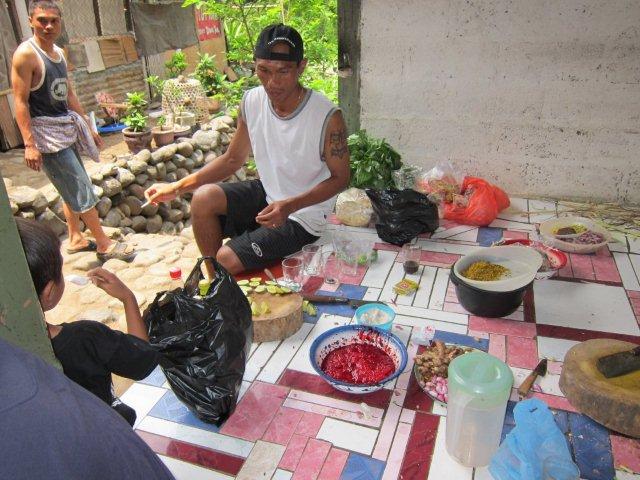
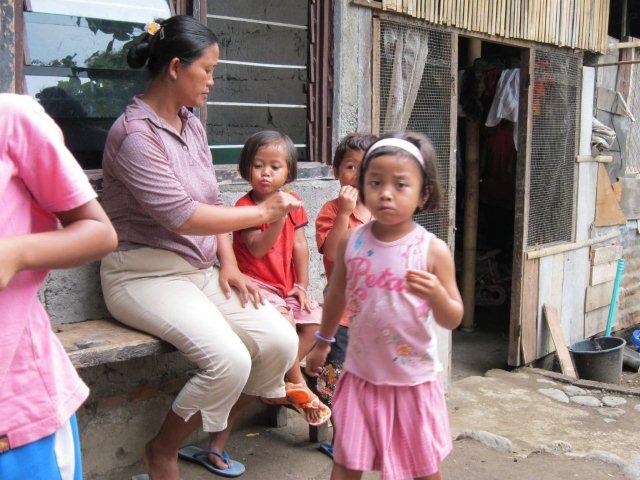
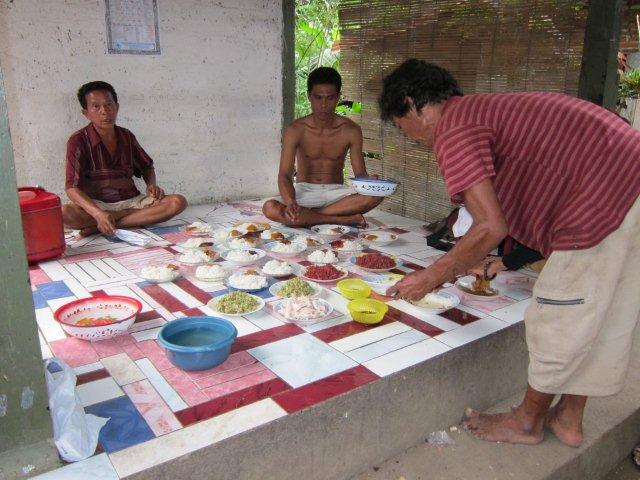
    Here’s some of the scene, worth a few pictures:


    Everybody loves cracklin!
    The pig was delicious. The people, friendly. A good time was had by all. We have the feeling they party a bit like this everyday, this day they just had a pig.
    It would be remiss to not mention that in the river were, among other things, one woman bathing and brushing her teeth upstream and another doing laundry. On the opposite bank people were gutting and cleaning a dog to eat. We were told they only eat the “bad dogs.” Why not? Hell, on our side we were eating a dish made with raw pig’s blood (mixed with grated coconut, spices, and grilled pigs innards). If it all sounds hardcore, well, I suppose it kind of is. I think it’s only the second time bougie old me has eaten at a home without running water.

    I also got a kick out of the fact that I was corrected for eating with my finger wrong. You can’t take me anywhere! I didn’t even know you couldeat with your fingers wrong. (Take note: after you grab your food, don’t put your fingers in your mouth but place the food on the ends of your first two fingers and then kind of shovel/push the food with your thumb into your mouth.)

    The majority of trip was spend in Thailand and Bangkok. The food in Bangkok is incredible. I love Thai food and the Thais are truly more into food than any country I have ever seen. And their sheer obsession with food, the amount of prepared food for sale–delicious, clean, spicy food–is hard to imagine. But those stories are for another time.

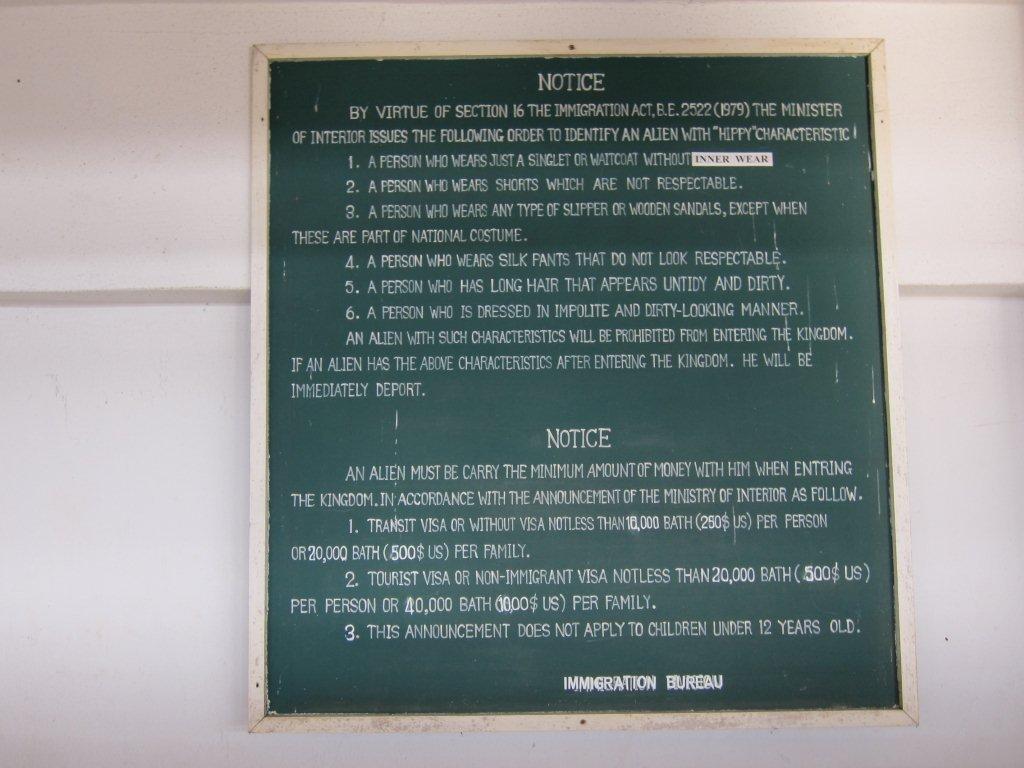
    Leaving Thailand, we saw perhaps the secret to their success: a sign keeping out all those with “‘hippy’ characteristics.”

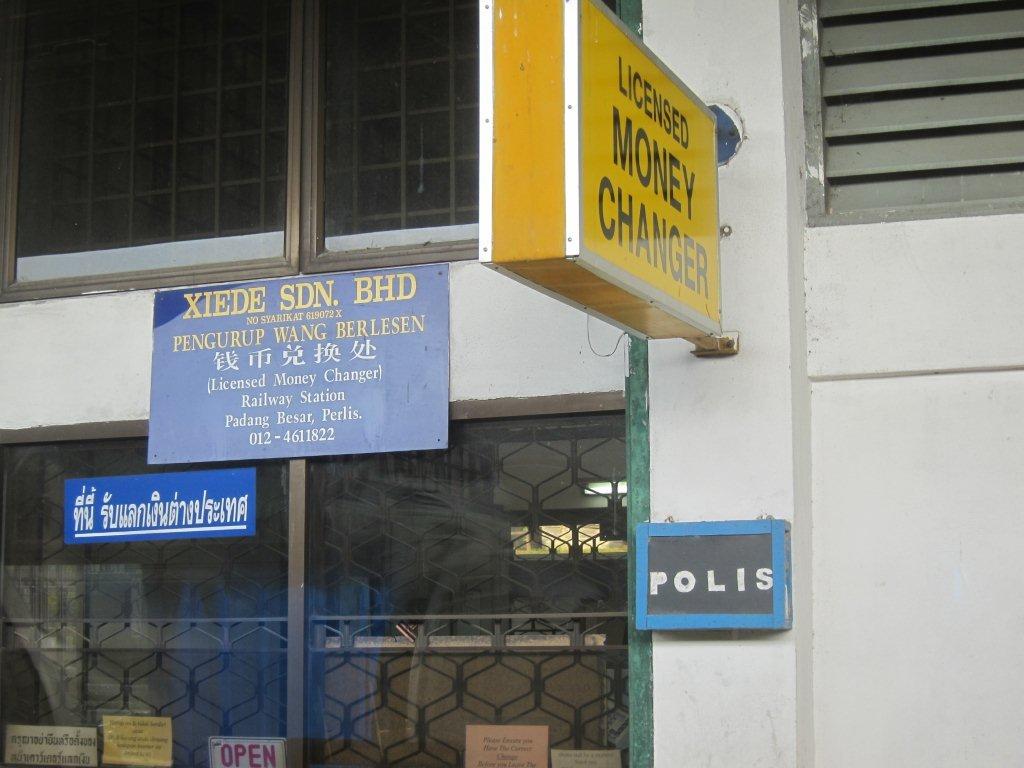
    And the police station sign on the Malaysian side of the border train station. We really did not want to leave Thailand, but damn it was nice to be a place again where you could sound out the alphabet!


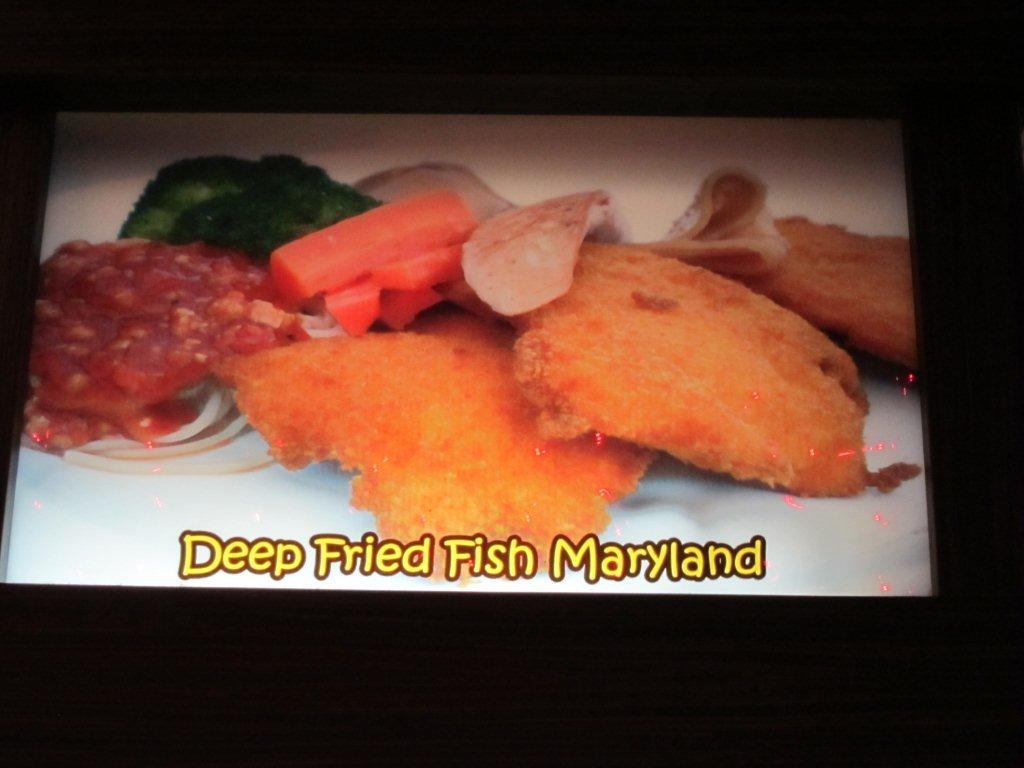
    And I’ve been to Maryland. I know Maryland. And this, my friends, is no deep fried fish Maryland (as seen in Georgetown, Penang, Malaysia).