Tag: sociology

  • The state of sociology

    I’m sure that just like me, you all are browsing the latest issue of Sociological Forum, the quarterly publication of the Eastern Sociological Society.

    Hmmm, here’s an article called “Anomie Among European Adolescents: Conceptual and Empirical Clarification of a Multilevel Sociological Concept.” The “results lend strong support to the theoretical construct of anomie as exteriority and constraint.”

    O-kay… I’ll think I’ll skip that one. Actually, I usually skip most of the articles in sociology journals. So does the rest of the world.

    But in this issues there’s a series of short pieces relating to Sudhir Venkatesh’s Gang Leader For a Day, probably the best selling sociology book in decades. But Venkatesh has gotten some flack from the Ivory Tower because the book exposes weaknesses in ethnographic methodology and is, well, a memoir.

    I’ve mentioned Venkatesh a fair amount about on this blog because our research and writing has a fair amount in common (not in sales, alas). I think we need more intellectuals like Venkatesh.

    The point of writing is to be read (though Venkatesh points out that 90% of those interviewing him about his book haven’t read his book). The point of sociology is to understand (and hopefully improve) the world around us. Venkatesh succeeds because he is interesting, insightful, and writes in a language we can all understand. There’s no crime in that.

    In the Gang Leaderexchange in Sociological Forum, one author asks, “What does America want of sociology?” Venkatesh answers quite frankly: “I don’t think America cares about sociology. And, unless we change our conventions, our writing, and our relationship to the public, I’m not sure they should.”

    I wonder what the fancy sociological term is for, “Oh, snap!”

  • Safe Injection Facilities Conference

    Safe Injection Facilities Conference

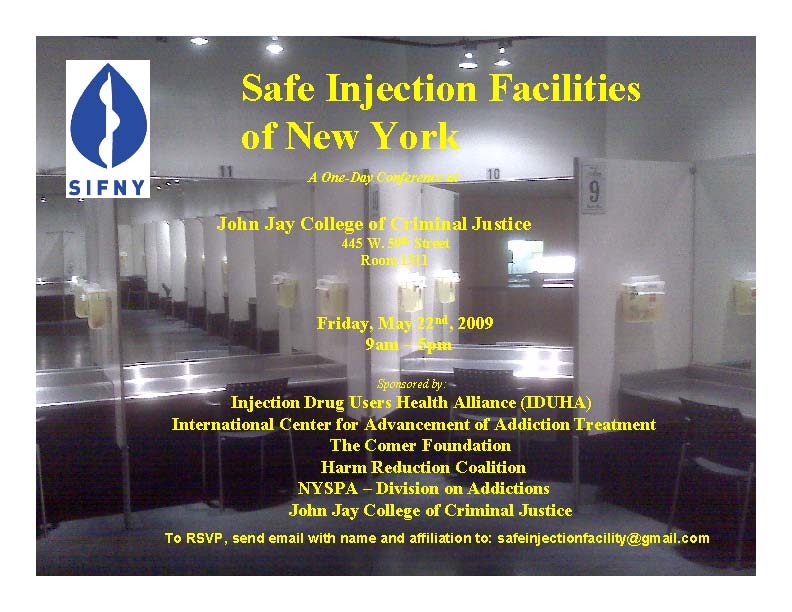
    There’s a one-day conference on Safe Injection Facilities (a legal place where addicts can shoot up) at John Jay College on May 22, 2009.

    The conference organizer is looking for somebody to provide a law enforcement perspective. Any police out there interested in talking about what police officers think about such programs? Email Rick Curtis. It will be fun, interesting, and good place to network with academics and public health people. They need a good law-enforcement perspective so that it’s not all just preaching the choir.

  • Fewer Police Deaths

    Fewer Police Deaths

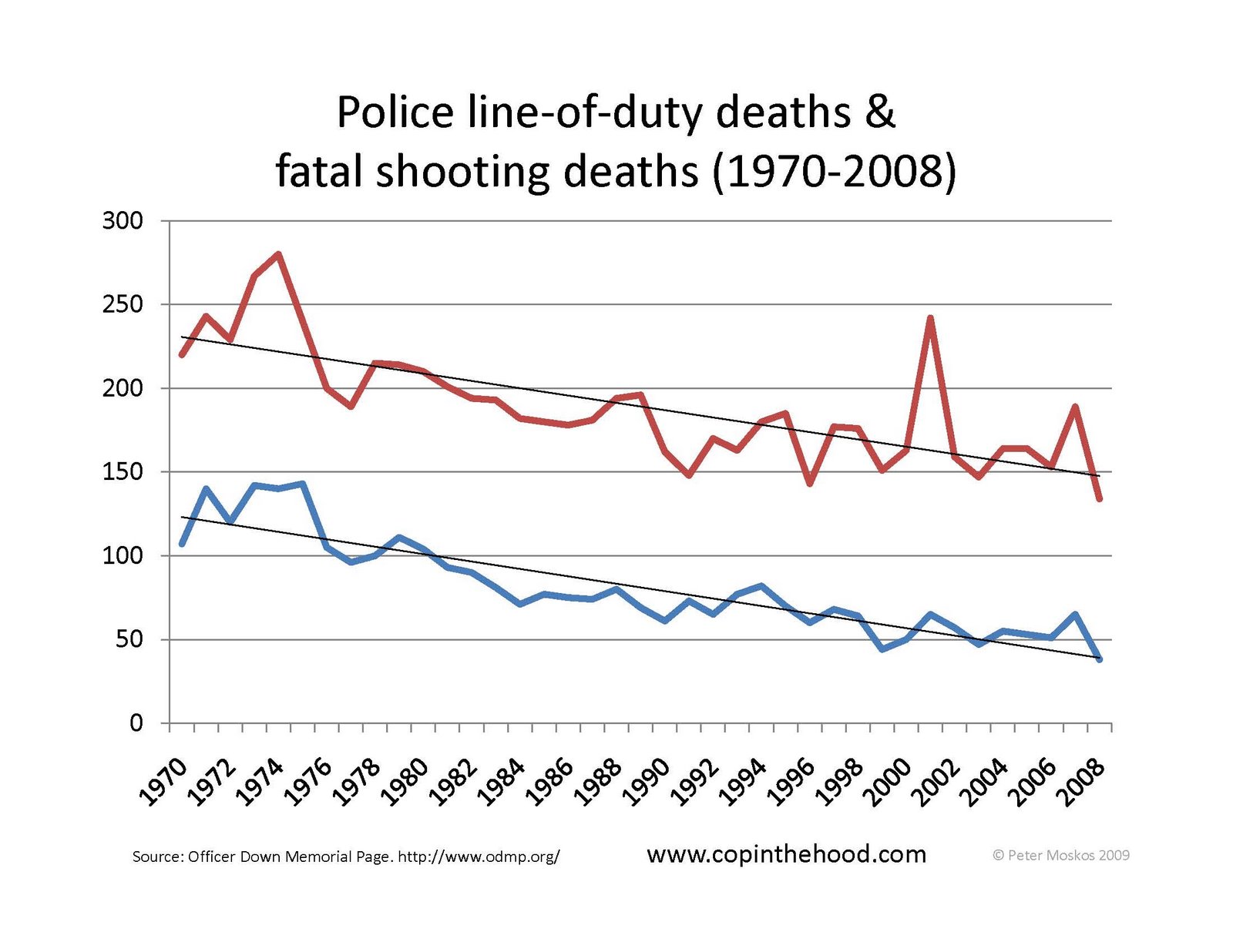
    It surprises a lot of people to find out that fewer and fewer police officers are killed on duty than in the past. I guess it counters the natural inclination to assume that the world is going to hell and violence is out of control and kids these days… have you seen what they’re wearing?

    The top red line is total police line-of-duty deaths. The bottom blue line represents cops shot and murdered on duty. I compiled these data for class. It’s much harder to get data on police-involved shootings.

    After being shot, car crashes comes in a close second. Nothing else comes close.

    Why are fewer police officers killed? Probably a combination (in no particular order) of better training, better emergency medical care, better equipment, and more restrictive shooting policies. Still, on average, a police officer is shot and killed almost every week in America.

    It’s interesting that shooting deaths don’t seem to correlate with overall trends in homicide. Because in general the best predictor of police and police-involved shootings is a high level of violence in the community.

    All the data comes from the Officer Down Memorial Page.

  • Arizona v. Gant

    The court just ruled that police can no longer search a car incident to arrest… assuming the car isn’t within reach of the arrested person and there is no reason to suspect that the car contains evidence related to the arrest.

    Since New York v. Belton(1981), police have assumed that they can search a car any time the driver is arrested. This relates to Chimel v. California (1969) saying a search incident to arrest is justified by officer safety or the interest in preserving evidence.

    In Arizona v. Gant (2009), a man was arrested for a suspended license and in custody in a police car. Police, because they could, searched his car (officer safety?) and found drugs. This is what has been overturned.

    The real-world implications of Grantwill be small. In my experience, most searches of cars happen not incident to arrest but technically to “inventory” belongings when the car is towed. Grant does not address that.

    But I’m always pleased whenever the courts extend fourth amendment freedoms of citizens. It doesn’t happen too often.

  • No Sh*t

    No Sh*t

    The New Orleans Times-Picayune reports: “New Orleans breeds bold killers: half of murders occur in daytime.”

    Duh. Three ace reporters have bylines on this story. Didn’t it occur to one of them to compare their stats with other cities?

    They report: “About half of last year’s 179 murders in New Orleans occurred in daylight,” which is defined as between 6am and 8pm.

    Now this isn’t real hard-core research, but sitting at my computer drinking my morning coffee, I can discover that in Oakland, 55% of homicides happen between 6am and 10pm.

    In Australia
    (the whole country of 20 million, by the way, over a 13-year period ending in 2002, has an average of 316 homicides a year–that’s a homicide rate about 1/30th of Baltimore City)…

    In Australia, 61% of homicides happen between 6am and midnight.

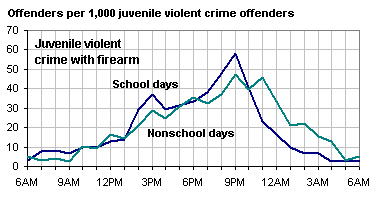
    Here’s a table showing juvenile gun violence by time of day. I bet that homicides correlate pretty strongly with this chart.


    That chart also reflects police call volume in high-crime areas pretty well. And thus (in part) why I liked working midnights.

    My point is that of course half of homicides happen during daylight hours because that’s when people are awake and out and about. And they increase throughout the day because that when problems develop and people get drunk. People don’t wait till dark before killing somebody. People kill when they’re pissed off and have the means and desire to do so. And when it’s bed time, the violence goes down. People go to sleep and have sweet dreams. Then, just like Groundhog Day, it starts over again. And generally, people who kill aren’t early risers.

    So instead trying to find a grabbing headline or presenting this amazing fact as some deep pathology of criminals unique to New Orleans, perhaps the reporters should have just used the google.

    [Note: In defense of the reporters (Laura Maggi, Brendan McCarthy and Brian Thevenot). Reporters don’t write their own headlines. The rest of the story is pretty good. The fault may lay with an editor trying to make a story and an attention-grabbing headline where there really is no story.]

  • Harm Reduction

    I enjoyed attending “New Directions for New York: A Public Health & Safety Approach to Drug Policy” sponsored at the New York Academy of Medicine and the Drug Policy Alliance.

    I was speaking on the Harm Reduction – Coordinating Strategies panel. Unfortunately, because I broke one of my rules and wrote on the back side of a copied piece of paper (rather than in my notepad), I left my notes at the conference.

    You can see the full program here.

    The instructions I received, and I chose to accept them, were these:
    The role we’d like for you to play on this panel is from a public safety perspective. We would like you to speak about where or how a harm reduction strategy would and could fit in the public safety sector, as well as what the barriers are. It would be tremendously useful to hear your thoughts on this matter as one who is an expert in the field of criminal justice and an ex-police officer that patrolled in an area with a disproportionately high rate of drug use.
    There were six on out panal and we each had about eight minutes.

    I made the following four points (or at least I tried to):

    When I arrived in Baltimore, Harm Reduction as it was perceived was seen as a failed program and Kurt Schmoke, a very smart man and advocate of Harm Reduction, was seen as a failed mayor.

    I support drug legalization (though I prefer to use the term regulation). I think it would reduce harm. But to play devil’s advocate to a room of harm-reduction supports I tried to make these points:

    1) It’s probably a safe bet that most academics and policy makers who support Harm Reduction don’t live in neighborhoods where Harm Reduction causes harm.

    As an example, in both Cambridge, Mass, and Baltimore I lived near methadone clinics. It wasn’t the end of the world, but I certainly prefer not living near a methadone clinic. Nobody wants to live next to a methadone clinic… and often for very good reasons. So if harm reduction involves methadone clinics, people who make policy need to understand the needs of all those affected, and not just those in the target population.

    For Harm Reduction to work, it’s very important to understand the opposition to it.

    2) Harm reduction needs to be judged with a multivariate perspective. That is to say, harm is a many faceted thing. For instance when it comes to drug addicts and a public drug market, there are a) the potential health harms to drug users, b) the harms of drug-trade (prohibition) violence, and c) to quality of life issues. If you’re just a normal working stiff, you very well might care most about the latter issue. But research, especially in the public-health fields, tends to be public-health oriented. In this case that means a lot of A and a little B.

    3) Though I’m happy to back in an era of science, understand that many people oppose Harm Reductions on moralgrounds, for instance: drugs are evil. Public-health people aren’t very good at conceiving of or talking about thing in moral terms.

    To find common ground, emphasize the impact on saving lives. That is common ground. Previously, Jill Reeves had given a powerful speech about her own perspective as an addict. She mentioned that one of the greatest needs for addicts is a nine-one-one Good-Samaritan law. In other words, you shouldn’t risk arrest by calling for an ambulance to save a life. That might be a good place to start forming common ground.

    4) Police generally are not sympathetic to Harm Reduction because, well, among other things, it’s not job. To ask police to care about clean needles for the health of addicts, well, it’s not their job. It would be like the police asking a doctor for help in bringing down a drug shop. It’s just not gonna happen. Public health messages geared to police need to focus of public safety and officer health.

    Clean needles, for instance, should be any easy sell. It’s easy to see the link between dirty needles and officer safety. When an officer is sticked, you really hope that needle is clean. I hated seeing officers crush needles in the gutter. Do any addicts get clean by virtues of a police officer crushing their needles? I don’t think so.

    In a different session, P. David Soares, Albany County District Attorney, made a very good point: if we want to stop young boys from working for drug dealers, it would help matters if we didn’t make it illegal for anybody under 16 to work at all.

    By far the loudest and longest applause (at least for what I attended) went to a CUNY colleague, Queens College Professor Harry Levine. He brought down the house (at least as much as you can at such a conference — but this conference was open to the public, so it was a little more rambunctious than the average academic fair).

    Levine ending his (precisely-timed) 10 minute speech by noting that if Obama had lived in New York under current NYPD arrest practices, he could easily have been arrested and, by having a criminal record, had no chance of becoming president. How many potential Obama’s lives out there right now, asked Levine, have we ruined through aggressive arrest policies in our war on drugs? The crowd, as is almost everybody in my New York world, was very pro-Obama.

    Levin is co-author of “Marijuana Arrest Crusade: Racial Bias and Police Policy in New York City 1997-2007.” I learned a lot about New York State marijuana law and police practice regarding said law. And it’s very readable.

    I don’t think Levine is on the NYPD Chief’s Valentine’s-Day mailing list this year.
  • Publishing qualitative criminal justice

    [Fair warning: Intended for stuffy academics. If you think you won’t be interested, you’re probably right.]

    I received the latest issue of Journal of Criminal Justice Educationyesterday. I have to confess, I’m not certain why I get this journal. I don’t remember ever subscribing to it. Of the journals I get, it’s the one I generally find least interesting. Take for instance: “Why we Need Certification Standards in Criminal Justice Education and what the Impacts will be: a Response to the Concerns of JDs.” Yawn. Maybe it comes with membership in some professional criminal justice organization I belong to.

    But the latest issue is great. I mean don’t mean CSI excitement here. But most of this is good stuff:

    “Lombroso’s Legacy: The Miseducation of Criminologists”argues that because of the evil history of genetic-based criminology, we’re missing out on important developments now. Given the poor track record of genetically-based social science, I’m not so convinced that we should be quick to discard the legacy of Hitler and assume that this time, we’ve got it right. I don’t know. Perhaps. They didn’t teach me this stuff (and that’s the point of the article).

    “Reviewers’ Views on Reviewing: An Examination of the Peer Review Process in Criminal Justice.”Worth reading if you’re trying to get articles published.

    “The Great Books in Criminal Justice: As Ranked by Elite Members of the Academy of Criminal Justice Sciences.” No, my book isn’t there. But it’s good to see what some consider to be our canon. If you’re a student in the field, you should know these books. And if you’re a student in the field, there’s a good chance you’ll never all these books in one list, conveniently broken down by field.

    “The Quantitative/Qualitative Divide Revisited: A Study of Published Research, Doctoral Program Curricula, and Journal Editor Perceptions.” This was the best article and that one that made me open the journal in the first place. As a qualitative researcher, I’ve very concerned with this divide. Can you get published if your work does not include statistical regressions? There is good news and bad news. The bad news is that leading journals publish even fewer qualitative articles than I thought. The quantitative/qualitative ratio is roughly 90%/10%. That’s not good.

    The good news is that most editors claim to be open to qualitative works but simply don’t receive enough of them. The article also has what seems to be excellent advice on what you, as a qualitative writer, can do to increase the chances of acceptance in a leading journal. Simple things I didn’t know (basically, among other things, use the format standard for quantitative pieces).

    This article by Kevin Buckler is rare for an academic writing. Along with being a nice blend of well presented quantitative and qualitative data, it’s informative, convincing, well written, and actually enjoyable to read. If you are a qualitative academic trying to get published in criminal justice journals, it is, as they like to say, a “must read.”

  • Amazon Sales Rank

    If you’re a published author, maybe you check Amazon.com sales rank (gosh, of course *I* never do).

    You can read this, this, or this.

    My book topped out at 500 (that’s pretty good) and is currently hovering around 15,000 [update: 50,000]. That means there are 14,999 books selling better than Cop in the Hoodat Amazon.com.

    What does that mean? Hard to say for sure. But the best guess is that a ranking of 15,000 through the world’s biggest book retailer means I’m probably selling about a book a day. And Amazon is perhaps about 1/3 – 1/2 of all sales. In terms of royalties, that’s about $2 day.

    One way to tell for sure is when Amazon gets low on stock. For instance, Amazon.UK (England) currently has one book for sale. They have had one for a while (or so I’ve noticed). When it sells, they’ll have no books for a day or two. So I can be sure I know the next time I sell a book in Europe. …It may be a few days.

    Doesn’t anybody read anymore?

    Have youboughtmy book? If not, please do. It’s cheap. And good.

  • How much I make from my book

    How much I make from my book

    I got my first annual royalty check from the good people at Princeton University Press. Not that you asked, but it was for $983.98. In other words, if you’re thinking of becoming a writer, don’t quit your day job. But it is $983 more than I had yesterday. It also means I’ve paid off my $4,000 advance and seemingly high $856 indexing fee.

    Why do I tell you this? Not to gloat (I’d have to make a lot more if I wanted to gloat, that’s for sure), but to help writers and working people.

    I think people should talk more about how much they make. My wonderful father, Charles Moskos, always gave his salary in his popular and very large intro sociology lecture at Northwestern University (I’m not certain why this came up. I didn’t take his class.). I think it was about $100,000 before he semi-retired. That’s about as much as a professor canmake. It’s funny I can’t tell you for sure. I guess if you talk about money, maybe you care less about it.

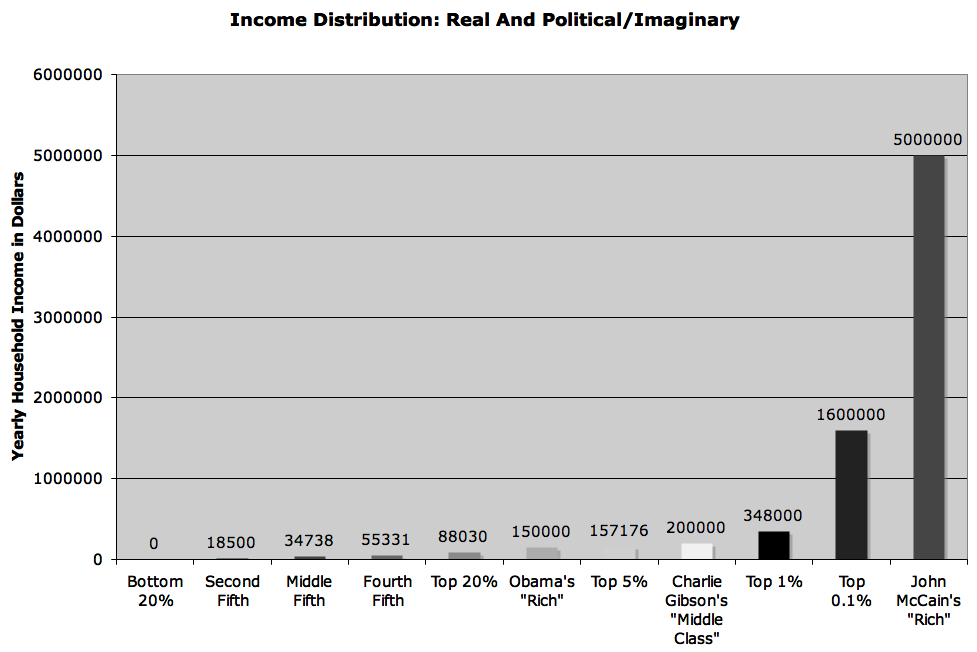
    It’s only bosses and rich people (and I’m talking John McCain rich) who don’t want you to talk about your wage.

    Why poor workers go along with this, I don’t know. Knowledge is power. And knowing how much people make is important if you’re not making much.

    I remember once maybe 10 years ago I was on the L in Chicago and I saw a Chicago Cub usher in uniform. I had that job back in 1988 (a long, hot summer to be wearing polyester pants). It was my first union job. I think I made $4.50/hour. I think somehow my union made me part of the teamsters–that was kind of cool–but my union dues were going straight to crooks.

    My first official payroll job, by the way, was in 1986 as a movie theater usher at the M&R Evanston Movie Theatres (you could tell they were fancy because they spelled theater with an “re”). I think my pay was for two dimes over the then $3.35 minimum wage.

    Maybe that’s when I realized how absurd it is that people making a few cents over minimum wage wouldn’t talk about how much they made except in hushed don’t-tell-others! voices. Some ushers after a few years made, gasp, perhaps 50 cents an hour more than other ushers! Meanwhile my first boss, Elaine, who was very good to me, was evidently embezzling much larger amounts.

    Anyway, back to the L and the Cubs usher. I told this kid that I used to be an Cubs usher way back when and in 1988 made $4.50/hour, about $1 over minimum wage. I told him I was curious how much they were now paying ushers now (or whenever this was).

    Ripping tickets, patting down bags, and pointing people to their seats (and yes, if an usher wipes your seat you should tip)… it’s not exactly a hard job. But I challenge anybody with a desk job to stand on their feet for 8 hours. You do get used to it after while, in the sense that your feet let you. But it’s tiring. One of the strange things rich people like doing to poor people is making them stand while they work. Low paying jobs often have a rule that you can’t sit. Can you imagine the kvetching if rich people hand to stand all day?! There’s something very wrong when bosses who can sit make workers stand for no reason other than to show that they’re in command and that the poor people are actually working.

    Anyway, back to the L and the Cubs usher. I remember being told as a Cub usher that we were not to discuss our salary. Because somehow it wasn’t in our interest. Undoubtedly we were being paid less than the Andy Frain Ushers who had worked at Wrigley Field for 60 years but the Tribune Company replaced a year or two earlier.

    Being told not to say how much I made was like when I was told at worker training at Papagus, Chicago’s Richard Melman’s “Lettuce Entertain You” restaurant chain’s “Greek Concept” (the food was excellent, by the way) that Lettuce Entertain You employees, and I quote, “don’t need unions.” That was sure nice of management to inform of us that.

    I thought of that often on my hour commute on the L back home after being cut at lunch and literally losing money at work after tipping out. For an hour of work, I made $2.01 (waiters make sub-minimum wage in salary). That almost covered both ends of my-hour-one-way commute on the L. But was I not going to give the illegal-immigrant Mexican coffee guy his money just because I didn’t make any? Shit, my Spanish wasn’t good enough to explain why I was being a cheapskate.

    Besides who can put a monetary value on being able to light delicious saganiki and yell, “Oopa!”

    Oh well. I wasn’t supporting a family. Besides, if I was pulling a double I would drop much bigger bucks between shifts chugging screwdrivers when I took my shift break at a bar down the street (don’t worry, your faithful servant would generally sober up while doing his opening sidework–God forbid somebody serving drunk people would actually be a bit tipsy himself).

    Anyway, back to the L and the Cubs usher. No doubt he must have feared that I, this guy riding the L, was a spy from high in Tribune Tower, destroyers of workers and newspapers nationwide. No doubt if he told me how much per hour he was paid, I would report back to the evil bosses in Tribune Tower and have him fired. And I would deflower his younger sister, too, just for fun.

    Minimum wage in Illinois, by the way, is now $7.75. It’s $7.15 in N.Y. and $6.55 in Maryland (that’s the federal level). I looked them up. By the way, if you work minimum wage full time, 50 weeks a year, you’ll make $13,100. These are just kind of good figures to know.

    I still don’t know how much Cubs ushers make these days. I’m curious. And yes, Go Cubs!

  • Baltiore homicide by the numbers

    Back in January, the Baltimore City Paper published a good simple analysis of homicide numbers in 2007. I was just looking at it again. As we all know, violence is not equally spread out in society. It may not be politically correct to talk about race and violence, but homicide in America is disproportionately a problem of black-on-black young male gun violence concentrated in poor communities with public drug dealing. It’s concentrated in places like the Eastern District. The question, of course, is what are we going to do about it?

    There were 282 murder victims in Baltimore City.
    261 (94%) were African-American (the city itself is 65% black).
    258 (91%) were male.
    233 (83%) were shot.
    The youngest was 2.
    The oldest was 82.
    The Eastern District took the crown this year with 50 homicides.