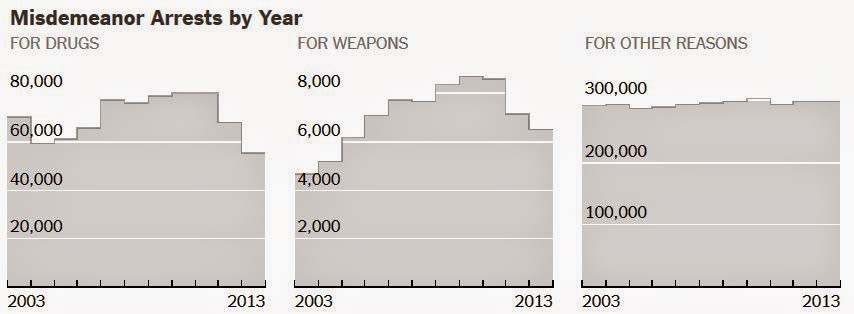
Tag: stop and frisk

  • Stop paperwork (2)

    Stop paperwork (2)

    An email from a Chicago Police Officer (emphasis added by me):

    I wanted to go through our new “investigatory stop report (ISR)” training before I replied. By now you realize we have an extremely long form to fill out every time we do a street stop. The form is ridiculous and redundant but fortunately the department has created a shorter form that will we start using on March 1st. I think they missed the point with the gripes about low street stops. The form sucks, is burdensome, and redundant, but it’s just paperwork.

    The issue is that there is still heavy oversight by the ACLU and many private attorneys and their quick access to all information on ISRs. So now, instead of just your sergeant deciding if you have articulated enough reasonable suspicion, each ISR has to be approved by a sergeant, the integrity unit, and then combed over by an endless amount of lawyers looking for the slightest hiccup in the report. Private attorneys have started contacted people stopped about two weeks after each incident, by phone and/or mail and asking them how the police treated them while they were stopped. This is really unsettling.

    All of this seems like a direct result from the McDonald shooting, even if it’s not. Although no one is talking about it (the media has moved on to other police issues from where we park to the “thin blue line” code of silence). Immediately after the dashboard camera video came out, most cops were defending the shooting even after seeing the video. I get it. I would not have shot, but I understand why Van Dyke did. A crazed maniac on PCP with a knife is certainly dangerous and it doesn’t morally bother me that he was shot. I do think it was a bad shooting, but not by much. Although, I come from a newer generation of policing with a different mindset I suppose.

    After the protests and eventually when the ISR system came out, everyone started to vilify Van Dyke as the cause of all this oversight whether or not they believed it was a good shoot or not. Those that believed it was a good shot, no longer say anything about it, if that makes any sense. Basically, no one is supporting Van Dyke anymore, at least not openly. Meanwhile, street stops are down an astronomical percent and homicides are at at 12-year high through February. On the 11th, the superintendent sent out an email to the department reminding them that it’s still okay to do street stops. No one took it seriously but the bosses have to do something to get numbers.

    The idea that every report is being read by people looking to sue police officers is not a way to encourage productive proactive discretionary police activity.

    The first two months of 2015 saw 51 homicides. 2016 has seen 101. That’s double, for those slow in math. If you don’t want to call this a “Ferguson Effect,” fine. I’ve never liked the term. But perhaps we can agree that if police feel they can’t do their job for fear of lawsuits and/or criminal prosecution and thus do their job differently and then crime goes up, something is going on?

    So if you don’t like “Ferguson Effect,” how about we call it the “when police feel they might get in trouble for doing their job, so police — mostly to satisfy critics on the left who seem not to care how many people die as long as police are not involved — get out of their car less, stop fewer people, interact with fewer criminals, and then murders skyrocket” effect?

    See part of the police job is to harass criminals. Maybe you can think of a better word than “harass,” but I use that work intentionally. Because policing isn’t all please-the-old-ladies-going-church. People don’t like to talk about it, but there is an actual repressive part of the job — legally and constitutionally repressive, but repressive all the same. When that doesn’t happen, criminals commit more crime.

    [What I also find interesting in that a change in police culture with regards to what constitutes a good shooting is happening in front of our very eyes in Chicago.]

    And here’s the email from the Acting Chief:

    Good Evening Everyone,

    I want to clarify concerns regarding the Investigatory Stop Report (ISR) and the Department’s Agreement with the American Civil Liberties Union of Illinois (ACLU). I have heard your concerns and I am working toward a solution.

    First, since January 1, 2016, Illinois Law requires all law enforcement agencies in Illinois to document investigatory stops and protective pat downs. We are not alone in this endeavor; the entire state is tasked with documenting investigatory stops and protective pat downs. Neither the law nor the Department’s Policy has changed as to when stops and pat-downs are appropriate; merely the documentation has changed.

    Second, Officers will not be disciplined for honest mistakes. I know that the Department ISR Policy has been in effect since January 1, 2016. The Department is working tirelessly to train everyone on the ISR policy and procedures. I know there is a learning curve and I appreciate your understanding as we make this transition.

    Third, I would like to clarify the agreement between the Chicago Police Department and the ACLU. The Department has not relinquished any control of our policies and procedures to the ACLU. The agreement does not provide the ACLU with any role whatsoever with respect to individual officers’ compliance with the Department’s policies. The Department alone is responsible for supervising compliance with policies and procedures. Rather, the Department’s agreement with the ACLU provides that a former federal judge, the Honorable Arlander Keys, will review CPD’s policies, practices, and data regarding investigatory stops and recommend any changes that are reasonable and necessary to comply with the law, and that the ACLU will have an opportunity to review and comment upon CPD’s policies, practices, and data.

    Fourth, our Department is working to reduce the burden on officers. Remember, completing an ISR is in the best interests of Officers based on the Illinois State Law. A properly completed ISR helps protect the officer by documenting the basis for the stop and any resulting pat-down. Additionally, the transparency of the agreement with the ACLU and the ISR create a trust and mutual respect between our agency and the communities we serve.

    Lastly, officer safety is one of my greatest concerns, and continues to be a valid basis for a protective pat down. Officers simply need to describe in the ISR why they believe their safety was at risk. To perform a stop, an officer must have reasonable articulable suspicion, based on the facts and circumstances, that a crime has been, is being or is about to be committed. And, before an officer conducts a protective pat-down, he or she must have reasonable articulable suspicion that a person stopped is armed and dangerous and therefore poses a threat to the officer’s safety or the safety of others. Neither of these requirements are new policies.

    I appreciate all of the hard work that each of you do on a daily basis. Additionally, thank you for your service and dedication to the people of Chicago. Take care and stay safe.

    Sincerely,

    John J. Escalante

    Interim Superintendent of Police

    Chicago Police Department

    Here’s the long form in question and my previous post on “stop paperwork.”

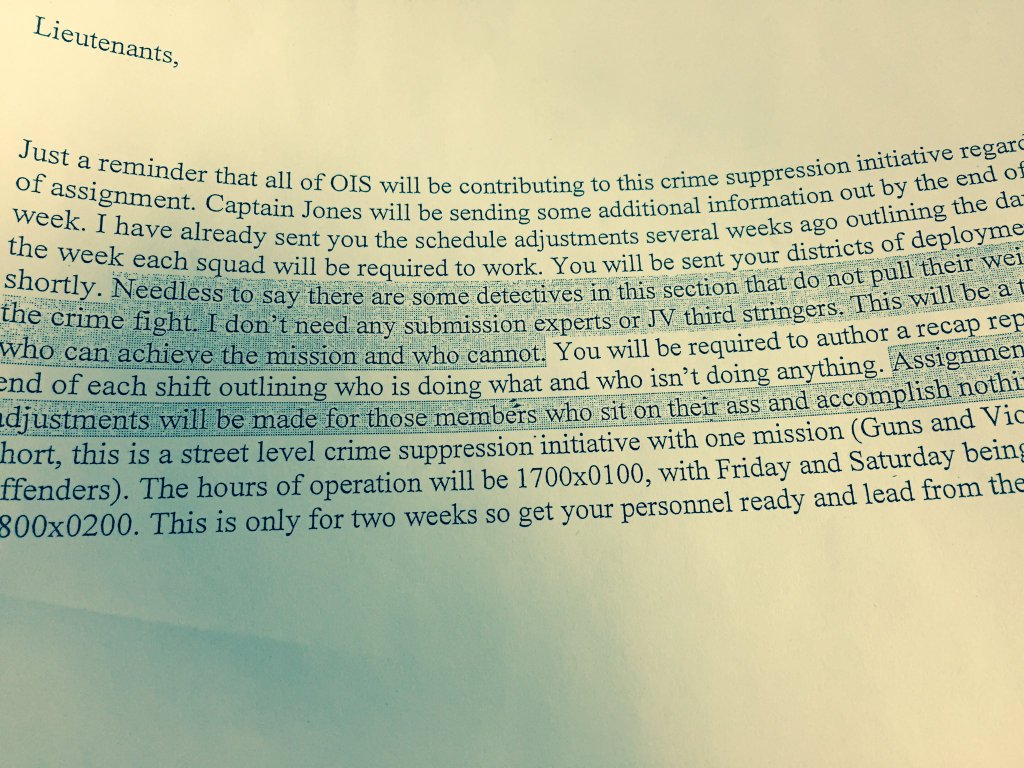
    Maybe Chicago could learn from the Baltimore way of motivating cops: pull your weight; and no “submission experts” or “JV third stringers” need apply!
  • Stop paperwork

    In Chicago, as in New York City, police officers have been instructed to fill out a new an extremely burdensome form every time they stop somebody. This would be great if eliminating police stops were a worthy goal.

    In Chicago, as reported in the Sun-Times:

    Interim Chicago Police Supt. John Escalante said Tuesday he hopes to counter a severe downturn in street stops by responding to cops’ complaints about the “burdensome” reports they’ve been filling out since the beginning of the year.

    Escalante told the Chicago Sun-Times that officers will start using a new, streamlined form on March 1.

    Street stops plummeted 79 percent in January compared with the same period of 2015. Meanwhile, murders and other crimes have skyrocketed this year in Chicago, which many cops have attributed to the slowdown in street stops.

    The city and the ACLU agreed last week on the streamlined form.

    Meanwhile, in New York, stops are down and reported crime this year to date is basically steady. Homicides are down 25 percent. Shootings down 30 percent.

    Subway crime is reported up. Or so I hear. I’m not certain because I can’t find any actual data on subway crime.

    I did see this video of a guy been egged on to assault a Chinese food delivery guy. The delivery man decided to fight back, got in a few punches (hee), and lived to tell about it. But what’s interesting is that this took place in the lobby of public housing, exactly where cops are patrolling less aggressively since they were accused of harassing poor innocent tenants hanging out in lobbies. While this is just one incident, it is exactly why police do need to patrol lobbies of public housing. And no, it’s not just a matter of people who don’t live there. It’s about maintaining order.

    According to one resident of public housing I spoke to, things are getting slightly worse in terms of people up to no blocking the way of people coming and going. But “it’s not nearly as bad as it used to be [years ago]. But it’s swinging in that direction.”

    Next post on this.

  • “Stop question and frisk” is dead

    “Stop question and frisk” is dead

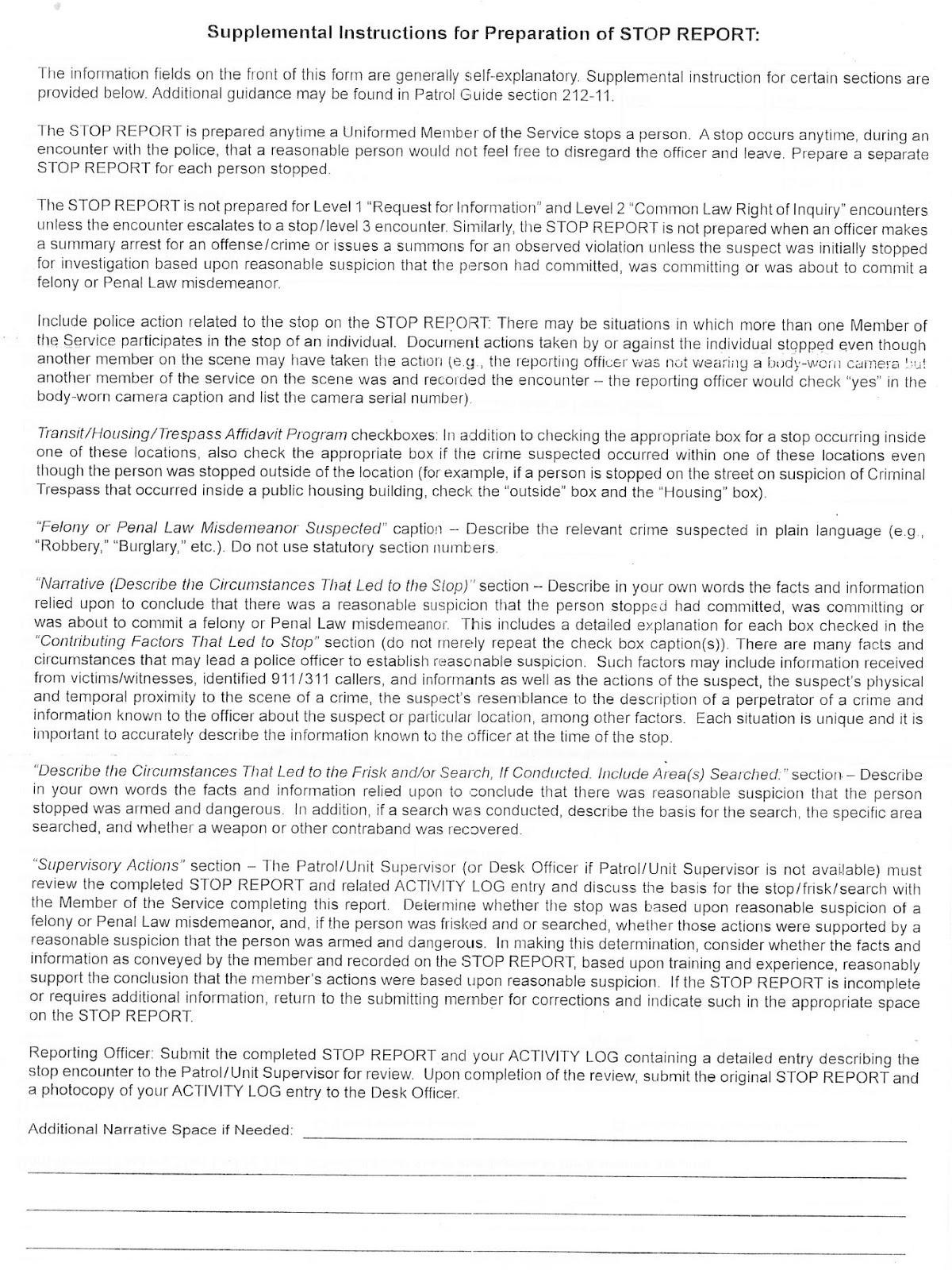
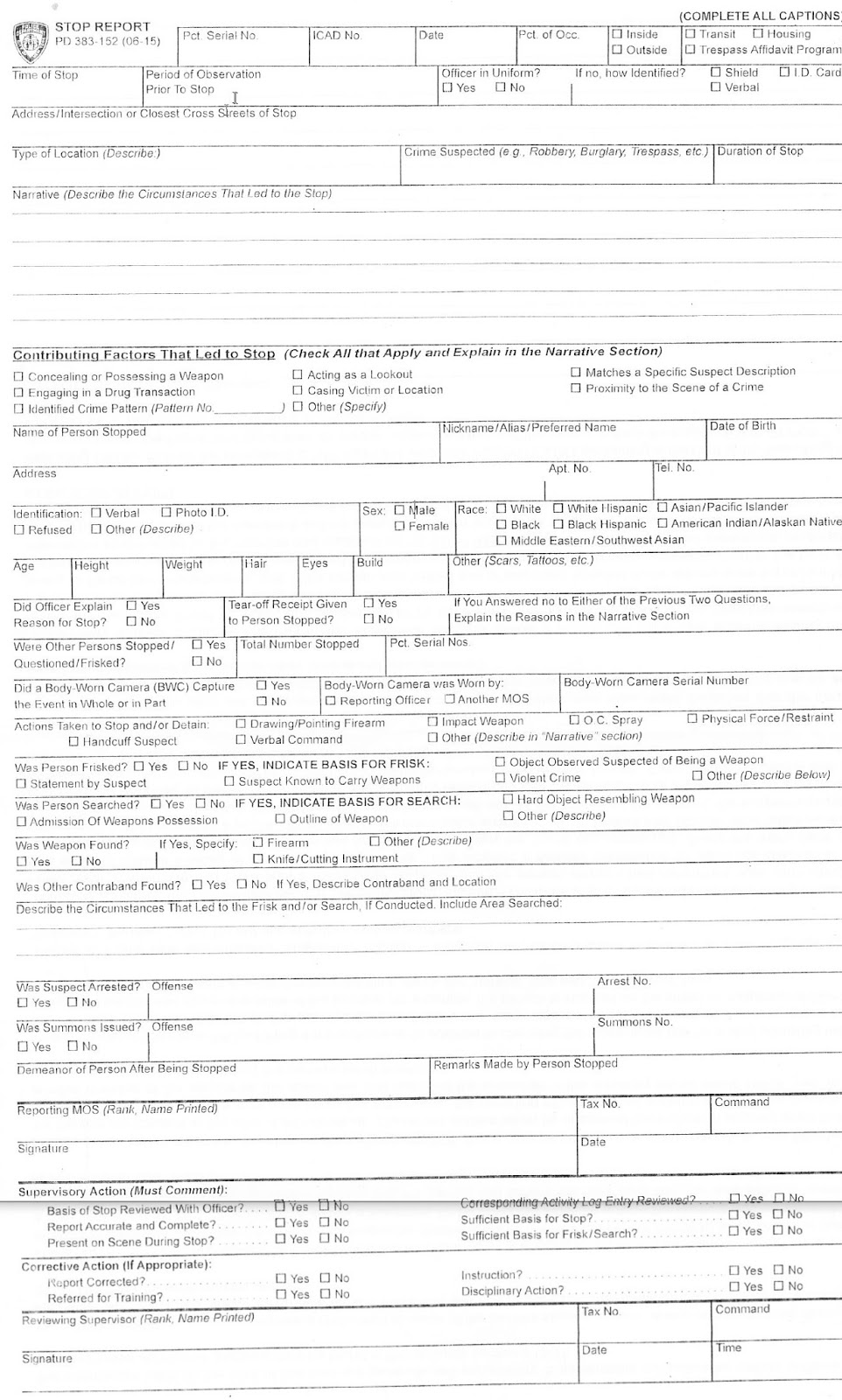
    Welcome the NYPD’s “PD 382-152” (06-15), née UF-250, AKA Stop Report, just FYI:

    This new “UF-250” replaces the old “UF-250” from 2002 that made an unconstitutional mockery of reasonable suspicion as laid out in Terry v. Ohio. (Also FYI, the original form actually called a UF-250 is long dead; long live the UF-250!)

    If the goal is fewer stops, add paperwork to each and every stop. Two things will be accomplished:

    A) There will be fewer stops.

    B) More stops will go unrecorded. (Who the hell has time or desire to fill out a form every time and tell a sergeant every time you stop somebody?)

    And what’s clever, is that in the supervisory action (must comment), you can’t just swipe down the “yes” column. It throws a “no” in there just to slow you down.

    More importantly, and correctly, there’s an actual “narrative” section. Yes, police officers will actually have to “articulate” their “reasonable suspicion” rather than checking a box saying “furtive movement.”

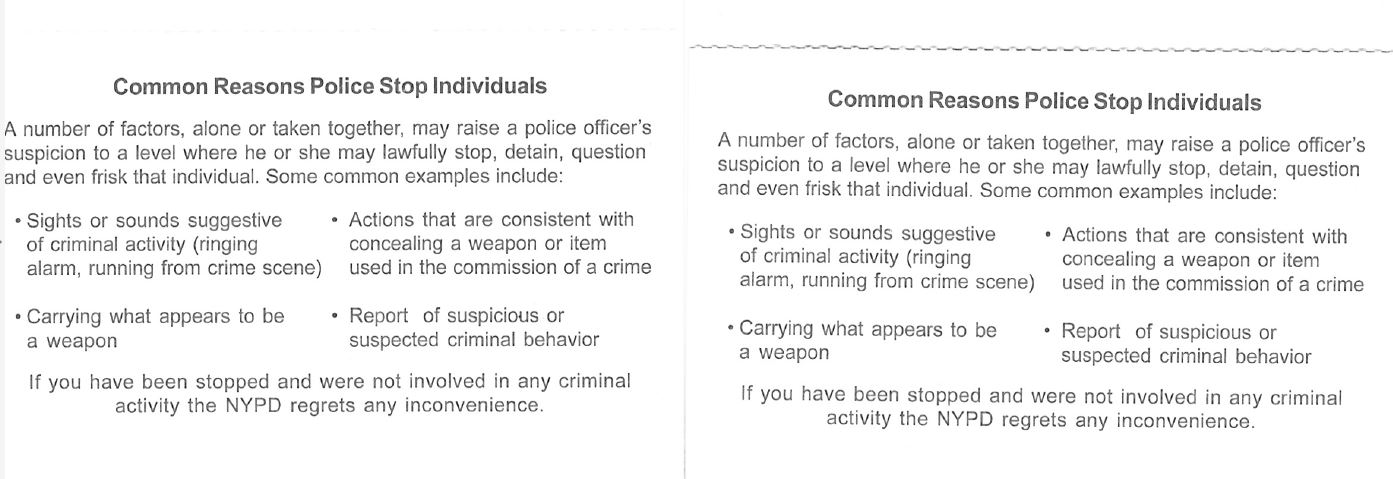
    And the back:

    And then you’re supposed to give the person this card (fat chance):

    Years or weeks from now, when past years’ “stop question and frisk” controversy is but a footnote to NYPD history, this form will still exist. And then, every time an officer doesn’t fill one out — because, for instance, there’s work to be done or there won’t be any forms available — he or she will be in violation of the patrol guide.

    Business as usual will adopt to get things done in a organization designed to be dysfunctional. Because we don’t really want an officer spending 5-15 minutes filling out a form and debriefing a sergeant every time they briefly stop somebody or pat a criminal down to make sure they’re not armed. (Can you “frisk” a person without “stopping” them? I don’t think so.) And then one day further in the future an officer will get in trouble for not following the absurd rules.

    Footnote from 2000: “Completion of the UF-250 form has been required since 1986. In 1997, however, Commissioner Safir declared filing the UF-250’s “a priority” that should be “rigorously enforced.” As a result, filings by the SCU, to cite one example, rose from 140 in 1996 to 18,000 in 1997.

  • Shootings up in NYC

    The recent crime numbers in NYC will soon come out, and they’re not good. Homicides this week are way up compared to last year. Of course that’s just one week… till it’s not. Shootings are up in NYC. Not Baltimore up. But up. People are dying. It is time to ring the alarm. Maybe not the crazy 5-alarm fire for Baltimore. Maybe a simple 1-alarm would do NYC. But more people are dying.

    So what might be the cause? A lot of things of course. One factor may be people’s willingness to carry heat. Word on the street is that guns are back in town. As I was told: “People are now shooting into crowds more often, doing drivebys, more often, and shootings as teams more often. The risk for carrying a gun in nearly zilch. Bottom line: cops aren’t stopping people, and young black men are paying for it with their lives.”

    Stop and frisks are down roughly 95%. Now we could debate whether certain police tactics are legal, constitutional, or moral. We should debate these things. Maybe it’s OK to have 50 more dead bodies in NYC if hundreds of thousands of other young black men aren’t stopped by police for no good reason. So let’s have that debate. What bothers me is the disingenuousness of those who refuse to grant criminals any agency in crime. Like Broken Windows is the root of all evil. Like it is inevitable that 2015 would see a 10 to 20 increase in shootings in Brooklyn. And it must have been written by the Almighty that some in Baltimore would riot on April 27, and then the homicide rate would skyrocket.

    Criminals don’t leave their guns at home because they’re asked politely by community leaders. It is possible that force and coercion might, in some cases, keep people alive. Remember (before we forget) that the arguments against stop, question, and frisk weren’t only that it was illegal, unconstitutional, and morally reprehensible. It was that it didn’t work — that stop, question, and frisk was actually counterproductive with regards to crime prevention. (I never quite understood that argument, but it was said.)

    The role of guns in NYC homicides is surprisingly varied. It wasn’t that long ago (well, the 1970s) that guns were used in less than half of all murders in NYC. In 1960, at least according to one source, guns were used in just 20 percent of homicides. But that changed in late 1960s and 1970s.

    By 1990, guns in NYC out of control. 1,650 killed by guns, 75% of all murders, higher than the national average (not including NYC) of 67%. (All these percentage may be a bit low based on “other and unknown”.)

    So along with all murder going down in NYC, gun murders went down in particular.

    In 2000 65% of murders in NYC involved guns. (Compared to 66% in the rest of the nation. UCR data, all.)

    In 2005 61% in NYC. (Rest of nation: 68%.)

    In 2010 60% in NYC. (Rest of nation: 68%.)

    In 2013 59% in NYC. (Rest of nation: 70%.)

    Meanwhile, the percentages of gun homicides in other cities is much higher: 84% in Chicago; 79% in Los Angeles; 81% in Baltimore. So New York looks all the more impressive.

    This was a little heralded victory against gun crime in NYC. While the rest of the country saw a small increase in the percentage of homicides involving guns, NYC saw a decrease.

    I asked my friend, Dan Baum, who insisted on being identified as “a liberal Democrat Jewish gun owner who wrote Gun Guys: A Road Trip“. Baum can write. (Too bad you didn’t buy his book.)

    Anyway, I asked Baum about what changed in the 1960s. Gun violence increased 50% in the 1960s (five times more than other/non-gun violence). He said:

    What changed in the early 1960s? JFK was shot, and the liberals began their long love affair with gun control. Until 1968, you could buy guns through the mail. Guns were things that people owned, but they weren’t a cultural marker, a badge of belonging to a particular subculture.

    The liberals changed all that, by relentlessly pushing the bubbas into a corner. Suddenly, people were in a panic to buy all the guns they could, because they never knew when the liberals were going to ban their sale altogether. The NRA, taken over by the loonies in 1977, pushed that narrative. The number of guns circulating in private hands exploded exponentially, with predictable results. Not only that, a tremendous amount of anger was injected into the national discussion around guns — also not a good thing.

    So I’d argue that we have the liberals, and gun control, to thank for the huge increase in gun murders. Guns are way more prevalent than they used to be, because the liberals made them a thing. Had they not done that, we’d be back in 1960 America — guns being a thing that some people own, that have no cultural/political/spiritual significance.

  • Shootings up in NYC

    Shootings are up 20 percent this year. Bratton is blaming marijuana. I doubt it. But maybe. I’m certainly willing to consider the idea. Most liberals, I find, never ever consider the idea that their advocacy might have unintended consequences, like more young black men getting murdered.

    That said, Bratton pointed to drug dealers getting killed. That was illegal last year and remains illegal this year. So I’m not certain how not arrested people for small scale marijuana possession really changes anything. (For public safety or Broken Windows, that is. It certain matters for the guy getting arrested or not.) If the increase is as Bratton describes it, these killings seem more like old-fashioned Prohibition killings than decriminalization killings.

    But… it could be that criminals are more brazen in response to less aggressive policing. And maybe some robber smoking a joint last year would have gotten stopped by the po-po. But not so in 2015. I’m not saying that is the reason. But it’s possible.

    Here’s the story in the Times. Worth reading if you’re into this kind of thing.

  • Crime isn’t up

    Crime isn’t up

    Man, if you read the NY Post, you might think the city is going to hell. And all because a liberal is mayor and cops’ hands are tied: “The attack raised fears of a new wave of anti-cop violence — with a police union president blaming the assault on Mayor Bill de Blasio and his crackdown on stop-and-frisk.”

    I don’t want to minimize the danger of “air mail,” people throwing things from high above. It can indeed kill. But I doubt this potential murderer threw a bike at cops because police no longer make quota/productivity-goal based stops.

    I also don’t want to minimize the unfairness of potential lawsuits brought against individual police officers who are, in good faith, trying to do their jobs.

    Even my old sergeant from Baltimore couldn’t resist telling me how New York was not longer safe without all those stops, not to mention a liberal Sharpton-loving mayor in charge!

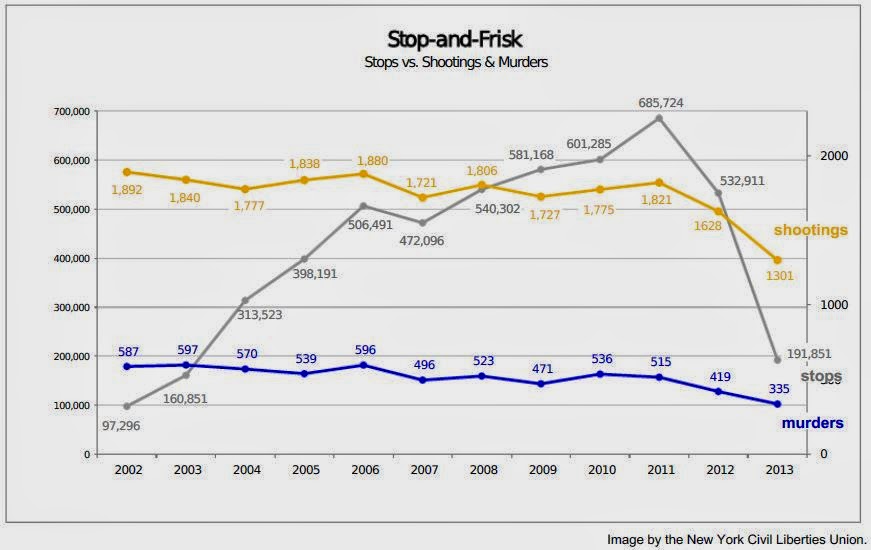
    But there’s one problem with crime-is-up-because-stops-are-down theory. Crime isn’t up! So until crime actually does increase, can we all just stop talking about the rise in crime so matter of factly?

    Here’s my theory: Cops have, are, and always will stop people when they have reasonable suspicion. Why? Because that’s what cops do! Call it doing your job or professional pride or whatever. Cops want to stop crime and catch criminals.

    But what cops are not doing much of making stops just to meet some perceived quota. This means that literally hundreds of thousands of guys a year are not being stopped because they’re wearing baggy pants in a high-crime neighborhood.

    I understand that logic of why massive stop-and-frisks could have a deterrent effect on crime. And yes, school is now out, the summer is hot, and stops have been way down for almost a year.

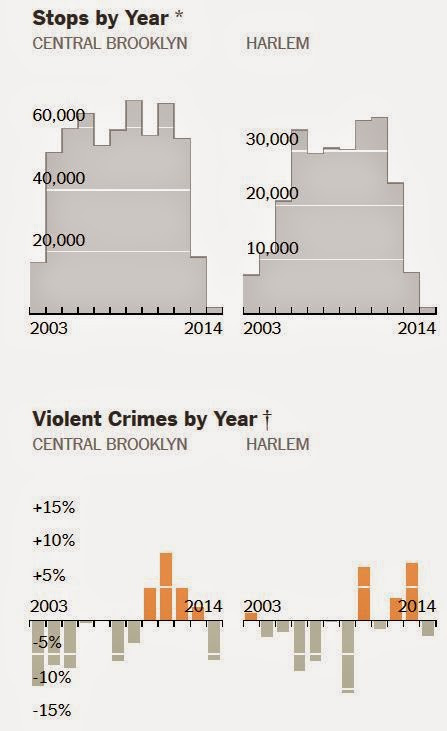
    Now this chart only goes to last year. This year stops are down, murders are down a bit, and shootings are up a bit. Overall, according to the stats, crime is basically unchanged (down 3%). But I make it habit not to rely on any crime numbers other than shootings and murders.

    So stops are down and crime is still down. Yes, crime is up in some places, but it’s down in other and overall constant. In the 75, stop are down 90% and shootings are up 30%. And leave it to a real news source to find local residents saying police need to start up those stops again!

    As somebody just put it (I forget where I just heard this), “what we have now isn’t a crime problem but a newspaper-selling problem.” I might also add there’s a bit of a problem with an ideology that believes the only effective policing is repressive policing.

    Is there a correlation there between police inaction and more shootings in East New York? Almost certainly. But we can deal with that without going back to blanket (and now illegal) police of massive stops and frisks.

    People feel safe when they see police and normal life functions. Police presence is key. Police getting out of their car is key. Police need to know the people — good and bad — in their area. Police need to stay in one area for a long time so that knowledge isn’t wasted. But 600,000 stops a year? That’s too many. And zero? That’s too few. But somewhere in between the two — and toward the lower end — it’s going to be just right.

  • Bratton tweak Operation Impact…

    …By putting rookie officers with more veteran officers. This should have been a no-brainer years ago. Partnering dumb with dumber — both right out of the police academy, both sometimes clueless white boys from Long Island — was never a brilliant idea (though even then it did help reduce crime). Rookie cops faced with quota pressure who could not distinguish class differences in the ghetto led to a lot of unwarranted stops, questionably legal marijuana arrests, and political backlash that hurt the NYPD. It also reinforcing the idea that foot patrol was just something to be endured before you got to become real police.

    The story in the Daily News.

  • Bratton says morale was low in the NYPD under Kelly…

    …And Bratton is right. Should be the end of the story, despite what you’ll read in the Postand the Daily News.

    More interesting is what is buried in the Daily News story:

    Police made 12,495 stops between October and December — down a staggering 86% from 89,620 during the same time period in 2012. And of the stops during the last quarter of 2013, 16% resulted in an arrest. That’s up from 6% over the same period in 2012.

    Raising the hit-rate of stops is a great indicator that more stops are based on actual real articulatable reasonable suspicion (you know, what is legally required) and not just quota pressure (er, productivity goals). 2,000 arrests from 12,500 stops is better than 5,400 arrests from 90,000 stops. Of course if these data simply mean more stops are unrecorded, this “improvement” could mean nothing…

  • Too *few* stop, question, and frisks? Perhaps…

    Bill Bratton was just quoted in the Post saying that the NYPD is conducting too few stop and frisks.

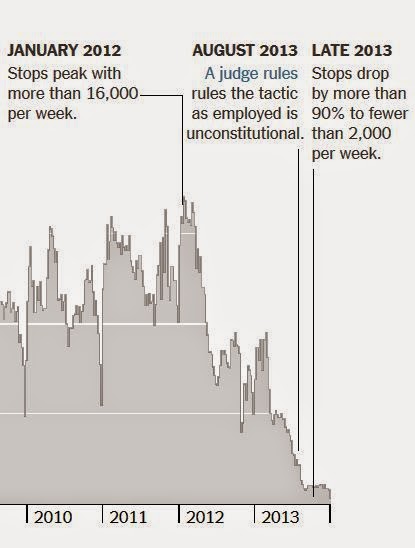
    Who would have thought that the shameful practice of mass stop, question, and frisk would ever end? Actually, I did (though I was two years too quick to predict its gradual demise). I knew there was internal pressure from up high in the NYPD to reduce quota-based stops. But nobody I know, certainly not me, expected the stops to completely stop! For that, we can thank not just the stop and frisk lawsuit but the absurd over-reaction of the PBA.

    We’re down to 3,000 stops a month. That’s 36,000 stops a year. Back when the NYPD conducted almost 700,000 stops a year (in 2011), I said that most of these stops were quota (er, “productivity”) driven, not needed, and bad police work.

    More recently I wrote:

    We now know that all these stops were not needed. Throw out that bathwater! But be careful, because there is baby somewhere in that murky water. Surely some of these stop are needed. You know, the stops based on officers’ reasonable and honest suspicion.

    We need to ensure we don’t let “stop and frisk” give a bad name to good police officers using discretion legally stopping (and questioning, and sometimes frisking) suspects.

    So is there a “right” number of stop, question, and frisk? I hate to quantify individual acts of police discretion (doing so is what got us into the stop and frisk mess). Bratton pointed out that stops should be “based on what officers are seeing and what they are reacting to. There is no number that you want to project toward.” But on a city-wide macro level, I think it’s fair to expect a certain number of proactive stops conducted by the NYPD en masse.

    Based on my intuition (and the “hit rate” for white people stopped, I suspected that an 80 percent reduction in stops would have no adverse effects (and much positive impact on police morale and police/community relations. Cut stops 80 percent and what’s left, the remaining 20 percent, might actually serve an essential crime prevention purpose.

    An 80 percent reduction from the peak would have been about 11,000 stops a month. (Put another way, this is less than one stop per month per patrol officer. Of course that number is just an intuitive guess. Perhaps the ideal number of stops is half or twice that.) But no matter how you look it, 3,000 stops per month is to low. To paraphrase a politically incorrect sign in the police station in which I used to work, “Unlike the citizens you police, you are required to work for your government check.” Police officers (and the PBA) would be wise to remember that.