Tag: stop and frisk

  • The NYPD is a-changin’

    Bratton Tells Chiefs He’ll Stop Sending Rookies to High-Crime Areas

    And, as you probably know, DeBlasio is dropping the city’s appeal to the stop and frisk lawsuit. But hoping to limit a federal monitor to 3 years. In response: “Four unions representing NYPD officers have filed appeals and motions opposing dismissal of the city’s appeal, which are pending.”

    Good times. Fun times.

  • “Decreased Stop and Frisk Causes Crime to Skyrocket in NYC”

    Well that’s the headline I would have expected to see after listening to Ray Kelly and Mayor Bloomberg (and almost all my police friends) over the past few years. They had me believe that each and every one of those more than 600,000 annual stops in 2011 was absolutely essential to prevent the city from descending into an Orwellian Escape from New York type chaos!

    Well this year stop, question, and frisks are down 50 percent and homicides are down another 20 percent (which is really amazing).

    Today the city released a press release touting this most recent crime drop (did I mention how amazing this is?!). Interestingly, nothing was said about stop and frisk. How odd.

    So while some stop and frisks are needed — you know, ones based police officers’ actual reasonable suspicion that a suspect is armed — it seem like the NYPD can do just fine, gosh, perhaps even better, while stopping 800 fewer people per day.

    The problem when you try and quantify the “productivity” of police work (or almost any occupation) is that those being judged start to play to the stats. Means becomes ends. Ends be damned.

    But now Bloomberg barely gives the police any credit at all! Here’s the press release:

    To: Interested Parties

    From: Howard Wolfson

    RE: T-Minus 5

    Over the last 10 days, Mayor Bloomberg has been to each of the five boroughs, cutting ribbons, touring schools, riding on a new subway extension, visiting new parks, and discussing the incredible progress of the last twelve years.

    Today and tomorrow the Mayor will highlight the Administration’s record fighting crime while reducing incarceration rates by visiting a Neighborhood Opportunity Network Center and by attending his final police graduation ceremony to swear in more than 1,100 police recruits.

    Under Mayor Bloomberg and Police Commissioner Ray Kelly crime has fallen in New York City to record lows:

    Safest big city in the nation: New York City has fewer major felony crimes per 100,000 residents than any of the nation’s top 25 largest cities.

    Total Crime: Down 32% compared to 2001, despite the added demand of counterterrorism, having fewer officers in the ranks, and adding 300,000 more people to the city’s population.

    Murder: On pace to have a record low number of murders in 2013 following a record low established in 2012.

    Murder is down 49% compared to 2001.

    Shootings: On pace to have a record low number of shootings in 2013 following a record low established in 2012.

    Terrorism: Since 9/11, there has not been a successful terror attack against New York City, despite the city remaining a top terror target.

    At the same time that Ray Kelly and the NYPD have brought crime to record lows, the Bloomberg Administration has actually reduced incarceration rates in New York City by 36% over the last twelve years.

    This drop occurred as the national incarceration rate rose by 3% during the same period.

    So during the last twelve years, the United States also saw crime declines, but it was achieved by locking more people up. But New York City didn’t reduce crime by locking more people up: in fact the City actually put fewer and fewer of its citizens behind bars as crime fell to record lows.

    How? The crime prevention strategies implemented by the NYPD, and under the leadership of Deputy Mayor Gibbs, Commissioners Vincent Schiraldi, Dora Schriro and others the City have expanded use of felony drug courts, alternative-to-incarceration programs for substance abusers, expanded alternatives to jail sentences for misdemeanants, created more effective probation programs and implemented the Young Men’s Initiative, which is reducing increasing opportunities for young black and Latino men and reducing the number of young black and Latino men who are entering the criminal justice system.

    The result? New York City is the safest it has ever been.

  • “You can’t stop me! You can’t do that no more! There are new rules!” says gun-toting idiot

    The Post reports (and some cops confirm) that word on the street is that cops can’t stop anybody anymore. Of course that’s not true. But it still make for some chilling anecdotes.

    “You can’t be stopping me, yo! The cops can’t be harassing us!”

    He was still frisked.

    And yet there is still no apparent increase in violence.

    [thanks to J.S.]

  • Five charts Ray Kelly Doesn’t want you to see!

    Five charts Ray Kelly Doesn’t want you to see!

    (Can you guess I was just on buzzfeed? A better headline would be “Murders way down in NYC. And so are stop and frisks. And nobody seems to care.” But what kind of clickbaite would that be?)

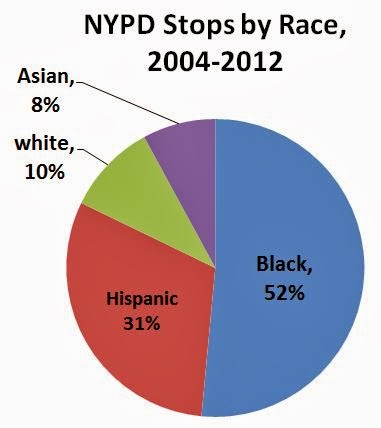
    1) Breakdown of NYC stops by race.

    Indeed, as often reported, 83% of stops have happened to black and hispanic people.

    2) Breakdown of NYC homicide victims by race.

    But ninety-one percent of homicide victims were black or hispanic. Wow. Actually, this is the chart Ray Kelly wants you to see. Critics of stop and frisk generally don’t like talking about this issue (as if the racial disparity in violent crime will just go away if we ignore it). But it is relevant. It may not excuse the racial bias of stop and frisk, but it goes a long to explaining it. Cops are where the violent crime is. Cops stop people where cops are assigned. Ergo cops stop black and hispanics disproportionately. “Racism without racists,” it’s sometimes called. It’s not that individual cops are racists in their day-to-day work, but the end result of a stop-and-frisk policy can still racist.

    3) Hit rate for stops of black people.

    (this and then next figure are taken from Mother Jonesand the data from the Center for Constitutional Rights)

    One in 143 stops of blacks yields guns, drugs, or other contraband. Compare this to the rate for whites who are stopped.

    4) Hit rate for tops of white people.

    One in 27 stops of white people yields guns, drugs, or other contraband. Same yield with 19 percent of the stops.

    Wow.

    One way to interpret these data is that white people must be 5.4 times as likely as blacks to be packing heat or drugs! Of course that’s unlikely. So why is contraband 5.4 times as likely to be found on white people? Because white people are more likely to be stopped based on actual suspicion (there is much less pressure to produce stats in low-crime neighborhoods). Black people are being stopped because Compstat and “productivity” pressure in high-crime neighborhoods mean some officers stop people simply because the feel they need to stop people to fill out the UF-250s (the stop, questions, and frisk form).

    So how about this for a goal: get the “hit rate” for blacks up to the same level for whites. Not only would this be fair, it would be good policing. It would also go a long way to mitigating the problem of excessive stop and frisks. And it’s not hard to do. Make smart stops, not more stops.

    5) Stops and homicides are both down!

    For years Bloomberg and Kelly were basically saying that every one of the five, six, and seven-hundred-thousand stops was necessary to keep the city from exploding in crime. An inevitable part of the crime drop in New York City.

    And yet stops have plummeting in the past two years (2013 figures are estimated year-end totals based on latest available data). In part this is from pressure from the top and in more recent part instructions from the PBA.

    And homicide? Must be way up, right? Because Bloomberg and Kelly have insisted we need all these stops to keep homicide down. And yet we’re on track from just over 300 homicides for the year in NYC. (Again, estimated year end total).

    What did I just say New York City is on track to have just 318 homicides this year?! That’s amazing. Why is this not front-page news? This 22 percent reduction is not from a crack-fueled high of the late 1980s but from the record low year of 2012! The 2013 homicide numbers are an amazing accomplished. (I mean Baltimore City used to top 300 homicides with just 650,000 residents.)

    Homicides in New York City are down 22 percent this year and nobody seems to want to take credit! Attackers of stop and frisk never like to highlight any evidence that might be used to imply stop and frisks are effective. But defenders of stop and frisk can’t reconcile a huge crime drop that correlates with an even larger decline in stop and frisks. In two years stops have been cut in half and homicides are down by one-third. (Of course there might be a delayed link between the end of stop and frisk and a rise in crime, but I think the past year or two should be enough time to see such a lag effect).

    So for crying out loud, give the NYPD some credit! Just last year academics, once again, were saying crime had bottomed out; crime won’t go down; crime can’t go down any more. And yet, once again, it did. This was not inevitable. This is not irreversible. But as Bill Bratton likes to say, “Cops count and police matter.”

    So give the NYPD credit for a record low number of murders, but remind them that this amazing reduction in homicide has happened without unnecessarily stopping and bothering another 350,000 innocent black and hispanic New Yorkers this year. That matters.

    We now know that all these stops were not needed. Throw out that bathwater! But be careful, because there is baby somewhere in that murky water. Surely some of these stop are needed. You know, the stops based on officers’ reasonable and honest suspicion.

    The crime reduction can continue at the same time unnecessary stop and frisks and ended. One goal should be to raise the hit rate for blacks stopped to the same level as found for whites who are stopped. This alone could reduce the total number of stops (and misdemeanor marijuana possession arrests) more than 80% from the 2011 high. The good news is we’re already half way there.
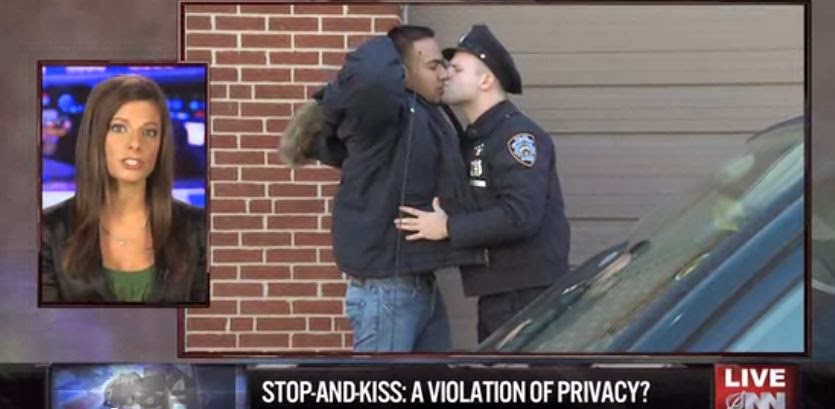
  • Shira Scheindlin Stop & Frisk Smackdown

    I’m in beautiful Sydney. Spring is in the air and the birds make funny sounds just to remind me that I’m on the other side of the planet. Despite my focus on the Festival of Dangerous Ideas, I couldn’t help but notice that everything Judge Scheindlin decided regarding stop and frisk has been put on hold! The New York Times reports:

    A federal appeals court on Thursday halted a sweeping set of changes to
    the New York Police Department’s policy of stopping and frisking people
    on the street, and, in strikingly personal terms, criticized the trial
    judge’s conduct in the litigation and removed her from the case.

    “In taking these actions, we intimate no view on the substance or merits
    of the pending appeals,” the two-page order stated.

    In its ruling, the panel … criticiz[ed] the judge for improperly applying a
    “related-case rule” to bring the stop-and-frisk case under her purview.  

    This is a fair smackdown of the judge. For a judge with a strong opinion on a case to make sure she gets a case so that her decision becomes law of the land makes a mockery of the concept of an independent judiciary. I mean, we all knew how she was going to rule.

    In an age of political cynicism, I’m actually thrilled to see that such shenanigans are not the way the system is supposed to work. And the system self corrected. (though it seems like this should have been decided before she heard the whole case.)

    I might be the only person in the world who agrees with this reprimand and (most of) her original decision. (And I still hope the cameras on cops pilot program proceeds.)

  • This is a big deal

    This is far more radical than anything Judge Scheindlin ruled in her well publicized stop and frisk decision.

    In a 3-2 decision (People v. Johnson is not long and worth reading in its entirety) the court managed to rule the following unconstitutional:

    In a New York City Housing Authority building, which the testifying officer characterized as a “drug-prone” location, the officer observed defendant descending the stairs to the lobby. Upon seeing the police, defendant “froze,” “jerked back,” and appeared “as if he was going to go back up the stairs,” although he never retreated up the stairs. The officer asked defendant to come downstairs, and defendant complied. The officer inquired whether defendant lived in the building, and defendant replied in the affirmative, whereupon the officer asked defendant to produce identification. Defendant immediately clarified that he was visiting his girlfriend, who lived in the building, and informed the officer that his identification was located in his pocket. As defendant moved his hands to retrieve it, the officer’s partner grabbed defendant’s left arm and pulled his hand behind his back, revealing a handgun inside defendant’s coat pocket. The officer seized the gun and placed defendant under arrest.

    Seems like good policing to me. This is from the dissent:

    Defendant initially told the officers that he lived there. However, when asked for identification, he began to stutter, and changed his story to say that he was visiting his girlfriend. Although defendant stated that he had his identification in his pocket, he began moving his hands “all over the place, especially around his chest area,” which the officers interpreted to be threatening and indicative of possession of a weapon. To “take control of the situation” before it could “get out of hand,” an officer grabbed defendant’s left arm and brought it behind defendant’s back, which caused defendant’s open jacket to open up further and reveal a silver pistol in the netted interior coat pocket. One officer removed the pistol from the pocket, and another handcuffed defendant.

    You can also read the New York Times article.

    What are police officers now allowed to do? Where exactly in this arrest did police overstep their bounds? I don’t get it. The court said it had a problem not with subsequent stop and frisk, but with the initial questioning!? I cannot fathom (maybe somebody can explain to me) why this isn’t covered under what is known as the “common-law right of inquiry.” See, for instance, People v. Moore, which limited but defined that right.

    I don’t see how to downplay this decision and say it’s no big deal (which is my usual reaction). If you were trying to get police to stop policing, telling officers they don’t have the right to question suspicious (and, in the end, armed) suspects seems like the ideal way to do so.

  • Stop & Frisk: They Had It Coming

    Stop & Frisk: They Had It Coming

    A (cop) friend in Baltimore asked me with regard to stop and frisk: “What the hell is going on?” I emailed back:

    You know, leaving aside the decision was entirely predicable based on the judge not exactly being a friend of police, her decision is actually kind of mild. All she f*cking asks is for cops to stop making illegal stops. It’s really not too much to ask for.

    The idea that cops can stop and search (because we both know how frisks can turn into searches) somebody and not even have/be able to articulate reasonable suspicion is absurd (because we both know how easy it is to articulate reasonable suspicion). They have these stupid forms in NYC (called UF-250s) and all the officer has to do is check a box — no writing required, because the forms were made to be idiot proof, which helps turn some cops into idiots — saying “furtive gesture” or something. It is a little absurd.

    A few months ago she instructed politely, and the police department ignored her. The NYPD got what they were asking for. They refuse to rational engage/debate even with people who don’t hate cops. So now they get some smart-ass judge telling them what to do. Kelly had it coming.

    I think the NYPD could reduce stop and frisks by 75% without any impact on crime — because probably 75% are quota driven and not based on valid suspicion, but instead are based on the end of the work period, not having 5 UF-250s that month, and worried that the sgt will chew you a new asshole. So you stop the first young guy in baggy jeans that walks by (who happens to be black).

    What worries me is what will happen if the cops stop doing that last 25%, the stop and frisks that are actually based on reasonable suspicion. Then shootings will go up.

    I still haven’t gotten my head around the federal monitor, however. And I’m kind of excited about the pilot camera program. I can’t imagine it will work well, but if it does it should help police tremendously, despite what police fear. Ten years ago I was against cameras (I think), but technology has moved forward. Cameras are there whether cops like or not. So it’s good to have a camera with a police POV.

    [Update: this is worth reading, by John Timoney. On the plus side (though he presents it as a negative) look at all the overtime cops are likely to get!]

    Related, there’s an excellent piece in Salon by Brian Beutler, “What I learned from getting shot.” Walking down the street in D.C., Beutler was held up by two black guys in hoodies and then shot three times. He was very lucky to live:

    I didn’t buy a gun, though several well-wishers seemed to think that night would’ve ended better if I’d been armed and had initiated a saloon-style shootout in the middle of the street. Other well-wishers wondered — let’s not sugarcoat it — if the experience had turned me into a racist.

    Those emails were easy to respond to.

    [Kal] Penn got in trouble for touting the supposed merits of New York’s stop-and-frisk policy. To the objection that the policy disproportionately targets blacks and Latinos, he responded, “And who, sadly, commits & are victims of the most crimes?”

    But that’s a non sequitur. A false rationale. Take people’s fear out of the equation and the logical artifice collapses. Canadians are highly overrepresented in the field of professional ice hockey, but it would be ridiculous for anyone to walk around Alberta presumptively asking strangers on the street for autographs. When you treat everyone as a suspect, you get a lot of false positives. That’s why above and beyond the obvious injustice of it, stop and frisk isn’t wise policy. Minorities might commit most of the crime in U.S. cities, and be the likeliest victims of it, and that’s a problem with a lot of causes that should be addressed in a lot of ways. But crime is pretty rare. Not rare like being a professional hockey player is rare. But rare. Most people, white or minority, don’t do it at all.

    Everyone who’s ever shot me was black and wearing a hoodie. There just aren’t any reasonable inferences to draw from that fact.

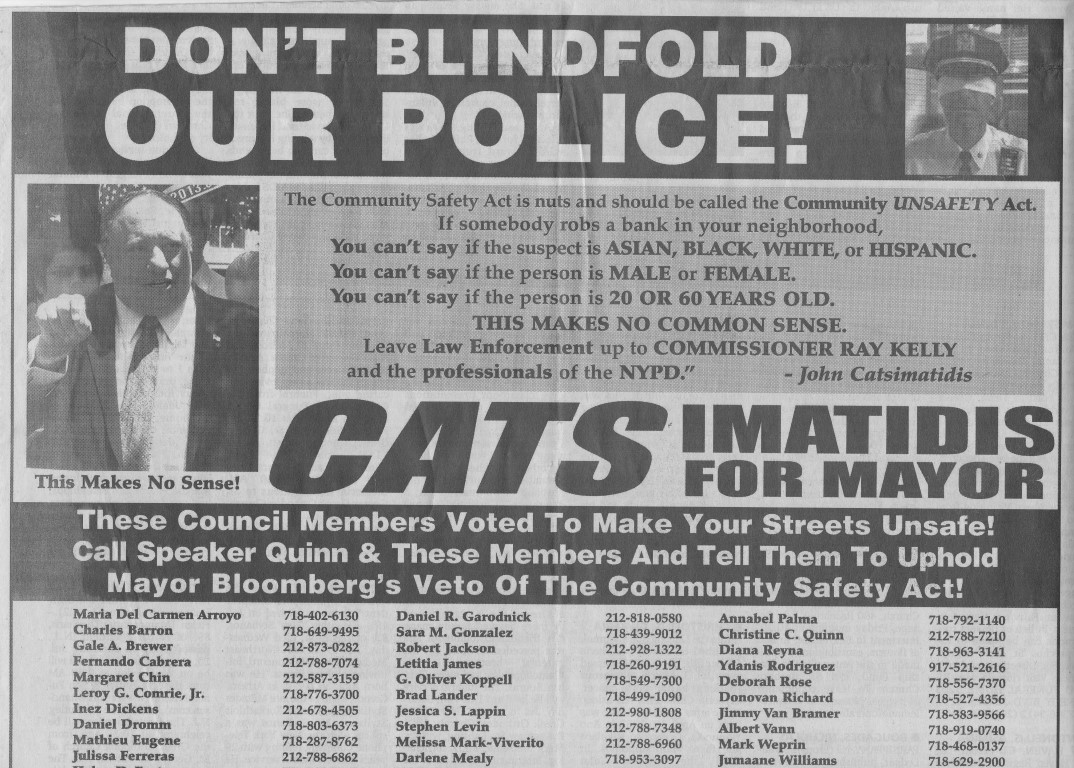
    And file this under Right Wing Lies (VIII). There’s an ad in the Greek-American paper, the National Herald, for John Catsimatidis. He’s a Republican running for mayor. The ad shouts: “DON’T BLINDFOLD OUR POLICE!” And there’s even a picture of a ranking officer violating rules by mis-wearing a uniform for a political ad (those are two separate violations). The ad is about The Community Safety Act, a not very significant anti-profiling bill passed by the New York City Council. Catsimatidis says, and it’s presented as a quote:

    The Community Safety Act is nuts

    and should be called the Community UNSAFETY Act.

    If somebody robs a bank in your neighborhood,

    You can’t say if the suspect is ASIAN, BLACK, WHITE, or HISPANIC.

    You can’t say if the person is MALE or FEMALE.

    You can’t say if the person is 20 OR 60 YEARS OLD.

    THIS MAKES NO COMMON SENSE.

    Leave Law Enforcement up to COMMISSIONER RAY KELLY

    and the professionals of the NYPD

    The problem, and I bet you can see where I’m going with this, is that those statements are bald-faced lies. The law is about police profiling. Of course you can describe a suspect. Shame on Cats, the lying Greek.

    But I can picture Greek grandmother in my neighborhood. She always suspected those Democrats loved crime and supported criminals. And now she knows it to be true because she read Yannis say it in the Herald.

  • Worth Reading

    Ta-Nehisi Coates on Stop and Frisk. It’s also well worth scrolling down to read his posts on Trayvon Martin and Zimmerman. Coates is one of the main reasons I haven’t written very much on the subject (another being I was on the road). Coates wrote what I was thinking. And he wrote it very well.

  • Stop, Question, and Frisk in court

    Stop, Question, and Frisk in court

    From the Times:

    Mr. Esposito insisted that a supervisor could conclude that a stop was legal based on reviewing that form alone.

    “If it’s filled out properly, it gives you reasonable suspicion. And if you have reasonable suspicion established, then you do not have racial profiling,” Mr. Esposito said. “It’s as simple as that.”

    Except it’s not.

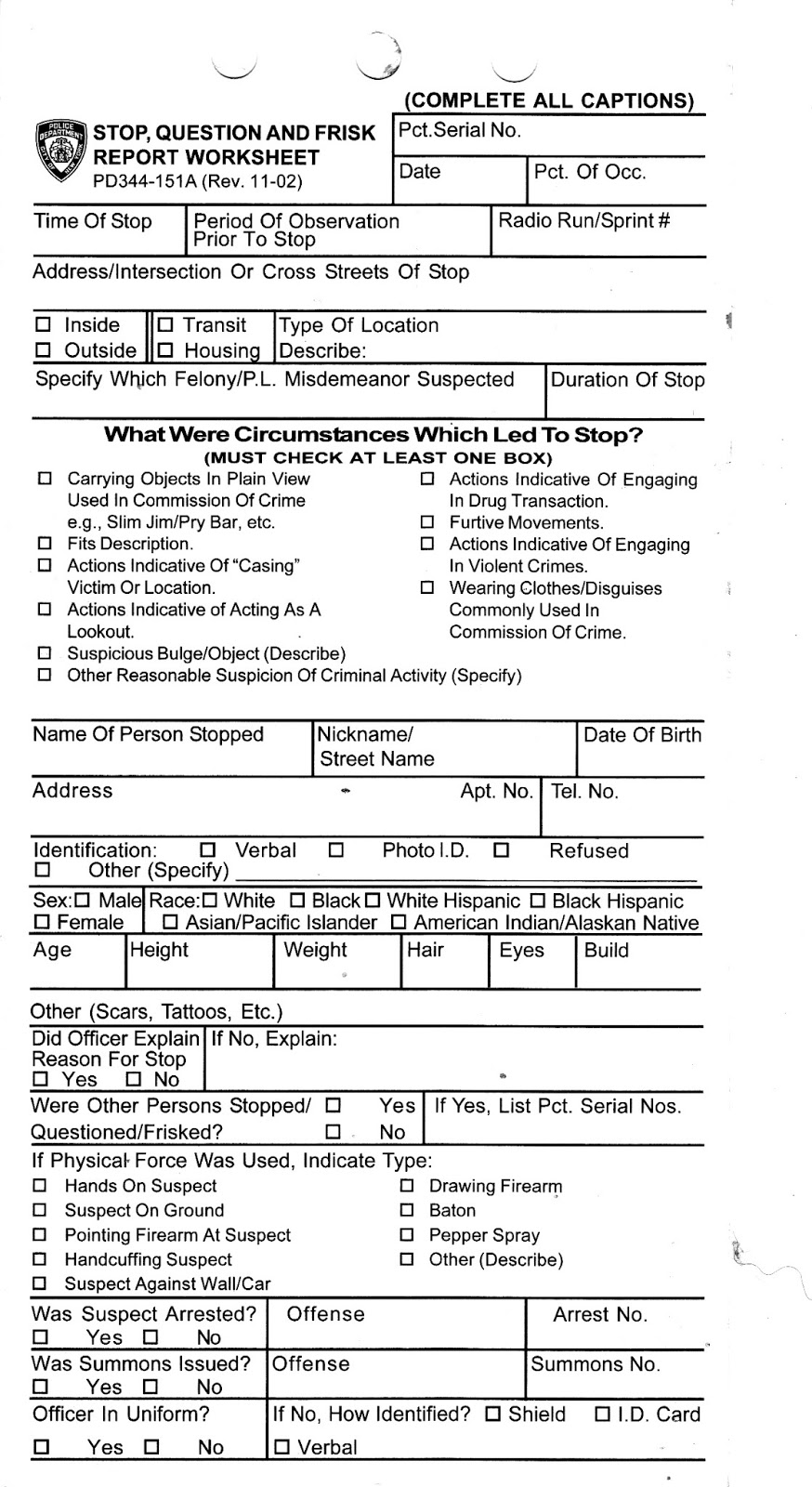
    Here’s the “UF-250.”


    Again from the Times:

    But Judge Scheindlin appeared skeptical that the paperwork proved anything.

    “Any officer can check off ‘high-crime area’ and ‘furtive movements,’ ” Judge Scheindlin said, referring to two check-box categories on the stop-and-frisk form. “You really don’t know much about the stop, looking at the form, do you?”

    No, you don’t.

    The Supreme Court has said that officers need to be able to “articulate” (based on the “totality of the circumstances”) why they have reasonable suspicion for a stop or probably cause for a search.

    Take Terry v. Ohio, where the whole concept of reasonable suspicion was invented. Detective McFadden wrote:

    I noticed two colored men [Keep in mind this was written in 1963] standing at the corner of Huron Rd and Euclid Ave. I noticed one of these men would leave the other and walk West on Huron Rd. He would kind of slow his walk and look in the the United Air which is located at 1276 Euclid Ave but has a rear entrance on Huron Rd. He would then continue to walk West on Huron Rd and stop and then as he came east again he would pause and again look into the United Air lines. When he came back to Huron Rd and Euclid he would talk to the other colored man and the other man would take the same walk and do the same as the other other man pausing in front of the United Air Lines. During the time I was watching them they made about three trips each. While they were together at the corner I saw [a] white man who came east on Huron Rd stop and talk to these two colored men and after he left them he walked west on Euclid Ave. I could not see him after he left these men and can not say where he went or what he did. About five minutes after this white man left the corner these two colored men met the white man again and they stopped and talked. At this point I approached these three men and informed them I was a police officer and told them to keep their hands out of their pockets.

    Now that’s reasonable suspicion!

    Detective McFadden patted the men down and found a couple of loaded guns.

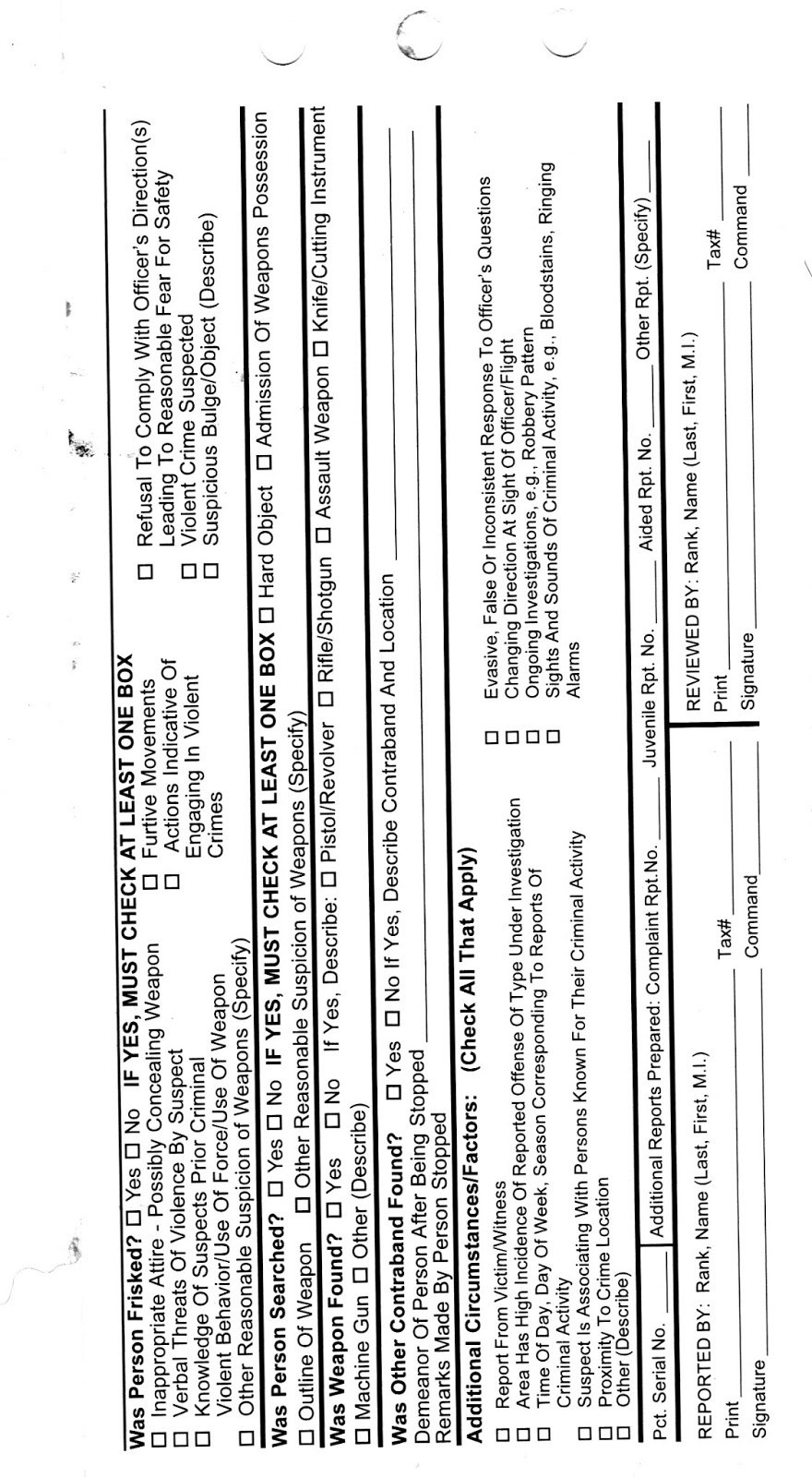
    Today, the NYPD brass has tried to make the process of describing reasonable suspicion so idiot-proof (on the horrible and somewhat self-fulfilling assumption that police officers are idiots) that Detective McFadden would simply have to check a few boxes. For “What Were Circumstances Which Led To Stop?”, I’d go with, “Actions Indicative of ‘Casing’ Victim or Location” and perhaps “Actions Indicative of Acting As A Lookout” and then throw in “Furtive Movements” (whatever that means) just for kicks. And “Was Person Frisked?” I would go with “Actions Indicative Of Engaging in Violent Crimes.” And finally, for “Was Person Searched?” Let’s check “yes” and “hard object” and “outline of weapon.”

    Does any of this “articulate” anything about what Mssr. Terry, Chilton, and Katz actually to did? Of course not.

    Would it establish reasonable suspicion, thus disproving racial profiling? Esposito says yes. The court is going is going to say no.

    One irony of all this is that the “UF-250” only exists because people were worried about too many police stops. Before stops could be quantified, the department couldn’t use them as measures of productivity. Now that they can be counted, the department wants more of them.

    As asked in court: “Do you think focusing on the raw numbers gives the wrong impression to your subordinates?”

    That’s an excellent question.

    And the answer is an unqualified “yes.”