Tag: stop and frisk

  • NYC Shootings and Homicides

    NYC Shootings and Homicides

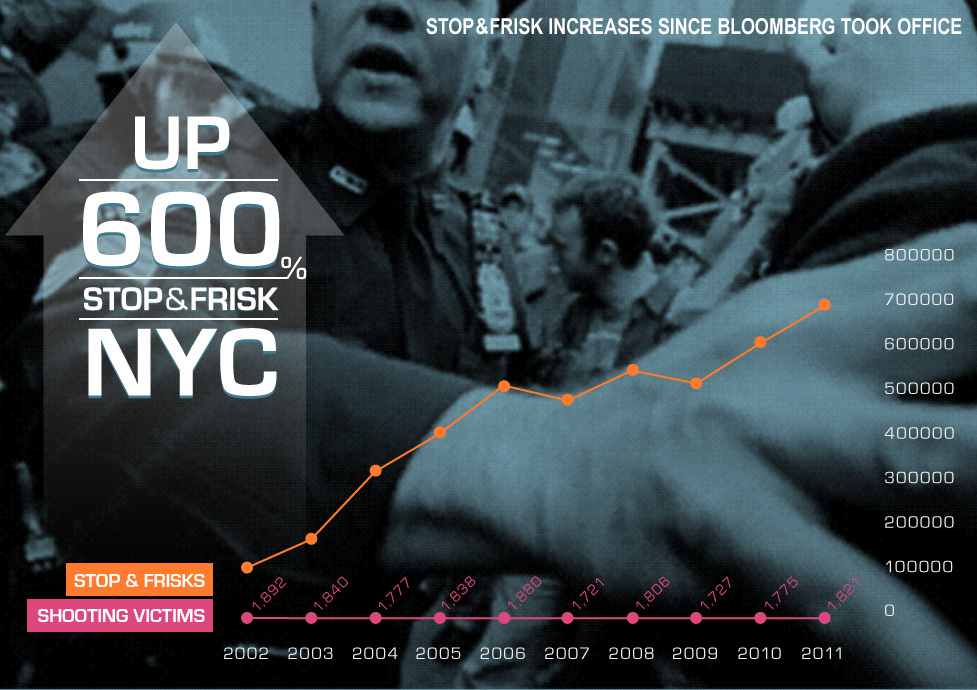
    A short while back I was hit with this little picture:
    You may look at the stop-and-frisk trend. But what I found more interesting are the shooting numbers. You don’t often see those numbers. Homicides are well tallied by police departments and the Uniform Crime Reports. Shootings less so. I’ve always used homicides as my standard indicator for crime. Homicides are reliable and valid, right?

    But here’s what threw me for a loop: are shootings in NYC really not down? 1,892 in 2002 and 1,821 in 2011. During that time, homicides went from 587 to 515.

    So here’s the problem: using homicides as a bellwether indicator for crime rests on the assumption that 1) there is a direct and consistent correlation between violent crime and shootings and 2) between shootings and homicides. So if homicides are down and shootings are not, it doesn’t work. Something else other than police work is probably responsible for the drop in homicide. Paramedics, nurses, and doctors jump to mind. The Wall Street Journal reported on this a few months ago (but the story is behind a paywall).

    The problem with the chart on shooting victims from dnainfo (which is a horrible name for a great news source) is that it draws a flat line. And 2012 was a good year for the NYPD: shootings dropped to 1,625 and homicides to 419. So if you punch the numbers into SPSS and get a trendline, you get this:
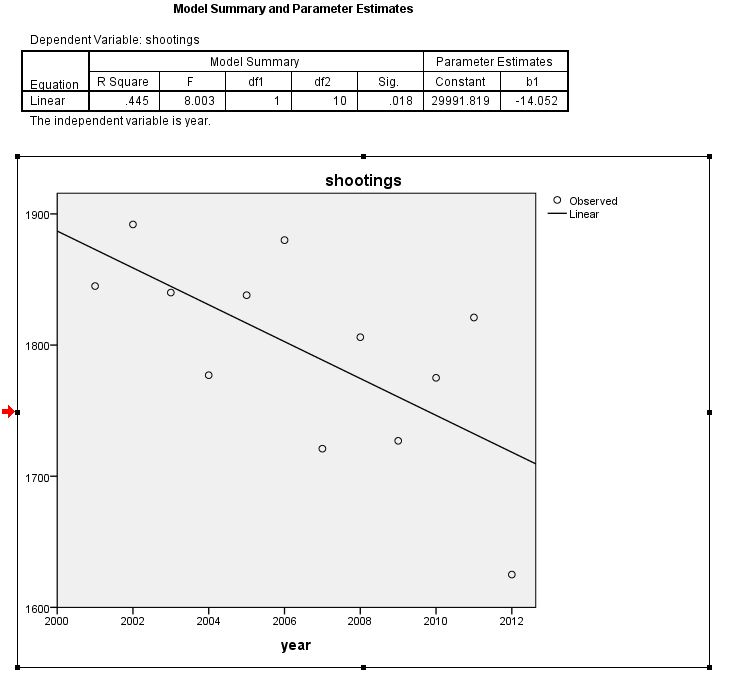
    It’s an average reduction of about 12 shootings per year over the past 13 years. It’s not huge, but it’s not insubstantial (and it is statistically significant). Shootings are down about 12 percent since 2001; homicides are down one-third (I haven’t broken down the homicides by weapon, but roughly 70 percent of homicides in NYC are shootings).

    One could reasonable infer that about 2/3 of the decline in homicides in NYC has nothing to do with police (because shootings are a better indicator of crime than are homicides). But still, a long-term (since 2001) 10-to-15 percent decline in New York City shootings (and, I would infer, crime) is noteworthy, if not exactly headline grabbing.

    Last year, 2012, recorded stop and frisks were down 22 percent, to 533,000 (compared with 685,700 in 2011. Homicides and shootings in 2012 were also down. (So clearly, if nothing else, last year tells us there’s no direct inverse linear relation between stop-and-frisks and homicides.)

    I’ve long argued that some some stop-and-frisks are necessary. You know, the ones based on reasonable suspicion that a suspect is armed. It’s the ones that are nothing more than stat fluffers that bother me.

  • Stop and Frisk

    A federal judge ruled that some of the ways the NYPD conducts their “Trespass Affidavit Program” are unconstitutional. The NYT reports, “The judge ordered the police ‘to cease performing trespass stops’ outside the private buildings in the program unless officers have reasonable suspicion, a legal standard that requires officers to be acting on more than just a hunch.”

    So the judge basically ordered the NYPD to follow the law and the constitution. You’d think that would go without saying, but apparently somebody had to say it. The ruling is well stated and actually pretty mild. It doesn’t ban the program or stop and frisks. It bans illegal stop and frisks (which, of course, were already technically illegal).

    Of particular note, the judge criticized the check-the-box system in which officers tic, “furtive movements” as a basis for the stop. The NYPD set up this system to make the forms idiot proof. But most cops aren’t idiots. And maybe those that are shouldn’t be on the street.

    It is likely that the NYPD will have to go back to what is generally accepted standard practice everywhere else: articulating in words their reasonable suspicion for a stop. That’s the way it should be.

    I find it curious that the NYPD defends the system by saying this is what landlords want. It would be a lot better of the program was conducted at the behest of the residents. I don’t think most tenants, particularly poor tenants, see their landlords as looking out for the best interests. Landlords own buildings to make money, not to serve the best interests of their tenants.

    As a side note, and quite worrisome assuming it’s true:

    The judge expressed concern over a department training video that she said incorrectly characterized what constituted an actual police stop. In the video, a uniformed narrator states “Usually just verbal commands such as ‘Stop! Police!’ will not constitute a seizure.”

    The narrator explains that the encounter usually qualifies as an actual stop only if the officer takes further steps such as physically subduing a suspect, pointing a gun at him, or blocking his path. “This misstates the law,” Judge Scheindlin said of the video, which has been shown to most of the patrol force.

    To say only that this “misstates the law” is quite generous. That the NYPD would incorrectly educate its officers on such a basic issue… well I’d like to think it simply ain’t so, Joe.

    A “stop” (for which reasonable suspicion of crime is needed) occurs when a person cannot or reasonably believes he or she cannot leave. Because it is illegal to disobey a lawful order, reasonable suspicion kicks in the second a cop says “stop” or “come here.”

    This decision could be a win-win for the police and the community if the NYPD rises to the challenge by discouraging illegal quota-based stops based on “hunches” while continuing to encourages and support officers who perform legal stops. The risk (I think it’s a small risk) is that NYPD will know throw up its hands and stop policing. But nothing in this decision bans legal and effective policing.

  • The Ray Kelly Smackdown Hour

    Except this time it was Ray Kelly who was doing the smacking down. He gave it back good to the New York City Council on the subject of stop and frisks and violence among minority youths. From the New York Times:

    “What I haven’t heard is any solution to the violence problems in these communities — people are upset about being stopped, yet what is the answer?” Mr. Kelly asked Councilwoman Melissa Mark-Viverito, who had been asking the commissioner to acknowledge that the department’s practice of street stops in minority communities left many people “feeling under siege.”

    “What have you said about how do we stop this violence?” Mr. Kelly asked, asserting that violence among minority youth is “something that the government has an obligation to try to solve.”

    Ms. Mark-Viverito, whose district includes East Harlem and part of the South Bronx, was now pressed for an answer.

    “There needs to be prevention and deeper community-based tactics and strategy” she offered. “Yeah, what is that?” he asked in a dismissive manner.

    Ms. Mark-Viverito spent the next few moments trying to exit the debate over police tactics that she had sought, eventually saying, “I think I’ve made my point.”

    To that, Mr. Kelly shot back: “I’m not certain what your point is.”

    Dammmmmmn.

    Of course there is a better solution: smarter stop and frisks, based not on “productivity goals” but on actions of intelligent police officers who have discretion and can distinguish between criminal and non-criminal black man.

    But Kelly has a point. It’s too easy to criticize the police. It would also help if you actually had some ideas as to how to make police better. And it isthe government’s obligation to try and solve the problem of violence in minority neighborhoods. It’s not that the police are without blame… but don’t justblame the police.

    Update: Some of the video can be seen here.

  • NYPD Stop and Frisks and Marijuana Arrests

    WNYC reporter Ailsa Chang reports on the curious link between stop and frisks and marijuana arrests in New York City. It’s curious because small-scale possession of marijuana in New York State isn’t a crime (it is a non-arrestable ticketable “violation”). Nor do drugs that are “immediately apparent” based on “plain-feel” during a “Terry Frisk” (for weapons) give police justification to search (this is unique to New York State based on People v. Diaz).

    I also did a little research based on the nifty map provided at the above link. There are 76 precincts in New York City. In 2010, 19 police precincts with the highest arrest rates for the lowest level marijuana-possession had 48 percent of the city’s murders and 39 percent of city’s robberies. But I’m not certain what percent of the NYC’s population lives in those 19 precincts. Anybody have data for population by precinct?

    I’m briefly quoted in the story. And you can read what I’ve already written about stop and frisks by clicking on the “stop and frisk” tag below. This story is a bit different because it focuses on illegal searches, which are never OK. Police are given so much leeway within the law that I can’t help but think that cops who conduct illegal searches are, at best, lazy and stupid.

  • Marijuana Arrests in NYC to Decrease in 2011

    As one does, I was just reading the future in my Greek (née Turkish) coffee grounds, and I saw an interesting development.

    [Cue swamy music] I see that the NYPD is going to start making fewer arrests for possession of marijuana this year starting right about now… I predict that in 2011, misdemeanor marijuana possession arrests in NYC are going to be down from 50,300 in 2010… and somewhat substantially… maybe a third fewer?… but now things are getting a little hazy.

    How do I know? I don’t. That’s wall they call it a “prediction.” But I’m not just saying this because of the gypsy blood in me tells me so (even though I am 1/8th gypsy).

    Remember to check back in a year or so. Cause I’d love to be the first to say, “I told you so!”

    [Updatefrom the future: I was wrong.]

  • 600,000 (official) stops in NYC

    Here’s the story in the Timesand in the Daily News.

    The difficulty is that any benefits and harms of aggressive stop and frisks are not only found in aggregate numbers but also in the individual incidents. Some of these stops are good. Some aren’t. So how do we tell the difference? How do we keep the good and get rid of the bad?

    In theory, I’m not against police stopping people based on reasonable suspicion. What’s the alternative? Waiting for someone to call 911?

    In practice, I worry about young and inexperienced officers stopping people to meet quotas.

    In theory, I think stop and frisks can play an essential role in crime prevention and getting guns off the streets.

    In practice, I worry about the extension of the Terry Frisk to an exploratory search.

    And in theory the police can defend the racial disparity of those being stopped…

    But in practice the NYPD needs to do a better job doing so. There are legitimate, serious, and moral issues involved. Simply pointing to crime stats isn’t enough.

    On one hand, it might be hard to defend this tactic if crime goes up. On the other hand, it’s worth contrasting the situation in New York with the situation in Seattle. We need better policing–not less policing.

  • Heather MacDonald on NYPD Stop-and-Frisks

    Heather MacDonald has an op-ed in the New York Times. You know, on police issues we probably agree 75-80% of the time. And yet I’m always left frustrated and strangely disappointed by her writings. She’s too predictable. And her writing lacks depth as she simply sidesteps the main points of the opposition.

    I generally agreewith her, and yet still find myself unconvinced.

    When it comes to police matters, I also want to learn something I didn’t already know or think about something in a way I haven’t considered. No such luck.

  • NYPD Stop and Frisks

    Al Baker reports in the Times:

    Any officer stopping a person in the street must tell the person “the reason, or reasons, why it occurred,” according to a letter from Police Commissioner Raymond W. Kelly. The policy took effect April 23, according to a departmental order to revise the police patrol guide.

    Street stops jumped to 508,540 in 2006, from 97,296 in 2002, according to data from the police, and reached 531,159 last year, the most on record.

  • Stop and Frisk

    Officially, the NYPD stopped and frisked 531,000 people last year. That’s a lot. They resulted in 31,665 arrests and 34,081 summonses.

    Because of the 4th Amendment, you need “probable cause” for a search or arrest. A search happens once you go inside pockets or look for anything accept weapons (drugs do come to mind).

    Because of a Terry v. Ohio, you need “reasonable suspicion” to stop and/or frisk a suspect. Afrisk is a pat down of the outer closing for weapons in the interest of officer safety. Sounds benign, but a frisk is aggressive, hands on, and personal. Ask anybody who has been frisked. It’s not fun. (I should mention it’s not fun to frisk, either. But similar to being hit by a car or hitting someone while driving a car, I’d prefer to be the “frisker” rather than the “friskee.”)

    Now half a million frisks a year is a lot. In NYC it’s part of a strategy to disarm criminals. There’s debate as to its effectiveness, but personally I think it’s likely that aggressive stop and frisks did and do play some role in reducing crime in NYC.

    But that’s easy for me to say. It’s not me they’re frisking. I’m white, professional, getting to middle age, and know how to talk to police. Though I have been stopped twice by the NYPD, both times while on my bike.

    I ask my undergrad students how many have been frisked. About half the hands go up. Most have darker skin (though there are white hands, too).

    Maybe the first time you’re frisked and innocent you say, “Fine. OK. I want a safer city, too.” But the fifth time your frisked on your way to work or school? I don’t know about you, but I’d be pissed off.

    So what level of frisking is acceptable? If there were 500,000 frisks and 500,000 illegal guns found, I don’t think anybody would have a real problem with frisks.

    If there were 500,000 frisks and no guns were found (though it could be argued that frisks still served some deterrent value), nobody would argue it was a good policy.

    So what “hit rate” justifies the frisks? 50%? 10%? 5%? I don’t have the answer.

    Also, consider these:

    1) Most police tell me that the vast majority of frisks in NYC are officially counted (that certainly was not the case for me in Baltimore). But still, there is certainly some undercount.

    2) If officers make an arrest, many don’t fill out the stop and frisk form. In other words, for some, the form is only filled out when nothing is found. So the hit rate may be somewhat higher that official stats indicate.

    3) To argue, based on the stats, that 88% of those frisked did nothing wrong is absurd. If there’s a corner of active drug dealers and you stop and frisk eight people. You find a gun! Well the stats, seven out of eight (88%) were innocent and doing nothing wrong. Bullshit. In this case, all eight of those frisks were justified. Even if no gone was found (this time)!

    4) On the other hand, if you’re frisking walking to work with a small bag of weed, that counts as a hit but I’d say isn’t justified. You frisk for weapons, not drugs. And in New York State you can’t use plain feel from a frisk to prosecute for drugs. but many NYPD don’t know this.

    5) Does a 21-year-old white rookie cop out of Long Island have any knowledge regarding the nuances in street behavior and dress that distinguish between hip street-look and criminal thug?

    6) Is it fair to disproportionately discover marijuana on urban minorities (found during a frisk) when the equivalent risk of discover for suburban whites is virtually zero?

    So let’s say frisks do lower crime. Let’s say they also pisses off a lot of the non-criminal public. Is it worth it?