Tag: the ghetto

  • 20 People Shot at Florida Nightclub (ho hum)

    From the Times:

    Two teenagers were killed and at least 18 people were wounded early Monday when attackers raked a crowd with gunfire outside a nightclub here that had been hosting a party for young people, the authorities said.

    Sound familiar? Yeah, because it is. But this isn’t even the main story of the day.

    It kind of started as news, but then, you see, the victims weren’t gay, or white, or blacks shot by cops, and the shooter (or shooters) wasn’t a “terrorist,” which really means he didn’t have an Arabic last name, nor a “troubled” white kid.

    Obama won’t speak about it; Trump won’t claim he can fix it. You know, it was just one of our “routine” mass shootings. The story is demoted to “Fort Myers shooting: 2 dead outside teen party at club,” like these lives don’t matter. Like this is acceptable in a civilized society. No matter a 12-year-old was killed, it’s just “ghetto” crime. Dog bites man.

    Just think of the news editors who really ask these questions before keeping “Convention Tension” as the lead story of the day.

    What a country.

  • The New York Times goes to the Hood

    I applaud any effort to focus on the victims of violence in America. Too often nobody knows or cares about this real carnage in this country.

    So over Memorial Day weekend the New York Times went to the bad parts of Chicago to sightsee:

    [We] dispatched a team of reporters, photographers and videographers to virtually all of the shooting scenes across the city. Working around the clock through the three-day weekend, The Times interviewed relatives, witnesses, police officers and others, and captured how much violence has become a part of the city’s fabric.

    After that self-congratulatory moment (wow, did they really work “around the clock” on a “three-day weekend”?!) I really did have high hopes for this 5,000-plus word article. But I was left feeling empty. Though I can’t quite put my finger on the problem, let me try.

    Murder victims should be humanized. You’re not just a homicide victim. You’re a real living human being with lives and stories and loves and problems. (And also, as cops know all too well, with soft flesh and blood and sometimes spattered brain matter.)

    This weekend, among the six killed are a father, Garvin Whitmore, who loved to travel but was scared of riding on roller coasters; and Mark Lindsey, whose outsize personality brought him his nickname, Lavish. The oldest person struck by a bullet is 57. The youngest person to die is Ms. Lopez, a high school student and former cheerleader.

    And so the logic of one Chicago mother, who watches another mother weep over her dead son in their South Side neighborhood, is this: She is glad her own son is in jail, because the alternative is unbearable.

    “He was bound to be shot this summer,” she says.

    That last part is powerful. Let’s be clear: a mother says she’s happy because her son is in jail, because otherwise he would probably be killed. As Yakov Smirnoff says, “what a country“!

    The Times reports that one victim was just watching the Newlywed Game on TV. Another has an “outsize personality.” (Though I’m not certain what that means, his nickname of “Lavish” raises my eyebrow. And how can you a “former cheerleader” at age 15? But maybe I protest too much….) I’m torn between my usual line, “damnit, these victims are Americans we should care about!” and “damnit, this is tear-jerking PC bullshit!”

    I quibble with this Times’ portrayal because most murder victims in Chicago (and other cities) are not just normal hard-working people with normal jobs who happen to be in the wrong place at the wrong time. Sure, sometimes the street draws in kids despite loving moms. Maybe mom is too busy working poorly paid jobs to keep an eye out on her child. But too many never had a loving parent when they needed to be brought up right.

    Cops see this all the time: living situations where little kids are growing up without any structure, much less electricity or a functional loving parent. Dad might be dead or in prison; mom might be turning tricks to support her addiction. Then what? What happens to the kids sleeping around mice and roaches, three to a bare mattress? Nobody talks to the kids, much less reads to them. Kids are simply ignored or neglected, ineffectively raised by siblings and cousins. What if you parents try to sell you for drug money? [Update: What if your dad shoots your grandfather at your uncle’s funeral?] How do you think you’re going to turn out?

    These things need be discussed, but the Times doesn’t want to go there. You might say I’m blaming the victim (because I am), but my point is not that “these people” deserve to get shot and killed (call me a pinko-lefty, but I’m firmly in the camp of those who believe that nobody deserves to be shot and killed). The problem is that if we don’t accurately address the real problem and characters involved — if we only romanticize victims and blame bad luck — we’re never going to get at effective solutions.

    This gets more at the truth:

    Sometimes only minutes after the gunshots end, a computer system takes a victim’s name and displays any arrests and gang ties — as well as whether the victim has a rating on the department’s list of people most likely to shoot someone or be shot.

    Police officials say most shootings involve a relatively small group of people with the worst ratings on the list. The police and social service workers have been going to some of their homes to warn that the authorities are watching them and offer job training and educational assistance as a way out of gangs.

    Of the 64 people shot over the weekend, 50 of them, or 78 percent, are included on the department’s list. At least seven of the people shot over the weekend have been shot before.

    For one man, only 23 years old, it is his third time being shot.

    As a cop, this makes me question the operational effectiveness of the “strategic subject list.” But as an editor, I would say this point needs to be more developed.

    You can’t say with certainty that an individual who is shot is also a shooter, but you can hazard a bet that a 23-year-old who has been shot on three separate occasions has also pulled the trigger a few times. On the front end of every murder is a murderer. Collectively the pool of murder victims is the pool of murderers. An exclusive focus on victims as victims glosses over the fact that many of the victims are the problem. They are murderers. (And, as the article points out, these murderers are not being arrested.)

    The Times quotes a Mr. Hallman:

    “Why did I gang bang?” asks Johnathan Hallman, 28, who lives on the South Side. “Just to be around something, like just to be a part of something, man. Because when you growing up, man, you see all these other people, older people that’s in the gang life or whatever. They making they little money and they doing they thing. You see the little ice, the car they driving. It’s just an inspiration, man.”

    Mr. Hallman says he joined a gang at a young age, but eventually decided it was not all he thought it would be. He got out, he says.

    Is he a good guy because he got out of the game? Hell if I know. But what about all the people who never got involved in the first place? Even in bad neighborhoods, it’s not normal to gang bang, shoot people, or be shot.

    Or take Mr. Roper, 24:

    who grew up in the Englewood neighborhood, says he had occasionally carried a gun to protect himself from being robbed, but never used it. “I have to have a gun to scare them off,” he says.

    Poor Mr. Roper. Personally I’m thinking that Mr. Roper is part of the problem. Does the Times really think Chicagoans should carry illegal guns for protection? Their editorial board has certainly preached to the contrary. Are young men who don’t carry guns irrational or somehow wrong? So what is the Times position on people’s needs to carry guns in Englewood?

    And then there’s Ashley Harrison, 26. She and her fiancée, Mr. Whitmore

    had been sitting in the car outside a liquor store, in a South Side neighborhood accustomed to gunfire, when, in broad daylight, shooting started. Mr. Whitmore was fatally shot in the head.

    “Broad daylight!” Like shooters don’t even have the common courtesy to kill at night. But it’s the intransitive almost-passive voice that kills me: “shooting started.” Like nobody actually shot a gun. Those guns, they just start shooting. And poor Mr. Whitmore got shot. And in “broad daylight”!

    So what would you do if you were with your fiancée in a car, and he gets shot? I suspect you wouldn’t be as bad-ass as Ms. Harrison, who grabbed her illegal gun, jumped out of the car, and popped off a few “warning shots” in return. (She has since been charged.)

    This is not the normal urbane behavior one might expect in a civilized society. But it goes unquestioned by the Times.

    By my count, the article talks about 12 of the 64 victims. What about the other 52? So far it doesn’t seem to be a random sample. Eight of the weekend’s 64 victims are 39 years or older. The Times mentioned four of them (out of the 12, total). The median age of the victims in the Times is 32. That’s more than 5 years older than the average murder victim over the weekend. Except for the 15-year-old “former cheerleader” — and to mention the youngest is pretty much obligatory — what about the other 21 victims under age 23?

    Who are these young black (and occasionally hispanic) men? The Times doesn’t tell us. I suspect this is because most of these young victims are less sympathetic than those who “love to travel but are afraid of roller coasters.”

    I don’t know if this is superficial reporting, a desire to avoid being “judgmental,” or something else. Is it because older victims are more sympathetic? Is it because younger victims would not talk to reporters? Is it because reporters couldn’t or were afraid to approach the younger victims and their friends? I don’t know.

    The Times mentions “52 of the shooting victims are black, 11 Hispanic and one white.” Just one white? Think of what that means for policing. The black/white disparity in shooting victims this weekend was 52(!)-to-1! And yet when police hassle/stop/arrest/shoot more blacks than whites, the Times and others scream bloody murder about racist policing and implicit bias. When I highlighted this racial disparity to explain/defend/justify racially disproportionate policing, I was called (by the Times no less) a “denier.”

    Jose Alvarez, 28 — AKA “Chi Rack Alvarez” (red flag!) — is mentioned. There’s a video of Chi Rack flashing signs disrespecting a gang. He was on the receiving end of 15 shots.

    The police describe Mr. Alvarez as a gang member and say he may have been the intended target of the shooting.

    You think?

    Mr. Alvarez insists that the police are wrong in labeling him part of a gang.

    Well, I bet the police are right. But who am I to judge?

    There’s Mark Lindsey (AKA Lavish), whom a friend calls, “one of the success stories.” “Lavish” was targeted in his car. (The last sentence on “Lavish” mentions, just barely, that he was arrested the previous day on domestic battery and released on bond. Hmmm, that is, as we say in the police business, “a clue.”)

    Or take Calvin Ward, 50. Two young men come up the street and fire is his direction six times. One bullet goes inside a home and hits his wife. Ward says he has no idea why people would shoot him, “I ain’t no gangbanger or nothing.” But Ward was “convicted several times of battery and aggravated unlawful use of a weapon.” I’m thinking that he may not be fully out of the game. But what do I know?

    If we want to reduce violence — and we do — police need to be more aggressive and focus on on the criminals who are linked to violence. When somebody gets killed there’s almost always a link to public drug dealing (even if the actual murder stems from some more mundane beef).

    If the goal of the Times is to show that murder victims are people too, great. That should be done. But most murder victims in Chicago are young black men who never realistically had a chance. They grew up with absent or bad parents (this point cannot be stressed enough). They dropped out of school (and you, gentle reader, have worked damn hard to make sure your precious little angels aren’t even in the same school buildingas them). These cast-offs are functionally illiterate. They have no mainstream social skills. They’ve never had a legal job. Nobody wants to hire them. They have no money. They hustle to get by. Then one day their luck runs out, and they’re slow on the draw. Rather than shooting someone, they get shot. This is reality that most of American and the Times still won’t touch.

    Statistical postscript: The Times also refers to a poll (an interesting poll by the way) in which 54 percent of blacks say calling the police will “make the situation worse or won’t make much difference.” That sounds damning. What do you think that means?

    The same poll also says — the same damn question! — that 84 percent of blacks say calling the police will “make the situation better or won’t make a difference.” Given those two statements (both are true because 42 percent say “calling police won’t make much difference”), how would you summarize the results?

    Their analysis is either statistical ignorance or intellectual dishonesty. Statistically and logically, it makes more sense to take out the middle (“won’t make a difference”) and observe that blacks are 3.5 times more likely to think police make the situation better than make than the situation worse (42 percent to 12 percent).

    This question isn’t a Likert scale, where a 3 is halfway between 1 (“strongly disagree”) and a 5 (“strongly agree”). These are three distinct non-linear answers. Hell, I called police in New Orleans even though it wouldn’t “make a difference” simply because because calling police is the right thing to do.

    The poll also has some interesting data that go beyond the scope of this post or their article, but they’re worth mentioning in light of the “progressive” context much police-related reporting.

    Compared to blacks, a greater percentage of whites have “had interactions with police officers in the past 6 months” (and this does not include close friends or family members). If this is true, what is going on? Given the level of violence in black Chicago, this is odd and even problematic.

    Thirty-seven percent of blacks (a plurality) say that “lack of strong family structures” plays the biggest role in Chicago’s high crime rate. The Times won’t touch this with a 10-foot pole. (Next on the list is “lack of good jobs.”)

    Also, even though 72 percent of blacks in Chicago consider themselves Democrats (compared to 53 percent of whites), blacks are just as likely to be “conservative” as “liberal” (compared to 17% conservative, 40% liberal breakdown for white Chicagoans. “Progressives” always seem to know what is best for other people, but they and their Bernie supporters doggedly refuse to acknowledge that collectively, blacks aren’t actually liberal like them. (Blacks are also much more likely than whites to be religious and go to church. And I never arrested any kid who went to church.)
  • You can’t make this sh*t up

    Hours after posting about the police-involved killing of robber Robert Howard, I read Justin Fenton’s amazing storyabout the robber: “Man fatally shot by off-duty officer was also shot by police 20 years earlier.” Are you effing serious?! What are the odds? I don’t think anybody in American history has ever been shot by cops in two separate incidents. I don’t know what that amazes me, but it does. Oh, Baltimore.

    But wait, there’s more. It’s deja vu all over again! Remember how in last week’s shooting, witnesses reported Howard was unarmed and running from cops? And they said that cops shot him in the back? If it weren’t for the video, many people (and a Baltimore City jury) would doubt the cops.

    How many “witnesses” come forward when the shooter isn’t a cop?

    Well back in 1996 Howard was again busy robbing. He pulled a gun on cops, fired on cops, and cops shot back. Cops could have kept shooting. But the police didn’t kill Howard because once Howard was no longer a threat, they stopped shooting. That’s what cops are supposed to do. Police arrested Howard, without further incident, after Howard tried to kill them. Job well done, right?

    Well in the 1996 shooting there was no video, and a jury acquitted Howard of all criminal charges. Howard’s attorney said officers planted a “drop gun” on Howard. One witness adamantly testified Howard did not have a gun. (Boy, if cop did have drop guns to plant, why are so many “unarmed” people shot by cops? Think Sean Bell, Diallo, Zongo, and Michael Brown.)

    As an outsider, this may seem like just a shame, understandable given years of oppression. Or maybe even true. But it’s not. And it happens all the time. It what frames cops’ worldview. And if you’re the cop involved? It’s life changing. And not for the better.

    Howard then (unsuccessfully) sued the officers for $12 million. He claimed he was unarmed and had his arms raised.

    When I was in Baltimore, Kevon Gavinwas killed after his car was deliberately struck by a criminal being chased by other cops. The killer was doing 80mph and rammed Gavin’s car, crushing it. The killer was arrested at the scene wearing a bulletproof vest and carrying a semi-automatic handgun. Later, in the jury trial, the killer was acquitted of all criminal charges. He walked free. (Even his lawyer admitted he was surprised at the verdict.)

    It’s happened before and it will happen again.

    So back in 1996, Stephen Cohen was one of the two cops that shot Howard:

    The fallout prompted Cohen to leave the agency: He said he was accused at the civil trial of being corrupt and racist.

    “The most upsetting thing about it was that he had the audacity to come after us, like we did something wrong,” Cohen says in a phone interview…. He pulls a gun, we shoot him, and now he’s accusing us, because he did nothing wrong and we’re the bad people.”

    “I saw the writing on the wall. I decided, I can’t live my life like this. This is not what I want for my life,” he said.

    Cohen said the civil case with Howard 20 years earlier caused him to lose faith in his role as a police officer.

    “This was life-changing. You’re a young white guy, being crucified by a whole community of black people saying the only reason you shot him is because he was black,” Cohen said.

    “At the end of the day, you can’t help people who don’t want your help, and can’t help themselves,” he said. “I was saying, ‘What am I doing in this picture? I can’t change anything. I’m going to end up miserable, bitter or dead in jail.”

    So he quit.

    Right now people are getting away with robbery and murder. This year alone there have been 67 homicides and 1,219 reported robberies in Baltimore. And yet when the story is reported, the only questionable characters are the cops.

    I wonder how many people Howard robbed in the past 20 years. You have to assume he didn’t die with a lifetime robbery record of 0 – 2.

  • Bad Cop Good Movie: The Seven-Five

    I’m finally getting around to watching The Seven Five, a documentary about the 75 Precinct in the 1980s and criminal cop Michael Dowd. Good stuff… the documentary, that is, not the cop.

    I like how the movie is told through three perspectives: the dirty cops, the cops who caught them, and the criminal the cops worked for. And of course they’re all really charismatic.

    But what amazes me is the reputation for NYC being so crazy back then. I mean it was. Sort of. In 1990, the height of the crack epidemic (the Bronx was already burnt) New York City’s homicide rate peaked at 30 per 100,000.

    And the 75 Precinct was the highest homicide precinct in the city, with 126 murdersin 1993. That’s a rate of about 80 per 100,000.

    Last year in New York City? The homicide rate was 4.

    You know what Baltimore’s homicide rate was last year? 55.

    When I worked the Eastern District the homicide rate was 100.

    Last year in the Western District, the homicide rate was 140.

    Think of what that means, to residents and cops alike.

    [Fun fact: The most ever homicides in any one Baltimore district? The Western in 1972. 87homicides. (Though last year’s rate was probably higher, given the population flight from the area.)]

  • “Pander to audience expectations”

    There’s a nice article about Alice Goffman in the Times magazine. Overall it’s a great piece about Alice Goffman, who has written one of the best sociology books ever, and the state of sociology in general. One line I find funny is the assertion that she “panders to audience expectations” by this description of a house: “[it] smelled of piss and vomit and stale cigarettes, and cockroaches roamed freely across the countertops and soiled living-room furniture.”

    In Cop in the Hood, here’s my description:

    Police are called into people’s homes because the residents have, at some level, lost control: intensely overcrowded apartments next to abandoned housing and empty lots, families without heat or electricity, rooms lacking furniture filled with filth and dirty clothes, roaches and mice running rampant, jars and buckets of urine stacked in corners, and multiple children sleeping on bare and dirty mattresses. Simply entering a “normal” home, well furnished and clean, perhaps to take a stolen car report, is so rare that it would be mentioned to fellow officers.

    The criticism against Goffman is just petty semantic BS and academic jealousy.

    Part of the problem is that if even a well intentioned person goes so far as to describe such conditions, much less befriend the people who live there, as Goffman did, they’re accused of pandering or “orientalism.” And what kind of country do we live in where a white girl can’t choose to live anywhere and befriend anybody she damn well pleases. This isn’t apartheid. It’s not taboo.

    And if we don’t accurately describe reality, how will people ever know? And though I’m probably wrong, I’d like to think that if people really did know about this reality, they might care. Instead, when we close our eyes to such conditions and then, when confronted with it, blame teachers or cops. Cops, for their part, blame liberals and Hillary Clinton.

  • Dying in Baltimore? Blame the Police.

    Dying in Baltimore? Blame the Police.

    I saw a Tweet about something I already knew, and it still shocked me.

    This year 1 in every 2,000 Baltimoreans will be murdered.

    I know this number is true. I’ve done math. But I still needed to double check. And in many ways it’s even worse. Because we know most people in Baltimore aren’t going to get murdered. 86 percent of those killed in Baltimore are black men. Collectively, you can group together all whites, all black women, all hispanics, and all asians. Together they account for just 11 percent of Baltimore homicide victims. (Race is unknown 3 percent of time.)

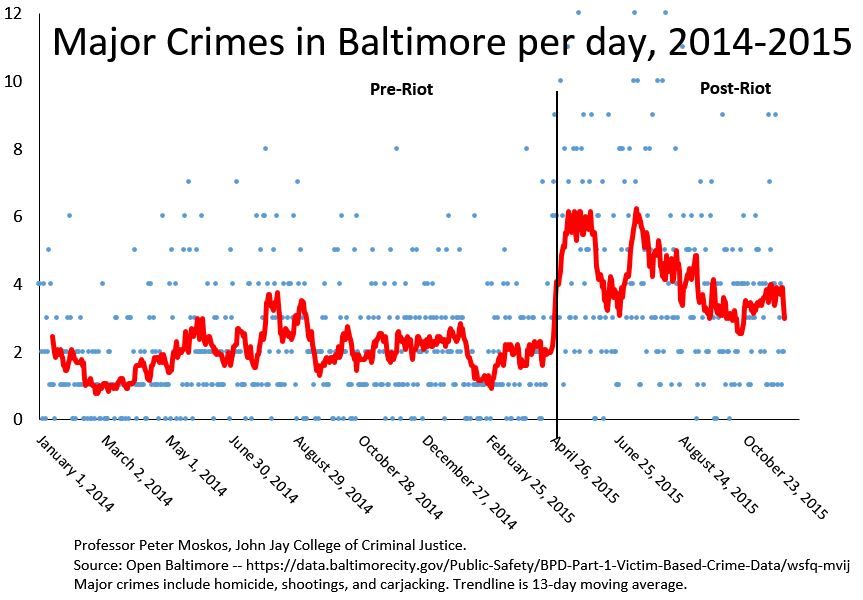
    Lethal violence doubled after riots.

    I still want an apology from those idiots who went on national radio and TV with me saying police were the main problem and violence wasn’t even up in Baltimore the riots (they used, “uprising”). Bet I’m not going to get one. I don’t know if anybody still claims that, but nobody ever admitted they were wrong.

    I spend my Saturday night playing with Excel and SPSS. I made three charts that all say the same thing in slightly different ways. I’m not certain which one is the best. Here they all are.

    There are about 180,000 black men in Baltimore. To date 273 have been murdered. Yes. This year, one in every 660 black men in Baltimore has been murdered.

    [Update: 304 black men were killed in Baltimore in 2015. One in every 600 black men was murdered in 2015.]

    And it gets worse. There are only about 45,000 18- to 35-year-old black men in Baltimore. By year’s end, more than 200 will have been killed and another 500 will be shot but live. 45,000 divided by 700 is 64. One in 64 black men 18 to 35 will be shot or killed. One in 225 will be murdered. One year. Think of those odds. Officer William Porter, a black guy from Baltimore who survived those odds, he was working to save lives. He was trying to make his city a safer place. Now Portor is on trial for basically doing his job. Who are the only people who see every bloody crime scene? Who do we send in to deal with this literal and figurative bloody mess? Police officers. “Do something!” we order them.

    And the mayor and State’s Attorney? They’re using their precious resources to lock up the same exact cops they told to “do something” about the drug corner Freddie Gray was on when he ran from police. And poor Freddie Gray? The lead-poisoned drug-addicted barely-literate low-level habitual criminal? He’s a victim, too. But he’s not a hero. They’ve name a “Youth Empowerment Centers” after him? If you can’t find a better role model for black youth in Baltimore, you’re not looking hard enough.

    Maybe if we can keep the focus on the police, nobody will ever get around to noticing the who real is to blame. No need to blame Freddie’s mom, the drugs, lead paint, the schools, the city, the neighborhood, the corrupt politicians, the self-serving religious leaders, the violence, the racism, the criminals, the blight, the lack of jobs, or even Freddie himself. Nope. None of them’s on trial. Only the PO-leece.

    Pa-leeze.

  • Good times…

    Baltimore, December 9, 2000:

    We get a call for disorderly on Somethingleaf Court. Turns into an armed person. Housing won’t take it. Man is there as promised. We get there and I frisk him. [Officer C] has his gun out. No gun. The guy said he gave this woman $20 for “you know, whatever”. He said he has “relations” to the woman. Vaughn warns him he could be locked up for solicitation. Advises the guy to walk away before he gets arrested. He leaves.

    There is a call later that he came back, but housing does handle that call. “But officer,” I joke, “last time you just told me to tell the truth!” Of course I’m somewhat serious. If he lied to us he would have been told to tell the truth. But telling the truth about a crime? You can get locked up. Of course, as a cop will tell you, if he hadn’t been doing anything illegal… Still, this is why people think the police won’t do shit. Of course, even if he had been robbed of $20 unarmed, we would just tell him to go to the court commissioner.

    I pull up next to [J.W.] at 4AM at 500 Caroline, next thing you know it’s 7AM! Looks like that “sleepy monster” got me, too.

    B+E at 2210 Jefferson at 0722 hrs. I got 3.3 hours overtime, so that’s all right (that’s 7.5 for the week–didn’t get any at all last paycheck). Got in through the 2nd floor window. A nice couple, good home. Being on overtime and liking the couple, I decide to do a very thorough investigation.

    I search the vacants nearby for property and don’t find any. One quote from [Mrs. Victim]: “The local yo-boys…” and about a neighbor “they’re part of the problem.” [Mr. Victim] says he saw one of his hoodlum neighbors standing outside when he left. I go to that home during my neighborhood canvass. He opens the door and I stand on the threshold, not really on the stoop by not in the home either. I mention that one of their neighbors had some property stolen and if they heard anything.

    Not the guy who opened the door, but another comes up and says, “you got no right to be up in my house!” Strange cause I wasn’t in his house. (or: Like hell I don’t!). Now having articulable suspicion they were involved, and worried that any property could be moved from the home if I were to leave. I go in and give a quick visual inspection of their ground floor. Nothing in there. The guy is pretty pissed and I’m thinking of arresting him for assault (getting in my face), but I decide I don’t want that much overtime. [Nor am I 100% certain about the legality of my entry into the house] He says he wants to complain. I give him my card and tell him to go ahead. I write the above in my report. He didn’t complain. [Given your card was always a disarming way to get people not to complain.]

    [Two other officers] were there late, too. Made a 7AM lockup on 800 N. Madeira. About 12 vials [of crack]. [One of them] was pissed off that he had to stick around for his lockup. “Goddamn felony CDS lock-up.”

    I backed up [V.] on Patterson Park. Some vacant we didn’t go into because of a big dog. [B.] mentioned that [L.] used to screw some 19-year-old in that house. [L.] later confirmed it by saying, “What a big mouth! Why’d he have to say anything. Yeah, I used to date a girl who lived there. A nice girl too.”

  • Just another day in the Eastern…

    Sometimes it’s fun to re-read my old field notes. I should write a book or something. This is from Jan 24, 2001 (and better than my average day’s notes):

    [Officer A] and I are walking our 4 miles at 5am: “People say this is a good neighborhood with a few bad people. But it’s not. I’d say that 50% are bad, and most of the rest, another 30% don’t care… The reason things are so bad here is because nobody does anything. If they gave us some information, like stayed on the line and told the dispatcher that it’s that guy in the red jacket and the stash is in that box over there. Then we could do something. But they don’t care… so they get what they deserve.”

    This occurred while I was complaining about [Officer B] locking people up for riding bikes (I had a nice night riding with [Officer B] tonight). And I mentioned, “and that’s why you shouldn’t lock somebody up for riding a bike. Because someone will say I or my nephew got locked up for nothing and they’d be right. Of course they’re not going to like the police.” [Officer A] said, “well, they were doing something.” “I know, it’s a legal lock up. But it’s not a moral one.”

    [Officer B] says regarding lock ups, “the major wants stats, I’m going to give him stats… And I may want to transfer somewhere else someday.” I tell him where he’s going to transfer couldn’t care less if he’s got 40 arrests or 400. It’s still more than they’ve ever got. What they do care about is if he’s got an open IID number. And he’s more likely to get one every time he arrests somebody. [Officer B] also says, “The only reason you don’t like bike lock-ups is because you ride a bike.”

    “Damn right that’s why I don’t lock people for riding a bike. But also because I don’t think riding a bike is a crime.” “But if they don’t have a light, and they don’t have ID….” “Yes, but you’re just locking them up for not having ID. You let them go if they do.” “That’s not true! I’ve written many citations.” “If you’ve written one citation, I’ll give you credit. If you’ve written many, good for you.”

    After walking with [Officer A] I got a newspaper and then hung out at the laundromat at 1900 E Eager. At one point a white women, looked like a junkie with straggly hair and bad skin, comes in honestly upset and says, “I was just robbed.” I’m barely with her, even now, but I need to hear more.

    “What happened?”

    I was leaving the store (she points across street) and a guy grabbed me by the throat and took $13.

    “Where did he go?”

    That way (points East).

    “Where exactly did this happen?” I think she’s telling me right on the corner, though later she says on the next block. Maybe that’s what she meant all along, but I doubt it.

    “OK, what did he look like?” She gives a brief description of a black guy.

    “Where do you live?” On Eastern Ave. (I hate when I hear that, living on Eastern myself.)

    “What are you doing here?” Going to court. (It’s 7AM and court ain’t for another two hours–but that didn’t occur to me till later.) My thought was, no way in hell are you walking through this neighborhood to go to court.

    “For what?” (I ask because I suspect it’s CDS)? I’m on probation.

    “For what originally?” Something to do with her husband (doesn’t mesh because what does that have to do with probation?). I’m sure it’s bullshit (meaning made up, or, given her upset nature, drug deal gone bad).

    I walk to a guy sitting on the stoop two doors down East on Eager. I ask him if he saw anything across the street. No nothing.

    “This woman… this white woman says she was robbed over there [on the corner at the bar]. But you didn’t see nothing?” No.

    “How long have you been sitting here?”

    “Since we was talking and I left the laundromat (I didn’t remember this guy, but I guess he was in the laundromat), must have been a half hour.”

    “All right. Thanks. I appreciate it.”

    So I go back and tell the woman nothing happened on that corner. Then she says it happened up the street, on Ashland. That she got robbed, came down Wolfe, and someone told her a cop was in the laundromat. I start walking towards Ashland and cross the street and tell her to come with me. After crossing the street she says, “where are you going?”

    “To where it happened. To see if anybody saw this.”

    “Nobody was around,” she insists, “and he ran that way [points East].” So I ask her her name (thinking I need this info if I do have to write a report. Always good to have the vital stats). The only thing she’s got going in her favor is that she is a little distraught (probably because she don’t know where she’s going to get her next fix).

    “Aren’t you going to look for the guy?”

    “Well we can take a walk around.”

    “Well can’t you call for a car or something?”

    “Ma’am, it’s been at least ten minutes, it’s not like he’s going to be standing on the corner waiting for us.”

    “It just happened!”

    “I need to know your name.”

    “I can’t believe this! I was robbed and you’re wasting my time.” (Just the opportunity I was waiting for, and excuse to leave.)

    “Well I’m very sorry to waste your time.” I turn and walk away.

    She starts screaming, “PIG! Bastard!” and a few other things I can’t remember well enough to quote. But she wasn’t happy. I go back in the laundromat (so that she leaves) and she walks away.

    I leave the mat to make sure she’s still not still yelling or calling 911 to file a complaint. At this point I’m also thinking: do I have to arrest her to make sure that it doesn’t look bad on me?

    If she’s making a big fuss I could lock her up for making a false statement (my own little favorite cause) but then I’d really have to defend my actions or more likely just for disorderly. But she’s gone.

    There’s a little discussion on the corner given her yellings as to what happened.

    “She says she was grabbed by the throat.”

    “Ain’t nothin’ happen here.”

    “Naw, she says from the store up the street.”

    “That store ain’t open.” A little discussion about that store, who owns it, and they all agree it ain’t open, so she wasn’t leaving it. Then the guy who said “nothin’ happen here” (same guy from sitting on the stoop). Says, “but she came from up this way [points East up Eager].”

    “Won’t be the first time that somebody said they were robbed when they weren’t. What we have here is a business deal gone bad. What’s she doing lying to me and expecting me to do?” Heads nod in agreement.

    This is interesting for many reasons. Most cops’ first thought would be, “I don’t want to write.” That was my second thought. My first was this girl in lying (she was probably about 30. Looked older from the drugs). But you can’t just tell her to piss off because not writing an armed robbery (strong armed in this case) report is a serious offence. So now I’ve got to get enough info out of her to contradict herself or convince me that’s it’s bullshit but also so that if she complains you can defend yourself based on the facts.

    Once I’m convinced it’s bullshit, then it’s simply how to get rid of her. In this case her telling me I was wasting her time was enough. If she hadn’t said that, I probably would have had to confront her (like I’ve seen [Ofc A] do) with just why I thought it was bullshit and I think you’re a lying sack of shit, get her to admit more of the truth–like she gave a guy money for drugs, and then so where does that leave us?

    I was also happy because when I went back into the laundomat Mr. [G] says, just from the beginning of the conversation that he saw, “she wasn’t robbed.”

    All in all though, this was a typical example of the most bullshitty type call (or on-view in this case) you could get. This one there was no doubt that she was either making it all up or at least leaving out important details.

    Reminds me of [Officer A’s] story where a women says she was robbed of $20. Finally the guy says “yeah, but it was only $10!” And the woman says she wants her money or drugs, and he locks them both up. I have to ask him again about this story, mind you he’s told me three times, you’d think I knew it.

    But with drugs being illegal, what should happen when someone takes somebody’s drug money? Is it a crime? Should it be?

  • “In a Dream, I Saw a City Invincible”

    “In a Dream, I Saw a City Invincible”

    That’s the motto of Camden, New Jersey. It’s from a Walt Whitman poem. A comment to a previous post made me think more about Camden. I’ve been through there a few times. Caught the River Line. Looked down from the PATCO Speedline. And I know a lot of my old 78s are from Camden. That’s about it.

    I wish I knew more about what’s going on there with policing. My knowledge, very limited, consists of the following:

    A) There were issues.

    B) The police department was basically disbanded; there was some police-union busting.

    C) Murders were way down in 2014.

    D) Obama said nice things about what was been going on there recently.

    E) There are still issues.

    That’s it. I wish I knew more. What happened to the cops who were on the job then? Who are the cops on the job now? Let me know.

    [Update: a 2019 post.]

    Checking just now, murders in Camden were way down in 2014: just 33 compared to 58 in 2013. That’s a great reduction! The 2015 pace seems in line with 2014. But this is a city with just 77,000 people. 33 murders? It’s not great. Even by violent US standards, a city with 77,000 peoples should have maybe 4 homicides a year. Not 33.

    The other night I was talking to a friend of mine. She had just received a #BlackLivesMatters bracelet and said I could get one, too. I confessed, a bit apologetically, that I won’t wear a #BlackLivesMatters bracelet. It’s not that I don’t care about black lives. It’s because I don’t agree with the ideological baggage that goes with the hashtag. I work with police. #BlackLivesMatter, in my humble opinion, sees police as the problem. [If that logic doesn’t make sense and you’re liberal. Let me say this. I’m not wearing a “pro-life” bracelet either. And that despite the fact that I absolutely love life.]

    It’s the “petite intelligentsia” that worry me. (Yeah, I’m coining that term, damnit.) What bothers me is the public shaming of people who “don’t get it.” Maybe O’Malley doesn’t “get it,” but does that make him “not human“? Come on, now.

    The Left has a horrible tendency to cannibalize itself. (Sanders isn’t the problem, Ted Cruz is!) Remember that great peace protest at the 1968 Democratic National Convention? (I don’t. I wasn’t born yet. But thank God liberals helped get Nixon in office. We never had Humphrey to mess things up.)

    From the fringe and not so fringe left, there can be no acceptable intellectual disagreement. If you don’t agree with the politically correct movement of the moment, the only acceptable form of disagreement is silence.

    I’m not willing to pass the progressive ideological linguistic litmus test. While trying to talk about real police issues on CNN, I was berated for using the word “ghetto” to describe, well, the ghetto. (See pp 16-17 of Cop in the Hood if you want a more articulate defense.) I’ve been interrupted for using the word “riot” to talk about, well, a riot. Most recently, I was actually reproached on NPR for using the word “criminals” to describe, well, people who commit crimes. My message to the Left: stop this!

    When Batts got fired, somebody asked me, “But what does this do for the ‘reform’ movement?” I think my answer was something none-too subtle like, “If Batts is ‘reform,” fuck ‘reform’! [If you make your position clear, reporters will paraphrase a bit.] I don’t care what Batts labeled himself. He wasn’t a reformer because he failed at reform. Batts made the problem worse. You don’t get credit for what you want to do. You don’t get credit for what you should do. You get credit for results.”

    I want to improve policing. And right or wrong, I see #BlackLivesMatter, the movement, not the concept, as more into blaming police than saving black lives. Maybe that’s the point. But then pick a more accurately descriptive hashtag.

    The other day I received a flyer (from a young white woman at a George Clinton concert in Queensbridge Park): “Stop Police Terror” it said. Gosh, I’m not for police terror. My eye jumped to the bottom: “Stop Mass Incarceration Network.” What’s not to like? I am against mass incarceration. I wrote a book against mass incarceration! Great cause. Except for this:

    The powers-that-be have continued to unleash their cops to kill and brutalize people…. These killings are the spearpoint of an overall program of suppression that includes mass incarceration and all its consequences. This program of suppression especially targets Black and Latino people and has genocidal implications…. Which Side Are You On?

    Well, they’re having a march in NYC on October 24, if you’d like join. But given these facts, I’m definitely on the side of police.

    Is it not possible for one to think there are problems in policing without believing police are evil? You need to let people argue the former without preaching the latter. I want police to kill fewer people. And I think the best way to get police to kill fewer people (blacks included) is to, well, get police to shoot less often.

    So if you take the macro lessons of history and racism and violence and conflate that with individual police incidents today? Well, maybe history will prove you right… but I doubt it. Focusing on police as the problem rather than the solution will result in more black deaths (see Baltimore post-riot).

    And if you think this “seasonal uptick” in Baltimore homicides is a small price to pay for a step toward a better society? Well, personally I think you’re morally and intellectually delusional. The road to hell is paved with good intentions. But hell on earth is paved with people who do the wrong thing and say, “gotta try harder!” (Put that on your inspirational poster.)

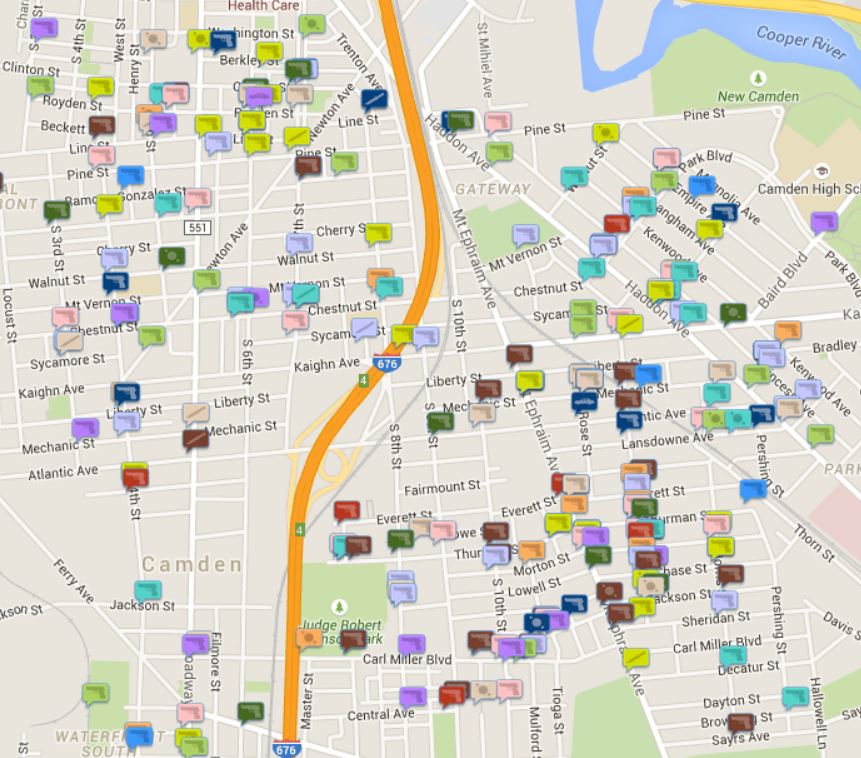
    But back to Camden…. Now I understand that these murders are, well, crimes. In theory, the state investigates crimes and then arrests and prosecutes the offender. In theory “justice” is served (which happens about a third of the time). But if a cop kills you, there’s little recourse. It is different when the state takes your life. This matters. This matter a lot. I do understand. But still, just look at this part of Camden. These little flags are murders since 2003. What are we going to do about it?

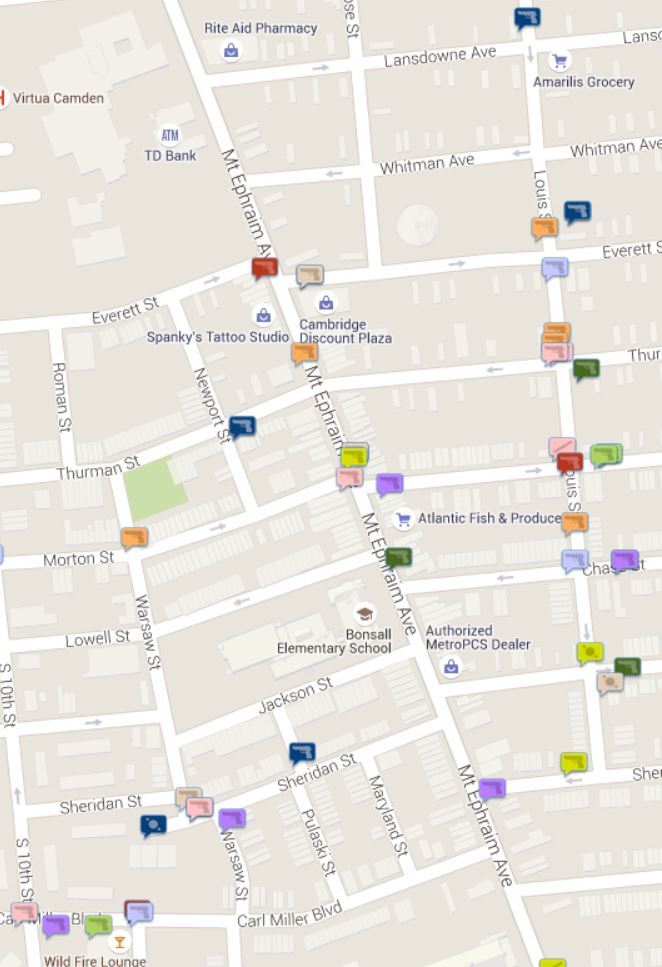
    Let me zoom in on just a few blocks. And these are really small blocks. From top to bottom is half a mile. This whole area is about one-fifth of a square mile.

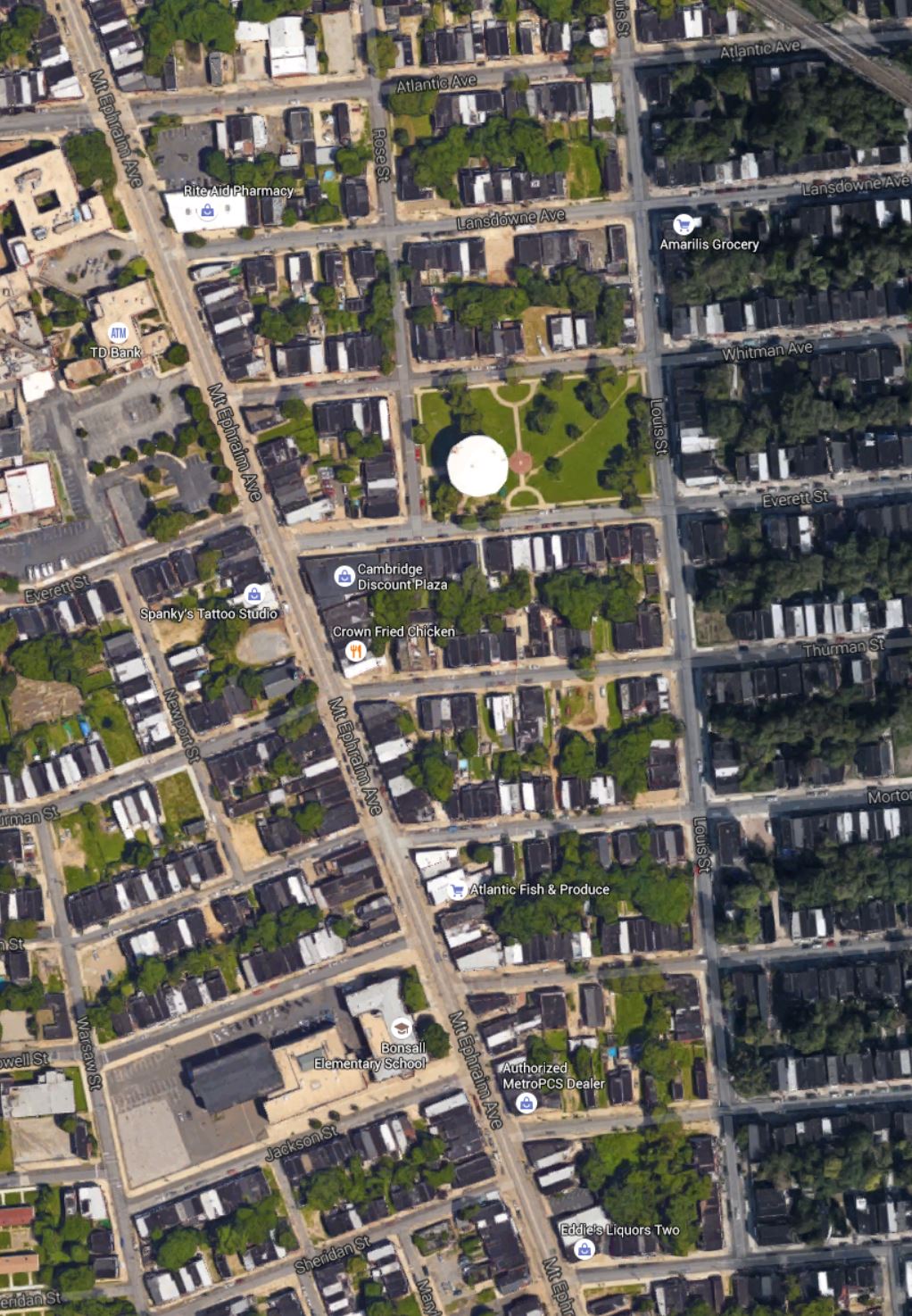
    You might not believe what a small area this is. So here’s google satellite view so you can see individual homes.

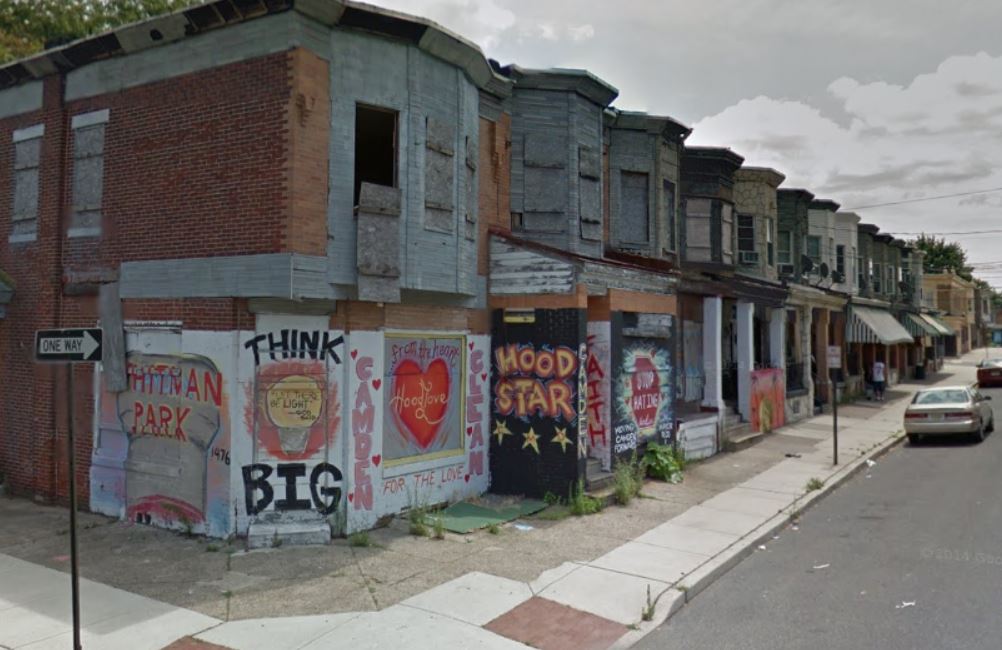
    I want you to see the individual homes. I want you to understand that people are born here, grow up here, live here, and die here. This is America, too.

    Atlantic to Sheridan on Louis Street? 2,000 feet and 20 homicides. How many people even live there? I don’t know. A few hundred? There have been about 24 homicides within a few hundred feet of Bonsall Elementary School. Gosh, I wonder why their test scores are slightly below average? Must be the “soft bigotry low expectations.”

    In Camden there’s hardly a corner where somebody hasn’t been murdered. And #BlackLivesMatter says murder at the hands of police is the biggest problem? Get real.

    Let’s talk black lives. Let’s talk War on Drugs. Let’s talk mass incarceration. Let’s talk racism and a whole class of people left behind by a free market and political system that couldn’t give a damn. Let’s talk good policing. Let’s talk police abuse. But you can’t demand intellectual acquiescence as a precondition.

    As to police in Camden? I got no clue. Let me know what’s going on. But more importantly, tell me how we’re going to make things better?

    Updated homicide numbers

    2018: 22

    2017: 23

    2016: 44

    2015: 32

    2014: 33

    2013: 57

    2012: 67

    2011: 52

    2010: 39

    2009: 35

    2008: 53

    2007: 45

    2006: 33

    2005: 35

    2004: 49

  • The Futility of the War on Drugs

    Given the recent discussion started by Michael Wood, Jr. this last excerpt from Cop in the Hood couldn’t come at a better time:

    It may seem incongruous for police officers to see the futility of drug enforcement and simultaneously promote increased drug enforcement. But for many, the drug war is a moral issue and retreat would “send the wrong message”:

    “It’s a crusade for me. My brother and a cousin died from heroin overdoses. I know that on some level it’s a choice they made. But there was also a dealer pushing it on them. I want to go out and get these drug dealers.”

    Another officer was more explicit: “You’ve got to see it [drugs] as evil. What do you think? It’s good? When we’re out there, risking our lives, we’re on the side of good. Drugs are evil. It’s either that or seeing half the people in the Eastern [District] as being evil. I like to think that I’m helping good people fight evil. That’s what I’d like to think.”

    The attitudes of police and criminal are largely controlled by a desire to protect their turf while avoiding unnecessary interactions. On each call for service, drug dealers generally do not wish to provoke the police and most police officers are not looking for adventure. At night, curfew violations can be enforced on minors. Open containers can be cited. People can be arrested for some minor charge. But arrests take officers off the street and leave the drug corner largely unpoliced while the prisoner is booked. Nothing police officers do will disrupt the drug trade longer than it takes drug dealers to walk around the block and recongregate. One officer expressed this dilemma well: “We can’t do anything. Drugs were here before I was born and they’re going to be here after I die. All they pay us to do is herd junkies.”