Tag: the ghetto

  • Things Police Do

    Things Police Do

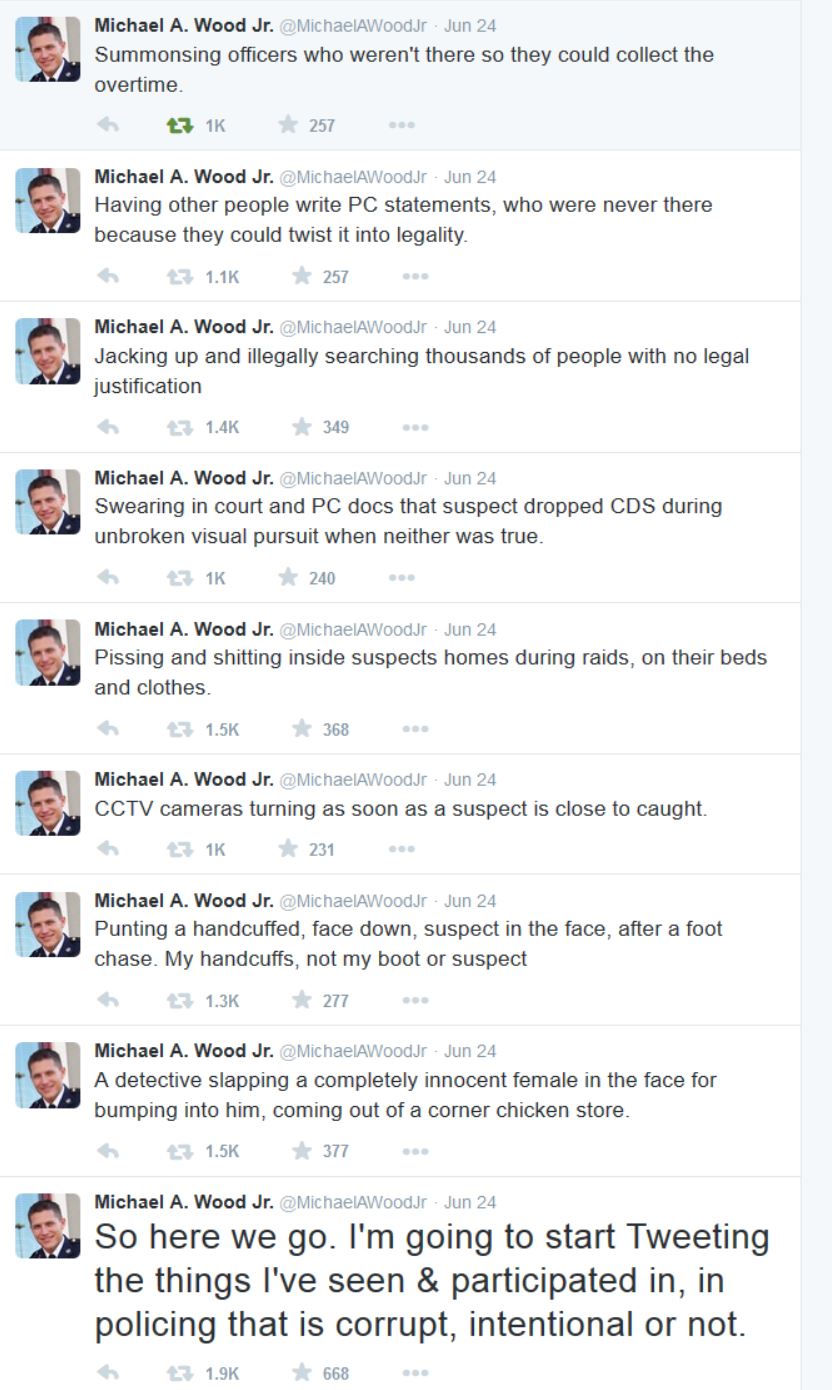
    Michael Wood Jr. has made some waves by tweeting about things he saw as a Baltimore cop.

    [To get up to speed, single best thing to read now is the Balko interview.]

    Honestly, I don’t doubt what Wood says. I am curious if all the bad he saw came from his time in narcotics. And for better or for worse, he wasn’t in narcotics long. I don’t think he made an arrest since 2009. There has been lots of time to bring up these issues. Lots of time to go to IAD. In fact, he still could. But anyway…

    I never worked a specialized unit. I didn’t want to. I didn’t like they way the worked. (I also wasn’t there long enough anyway to get out of patrol.) I saw the drug squads tear up homes during raids. (I was sometimes the lone “uniform” out back.) It was immoral and ugly. Worst of all, it was legal.

    End the drug war and 80 percent of police problems vanish.

    But I’m curious, if Wood was a sergeant, did this stuff happen under his command? Because then it’s also on him. But all in all, I have no reason not to take him at his word:

    I will admit to some self interest in coming forward. I’d like to part of the solution. I woke up to this, and I think I can be a bridge. I speak the language cops speak. If there’s some task force or policing reform committee I can serve on, I’d love to do that.

    Other than that, I think we just need more conversation.

    Unlike Wood, I never had a “come to Jesus” moment working as a cop. The world — and policing — is filled with a lot of gray. I already knew the war on drugs was doomed. (What I learned as a cop on the front line was how that failure worked out on the front line.) I suppose I went in a bit more world weary and cynical than the average cop. I was older (29) than the average rookie. I lived in the city. I did not have a military us versus them attitude. I was college educated. Well traveled. I spent a lot of time with the police in Amsterdam (on and off from 1996 to 1999). So I had a certain perspective as to what I was seeing and doing on the job. I was not completely unfamiliar with the ghetto, black people, or urban life in general. I was not afraid.

    I am afraid that lost in the sensationalism of a cop “telling all” will be the subtlety and nuance of what Wood is saying. It would be unfortunate were this just filed away as ammo in the “cops are bad” camp. I know — as I presume Wood does — too many cops who do care, do have empathy, and do work very hard to help people. I also know a lot of cops who maybe stopped caring, but still do a good job. And, sure I’m all for societal justice, but lofty ideals don’t tell police what to do in neighborhoods with these kinds of problems!

    In a very long radio interview Wood mentions something which deserves highlighting:

    This job is largely impossible.

    The expectation of the modern police officer is that they should be a medic. They need to be MapQuest. They need to be a jujitsu expert. They need to be a handgun superstar who can shoot somebody in the knee…. They need to be a psychiatrist. They need to understand mental illness. They need to be able drive effectively. They need to do all of this while making $45,000, having minimal training, and no education.

    Wood makes the point that there’s too much injustice in our society. He’s right. And he’s right that they’re linked to race and class. He’s right that the rules are different if you grow up in the ghetto. He’s right that the war on drugs is a failure. And he’s right that too many cops come from completely different backgrounds without any empathy or understanding of the area or the people in the area they police. He’s right that what we’re doing isn’t working. He’s right that police can do better.

    Here’s an interview of Wood by Radley Balko in the Washington Post:

    What we’re doing to people to fight the drug war is insane. And the cops who do narcotics work — who really want to and enjoy the drug stuff — they’re just the worst. It’s completely dehumanizing. It strips you of your empathy.

    I found his take on veterans as cops (he is one) interesting:

    But when it comes to former military joining law enforcement, I’m in the camp that says they’re going to be better when it comes to shootings and using force. Bad police shootings are almost always the result of a cop being afraid…. The military strips you of fear. Here’s the thing: There’s nothing brave or heroic about shooting Tamir Rice the second you pull up to the scene. You know what is heroic? Approaching the young kid with the gun. Putting yourself at risk by waiting a few seconds to be sure that the kid really is a threat, that the gun is a real gun. The hero is the cop who hesitates to pull the trigger.

    That’s where I think a military background can help. Very few of these bad shootings were by cops with a military background. There may have been a few, but I can’t think of one.

    I’ve often said it would be nice if we could talk about some of the important issues before somebody dies. Maybe Wood is giving us that opportunity.

    [Though he’s wrong about the baton.]

  • On arresting drug offenders

    From Cop in the Hood:

    Because of these problems and the “victimless” nature of drug crimes, most drug arrests are at the initiative of police officers. On one occasion, while driving slowly through a busy drug market early one morning, I saw dozens of African American addicts milling about while a smaller group of young men and boys were waiting to sell. Another officer in our squad had just arrested a drug addict for loitering. I asked my partner, “What’s the point of arresting people for walking down the street?” He replied: “Because everybody walking down the street is a criminal. In Canton or Greektown [middle- class neighborhoods] people are actually going somewhere. How many people here aren’t dirty? [‘None.’] It’s drugs. . . . If all we can do is lock ’em up for loitering, so be it.”

    I don’t think that’s the answer. But… I’m not certain what is the answer. Certainly junkies are a quality-of-life issue. The best we could do is regulate the drug trade. The worst we could do is decriminalize low-level drug offenses. The latter solves neither quality-of-life issues nor the violence around public drug dealing.

  • Police/Community relations in Baltimore

    They weren’t good then. They’re not good now. From Cop in the Hood:

    While the police see good communication between the public and the police as essential to fighting crime, relations are quite poor. This shouldn’t be surprising. Drug users are criminal. If they want to stay out of jail, they and those who care for them have every reason to be wary of police. One officer complained:

    “Nobody here will talk to police. Half the public hates us. The other half is scared to talk to us. I would be, too. But we can’t do anything without the public. They know who’s dirty and who’s not. They know who’s shooting who. We don’t know. They live here. We just drive around in big billboards. How are we supposed to see anything? The public doesn’t understand that nothing will ever go to court if nobody talks. We can only do so much. As long as nobody ever sees anything, things aren’t going to change.”

    New or not, the impact of silence is hugely detrimental to police and prosecutors. Even without personal risks, there is little incentive to testify. Nobody gains through interaction with the criminal justice system. You don’t get paid for it; there is no guarantee that testimony will result in conviction and jail time; and after the second or third postponement, a sense of civic duty usually fades. The hassles of court–passing through metal detectors, wasted days, close contact with crowds of criminals–combined with practical matters such as work and childcare make it far easier, even smarter, to see nothing, hear nothing, and mind your own business.

    That’s the real wall of silence we need to break down. And I have no idea how to do it. Especially given the rules of the game, both judicial and criminal. Make no mistake about it: snitches do get stitches. Witnesses get killed. Not that often, mind you. But just enough to shut people up. (This also seems relevant if you’ve read Ghettoside, which I wrote about in a comment to this post.)

  • Baltmore’s so-called gang problem

    From Cop in the Hood:

    In cities like Chicago and Los Angeles, gangs control the drug dealing. Because of that, some assume that drug violence is intrinsically linked to gangs. But East Coast cities have a different history. Large-scale gangs, such as the Bloods and Crips, are growing but still comparatively small. Gangs in Baltimore tend to be smaller and less organized, sometimes just a group sitting on a corner. Any group selling drugs can be called a gang, but the distinction between a gang and a group of friends is often based more on race, class, and police labeling than anything else. The disorganization of Baltimore’s crime networks may contribute to Baltimore’s violence. Conceivably, organized large gangs could reduce violence by deterring competition and would-be stickup kids.

    While drug-dealing organizations exist, they tend to restrict themselves to wholesale operations without conspicuous gang names, clothes, or colors. In Baltimore, wholesalers–often SUV-driving Dominicans and Jamaicans with New York or Pennsylvania tags–will sell their product to various midlevel dealers once or twice a week. The midlevel dealers will re-up the corner dealers’ stash as needed. Street-level dealers in Baltimore control smaller areas, perhaps three or four corners in close proximity. As a uniformed patrol officer, my focus was exclusively on the low-level street dealer. Going up the drug ladder requires lengthy investigations, undercover police, snitches, and confidential informants. A patrol officer’s job is to answer 911 calls for service.

    Has any of this changed?

  • Violence and the Drug Corner in Baltimore

    Too many people are getting killed! From Cop in the Hood:

    Still the risk of death is astoundingly high. For some of those “in the game,” the risk of death may be as high as 7 percent annually. Each year in Baltimore’s Eastern District approximately one in every 160 men aged fifteen to thirty- four is murdered. At this rate, more than 10 percent of men in Baltimore’s Eastern District are murdered before the age of thirty- five. As shocking as this is, the percentage would be drastically higher if it excluded those who aren’t “in the game” and at risk because of their association with the drug trade. Yet if everybody you know has been shot, killed, or locked up, perhaps such is life.

    Linked to the recent increase in homicides:

    Police don’t find many guns when frisking suspects. The threat of arrest may outweigh the risk of being robbed or attacked. For others, a reputation for violence may be enough of a deterrent. Yet there is no doubt that guns are accessible to many. After all, gunfire is a daily reality and pacifist corner drug dealers don’t last long.

  • Where and how you are raised? It matters.

    When it comes to policing and crime, I’m quick to harp on individual agency and free will. It matters. People make bad and harmful choices. They choose to do so. And police can prevent some of the things that lead to bad choices. Some liberals forget that.

    But this isn’t say that root causes don’t matter. Of course they do. More than police. More, on a macro level, than free will or police. And sometimes conservatives forget this. From the Economist:

    The great thing about America, Scott walker went on, was that it offered equality of opportunity, even if outcomes were up to individuals. America is one of the few countries left in the world where it doesn’t matter what class you are born into, he declared, and many in the audience, notably the older voters with snowy hair, clapped enthusiastically.

    That’s laughable. Prof Michael Jenkins states this well (in a column about Spike Lee’s “Chi-Raq”) (though I think his student body is very different from what you’ll find in my classroom):

    “I tell my students, ‘Think about the circumstances in which you were raised,’ ” says Michael Jenkins, a criminal justice professor at the University of Scranton. About the parents, teachers, schools and other organizations that get thanked in the graduation speeches, that were there to support you. Then “think about some of the poor decisions you made even with all those structural conditions in your favor.”

    There are things “we celebrate as leading to success, but we fail to acknowledge that the lack of those things explains poor behaviors,” he says. There are places that suffer from lack of investment, unemployment and underemployment, under-education. We act as if everyone has “the same choices we have, then we take credit for our own decisions when they were also bounded, but bounded by more positive outlines.”

    If conditions didn’t matter, if you think your kids would turn out just as well growing up in the ghetto, then why don’t you move to a “bad” neighborhood? Housing is cheap. But I don’t blame you. There are good reasons you don’t want to raise your kids in segregated poor violent neighborhoods. Such as:

    A) The schools are bad.

    B) The streets aren’t safe.

    C) There are no stores.

    D) Your neighbors may be, if not criminals, inconsiderate of those who, say, have to get up in the morning and go to work.

    So you’re not moving to Camden (or wherever). For the kids, perhaps. So why wouldn’t it affect those who actually do live there (usually because they just happened to be born there)? So shouldn’t we all have a little more empathy for those who are forced to grow up without any of the advantages mainstream America can provide?

    This doesn’t mean you can’t and shouldn’t blame people for their actions. But after we do that, can’t we also work to improve society and the world others are forced to live in?

  • The “ghetto”

    I use the word “ghetto” because it is the vernacular of police officers and many (though by no means all) of the residents. Here’s what I said about “ghetto” in Cop in the Hood:

    In any account of police work, inevitably the noncriminal public, the routine, and the working folks all get short shrift. Police don’t deal with a random cross-section of society, even within the areas they work. And this book reflects that.

    The ghetto transcends stereotypes. Families try to make it against the odds. Old women sweep the streets. People rise before dawn to go to work. On Sundays, ladies go to church wearing beautiful hats and preachers preach to the choir. But if you’re looking for stereotypes, they’re there. Between the vacant and abandoned buildings you’ll find liquor stores, fast food, Korean corner stores, and a Jewish pawnshop. Living conditions are worse than those of third-world shantytowns: children in filthy apartments without plumbing or electricity, entire homes put out on eviction day, forty-five-year-old great-grandparents, junkies not raising their kids, drug dealers, and everywhere signs of violence and despair.

    …If you’re not from the ghetto, and though it may not be politically correct to say so, the ghetto is exotic. One field-training officer accused me of being “fascinated by the ghetto.” I am. There are very few aspects of urban life that don’t fascinate me. But it is not my intent to sensationalize the ghetto. This is a book about police.

    If you want to read about the ghetto, good books are out there. Ghettos are diverse and encompass many cultures and classes. Some object to the very term “ghetto.” I use the word because it is the vernacular of police officers and many (though by no means all) of the residents. If you really want to learn about the ghetto, go there. There’s probably one near you. Visit a church; walk down the street; buy something from the corner store; have a beer; eat. But most important, talk to people. That’s how you learn. When the subject turns to drugs and crime, you’ll hear a common refrain: “It just don’t make sense.”

  • Life and Death in Baltimore’s Eastern (and Western) District

    See Update for more current data

    More than ten percent of black men in Baltimore’s Eastern District are murdered! Why is this not known? Why is this not discussed with urgency? Why has this been going on for decades?

    This is from my book, Cop in the Hood. I can’t find it anywhere online. It should be. I’m still honestly hoping there is some major error in my math. But if there is, nobody has brought it to my attention. This stats comes from 2000-2006. Though it may have changed slightly, I have no reason to think it’s changed significantly. And to be clear, the “men” I’m talking about are black men:

    The risk of death is astoundingly high. For some of those “in the [drug] game,” the risk of death may be as high as 7 percent annually.* Each year in Baltimore’s Eastern District approximately one in every 160 men aged fifteen to thirty-four is murdered. At this rate, more than 10 percent of men in Baltimore’s Eastern District are murdered before the age of thirty-five.** As shocking as this is, the percentage would be drastically higher if it excluded those who aren’t “in the game” and at risk because of their association with the drug trade. (p. 73)

    And here is the fine print, the dirty details, the footnotes from pages 219-220:

    * Levitt and Venkatesh (Levitt, Steven D., and Sudhir Alladi Venkatesh. 2000. “An Economic Analysis of a Drug- Selling Gang’s Finances.” Quarterly Journal of Economics 115 (3):755–89) show an annual 7 percent death rate for those actively involved in street-level drug dealing. A Baltimore City police officer entering the force in 1982 and retiring in 2007 would have had, roughly, a 0.7 percent chance being killed on duty during those twenty-five years.

    ** More than 11.6 percent of men in the Eastern District are murdered. This is based on homicide and census data. The 2000 Eastern District population for age 15 to 34 is 5,641 (derived from 2000 block-level U.S. Census data). The official U.S. Census citywide undercount for Baltimore was 1.8 percent. I arbitrarily doubled this figure for the Eastern District. Adding 3.6 percent raises the sample population to 5,844. The Eastern District lost 3 percent of its population annually between 1990 and 2000. Following this trend (it may have even accelerated give the massive expansion of Johns Hopkins Hospital), the 2006 population would be 4,867. I keep the 2000 population figure to be more conservative with my estimation of the homicide rate. Daily migration is not taken into account. I do not think this accounts for a large bias in either direction. All homicide victims in the Eastern District are assumed to reside in the district. Likewise no victims outside the Eastern District are assumed to come from the district. Homicide deaths in the Eastern District between 2000 and 2006 (excluding 2003, when I could not acquire data) are, respectively: 59, 38, 61, 55, 35, and 43. The mean is 48.5 murders per year. The demographic characteristics of homicide victims in the Eastern District are estimated from citywide, African American sex and age data. Of the city’s 179 black homicide victims in 2000 age 15 to 34, 168, or 93.9 percent, were men. 78.9 percent of all black male Baltimore homicide victims are 15 to 34 (FBI UCR 2000 Homicide Supplement). Based on these data, the average annual homicide rate for men 15 to 35 is 615 per 100,000. To put it another way, for these men, the odds of being murdered in a single year are 1 in 163. Based on the survival rate function 1 − (1 − r)^x, (r = death rate and x = number of years), 11.6 percent of men are murdered during a twenty-year period.

    Source: Peter Moskos. 2009. Cop in the Hood. Princeton University Press.

  • “Group on the corner, disorderly, no further, anonymous”

    I don’t want to make too much out of this, but there is something just a little funny about a reporter being robbed on camera and then running, in tears, to the police. No, it’s not funny because somebody is robbed. No, it’s not funny that she was traumatized by it. It is just a little funny because at the same time she might be filing a report about police brutality, who does she run crying to when threatened? The police.

    Or… maybe she’s just harassing an innocent unarmed youth. After all, the guy said he didn’t do it.

    It’s the moral equivalence that bother police. The idea that people would take word of the mob purse snatcher as equal to a cop’s word. Even worse is the idea, which I hear a lot of, that these guys are actually morally superior to working police officers. It’s absurd. (You can get another take on this from a previous post.)

    Here’s the thing about the guys who were threatening her: it’s not like they just appeared yesterday and won’t be here tomorrow. Police deal with these guys literally every day. These dozen youths are out there every night in the streets of Baltimore. They might not always be acting up quite so much. But sometimes they are. Too many people pretend it’s all about bad police oppressing good people. But they don’t live or work in neighborhoods where they get harassed by these specific youths. But good people do. And they call the police. I’m talking class, not race.

    Police handle “routine calls for service” like this every hour. When I texted my friend working the Eastern last night wishing him well, he replied, “Thanks brother. Just another night in the hood! Lol.”

    A typical call may be because Pops called 911 because these kids on the corner, in front of his house, are being loud, rowdy, breaking bottles, and otherwise disrespectful. You get the call. You pull up. You’re solo. There they are. Deal with it. That’s what cops do. Every goddamn day. You know, I got tired telling the same group of drug dealers to get off the same corner every goddamn night. But I did. I had to. It was my job.

    Usually what happens in the ghetto stays in the ghetto. Literally and figuratively. I spoke to many teenagers in the Eastern who had never been downtown. Never been out of Baltimore. Never left their neighborhood. It might be one thing to never leave your neighborhood if you live somewhere nice, but if your whole world is centered around Rutland and Crystal? (Go on, google-steet-view 1511 Rutland Ave, Baltimore MD 21213 and take a look around. Hell, buy that home for $8,000!) Take a stroll down the 1700 block of Crystal Ave. No wonder you’re messed up. Who do you think is pulling the trigger on 200-plus homicides a year in the city of Baltimore? Since Freddie Gray died in police hands — between April 13 and April 26 — there have been 8 murders in Baltimore.

    So yesterday — along with hundreds of peaceful protesters — a bit of the ghetto broke out of the ghetto. Now if you’re so ideologically inclined you might think that’s good. Or, if you’re in a restaurant where things are being thrown through the windows, you might not (while praying that a Molotov cocktail doesn’t follow suit). But here are a dozen human being society tries to ignore, until we put them in prison. I’m not talking about the protesters. I’m talking about these dozen thugs.

    And I don’t actually blame these kids for being foolish — I know they’re fools, but hell, they never had a chance. Look where they grew up. Look at their parents — as much as I blame the people who apologize for their bad actions. Those who call mindless violence a “rebellion” or “giving voice to the voiceless.” Those who blame police for trying to calm a disturbance. Those who believe in the false ideal of the gentleman thug.

    So we pay police to deal with the problems of our country and to somehow contain these kids so they don’t beat up working tax-paying voters. We, collectively, have failed. And then we wait for police to make a mistake and blame it all on them.

  • There are good people, too.

    The sixth in a series from Sgt. Adam Plantinga’s excellent 400 Things Cops Know: Street-Smart Lessons from a Veteran Patrolman:

    There are good people in the neighborhood. They work hard. They try to raise their kids right. They’ll even help you push if your squad car gets stuck in a snow bank. You see them out there, tending to their lawns, cleaning the broken bottles off the sidewalk in front of their house, shaking their heads as a car with chrome rims drives by, the bass turned up so loud it rattles the stemware in their kitchen.

    Some of them have lived in the same house for 20, 30, 40 years and now look around and don’t recognize the street they grew up on or the people that live there. The block has taken a turn for the worse and they’re talking about moving. They don’t want to move, mind you. But maybe they’d rather live in a place where they can watch their grandkids play without having to worry about stray bullets or vicious dogs. Maybe they want to look out the window and see kids racing each other on bikes instead of some teen in an oversized I Got That Snow T-shirt doing a hand-to-hand drug deal. You can’t blame them for wanting out. You don’t live there. You wouldn’t make it. Sure, you patrol those streets and alleys but at the end of your shift, you go home. That makes you merely a tourist. Not a guide, but a guest.