Tag: use of force

  • Paul O’Neal shot and killed by Chicago police

    Last week Paul O’Neal was fleeing from police in a stolen car. He crashed past one police car, and cops shot at him. He then veered head-on into another cop car, bailed, jumped over a fence (being more agile than any of the chasing cops), and was then shot at again. One (or more?) of these shots hit O’Neal in the back and killed him. O’Neal did not have a gun.

    I spent a few too many hours editing these videos down to an annotated good parts version. Here’s the timeline:

    0:00 1st police car passenger’s bodycam

    0:21 1st police car passenger’s bodycam, with comments

    1:47 1st police car driver’s bodycam

    2:01 1st police car driver’s bodycam, with comments

    2:50 rammed police car’s dashcam

    3:08 rammed police car’s dashcam, with comments

    It all does happen so fast. But it’s a bad shooting. And that’s before O’Neal is killed. The bottom line is that the first cop who shot — the passenger in the first police car struck — shot too quickly and unreasonably. His actions directly led to O’Neal’s death by creating what is known, in technical police circles, as “a complete clusterfuck.”

    This cop fucked up in so many different ways, it’s hard to count the ways. But I came up with eight, for starters:

    1) His gun is unholstered in the car (WTF?) before he even gets out.

    2) He shoots without an imminent threat to him or his partner.

    3) He shoots one-handed, while moving, without trigger control.

    4) He shoots at a moving vehicle (which goes against department policy).

    5) He came damn close to shooting his partner!

    6) Twice!!!

    7) He shoots at a fleeing felon (which goes against Tennessee v. Garner).

    8) He shoots downrange toward a light-flashing police car coming in his direction.

    And for what? A stolen car?

    And after the shootings, his most-vocalized worry was:

    Fuck, I’m going to be on the desk for 30 goddamn days now. Fucking desk duty for 30 days now. Motherfucker.

    Don’t worry. You won’t be sitting at a desk for long. You’ll be criminally charged with something, as you should be. Probably convicted, too. And I hope you’re fired for shooting at other cops. No cop will work next to this trigger-happy shooting-at-his-partners cowboy. The other officers on scene could only be so lucky if it turns out that the fatal bullet did come from his gun. See, despite having fired at at least 10 times, Officer 30-Goddamn-Days can’t be convicted of homicide because he probably never hit O’Neal! It would be fitting if they made him pay for the bullet hole in the car.

    The officer who fired the fatal shot probably shot O’Neal in the backyard, and there’s no video of this. He or she will have a reasonable defense. They had good (albeit incorrect) reasons to believe O’Neal was armed, dangerous, and shooting at cops. O’Neal was a felon who rammed a cop car head-on. The irony is that Cowboy Cop, by shooting, makes the subsequent officers’ actions more reasonable.

    This could turn out like the police-involved shooting of Amadou Diallo: a tragedy, a bad shooting, and a collective fuck-up, but still not a convictable criminal offense for cops thinking they’re under fire. “Reasonable” is the legal standard. (But it doesn’t do justice to Diallo to compare these shootings. Diallo’s death was worse because Diallo was innocent, compliant, not in a stolen car, and not fleeing from police.) This won’t be as open-and-shut obvious acquittal as, say, homicide by failure to seatbelt. But cops don’t have to be right; they have to be reasonable. And criminal cases need to be proved beyond a reasonable doubt.

    And yes, it should be said: kids, don’t steal cars!

    [I first saw the videos on Tanveer Ali’s article in DNAinfo. Unedited videos can be found at Vimeo under Log# 1081642.]

    [The one “good” shot, in my opinion, comes from the driver of the first police car. He gets out of the way of the car coming at him and takes fire (turns out from his stupid partner, but he didn’t know that). What he does know (even though it turns out to be wrong) is that a felon is shooting at cops and driving toward more police officers. You can shoot at a vehicle if you believe that vehicle to be an imminent threat is a form other than the vehicle itself. (The police passenger knew the car thief wasn’t shooting, so his shots were not good.) The police driver assumes a good shooting stance, aims, and fires once (or maybe twice), hoping to hit the driver in his back. Given what he knew right there and then, it’s a good shooting (even with the cop car downrange, but off-target). This is not the same as saying his shooting was right in hindsight. It wasn’t. But shootings can be legally justifiable even when hindsight proves them wrong.]

    Update (January 12, 2018) from the Chicago Tribune:

    Two Chicago police officers should be fired for shooting at a moving vehicle without justification during a chase and fatal police shooting in 2016, disciplinary officials ruled in a report obtained Friday by the Tribune.

    Officers Michael Coughlin Jr. and Jose Torres endangered the public and the lives of their fellow officers when they shot at 18-year-old Paul O’Neal as he tried to flee police in a stolen Jaguar convertible on a residential street in the South Shore neighborhood, according to the report by the now-defunct Independent Police Review Authority.

    The same report concluded that a third officer, Jose Diaz, who ultimately shot and killed O’Neal during an ensuing foot chase, was justified because he reasonably believed that O’Neal had a gun and had already fired shots at the police, even though O’Neal turned out to be unarmed.

    It was recommended, however, that Diaz be suspended for six months for kicking O’Neal and yelling “Bitch ass mother——, f—— shooting at us!” while the teen lay mortally wounded in a backyard.

    That same profanity-laced statement, which was captured on a police body camera, convinced investigators that Diaz “genuinely believed” at the time that O’Neal had fired at him, according to the report, obtained by the Tribune through an open records request.

    Further update, October 2018. Looks like both officers are going to be fired.

    Further more update, March 2020. They are being fired. I can’t believe it’s 4 years later.
  • Reducing police-involved shooting & “The List”

    This past week John McWhorter and I were both (separately) on Bloggingheads.tv with Glenn Loury to talk about race and all the recent shootings. McWhorter emphasized race as a factor of those shot by police and:

    challenged those who disagree to present a list of white people killed within the past few years under circumstances similar to those that so enrage us in cases such as what happened to Tamir Rice, John Crawford, Walter Scott, Sam Debose and others.

    Well I keep track of these things and through Glenn passed some names on to Professor McWhorter. I give sincere respect to Professor McWhorter for his intellectual honesty today in Time:

    The simple fact is that this list exists.

    When a black man is killed by a cop, do we grieve more because there are 46 million of us as opposed to 198 million whites? I doubt it: most Americans never hear about the white men’s deaths at all.

    Rather, we operate according to a meme under which cops casually kill black men under circumstances in which white men are apparently let off with a hand slap — and occasional cases of just that are what often get around social media, suggesting that they are the norm.

    However, at the end of the day any intelligent engagement with these issues must keep front and center that there was a Daniel Shaver for John Crawford, a Michael Parker for Walter Scott, a James Scott for Laquan McDonald. Economist Roland Fryer’s conclusions, stunning even to him, that cops use more force against black people but do not kill them more than they kill whites is perhaps less perplexing than it seems.

    Unlike McWhorter, I was not surprised by Fryer’s conclusions. Like McWhorter, “I am neither a neither Republican nor conservative.” But unlike McWhorter, I am white. (Though I have written about some of the more egregious cases, it sounds a bit funny to say, Romney like, “I have a binder full of white people!”) I don’t want to be liked and linked to by racists and the “alt-right”.

    But I’ve researched and written about race before. I said, “The idea that police don’t use lethal force in a racist way might be a tough pill for many to swallow.” But if one wishes to reduce police-involved shootings — and all of us do; cops don’t go to work hoping to shoot somebody — there are good liberal reasons to de-emphasize the significance of race in policing.

    Jonathan Ayers, Andrew Thomas, Diaz Zerifino, James Boyd, Bobby Canipe, Dylan Noble, Dillon Taylor, Michael Parker, Loren Simpson, Dion Damen, James Scott, Brandon Stanley, Daniel Shaver, and Gil Collarwere all killed by police in questionable to bad circumstances. McWhorteradded Alfred Redwineand Mary Hawkes. You can probably find others from Washington Post data. What they have in common is none were black and very few people seemed to know or care when they were killed.

    According to the Washington Post, 990 people were shot dead by police in 2015. 258 were black. More significant than racial differences — much of which can be explained by racially disproportionate levels of violence — are stunning regional differences.

    Last year in California, police shot and killed 188 people. That’s a rate of 4.8 per million. New York, Michigan, and Pennsylvania collectively have 3.4 million more people than California (and 3.85 million more African Americans). In these three states, police shot and killed (just?) 53 people. That’s a rate of 1.2 per million. That’s a big difference.

    Were police in California able to lower their rate of lethal force to the level of New York, Michigan, and Pennsylvania — and that doesn’t seem too much to ask for — 139 fewer people would be killed by police. And this is just in California! (And California isn’t even the worst state; I’m picking on California because it’s large and very much on the high end.)

    Now keep in mind most police-involved shootings are not only legally justifiable, they are necessary and good at the moment the cop pulls the trigger. But that doesn’t mean that the entire situation was inevitable. Cops don’t want to shoot people. They want to stay alive. You give cops a safe way to reduce the chance they have to pull the trigger, and they’ll certainly take it.

    I really don’t know what some departments and states are doing right and others wrong. But it’s hard for me to believe that the residents of California are so much more violent and threatening to cops than the good people of New York or Pennsylvania. I suspect lower rates of lethal force has a lot to do with recruitment, training, verbal skills, deescalation techniques, not policing alone, and more restrictive gun laws. (I do not include Tasers on this list.)

    If we could bring the national rate of people shot and killed by police (3 per million) down to the level found in, say, New York City (The big bad NYPD shoots and kills just 0.7 per million) we’d reduce the total number of people killed by police 77 percent, from 990 to 231!

    [Update: Here are more names worth considering, taken from comments to this post: David Kassick, Josh Grubb and Samantha Ramsey(examples of officer-created danger), John Winkler, Robert Saylor. Zachary Hammond. Sal Culosi. John Geer. Autumn Steele (This is rare case of an unarmed white person shot by a black officer.) Michael McCloskey.

    Also, it turns out Bobby Canipe lived. But I’m still including him because, my God.

    And it’s well worth watching Glenn Loury and John McWhorter talk about The List in a more recent Bloggingheads.tv]

  • Chicago Police Report

    It’s kind of hilarious that Chicago Mayor Rahm Emanuel is trying to present his cover-up-and-dictate style of management as concern for police misconduct. But leaving that aside, a task-force he appointed has released its report.

    Some of what it says needs to be said: “From 2011-2015, 40% of complaints filed were not investigated by IPRA.” And: “These events and others mark a long, sad history of death, false imprisonment, physical and verbal abuse and general discontent about police actions in neighborhoods of color.”

    And let’s not forget the false (and consistently false) police reports and (mayoral?) cover-up related to the killing of Laquan McDonald:

    Not until thirteen months later — after a pitched legal battle doggedly pursued by local investigative journalists resulted in the court-ordered release of the dash-cam video of the shooting — did the public learn the truth: McDonald made no movements toward any officers at the time Van Dyke fired the first shot, and McDonald certainly did not lunge or otherwise make any threatening movements. The truth is that at the time Van Dyke fired the first of 16 shots, Laquan McDonald posed no immediate threat to anyone.

    They really should have added that McDonald didn’t pose any threat when the last shots were fired.

    There are the ignored red flags:

    The enduring issue of CPD officers acquiring a large number of Complaint Registers (“CRs”) remains a problem that must be addressed immediately. From 2007-2015, over 1,500 CPD officers acquired 10 or more CRs, 65 of whom accumulated 30 or more CRs. It is important to note that these numbers do not reflect the entire disciplinary history (e.g., pre-2007) of these officers.

    The inability to act on red flags:

    Sadly, CPD collects a significant amount of data that it could readily use to address these very troubling trends. Unfortunately, there is no systemic approach to addressing these issues, data collection is siloed and individual stakeholders do virtually nothing with the data they possess.

    And the perennial problem with “community policing”:

    Historically, CPD has relied on the Community Alternative Policing Strategy (“CAPS”) to fulfill its community-policing function. The CAPS brand is significantly damaged after years of neglect. Ultimately, community policing cannot be relegated to a small, underfunded program; it must be treated as a core philosophy infused

    But here’s where ideology begins to trump common sense. It’s claptrap to advocate for “community policing” without defining community policing or offering any evidence to its effectiveness. Yes, police right now need better relations with the non-criminal public in minority neighborhoods. But the main job of police, lest we forget, is to deal with the criminal public.

    And then there’s the absurdity — the dangerous and even racist absurdity — of promoting racial balance in police activity and use of force.

    Police Officers Shoot African-Americans At Alarming Rates: Of the 404 shootings between 2008-2015:

    • 74% or 299 African Americans were hit or killed by police officers, as compared with

    • 14% or 55 Hispanics;

    • 8% or 33 Whites; and

    • 0.25% Asians.

    For perspective, citywide, Chicago is almost evenly split by race among whites (31.7%), blacks (32.9%) and Hispanics (28.9%).

    Really? That’s your perspective?

    The idea that police should stop, arrest, and even shoot and Tase people in proportion to population demographics is nutty. For real perspective, consider that of 3,021 Chicagoans shot last year, just 25 were shot by police. 79 percent of murder victims were black; 4 percent were white. For known assailants (which is known just a shamefully low 26 percent of the time) the figures are comparable.

    With this perspective, the use-of-force stats seem quite reasonable. To say this is not to deny a historically troubling legacy or even current problems. But if the benchmark for success in policing is racial parity in use of force, then Chicago and Chicagoans are in for more bloody years.

    Chicago is 5.5 percent Asian. As a benchmark of success, will we not rest till more than 5 percent of those shot by police are Asian?

    Overall, use of lethal force by the Chicago Police Department is on par with the national average (0.33 per 100,000 for the CPD, compared with 0.31 for the nation). Chicago is below LA, Houston, Atlanta, San Francisco, and most cities. The Chicago Police Department may have 99 problems, but an excessive use of lethal force and a racial disparity in that use of force doesn’t seem to be one of them.

    Still, there is a room for improvement. The NYPD kills people at an outlyingly-low rate of 0.08. Maybe, instead of suing police departments into institutional paralysis, folks could determine what the NYPD is doing right and advocate better — rather than less – policing based on best practices. (But who on the Left wants to talk about what the NYPD is doing right?)

    But I’ll finish on a positive note:

    The findings and recommendations in this report are not meant to disregard or undervalue the efforts of the many dedicated CPD officers who show up to work every day to serve and protect the community. The challenge is creating a partnership between the police and the community that is premised upon respect and recognizes that our collective fates are very much intertwined.

  • Problems with Tasers

    I had no idea TASER was an acronym standing for anything, much less “Thomas A. Swift’s electric rifle“!

    The LA Times reports:

    LAPD officers fired Tasers just over 1,100 times last year…. The devices had the desired outcome — causing someone to submit to arrest — only 53% of the time.

    Is half the time better than nothing or not nearly good enough? Anecdotally, it seems like a lot of bad police shootings are preceded by Tasers not doing what they’re supposed to do. You press the magic button… and nothing happens. And you’re not used to having to go hands-on, fighting, and physically dominating a suspect. So you’re scared and reach for your gun.

    And that’s not the only problem with Tasers.

  • Taser Use

    Great story in the Baltimore Sun about taser use:

    • Nearly 60 percent of those hit by Tasers in Maryland were described by police as “non-compliant and non-threatening,” according to data from 2012 when the state began collecting data through 2014.

    • In one out of every 10 incidents, police discharged the weapon for longer than 15 seconds — a duration that exceeds recommendations from Taser International, the U.S. Department of Justice and policing experts. The data downloaded directly from the devices often shows more activations than officers document in police reports.

    • Officers fired the weapons at the chest in 119 incidents in 2014 — even though Taser has warned since 2009 that doing so could cause cardiac arrest.

    And why?

    From 02:20 of the video in the story:

    The Taser is a great tool because if you go out on a call or something… and he’s fighting… before, if you hit him was a asp [baton] he’s going to get a lot of contusion marks and maybe break some bones. A Taser is not going to do that.

    See contusions look bad. But Tasers sometimes kill. To me the issue has always been whether the Taser is used for a threat (OK) or compliance (bad).

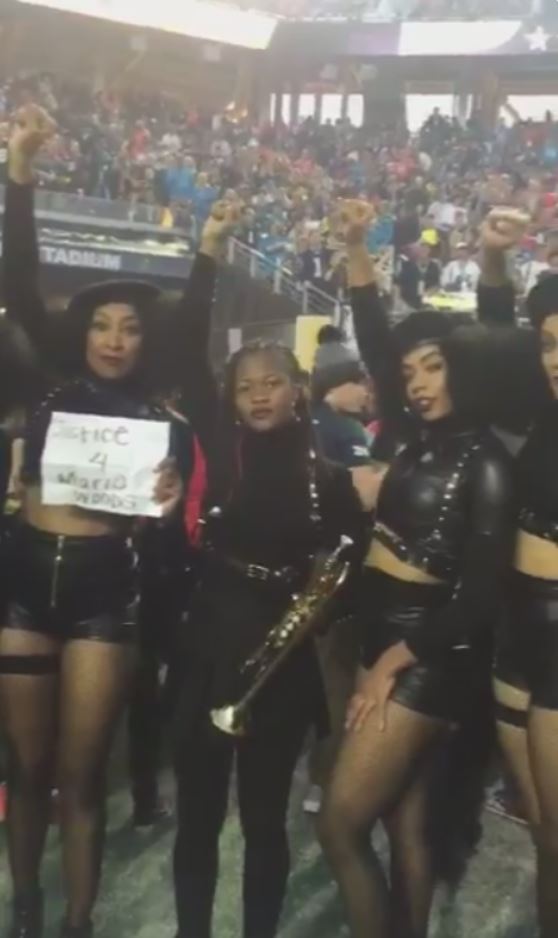
  • “Justice 4 Whom”?!

    “Justice 4 Whom”?!

    Generally I couldn’t care less what Beyonce’s dancers think. But “Justice 4 Mario Woods” and a black power salute? Are you effing kidding me? Mario Woods was shot and killed by San Francisco police back in December. It was a good shooting.

    Christ almighty there are plenty of bad police shootings. Not this one. Woods doesn’t need justice. “Justice 4 Mario Woods” means there was an injustice done by police. But right there and then, Mario Woods was armed and dangerous and needed to be stopped.

    Crazy Mario Woods had already stabbed a stranger. And now he’s just walking down the street holding the bloody knife. Police tell him to drop the knife. He won’t. Police knew Woods had knife, had just used it, and may have wanted to use it again. Police use less lethal force… one, two, three, four, and five times. Woods won’t drop the knife even after being beanbagged and tased. It’s like he’s on a mission. (Based on what Woods said, I suspect this was suicide by cop.) If he gets closer to others and starts cutting, police might not be able to shoot. It’s a crowded street. Woods needed to be stopped.

    The Guardian, which since Coldbath Fields Riot of 1833 has published exactly one unbiased story about police, says, “Mario Woods was allegedly armed with a kitchen knife.” No. He had just tried to kill somebody. He was armed with a kitchen knife.

    One thing that bothers me about press accounts of this incident are journalists who still talk about the knife being “alleged” or the victim being “allegedly” stabbed. For legal reasons, I understand why you might throw in “alleged” when describing the suspect. But when the suspect is dead, you can drop the “alleged” crap. Dead men can’t sue any more than than they can be convicted of crime.

    The very first reporter who called me, the one who brought this shooting to my attention, mentioned almost in passing that Woods “allegedly stabbed somebody.”

    “What?” I said, “Well, that would really matters to police. He had just cut somebody? That would change everything.”

    “Allegedly,” she insisted.

    “Well, did he just cut somebody or not?!” To police, this detail would matter tremendously.

    To the best of my memory, I swear the reporter said: “Yes, but he hadn’t been convicted yet.”

    I felt like I was entering the Bizarro world of liberal media make-believe I’ve heard conservatives foam about. Did she really expect police to wait until conviction before deciding the victim was real and knife sharp? Go tell the stabbed dude he was only “allegedly” stabbed. Here’s what the actual victim did say:

    “I’m trying to get my life together. My life has been a shambles since this happened.”… “I got stabbed by someone I don’t even know and I don’t have a beef with or anything like that.”… Jacob says he is the forgotten victim, the one who was attacked and the victim protesters and city officials have ignored.

    Woods, who according to his mom and lawyer was a gentle man (of course) who was turning his life around (“He was really kind and easy to deal with and really appreciative. Terrific. Never aggressive”) had an extensive violent criminal history. He had spent nearly all his adult life in prison. Now Woods’s record doesn’t mean cops get to kill him for no reason, but it might shed some light on why Woods would do some crazy shit.

  • The truth will set you free

    Another case where body cams help police officers avoid false accusations of brutality from a viral video.

  • Cops on Comey

    I love thoughtful cops. Especially those who can write. He emailed me this and agreed to let me repost it, anonymously. I wish him well and am happy to see people like this still becoming police officers.

    I’m a police recruit with a B.A. in the social sciences, and I read your blog a lot. Granted I am just a recruit and don’t know anything at all, but I thought I’d send you some thoughts about your posts on Comey and his remarks.

    I do not care at all about “scrutiny.” I work for a large, liberal city. We all have dash cameras and are required to tape every call. Body cameras are coming shortly and everybody knows it, and I’m fully in favor of it. I don’t care one bit if citizens film. We’ve talked about it in the academy, and it’s part of our training.

    What I do care about a lot more is the possibility of being the next Darren Wilson. Everybody in the academy watches every viral video and reads about every controversial police incident that happens in this country. Everybody knows about Ferguson. In Ferguson, a cop defended himself while trying to detain a robbery suspect. The Grand Jury agreed with it and the DoJ’s own investigation proved it via forensics and witness interviews. And that cop lives every day of his life in hiding. Wilson has no job, no job prospects, a wife and kid he can’t support, half the country thinks he’s a murderer, and every news article about him states he is “the white police officer who shot unarmed black teen Michael Brown.” His life is over.

    So people are idiots if they think cops don’t stand out there, see a black guy with some good warrants or who matches the description of a suspect, and think “this stop could cost me everything if he fights and dies – is it worth the risk?” To me, being fresh and new, I say it is. But I definitely understand it when the old guys sit around and say it isn’t. Your data from Baltimore shows this quite clearly.

    I think most cops recognize scrutiny is important and valid. But they also feel like this is a profession and we are entitled to some professional respect. Nobody tells nurses how to give medicine, or plumbers how to fix piping, but everybody feels the need to referee police use of force even if the extent of their expertise is watching NCIS reruns.

    So while police need to be responsive to public opinion, the public also needs to defer at some point to people with technical expertise on use of force. Certain things cannot bend. If someone tries for my gun, I will kill or maim them until they quit, even if they’re 18 and I originally stopped them for jaywalking. If the public refuses to accept that, police will pull back because the only other choices are to get fired or get hurt.

  • “We can’t walk away.”

    Baltimore’s Acting Commissioner Kevin Davis speaks about this video where officers fight with a suspect:

    The community doesn’t expect police officers to walk by that type of thing.

    I’ve watched the video 5 or 6 times and think the officers showed remarkable restraint.

    This is where the art form of policing is really best spoken about. What does the community, what does leadership expect police officers to do in that scenario?

    We can’t walk away. I don’t expect those officers to walk away.

    Well spoken, Commissioner Davis.

    This made me think of the Blake takedown, the tennis player wrongly identified and cuffed in a fancy hotel lobby. In another post commented:

    I’m certain the tactic [Frascatore] used to bring down and cuff Blake could have been just what was needed… in another situation.

    You know what? This is that situation.

    The CCRB just ruled against Officer Frascatore for the force he used against Blake. My guess is Bratton will throw Frascatore under the bus. (Not just because of the Blake incident, but for a pattern of earlier abuse.)

    I am impressed with both cops in Baltimore for staying in the fight. Everybody has got a plan… till they get hit. She doesn’t back down. She gets in there. He gets back up after being hit. But the officers were not able to get the guy under control. [They also, apparently, didn’t get on the radio. You gotta call it in. Not a 10-16. Just a 10-23 or a 10-14 or an address so other cops know something is up and can point their cars in the right direction.]

    Cops will be in fights. But cops should never be in a fair fight. Once an “unarmed” suspect gets the upper hand and stand pounding the shit out of an officer, you shoot him. So let it be said — given the wonders of 20/20 hindsight not available the the cops at the time — these officers were not physical aggressive enough. Either that or they needed to maintain until backup arrived.

    This is exactly the situation where you want an Officer Frascatore to make a good aggressive takedown and keep the fight from happening. And then you need a department to back you when a video shows good physical tactics under the banner: “police brutality!” But then in a hotel lobby with a calm person suspected of a non-violent crime you need officers like Frascatore to have enough mental skills to not use their physical skills.

    Like most of policing, it’s complicated.