The Guardianhas one, two, and threestories on the war on drugs.
Tag: war on drugs
-
LEAP vs. Prohibition
LEAP has made a parody of the Mac vs. PC ads, but about the war on drugs.
-
Breaking News!!!
From Kingston… Dudas in custody!
The New York Times story. (The New York Timesapparently has no reporter in Jamaica, since the dateline is Mexico City. Though non-byline credit is given to stringer Ross Sheil). Here’s the story in the Jamaica Observer. But The Gleanerreports: No End to Emergency.
[Now ask yourself if this was worth the lives of like a hundred people, including many police officers.]
Now the real question is whether or not Dudas will make it to the US alive or be killed like his father was.
[And if you just miss good ol’ Jamaican dialect in print (nothing to do with Dudas), you can read this.]
-
Numbers, please
I don’t normally go around asking for stats. I’ll take a good anecdote over a slippery statistics any day.
And yet… I feel like an old operator at times saying, “Number, please.”
Last night I was writing and had a very simple question: how many US prisoners are in solitary confinement? Seems like a simple and important question since this a free country and solitary confinement has been proven to drive people crazy.
Get this… we don’t know. How can we not know? I don’t think you have to be a bleeding heart to think we should know how many people are locked up in solitary confinement. Isn’t not knowing a sign of the gulag?
Then by chance there’s a story in USA Today about solitary. At least from the Illinois figure we can extrapolate to the rest of the nation. So I would guess between 40,000 and 80,000.
Speaking of numbers, there’s this story in The Wall Street Journalabout, a 54-year-old librarian in Las Cruces, New Mexico, who “spends most mornings sifting reports in the Mexican press to create a tally of drug-cartel-related killings in Ciudad Juárez, Mexico.”
Why? Because nobody else is keeping track. The paper points out, “There is no official count of the people killed in Mexico’s escalating drug wars—whether the victims are drug traffickers, police or civilians.”
In Juarez, the tally this year already (it’s June) is over a thousand. “I don’t think there’s a phenomenon like that in the world unless it’s a declared war,” Ms. Molloy said, “Ten years from now, people are going to ask ‘What happened in Juárez?’”
When I see fancy stats I’m always skeptical (especially when they’re based on data of questionable validity). But a basic count? A simple population figure? Solitary confinement? Murders? People… these are numbers we need!
[Update: LEAP board member Walter McKay lives in Mexico and keeps track of the numbers. He posts on the LEAP Blog. He also maintains a Google map of the murders.]
-
The Parable of Prohibition
Daniel Okrent has a new book out, Last Call: The Rise and Fall of Prohibition. I haven’t read it yet. But I’ll be damned if Johann Hari in Slate hasn’t written one of the better book review I’ve ever read.
It’s not easy to keep writing about the absurdity of prohibition in a new way. But until we end drug prohibition, we got to. This whole this is worth a read. Here’s a chunk of it:
The hunger for a chemical high, low, or pleasingly new shuffle sideways is universal.
…
And in every generation, there are moralists who try to douse this natural impulse in moral condemnation and burn it away. They believe that humans, stripped of their intoxicants, will become more rational or ethical or good.
…
The story of the War on Alcohol has never needed to be told more urgently—because its grandchild, the War on Drugs, shares the same DNA. Okrent alludes to the parallel only briefly, on his final page, but it hangs over the book like old booze-fumes—and proves yet again Mark Twain’s dictum: “History doesn’t repeat itself, but it does rhyme.”
…
When you ban a popular drug that millions of people want, it doesn’t disappear. Instead, it is transferred from the legal economy into the hands of armed criminal gangs.
…
So if [Prohibition] didn’t stop alcoholism, what did it achieve? The same as prohibition does today—a massive unleashing of criminality and violence. Gang wars broke out, with the members torturing and murdering one another first to gain control of and then to retain their patches. Thousands of ordinary citizens were caught in the crossfire. The icon of the new criminal class was Al Capone…. But he was an eloquent exponent of his own case, saying simply, “I give to the public what the public wants. I never had to send out high pressure salesmen. Why, I could never meet the demand.”
…
By 1926, he and his fellow gangsters were making $3.6 billion a year—in 1926 money! To give some perspective, that was more than the entire expenditure of the U.S. government. The criminals could outbid and outgun the state. So they crippled the institutions of a democratic state and ruled, just as drug gangs do today in Mexico, Afghanistan, and ghettos from South Central Los Angeles to the banlieues of Paris.
…
Who now defends alcohol prohibition? Is there a single person left? This echoing silence should suggest something to us. Ending drug prohibition seems like a huge heave, just as ending alcohol prohibition did. But when it is gone, when the drug gangs are a bankrupted memory, when drug addicts are treated not as immoral criminals but as ill people needing health care, who will grieve? American history is pocked by utopian movements that prefer glib wishful thinking over a hard scrutiny of reality, but they inevitably crest and crash in the end. Okrent’s dazzling history leaves us with one whiskey-sharp insight above all others: The War on Alcohol and the War on Drugs failed because they were, beneath all the blather, a war on human nature.Read the complete version in Slate.
-
Goddamn pharmacist set me up!
Cops should not ask other people to commit crimes. Nor, legally, can they give you permission to do so. Certainly not for a felony. Seems pretty obvious to me.
Specifically this is about pharmacists filling out prescriptions they know to be bogus so drug addicts can then be arrested for the more serious crime of drug possession. To do so would be a crime.
Now if pharmacists really wanted to fight this fight for police, I suppose they could fill the prescription with sugar pills. Maybe that wouldn’t be a crime (but might violate some professional code of ethics). But then police wouldn’t get their drug possession charge.
And we wonder how the war on drugs corrupts society.
And then there’s this numnut, a Florida professor “with more than 30 years of teaching future pharmacists.” He says, “despite the fact it’s technically illegal, the pharmacist’s responsibility is to comply with the request of law enforcement.”
“Technically illegal”? Could somebody please explain to me the difference between “technically illegal” and “illegal”?
At least we might get a good entrapment court case out of this. Those are my fav! Hopefully somebody will say, “Goddamn setup… I’ll be goddamn… pharmacist set me up!”
-
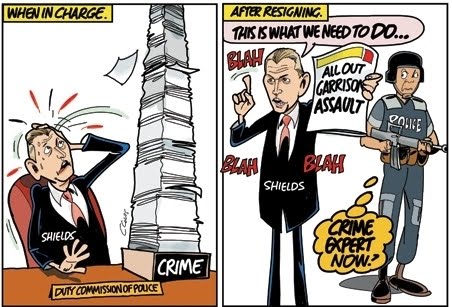
“Police dem a wicked n’ a tief…soldier not so bad”
According to the papers, life in Kingston begins to return to normal. Dudus has not been captured. Until he his, seems like you’d have to call the whole operation a failure.
My quote of the day comes from The Observer’s Twitter feed: “Dem say Dudus hold us hostage but it Bruce [The P.M.]. Mi wana go look for mi son. Mi don’t know if ‘in dead!”
 cartoon from The Observer
 -
Di President dat and anything possible wid him
I know it’s wrong, but I’m kind of starting to root for Dudus. Of course I can’t really root for cop killers, but this is one guy taking on two entire nations. And, at least for now, he’s winning! Plus, the more I learn about Jamaica the less I want to root for the government. They’re crooks. And not in a “throw-dem-bums-out-of-office” kind of way, but in a corrupt working-with-the-mobsters kind of way.
Well Dudus is still on the lamb and may have escaped the Tivoli Gardens dragnet. My quote of the day comes from the Jamaica Star: “Is like di man get a feeling and jus cut same time … It look like di Babylon [security forces] dem a get information pon him cause di building weh him did inna a one a di first building dem weh dem search.” But, kind sir, which way did Dudus go and how did he manage to get away? “Bway mi nuh know which way him tek eno but a di President dat and anything possible wid him.”
Turns out that over the years the government has given Dudus’s consulting company million of dollars (and nice to see one America newspaper finallyget a reporter to Jamaica to cover this story). Dudus is part of the system. Dudus got paid to provide government services and keep the streets safe. And to some extend he did. Meanwhile he makes a lot of money. He reminds me a local ward alderman of 19th-century America (but with more drugs and bigger guns).
The Daily Gleaner reports:
Soldiers … were engaged in a more than five-hour gun battle with the criminals.
One soldier was fatally shot during that battle while five others suffered gunshot wounds. Another soldier was injured in an undisclosed accident.
Medical sources [said] that the civilian death toll had climbed to 44, with the number of injured moving to 37.
The deaths included two men reportedly found in a neighbouring community with tags on their bodies, indicating they had been shot for refusing to participate in the fight to defend Coke.
Meanwhile… “An appeal was made by Health Minister Ruddy Spencer for gunmen within communities in the vicinity of the Kingston Public Hospital to cease from attacking hospital workers.” Seems like a reasonable request.
I think it’s a safe bet that in his area, Dudus would win any election. And the Jamaican government didn’t have much a problem with him until America demanded they turn Dudus over. That’s when all hell broke out. Dudus’s father met the same fate and was killed (or died in a suspicious jail fire) before he could be turned over to America (and rat out police and government officials).
Once drug prohibition allows criminals to get rich and arm themselves, a massive crackdown doesn’t work. It just causes violence and highlights the impotence and corruption of the supposedly legit government. It’s kind of like Mexico. Except in Jamaica, unlike Mexico, the drug lords actually do seem to provide some kindof community service.
-
US Ends ‘War on Drug’
Sounds like an Onion headline but it’s real.
The Drug Czar himself said, “I ended the war.”
You’d think this would be big news in America.
Did we win?
[thanks to Drug WarRant]
-
Stupid Drug Story of the Week
I read this stupid AP story and it set off warning bells in my head.
“ULTRA-POTENT HEROIN… MEXICAN DEALERS… $10 BAGS KILL UNSUSPECTING USERS INSTANTLY… NEEDLES STILL IN ARM AT THE DEATH SCENE!!!”
OK, the caps and exclamation points are mine, but you get the idea. It’s a little strange because people who die from heroin overdoses rarely suspect it and often have needles in the arms. [I’m saying this in the most patronizing tone I can muster:] That’s why it’s called an accidental drug overdose and not a suicide.
But I couldn’t articulate the bells in my head (they can are particularly unhelpful that way) until Jack Shafer of Slate wrote his response.
One constant prohibitionist line of argument is that drugs these days aren’t like the drugs you were safely taking when you were a kid (the strange subtext being that it would have been OK to legalize drugs back then… but now they’re too dangerous to regulate).
I love how Shafer points out that the AP story (headlined “Deadly, Ultra-pure Heroin Arrives in the US”) seems to ignore not one or two but 19AP stories over the past 25 years that all herald basically the same thing.
[It is, of course, particularly ironic to use the risk of dying from an overdose as an argument in favorof prohibition. The one sure thing we know would come from legal and regulated drugs is a guarantee of consistent purity. Heroin overdose deaths could drop to near zero if users actually knew how much they were taking. It really is that simple. But to get there we would have care more about the lives of heroin users more than we care about “sending a message.”]