Author: Moskos

  • Cops rat out cops. Cops get punished.

    Al Baker in the Times:

    Nineteen New York City police officers assigned to a station house in the Bronx face disciplinary action after being charged on Friday by department lawyers with wrongdoing, including incorrectly classifying crimes and downgrading criminal complaints, the police said.

    The administrative charges against the officers, from the 40th Precinct, follow an internal audit that uncovered 55 crime reports that were improperly processed during a four-month period last year, the police said.

    It’s worth observing that a cop called Internal Affairs to rat out other cops for their misdeeds. The cops investigated and did an internal audit. The investigation concludes there is a problem, and some action is taken.

    The system may not be perfect (it isn’t). And lives were not at stake. But in the end, this is one way the system is supposed to work. Sometimes it sort of does.

  • Bad shooting in Gardena, California

    Usually when I get called from the media about a police-involved shooting I expect I’m going to have to explain how a reasonable police officer might perceive a potentially lethal threat.

    Not here.

    This is a bad shooting:

    The killing happened two years ago. The video was just released. The officers faced no legal consequences. The city paid $4.7 million. The victim, Diaz Zeferino? Never heard of him before yesterday:

    Three media outlets pushed for its release…. A judge granted their request, saying it was in the public’s interest to know why that city money was being spent.

    Why are these cops so afraid? Why it is so obvious to me, formerly a reasonable police officer, that the guy is holding a hat and thus isn’t holding a gun?

    Might this help demonstrate why citizens of California are 50 percent more likely than the national average and almost 4 times more likely than New Yorkers to be killed by police.

  • The Kelly Legacy of Micromanagement

    Cops would complain about this all the time when Kelly was chief. After a decade in power, the stories of his micromanaging were legendary. This is the kind of stuff the public never really understands or appreciates, even when it dominates internal police culture.

    A long overdue article, from the veteran Murray Weiss at DNA.info:

    An aide approached [Bratton] with a request for the transfer of “a single police officer.” The aide said the move required his signature and that the NYPD’s “Office of Management and Budget” had already been involved.

    [Bratton] was incredulous.

    “The transfer generated between nine and 14 pages of paperwork,” the commissioner recalled.

    And

    There had been a fatal shooting.

    Bratton asked what [Deputy Inspector Raul Stephenson] was going to do to prevent the violence. The commissioner was stunned at what he heard.

    Stephenson explained that he wanted to shift “Impact Zone” officers from their mandated posts to the part of the precinct where the crew resided.

    But he said he first had to put the request in writing and send it to his Borough Commander who, in turn, would send it up to the Chief of Patrol’s office where it would be forwarded to the commissioner’s office at Police Headquarters for final approval.

    “Can you imagine how long that request took to go up the chain of command and then back down the chain before the inspector could do what he wanted?” Bratton said.

    “Something was happening in real time and our commander, who knows who is responsible, was unable to move personnel.

    Sure this is a bit of fluff piece, and it’s never that simple. But it’s exactly what can make a difference within a department.

  • Headline you won’t see:

    Police officer line-of-duty deaths are down 15 percent this year. Gunfire deaths are down 38 percent.

    Odd, because a lot of reporters were calling me last year when the number were up.

    “Is it Ferguson?!” “Is it Obama?!” “Are criminals less brazen?!” “Has training gotten better?!” “Are criminals worse shots?!”

    [Silence of me staring at non-ringing phone]

    That said, I thought I had a rather nice discussion on the Larry Mantel show the other day. Talking about the potential trade off between less incarceration and more crime.

    [Near silence of me picking up old-fashioned phone to see if the dial tone is working. It is.]

    For the record, just like I said last year, I don’t think it’s a big deal.

  • “Dear Sir or Ma’am…”

    In late May Rolling Stone had a poorly conceived article about Baltimore police and riots. On May 30th I wrote this letter to the editor:

    I applaud Matt Taibbi (“Why Baltimore Blew Up”) for keeping the focus on Baltimore after the nation’s attention seems to have shifted elsewhere. But Taibbi seems more intent on attacking police and Broken Windows – something never tried in Baltimore – than the crime and police issues that uniquely affect Baltimore.

    If Baltimore police were to blame for the riots — if overpolicing and too many arrests caused the violence — why didn’t the “uprising” happen back in 2003, when Baltimore arrests peaked? (Tiabbi is in error when he says Baltimore arrests peaked in 2005.) It seems worth mentioning, at least in passing, that arrests have dropped every year since then, 65 percent in total.

    If one were to put facts before anti-police ideology, one might blame the riots and subsequent increase in homicides on incompetent political leadership and the underpolicing of criminals. Baltimore’s mayor and police commissioner, in particular, stand out for their incompetent handling of events after Freddie Gray’s death in police custody. Regardless, I find it odd that an article about policing and riots in Baltimore omits any mention of criminals and fails to quote a single Baltimore City police officer. I suppose it’s easier to simply blame Baltimore cops, but the next time I urge Taibbi to perhaps speak to a few.

    They didn’t publish it.

  • “Albuquerque to pay $5 million in death of mentally ill man shot by police”

    Reports the LA Times. This came about after a very bad shooting.

    Twenty-eight people have been shot to death by Albuquerque police over the last five years, a per capita rate eight times that of New York.

  • How was your weekend?

    300 Men marched against violence In Baltimore. I guess since was no looting or violence associated with the march, it did not make national news.

    But apparently the criminals weren’t listening. “At least 21 people were shot since Friday,” reports the Sun. To put it in perspective, as Justin Fenton did, that rate of violence would be 92 shot in Chicago. Or 279 people shot in New York City. Now that would be a story.

    The level of carnage, the lost and broken lives, is almost impossible to comprehend if you’re not there. That doesn’t mean we shouldn’t try.

  • “The Rise and Fall of Anthony Batts”

    Great piece by Simone Weichselbaum in the Marshall Project about Batts and his problems in Baltimore.

    Good piece in Vice about the problem of “superstar” police chiefs.

  • Post-Riot Baltimore: Arrests Down and Gun Crimes Up

    Post-Riot Baltimore: Arrests Down and Gun Crimes Up

    Total arrests per day are in orange. Firearms crimes per day are the lower lines, in blue.
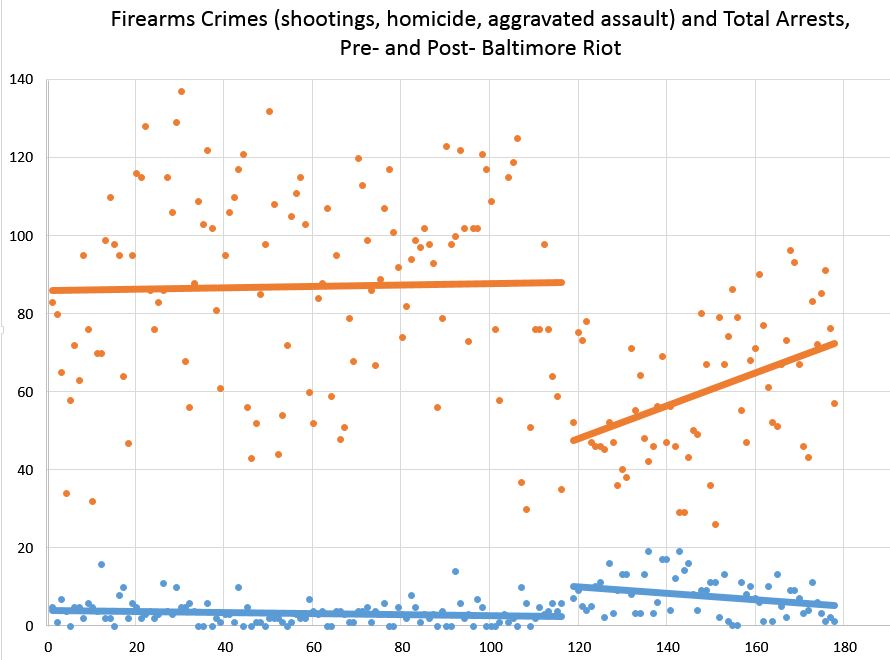
    (Click to embiggen)

    The bottom axis represents the numbered day of year. 1 is Jan 1. 178 is June 27th. The riot was on April 27, day 117.

    This was partly inspired by a frustrating discussion on the radio yesterday in which one person was trying to assert that Baltimore hasn’t seen any increase in violent crime related to the riot and its aftermath. What world is he living in?”It was up before the riots.” Yeah, a bit. “It’s seasonal. Shootings go up in warmer weather.” Not this much, they don’t! (And shootings were actually down in June compared to cooler May). But then the same guy also insisted there was no riot. (It was, of course, a “rebellion.”) Methinks his ideology may be trumping reason.

    I like to think that facts matter, especially when lives are ending. So here we ago again….

    I’ve already looked at the massive increase in homicides (one more person each day is being killed in Baltimore post-April 27). This time I thought I’d look at gun crimes, which correlate very well with homicides, just to get a bigger N (more cases). And I excluded outlier arrests numbers from April 27 and 28 (which were 178 and 143, respectively).

    These data go up to June 27, 2015. Before the riots, there were 3.4 recorded gun crimes per day (those classified as shootings, homicides, and aggravated assault with firearms) and 87 arrests. (Back in in the 2000s, there were roughly 275 arrests per day, which is worth noting.)

    After the riots, there were 7.7 daily gun crimes and 60 arrests. That actually less of a decline in arrests than I suspected. But it’s still a one-third decrease. Gun crimes are up 118% post riot.

    The good news, limited though it is, is the current trend. Arrests are inching up back up to “normal” and gun crimes are declining. While of course correlation doesn’t automatically mean causation, I beg anybody to offer an alternative hypothesis here. This social scientist is willing to assert cause and effect.

    Here are the number this year compared to last year:

    2014 pre-April 27: 3.4 gun crimes per day and 114 arrests.

    2014 post-April 27: 4.9 gun crimes per day and 117 arrests.

    2015 pre-April 27: 3.4 gun crimes/day (identical to 2014), 87 arrests.

    2015 post-April 27: 7.7 gun crimes per day and 60 arrests.

    So we might have expected a 40 percent increase in gun crimes after April 27 as a seasonal factor. We saw a 126 percent increase.

    (It’s worth pointing out that I’m not saying arrests are good just for their own sake, but they can be a good indicator — a proxy — for more general discretionary crime-preventative proactive policing.)

    [see future post: The Freddie Gray Effect in Baltimore]
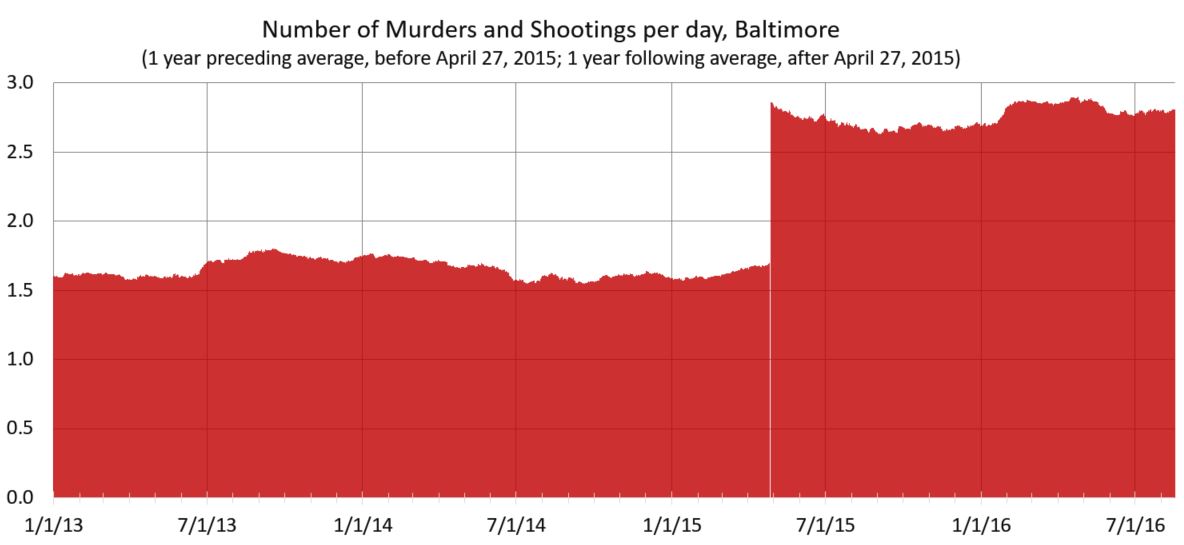
    Source: Baltimore Open Crime data.
  • “My own private Baltimore”

    This piece by Tim Kreider is pretty fabulous.

    It includes John Waters’ great line: “NYC is full of normal people who think they’re crazy; Baltimore is full of crazy people who think they’re normal.”

    And “Bananas & hardware for sale at the bar” actually only narrows things down to a half-dozen locations. I still use the hair clippers I bought at a bar on Eastern Ave 15 years ago. But I realized that bars sold hardware because there were no hardware stores selling hardware.

    And: “White Baltimore, which, if mapped, would look like a tenuous network of interconnected nodes laid over the terra incognita where the majority of the city’s inhabitants lived their lives. That other Baltimore, hungry and disenfranchised and heavily armed, written off by politicians, pushed around by the cops and called animals on the Internet, was always a block away.”

    And finally: “Even though NYC is where I belong now, I still feel at home in Baltimore in a way I will never feel anywhere else.”