Author: Moskos

  • “Cop of the Year”?

    I was recently asked for comments about a “Cop of the Year.” It doesn’t matter which. I didn’t know the cop, so I didn’t say much. I have no clue what he did (or didn’t) do. But I am suspicious of “cops of the year.” Are my suspicions justified? I’ll presume there are lots of nice “cops of the year” out there. Wonderful cops of the year. But I don’t remember meeting one. Of course a good cop would be modest about such an award and wouldn’t wear it on his sleeve.

    So maybe I’m just barking up the wrong tree. But it sure does seem like a disproportionate number of arrested cops have been a “cop of the year” at some point. (Of course if I’m looking for something like this, and I am, then I’m susceptible to “confirmation bias.”)

    I do worry that the same factors that make a cop “cop of the year” — aggression, a lot of arrests, a focus on results, seeing your job as a crusade against evil, seeing no gray in the world — these are exactly the same factors that get you in trouble in the long run.

    Quite simply, it’s nearly impossible to consistently make 10 times as many arrests as other cops. Seems to me that being a “super cop” is more a red flag than a cause for celebration.

    Also, I never wanted to work with an over-driven I’m-going-to-save-the-world let’s-lock-up-all-the-bad-guys adrenaline-loving supermen. I mean, why is somebody getting into a signal-13s when you’re off duty? And when that happens, why would that person end up on my post saying, “you never saw me.” I never wanted to see him because trouble was always finding him. Maybe he was just a better cop than me. Either way, I stayed clear.

    [I just googled the guy I’m thinking of, because I assumed he didn’t retire as a cop. And he didn’t. Though he does seem to have a better job. So for all I know he mellowed and learned and took a wise career move. Maybe. But to see him described in one article as a “by the book” cop? Ha.]

    Anyway, this all came to mind because another “cop of the year” was just sentenced to 10 years for drug charges. So I googled “‘Cop of the year’ sentenced” and came up with a bunch pretty quickly. Coincidence? I don’t know. But they were all described as having at one been recognized as a “cop of the year”:

    Philip LeRoy, Queens. Drugs. The most recent.

    Noe Juarez in Houston. Cocaine trafficker for Los Zetas.

    Drew Peterson, Illinois. Domestic murder.

    Ron Coleman, Houston, Drugs.

    Jonathan Bleiweiss, Florida. Forced sex with male illegal immigrants.

    Jerome Finnigan of Illinois. Armed robbery (and racist bad taste).

    David Britto, Boynton Beach, Florida. Drugs.

    James Joseph Krey, Florida (again). Domestic-related.

    Michael Grennier, South Plainfield, NJ. Child porn.

    Michael Froggatt. Gold Coast, Australia. Drunk Driving.

    Matthew Anselmo. Omaha Nebraska. Mail fraud & money-laundering.

    Pace yourself, I say. You got years on the force to do good. And you don’t want to get burnt out of banged by the department because you took the job too seriously.

  • Where and how you are raised? It matters.

    When it comes to policing and crime, I’m quick to harp on individual agency and free will. It matters. People make bad and harmful choices. They choose to do so. And police can prevent some of the things that lead to bad choices. Some liberals forget that.

    But this isn’t say that root causes don’t matter. Of course they do. More than police. More, on a macro level, than free will or police. And sometimes conservatives forget this. From the Economist:

    The great thing about America, Scott walker went on, was that it offered equality of opportunity, even if outcomes were up to individuals. America is one of the few countries left in the world where it doesn’t matter what class you are born into, he declared, and many in the audience, notably the older voters with snowy hair, clapped enthusiastically.

    That’s laughable. Prof Michael Jenkins states this well (in a column about Spike Lee’s “Chi-Raq”) (though I think his student body is very different from what you’ll find in my classroom):

    “I tell my students, ‘Think about the circumstances in which you were raised,’ ” says Michael Jenkins, a criminal justice professor at the University of Scranton. About the parents, teachers, schools and other organizations that get thanked in the graduation speeches, that were there to support you. Then “think about some of the poor decisions you made even with all those structural conditions in your favor.”

    There are things “we celebrate as leading to success, but we fail to acknowledge that the lack of those things explains poor behaviors,” he says. There are places that suffer from lack of investment, unemployment and underemployment, under-education. We act as if everyone has “the same choices we have, then we take credit for our own decisions when they were also bounded, but bounded by more positive outlines.”

    If conditions didn’t matter, if you think your kids would turn out just as well growing up in the ghetto, then why don’t you move to a “bad” neighborhood? Housing is cheap. But I don’t blame you. There are good reasons you don’t want to raise your kids in segregated poor violent neighborhoods. Such as:

    A) The schools are bad.

    B) The streets aren’t safe.

    C) There are no stores.

    D) Your neighbors may be, if not criminals, inconsiderate of those who, say, have to get up in the morning and go to work.

    So you’re not moving to Camden (or wherever). For the kids, perhaps. So why wouldn’t it affect those who actually do live there (usually because they just happened to be born there)? So shouldn’t we all have a little more empathy for those who are forced to grow up without any of the advantages mainstream America can provide?

    This doesn’t mean you can’t and shouldn’t blame people for their actions. But after we do that, can’t we also work to improve society and the world others are forced to live in?

  • “Broken Windows” fights crime, when used wisely

    Clarence Page, as usual, provides a rational, reasonable, and correct analysison the crime rise and Broken Windows.

  • Is there a new crime wave?

    “Don’t bet on it,” say Frank Zimring in the NY Daily News. I could not have said it better myself:

    At their current rate, killings in New York City would end 2015 as either the third or fourth lowest year in the city’s modern history.

    “Ferguson Effect”? Doesn’t look like it.

    To a student of crime data, this sounds much more like white noise than a blaring siren.

    There are real increases in violence in Baltimore, Maryland in recent weeks and perhaps in St. Louis, but making that into a national crime wave deserves an Olympic medal for jumping to conclusions.

    Why Mac Donald’s fearful haste?

    On the subject on Zimring, I always show this 9-minute Vera talk on why crime went down in the 1990s. It’s the best 9 minutes you’ll ever hear on the subject.

  • Baltimore police talk

    If you want to hear some details about Baltimore police and policing during after the riots, listen to this 20 minute discussion with Sgt Robinson and Lt Butler on WBAL with C4.

  • Let’s Rethink Patrol

    Here’s another piece of mine in CNN, also out today. I hope this gets a bit of attention because I was able to move past the headlines (thanks to my wonderful editor at CNN for her encouragement and mad editing skillz) to question the very concept police patrol. That’s the type of moderately deep-thinking that is hard to get published in op-ed form.

    But at this moment there might be a small window of opportunity to make substantive changes in policing. Why do have a system where, for instance, the first responder to a mentally ill person is a police officer? It doesn’t make sense. Not for the cops. Not for the mentally ill. So why not rethink a reactive model of undervalued and understaffed police patrol. The status quo swallows up resources and — by design — limits the discretion and problem-solving ability of police officers.

    Many people who call 911 do need help, but it’s not help that a very young police officer barely out of high school — armed and with the power of arrest — can provide. These calls for service would often be better addressed by doctors, social workers, teachers and parents.

    Over the past 40 years, with the advent of call-and-response policing, the mentality of policing changed. Consider the portrayal in the 1980s TV show “Hill Street Blues” (it’s pop culture, but it contains truth): The first sergeant, played by Michael Conrad, finished roll call with the sage advice: “Let’s be careful out there.” After his death, the new sergeant was played by Robert Prosky. His motto? “Let’s do it to them before they do it to us.”

    There are benefits to old-fashioned beat policing that we need to reclaim, but we can’t as long as most police resources are controlled by civilian dispatchers, officers have too little discretion, and the war on drugs dominates urban policing by criminalizing too many people.

    For a cop bouncing from call to call constantly dealing with criminals or people who have lost control of their lives, it’s too easy to believe that nobody in the area is in control. From the window of a patrol car, every face on the corner starts looking the same. By walking on foot and engaging with the noncriminal public, police officers, especially those without any prior knowledge of the area they police, could begin to understand both how communities function and how they fail.

    Read the rest here.

  • How about telling cops what they should do rather than what they shouldn’t do?

    Here’s my piece in today’s New York Times:

    Critics of police — and there have been a lot this past year — are too focused on what we don’t want police to do: don’t make so many arrests; don’t stop, question and frisk innocent people; don’t harass people; don’t shoot so many people, and for God’s sake don’t do any of it in a racially biased way.

    Those are worthy goals all, but none of this tells police what they *should* do. Some critics of police seem to forget that the job of police and crime prevention involves dealing with actual criminals.

    It’s a perfectly fine short piece. I do want to move the discussion away from what police shouldn’t do to what police should do. But I find the whole New York Times “room for debate” concept a bit disingenuous. Because there’s no debate. As a writer, I don’t know who else is writing or what they are going to say. It really would be nice to respond to other points and flesh out the issues. Instead “room for debate” is a collection of 300-400 word op-eds. Perhaps that is what it should called: “Room for too-short opinion pieces from people willing to write for free just to get a Times byline.” Doesn’t really roll of the tongue, admittedly.

    (On principle, in solidarity with free-lance writers everywhere, I try not to write for free, especially to for-profit businesses. Writing is work. And workers should be paid. A proper 800-1,000 word op-ed published in the print edition of the Times or the Washington Post or the Daily News or with CNN.com generally pays $200 – $300. A dollar figure that has actually decreased for some publication. Now the $300 I get from CNN is not a lot of money, mind you. But it really is the principle… and the money. And yet once again I wrote for the Times for free because it’s the Times. So much for principles. Or money. But it is pretty easy for me to hammer out 300 words.)

  • Policing Will Never Be The Same

    Policing Will Never Be The Same

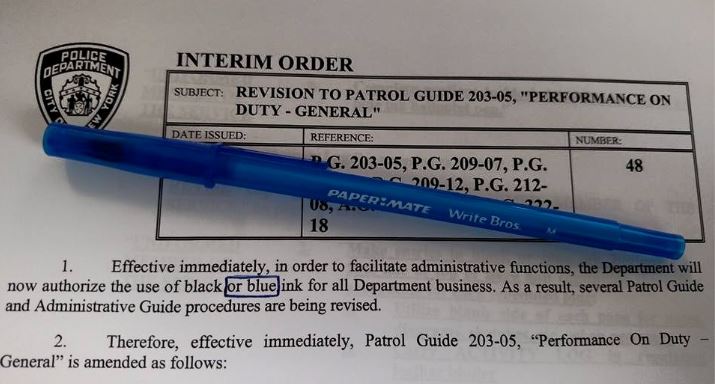
    This is huge: The NYPD has authorized, effective as of 0001 hrs, 4 June 2015, the use of — are you seated? — black OR BLUE ink for all department business.

    Too much. Too soon.

    It’s gotta be DeBlasio’s fault. For sure.

  • John Waters on the Riots

    From the Daily Beast:

    “I was around for the first Baltimore riots,” Waters says. “My first apartment in Baltimore was on 25th Street and Calvert, and there were tanks outside of my house. Everywhere was burning. Believe me, these riots were not as bad as those. But the riots in Baltimore this time were more widespread than what you saw on CNN, because if you watched CNN, you’d think it was that one big fire and Penn and North. The Penn-North neighborhood, I guarantee you, 80 percent of white people I know haven’t been there. I used to live [around] there. I used to live in an all-black neighborhood…The problem in Baltimore is that…there is also an equal number of poor white people. I really wish that they would team up. The poor people of Baltimore need to make it a class issue, not a race issue.”