I don’t know if this is good or bad, but why does it take years? That’s what’s so f*cked up about police discipline. And these charges were placed only, 18 months later, to beat the statute of limitations. The story in the Times.
Category: Police
-
Ambush in Philly
Officer Jesse Hartnett is lucky to be alive. And bad-ass for returning fire and hitting the wanna-be killer. From ABC:
“I just have to tell you, when you look at the video – we have video that captured all of this – it’s one of the scariest things I’ve ever seen,” said Ross. “This guy tried to execute the police officer. It’s amazing he’s alive.”
The moments immediately following the shooting were also captured in a dramatic recording of police radio calls obtained by Action News overnight.
“I’m shot! I’m bleeding heavily!” Hartnett was heard saying.
The bad guy said he was doing it in the name of Islam. His mother said:
He had been hearing voices recently and that family asked him to get help. She also said her son felt targeted by police and described him as a devout Muslim.
…
“Last March, Archer pleaded guilty to firearms and assault charges stemming from a 2012 case, but was released and placed on probation, court records show. His criminal record includes domestic violence and a traffic and forgery case.
-
2015 homicide increase
I’d like to double down on the 2015 homicide increase. I’ve made a habit of offering a $100 bet to anybody says “we don’t know if homicides are up.” What’s odd is that nobody has taken my bet. Some insist that crime can’t really be up till the data is formally compiled and tell us it is. That’s an odd form of statistical oblivion. Others say that though homicide may be up, crime isn’t. That’s hard to believe. Still others think it’s not a big deal, any one-year increase. I beg to differ.
I cannot be sure of the motives of the crime-increase deniers, but I suspect it gets to the ideology of “root causes” and the anti-police narrative built with great sweat, care, and tears over the past two years (a narrative built partly on lies). (Yesterday, Sun-Times columnist Mary Mitchell rather boldly wrote: “Until young activists put the same level of energy into fighting street violence as they put into fighting police violence, little will change.”
The reason I’m doubling down is that a reporter showed me some data he compiled. I’m not going to get into the details and steal his thunder. Yeah murders are up in cities. But we knew that. We just don’t know how much and what it means. Can we assume a nationwide trend based on just the biggest cities. Well, statistically and historically, yes, we can. (Looking at homicides in these cities versus the rest of the nation over many years, I get an r of .935 with sig < .001.) As to absolute numbers, that's still anybody's guess. In 2014 there were 13,472 murders. In 2015 I think we'll see around 15,000 homicides. And that's if we're lucky.
-
How many strikes do you get?
I’m not for “three strikes and you’re out.” I am, however, supportive of 32 strikes and you’re out (I’d even go down to 20). Kari Bazemore, who has a history of random violence, slashed a woman walking down 23rd St at 6AM. There’s something particularly chilling about the pointless randomness of it. No argument. No robbery. No conflict. Just cut and run. This one was caught on video.
Here’s an interviewwith the latest victim. Good for her for facing the camera, scar and all.
Thirty-two priors and that doesn’t begin to could all the sh*t he’s done without being arrested? He’s a one-man crime wave. His last arrest was on December 30 (yes, one week prior), when he randomly punched a woman on East 8th Street. He was also arrest in February 2015 for grand larceny and in 2013 for “forcible touching.”
Does the guy need help? Obviously. But what kind and how do we give it to him? If he hasn’t been able to get needed help by now, what makes anybody think the 33rd arrest is going to be charm? He simply needs to be kept off the streets.
-
I didn’t see this coming
As usual, they don’t get you for what you did. They get you for what you write.
While morally suspect, Officer Encinia didn’t do anything legally wrong legally when he stopped and arrested Sandra Bland in Texas. But what he wrote seemed a bit different from what he was seen doing on video. And now, as is too often the case in our prosecutorial system, because they want to get him, they can.
Encinia is being charged with misdemeanor perjury. (Which I didn’t think was possible; perjury is a felony where I come from. Also, it’s unusual, to say the least, to use a grand jury to bring misdemeanor charges.) The New York Times reports:
The trooper wrote that he removed Ms. Bland from her car to more safely conduct a traffic investigation, but “the grand jury found that statement to be false,” a special prosecutor, Shawn McDonald, said.
Here’s what I previously wrote about this traffic stop.
-

You gotta break some eggs… to make a mess
According toMaryland Governor Hogan, C.O.R.E. stands for Creating Opportunities for Renewal and Enterprise.
“We should be able to make tremendous progress over the next for year,” said the mayor.
What’s the cause for celebration? Demolition.

Forgive me if I hold my applause till something is built. Now don’t get me wrong, tearing these buildings down is necessary.

These buildings are beyond saving not just because they’re abandoned but because everything of value has been stripped. There is no metal left in them. No pipes. No wires. Nothing left but rotted wood and brick walls. And even Baltimore’s bricks are kind of crappy. Or they get squatted by drug addicts, and then they end up looking like this.
Earlier this year, the mayor said his goal to eliminate vacant dwellings in Sandtown-Winchester will help complete a nationally recognized renaissance in the neighborhood.
…
“We’ve got a tremendous commitment to Sandtown…. We need to show that we can make a difference.”
Besides new housing, the area has got a prenatal outreach program and drug treatment services.
These and other community projects are supported by neighborhood residents, who, for the first time in their lives, are becoming involved in their community, the mayor said.
City Council President Mary Pat Clarke said the push to eliminate vacant houses in Sandtown-Winchester may start a larger push to diminish the tally of 6,000 vacant dwellings scattered throughout Baltimore.
Yeah, if only 6,000 vacants doesn’t give it away, that was from 1993.
How’d that work out? Not so good. A few years later in 1996, when there were 9,000 vacant buildings in the city:
Baltimore is preparing to tear down more than 800 vacant rowhouses as part of a vast, multimillion-dollar undertaking to revitalize impoverished sections of the inner city.
…
The first will be torn down in the West Baltimore community of Sandtown-Winchester….
Most of the land would be transformed into parks, yards and vegetable and flower gardens. Only a quarter of the properties would be redeveloped for housing, and a few others would become neighborhood shopping centers.
How’d that work out? Not so good.
This 1996 plan was to be “the largest rowhouse clearing in Baltimore since the early 1970s, when homes were razed along Franklin Street for an expressway that was never completed.”
Oh, that.

Yes, it is America’s goofiest 15-block highway. Does this happen in other cities?!

Maybe one day — not for decades, I hope — we can name it the John Waters Memorial Highway.
And before that in the 1950s:
the city cleared several slums and replaced them with huge public housing projects. The four high-rise complexes that were built after World War II have since deteriorated, beset by crime, drugs and poor conditions, and are being torn down.
Today, a few decades later, there are 17,000 vacant houses that used to be homes. Plus seventeen-more-thousandvacant lots.
There’s a long strain in Progressive thinking that blames bricks and mortar for the problems of the people who live there. It’s most exemplified by the building and then razing of high-rise public housing. But high-rise housing not inherently worse (or better) than the “slum” tenements they replaced. I hate to say it, but a slum is less defined by a bunch of buildings than the people who live live there. Not all the people, mind you. Not at all. But some of the people — the murders, the junkies, the people who never wanted a regular job, the kids who grow up without loving parents — they exist. And they don’t make good neighbors.
The problem is, demolition is a necessary first step to improvement. Vacant buildings are bad for crimeand good for nobody. But building is the hard part. And getting people to want to live there. That’s hard, too. And even if it is necessary, it’s still kind of sad to see these handsome Formstone buildings come down.
Maybe this time it will somehow work. It can’t get better if we don’t try. But forgive me for not being optimistic.
-
Black lives matter to homicide detectives
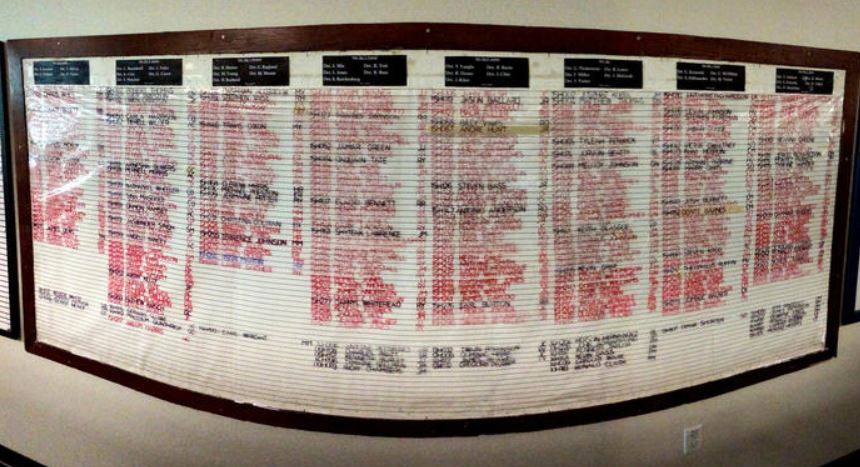
The homicide board downtown. I have to admit, when I first walked by it, I had to do a double take, thinking, “it really does exist!”

That’s a lot of red.
From Justin Fenton’s five part series on a homicide investigation.
-
Me talking about Tasers
On NPR Weekend Edition. From my basement. I was wearing a snazzy three-piece suit, in case you were wondering. It’s radio, right?
-
God save the Queen
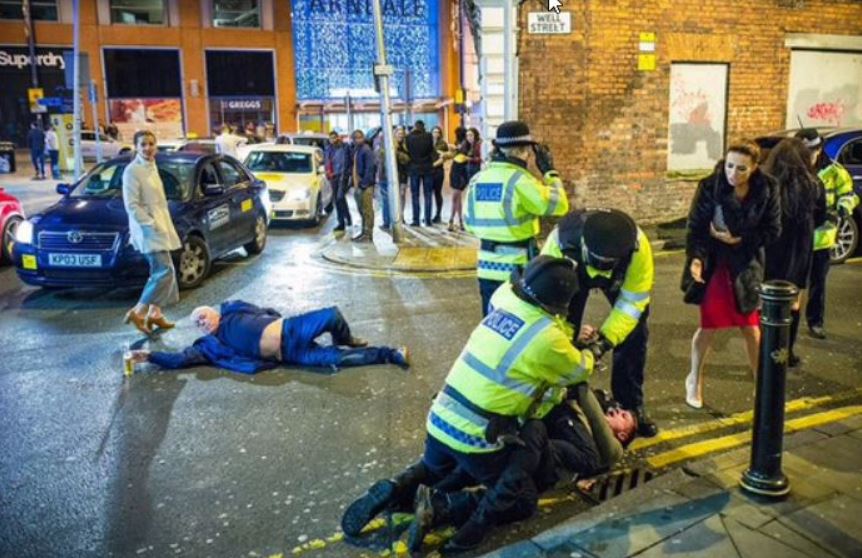
So much going on this pic of New Year in Manchester by the Evening News. Like a beautiful painting. pic.twitter.com/szKKRM4U4i
— Roland Hughes (@hughesroland) January 1, 2016
It’s like a classic Jan Steen.

-
Happy New Year
Group reading names of Balto homicide victims. 344 in 2015. Group ask " why aren't more people here?" pic.twitter.com/wOt5U0Hfvj
— Jayne Miller (@jemillerwbal) January 1, 2016