There’s a lot of pathos in this video. And a hell of a Baltimore accent.
A visit to Maryland’s supermax. And quite an indictment of the criminal justice system.
There’s a lot of pathos in this video. And a hell of a Baltimore accent.
A visit to Maryland’s supermax. And quite an indictment of the criminal justice system.
…Someone with way too much time on his hands made this. And I love it. Homies meet Baltimore’s Eastern District. I love Homies. And I love the Lego police motorcycle paddywagon that zooms through.
Amazingly, this isn’t the only stop-motion animation with Homies and cops. But it is the only stop-motion animation with Homies and cops that promotes my book. Guerrilla advertising at its best.
Here’s the You Tube link.
Strand is selling my book for $12.47. I doubt you will ever find it cheaper. But there are only 2 copies in stock. I bet when these 2 are gone, the price will go up. $12.47 is 50% off cover price. I can only get 40% off cover price and I wrote the damn thing! Amazonwith free shipping ($16.47) is always a bargain.
Of course nothing is better than loving your neighborhood book store and getting them to stock Cop in the Hood.
I wish I loved myneighborhood book store. And I’m not the only one, who’s got issues… or two, or three.
A police officer was arrested in Pennsylvania for bank robbery. I don’t like to compare common criminals with mistakes people make because they’re poor–like the NYPD officer who discharged his gun (shooting an 18-month-old boy in the apartment below) while cleaning it… in the dark… because he couldn’t pay his electric bill.
But what all this has in common is that it wouldn’t happen if police officers could live off their starting salary ($25,100) and recruiting standards were higher.
From Veronika Belenkaya and Ethan Rouen’s story in the New York Daily News:
An NYPD rookie sworn to enforce the law broke it big-time Thursday, stealing $113,000 from a Pennsylvania bank at gunpoint, authorities said.
Cop-turned-robber Christian Torres, 21, of Queens, was collared less than a block away and the loot was recovered, police said.
…
Officers Hector Alvarez and Miguel Castillo told New Jersey police they were investigating terrorism when they were caught trying to rob a Bergen County drug den in May 2007, cops said.Four months later, NYPD recruit Claribel Polanco, a mother of two, allegedly committed welfare fraud.
Too poor to pay his electric bill, Officer Patrick Venetek of Brooklyn was cleaning his gun in the dark when it accidentally went off in February. The bullet struck an 18-month-old boy in the apartment below.
More good discussion from the comments of marginal revolution.
I’ll call this: Ask Officer Pete!
Q: Peter, I have an issue with you comments about police use of force. Your argument that the use of “muscle,” physical strength and holds, will lead to less excessive force issues in contrast to Tasers or other less lethal uses of force, needs to be substantiated. Officers who go over the line, in my experience prefer to use physical strength and intimidation. It gives them a better “high;” that feeling of control and power. It has been my experience with the modern Tasers, … that trained Officers are more likely to stay within the bounds of Departmental policy and the Law. Additionally, do we as a society want to expose our law enforcement officers to MORE danger by not allowing them the advantage of distance? Officers and suspects are less likely to be injured if there is no physical force used. This has multiple “good” effects.
A: You very well might be right. What you say is certainly the modern and progressive thinking of the day. But I still disagree. I’m not talking about officers who want to use excessive force. I’m not talking about abuse by “bad” officers. I’m talking about torture by otherwise “good” officers.
I have three main problems with Tasers: 1) they’re used too readily, 2) the pain they cause isn’t geared toward the compliance I want, and 3) people die.
Nine times out of ten officers exercise more restraint that allowed by departmental policy and law (See Dave Klinger’s book Into the Kill Zone for lots of examples of this). In Baltimore I didn’t have a Taser, but the use-of-force guidelines for Tasers and mace (actually pepper spray) is generally the same–for compliance. That’s too low a bar.
If I followed departmental policy, I could have maced about 3 people a shift. Instead, I maced one person in 14 months. Mace has a natural check and balance: it goes everywhere. No officer quick with the mace will be popular in the department for long.
Physical force can often be done without too much pain. And the pain caused is directly proportional to your resistance. For instance, I need you to put your hands behind your back. I use force. Force isn’t the same as pain. It might hurt if you fight it. But as soon as you stop resisting, any pain is over.
Officers use Tasers quicker than they otherwise would apply hands-on force. “Comply or I Taze you.” You don’t comply so I Taze. Clean and legal. But wrong because it’s not necessary. Departmental regulation be damned! It’s too easy to press a button.
We’re talking about pain compliance… hurting somebody. Tasers cause pain as punishment. That’s not right. We shouldn’t pretend that causing pain is clean process. It never is.
Force is part of the police job. No suspect puts handcuffs on himself.
Without a Taser, I just say “Comply.” You don’t. So I keep talking to you, cajoling you, ordering you, threatening you. But the point is I’ll work harder trying to convince you to comply if my only alternative is hands-on force. Officers *should* be reluctant to use force. You don’t want to use physical force because there is some danger… and also you break a sweat–something you always want to avoid while wearing body armor.
When I do use hands-on force, at least my force is geared toward getting you to do what I want (like getting your arms behind your back so I can cuff you). With a Taser, it’s just about disabling pain. That’s torture. And consider this, it’s not easy to follow instructions after being in the greatest pain of your life. So you get tazed again.
I worked in a rough district. I want to police to be safe. But the danger police face isn’t really from officers working to put handcuffs on one suspect or get that suspect out of a car. That’s just part of the job.
Besides, I trusted my squadmates because I knew they could handle themselves in a fight. I don’t care how hand-off people try and make policing in theory and in the academy, on the street, it’s hands-on. I want to work with officers who aren’t afraid to use their hands. Reluctant, yes. But afraid, no.
And oh yeah, Tasers kill people.
There’s a good discussion I’ve been contributing to in the comments section from a post in marginal revolution.
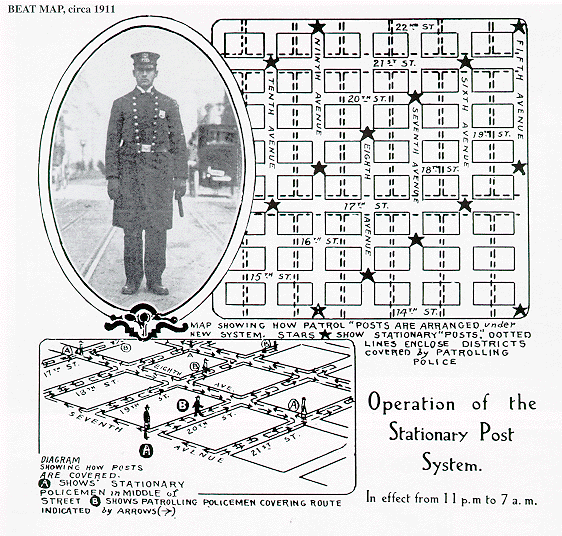
More foot patrol is always possible. Back in the days, all patrol was foot patrol. Our almost complete dedication to cars responding to dispatched calls is a choice we make… or maybe a choice made for us. But if we really wanted and demanded more foot patrol, we could have it. Police departments need to defend car patrol with something better than tradition and response time. Here’s an op-ed I wrote a few years back for the cause.
One of my favorite pictures shows how it was done in 1911 New York City, at least in theory. Maybe today cops shouldn’t stand in the middle of intersections like bowling pins, but the idea is better than any patrol done today.
 (If anybody knows the source of this picture, let me know. I got it from an old Yale Alumni Magazine. They could only tell me they thought it was public domain.)
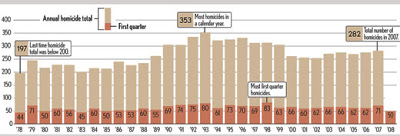
At least for the first three months of 2008. Hopefully it will last. Here’s the Sun’s story by John Fritze and Sara Neufeld.
There’s a nice Sun news graphic in the story. It’s rarely mentioned that what looks like a steady decline in homicides in the 1990s correlates pretty well with the decline in the city’s population. So while the numbers dropped, the rate didn’t.
If that statement shocks you, you’re a fool. All cops don’t tell the truth all of the time. But cops tell the truth a lot more than many people seem to think. At least in Baltimore there is no culture of lying on the stand or anywhere else.
Why would I perjure myself and risk my job and my reputation just to convict some teen-age crack dealer? I don’t live in that neighborhood. I’ll do my job, play by the rules, and go home, thank you very much.
In the Queens trial of the officers who killed Sean Bell, a police officer testified last week that the officers identified themselves as police before shooting. This was largely discounted by many. The assumption was that an officer would always lie to protect a fellow cop.
Today a person who lives near the shooting testified that the police did in fact yell a lot before shooting… just like the cops said. This is huge for the defense of the officers.
Maybe they’re both lying, or maybe not. I don’t know. I wasn’t there.
My point isn’t about Sean Bell and his friends. The cop in me is bothered when people reflexively believe the testimony of thugs and their mothers rather than hard-working and dedicated police officers. If a cop says one thing, and a criminal says another, believe the cop!
Too often TV news, in some attempt to get “both sides of the story,” talk to some thug’s mother. The mother says her son is an angel and couldn’t have been doing anything because he was home asleep at the time, or in church, or helping homeless orphans with their homework.
Guess what? Mothers always think their son is an angel. That’s their job!
Here’s a case of a poor mom, seeing the truth. From my Baltimore notes:
We pull up on 700 N Port St and [my partner] knows one of the kids there. [My partner] says he promised to arrest him if he saw him there again. When [my partner] gets out of the car with cuffs, the guy takes off. [My partner] chases and I follow in the car, calling us out on the radio. I see them run down Madison and up an alley towards Ashland. I turn up Collington and make a right on Ashland and stop in front of Bradford.
I can’t figure out what’s going on with [my partner], who it turns out lost the trail when the guy booked in a vacant. But [my partner] thinks he’s still in there. Meanwhile I see who I think is him stroll off Bradford. That’s him, I think. So I get out and he starts to take off again, but another car pulls up from the other side on Madison and he stops.
I grab him, the other cop says, “put him down” and we put him on the ground. [The other officer is] holding his arm back Koga style [a way that doesn’t hurt, but will hurt if the suspect moves or get squirrely]. His mothers appears (as they are wont to do) and starts screaming, “Why you hurting him? Why you holding his arm back. He ain’t done nothing!” I’m waiting for [my partner] to come and say if it’s him or not.
After a bit [my partner] does show up and says that’s him. We stand the kid up, and another cop (there are many here by now) says, “what’s that in your mouth?” Out of the kid’s mouth pop one coke vial, then a second. The mother, looking on from about ten feet away, sees her angel pop coke vials out of his mouth and falls out [faints]!
That, indeed, is comedy. We call an ambo for the woman and give the 16-year-old kid shit for doing that to his moms.
I was on the subway today, reading the Atlantic Monthly(or is it just The Atlantic?… no matter, it’s my favorite magazine…. with the New Yorkerplacing a close second and the Economistto show). I see a book review for Judith Herrin’s Byzantium: The Surprising Life of a Medieval Empire. I like Professor Herrin. I took a class from her in Byzantine History. She was great.
As the subway picks up speed going under the East River from Queens into Manhattan, I turn to my wife and say, “Hey look, I took her class at Princeton. She was great. Why isn’t mybook in here?! And as my finger goes down the page, I see MY book:
Here’s the review. It’s short, but it’s good. I wonder how many times a professor and her student have had books reviewed on the same page? From the Atlantic’s May, 2008 issue.
Cop in the Hood(Princeton)
Those prone to facile comparisons will liken this riveting book to The Wire, the acclaimed and popular cable-television series that inhabits the same mean streets. Those who take a longer view, however, will see this for what it is: an unsparing boys-in-blue procedural that succeeds on its own plentiful—and wonderfully sympathetic—merits. Moskos, now an assistant professor at John Jay College of Criminal Justice, deftly intermingles cops-and-robbers verisimilitude and progressive social science, yet keeps his reportage clear-eyed, his conclusions pathos-free. What results is a thoughtful, measured critique—of the failed drug war, its discontents, and the self-defeating criminal-justice system looming just behind.