So last night I listened to a online discussion with Bill Bratton and Connie Rice. Bratton, you probably know, is the former police commissioner/chief of the NYPD and LAPD. Rice graduated from Harvard and NYU Law and is a civil rights attorney, activist, and a former member of President Barack Obama’s Taskforce on 21st Century Policing. That last part matters. Because that report is taken seriously by a lot of people as a vision for progressive police and a blueprint for reform. (Though I’ve never been a big fan.) The discussion was OK. But I really couldn’t focus on much after this moments 22 minutes in. Ms Rice says:
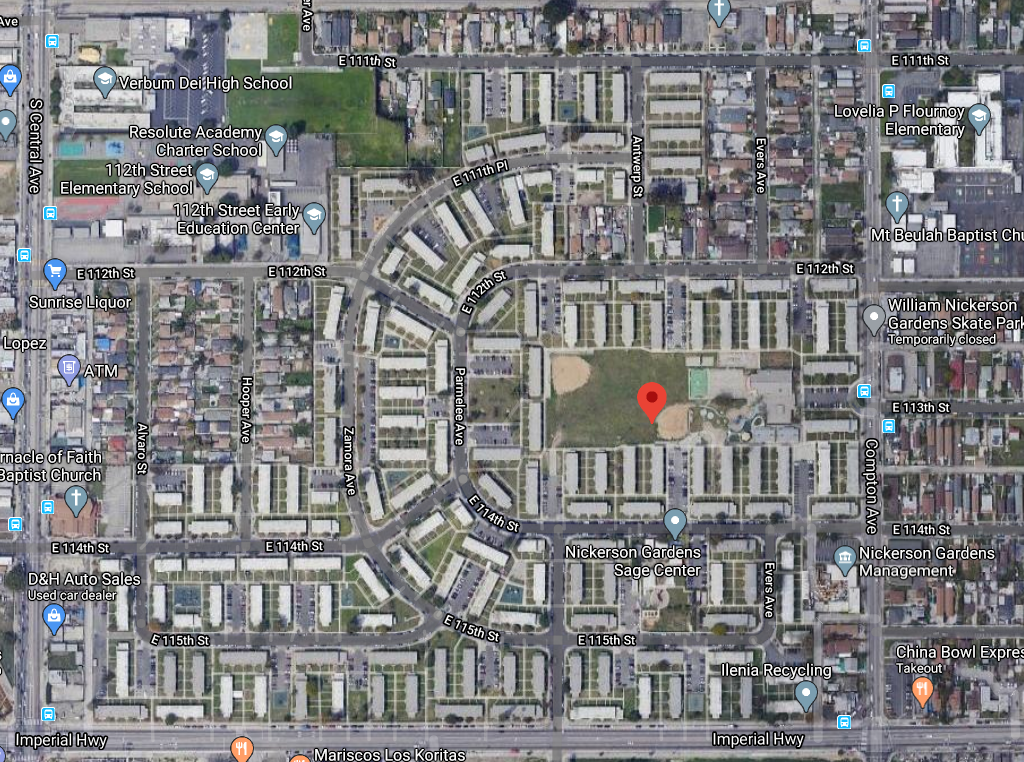
I’m just going to say this one stat once. If you’re a black man in Nickerson Gardens, today, every time you step out of your unit in that housing project, you face a 45% chance of going to jail. Every day. Not being stopped. That’s 90%. That’s what mass incarceration has done to these communities. That’s not safety, that’s destruction. … We’ve got to stop that aggressive proactive preemptive policing that criminalizes the entire community.
But there’s no way 45% of black men going outside are locked up every day. No way. There’s no way 90% of black men are stopped every day. It’s impossible. How can one with common sense think this to be true?
If there’s a police-related epidemic right now, it’s an epidemic of crazy talk about policing. Not from anti-policing people or somebody at a protest. I’m talking about professors, writers, lawyers, people who impact police reform and policy. People who really should know better.
Last month I was bothered when a respected professor proposing that the NYPD was playing fast and loose with shooting numbers. Then Jill Lepore wrote an article in the New Yorker based, in part, on the belief that a majority of 18-to-34 year-old men admitted to hospital emergency rooms go there because they were beaten by police or security. It can’t be true and it’s not. And if you think it might be true, well, you’re ignorant. And then it’s hard to take your opinions seriously on anything else related.
But maybe Rice misspoke. It happens. I know Bratton heard her. Maybe he blinked. But Bratton is so smooth you don’t even see him flinch. So we’ll let it slide, we will.
Rice: I also know in the communities where George Floyd come from, the police have helped to destroy those areas. When you have mass incarceration rates, when somebody can’t walk out of their unit, without facing a 45% chance of going to jail that day? Houston, we’ve got an enormous problem.
This time Bratton jumps in, politely:
Bratton: If I may, Connie, I’m intrigued by that figure. You’ve used it twice now, that 45%, 90%, where did that come from?
Rice: It comes from Dr Raj Chetty, who is an economics professor at Harvard. And he does a report called “Zip Code is Destiny.” … Nickerson Garden Housing project is so big it’s its own census track. And he delved down into the dynamics and the multivariate regression analysis. He isolated what’s the risk of going to jail every day if you’re a black man between 18 and 25. He speaks math, Bill. You and I can’t read his equations. But you can’t knock down that study. It’s rock solid.
“Rock solid”? To me that’s like saying “I double dog dare you!” And, oh, pardon me, I do speak math.
Here’s a “back of the envelope” way to figure out how crazy Rice’s belief is. Nickerson Gardens is 1,066 units of public housing with a population of around 5,000 (I’m making an educated guess on the latter). There are probably ~1,400 black men in Nickerson Gardens. The employment rate for black men in is 48% (Opportunity Atlas, track 06037242600).
So let’s just imagine, as Rice must — that in this police state where men get stopped as soon as they leave their (as she strangely puts it) “unit” — imagine there’s such a fear of the destructive police state that no black man in Nickerson Gardens ever leaves his home except to sneak off to work. We know that’s not true, but even with that absurd assumption, where half the men never leave their house, at least 700 black men must leave their “unit” every day. If 45% of these 700 get arrested, that equals 114,660 arrests a year, just from Nickerson Gardens, population 5,000. But here’s the thing, the LAPD made a total of 90,143 arrests in 2019, for of all of Los Angeles, population 4 million.
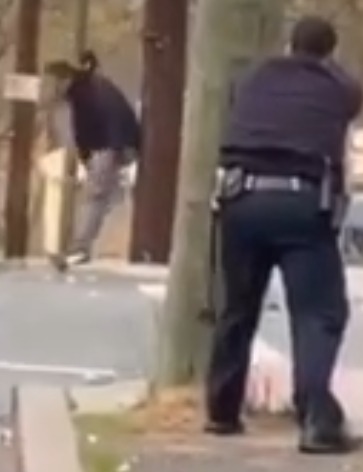
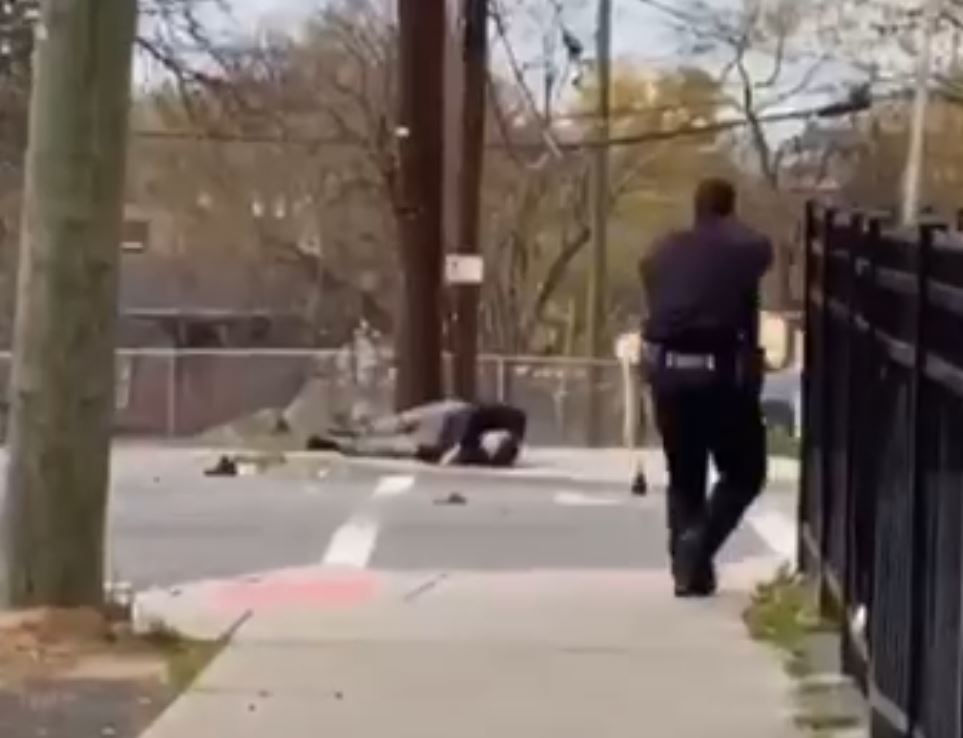
Here’s a not so sensational video (as these things go) of life on the streets of Nickerson Gardens. You know what you don’t see? You don’t see cops stopping 90% of men. You don’t see cops arresting 45% of men. Quite frankly, you don’t see cops.
But, I mean, I go into this knowing Rice is wrong. The only question is “how?” (Though what really bothers me is “why?”)
Raj Chetty is probably best know for his Opportunity Atlas, which documents how much of life outcome can be predicted simply by where you grow up. This is good and important stuff. Now I don’t think Raj Chetty (nor anybody else) has written a report titled “Zip Code is Destiny.” I could be wrong. But there’s “The Opportunity Atlas: Mapping the Childhood Roots of Social Mobility.” There’s nothing about 45% of men being arrested.
44.1% of black males growing up in the poorest (bottom 1%) families in Watts* were incarcerated on April 1, 2010. In contrast, 6.2% of black men who grew up in the lowest-income families in central Compton were incarcerated on April 1, 2010.
* there’s an odd footnote here:
This particular statistic is for a tract in Watts that contains the Nickerson Garden public housing project. For convenience, we refer to tracts by neighborhood names in this paper, but quote statistics from specific tracts within those neighborhoods
I don’t know why you’d choose to do that. Why say “Watts” and “Compton” if you mean one track in Watts and Compton? But what matters for me is they’re taking about incarceration, not arrests. But 44% is still too high. It just is. What gives?
The Opportunity Atlas shows a 7.1% incarceration rate (and a 71% poverty rate) for Nickerson Gardens (both sounds true). And for black men, incarceration is much higher (28%). But the 44.1% Chetty et al reference is only for black men from the lowest 1% of household income, less than $3,300 a year in Nickerson Gardens. If there are 1,400 black men in Nickerson Gardens. 1 in 100 means 14 men. Statistically this gets odd. Yes, maybe 6.2 of these men, statistically, are in prison. But that’s not my point.
But I’m curious how “44.1% incarcerated” transfers into educated urban myth about arrests and a false narrative of racial injustice and over-policing. In February Rice wrote an op-ed in the L.A. Times advocating that the LAPD get rid of their gang database:
45% of black men who grew up in the Nickerson Gardens housing project were incarcerated on one particular day.
Still not true (also not corrected). But hell, the real figure (28%) is still too high. (But so is the rate of murder.) Regardless, Rice is talking about incarceration, not arrest. Now in Rice’s defense, Chetty himself said this in 2018:
CHETTY: On a given day. On a given day — the date of the 2010 census, 45 percent of the black men who grew up in this tract in Watts — it’s called the Nickerson Gardens public housing project. Forty-five percent of them are incarcerated.
But it’s not what his own research shows. He’s kind of muddling the lowest-income part. It’s sloppy, but it’s also a radio interview and having done a lot, I cut him some slack. Here is his greater point:
CHETTY: Here’s maybe something you didn’t know, though. If you go a mile or two away, to Compton, you see that rates of incarceration for black men growing up there in families of comparable income are something like 6 percent. So still actually high — 6 percent is not a small number. But relative to 45 percent, it’s dramatically lower.
See, that’s good stuff. But maybe Chetty doesn’t realize how low his n (number of people in a sample) is here. But it’s his study, and I don’t want to cut Chetty too much slack, because, his verbal errors, as they say, always seem to lean “in the same direction.” I don’t like that.
A fair listener, perhaps even Connie Rice, might think Chetty said 45% of black men in Watts are in prison because that is what Chetty said. He really should make clear he’s talking about the poorest 1% of the population, which is a statistically dubious category for a census tract. (Also, as a side note, who in the world but an economist believes the reliability of self-reported household income data, in Nickerson Gardens, for the poorest 1%? Are you kidding me?)
Anyway, somehow Rice went from hearing a false but understandably misconstrued take on the incarceration rate and turned it into an absurd statement about the probability of arrest. Again:
Rice: Every time you step out of your unit in that housing project, you face a 45% chance of going to jail. Every day. Not being stopped. That’s 90%…. Somebody can’t walk out of their unit, without facing a 45% chance of going to jail that day.
Wow, if that were true, my opinions on policing would be quite different than they are. As to the 90% of black men stopped by police every time they leave their “unit”? I don’t know. It’s also not true. But maybe it comes from some lifetime chance.
Look, I don’t expect everybody to read every study. I don’t expect everybody to be informed on every issue. But I do ask for some basic common sense.
Here’s the thing: Connie Rice is no kook, she’s an educated and respected authority of the law and policing. But you wouldn’t listen to a flat-earther talk about global circumnavigation. You wouldn’t listen to an anti-vaxxer’s opinion about the latest clinical COVID vaccine trials. So why do we listen to misguided people speak about policing? It’s not good for reform. It’s not good for race relations. It’s not good public safety.
Justin Nix has a good article (academic, but plain English and not behind paywall) about the dangers of using cops-killing-people as a variable. He writes in response to an article by Schwartz and Jahn that maps “police violence” across U.S. metropolitan areas. Schwartz and Jahn find, as have I, that
Rates of police-related fatalities varied dramatically, with the deadliest MSAs (metropolitan statistical areas) exhibiting rates nine times those of the least deadly. Overall rates in Southwestern MSAs were highest, with lower rates in the northern Midwest and Northeast. Yet this pattern was reversed for Black-White inequities, with Northeast and Midwest MSAs exhibiting the highest inequities nationwide.
Not that I’m cited or anything — though granted this blog is not a peer-review publication — but I do believe I was the first to observe and try to raise the issue of state and city disparities in police use of lethal force back in 2015 (and everyyearsincethen). This was after the Washington Post and Fatal Encounters starting keeping a reliable count of those killed by police (starting in late 2014, after Michael Brown was killed in Ferguson). My goal has always been to have others do more thorough statistical analysis, so I’m happy it’s finally getting some attention.
What Nix does is raise some very serious and legitimate issues about what can be gained from this kind of analysis. Not to say one shouldn’t look at those killed by police, but any conclusions need to come with much larger caveats.
Nix’s first issue, however, is with Schwartz and Jahn’s term “police violence” (this and all subsequent quotes are from Nix):
Use of the term “police violence” has the potential to mislead readers who believe that police use of deadly force is rampant and usually unjustified (e.g., those who view police as “vigilantes” or “oppressors”). It also has the potential to drive away readers who understand how statistically rare police use of deadly force is, and that it usually occurs in response to violence (e.g., police officers themselves, and those who view police as “professionals”).
We in the field tend to use “police use of deadly force.” Why does this matter? Because, as Nix says, “‘police violence’ assigns all responsibility to officers, as if none of the citizens involved contributed in any way to the violence.” This contributes to a certain anti-policing narrative. But also “police violence” groups incidents in which police need to use deadly force together with incidents in which police shouldn’t have used deadly force. If cops shoot a shooter actively killing people, it seems a bit unfair to focus on the race of the shooter as causal factor.
But there is a more serious statistical problem with using police-involved killings as indicative of deadly-force situations. The problem is that “killed by police” is not a reliable and instructive variable even with regards to deadly-force encounters with police! And given that US police have literally hundreds of millions of interactions with people, fatal shootings are really rare (about 1,000 per year).
The number of times in which police might use deadly force (pointing a gun at somebody) and the number of times police do use deadly force but do not kill (more on that, later) far outweigh the times somebody is shot and killed. So we’re studying a very rare phenomenon, extreme outliers, while also missing most of the cases of exactly the phenomenon we’re trying to study.
The numerators of Schwartz and Jahn’s fatality rates are a nonrandom sample of all deadly force incidents that occurred from 2013 to 2017. To be sure, there is some degree of chance in whether a person who is shot lives or dies (e.g., whether bullets pierce a vital organ). But part of the variation across MSAs both in terms of rates of police-involved fatalities and racial disparities therein might be driven by nonrandom factors apart from police behavior. [italics added]
That’s serious, if your focus (or blame) is on police behavior. When people, myself included, compare fatal police shootings in, say, Las Vegas, Nevada, and St. Louis, Missouri, we’re assume that fatal shootings represent the number of times cops shoot people. But that’s not the case. At least in the limited cities we do know about. In some given time frame, Las Vegas police killed 47 people while St. Louis PD killed 20. So it seems like Las Vegas police shoot more than twice as often as St Louis police. But both police departments shoot just as often. The Las Vegas fatality rate (chance of dying after being shot by cops) is 41% while in St. Louis it is just 17%. And this doesn’t begin to take into account police-involved shootings where cops simply miss. (I’d guess, very roughly, based only on the NYPD concept of “object completion,” that that may be somewhere between 10% and 20% of the incidents in which police shoot.)
Similarly, based on people killed by police, Boston and Atlanta seem to shoot the name amount (not rate, just number). But in reality Atlanta police are 3 times as likely to shoot. The fatality rate after being shot by a cop in Boston is 71% while Atlanta is 24%. Why are these rates are so different? Distance to good trauma care is a proven factor, but that can’t be the only one. And we don’t have national data on this.
This is the “numerator” problem. We’re studying use of lethal force and don’t know how often it happens. Sure, being shot and killed is proxy. But how good of a proxy is it? We don’t know. Hell, only for the past 5 years do we know the number of people cops kill. So we’re forced, like it or not, to use the best data we have, the data we have rather than the data we want. Is this good enough? That’s the question. And Nix makes a good argument that the answer is “no.”
The third of three issues raised by Nix is about the “denominator.” Or, to put it another way, “Yes, the use of force is disproportionate… but compared to what?”
One can only be subjected to police force—including deadly force—conditional on interacting with a police officer in time and space. So how informative is it to calculate police-involved fatality rates for a population that is mostly never at risk? … A Venn diagram of the “at risk” and general populations would not perfectly align—instead, the “at risk” circle would be a small circle within the much larger general population circle. Perhaps some comparisons to other phenomena are in order. To estimate maternal mortality rates, researchers do not include all women in the denominator, but instead the number of live births. … To estimate the rate at which sharks bite people, researchers would need to determine who goes into the water. Studies concerned with police use of deadly force must be equally attentive to identifying a meaningful denominator.
In any given year, most people have zero chance of being killed by cops. Why? Because they don’t interact with cops in that given year. If we’re looking at individual police as a source of bias, it doesn’t make much sense to include those who don’t interact with cops. The Bureau of Justice Statistics estimates that in one year about 20% of Americans over 16 had some sort of contact with police.
We know there are racial disparities in policing based on — in addition to any active bias on the part of police — 1) people who call 911, 2) victims of crimes, 3) criminal offenders, and 4) traffic stops. And numbers 3 and 4 are related to 5) disproportionate police presence and activity in high-crime neighborhoods. We do not have reliable data on the rate at which cops interact with people. And even then, all interactions are not equal. Context matters.
The available evidence indicates that both crime reporting and proactive police stops differ systematically across racial groups. … Is the solution to ignore this mediator—which is literally a necessary precondition for being killed by a police officer—and calculate rates for the entire population (most of whom are never at risk)? If the goal is to understand and improve officer decision-making as a way to save lives, then I am not convinced. Stopping a person and using deadly force on a person are two different decision points, with different antecedents, and need to be analyzed as such.
Yes, as we like to say: it’s complicated. Comparing racial disparity to overall population figures does has its use. It describes, well, police use-of-force on a given population. But it does not explain the police part of use-of-force.
To be clear, there is nothing inherently wrong about Schwartz and Jahn’s use of population denominators in their analysis, so long as readers bear in mind there are many factors (including police behavior) that drive the disparities. I am merely pointing out that it produces rates that are not all that helpful in understanding why police-involved fatalities vary across space as they do.
If we are to move beyond shock and outrage that there are racial disparities in police use of lethal force — if we are actually going to reduce the number of people killed by police — we need to understand the “how” and “why” as much as the “what.”
Full citation: Nix J. (2020). “On the challenges associated with the study of police use of deadly force in the United States: A response to Schwartz & Jahn.” PLoS ONE 15(7): e0236158. https://doi.org/10.1371/journal.pone.0236158
Jill Lepore has an article in the New Yorker about the invention of police that somehow manages to sidestep every thing I know about the history of police. I know a little about the history police history. Much more, I suspect, than Jill Lepore.
I discussed a key problem of Lepore’s perspective in my last post. She writes through a lens, a worldview, in which she believes that two-thirds of people aged 15-34 who go to the Emergency Room are there because they were beaten by police or security.
It’s crazy talk. And it makes me question everything else she writes on the subject.
Her article has so many errors. But rather than refute her point by point (though there’s some of that), I’m just going to present my own history of the invention of police. Now this is just one version of police history (albeit a pretty mainstream one). I’ve got no grand narrative here. It’s what I consider “objective.” That used to be goal. Now? I don’t know. If you want to put your spin on this to apply it to current events, feel free. But that’s on you. And yes, of course this is over-simplified. But here’s my brief history of the invention of police in America, from 2050BC to 1870AD, from a New York City perspective.
Hammurabi did it in stone
Long before there were police, society and governments and communities maintained order. That’s important to keep in mind.
1800 BC, 3,800 years ago, Hammurabi invents the “rule of law.” Or at least he was smart enough to carve it in stone, so we give him credit whether he deserves it or not.
The Old Testament (Exodus 21:24) talks about an “eye for an eye, tooth for tooth.” Harsh? Maybe. But much softer than Hammurabi! Justice in the Judaeo-Christian world changes when Jesus says, “go and sin so more” (John 8:11). Retribution vs restorative justice? Deep.
Not too much innovation in the west from then until the Anglo-Saxon “kings peace” concept that all crimes are crimes against the king, and the state will keep a monopoly and prosecution and punishment, thank you very much.
James Watt’s steam engine comes along in 1780 and you got your Industrial Revolution. And with it, urbanization, disorder, gin, and the growth of crime and disorder in London. America was a few decades behind.
Very long story very short: Sir Robert Peel invents and implements the concept of modern police in 1829 London, the Bobbie. It’s to maintain order and prevent crime, he says. It’s so not an army we’ll put them in blue instead of red.
The word “police” isn’t new. What has changed is the concept of “policing.” There had been watchmen since forever, and America certainly had bounty hunters and slave catchers long before 1829. Britain had frankenpledge and tithing. Before that the Romans had the “urban cohort,” Vigeles, public servants who did some of the things associated with police today. But we define “police” as full-time public employees, most in uniform (originally blue, with hat, rattle, and baton) whose purpose is to prevent crime and disorder, and who also have the power and obligation to arrest criminal offenders. What Peel did was combine a lot of public functions into one, and center it around the idea that police should be public servants whose primary (almost exclusive) purpose was to “maintain order and prevent crime.” He was pretty clear about this (though note he never wrote his famous “principles“). I’ll also give Peel credit for inventing foot patrol. That’s kind of big deal in the policing context. Public patrol is very different from “guard this property.” I’d say it defines policing.
Peel’s policing idea was adopted in New York City in 1845. It quickly spreads from New York to other American cities. But I’m going to focus on New York.
Unlike police in London, American police (at first) don’t wear uniforms, but more important, police in New York are under local (ward aldermanic) political control. They also carry guns.
In the South, police remains a slave catching / bounty hunting proposition until Reconstruction. During Reconstruction, Southern cities had a pretty clear divide between antebellum slave catchers and the post war “modern” policing imposed by northern occupation. But Reconstruction ended up being too brief, police in the south reverted to their racist role as enforcers of slavery-based Jim Crow.
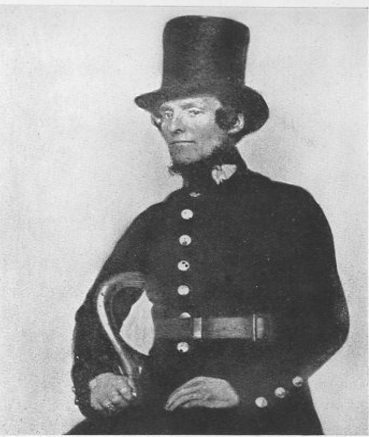
One of Peel’s Bobbies
I try to cover that in my first class in an hour. It’s not easy. In my second class I turn to Kelling and Moore’s Three Eras and Williams and Murphy’s Minority View. I add some August Vollmer (and shame on Lepore for making him sound like some cracker), Civil Rights, the LA Riots, and the NYC crime drop, and pretty soon you’ve got a decent foundation for me to get on with whatever the class is supposed to about.
It is often said that Britain created the police, and the United States copied it. One could argue that the reverse is true.
You could argue that, but you’d be wrong. And Lepore is not very convincing, at least to anybody with any knowledge of police history.
Lepore stresses Patrick Colquhoun. But not because of his contributions his dockside “River Police” (usually the “Bow Street Runners” get more credit, but both were, still, in essence, bounty-hunting operations), and less for his 1800 treatise on police that talked about the “new science” is which police should “prevent and detect crime” (this no doubt this influenced Robert Peel), but because [gasp] Colquhoun had spent years in Colonial Virginia and owned shares in a sugar plantation in Jamaica. Ergo, through Colqohoun, American police are rooted in slavery. Though Lepore admits that not much came of Colquhoun’s idea for another generation, until the London police started by Robert Peel, to whom she gives two sentences.
Why does that matter? Because one could either see the invention of police as good, as a noble concept, as a way in which society tried to defend the community and protect those most vulnerable. I actually believe that. But even if I didn’t, I don’t see why I wouldn’t want to believe it. Or you see American police as rooted in slavery and doing little more than serving White Supremacy. I certainly know the dark side of police history as well as anybody. It’s real. But that’s not and never has been the ideal. It’s not what American policing is rooted in. American policing doesn’t come from slavery. And it’s certainly not why American police expanded.
Lepore says:
It is also often said that modern American urban policing began in 1838, when the Massachusetts legislature authorized the hiring of police officers in Boston.
Actually, no. Nobody outside Boston ever say that.
For what it’s worth, in Baltimore you’ll sometimes hear Baltimoreans say they had the first police (established 1784). And a Glaswegian might tell you modern policing started with the Glasgow Police Act of 1800 (which has more merit). This is like rah-rah boosterism. Not real history.
I mean, even in Boston the Boston Police department doesn’t claim American urban policing began in 1838 Boston. The Boston police were established in 1854, a date Lepore somewhat sloppily references later in her article.
To be generous, if this isn’t your field, one basic source of confusion is that the word “police” is an old word. And sometimes people were paid to “police.” What changed is the meaning of the word. To be a a police officer didn’t mean what we think it means until Peel’s Bobbies hit the street of London in late 1829. Peel’s model is the one that worked, the one that lasted, and the model that was copied in America (and is given credit in every policing textbook).
From 1829 London, the idea of “preventative police” spread. (And the successful implementation of policing in London is great story, well worth reading about. It was not an easy lift.) In 1838 the New York Morning Heraldwrote: “The new police system of England is to be introduced into South Australia, and two London officers have been sent out.”
Our citizens are all agreed that a thorough, radical Reform is needed. Such are the general features of the Plan proposed. It seems eminently simple and well calculated to effect the great object for which any Police is needed – the prevention of crime.
Because we already had detectives and people running around to catch thieves for profit. Here’s a letter to the editor of the Daily Tribune:
I fully agree with you that a Police is wanted to take the place of the present Watchmen, Constables, &c. I saw, during some years’ residence in London, the effect of the new Police established by Sir Robert Peel; and I think one of that plan for this city would not be far from the best. The necessity of keeping them on duty at all hours is unquestionable.
And this is not too long after the War on 1812. Revolutionary War veterans were still alive. It wasn’t like “it’s British” was a great selling point. But there was no mistaking what the “new police plan” was modeled on. This isn’t controversial.
The first (abortive) New York police superintendent was mocked, according to the New York Herald, because he gave he copied a long speech, “word for word from a manual of instructions to the Liverpool police, published some half dozen year ago.”
There’s no reference to slavery. Nothing about Boston. But a whole lot about preservation of the peace and good order, which is straight from England. New Yorkers weren’t looking back to slavery, they were looking across the Pond to Peel.
From David R. Johnson’s (1981) American Law Enforcement: A History:
The reform of the London police attracted favorable attention in America shortly after the bobbies began patrolling their beats. … In an era when an attempt to collect accurate crime statistics had not even been made, it is extremely difficult to determine whether crime was actually increasing. We can say, however, that concern over property offenses had become widespread. Citizens arming themselves to defend their homes and persons was only one indication of this growing fear. Such measures had been unthinkable prior to the 1830s. Fear about this kind of crime, combined with dismay over the decay of social order, therefore made a powerful argument for police reform. … New York was the first American city to adopt a lasting version of a preventive police.
American policing — preventive police, a “new police” — started with the New-York Police Bill, written in 1844, but not passed until 1845. Objections came from Nativists (anti-immigrant) opposition to what they saw (correctly) saw as an immigrant dominated police force. This speech was given outside City Hall:
They … are now about to pass an odious and base police bill to bind us down. (Cries of shame, shame.) They will then appoint persons to office, and those men will not be native born citizens. (Cries of shame). We have had to encounter much opposition from these foreigners. In the ward were I reside the Greeks and the Hessians deposited their ballots, and when I asked them were they resided, the inspector said he would challenge every one at our side. It was not enough for them to have the privilege of voting: no, for when they found they were cut down at the polls, they then had their Greeks and their Dutchmen to kick up a row. and when we claimed to have the men arrested we were then struck down (cries of shame). I saw a state convict let loose from Blackwell’s Island by the Governor, to pollute our polls by his presence. I saw him parading in our streets at the head of bands of blood-thirsty ruffians, banded for the purpose of preventing the native citizens from giving their votes. Old Tammany Hall must die. (Cheers). It is already tumbling, and for ever let it be damned and lost, and the Native American party rise and extend its influence. [Mr. Whitney concluded by exhorting his party to rally round the glorious banner, and] conquer the Greeks and Germans, and all other foes of reform. (Great applause).
But the the New York Police Bill passed the next year and took effect in June, 1845. George Matsell was appointed commissioner on June 17, 1845 and would serve for 13 years (plus 2 years for a second term later on). The main points:
Article 1 §1 The watch department, as at present organized, is hereby abolished, together with the offices of marshals, street inspectors, health wardens, tire wardens, dock masters, lamp lights, bell ringers, day police officers, Sunday officers, inspector of pawn brokers and junk shots, and of the officers to attend the poll at the several election districts of the city and county of New York. … §2 In lieu of the watch department and the various officers mentioned in the foregoing section, there shall be established a day and night police of not to exceed seven hundred and fifty men, including captains, assistant captains and policemen. … §5 Each ward of the city of New York shall be a patrol district. … §12 It shall be the duty of the policemen to render every assistance and facility to ministers and officers of justice, and to report to the captain all suspicious persons, all bawdy houses, receiving shops, pawnbrokers’ shops, junkshops, second hand dealers, gaming-houses, and all places were idlers, tipplers, gamblers, and other disorderly and suspicious persons may congregate; to caution strangers and others against going into such places, and against pickpockets, watch-stuffers, droppers, mock-auctioneers, burners, and all other vicious persons; to direct strangers and others the nearest and safest way to their places of destination, and, when necessary, to cause them be be accompanied to their destination by one of the police. … Article IV Compensation of officers §2 No fees or compensation shall be charged or received by any officer for the arrest of any prisoner… [or] the issuing of any warrant, subpoena, or other process. Any magistrate or officer violating the provision of this section shall be guilty of a misdemeanor, and shall be subject to the pains and penalties for such an offence. §10 No member of the police department shall receive any present or reward for services rendered or to be rendered.
The new police were called the “new police” because they were, in fact, not just an evolution of the old. The old system was abolished and at least 12 municipal functions were absorbed into one “new police.”
But anti-immigrant sentiment was strong. The pro-new-police and not particularly Nativist Herald wrote in June 1845:
The Organization of the New Police is proceeding rapidly under the new Superintendent, Major Matsell. About five hundred men have passed the ordeal, and some two or three hundred incompetent candidates been rejected. … The nominations are made by the Aldermen of the Wards, and in some instances they have been so silly as to nominate men who could neither read nor write; some of these candidates being Irishmen, who have all, of course, been rejected, although nothing like “native” feeling exists in the selection. Adopted citizens, if competent, are just as eligible as any others.
But, unlike the Bobbies, these “new police” weren’t in uniform. This was a big issue for a while. The New York Herald emphasized the goal of “public safety” and made a plea for uniforms in early July:
We sincerely wish they had been more proscriptive in this particular, and made a uniform as essential feature in the police organization…. Let us have a uniform–we are no admirers of hogs in armor, but by all means let our police dress as policemen.
[Could this be the first ever reference to cops as pigs?]
There was a great fire in New York in July, 1845. Three hundred buildings burned and lives were lost. Troops were sent to prevent looting. The ever supportive Herald noted:
The police along Broad, Pearl, Stone, and William streets, was most energetic, at the same time civil and firm. The Value of the new body was spoken of by all in the highest terms, and have doubtless been the means of preventing the plundering of some thousands of dollars worth of property.
Two days later, still discussing the terrible fire, it was noteworthy enough to mention:
The Police wore large metal stars on their coats on which are the city arms, and the word, “Police.”
And the “new police” were often referred to as the “star police.” Both expressions seem to have died out by about 1850.
The New York new police lost the support of the Herald in late 1847, which noted that crime was up, and around 20% of the force had resigned or been fired. This was probably true, but paper’s objection may have been politics and the election of Mayor Brady (anti-Tammany). Or maybe there was a new editor at the Herald? But just a year earlier the paper was lauding the New Police for their “judicious use of authority” and usefulness in “the prevention of crime.” In May 1847 Mayor Andre Mickle (Tammany) went so far as to advocate for the complete abolition of the police system and a return to a system of night watchmen:
It has been in operation a sufficient time to enable us to form a just estimate of its worth, and I regret the necessity which compels me thus officially to state, that so far as my own observation extends, it has failed to meet the just expectations of the community.
It’s hard to follow all the local politics. But they matter. The Herald also highlighted the problem of corruption in policemen serving at the will of local ward aldermen:
Let a policeman make a descent on one of the lottery or policy shops in Broadway, and the changes are against his holding officer another year. The owner of the such shop possesses political influence, which he will exert against that policeman. And he will be backed by all his associates in the same business, in running and hunting down the faithful officer who has dared to fulfill his duty by enforcing the law
The paper seems to become pro-police again three months later, with the swearing in of Mayor Havermeyer. I could go on. But, to paraphrase Tip O’Neill, all policing is local. In a few very short years, other cities copied the New York “new police” model. And with the notably exception of the enforcement of the extremely unpopular (in the North) federal Fugitive Slave Law, the era of for-profit bounty hunting and policing for profit (at least legal profit) ended.
The New York model spread across America. Johnson:
Police reformers in other cities did not adopt every feature of New York’s plan. But there were enough similarities to say that New York served as a kind of model for the campaigns to establish preventive policing elsewhere. New Orleans and Cincinnati adopted plans for a new police in 1852. Boston and Philadelphia did so in 1854, Chicago in 1855, and Baltimore in 1857. by the 1860s, preventive policing had been accepted in principle, properly modified to meet American conditions, in every large city and in several smaller ones. This was an important achievement.
Let me just quickly get up to the start of today’s NYPD before ending. The NYPD actually does not descend from the “new police” of 1845! There were the Astor Place Riots of 1849. And in 1853 power to hire policemen was taken from local ward aldermen and given the mayor (Mayor Westervelt). This was progress, probably. Also in the early 1850s the size of the New York Municipal Police Department increased, cops were finally forced to put on a uniform, and police received military-like drill training (including baton training). And technology is always improving! The “magnetic telegraph” connected all the various stations. The telegraph actually precedes the police whistle, which won’t be invited until 1884. Want backup to deal with ruffians? Bang your night stick on the ground or fire off a few rounds into the air. “Service pistols” didn’t because standardized until Teddy Roosevelt required them as police commissioner sometime around 1895 (before that cops carried whatever gun they wanted to).
All this leads to New York State’s abolition of the Municipal Police in 1857. Corruption this; brutality that; nepotism this. But it was about power and politics and anti-immigrant sentiment. The state abolished the Municipals. The state established (and controlled) the new New York City Metropolitan Police. For a while there were two police departments as the Municipals sued in court against the legal power play. They wouldn’t turn over their property (and lose their jobs) to the upstart police. When the New York Appeals court ruled the legal shenanigans constitutional, the Metropolitans had the law on their side. It was all over but the shouting. Except…
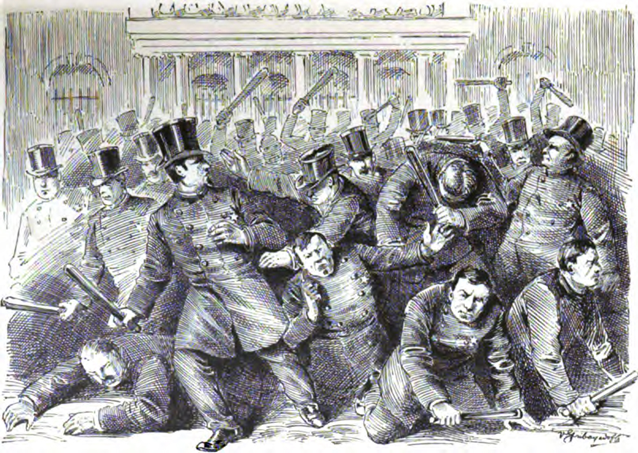
The Municipals didn’t go down with a fight, literally. On the steps of City Hall! I can’t believe there’s no book dedicated to this: a City Hall battle between two New York City police departments. Mayor Wood barricaded himself in his office. The siege ended only when Wood faced the possibility of an artillery bombardment! Just so happens an army regiment was passing by, so the Metropolitans borrowed a piece or artillery and turned toward City Hall. And so begins the NYPD, established 1857. Everything changed and nothing changed. The state returned control of the police department to the city in 1870.
There’s so much Jill Lepore gets wrong in her New Yorker article “The Invention of the Police.” The spoiler is in the subtitle: “Why did American policing get so big, so fast? The answer, mainly, is slavery.” She seems to ignores the actual history of police in America, but I’ll get to that in my next post. For now let me obsess on this paragraph Lepore wrote:
One study suggests that two-thirds of Americans between the ages of fifteen and thirty-four who were treated in emergency rooms suffered from injuries inflicted by police and security guards, about as many people as the number of pedestrians injured by motor vehicles.
Now if you, gentle reader, were to read a study that said that, what would your reaction be? Perhaps: “Huh?” “Can’t be.” “Crazy.” “Must be a bad study.” “Maybe I misread it?” Also, not to get all math on you, but “how can you have admissions made up of two distinct groups of two-thirds each?”
All of the above. Actually, though, it’s not a bad study. It’s a clever study by Feldman et al (2016). Limited by data, as the authors admit, but good for what it is.
As to Lepore, I had a tough time reading the rest of her article. I like (or liked) her work. But this is subject I know a little about. And her article is so skewed, so biased, and so absent of historical context and accuracy. But keep in mind, though, I just teach this at a public university. She’s a chaired Harvard historian. Plus she writes in the New Yorker. But has she never visited a high crime neighborhood? Has she never been to an emergency room?
This mistake stood uncorrected online for more than a week. Currently it’s gone from the web version. But the mistake went to print. Online it says this:
An earlier version of this piece misrepresented the number of Americans between the ages of fifteen and thirty-four who were treated as a result of police-inflicted injuries in emergency rooms.
That’s it? Shouldn’t the correction correct the error, and not just make it go “poof”? It should say: “An earlier version of this piece suggested that nearly 66% of Americans between the ages of fifteen and thirty-four who were treated in emergency rooms suffered from injuries inflicted by police and security guards. The real number closer to is 0.1% We regret the error.”
The error isn’t in the study she’s citing. The error is in how she read it. It could have been from reading this:
We restricted our queries to persons age 15–34, the highest risk group, accounting for 61.1 % of all legal intervention injuries over the study period.
But most likely she didn’t even read the study and misread the Harvard press release about the study:
Sixty-four percent of the estimated 683,033 injuries logged between 2001-2014 among persons age 15-34 resulted from an officer hitting a civilian. The data did not distinguish between injuries caused by police and private security guards, who the authors said now number nationally about the same as police officers.
But the context for the 64% isn’t all admissions. It’s 64% of those admitted for injuries related to what the authors call “legal intervention.” 64% of them have been hit. That might mean, hypothetically, that 20% were beaten with a rubber rose, 10% fell down stairs, and 6% had too tight hand-cuffs.
Aside from common sense, there is also another way this error should have been caught. Lepore says two-thirds of injuries are from cops or security, and it’s the same number as pedestrians injuries by cars. Last I checked, 2/3 + 2/3 > 1.
So what is the correct percentage? The number of people in the ED (Emergency Department, AKA ER) for cop-security injury annually is 683,000 divided by 14 years. About 48,800 admissions a year. The data doesn’t break down how much of this is police vs private security (the authors’ acknowledge this).
I would note: 1) private security — and they’re more of them than there are cops — can be much more brutal than police (I’m thinking bouncer / club-security). And 2) police can be very quick to take people to the hospital (to CYA), no matter how minor the injury. So of those 48,800 admissions, some (an unknown fraction) have been injured by police. But we don’t know. But grouping two groups when you’re talking about one is a bit dodgy. Potentially like saying, “cops and grandmothers killed a 1,000 people” and blaming grandmothers.
There are 139 million Emergency Departments visits in the US. Roughly 45 million of this visits are 15-34 years old. (That exact age breakdown isn’t in that link, but you can find it if you care). So 48,800 is 0.1%, one-tenth of one percent. Were to Lepore to claim “two in three” when the actual number was “one in three,” I’d be upset. But she claimed “two in three” when the real number is “one in one thousand.” How could you be off by so much?
If you could for even a moment believe that 67% of hospital emergency admissions for any group are because they’re getting beat by cops (or security), how clueless can you be? What does that say about your worldview? What crazy lens are seeing the world through? Who actual believes this? And why? Is it the articles there about cops hunting black men, talk of a literal epidemic of police brutality, comparisons to a real pandemic? Maybe.
Partly what bothers me about Lepore’s statement is that it was in the New Yorker. This means that after it was written, it went through an editor, a copy editor, a proofreader, and, in theory, a “fact checker.” All this and not one of those people — and by “those people” I mean people of New Yorker persuasive (liberal and white) — thought, “Hey, this can’t be true.” No, it’s almost like they want it to be true.
The blueprint for law enforcement from Nixon to Reagan came from the Harvard political scientist James Q. Wilson between 1968, in his book Varieties of Police Behavior, and 1982, in an essay in The Atlantic titled “Broken Windows.” … Wilson called for police to arrest people for petty crimes, on the theory that they contributed to more serious crimes. Wilson’s work informed programs like Detroit’s STRESS (Stop the Robberies, Enjoy Safe Streets), begun in 1971, in which Detroit police patrolled the city undercover… The campaign to end STRESS arguably marked the very beginnings of police abolitionism.
To say say something “informed” something is a cheap why to link two things that aren’t related, simply because one happened before the other. She wants to slander James Q. Wilson because he was conservative. It’s what Ivy League academics do, I suppose. But what do Varieties of Police Behavior and “Broken Windows” have to do with either Nixon or Reagan? And nobody outside the field knew of “Broken Windows” until Bratton brought it to New York in the early 1990s (and brought down crime).
And why go after August Vollmer? There are enough bad guys you don’t have to go after the good guys, too. And Vollmer, ironically, could have strengthened her point and serve as an inspiration for today’s police-reform movement. In his 1936 The Police and Modern Society, Vollmer questioned the police roll in traffic enforcement. He said the laws against prostitution can’t work and therefore we shouldn’t have them; gambling should the licensed and regulated; prohibition was a mighty failure; and let’s leave the moralizing to the church and other such agencies. As to to illegal drugs?
Drug addiction, like prostitution, and like liquor, is not a police problem; it never has been, and never can be solved by policemen. It is first and last a medical problem…. The first step in any plan to alleviate this dreadful affliction should be the establishment of federal control and dispensation–at cost–of habit forming drugs.
Instead (why? I don’t know) Lepore blames slaps the label of “Vollmer-era Police” on everything bad (including some items that were before Vollmer’s time). [Though I too, like Lepore, like to highlight the harm of the so-called “progressive” era of policing, which generally gets off too easy. And I would start police abolitionism a bit early. The mayor of New York called for the abolition the police in 1848. But those facts don’t matter when you’re writing about narrative.] Why blame Vollmer for what he was trying to change? Why not call it the “W.E.B. Du Bois-era Police.” Would almost make as much sense. Du Bois, too, wrote about crime and police.
In Lepore’s narrative nobody gets shot, except by police; the only legitimate fear is to be afraid of police; riots are protests; crime is a non-issue (and police do nothing to prevent it); the only victims are “victims of police brutality [who] are disproportionately Black teen-age boys: children.” I doubt that to be true. But who knows? Certainly not Lepore.
I don’t mean to “whatabout” her article by bringing up crime and victims of violence, but she did write an article about the history of police. I’m supposed to snuggle down with my New Yorker, sip an herbal tea, and believe violent crime is but a figment of the racist right. At a time when shootings in my city have recently tripled and 96% of shooting and murder victims in New York City are Black or Hispanic, I’m supposed to think the roots of US police lie in slavery? That police have never been anything more than agents of White Supremacy? But I don’t live in Lepore’s world; a world without violence; a world divided between privilege and victimhood; a world in which one can think hospitals Emergency Departments are just filling up daily with black children beat by police.
My next post is going to talk about the history of policing in New York City, where modern police in America started.
[Warning, this is a whole lot of nothing-burger in the end. But still, for those interesting in crime data, it might be worth reading.]
Shootings are up so much in NYC that social scientists are left accusing the NYPD of “juking” the stats. Now I’ve been using NYPD data for a long time and compared to, well, every other source of data I’ve every used, NYPD data is pretty damn good. Seriously. They are smart people there and they care about data quality. Doesn’t always mean the data going into the system is right, but the NYPD really does care about the quality of their data. (Now if only they would make more of it public…)
That said, even with NYPD data, I still only trust murder and shooting data. Not because of intentional manipulation as much as knowing how tricky it is when data goes into the system, and how tricky it can be to get reliable input. Much less if precinct commanders actually are trying to juke the stats
What this means is that educated people are saying it’s entirely possible — likely even — that violence isn’t really up. That instead NYPD is making up data. I actually find this preposterous when it comes to NYC shooting data. But hey, who knows?
In fact, says one good professor, one shouldn’t even write about the increase in violence. Denial is always the first stage in social science when it comes to changes in crime. It will move on to framing and confusion very soon.
Anyway, if NYPD is trying to artificially inflate shooting numbers, that’s a new one. Of course, maybe they somehow hid away shooting victims last year and every year for the past many years. I doubt it, but it’s possible.
Now the people who actually analyze this very data provided some pretty good answerrs, but it fell like water off a duck’s back. (To wit: current homicide numbers are lower because some injured people haven’t yet died; this month last year had an unusual number of non-gun homicides.) Anyway, the gist being, “Are you effing crazy? No, we haven’t changed anything. Shootings last month really were triple the year before!”
Honestly, to accuse professional crime analysts, people who do this for a living, to accuse them of conspiring to lie about data is a pretty big accusation. Especially when your only proof is, “Shootings can’t be up that much without a greater increase in murder.”
But still, I was led to gun violence archive (GVA), which I’ve never used, as potentially a more accurate source than NYPD data. And this even though some of their data collection seems to be based on little more than tweets put out… by the NYC Alerts911.
So I thought I’d spot check some data. At the time I’m typing this, I haven’t actually checked yet! For real! So this could go either way… but my money is on NYPD data. But still, this is exciting (well, to me, and actually not really).
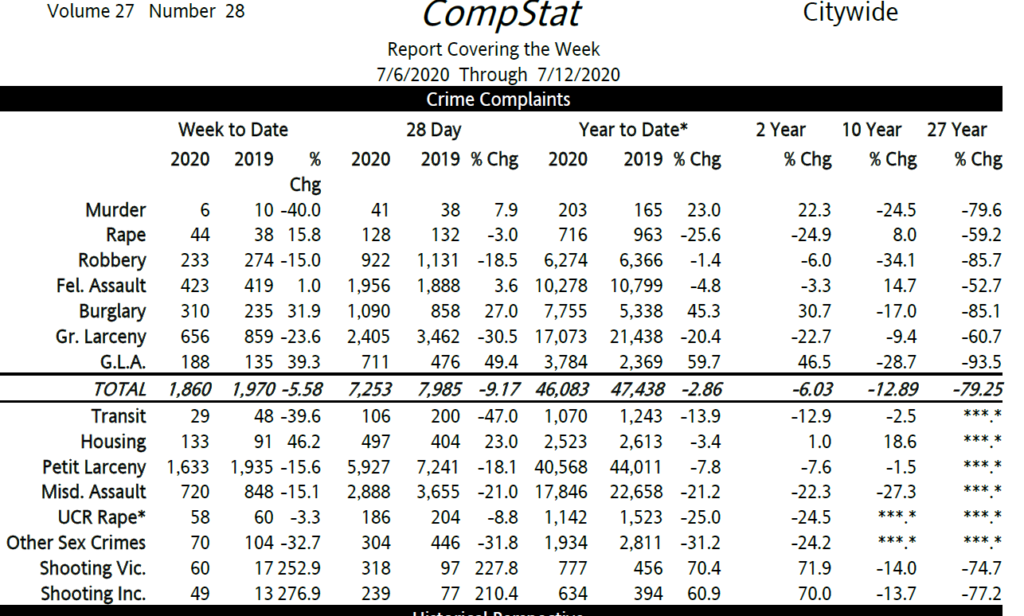
I’ve decided to spot check the week July 6-12, mostly because I downloaded the PDF of the official NYPD Compstat data for that week. (NYPD does a horrible job of releasing data. And were they to release more data , in a good form, it would so help the NYPD [echo echo echo]. It’s just frustrating because I could have saved a day of my life if this data beyond a goddamned 1-page PDF were public. Why isn’t it?)
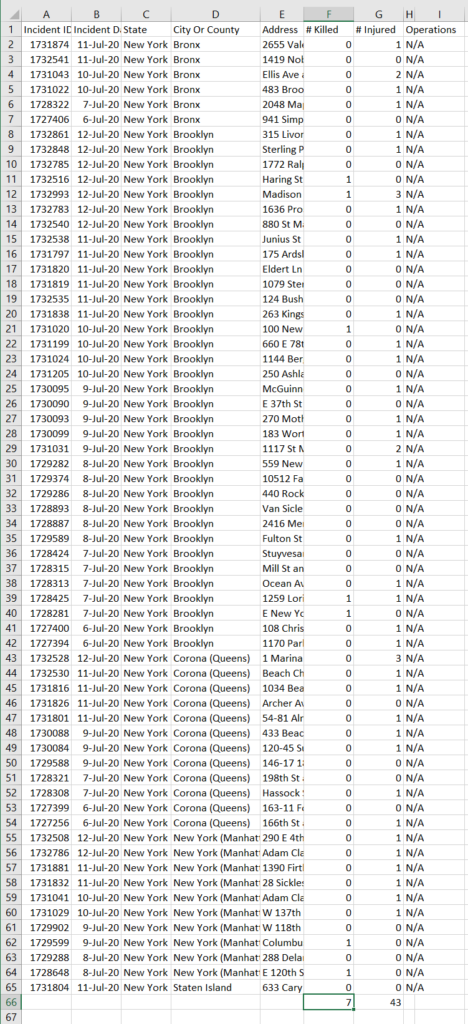
So that’s the NYPD data. I’m going to focus only on the 2nd from bottom line, Shooting Vic. That means people who took a bullet. Now I also happen have the actual list of every shooting and murder victim in the city, which isn’t public. It should be. But it allowed me to check the internal validity of the public Compstat page, above.
60 shooting victims. 7 murders, one of whom was not shot. 6 shooting murders. Does that match with the pdf? I hope so. [checks] Bingo! Well, there is one more murder, 7 vs 6. But that doesn’t bother me. The Excel file I have is more up to date than the PDF, so I presume one of the victims died after the PDF was put out. It happens.
Now this just proves internal consistency in the NYPD. There could still be a big conspiracy.
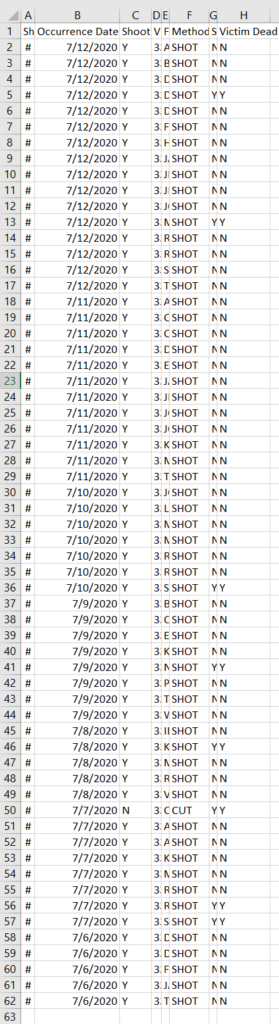
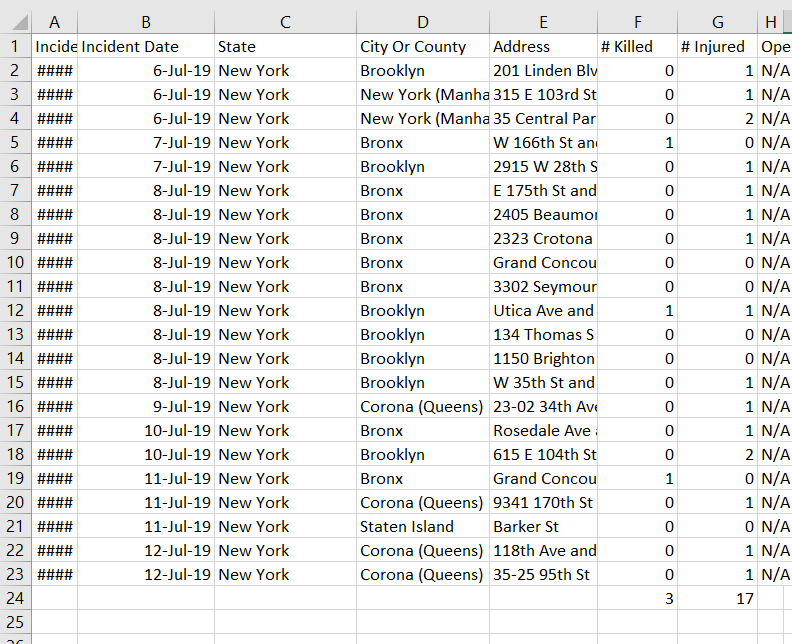
Now let’s look at the Gun Violence Archive for this same week in 2020. They show 7 murder victims shot and killed and 50 people (43+7) shot.
(By the way, it bugs the hell out of me that every place in Queens is listed as “Corona (Queens).” Corona is one neighborhood in Queens. Doesn’t really matter, but it’s a yellow flag for sloppiness.)
Now let’s shift to 2019. According to the NYPD Compstat page from this year (above), there were 17 shooting victims and 10 murders in 2019. (I do not know if the weeks will line up perfectly.) Let’s see…
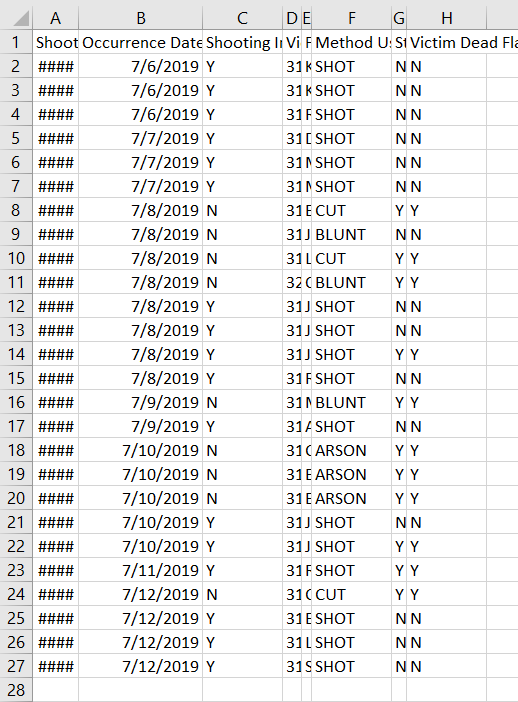
According to the internal data I have, there were 17 shooting victims and 11 murders. Maybe 1 of those died this week? Maybe they’re off by 1. Either way, it jibes. Of note is that 8 of these murder victims last year were not shot (3 were killed by arson!).
NYPD 2019, week of 7/6 to 7/12:
This helps explain a lot of why shootings are up so much more than murders this year. In 2019 there were only 3 shooting deaths during this 28-day period. (Those were the days!) And there were 3 deaths for 17 shootings. That means 18% of those shot died.
This year only 1 murder wasn’t by shooting. There were 7 deaths out of 60 shootings: 12% (a notable difference from 18%–one that needs explaining, but not one that is unexplainable–one that could be expected if there’s more people shooting semi-randomly into crowds).
Now going to GVA for this same week in 2019. (This omits all non-shooting victims.) (Also, I want to gripe that GVA is a shitty website because it doesn’t allow me to download more than 501 cases at a time. So this took awhile to download everything from Jan 1, 2019. Grrrrrr. It also doesn’t allow to filter by locations easily. Or at least correctly. So I downloaded for all of NY State month by month, combined, and then manually took out everything that isn’t NYC. I have better things to do with my life. Or maybe I don’t?)
3 murders and 20 (17+3) shooting victims. (I don’t know what it means when they list an incident without a victim, but whatev.) This is three more shooting victims than the NYPD counts. That’s… interesting. Why the discrepancy? July 6: “GVA” has 4 victims; NYPD 3. July 7: GVA has 2; NYPD 3. July 8: GVA has 6; NYPD 4. July 9: 1 and 1. July 10: 3 and 2. July 11: 2 and 1. July 12: 2 and 3.
Some of these might be shootings that happen around midnight. Or maybe not. So as research I’m thinking let’s spot check a few days. July 10? I’m using GVA for the link to source. Definitely 2 people were shot. But the third? “Reports of” are very different than a person actually shot. Probably didn’t happen. But GVA counts it. Because there were “reports of.”
On July 6 GVA lists 4 victims. NYPD 3. But one of them listed by GVA, it turns out, wasn’t a shooting victim. He was pistol whipped, according to the NYPD. Could by lying… but no.
Here’s a crazy idea: What if @NYC_Alerts911 isn’t the most reliable source of data. And what if NYPD crime data actually is reliable? Crazy, I know. But I’ve been doing this for years. And it’s what I’ve found to be true.
Anyway, it comes down to this. For June 14 to July 12, 28-day period, GVA lists: 2019: 85 people shot in NYC 2020: 265 people shot in NYC That’s a 211% increase. NYPD (which is more accurate): 2019: 97 people shot 2020: 318 people shot That’s a 228% percent increase.
So there’s no great discrepancy. All this is because somebody carelessly analyzed the GVA incorrectly. Now I’ve wasted half a day confirming what I already know because the idea that the violence rise in NYC isn’t happening was gaining traction on Twitter. Frustrating. But that’s OK, I suppose. It’s good to confirm data. But it’s better to focus on the problem that more people are getting shot. And questioning the integrity of the good data distracts from that. That’s what pisses me off. Shootings are up in NYC. For at least the past 5 (6?) weeks; triple compared to last year. Triple! No, it’s not NYPD making up numbers. But I guess there’s always value in making sure one’s data is correct.
But seriously, for the day I’ve spent proving the obvious? Arguing if lives are really being lost? It’s just that I could have spent that time thinking about what we could be doing to actually prevent lives from being lost. That’s what’s frustrating.
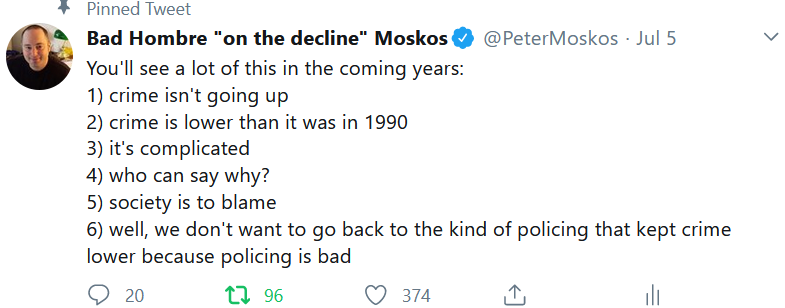
My “pinned tweet” on twitter is this:
I wish I had added, “the stats are rigged” to #1. But today I saw somebody go down the list in order, through #1,#2 (though the year mentioned was 2010), #3, and #4. It’s frustrating. Because I’ve said why (at least as well as one can in 650 words).
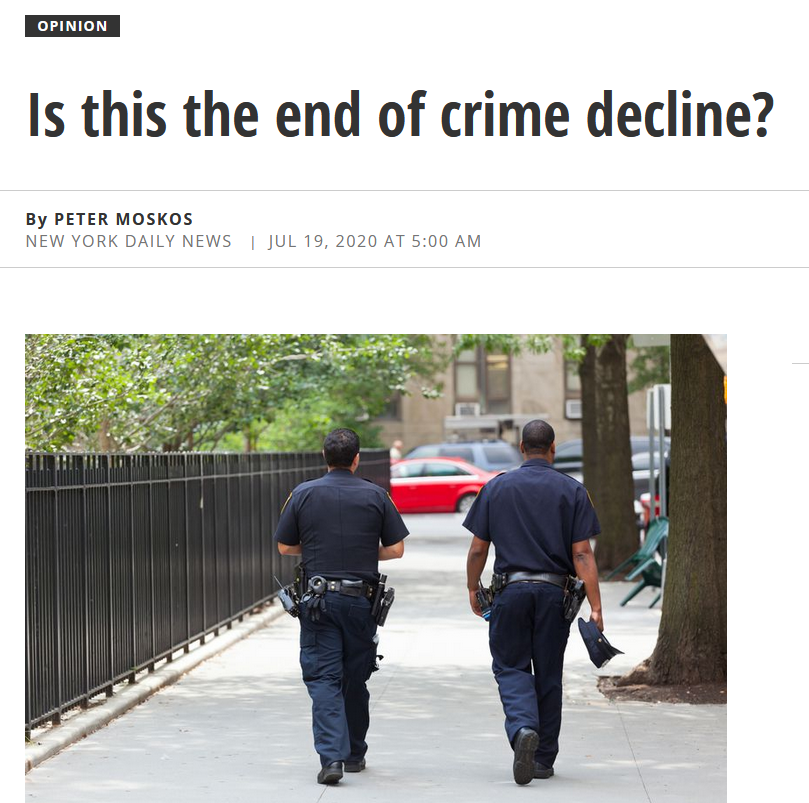
Betteridge’s law of headlines states: “Any headline that ends in a question mark can be answered by the word no.” I hope I’m wrong and Betteridge is right. This piece of mine was in the Daily News.
Violence in New York is up. If you ask the NYPD, the 30-year New York City crime decline is over. Police have been known to cry wolf and can see the even most beautiful blue sky as falling. But what if this time it’s true? In New York City, violence started increasing in October, before George Floyd was killed, before protests and before “defund police” became a catchphrase. In the last 28 days (through July 12), compared to last year, shootings have more than tripled (318 vs. 97). Last week was even worse. If the last 28 days become the new normal, 2021 will have more than 4,100 shootings, a level not seen in well over 20 years. Undoubtedly bail reform, protests, looting, COVID-19, and the release of prisoners because of COVID all play a role, though how much is debate. What’s less known is how the NYPD has been methodically declawed by design. Years of political advocacy have resulted in the intentional erosion of legal police authority. There is less prosecution. Most miscreant activities have been decriminalized. The city survived and even benefited from many reforms, but now the camel’s back is breaking. It’s like a game of Jenga in which the wooden blocks of public safety are stacked into a tower. Each player in turn pulls out one block. The tower holds. But as more and more blocks are removed, one too many is pulled — one that may have been removed earlier and without consequence — and now the entire tower is tumbling down.
Here are some bits I would have kept in, but for length:
And here are some parts I would have kept, but for length: Enforcing gun laws is key. In 2013 and 2014, 40% of all the “disposed cases” for carrying an illegal gun in NYC ended up with some kind of jail or prison. In 2019 it was just 17%. Near-mandatory jail time for guns was a big reason NYC became less violence in the 90s. Or take disorder on the subways, nothing legally prevents the NYPD from enforcing quality-of-life rules. But under Mayor deBlasio, enforcement ended. To that extent police are standing down, but not because they want to. They’ve been told to, often in the name of social justice. Good policing is about changing people’s behavior before they need to be arrested. To do that police need information, leadership, tactics, and the legal right to enforcement. Crime prevention is by nature pro-active. And that, of course, is the root of some police opposition. Bit by bit the NYPD has seen their legal authority pre-empted by elected officials, primarily the mayor and district attorneys (to a lesser extent city council members) by directives not to detain people pre-trial. Open container, disorderly behavior, turnstile jumping, smoking weeds, shoplifting, but even theft, assault, and illegal gun possession are now but non-violent crimes to be ticketed and released. There is no detention. There is little prosecution. The NYPD can’t use their tools. This is a political choice. Precision policing, broken window, stationary posts, quality-of-life, Clean Halls, Borough Specialty Units, Organized Crime Control Bureau, Street Narcotics Enforcement Unit, and most recently, anti-crime. All gone. By any quantifiable measure–a decline in arrests, a decline in crime, a decline in police use of lethal force, a decline in the number of complaints, plus terrorism prevention–the NYPD has been effective. But none of this matters. Instead we’re dismantling the NYPD. And for what? Just imagine telling the next generation, after murders top 1,000: “Well, of course we had to dismantle the NYPD, you see, because a cop killed a man in Minnesota.”
I just want to put this out here so *I* don’t forget. I somehow hadn’t heard of Tony Timba until like two weeks ago. This is an egregious Floyd like case of a man killed by cops. But only Floyd, here there was also a cover up and there was no accountability. Cops did nothing wrong, they say. I disagree.
In some ways this is yet another too typical police-involved shooting (not that police-involved shootings are typical — these kind of calls get handled in the thousands “without incident”). But it’s all here: a man with a gun, mentally disturbed, confronted by police. And not for the first time. The man is black, unlike the previous one I wrote about, in Patterson, NJ, in which the man was white. Here the only white people are the paramedics. That too is not untypical.
This is not an unusual call. It’s a 3AM call for somebody in “behavior crisis.” It’s the fourth such call of the day. The previous day, June 30, there were 36 such calls. On July 1st, this is the 4,071th such call this year for Baltimore City Police. Probably (though I don’t know) this was the first to end with somebody being shot. Anyway if you don’t want cops to respond to this call, you’d need resources to handle up to maybe a half dozen of these “behavior calls” calls an hour. This is for a city of (sigh, less than) 600,000 people.
But this is worth analyzing because, well, it seems to be handled very well by police, and the mentally ill guy still gets shot. The cops do well. They treat the man as a man in crisis and not a mortal threat. they don’t dehumanize him. You don’t hear de rigueur verbal commands for the sake of “controlling the scene.” This is the midnight shift in action.The cops take their time. The cops are calm. They are caring. They try to connect with the guy. They make sure he knows they’re here to help him. They don’t have their guns out even though they strongly suspect the man is armed and turns out to be a mortal threat!
I’d like you to look at this and think, “At what point did the cops make a mistake?” “At what point would I or better yet a trained expert done something differently? Short of the guy being on his meds and/or not having a gun, how could have this turned out differently. But he wasn’t on his meds. And he does have a gun (though we don’t know that, and that’s part of the problem). And the family has tried and failed to managed the situation. So they call 911 because they help.
So we send the cops. And the handle the situation well, in my humble opinion. And a cop comes within a split-second of being killed. And the mentally ill get get shot multiple times (though lives).
When the cops enter the house, the mother-in-law warns them, “It ain’t gonna be that easy.”
The cop replies, “Nothing ever is.” Truer words have never been spoken.
The moment this becomes a lethal force situation happens so fast that I missed it more than once, trying to take notes. From police arriving on scene to shooting takes 18 minutes. But from sight of the gun to the shootings takes less than 2 seconds. Even knowing it’s coming, you’ll miss it. I guarantee it.
The other reason I’m writing a lot is to weed out the weak! But seriously, I can’t force you to watch the whole video, but if you’re still interested and willing to watch the shooting part, watch the whole damn thing. My point is not to show violence, but how to prevent it. Or, unfortunately accept that sometimes, for many reasons, it is inevitable.
After the shooting the Mayor of Baltimore says through a spokesman that the shooting was under an “active investigation.” The Maryland ACLU said: “In Maryland, this has become a disturbingly familiar pattern – where officers called to assist someone in mental distress instead trigger a crisis, failing to see the person’s humanity and shooting instead of helping. This latest incident further points out how Baltimore’s over-dependence on police is setting them up to fail, and costing unnecessary lives.” Gosh. Sounds horrible.
“This is why the ACLU of Maryland and and more than 60 other organizations across the state are demanding that the Law Enforcement Bill of Rights be repealed…. #BlackLivesMatter”
So the ACLU says this would not have happened if only LEOBOR were repealed. (Personally I’m not a big fan of LEOBOR, but that’s neither here nor there right here). The ACLU is literally taking this man’s death, a man a crisis, a black man, and using it for political gain. This needs to be pointed out. It’s a shitty thing to do. Anyway, after (hopefully) proper redactions, a few days later the BPD did release the body cam footage. As far as I know the ACLU never said anything about maybe the cops did pretty well here, all things considered.
From the Sun: The police commissioner said that after the shooting by the officers, the residence where the shooting occurred was searched and eight weapons were found, including a second weapon registered to Walker. Asked whether police should have taken steps after the first incident to determine whether Walker had additional weapons, Harrison said the investigation was “ongoing.”
The police commissioner could have should have been more laudatory about the professionalism of the officers. It’s not exactly the defense you’d like to hear from your boss after you just had to shoot someone, had your game taken away, and worry if the prosecutor will slap you with criminal charges.
Think that’s crazy? Cops fear getting in trouble not for doing wrong, but for doing right. Just one year ago Sgt. Bill Shiflett confronted an active murderer and got shot for his efforts. For his troubles, Mosby, the prosecutor, held potential criminal charges against him for 7 months. I don’t know why. You’ll have to ask her. But this is policing today.
This police-involved shooting, as is common, starts with a 911 call. It’s after 3AM on Wednesday, July 1, 2020. The call itself is very well handled. Mother in law calls and says: Last time he was drinking he had a gun. … He’s a psych mental patient. … Yelling and screaming and ranting. …Last time they give him two shots and took him to [the hospital.] …My daughter is trying to get him to come up. …My daughter’s husband is in the basement and he’s paranoid or schizophrenic. … He was diagnosed with that couple weeks ago. …He’s down in the basement and he’s like that now.
Operator: Is he having an episode or something?
Yes.
Operator: How old?
33 years.
Operator: I’m making request for an ambulance. Is he violent?
I guess. I don’t know.
Operator: Possibly or likely?
Yes.Possibly.
Operator: Does he have a weapon?
That I don’t know.
Operator: Is he thinking about suicide?
I don’t know.
Operator: Is he completely alert?
Not really. Hearing voices.
Operator: I’m going to send the paramedics and well as police. They’re going to monitor.
You should make them silent cause he’s going to go crazy when he hears.
Operator: They usually do accordingly for certain calls.
And then standard instructions are given about setting up the house and whether people have COVID. The whole call takes two minutes and thirty seconds. The cop on 414 post gets a medium-priority call for a “behavior crisis” and probably takes about 15 minutes to get there. Another officer would be assigned as backup. Usually this can of call involves standing around while paramedics do their thing.
It’s worth pointing out that all three cops parked some distance from the house, as they should… but that didn’t used to happen when I was there. Better to take a minute to approach on foot and judged the scene. Also they didn’t want to block the ambulance in. Anyway, to me it’s noteworthy. Also there were no sirens. But it’s late night/early morning. Only the ambulance has its flashing lights on. The fire department does that. Partly they just like their lights. But also it does provide a beacon to approaching vehicles, which can be life saving.
Anyway, so once the cops are there, at the front door, with paramedics, we get this additional information from the mother in law. She is on the phone with her daughter, who is in the basement with her daughter’s husband, Walker. The mother in law says the following: Running down the street acting crazy. … When the found him last time he was ranting, he had a gun. … He is a psych patient. … Down there screaming and ranting now. … He probably didn’t take his meds. “I’m doing this natural. I’m doing this natural.”He ain’t harmed nobody.… About 2 weeks ago running up and down the street. That’s him.
Paramedics know the guy from the previous week’s incident, when he was running around, maybe shooting a gun? I’m not sure. One paramedic asks the other if he is combative. The other replies, “very.” So they won’t go in. And it’s not their job. So at 5min 34sec (on Officer Gray’s bodycam, below) two police enter the house. A third joins later. This is 4 minutes after Gray got out of his police car. There’s no rush. That’s good.
Walker’s wife, the caller’s daughter, can’t get him to come upstairs. She probably been trying for hours. Eventually she concedes what she’s doing isn’t working and says cops are going to come downstairs.
When everybody gives up, cops go in. The wife can’t get her husband to come up. The paramedics won’t go down. There is no dedicated social worker cops know to call. But is that really the solution at this point? Like the paramedics, it’s hard to social workers going down without cops. And I’m not certain what they would do that the cops didn’t. The mother and father in law? God knows what they think about how they got in this situation. Pops seems to have given up. But I’m sure it’s been a very long night. Again.
So should the cops refuse to go in because it’s dangerous? They can’t. Or maybe the cops leave and say this isn’t a job for police. Except it is. Because it’s dangerous. The police are our responders. And they’re trained. Their goal is to get this guy to either calm down enough so the cops can leave and the paramedics can have a look. Or to get take the man into custody and get him safely into appropriate medical care. That’s it, right? Those are the choices.
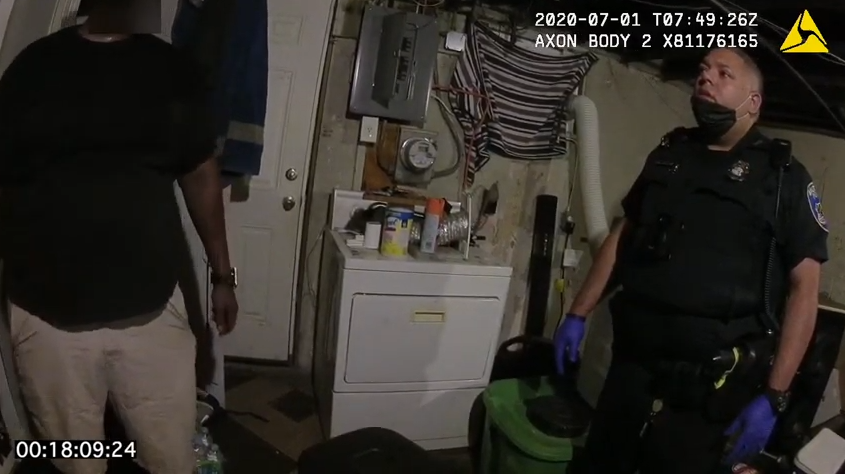
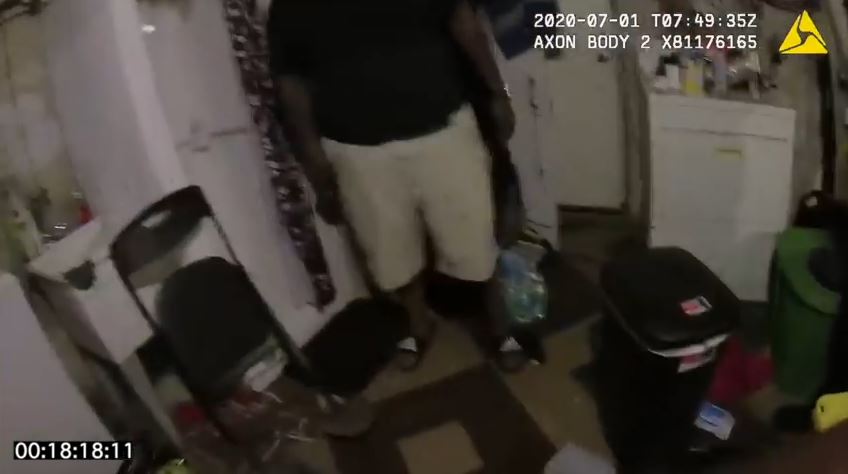
Baltimore Police released video. This is the video from Officer Gray’s bodycam. This is the one I’m going to use. But here is the video from Officer Torand. And from Del Valle (I’m not certain why there isn’t video at the moment he’s doing most of the shooting. Could be too gory. Could be malfunction. Could be a massive cover up!… but it’s not). Here’s the the version edited by the BPD which they released for the press conference. It’s a good job and kind of covers it all. But it’s also a bit confusing since they show multiple bodycams and slow-mo and stop things down at times. But police work in real time. I like real time. Finally, here’s Justin Fenton’s article in the Baltimore Sun. (Fenton does a good job, but I don’t want that to go to his head.)
Gray asks for addition units at 5min 37sec (this is not clock time, but the time on the video, which is the after the officer started his body cam). The officer confirms the name of the man in “distress.” It’s about 4AM. Gray and another officer go to the basement at 6:15. At 6:40 they ask the wife to clear out, and they tell her that medics are there. The man’s name is Walker. The timeline below is this video. The transcript is edited and not complete. The only white people I can see are the paramedics, which isn’t that uncommon for Baltimore. I’ll leave to you to say if that matters.
This is the video that corresponds with the timeline, below.
7:30 Cops: Your family called us.
7:42 Walker: Come in front to the cameras. [This is in reference to cameras that may but probably do not exist.]
8:00 Walker: Trying to take my life. In my house illegally. And about to kill me.
For much of the time, Walker has his hands in a prayer-like position and speaks to either a non-present friend (maybe his barber?) or God.
8:25 Walker: Distorted because my wife tried to poison me.
8:48 Walker: Take your masks down.
9:23 Cops: If he takes his mask off?
9:38 Cops: Can you listen to me? I‘ll go in front of the camera if you take that knife out of your pocket.
10:10 Cops: Where are the cameras?
10:15 Walker: I know tribal tattoos when I see them.
10:17 Cops: We’re trying to help you. The medics are upstairs.
10:45 Walker: Nobody called y’all.
11:00 Walker: He’s been sleeping with my wife. Whole time.
11:20 Cops: Do you feel like you want to hurt yourself?
11:22 Walker: Hell no.
11:39 Walker: Come shake my hand like a man.
11:45 Walker: [third officer arrives about now] I don’t know him, sir. Can you take down your mask please. And if I kill you inside my house, it’s legal, yo. I’m peaceful.
At some point the specifics of the dialogue here don’t really matter. This man simply isn’t all there. Times like this were only time I was afraid as a cop. That moment when I realized that all the words I said, any empathy I had? They mean nothing. And there lots of red flags. Messianic references to rising from the dead. Threats. Paranoia. Speaking to God. None of this is a good, from the cops’ perspective. But they do their best to stay calm and get the man to comply and come upstairs.
12:14 Cops: Your family is here. If your family comes down…
12:20 Walker: I apologize come. Shake my hand. I was chastised. They poisoned me. …Take off your mask .
12:45: Cops: I took off my mask….. I can’t take off the gloves.
12:55 Walker: How’d I get to the hospital illegally.
13:12 Walker: The police are here illegally. I didn’t invite them in.
13:20 Walker: I died. I came back on the third day. On the cameras.
13:35 Walker: Every time I’m in front of cameras they still trying to kill me. The whole time they kept trying to kill me. Please they tried to kill me other day. I don’t know you. You either.
13:55 Cops: The ambulance is upstairs and we’re trying to help you.
14:10 Walker: [to the heavens] Please save my life. They’re trying to kill me in real life. On camera. I don’t know how these people got here. [yelling] Bosses only king chambers. Get out my chambers!
14:35 Walker: They’re trying to kill me in real life.
14:42 Cops: They’re the medics behind us.
14:45 Walker: How’d they get here when I didn’t invite them.
14:48: Cops: Cause your family called them.
14:50: Walker. I hate everything.
15:25 Walker: [Yelling] You can’t kill me. Everything recorded, yo.
15:55 Walker: Y’all can’t kill me in real life.
16:10 Cops: If you’re not able to go with us, then we’re going to have to put cuffs on you.
16:15 Walker: I’m on camera. You can’t kill me in real life. You gonna kill me in front of my father. It’s my real life. Can you lock them up before I die, yo?
16:47 Cops: Nobody is trying to kill you. Nobody is trying to harm you.
16:49 Walker: Everybody in my house right now. They’re moving stuff. They’re trying to kill me.
16:51 Cops: We’re trying to help you.
16:52 Walker: They’re moving stuff, you. Why y’all trying to kill me. All y’all was here the other day. Sheriffs here! Please save my life.
[Officer moves camera right to side of Walker, moves an object that we could trip over. Officer Gray silently points to two possible weapons. This is a tight team. I like that.]
17:15 Walker: Why ya’ll getting close. I died in real life. Please save my life. The sharps are here, yo. Why you moving stuff, yo?
17:30 Cops: Keep your hands out your pocket. Keep your hand out your pocket.
17:35 [officer on right move what I think is a knife from off the top of the dryer.]
17:38 Walker: I’m distorted. Everything is recorded yo. I’m distorted because these people trying to kill me. Can I get a hug, yo?
17:48 Cops: Do you want to go with the medics?
17:48 Walker: Come give me a hug in front of the camera.
17:55 Walker: I didn’t invite these people in. Quarantine and chill. I’ve been begging to chill all day.
17:56 Cops: Do you want to go upstairs with the medics?
17:58 Walker: I ain’t going nowhere. [Angry] Cause I’m all natural!
18:08 Cops: Did you take your medication.
18:11 Walker: Naw. That shit fake.
18:15. So listen. The medics are outside. Can we get you upstairs for the medics to have look at you?
18:16:00 [Walker’s hand goes in his pocket. No visible officer has their hand on their gun. Though I would hope the third officer, Torand, the one behind Gray does have his gun in hand.]
18:17:05 [Walker’s gun is visible. And yes, here the timelines has to go into milliseconds. You’d have to watch this multiple times frame-by-frame (like I did) to see how all the cops react in sync, without saying a word, to that gun that just appeared. This is where training kicks in. There’s no hesitation. There can’t be. This whole time there, the officers were focused. Completely. And aware of their surrounds. Hyper aware.]
Oh, indeed he wasn’t just happy to see me. That was a gun in his pocket.
18:17:17 [Walker’s gun aimed right at officer’s bodycam. This image is highlighted in the BPD edited version, and for good reason. Yes, the cop is looking down the barrel of a loaded gun. In freeze frame, in hindsight, I see his finger is not yet on the trigger. The fact that Walker doesn’t have a good grip on the gun is what saves the cops’ lives. It buys them an extra second.]
18:17:29 [Cop on right starts to reach for gun. Walker’s gun is visible at 18:17:05. 1/5th of a second (00:00:20) is the standard alert human’s reaction time.]
18:18:00 [Walker lowers his arm holding the gun.]
18:18:18 [Cop on right gets to his gun holster.]
18:19:06 [Walker starts to raise gun toward cop on right.]
18:19:17 [First shot. Not clear from whom. BPD says Torent, behind Gray, fired. If so, he probably fired first. Just be happy Gray didn’t jump to his left to take cover. It’s not a good shooting position to be in. But what can you do? We see Del Valle on the right fire at least 3 rounds, the 3rd through 5th shot.]
18:19:22 [Walker is in shooting position, aimed at officer on right.
18:19:50 [A second shot is heard. I don’t from whom or exactly when.]
18:20:06 [Cop on right fires the 3rd shot.]
That little bright dot in the barrel of the gun is the muzzle flash. The recoil 1/100 of a second later
18:20:15 [Cop on right fires 4th shot.]
18:20:24 [Cop on right fires 5th shot. The cops stop shooting ends exactly 1.07 seconds after they start shooting. Why? Because in that one second the threat was no longer a threat. “Shoot to incapacitate. That’s how I was trained. They haven’t killed Walker (they could have), but they ended the threat. So they stop shooting. That’s the way it’s supposed to work. Quite often, too often, despite training, what happens in “contagion shooting.” Once one shot goes off, everybody shoots, and next you know all the cops have emptied their magazine and 1 of them somehow managed to reload and fires even more. That doesn’t happen here. It’s really impressive.]
18:26 Cops: Twenty-three [unit number], shots fired get the medics down here.
18:29 Walker: I’m still alive. You saved my life. They shot me. Please save my life.
18:45 Cop: Where’s the gun? He had a gun.
18:46 Cop: Medics!
18:46 Cop: Put him in cuffs!
Cops went from “no visible threat” to shooting in 2 seconds. In the next second cops went from 1st shot fired to 5th and last shot fired. From the first bullet, it is just 7 seconds before the cops are calling on the radio for a medic to help save Walker’s life.
In the proverbial “split second,” cops see a threat, respond, shoot, stop the threat, stop shooting, and then render aid. All this despite the fact that (presumably) none of them has ever been in this situation before.
That’s what training is about. In times of crisis it’s supposed take over, because you literally don’t have time to think. Had the officer not fired when he did, had he been just maybe 1/4 second slower on the draw. He’d likely be dead. Had Walker’s gun been just a “gun-like” object, the cops would be facing criminal charges. As I like to say, “how was your day at the office?”
I believe the gun was indeed loaded, but I don’t know that for sure. But really, does it matter? What if it had been a BB gun? Or a cell phone? It doesn’t matter. Are the cops supposed to stand there and take one in the face before returning fire? Who can watch this saying the cops shouldn’t have shot this man exactly when the did?
Anyway, these cops are tight, working together as a team. Never do they raise their voice. The communicate with each other barely saying a word. They try to connect with Walker. They say his name. Nothing works. I can’t think of what they did wrong. In hindsight, perhaps they sould have just Tazed him right off the bat. But had they done that, I would criticize them for that. Doesn’t mean I’m right. But the truth is the guy wasn’t a sure threat until he pulled out a gun. His hands were mostly in the air. He is delusional. And has worrisome fits of flexing anger. But he’s not actually a threat to cops… until he is. And the cops treat him accordingly both before and after.
In too many videos you see cops standing around after shooting somebody still shouting, “Let me see your fucking hands!” This said to somebody who may not be moving because… he’s dead or dying. But one thing BPD has been good at for decades is the first priority is always: “render aid.” [By the way, cops, at least in Baltimore, didn’t call for “medics” until veterans started coming back from Iraq and Afghanistan post 2001. Before the endless war, we just called for an “Ambo.”]
Also, does it matter that Walker was black? Did that change police behavior. The public sure thinks it does. Doesn’t seem very relevant to me here. Nor does the officers’ various skin tones seem to matter. But you know what probably didn’t help? The narrative Walker was pretty convinced of: that cops are there to kill him.
In comes down to this: this man can’t be left to his own devices, not in the state he’s in. So let’s accept that some response is needed. At 3AM. Who? Well, paramedics, of course. They respond. But they won’t go in without cops because this guy was “very” combative with them just the other week. Is a social worker or shrink going to come and calm him down? Maybe. But I doubt it. Not with the history of guns and violence. But if an unarmed social worker and psychiatrist want to go down to that basement and offer themselves up as an human shield, police will gladly stand behind them.
(Update 6/17/21: Here’s an article in the Washington Post about mental health response in Montgomery County, MD, that goes well with this post.)
So I’ve done a little work using the data from FatalEncounters.org on people shot and killed by police. Fatal Encounters is like the Washington Post database, but for adults. I combined/merged this with a city or police department’s population, number of cops, average number of murders in the jurisdiction (over 4 or 3 years), median household income, percentage Black, and percentage Latino/Hispanic. The dataset includes every city/town where cops killed somebody between 2015-2019 and also every city above 100,000 population. I end up with 2,872 cases.
I also looked at counties, which nobody has ever seem to have done before. If you live in a state like Maryland, Texas, California or Arizona, you probably know that county police of sheriff can be the major police department. Some of the counties are huge, and their very existence is seemingly noticed by research despite the fact that there are 88 county police departments that have jurisdictions of more than 100,000 people. The police departments of 20 counties police more than 500,000 people. County data is tricky. So take this with grain of salt. Population (the denominator is the rate) is based not on the entire county but on the population policed by the department. It could be wrong (corrections welcome). And I tried to exclude jail operations from cop population (by taking only sworn officers).
LA County Sheriff’s Department kills an average of 12 people a year (2015-2019). That’s a lot. Their rate is 11 per million population (if my population figures are correct, which is tricky for county police and overlapping jurisdictions). The rate for Los Angeles City Police Department is 4.2. The national average is about 3. Riverside County and San Bernardino Counties also have very high rates. Riverside County is 32 per million, the highest in the nation. But that is only if Riverside County Sheriff’s Department polices but 180,000 people (which is the population of Riverside County minus the cities that have their own police department… but maybe that’s not a good way to figure it out; the population of Riverside County is 2.4 million). Either way, 1,795 cops killing 5.8 people a year over 5 years is a lot. That’s 1 killing for every 310 cops. In NYC, the comparable figure is 1 killing for every 4,605 cops.
The Bernalillo County Sheriff’s department (Albuquerque) has a rate of nearly 20 (per million). Three-hundred Sheriff Deputies killed 10 people over 5 years. That’s a lot. Could be bad luck. Could be unfortunate but necessary shootings in cases for which there was no less-lethal alternative. But if the NYPD killed two people for every 300 cops, it would be over 200 police-involved shooting deaths a year in NYC. Last year in NYC police shot 15 people and killed 5.
Other county sheriff departments in which there aren’t that many cops and kind of a lot of people killed are Spokane WA, Pierce WA, Clark WA, Volusia FL, and Lexington SC, King WA, and Greenville SC
Riverside County CA and Bernalillo County NM are interesting because the largest city police departments in their county (Riverside City and Albuquerque, respectively) also shoot a lot of people (but not nearly at such a high rate). Here are the cities of over 100,000 population with the highest rate of people shot and killed by police.
Every single city on this list is west of the Mississippi (or in Florida). Every single one. The mean rate for cities in eastern states is 3.8. If you take Florida out of the east, the mean goes down to 3.5. For cities in western states, the mean rate is 5.4. That’s a big difference. (The median is 3.2 and and 4.2.) And whatever real differences account for the arbitrary geographic difference, there are many department in cities over 100,000 that shot and killed few few people from 2015-2019, or at a rate less than the national average: Plano TX, Irvine CA, Fairfield CA, Grand Prarie TX, Pasadnia CA, Mesquite TX. Were they just lucky? Or were they doing something right. Or maybe both.
Maybe population greater than 100,000 isn’t the right cut off. The top cities just make the greater than 100,000 list. The total n (for 5 years) is between 8 and 35. So a little good or bad luck can affect the rate a lot. But still, a lot of shooting goes on in cities of this size. Also, the murder rate is high in a lot of these cities… but not all of them. And the murder rate is also high in Birmingham, Baltimore, New Orleans, Jackson, and Detroit, and they’re not on the list. And a lot of cities that are on this list have very few black people (Las Cruces, Pueblo, Westminster, Billings, Albuquerque, Tucson, Spokane, Salt Lake City).
Once you start getting into larger cities, I should look not only at places where cops shoot a lot, but also at places where cops shoot very little. Sure, since shootings are rare, at might just be luck. But it might be police departments are doing something right.
Thirty-one cities have rates under 1 per million. All but 4 have fewer than 200,000 people. So maybe they’re lucky. Irvine California is on the list. But hey, Irvine is rich. But what about Hialeah FL? Or Lexington KY? Or Lubbock TX? Zero fatalities all. What about New York City? 8.5 million people. And a rate of 0.89, less than a third the national average? That’s not an accident. That’s policy, training, and leadership. Why not learn from the cities doing it right?
Βetter cities (rate < 1.5 / million, half the national average) in the 200,000 to 300,000 range (n = 52), include Lubbock, Hialeah, and Greensboro. They aren’t rich. (Irvine, Oxnard, Glendale, Plano, and Jersey City are also on the good list.) In the most-shooting category (rate > 10 / million, 3 times the national average) are Orlando, Baton Rouge, Tacoma, Spokane, Salt Lake City, Birmingham AL, Richmond VA, and Modesto CA. These are mostly middle income places with a wide variety of racial demographics.
In the 300,000 to 500,000 category (n=29), only Lexington KY and Raleigh NC stand out as better than average (rate < 2). Though Virginia Beach, Minneapolis, Pittsburgh have rates < 4. On the high end (rate > 10) are Miami, Bakersfield, Tulsa, and St. Louis. St. Louis tops the chart at a whopping rate of 22.2 / million. Though St. Louis has a terribly high murder rate of 60 (per 100,000). Though New Orleans has a high murder rate of 39,000 and a cop-involved killing rate of (just?) 4.5 per million. (The US murder rate is about 5 per 100,000.)
Above half a million population, the range in rates of killed by police goes from above 8 in Albuquerque, Tucson, Denver, Mesa, Oklahoma City down to New York City with a rate of 0.89. Nothing comes close. Nashville, Philadelphia, Boston and San Diego have annual rates between 2 and 3 per million.
(Note I’ve changed the scale from the above charts. The x axis went to 30. Now it’s 14.)
Keep in mind there are hundreds of smaller cities and counties between Albuquerque and New York City. But the disparity between cities at the top and bottom of the list! It’s immense. And nobody sees to be able to look up from the latest outrage and ask, why?
So let’s give credit where it is due. By my figuring these departments all have killing rates under 1 per million (and serve populations over 180,000. If my data is correct, which it may not be). Their success should be applauded and emulated:
Travis County Sheriff’s Office Montgomery County Department of Police New Castle County Police Department Gwinnett County Police Department Loudoun County Sheriff’s Office Chesterfield County Police Department Prince William County Police Department Santa Clara County Sheriff’s Office Fairfax County Police Department Monroe County Sheriff’s Office Arlington County Police Department Macomb County Sheriff’s Office Oxnard Police Department New York City Police Department Lubbock Police Department Lexington Police Department
For those who understand such things, I also ran this regression for cities > 100,000. Dependent variable being the rate of police killings and independent variables being median household income, percentage black, murder rate, cops per capita and Hispanic/Latino percentage. Income matters (not a surprise). So does murder rate (obviously). But the negative correlation with Black percentage is of note. I was not expecting the lack of correlation with Hispanic/Latino percentage. My knowledge of advanced statistics doesn’t get much advanced that this, alas.
And this is all subject to errors and corrections. This a blog. Not a peer-review article. Leave a comment or better yet email me. Or twitter @petermoskos
Killed by police data is from https://fatalencounters.org/. I gave $100; you should give few bucks, too. This is really important data, and it’s all the work of one guy. Plus he puts the format of the Washington Post’s gathering of similar data to shame.
Then I filtered for intentional gun killings for each city, county, and police agency. From this I created a data set (one row) for each city, county, and/or agency. County data is tricky. Best I could, I figured out the population policed by large police agencies. But it’s not an exact science. (Basically take a county and subtract the cities and towns that have their own police.) There’s a lot of overlapping jurisdiction. There’s also the issue that a lot of sheriff department are responsible for jails, and I tried to exclude correctional officers (by leaving out non-sworn employees). But then in the end it turns out the number of cops per capita seems to not be that revealing, other than being correlated with murders per capita (yes, cities with more murders have more cops, presumable in that direction of causality).
It’s also likely that some of the counties shouldn’t be included because their work is limited to courts and jails. Some of the police in these counties probably aren’t doing active policing, and hence shoot nobody. Also, murder data is probably accurate, because it comes from county departments reporting. And departments don’t generally claim other people’s murders. And some county department just don’t report any data. So some of the rates may be wrong. Long way of saying take county data with a grain of salt. But it’s still worth looking at.
[Update] Here are the rates for every city in America with more than 200,00 people. Because somebody asked requested. This is the annual rate of people shot and killed by cops (2015-2019) in this city. Rate per million.
Here’s county data. (Sorted by state, then city). Here I am including more data because I’m not confident about these rates. What is correct is the number of people killed by the agency in 5 years (Avg1yrKillAgcy). I’m not certain about the rate (KillMilAgcy) because I’m not certain about the population policed (Or the number of cops). If you know better, let me know.
Here’s some fancier statistical regression courtesy of Professor Gabriel Rossman. This is a work in progress.
I think we get a few things from the Poisson:
The satisfaction that it’s done right, or at least that it’s less wrong.
Cops/1000 population is now significant. Given that the specification is technically better, as in the data better fit the model’s assumptions, you can probably trust this, or at least trust it at least as much as you could the OLS of rates
You no longer need to worry about small n and zeroes biasing the models which means that even with a rare event you can include small cases. You no longer need to drop Mayberry from the dataset though obviously data cleaning is a pain with a bunch of small towns.
12/7/2020 KillMilCity and KillMilAgcy are deaths as police homicides per million population.
Reasonably good match for Moskos’s 7/5/2020 blog post but numbers aren’t exact. Perhaps it’s minimum population of 100,000 (blog) vs 150,000 (this notebook). Alternately may be a counties issue.
cops %>% ggplot(aes(x=KillMilAgcy)) + geom_histogram() + labs(x='Police Homicides Per Million Population', caption='Agency, not city')
## `stat_bin()` using `bins = 30`. Pick better value with `binwidth`.
cops %>% ggplot(aes(x=killedByAgency5Yr)) + geom_histogram() + labs(x='Police Homicides Over 5 Years, Raw Count', caption='Agency, not city')
## `stat_bin()` using `bins = 30`. Pick better value with `binwidth`.
cops %>% ggplot((aes(x=cop1K,y=killedByAgency5Yr,size=Population))) +
  geom_point() +
  labs(x='Number of Cops / 1000 Population',y='Police Homicides Over 5 Years, Raw Count')
Because police homicides are events, they can be modeled with a count model. Assuming the events are independent net of observables, a Poisson is appropriate. This seems consistent with the histogram. If the histogram were much more right-skewed or if there were strong theoretical reasons to think police homicides were not independent, then a negative binomial could be appropriate.
Because cities/ agency jurisdictions vary wildly in size, it’s best to include population as an offset to model the different exposure. That is, more people means more people at risk of getting shot by cops and the model accounts for that.
Compared to the OLS analysis of rates, the Poisson analysis of counts is similar but now everything is significant, including number of cops and percent Latino, both of which are negatively associated with the counts of police homicides.
##
## Call:
## glm(formula = killedByAgency5Yr ~ IncMedHouse + BlkPer + Mur100K +
##     cop1K + HisPer + offset(log(Population)), family = "poisson",
##     data = cops)
##
## Deviance Residuals:
##     Min       1Q   Median       3Q      Max
## -3.9061  -1.2174  -0.1628   0.9152   3.3863
##
## Coefficients:
##               Estimate Std. Error z value Pr(>|z|)
## (Intercept) -9.609e+00  1.748e-01 -54.973  < 2e-16 ***
## IncMedHouse -1.068e-05  2.140e-06  -4.993 5.95e-07 ***
## BlkPer      -2.789e-02  3.018e-03  -9.242  < 2e-16 ***
## Mur100K      5.070e-02  3.583e-03  14.149  < 2e-16 ***
## cop1K       -2.050e-01  3.459e-02  -5.926 3.10e-09 ***
## HisPer      -5.088e-03  1.536e-03  -3.312 0.000925 ***
## ---
## Signif. codes:  0 '***' 0.001 '**' 0.01 '*' 0.05 '.' 0.1 ' ' 1
##
## (Dispersion parameter for poisson family taken to be 1)
##
##     Null deviance: 654.06  on 164  degrees of freedom
## Residual deviance: 369.63  on 159  degrees of freedom
##   (1 observation deleted due to missingness)
## AIC: 960.63
##
## Number of Fisher Scoring iterations: 4
Percent Black vs Murder Rate
There is a 0.772 correlation between % black and the murder rate, which suggests possible collinearity. As such,
Note that the murder only version has a lower AIC so if forced to choose that’s the better model. Also note that when only one at a time is included, murder remains positive and black remains negative. Whatever is driving the murder and black effects, it is not collinearity.
cops %>% ggplot((aes(x=BlkPer,y=Mur100K,size=Population))) +
  geom_point() +
    labs(x='Percent Black',y='Murders per 100,000')
In some ways this is a very typical police-involved shooting, not that police-involved shootings are are typical. But it’s all here: a man with a gun, probably mentally disturbed, confronted by police. And not for the first time. The man is white. You hear cops saying, “We can help you.” You also hear the de rigueur,”Drop the fucking gun!” He does not drop the gun. He raises the gun, not at first to a shooting position. He isn’t shot. Five seconds latter he lowers the gun barrel just a smidge. A cop fires. Then a barrage of gunfire is heard. That could be contagion shooting or in response to man seemingly trying to take a shooting stance. Many bullets strike him. He is dead.
What makes this post-worthy is that there are at least 3 cellphone videos I’ve seen of the incident, and all of pretty good quality. Also, the area, despite the man who was shot being white, seems to be black.
Here’s a transcript from the video that I put together:
Man #1: I would have been shot, that nigga, man.
Woman #1: Watch that bitch on side.
Man #1: Hey, yo, kill that nigga.
Woman #2: [exasperated] Come on.
Man #1: If he was black I would’ve been shot, that nigga, man.
Woman #1: They’d a-bin shot.
Police: Drop it. I’m not fucking, drop the fucking gun.
Woman #1: Oh, my god
Police: Drop the gun. You gotta help me out.
Woman #1: Drop the gun
Man #1: Yo, if he was black, I would’ve been shot him, man.
Man #2: He up that gun, they gonna shoot him.
Man #1: He did up it already.
Woman #2: They’re going to light his ass up, if he shoot.
Man #2: Nigga still doing something.
Man #1: Light his ass up!
Man #2: Cause he not putting the gun down.
Man #1: If he was black I would’ve been [unintelligible]
Woman #2: But I’m saying, if he shoot.
Man #2: He not putting the gun down.
Man #1: But but but, I’m up top, nigga.
Woman #2: Hell no, he ain’t putting it down. He had an opportunity the first fucking call.
Man #1: Light his ass up.
Woman #2: He like, “hell, no.”
Man #2: They got all right to shoot him. He ain’t putting the gun down.
Man #1: He standing his ground, man
Man #2: Once he raises it they gonna shoot him.
Woman #2: He raise it…
Man #2: Once he raises it they gonna shoot him. They got all right to shoot.
[GUNSHOTS]
Others: Oh!
Man #1: They done him!
Others: Oh, my God.
Man #1: BYE, BYE! BYE, BYE!
Others: I told you they…
The crowd’s combination of spectator sport, sporting commentary, fatalism, blood-lust (Man #1, below, makes me think of how crowds must have been like at death matches in the Roman Colosseum), and actually quite astute legal analysis on whether the shooting is legally justified before it happens. Man #2 says exactly when “They got all right to shoot him.”
One person warns the to-be-shot guy about a cop approaching. Another person wants nobody shot. A third person wants him shot. A fourth is calling the shooting justified before it happens. It really does cover all the bases. And all this in one scene of less than 60 seconds.
It’s worth watching the video just for the crowd
commentary. Depends on what kind of neighborhood you live in, you might
be surprised. One rarely gets this sense of scene (mise-en-scène, if I may)in post-shooting analysis. But here you have it. American 2020, in the midst of the Coronavirus.
I do feel bad A) for cops who have to deal with and armed man and end up killing him and B) also for a man who was killed, probably while in state of mental crisis.
But consider being a cop and having this running commentary in the background. Calling out the position of cops places everybody in greater danger. People shouting “shoot him” does not make the job easier nor the shooting less likely. Also, if gun shots are about to fly, sound advice is get out of the line of sight. But who am I to judge? Policing in this kind of neighborhood is different. So is living there. And people forget these facts.
Of note: A woman officer jumps out of cover to tell an approaching motorist to back up. She may have saved a life. They were all brave. She should get a special medal just for that.
The gun in the lowered position. At 0:57
Gun is raised at 1:03
The gun is in the raised position from 0:58 to 1:03 in the video. My Monday-morning-quarterbacking opinion is police should have shot him at 0:58, when he raised the gun. But I wasn’t there.At that moment no officer felt it was a threat. Maybe the barrel of the gun was pointed elsewhere as it was raised. Who am I to judge? Regardless of my opinion, police hold their fire for another 5 seconds.Kudos? Maybe. But I’m glad nobody else got shot. Given how this situation ended up being resolved, lethally, I see it as a dangerous delay, at least in hindsight.
When I first watched the video I thought, “how odd they didn’t shoot him when he raised his gun and then did shoot him 5 seconds later as he stood still.” Even I missed this: he didn’t stand still. Cops on the scene would see this. Bystanders and those watching the video in real time would not.
Because of the threat, tunnel vision and heightened senses kick in for the officers. At 1:03, the man lowers the barrel of the gun, just a bit (3A-3D, below). Only then is the first shot fired. (The first cop to shoot is off-screen to the left. You don’t see him in these pictures). Here is a frame-by-frame at the moment of shooting.
That little movement (3A-3D) is the difference between life and death. Both for him and, potentially, police officers. Because once that barrel points towards you, you could be dead. And as a police officer, I wouldn’t take that chance. And I won’t ask other to take it, either.
1
2
3A
3B
3C
3D
4
5
6
Then there is what sounds like the predictable contagion fire. Except notice the stance the guy takes after being shot (4). Whether this is a reflex reaction to being shot or his desire to take a few cops out, I don’t know. Either way it’s a shooting stance. And he gets lit up.
Had the victim been black, given the video, this would be
bigger news. So far this incident is just in the local press. And there
it probably will remain. Which is fine. (And a pretty good account here;
local press is often better than the Big Boys on police-involved
shootings, because they report just what happened without running it
through the politically-correct filter that fancy journalists seemed to have learned in “J-school”).
Because the victim of the shooting is not black, by taking race
out of the equation it makes it easier to analyze this
shooting objectively. Not that the bystanders do. There’s something
tragically ironic about one woman, right before the man is killed saying
“Boy, if he was black…”. Turns out white people get shot by police, too.
[Linguistically, not that you asked, I’m fascinating with this sentence from Man #1: “Yo, if he was black, I would’ve been shot him, man.” “Would have been shot him.” Is he saying “Were the guy black, he would have been shot” or “I would
have shot him, if he were black”? It’s the “him” at the end that throws
me. “…[were I] him” or “I would [shoot] him”? Sorry, I do think about
things like this.]
Update. This comment from twitterexpressed something I wanted to say but couldn’t figure out how to say:
Another thing the video shows is the constant trauma in poorer communities. It shouldn’t be a thing where people are at a stand off and someone is video taping not worried about being shot. Or you don’t run or drop to the ground once shooting starts.
Post Script: If you’re interested in this kind of deep description of policing, see my description of the 2016 fatal Chicago police-involved shooting of Paul O’Neal. I also wrote described in great detail the 2015 arrest of Sandra Bland. And, as always, there is my book about policing in Baltimore, Cop in the Hood.