Copinthehood.com has moved to qualitypolicing.com

  • Meanwhile, “discovery” back in Baltimore

    A bunch of people are getting shot. Including kids. An arrest was made.

    But more out of the ordinary is this by Keven Rector in the Sun:

    Attorneys for six Baltimore police officers charged in the arrest and death of Freddie Gray said in a court filing Thursday that prosecutors either failed to turn over evidence or lied about conducting a thorough investigation into Gray’s death.

    The evidence already provided by prosecutors is “completely devoid of any information obtained during the course of the State’s investigation,” the defense attorneys said, leading them to conclude that “either the State is withholding the information from its investigation, or there was no investigation.”

    I suspect the former. A judge will rule soon.

    Prosecutors are required by law to share any “exculpatory” evidence that would help clear a defendant of charges, and the defense said it is “difficult to imagine” that nothing in the state’s investigation was “in some way exculpatory to at least one of the Defendants in this case.”

    Other than one witness interview by an investigator in Mosby’s office, the defense attorneys said, they have not received “a single document, witness interview, report, recording, or even mention of a shred of evidence procured through” the independent investigation.

  • The car-stop game is rigged

    Cops can stop a driver for any violation of any traffic rule. And there are a lot of traffic rules. Whren v. United States (1996) is a good illustration of how much discretion the Supreme Court has given police officers. It doesn’t even matter what the officers’ motive are. (Except for equal protection issues raised by race and intentional discrimination.)

    Whren permits “pretextual” car stops. This is when an officer wants to stop a person for some specific reason (usually drugs, but the Court doesn’t care what the reason is), and then cherry picks a violation in order to stop the car. I think Whren is a bad decision, but my opinion doesn’t matter. As a cop I made pretextual car stops; I played by the rules of the game. And the rules were in my favor. The reason I bring this up is because a similar logic applies to ordering somebody from her car during a car stop. From Whren (but referring to Robinson):

    A lawful post-arrest search of the person would not be rendered invalid by the fact that it was not motivated by the officer safety concern that justifies such searches…. “[s]ubjective intent alone . . . does not make otherwise lawful conduct illegal or unconstitutional.”

    Subjective intentions play no role in ordinary, probable cause Fourth Amendment analysis.

    But wait…. Isn’t a true that officers can always find a minor traffic violation? Yes. And the Court is fine with that.

    [Some say] the “multitude of applicable traffic and equipment regulations” is so large and so difficult to obey perfectly that virtually everyone is guilty of violation, permitting the police to single out almost whomever they wish for a stop.

    The Court slaps this down with vengeance:

    We are aware of no principle that would allow us to decide at what point a code of law becomes so expansive and so commonly violated that infraction itself can no longer be the ordinary measure of the lawfulness of enforcement. And even if we could identify such exorbitant codes, we do not know by what standard (or what right) we would decide.

    The Court goes on to say (and this gets into the legal weeds a bit) that even an “objective” standard of “reasonableness” (from Mimms, 1977) would be too “subjective. And Scalia (who wrote the unanimous opinion in Whren) don’t play that subjective game! All police need is “probably cause” of a traffic violation. And that is a very low bar indeed.

    Ordering somebody from a car during a car stop is distinct from the “reasonable suspicion” to stop or frisk (Terry v. Ohio, 1968) or the “probably cause” needed to search or arrest (4th Amendment). Officers must “articulate” (Florida v. Royer, 1983) the relevant facts based on the “totality of the circumstances” (Illinois v. Gates, 1983, Burnham v. Superior Court, 1990 & United States v. Arvizu, 2002). The latter issues are connected to the “reasonableness” found in the 4th Amendment. If it’s not “unreasonable,” the Fourth Amendment doesn’t kick in. But controlling people in a car stop is something else. In a car stop, you’ve already been “seized.” Going back all the way to Prohibition (starting with Carroll v. US, 1925), car stops have been a bad place to look for 4th-Amendment rights.

    Ordering somebody out of a car (or telling them to stay in the car) is rooted in a concern for officer safety. But officers don’t have to justify that order based on officer safety. Permission comes with the car stop. The link between ordering a person out of a car an officer safety is more like your mom saying you should carry an umbrella because it might rain. “But it’s sunny,” you say. It doesn’t matter. You can still carry that umbrella because one day it might rain. And you don’t have to wait before opening it.

    One comparison is with “search incident to arrest” (all people get searched after an arrest). Search incident to arrest is also based on concern for officer safety. And like ordering a woman for a car, there does not have to be any suspicion regarding the individual. No justification, articulation, or reasonableness is necessary. It’s permitted. End of story.

    Could any of this change? Sure. If the Court issues a new Landmark Decision. But until then these are the rules we have.

  • Atwater v. Lago Vista (2001)

    Fifteen years ago I published my very first op-ed. Sniff. You never forget your first, even though it was kind of a forgettable op-ed. (I’ve published close to 30 op-eds since then… jeeze.)

    Atwater was a Texas case, no less, in which a woman (Gail Atwater) was arrested for a seat belt violation. Now a seat belt violation wasn’t even a jailable offense. But the Court said it was constitutionally OK to arrest someone, even for a non-arrestable offense. I still don’t understand this logic. Now these arrests could be prohibited by law or policy (which the Court recommended) but constitutionally the Court said it’s OK to arrest people for even the most minor of traffic violations.

    Keep in mind this isn’t really relevant to Bland’s arrest. She was initially placed under arrest for some variation of failure to obey (or maybe not, maybe the officer decided to arrest on the discretion granted to police in Atwater?) and then charged with assaulting a public servant, a felony. Either way, it’s worth pointing out that the legal standard for an arrest — particularly traffic related, particularly coming out of Texas — is really low.

  • Get out of the car when ordered

    Last month I composed this haiku:

    don’t be so certain

    if you say “I know my rights!”

    you probably don’t

    That was cute and all, before Sandra Bland died after being arrested in what was so close to being a warning for a minor traffic violation.

    Three(?) times Sandra Bland asserted her “rights.” Three times she was wrong. Now she’s dead. You do have to put out your cigarette as a matter of officer safety. You do have to get out of the car. During a car stop, you are being detained. The 4th amendment barely applies. This isn’t my opinion. These are Court decisions regarding general concepts of officer safety — far more pro-cop than most cops and the public realize — that emphasize the phrase “unquestioned police command.”

    Ordering people out of car isn’t like use of lethal force. The latter requires articulation of danger. The Court says car stops are inherently dangerous and thus gives officers the greatest amount of discretion to whatever they see fit. (In a similar way, the Court recognizes the “inherent link” between violence and the drug corner, which gives officers carte blanche to frisk almost everybody on a drug corner, no further articulation of danger required.)

    The basic rule, especially in a car stop, is obey lawful orders. Period. Resistance really is futile. Force can used to ensure compliance. I’m not saying this is good. But it is established Law of the Land.

    So it pains me to read a legal analysis in a respectable publication that is so patently, even dangerously, wrong.

    First let’s get the objective facts right. Then we can talk about the subjective issues.

    Jim Harrington, director of the Texas Civil Rights Project, should know better. You gotta get this right. He is wrong:

    [The cop] does not have the right to say get out of the car. He has to express some reason. “I need to search your car,” or, whatever; he needs to give a reason.

    Wrong, wrong, wrong.

    He can’t just say “get out of the car” for a traffic offense.

    Uh, yes, he can! What part of “precautionary measure, without reasonable suspicion” doesn’t he understand?

    Rarely is the Supreme Court so unambiguously clear. Best I can tell, it goes back to Pennsylvania v. Mimms(1977):

    The order to get out of the car, issued after the respondent was lawfully detained, was reasonable, and thus permissible under the Fourth Amendment. The State’s proffered justification for such order — the officer’s safety — is both legitimate and weighty.

    [T]he only question is whether he [lawfully detained driver] shall spend that period sitting in the driver’s seat of his car or standing alongside it. Not only is the insistence of the police on the latter choice not a “serious intrusion upon the sanctity of the person,” but it hardly rises to the level of a “petty indignity.” [quoted from Terry v. Ohio]. What is, at most, a mere inconvenience cannot prevail when balanced against legitimate concerns for the officer’s safety.

    [T]he police officers may order the driver to get out of the vehicle without violating the Fourth Amendment’s proscription of unreasonable searches and seizures.

    Maryland v. Wilson(1997) reaffirmed and extended this to the car’s passengers as well. Brendlin v. California(2007) re-affirmed again, but added some even stronger language:

    We held that during a lawful traffic stop an officer may order a passenger out of the car as a precautionary measure, without reasonable suspicion that the passenger poses a safety risk (driver may be ordered out of the car as a matter of course). In fashioning this rule, we invoked our earlier statement that “the risk of harm to both the police and the occupants is minimized if the officers routinely exercise unquestioned command of the situation.” [quoting Michigan v. Summers] What we have said in these opinions probably reflects a societal expectation of “unquestioned [police] command.”

    And in case you’re still hoping for a loophole:

    Our conclusion comports with the views of all nine Federal Courts of Appeals, and nearly every state court, to have ruled on the question.

    And no, cops don’t have to tell you anything or explain why. Maybe they should, out of courtesy or politeness or tactics. But they don’t have to. They order. You obey. So says the Supreme Court.

    Tangentially, not that you asked, this is what bothers me the liberal emphasis on “procedural justice” (See Obama’s Presidential Police Report). This was procedural justice. Nothing the cop did was illegal. Could have the cop acting differently? Sure. Should the cop have acting differently? In hindsight, yes. But did the cop have to act differently? No. The law was followed. And now a woman is dead. It’s not moral justice.

    Also, here’s the most complete video:

    This reminds me most of all of the Henry Louis Gates arrest. You get into a pissing contest with cops, odds are you’ll lose. “Pick your battles,” I tell my students. A car stop is great place to keep your mouth shut. Seriously, right or wrong, what do you hope to gain from pissing off a cop?

    [My analysis of the car stop is here.]

  • Oh, Habersham County…

    Is there any place in the US that so does more bad policing per capita? This Georgia county has a population of 43,000.

    Why oh why do I even know you exist, Habersham County?

    Oh, because of this.

    And this.

    And this.

    Well, related to drug raids gone bad, we now have this. A sheriff’s deputy was actually indicted:

    “Without her false statements, there was no probable cause to search the premises for drugs or to make the arrest,” acting U.S. Attorney John Horn said in a statement. “And in this case, the consequences of the unlawful search were tragic.”

    The child has undergone 10 surgeries since being injured.

    Maybe the “just the world we live in” is changing a little bit.

  • Question:

    Why was Sandra Bland kept in jail for 3 days after her arrest?

  • “System Failure”

    From the Baltimore City Paperby Edward Ericson Jr. A quote from an officer:

    I can recall Commissioner Batts addressing the officers at headquarters prior to going out on the street. He pretty much patted himself on the back making statements like. “I have been in five riots and I will assure you that this is the real deal.” With a potential riot looming, command staff was more concerned with officers not wearing black gloves and looking intimidating. With all this “experience” and beforehand knowledge at Commissioner Batts’ disposal, he still led us officers to slaughter. We were ill-equipped, overwhelmed and sent out with no less lethal crowd control weapons or real secondary plan. We were given the order to stand down, yet we could not retreat or defend ourselves. It wasn’t until after all of the officers were injured that we received riot equipment.

    And:

    Then last week Connor Meek published an Op-Ed in The Sun about his experience with police after he was mugged for his bicycle on the Gwynns Falls Trail. He walked to the district police station and was told by an officer there that it was closed after 7 p.m., then told he was at the wrong district. Even as the department scrambled and ordered districts to remain open 24 hours, one of the officers Meek had dealt with took to Facebook to chastise him, saying essentially that he was in public near dusk and so should not have expected to be safe. The Facebook posts quickly disappeared after City Paper called attention to them.

    And this:

    This year’s homicide “clearance rate”—that is, the percentage of murders in which police arrest someone and charge them with the crime—is under 40 percent. Officials at the July 6 press conference said the figure was above 60 percent earlier this year, but over the past four or five years it had averaged in the mid-40s, which was characterized as “just above average” compared to other cities that report the figure to the FBI.

  • “In a Dream, I Saw a City Invincible”

    “In a Dream, I Saw a City Invincible”

    That’s the motto of Camden, New Jersey. It’s from a Walt Whitman poem. A comment to a previous post made me think more about Camden. I’ve been through there a few times. Caught the River Line. Looked down from the PATCO Speedline. And I know a lot of my old 78s are from Camden. That’s about it.

    I wish I knew more about what’s going on there with policing. My knowledge, very limited, consists of the following:

    A) There were issues.

    B) The police department was basically disbanded; there was some police-union busting.

    C) Murders were way down in 2014.

    D) Obama said nice things about what was been going on there recently.

    E) There are still issues.

    That’s it. I wish I knew more. What happened to the cops who were on the job then? Who are the cops on the job now? Let me know.

    [Update: a 2019 post.]

    Checking just now, murders in Camden were way down in 2014: just 33 compared to 58 in 2013. That’s a great reduction! The 2015 pace seems in line with 2014. But this is a city with just 77,000 people. 33 murders? It’s not great. Even by violent US standards, a city with 77,000 peoples should have maybe 4 homicides a year. Not 33.

    The other night I was talking to a friend of mine. She had just received a #BlackLivesMatters bracelet and said I could get one, too. I confessed, a bit apologetically, that I won’t wear a #BlackLivesMatters bracelet. It’s not that I don’t care about black lives. It’s because I don’t agree with the ideological baggage that goes with the hashtag. I work with police. #BlackLivesMatter, in my humble opinion, sees police as the problem. [If that logic doesn’t make sense and you’re liberal. Let me say this. I’m not wearing a “pro-life” bracelet either. And that despite the fact that I absolutely love life.]

    It’s the “petite intelligentsia” that worry me. (Yeah, I’m coining that term, damnit.) What bothers me is the public shaming of people who “don’t get it.” Maybe O’Malley doesn’t “get it,” but does that make him “not human“? Come on, now.

    The Left has a horrible tendency to cannibalize itself. (Sanders isn’t the problem, Ted Cruz is!) Remember that great peace protest at the 1968 Democratic National Convention? (I don’t. I wasn’t born yet. But thank God liberals helped get Nixon in office. We never had Humphrey to mess things up.)

    From the fringe and not so fringe left, there can be no acceptable intellectual disagreement. If you don’t agree with the politically correct movement of the moment, the only acceptable form of disagreement is silence.

    I’m not willing to pass the progressive ideological linguistic litmus test. While trying to talk about real police issues on CNN, I was berated for using the word “ghetto” to describe, well, the ghetto. (See pp 16-17 of Cop in the Hood if you want a more articulate defense.) I’ve been interrupted for using the word “riot” to talk about, well, a riot. Most recently, I was actually reproached on NPR for using the word “criminals” to describe, well, people who commit crimes. My message to the Left: stop this!

    When Batts got fired, somebody asked me, “But what does this do for the ‘reform’ movement?” I think my answer was something none-too subtle like, “If Batts is ‘reform,” fuck ‘reform’! [If you make your position clear, reporters will paraphrase a bit.] I don’t care what Batts labeled himself. He wasn’t a reformer because he failed at reform. Batts made the problem worse. You don’t get credit for what you want to do. You don’t get credit for what you should do. You get credit for results.”

    I want to improve policing. And right or wrong, I see #BlackLivesMatter, the movement, not the concept, as more into blaming police than saving black lives. Maybe that’s the point. But then pick a more accurately descriptive hashtag.

    The other day I received a flyer (from a young white woman at a George Clinton concert in Queensbridge Park): “Stop Police Terror” it said. Gosh, I’m not for police terror. My eye jumped to the bottom: “Stop Mass Incarceration Network.” What’s not to like? I am against mass incarceration. I wrote a book against mass incarceration! Great cause. Except for this:

    The powers-that-be have continued to unleash their cops to kill and brutalize people…. These killings are the spearpoint of an overall program of suppression that includes mass incarceration and all its consequences. This program of suppression especially targets Black and Latino people and has genocidal implications…. Which Side Are You On?

    Well, they’re having a march in NYC on October 24, if you’d like join. But given these facts, I’m definitely on the side of police.

    Is it not possible for one to think there are problems in policing without believing police are evil? You need to let people argue the former without preaching the latter. I want police to kill fewer people. And I think the best way to get police to kill fewer people (blacks included) is to, well, get police to shoot less often.

    So if you take the macro lessons of history and racism and violence and conflate that with individual police incidents today? Well, maybe history will prove you right… but I doubt it. Focusing on police as the problem rather than the solution will result in more black deaths (see Baltimore post-riot).

    And if you think this “seasonal uptick” in Baltimore homicides is a small price to pay for a step toward a better society? Well, personally I think you’re morally and intellectually delusional. The road to hell is paved with good intentions. But hell on earth is paved with people who do the wrong thing and say, “gotta try harder!” (Put that on your inspirational poster.)

    But back to Camden…. Now I understand that these murders are, well, crimes. In theory, the state investigates crimes and then arrests and prosecutes the offender. In theory “justice” is served (which happens about a third of the time). But if a cop kills you, there’s little recourse. It is different when the state takes your life. This matters. This matter a lot. I do understand. But still, just look at this part of Camden. These little flags are murders since 2003. What are we going to do about it?
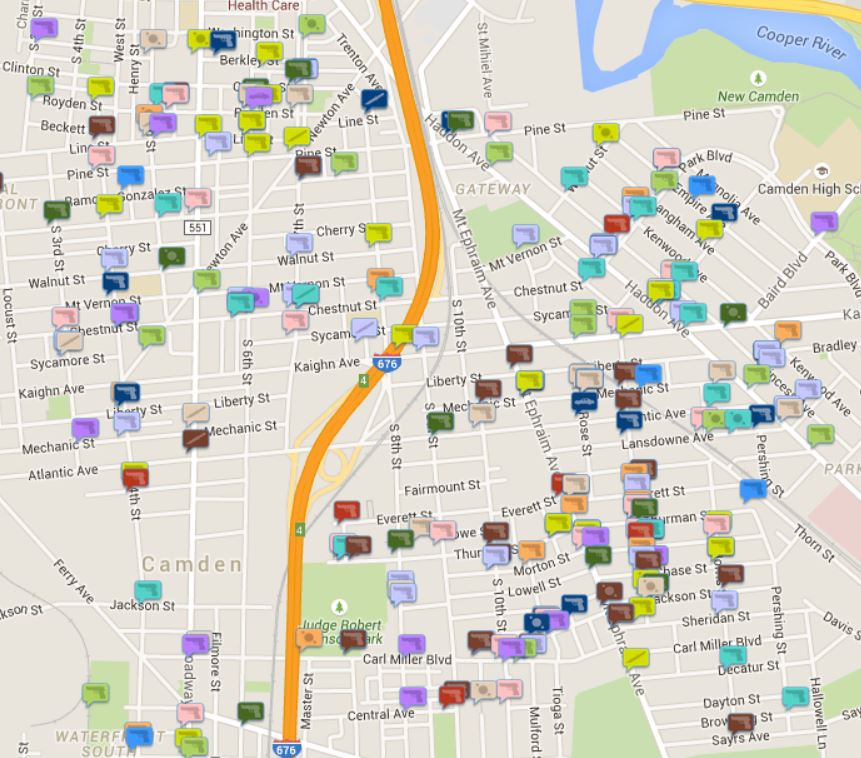
    Let me zoom in on just a few blocks. And these are really small blocks. From top to bottom is half a mile. This whole area is about one-fifth of a square mile.
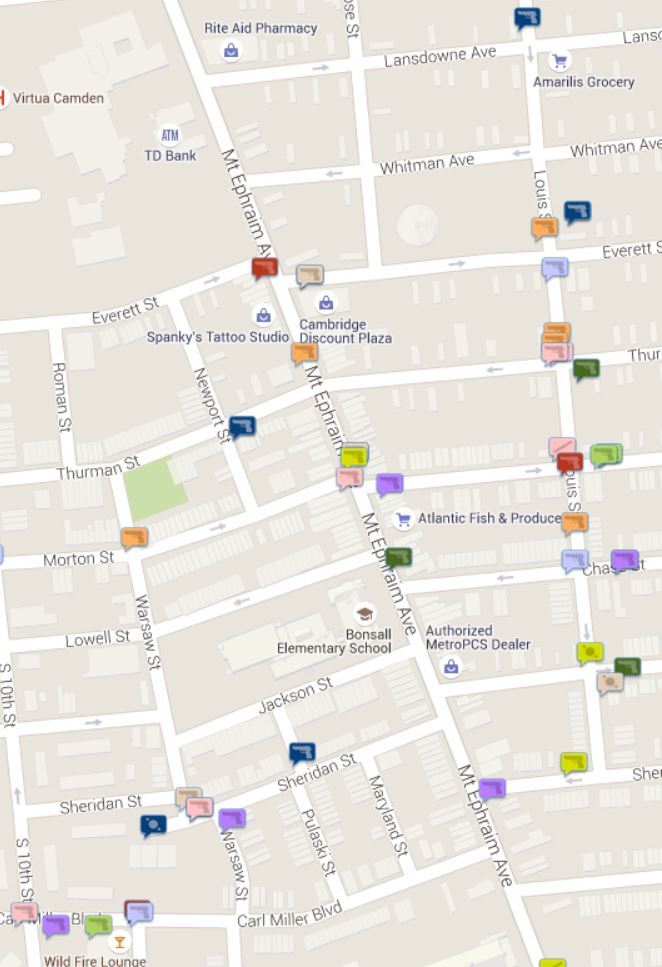
    You might not believe what a small area this is. So here’s google satellite view so you can see individual homes.
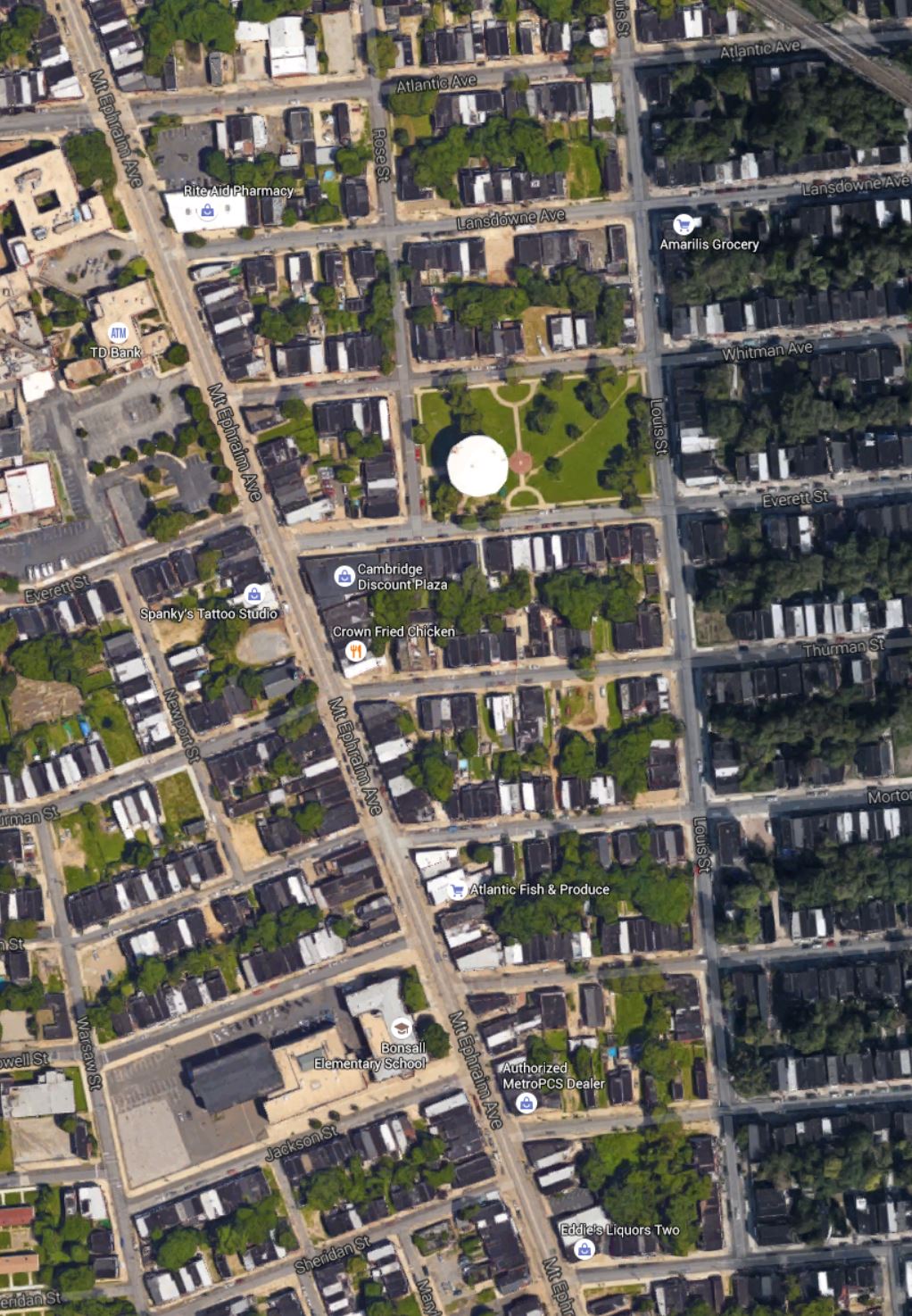
    I want you to see the individual homes. I want you to understand that people are born here, grow up here, live here, and die here. This is America, too.

    Atlantic to Sheridan on Louis Street? 2,000 feet and 20 homicides. How many people even live there? I don’t know. A few hundred? There have been about 24 homicides within a few hundred feet of Bonsall Elementary School. Gosh, I wonder why their test scores are slightly below average? Must be the “soft bigotry low expectations.”
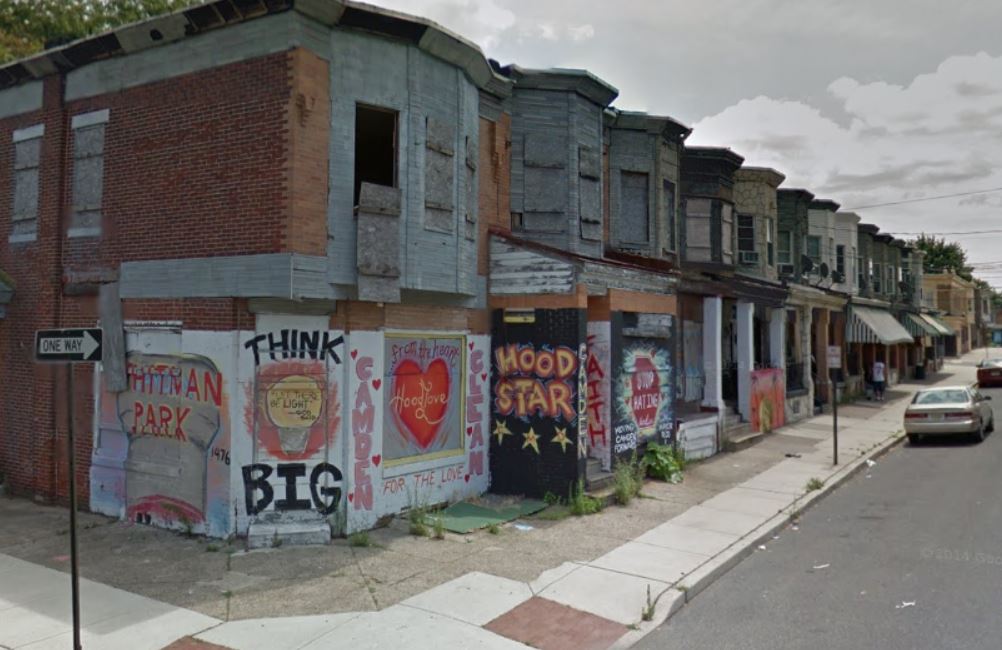
    In Camden there’s hardly a corner where somebody hasn’t been murdered. And #BlackLivesMatter says murder at the hands of police is the biggest problem? Get real.

    Let’s talk black lives. Let’s talk War on Drugs. Let’s talk mass incarceration. Let’s talk racism and a whole class of people left behind by a free market and political system that couldn’t give a damn. Let’s talk good policing. Let’s talk police abuse. But you can’t demand intellectual acquiescence as a precondition.

    As to police in Camden? I got no clue. Let me know what’s going on. But more importantly, tell me how we’re going to make things better?

    Updated homicide numbers

    2018: 22

    2017: 23

    2016: 44

    2015: 32

    2014: 33

    2013: 57

    2012: 67

    2011: 52

    2010: 39

    2009: 35

    2008: 53

    2007: 45

    2006: 33

    2005: 35

    2004: 49
  • Cue happy riot montage scene!

    Apparently — and I didn’t know this — Baltimore is actually a role model for other cities in how to control civil unrest.

    Baltimore Mayor Stephanie Rawlings-Blake didn’t exactly jump the shark right here. She jumped the shark a long time ago. But this is becoming insane. She actual said this:

    And while you say it’s under negative scrutiny, when I go around the country and I look at the fact that other cities have burnt for weeks — Baltimore itself burnt for weeks during the riots of 1968 — we were able to control the unrest and riots to a few hours on one day. There are a lot of cities right now that would love to have that record.

    And just which cities are those, Ms. Mayor? Madam Mayor is perhaps crazy (does she even believe what she says?). She is certainly incompetent. She is also dead wrong.

    At the latest, the riots began at 4:44pm on April 27 when the Rite Aid on North Avenue was looted and then set on fire. So, by her logic, everything was basically OK after a few hours. A record a lot of cities would “love to have”! What’s a few? Four or five hours? So can we can still catch a late show at the Senator Theater?

    The riots were not over by midnight. The city called down in the early morning hours. The riots weren’t really even over the next day. The national guard left and the curfew was lifted on May 3rd.