Copinthehood.com has moved to qualitypolicing.com

  • More on state differences in cops shooting people

    Inspired by some twitter threads — mostly this onewith Gary Cordner and this onewith Andrew Wheeler — I thought I’d look more at the cops getting killed as a factor in cops killing people.

    I like presenting this stage of research. In part because coming up with ideas and hypotheses and basic number crunching is what I like doing most. (I’ll leave the journal article submitted and advanced stats to others.) I’ll explain my steps partly to help others, but also to help me go through this on the old assumption that if you can’t explain it to others clearly, you don’t really understand it yourself. (I used Excel and PSPP.)

    I’m always partial to fewer better-data over more bad-data. So, as I often do, I’d like to stick with good old murder: officers shot and killed on duty (from the officer down memorial page, which over the years I’ve found close to faultless, which is more than one can say for the UCR or anything else.)

    The problem (from a statistical not a moral sense) is that there are many states in which very few officers are killed. So I went back to gather 20 years of data (for no particular reason, just a choice, it could have been 10 or 30) and got the number of officers killed between 1999 and 2018, by gunfire, for each state. 50 states. 990 total deaths. I dropped the states where n < 10. That leaves 33 states. Texas and California top the list, which isn’t surprising because they’re big states. But then come Georgia, Florida, and Louisiana. Interesting…

    But what’s the best denominator? I mean obviously one needs to look at population to get a rate. But which population? In order, I’m going to consider 1) number of cops, 2) population levels, and 3) violent crime levels, 4) population density, and 5) percent of population that is African American.

    1) Perhaps we should look at cops killed in terms of how many cops there are in any given state, so as to consider the chance of any given cop being killed on duty. Makes sense to me, the problem is that the official data even on how many cops there are looks dodgy. It seems unlikely to me, for instance, that Mississippi went from 5,222 cops in 2007 to 2,524 in 2014 (the two years anybody attempted to count, but reporting is voluntary). If I don’t trust the data, I don’t want to use it. But I still did the numbers, based on the average between 2007 sworn officers and 2014 sworn officers.

    For presentation purposes, let’s use the USA average (using all 50 states) as a baseline, set that to 0, and compare all the states:
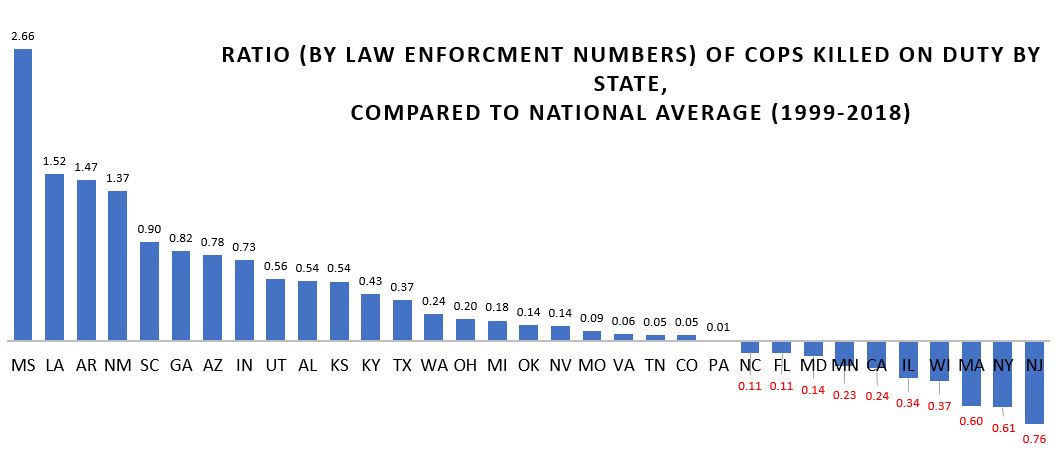
    Cops are more likely to be killed in MS, LA, AR NM, SC, GA, and AZ. Keep in mind the small and safe states have been removed from the calculation. I don’t like this. If nothing else because I don’t trust the Mississippi numbers.

    2) So let’s just use overall population as the denominator. I’m using 2016 population because that’s what I already have in my file. Some states have grown a lot in the past 20 years. Oh, well. I don’t think it matters that much for these purposes. If it does, we can consider it later. Keep in mind these are ratios, the actual numbers by themselves are meaningless. But as a ratio, yes, a value of 1 means a cop is twice as likely to be killed per capita. It does appear that a cop in Louisiana is about 4 times as likely to be shot and killed as a cop in New Jersey.
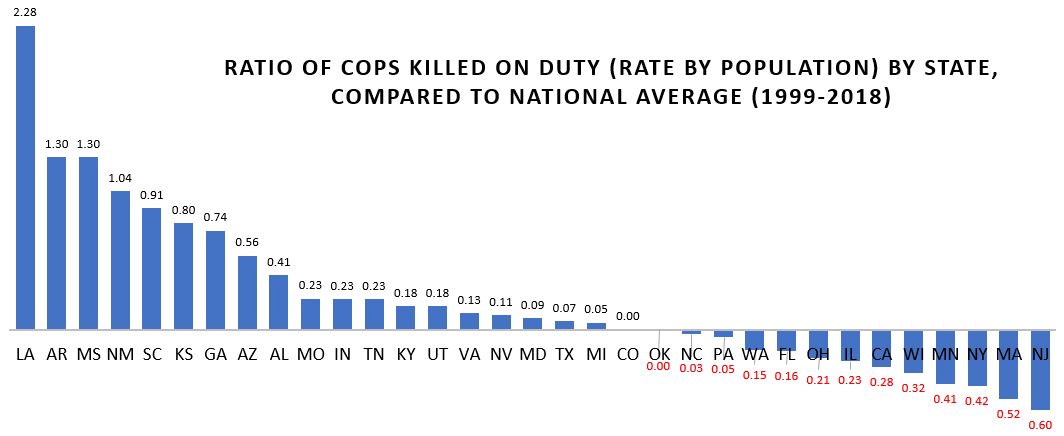
    This says that Louisiana, by far, is the most dangerous state to police in. Arizona is next. And given that its population has grown drastically in the past 20 years, it should really be higher. And that would make LA seem like less of an outlier.

    New Jersey, Massachusetts, and New York are all comparably safe. I won’t say the safest because the 17 safest (and smallest) states have all been dropped for the statistical reason of having fewer than 10 cops murdered over the past 20 years.

    I think number 2 (population) is better than number 1 (number of cops). But they’re not drastically different. You get the same states on top and the same states on bottom. But I’m going with state population as the denominator because I don’t trust the count of cops.

    3) Now let’s consider violent crime as an independent variable (which is the variable that affects something else, on which something else is dependent). And back to using all 50 states.

    I just got some crude numbers off wikipedia and then took an average of 5 years of data for each state. (Not the best methods, but probably accurate. Certainly fine for preliminary work.)

    Let’s run some correlations. I like correlations because they’re easy to understand. They also tell you where you should look for deeper answers.

    First question: at the state level, is violent crime rate correlated with cops getting killed? Absolutely (Pearson Correlation = .62, Sig = .000). This is a strong and unsurprising relationship.

    Next, at the state level, is violent crime correlated with being killed by cops? Surprisingly, technically, statistically, no. (correlation = .23 sig = .104) Not at the state level; not with an N of 50. Now I know from other research that violent crime is correlated with being killed by cops, but you’ve have to delve down into the neighborhood level to see that effect. But still, if it that doesn’t come out at the state level, it’s a clue that something else is also at work! This is where things get interesting. Something else is also at play on a state level that is more significant than straight-up levels of violent crime.

    4) What about geographic area? This is where wikipedia is great because you can get state size in seconds. And then if you already have population and you’re handy with cut-and-paste and sorting on spreadsheets, you can get population density in minutes.

    And it turns out the population density is indeed correlated with a lot.

    Lack of density — more space — is correlated with being more likely to be killed by cops. Think of what this means. Common sense tells you it’s not a view of “big sky country” that makes cops shoot someone. Whatever really matters, is correlated to density (or lack thereof). Maybe it’s single person patrol. Or the time for backup to arrive. Or meth labs. Or gun culture. This is why they say “correlation doesn’t equal causation” (which is also the most frustrating phrases in social science, because correlation can very much indicate causality, and the phrase is often used to dismiss meaningful correlations as meaningless.)

    Population density (lack thereof) is also correlated with cops being killed. Density is not at all correlated with crime (like not even leaning in one direction). And yet both crime and density are heavily correlated with a lot of other factors. And both are correlated with cops being killed. More crime = more cops killed; more density = fewer cops being killed.

    So now lets do a brief multivariate analysis, which is about as far as I go. This means that we look at more than variable at the same time. Which is more important (plays a greater role) in cops being shot and cops shooting people? Crime or density? (Or something else.)

    Density seems to be more predictive than crime in terms of cops killing people and less important in terms of cops being killed (though for the latter both are correlated).

    When I move “cops killed” to the independent variable side and keep a focus on people killed by cops, density becomes less important and violent crime becomes more important. This makes intuitive sense. Because the issue with a spread out area is that cop, alone, would face greater threats.

    Keep in mind the above is about cops being killed. Much more talked about (by non cops) is people killed by cops. I wrote about that a few days ago.
    If you’re still with me, kudos. Causes here’s where the whammo happens!

    Were one to only look at individual variables, the key would seem to be density followed by crime and rate at which cops are killed. But it turns out that much of what is measured in those variables are simply correlated with and less important than the percentage of black population in a state. Crime matters. Police being killed matters (independently of violent crime), population density may matter a little, and of course other variables that I’m not even looking probably matter a lot. The question is always if they can be identified and accurately quantified.

    Last year I observed that cops shoot more often in states that have fewer blacks. So I already had a strong hunch to look in this direction.

    When one puts the state’s percentage of African-American residents into the equation, things start to fall into place. This is also taking into account how often cops get shot, crime, and density (which finally starts to lessen in importance — because as we know is only indicative of other factors — but still probably important in terms of gun laws and culture and police-backup).

    If one considers crime, density, and black percentage — but only when one does so all together — all three are significant (with an R-squared of .55). When one adds the rate at which cops are killed, r-squared goes up to .62.

    [R-squared is technically the distance (squared to take account of negative numbers) that data points are from the trend line of a chart. At some level, r-squared is supposed to indicate how much of what is being looked at is explained by the independent variables in the statistical regression. But that’s more in a statistical sense than a real-world sense. Still, generally, other things being equal, a high r-squared is better than a low r-squared. And an r-squared of 0.63 ain’t shabby for this kind of game.]
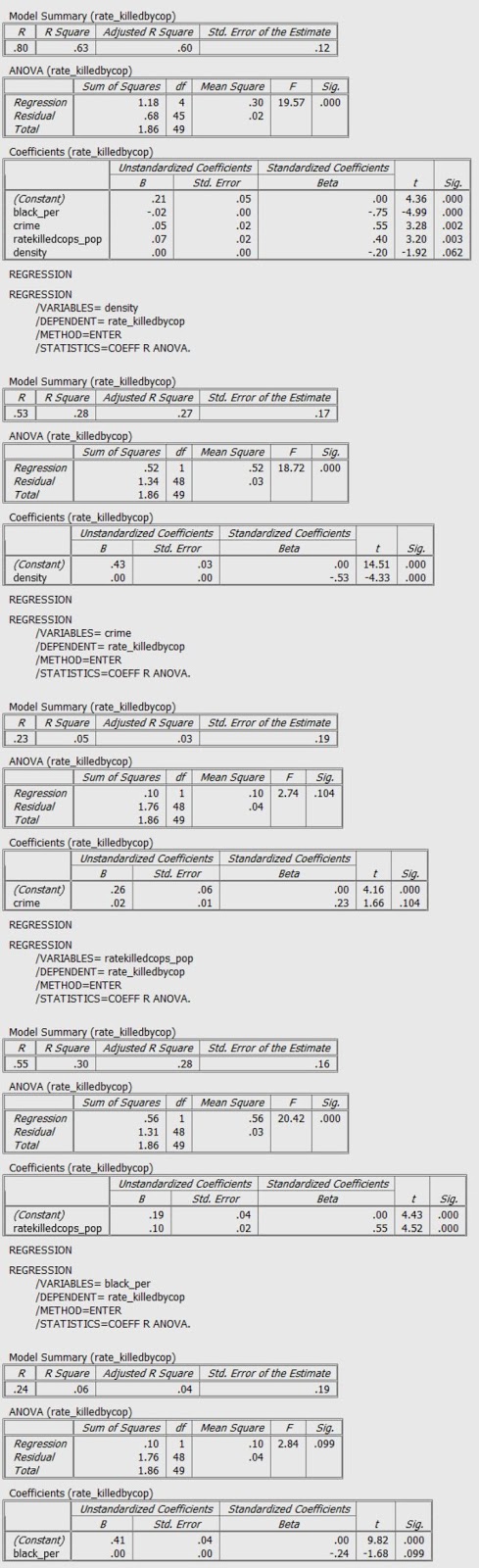
    So what does all this mean? Density matters, but not so much for what it is but for things correlated with it (same could be said for race). All these variables have “intervening variables,” the way people act, the choices they make, the factors that make us do what we do. Things that may be harder to measure than crude indicators like “population density” and “race.”

    Still, looking a these variables, density seems mostly to correlate with the lack of African-American in a state. The black percentage of a state seems to be the most significant factor in determining how many people are shot and killed by police (with overall violence and cops being killed also being important). But, contrary to what many people believe — and basically all of the “narrative” of the past few years — the relationship is inverse. The greater the percentage of blacks in a state, the less likely cops are to shoot and kill people.

    This is counter-intuitive to a lot of people, particularly if you think cops only shoot black people. But it makes perfect sense if one thinks about it in two parts:

    1) Whites don’t really care about who police shoot; period; end of story. And without the pressure over bad (or even good) police-involved shootings, cops never learn how to shoot less. Other things being equal, cops simply shoot more people if there isn’t any push-back from (to over-generalize) blacks and liberals and media and anti-police protesters. Call it the Al Sharpton Effect, if you will. Basically, in many places, police organization and culture do need to be pressured into changing for the better.

    2) Police can be recruited, trained, and taught to less often use legally justifiable but not-needed lethal force less. The state variations in police use of lethal force are huge. Some states (and particularly jurisdictions within states) do it better than others. Instead of saying “police are the problem” we could look at the states and cities and department that are doing it better and learn.

    Ultimately what we need are well and better trained police officers who shoot less often, but still shoot when needed.

    I’ll leave you one final bit of data. I don’t know if there’s a there here or not. My guess is this does matter. But maybe it’s just a clue that leads to the above. Or maybe it’s something else. Maybe you can figure it out.
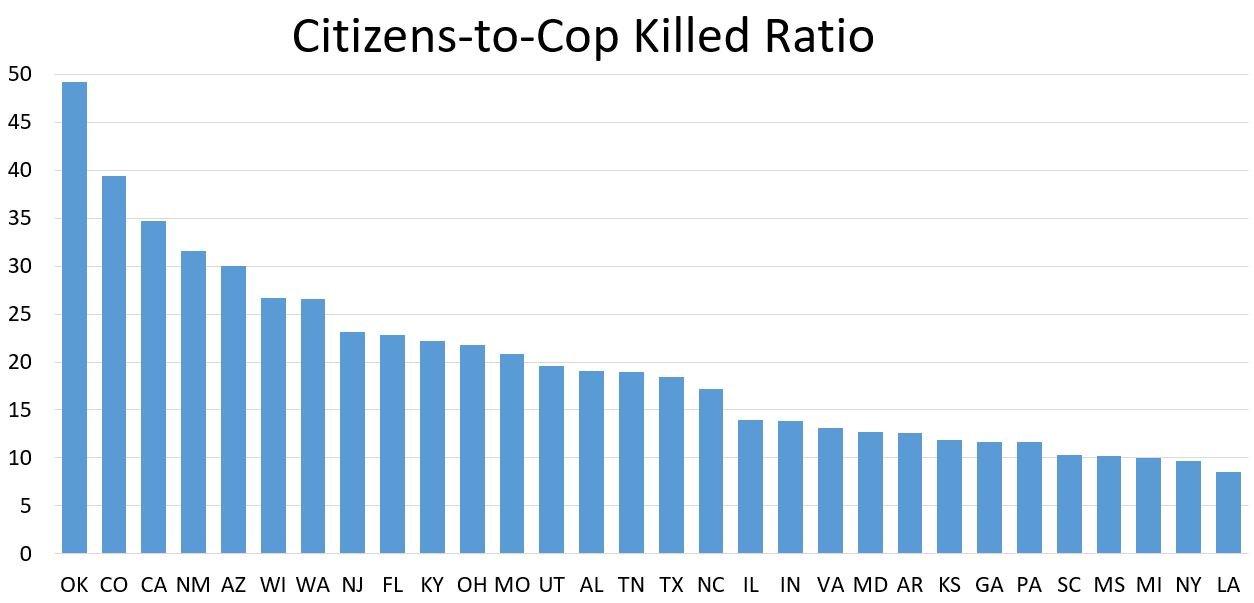
    This is a table that shows a simple ratio: the number of citizens killed for each cop killed. Good people can debate what this ratio should be. I don’t want to go there. The correct ratio is no cops getting killed and few criminals getting killed. But what’s interesting to me is the that there is such a large difference between the states, and by a factor of 10! By and large the states on the high-end (more citizens getting killed) are very white and the states on the low-end (fewer citizens getting killed) are disproportionately black.

    Take Oklahoma. Cops in Oklahoma are not getting killed a lot, per capita or per number (0.6 per year over the past 20 years). There’s not a lot of violent crime, and yet in the past 4 years cops in Oklahoma have killed 118 people. Again, I don’t want to get into what the correct ratio is, but seeing how the national average is 20 civilians-to-cops shot and killed, and seeing how some states are down under 10, why the hell is Oklahoma pushing 50?

    Louisiana cops are getting shot at and killed three-times more often than cops in Oklahoma (and 8 times more often than cops in New Jersey). Both Oklahoma and Louisiana cops shoot a lot of people. But in Louisiana, dare I say, they have good reason to.
  • Pushing the Ideological Narrative

    Pushing the Ideological Narrative

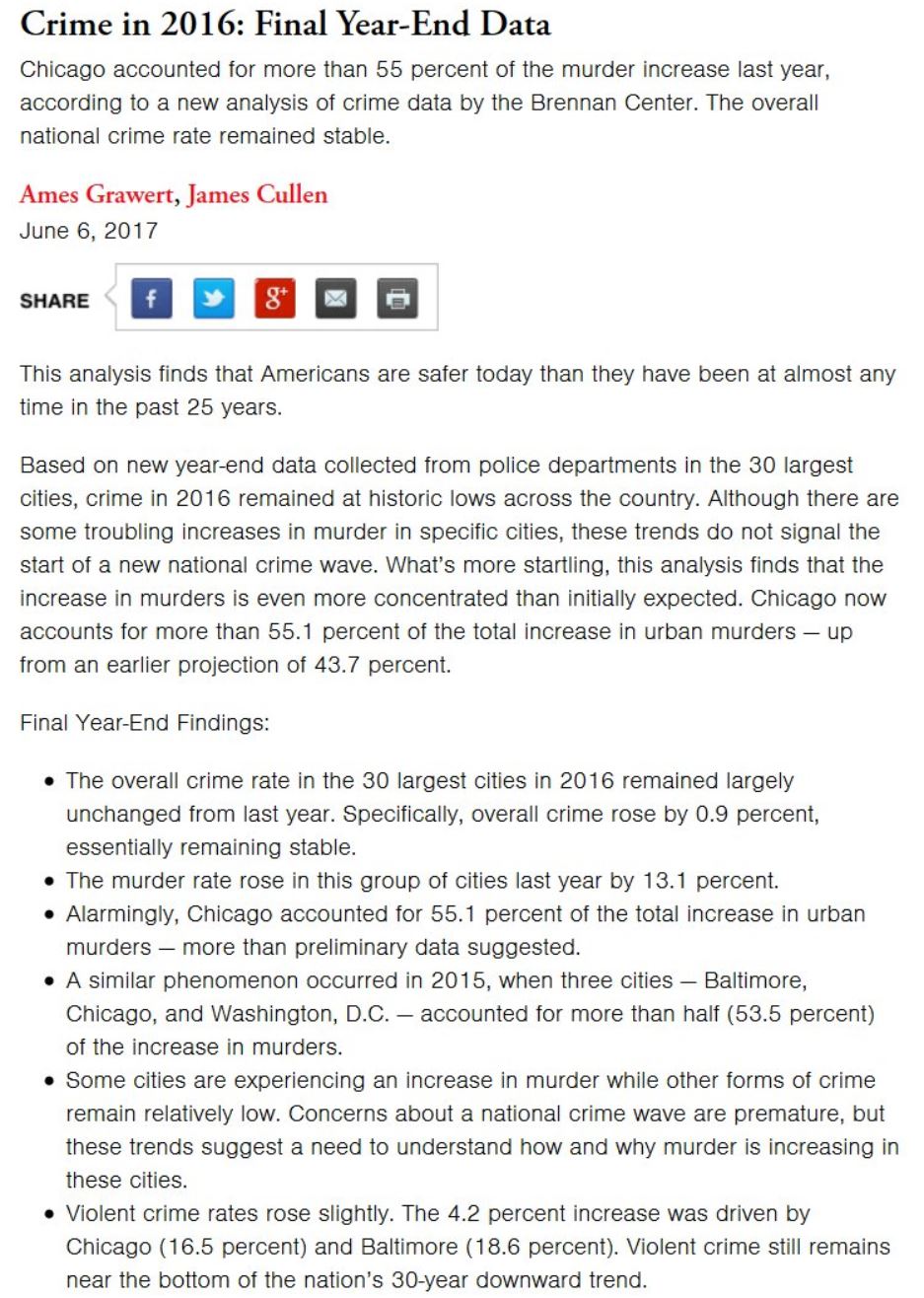
    I updated the Brennan Center’s crime report from 2016, to update it for 2018. I still have this urge to show how goofy their methods are. Why? Because, the authors are still cited by reputable journalists as experts, despite never acknowledging or correcting their past efforts to intentionally mislead journalists and the public. It’s advocacy data-analysis. It’s unethical, wrong, and harmful to the cause of truth.

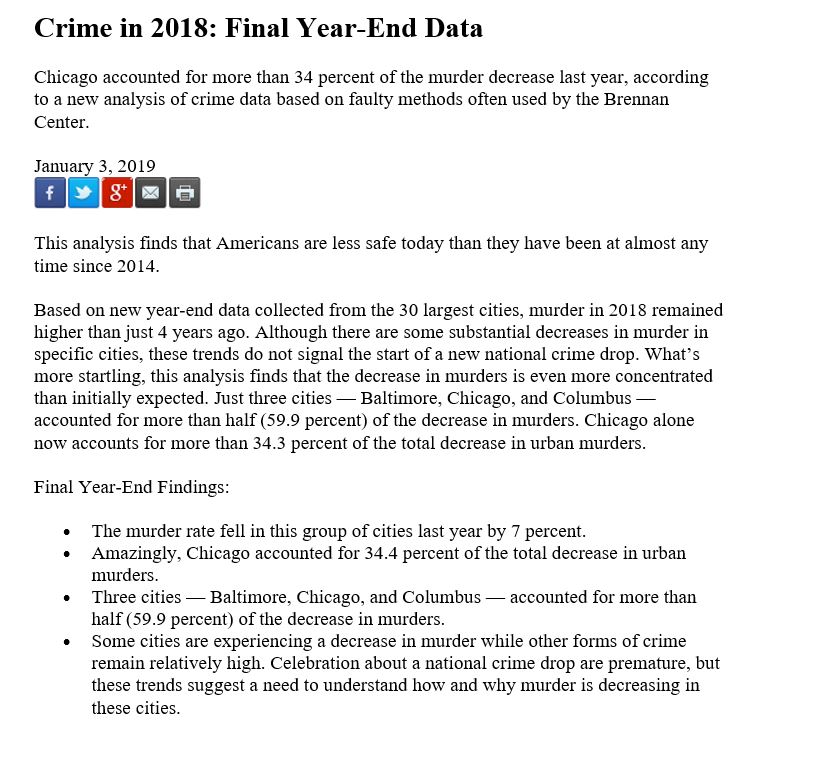
    Here’s my parody of the Brennan Center style, adopted for 2019. The numbers I use are actually accurate, based on the best available city-data. The logic and conclusions and push, however, are just as absurd.

    Crime in 2018: Final Year-End Data

    Chicago accounted for more than 34 percent of the murder decrease last year, according to a new analysis of crime data based on faulty methods often used by the Brennan Center.

    January 4, 2019

    This analysis finds that Americans are less safe today than they have been at almost any time since 2014.

    Based on new year-end data collected from the 30 largest cities, murder in 2018 remained higher than just 4 years ago. Although there are some substantial decreases in murder in specific cities, these trends do not signal the start of a new national crime drop. What’s more startling, this analysis finds that the decrease in murders is even more concentrated than initially expected. Just three cities — Baltimore, Chicago, and Columbus — accounted for more than half (59.9 percent) of the decrease in murders. Chicago alone now accounts for more than 34.3 percent of the total decrease in urban murders.

    Final Year-End Findings:

    • The murder rate fell in this group of cities last year by 7 percent.

    • Amazingly, Chicago accounted for 34.4 percent of the total decrease in urban murders.

    • Three cities — Baltimore, Chicago, and Columbus — accounted for more than half (59.9 percent) of the decrease in murders.

    • Some cities are experiencing a decrease in murder while other forms of crime remain relatively high. Celebration about a national crime drop are premature, but these trends suggest a need to understand how and why murder is decreasing in these cities.

    Highlights of this style (faulty logic obscured by dressed-to-impress layout, footnotes, and statistical concepts).

    1) The murder rate fell in this group of cities last year by 7 percent.

    * “In this group of cities” added only when called out. http://www.copinthehood.com/2017/07/two-year-increase-in-homicide.html

    2) Amazingly, Chicago accounted for 34.4 percent of the total decrease in urban murders.

    *Note: this simply is not true. But is a reflection of only looking at a number cities.

    3) Three cities — Baltimore, Chicago, and Columbus — accounted for more than half (59.9 percent) of the decrease in murders.

    *This is true when one includes the caveat “of the sample used.” And if one includes this caveat, the statement is statistically worthless.

    4) Celebration about a national crime drop are premature — America remains much more violent than just 4 years ago — but these trends suggest a need to understand how and why murder is decreasing in these cities.

    *If you cherry pick the baseline year, you can say anything!

    One lesson is always be suspicious of data presentation. Is somebody pissing on your leg and saying it’s raining? Trust your gut or your “lying eyes.” When crime is up and people say it’s not, be wary. But use the same vigilance when crime is down and people say “be afraid!”

    Know your source, if possible. Assuming people aren’t just making numbers up, see when people use one form of logic when data go one way, but sing another tune when the same data go in the opposite direction. (Could be crime, the stock market, gas prices, etc.)

    Luckily, murder really was down in 2018. I wouldn’t want to waste your time pretending otherwise.

  • State variation in police-involved shootings

    State variation in police-involved shootings

    Welcome to 2019!

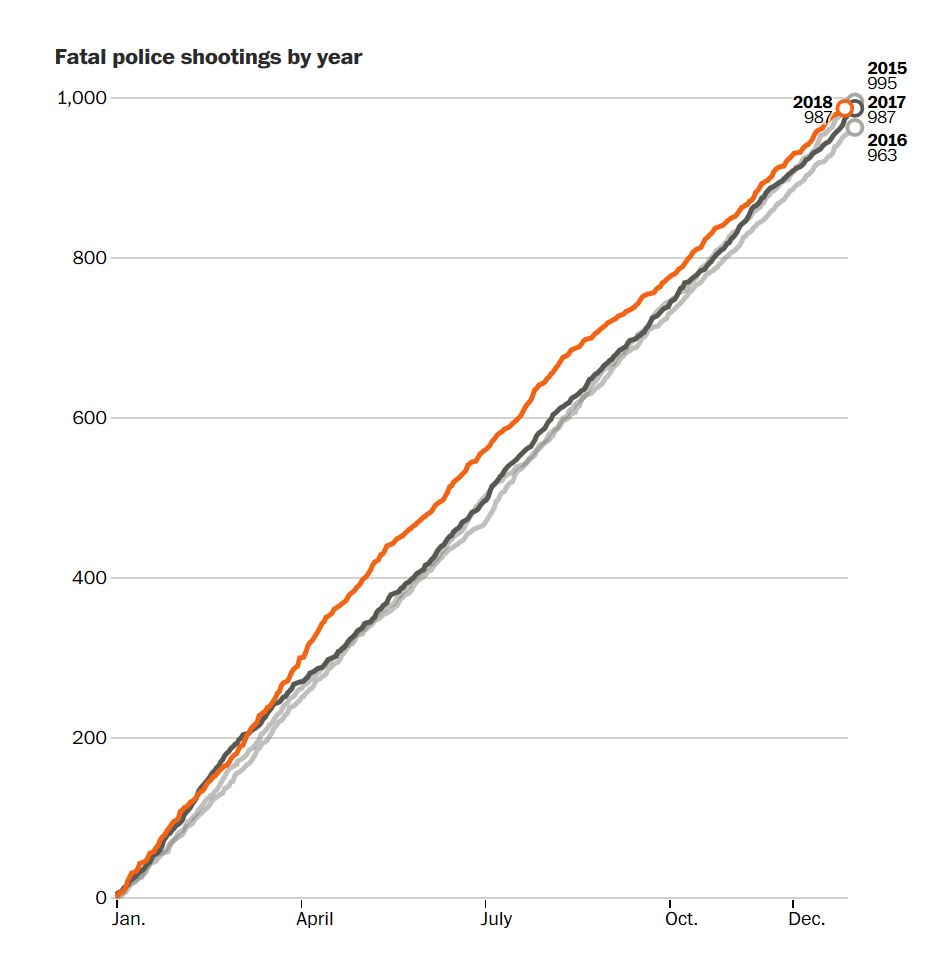
    I’ve compiled the past four years of Washington Post data on those shot and killed by police. Four years gives us a reasonable amount of data. The first thing that jumps out is that the number of people killed by police has remained strikingly constant each and every year for which we have data (from the Washington Post).

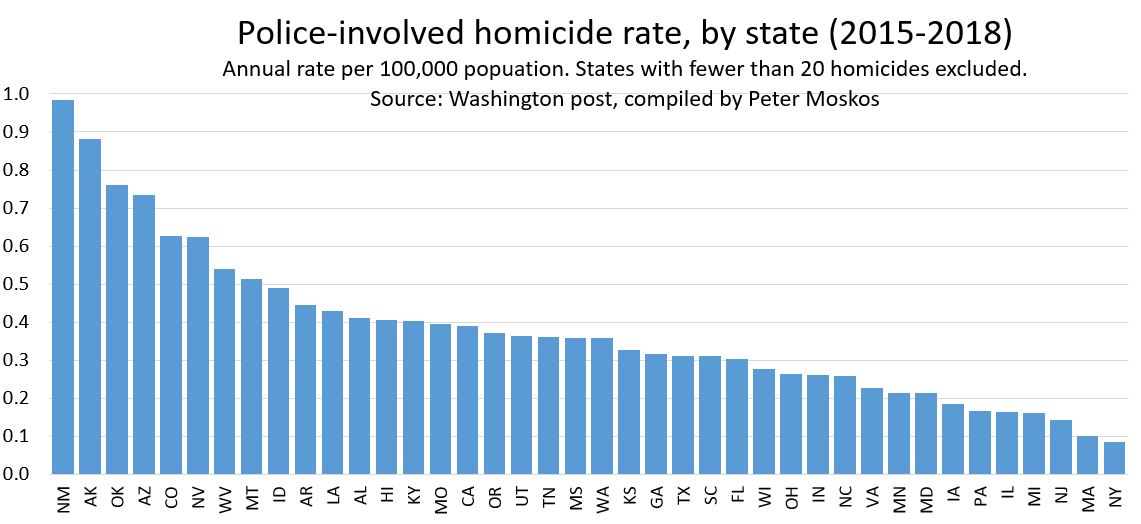
    The other thing that continues to jump out (I’ve written about this before) is the state-by-state variation.

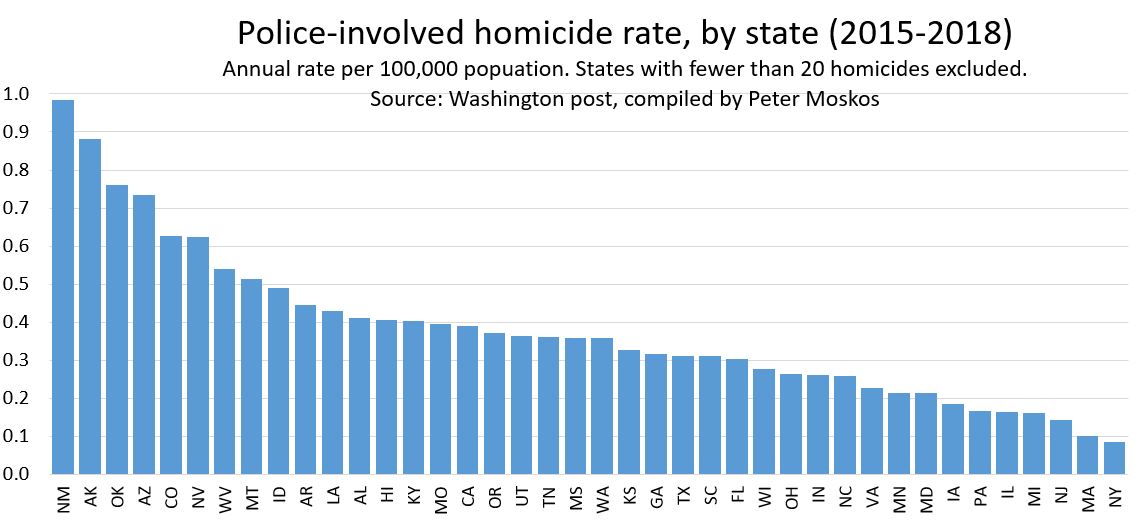
    The national annual average (2015-2018) is 0.31 (rate per 100,000). And yet New Mexico is 0.98 and New York is 0.09. This is a large difference.

    Or take Utah (because of this story in the paper). Utah has a murder and violence rate below the national average, a low poverty rate, and is 90 percent white. And yet people in Utah are almost 5 times as likely an in New York to be killed by a cop. Utah has murder rate lower than NYC, 1/5 the poverty rate, far fewer cops, and Utah is 90% white. In 2018, the rate of people shot and killed by police in Utah is multiple times higher than NYC.

    In all states (except small states in which n = 0) blacks are more likely than whites to be shot and killed. But states that have less police-involved shootings overall have greater racial disparity. But a  black man in Virginia or New York or Pennsylvania is still far less
    likely to be shot and killed by police than a even white man in Utah,
    Oklahoma, or Wyoming.

    I’d speculate significant variables are (in no particular order) training, fewer cops per capita, fewer cops per mile (no backup), one-person patrol, more guns, gun culture, more meth, more booze, and race (with more white states having more police-involved shootings).

    The ten leading states — as in cops-most-shootingest states — in rank order, are New Mexico, Alaska, Oklahoma, Arizona, Colorado, Nevada, Wyoming, West Virginia, Montana, and Idaho. It certainly seems like if we were to focus on the states that have the highest rates of police-involved shootings (and by far), we could find some low-hanging fruit to reduce the number of said shootings. But to do this we’d have stop thinking of police-involved shootings as primarily related to race.

    Collectively the top-10 (where cops kill most) states are 4.9 percent African American (compared to 13 percent nationally). These are the cowboy states out west. The 10 states with the highest percentage of black population (collectively 25%) have a rate of police-involved homicide (0.24) that is below the national average.

    All this said, the really large differences are found at the local level. Albuquerque, Bakersfield, Tulsa, and Salt Lake City all have rates above 10 per 100,000. New York City’s is less than 1.0. But that’s for another time.

    Update: later post from July 2020 http://www.copinthehood.com/2020/07/05/variations-in-police-involved-shootings-by-city-and-county/

    Update: 2020 caveat.

  • Progressive Misbelief

    For well over a century, “progressives” have a proud tradition of not only exposing what is best for other people (often correctly, I might add) but also thinking they know what other people believe (often incorrectly). There’s a paternalism inherent to the progressive movement that can come awfully close to racism (or at least a white-savior complex) when it comes to policies that impact non-white people.

    A recent article points out how white liberals (of which I count myself) have, on issues of race, moved to the left of black Americans.

    If you, like me, hang around mostly with a liberal white set, you might believe 1) the greatest problem in poor black neighborhoods is the risk of being shot by police; 2) crime is down everywhere; 3) black neighborhoods are over-policed and 4) any attempt to apply policing solutions to neighborhood problems of crime, violence, and fear is part of a right-wing plot to throw more blacks in prison. There are other crazy things I hear as well, like, for instance, proven crime-reduction strategies — take hot spots policing and Broken Windows (minus the zero-tolerance) — are racist because they disproportionately impacted African Americans.

    I’ve seen this for a while now on issues of policing issues, and it frustrates me to no end. Everybody is entitled to their own opinion, but white liberals and “progressives,” particularly the woke set, seem to have a certain fondness for thinking they know what other people should believe. That is a privilege you should check.

    So if, like me, you read the New York Times and listen to NPR, here are some things that might surprise you:

    • Blacks want more police presence more than whites want more police presence. Only 10% of blacks want less police presence. Read that again, if you have to. I remember having a discussion about this fact with a nice editor at a major national magazine. At first she simply didn’t believe it. It didn’t fit her worldview nor the view of her (mostly white) coworkers. It didn’t fit the narrative.
    •  Almost 70% of lower-income nonwhites have “confidence in local police.”
    •  Over 70% of Americans feel safe walking alone at night in the area where they live. For very low-income non-whites, it’s just over half. This is on par with residents of Nicaragua and Zimbabwe! Sigh. What a country.

    So if a majority of lower-income blacks feel unsafe and generally want more (and also better!) policing, why do so many of my well-off white liberals friends keep telling me that “their” problem  is over-policing? And yeah, some of my best friends are black. And they tell me they don’t like your paternalistic BS either.

    On Tuesday 11 people were shot in Baltimore. Eleven! In one day. It made the local paper. 6 more yesterday. And perhaps another 4 or 5 today (the day isn’t over). Think of the trauma that comes from this violence. The impact not just on victims but on family, friends, kids, and the entire community. It’s hard to imagine. When I brought this bad day to somebody, the response was responded “there are not jobs.” No shit! But there were no jobs in 2014 before violence doubled. There were no jobs on Monday. There will be no jobs tomorrow. Public order and safe streets are preconditions to fixing society’s greater problems. If you don’t feel safe leaving your house, very little good is going to happen.

    I know there are things police cannot do. But some problems — from squeegee boys right up to murder — can be mitigated and even solved by good policing. And we’ve moved away from that in some of our cities. And that has happened, in part, because people with influence and power — the liberal elite, if you will (a term I do not like because by most definitions I’d be part of it!) — have bought and drunk the Kool-Aid with regards to issues of policing, race, and crime.

  • Van Dyke Guilty in Chicago

    Former Chicago Police Officer Jason Van Dyke was convicted of second-degree murder in the shooting of Laquan McDonald. This isn’t surprising. I think Van Dyke was found guilty because, get this, he was.

    I wrote this in 2015:

    The video is out. Finally. After long attempts to sweep it under the rugfailed.

    It’s a bad shooting…. The officer who killed McDonald fits the pattern of bad cops: high activity, drug work, too many complaints. Sure, all the complaints weren’t justified, but some of them were. And undoubtedly he did a lot of bad shit that people didn’t file formal complaints about.

    Now of course I know that in a court of law anything Van Dyke did in the past is irrelevant to his guilt or innocence is this criminal case. Whether he was a “bad” cop or not is irrelevant and inadmissible in a court of law. But I’m mentioning it because I’m not a court of law.

    And second-degree murder seems correct. It meets these conditions:

    Intended to kill or do great bodily harm to that individual (or knew that the act would do so); or

    Knows that the acts create a strong probability of causing death or great bodily harm to the individual.

    Combined with this mitigating factor:

    At the time of the killing, he/she believed that the killing would have been lawfully justified but the belief was unreasonable.

    Van Dyke had options not limited to A) doing nothing, B) not shooting, and C) not continuing to pump rounds into McDonald after McDonald was down. As judged by this former police officer, I say Van Dyke was not reasonable.

  • Why they carry illegal guns in Chicago

    There an interesting studyby the Urban Institute on young men carrying guns in Chicago. This has already been misrepresented in the Chicago Sun-Timesas “1 in 3 young people surveyed in four Chicago neighborhoods say they carry a gun.” Factually true… but meaningless because they’re trying to survey people who carry a gun. 100% is the goal. It’s not trying to be a representative sample (even of a high violence neighborhood) or figure out how many people carry illegal guns. Rather, they tried to figure out why people carry guns (and what will make them less likely to do so).

    Not surprisingly, most people who carry a gun illegally do not do so all the time. Of gun carriers (n = 97), 7% say they always carry; 16% say they often do; 32% say sometimes; 45% rarely. Most who carry say they do so “for protection,” which also isn’t surprising. (What is surprising is the 6 people who said they carry a gun to commit crime.) Fear is real. So is the chance of being shot. So either we work to arm everybody who is afraid, or — better — we deescalate the streets and work to reduce fear by reducing violence and number of people carrying illegal guns.

    Of those who carry a gun, 37% say they have been the victim of a shooting or attempted shooting in past year. 85% know somebody who has. That figure is important and perhaps not well known enough. Instead of complaining when certain politicians call Chicago a disaster or a war torn — “oh, it’s not all neighborhoods,” say some — perhaps we should focus on making sure some neighborhoods aren’t so lethal!

    Most respondents say it’s easy to get a gun, and they could get one in a few hours from a street dealer, a friend or family member, or steal a gun. 84% of gun carriers say they’re not likely to get caught carrying. That percentage is lower (by a little) for those who don’t carry. Still, this indicates some potential for a deterrent effect.

    The sample of those who have illegally carried a gun is, not surprisingly, not pro-police. 75% of those who have carried say police have stopped them “for no good reason.” This in kind of ironic, since illegal gun carriers are exactly whom we want police to stop.

    And there’s an odd bit of data presentation. Either they’re not being great at the stats game or are trying to mislead. I think it’s the former. Two groups are compared over and over again: “those who have carried” and “entire sample.” But why include the first group in the 2nd group and then compare differences? Separate them. Also, “entire” implies it’s representative of something, but it’s not. It’s a non-random targeted sample.

    The groups are easy to separate. Or at least I did so based on their figure 9. And when I did so, for instance, 71% of the sample says police “often stop people for no good reason.” But of those who don’t carry guns, that figure goes down to 60%. Even for this sample, it’s surprising to me that of those who don’t carry, as many as 40% cannot agree with the statement “police stop people for no good reason.”

    I would like to see a sample in the same neighborhood of those who have nothing to do with carrying illegal guns or those who do. What are their opinions of police? That’s the group I would care about, in terms of police legitimacy.

    Do tell us what illegal-gun carriers think of police. But criminals aren’t supposed to like the police. And as this is an intentionally non-random sample, the part of the sample that doesn’t carry (or says they don’t) is an odd group from which one should not generalize.

    Their attitudes on police will be used to question police “legitimacy,” but that seems like abit of a distraction. The carriers of guns say they are carrying because of fear of victimization. More violence decreases legitimacy. Fewer stops by the Chicago Police Department haven’t increased legitimacy. And after having a “well paid job,” the top 5 leading preventative factors, according to those who carry illegal guns, are “none of their friends did,” “knew they would be arrested,” “more police on the street,” “guns cost more,” and “knew they would end up doing time.”

    To me those are all clues. I do want to know why gun carriers carry guns. And I also want to know what those don’t carry avoid doing so. The study concludes by stressing non-police “holistic” solutions “outside the criminal justice system” (which are no doubt needed). But based on gun-carrying respondents, four of the top six solutions involve police.

    Fear of getting caught can give people an out, a good excuse to not carrying a gun. Even though people don’t want to admit it, arrest, prosecution, legal stops, and legal frisks are *part* of the solution. And while others get holistic, police can focus on the police side. Police can reduce violence by reducing fear by getting people to leave their guns at home. De-policing to reduce encounters in Chicago (and elsewhere) hasn’t worked. “Holistic” needs to include police.

  • NYPD prostitution scandal

    When ever corruption scandals breaks, I always notice two things:

    1) The “blue was of silence” is more fiction than fact. Sure, cops in collusion won’t talk, at first. But that’s hardly a blue wall. I mean, given people’s natural inclination not to snitch on their friends and family, cops snitch on other cops quite regularly. Probably more so than other occupations. Why? A) cops don’t like bad cops, B) when push comes to shove, people CYA and say “I’m not going to risk my pension for that dirty cop I never liked anyway.”

    2) The dollar amount some cops are willing to screw up their lives, their reputations, and their valuable pension. It’s chump change. Lazy cops retire. Bad cops retire. But dirty cops rarely retire because being able to rat out a dirty cop is a great get-out-of-jail-free card. And that card is something other crooks find very useful. I mean, just put in 20 to 25 years and they pay you for the rest of life! And you screw it all for $100 here and $200 there?

    But here we go, as reported in the Times: “One detective was allowed to pay $20 for an encounter with a prostitute that would normally cost $40.” A cop gave his all for $20 off a blow job.

    This was a “multi-year NYPD investigation” started by a top from a cop. But a multi-year NYPD investigation means there are a lot of well crossed T’s and beautifully dotted I’s.

    Last I heard, 7 cops and about 20 civilians were arrested.

    It’s also interesting when internal PD investigation brings down dirty cops. Cops are like, “Great, system finally worked! Stupid dirty cops got what they had coming.” Cop-sceptics are like, “Blue Wall of Silence is proof police are irrevocable corrupt!”

    Also, for police and sex-workers alike, prostitution should be regulated and legal.

  • Michael Wood Jr. took money from veterans

    Michael Wood Jr. took money from veterans

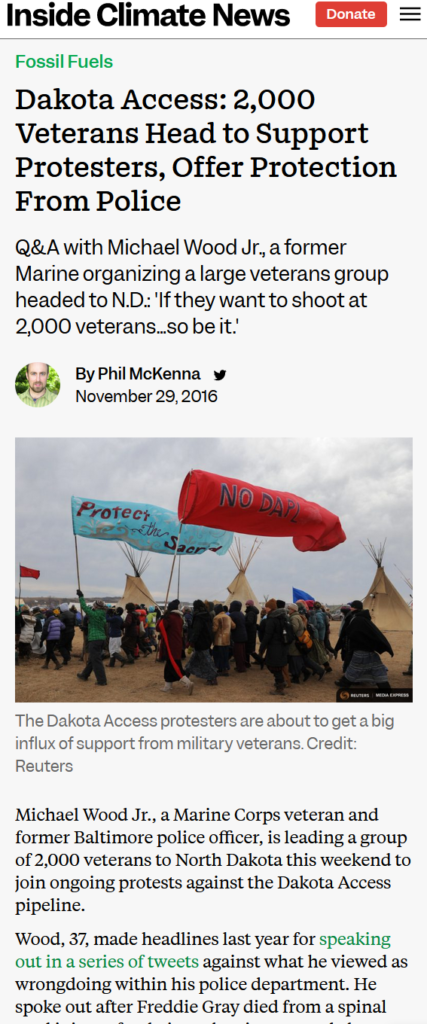
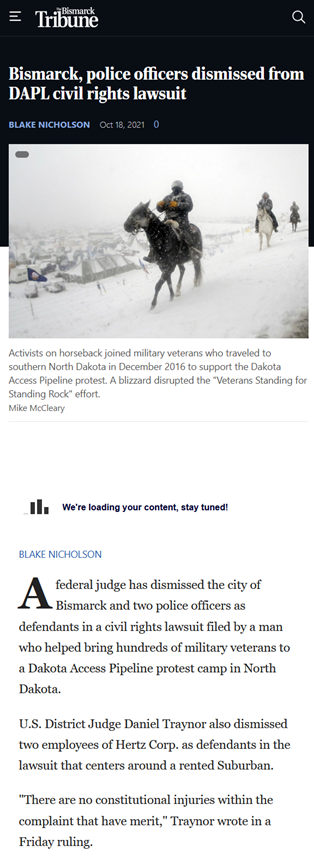
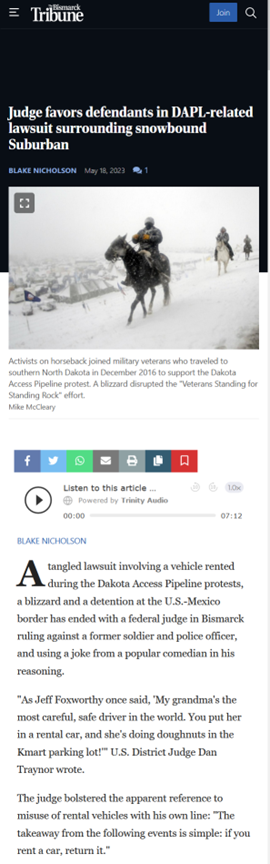
    Michael Wood Jr, a former Baltimore cop, confessed many of his sins a few year ago. Because of that, he became a darling of the anti-cop left who mistook his confessing for whistle blowing. Pretty much everybody who ever worked with the guy has stories about him, and not favorable ones. I never met the guy, but I think he saw me as his nemesis. Anyway, he got his when he was shut down by the #MeToo movement and also by the fact he took a bunch of money from veterans. And pocketed the cash. He’s not a force for good, no matter how much he says about how horrible police are. Mostly he just looks in the mirror.

    I’ve written about him before. Pulled a few punches, honestly.

    Update…. How it started:

    How it went:

    How it went some more:

    And in the Lakota Times.

    How it’s going:

  • Every four or five years…

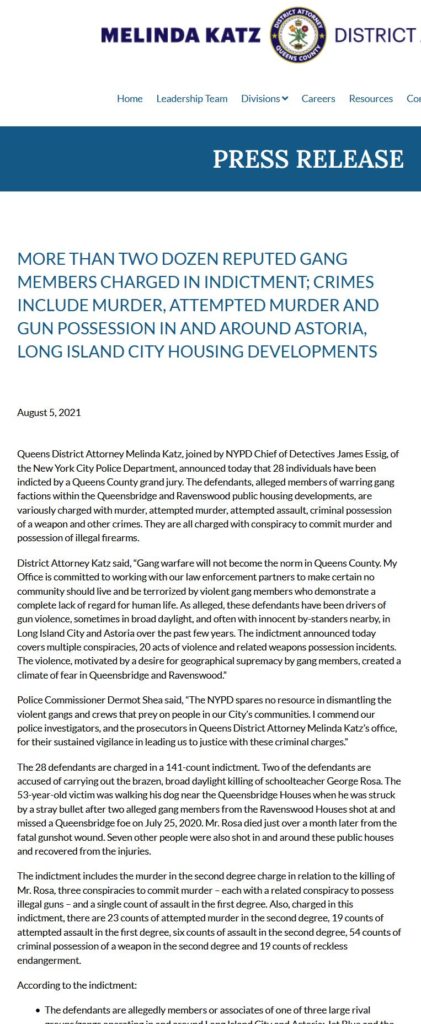
    Just a brief note to commemorate the semi-decennial NYPD drug sweep at the Queensbridge Houses.

    I keep track of these things. (I live nearby.) 9 raids. 22 arrests. 4 handguns.

    Last time this happened was 2013. And that was preceded by similar raids in 2009 and 2005. Sometimes police get disparaged for conducting wack-a-mole policing. (In fact, sometimes *I’ve* disparaged police for this reason.) But one of the reasons crime is so low in NYC is because police do wack those criminal moles (and have the resources to do so) when criminals pop their heads up. Illegal public drug-dealing, so linked to violence, is exactly what police need to focus on. And the residents of America’s largest public housing complex can be a little less afraid.

    There will be another similar raid in Queensbridge in 2023. Mark my words. But maybe that is exactly what is needed. Or maybe a little more continued presence now, rather than a few years, really could prevent the next crew from popping up.


    2021 Update: I was off by two years. https://queensda.org/more-than-two-dozen-reputed-gang-members-charged-in-indictment-crimes-include-murder-attempted-murder-and-gun-possession-in-and-around-astoria-long-island-city-housing-developments/


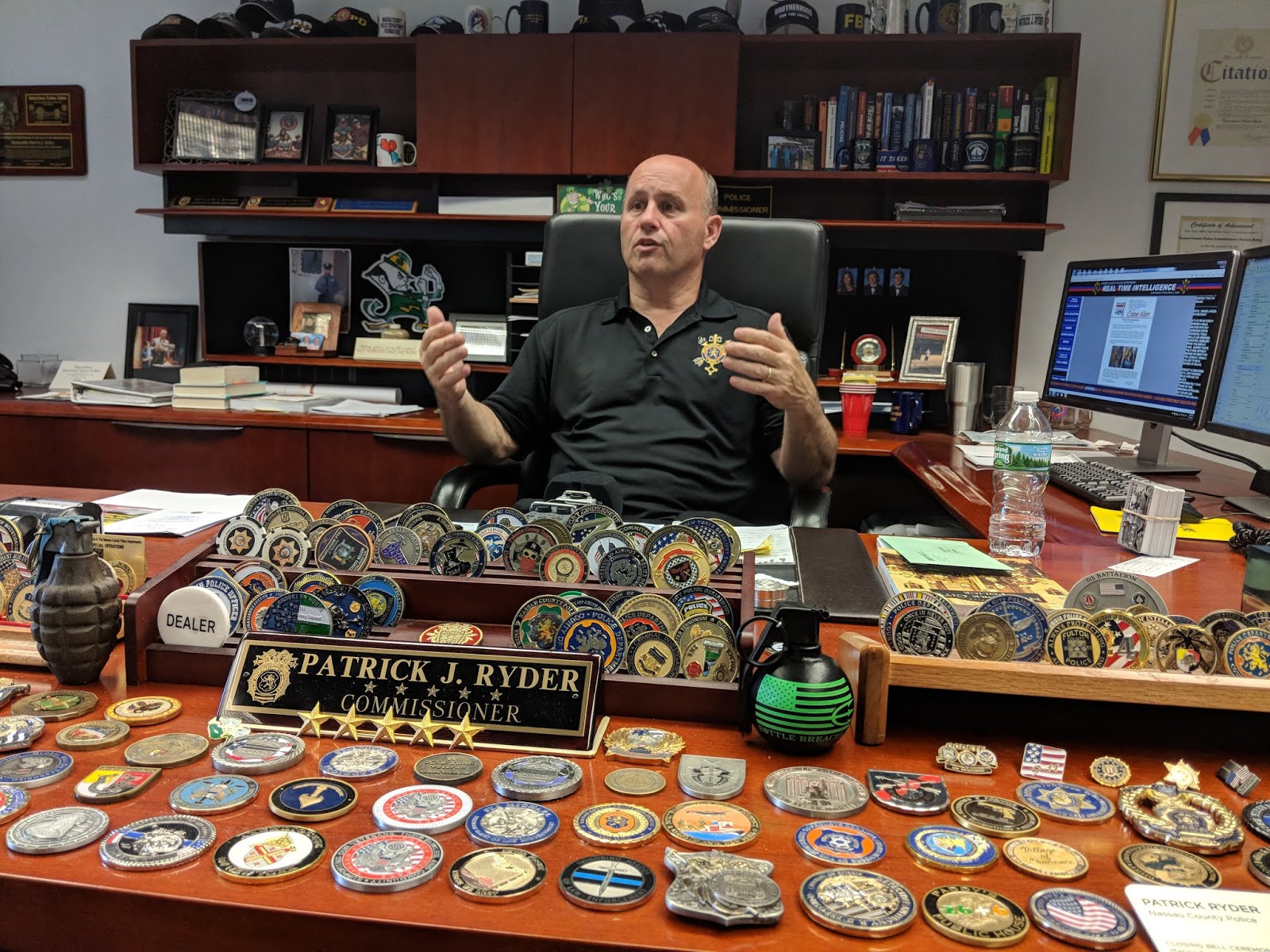
  • Nassau County Police Commissioner Patrick Ryder

    Nassau County Police Commissioner Patrick Ryder

    Over on our Quality Policing podcast, Nick Selby and I hit the road and interview Nassau County Police Commissioner Patrick Ryder

    Nassau County, if you don’t know, is the closer of two counties on Long Island outside of New York City. It’s largely a low-crime suburban community but has been in the news lately because of MS-13 and also a high number of drug overdose deaths. 1.3 million people live in Nassau County and the police department is (give or take) the nation’s 15th largest.

    We discuss information sharing, gangs, immigration, drugs, opioids, diversion court, the PC police, technology, relations with the Muslim community, and so much more.